Jump to Content
Arc Welding Equipment Market Size & Industry Share - Growth Trends & Forecasts (2026 - 2034)
Arc Welding Equipment Market Size:
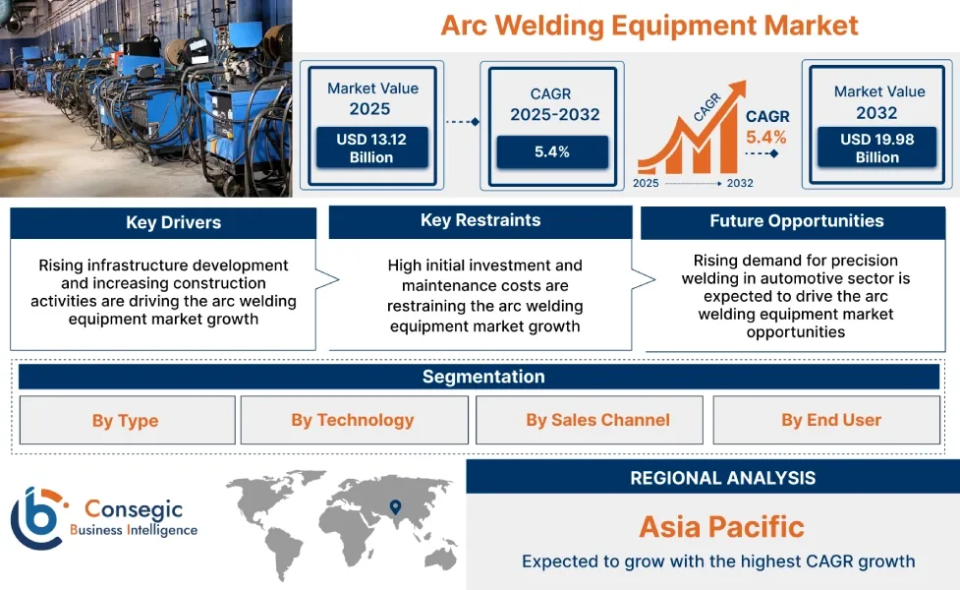
The Arc Welding Equipment market size was valued at 13.83 (US$B) in 2025 and is projected to grow from 14.57 (US$B) in 2026 to 22.2 (US$B) by 2034, at a CAGR of 5.4% from 2026 to 2034, according to a recent report from Consegic Business Intelligence.
Arc Welding Equipment Market Scope & Overview:
Arc welding equipment is a type of welding equipment that uses electricity for creating an intense electric arc, which in turn generates extreme heat to melt and fuse metal pieces together, while forming a strong bond when cooled. The machine powers a circuit between an electrode (a metal stick) and workpiece, which creates a molten pool that joins the materials. Moreover, arc welding equipment offers several benefits including versatility & wide material compatibility, portability, ability to weld thick metals, high strength & penetration, and others. The above benefits of arc welding machines are further increasing its application in automotive, building & construction, shipbuilding & marine, aerospace & defense, oil and gas, power generation, and other sectors.
How is AI Transforming the Arc Welding Equipment Market?
AI is considerably transforming the arc welding equipment market. AI incorporation helps in improving precision, efficiency, and quality control through real-time monitoring and automation. Key uses of AI in arc welding machines mostly include optimizing welding parameters, detecting defects through machine vision, predictive maintenance, and adapting to material variations. Moreover, AI incorporation is shifting the market from traditional, manual processes to intelligent, automated, and adaptive systems.
Also, AI-powered arc welding systems help in optimizing welding processes, which in turn increases efficiency as well as scalability for arc welding operations. In addition, AI-powered analytics and quality control systems help in detecting any defects during the welding process, which in turn ensures consistent quality. Therefore, the above factors are expected to boost the market growth in the upcoming years.

Arc Welding Equipment Market Dynamics - (DRO) :
Key Drivers:
Rising infrastructure development and increasing construction activities are driving the arc welding equipment market growth
Rising infrastructure development and growing construction activities, particularly in emerging economies, are among the key aspects driving the market. Increasing infrastructure development and construction activities mostly require heavy-duty joining of steel structures, pipelines, and bridges. The global construction sector, which is witnessing a steady increase in investments for roads, railways, and building construction projects, relies on robust, portable, and efficient arc welding solutions like stick (SMAW) and flux-cored (FCAW) welding to ensure structural integrity.
Also, the rising pace of urbanization is driving the demand for skyscrapers and large-scale, high-strength steel infrastructure, which in turn is increasing the need for automated and submerged arc welding systems for improving both precision and speed, thereby boosting the market.
- For instance, according to the S. Census Bureau, the construction sector in the United States demonstrated strong growth in 2024, with total construction spending, involving private and public construction, reaching approximately USD 2.15 trillion, representing an increase of 6.5% increase in comparison to 2023.
Hence, the rising infrastructure development and increasing construction activities are increasing the use of arc welding machines for ensuring structural integrity, in turn driving the arc welding equipment market size.
Key Restraints :
High initial investment and maintenance costs are restraining the arc welding equipment market growth
High initial investment and maintenance costs associated with arc welding equipment are among the primary factors restricting the market growth. Advanced arc welding systems, such as automated welding machines, offer superior precision, efficiency, and safety, however, they require substantial upfront investment for purchase, installation, and operator training. This in turn, may create a financial barrier, particularly among small and medium enterprises or businesses operating on a limited budget.
In addition to the purchase cost, manufacturers also face ongoing costs for maintenance, periodic upgrades, and others, which can further increase the additional expense. Thus, the high initial investment and maintenance costs associated with arc welding machines are hindering the arc welding equipment market expansion.
Future Opportunities :
Rising demand for precision welding in automotive sector is expected to drive the arc welding equipment market opportunities
The growing demand for high-precision welding within the automotive sector, primarily driven by the need for superior structural integrity in electric vehicles (EVs), hybrid models, and lightweight components, is expected to offer lucrative aspects for market growth. Advanced arc welding machines, along with robotic automation, are being increasingly used in automotive sector for facilitating superior quality, safety, and efficiency in manufacturing critical components. Also, factors including superior accuracy, consistent weld quality, and minimal heat-affected zones, are encouraging automotive manufacturers to invest in advanced automated arc welding systems which are capable of offering enhanced control, repeatability, and efficiency in high-volume production lines. The above factors are expected to drive the market.
- For instance, according to the International Organization of Motor Vehicle Manufacturers, the passenger car production worldwide reached up to 68,020,265 units in 2023, depicting an increase of nearly 11% from 61,553,361 units in 2022.
Hence, according to the analysis, the above factors are projected to boost the arc welding equipment market opportunities during the forecast period.
Arc Welding Equipment Market Segmental Analysis :
By Type:
Based on type, the market is segmented into automatic welding equipment, semi-automatic welding equipment, and manual welding equipment.
Trends in the type:
- Increasing trend in adoption of semi-automatic and automatic welding equipment for facilitating higher output and consistent quality in manufacturing, construction, and heavy engineering is driving the market.
- Factors including the rising demand for enhanced efficiency, precision, and reduced labor costs through advanced automation like AI-equipped robots, along with continuous technological innovations in areas such as robotic arc welding are boosting the market.
The automatic welding equipment segment accounted for a significant revenue in the arc welding equipment market share in 2024, and it is anticipated to register the fastest CAGR during the forecast period.
- Automatic welding equipment refers to welding systems that perform the entire welding process with minimal or no human involvement once the setup is completed.
- Automatic welding systems are operated with the help of pre-programmed parameters such as welding speed, heat input, arc length, wire feed rate, and movement path.
- Also, automatic welding systems are integrated with control units, mechanical drives, sensors, and software to ensure consistency.
- In addition, the market is driven by factors such as the rising need for improved efficiency, precision, and reduced labor costs through advanced automation, along with constant technological advancements in areas such as robotic arc welding for facilitating higher output and consistent quality in welding operations.
- According to the arc welding equipment market analysis, the above factors are increasing the adoption of automatic welding systems, in turn driving the arc welding equipment market size.
By Technology:
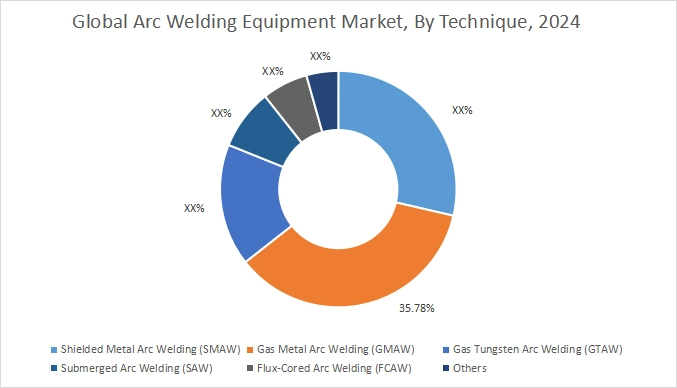
Based on technique, the market is segmented into shielded metal arc welding (SMAW), gas metal arc welding (GMAW), gas tungsten arc welding (GTAW), submerged arc welding (SAW), flux-cored arc welding (FCAW), and others.
Trends in the technique:
- Factors including the rapid industrialization, growing automotive and energy sectors, and rise in manufacturing activities are among the key aspects driving the market.
- Rising adoption of industrial automation, rapid development of industries such as automotive, construction, and heavy engineering, along with growing need for precise welding solutions among industrial sectors, are key factors driving the market.
The gas metal arc welding (GMAW) segment accounted for the largest revenue share of 35.78% in the arc welding equipment market share in 2024, and it is anticipated to register a substantial CAGR during the forecast period.
- Gas metal arc welding (GMAW), also known as MIG welding, is a versatile, high-speed, semi-automatic or automatic welding process that is capable of joining metals by heating them with an electric arc established between a continuously fed, consumable solid wire electrode and the workpiece.
- Also, gas metal arc welding offers several benefits including high efficiency, superior weld quality and cleanliness, increased adaptability, and versatility, among others.
- Moreover, GMAW is capable of producing strong, clean, and nearly slag-free joints, and it is commonly used in manufacturing, automotive, and construction industries on materials such as steel, aluminum, and stainless steel, among others.
- Also, factors including the increasing adoption of industrial automation, rapid development of industries such as automotive, construction, and heavy engineering, combined with growing need for precise welding solutions among industrial sectors, are further driving the segment.
- According to the analysis, the aforementioned factors are driving the arc welding equipment market trends.
By Sales Channel:
Based on sales channel, the market is segmented into direct sales and distributor sales.
Trends in the sales channel:
- Factors including the availability of excellent support and warranty, higher product quality, and reliable shipping and return policies are key prospects driving the direct sales channel segment.
- Factors such as higher accessibility to a variety of products, higher flexibility, and expanded reach are major determinants for driving the distributor sales channel segment.
The direct sales segment accounted for a significant revenue in the market in 2024.
- In direct sales channel, arc welding machines are sold directly to customers through numerous physical outlets, including company outlets, among others.
- Moreover, the direct sales channel also consists of an online mode, wherein the manufacturers sell the welding machines through its own company websites.
- Also, purchasing arc welding machines from direct sales channel offers numerous benefits, including faster response time, higher product quality, higher return on investments, competitive pricing, and others, which are key aspects for increasing the purchase of arc welding machines from direct sales channel.
- Therefore, the increasing availability of arc welding machines in direct sales channels is driving the market.
The distributor sales segment is anticipated to register a substantial CAGR during the forecast period.
- The distributor sales channel involves an indirect distribution of arc welding machines, wherein the welding machines are purchased from several regional distributors operating in multiple regions worldwide.
- Moreover, distributor sales channels provide several benefits, including increased market reach, reduced capital expenditure, increased cost efficiency, and others. The above benefits of distributor sales channels are further increasing its utilization for sales of arc welding machines.
- For instance, Harris Welding Supplies, Fastenal Company, Arc Solutions Inc., and others are few of the distributors of arc welding machines.
- Hence, the increasing availability of arc welding machines in distributor sales channels is anticipated to boost the market during the forecast period.
By End User
Based on the end user, the market is segmented into building & construction, automotive, shipbuilding & marine, aerospace & defense, oil & gas, power generation, and others.
Trends in the end user:
- The building & construction segment is primarily driven by factors such as rapid urbanization, rising infrastructure development, growing need for reliable, high-strength welds in structural steel fabrication and reinforcing materials, along with technological advancements and automation in welding operations.
- Factors including the rising vehicle production, ongoing development of electric vehicles (EVs), along with increasing adoption of automation and advanced welding technologies in automotive sector for improving manufacturing efficiency, are key trends driving the automotive segment development.
The building & construction segment accounted for a substantial revenue in the market in 2024.
- Arc welding machines play an essential role in building & construction sector for facilitating structural steel erection, infrastructure repair, and heavy metal fabrication. They are used for creating durable steel joints in buildings, bridges, and pipelines, among others.
- The segment is mainly driven by factors such as rising infrastructure development, rapid urbanization and population growth, along with the ongoing trend toward technological advancements and automation.
- Also, government investments in large-scale projects, such as roads, bridges, and commercial buildings, are significantly boosting the need for arc welding machines.
- Moreover, the need for reliable, high-strength welds in structural steel fabrication, reinforcing materials, and pipelines is a vital factor driving the building & construction section.
- Consequently, the aforementioned factors arepropelling the market.
The automotive segment is anticipated to register the fastest CAGR during the forecast period.
- Arc welding machines are primarily used in the automotive industry for joining structural frames, body panels, exhaust systems, and suspension parts.
- Also, it is used for offering high-speed, precision, and strong welds during vehicle manufacturing, or during vehicle repair and new EV battery assemblies.
- The automotive segment is primarily driven by factors such as the rising vehicle production, ongoing development of electric vehicles, and increasing adoption of advanced welding technologies during automotive assembly and manufacturing for increasing operational efficiency.
In addition, the rising shift towards electric vehicles, development of automotive manufacturing facilities, and growing need for reliable welding solutions for joining lightweight materials and assembling vehicle components are key factors anticipated to drive the market during the forecast period.
Regional Analysis:
The regions covered are North America, Europe, Asia Pacific, the Middle East and Africa, and Latin America.
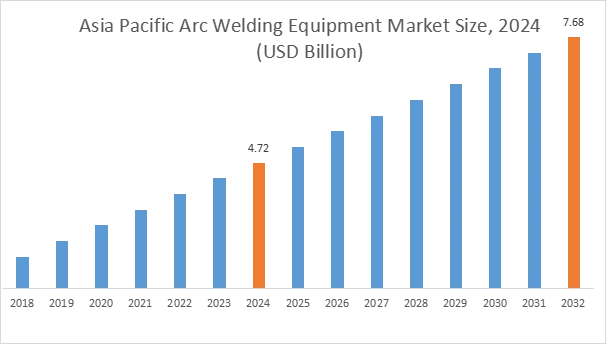
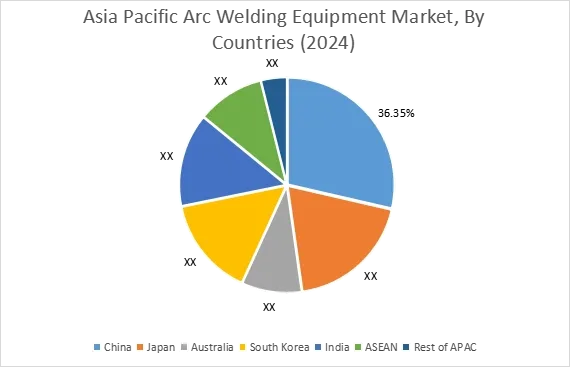
Asia Pacific region was valued at USD 4.72 Billion in 2024. Moreover, it is projected to grow by USD 4.91 Billion in 2025 and reach over USD 7.68 Billion by 2032. Out of this, China accounted for the maximum revenue share of 36.35%. As per the arc welding equipment market analysis, the adoption of arc welding machines in the Asia-Pacific region is primarily driven by factors including the rapid industrialization, urban infrastructure development, and expanding automotive and shipbuilding sectors in countries such as China, India, and Japan, among others. Additionally, the rising building & construction activities and increasing need for reliable, high-strength welds in structural steel fabrication, reinforcing materials, and pipelines are further accelerating the arc welding equipment market expansion.
- For instance, according to the Building and Construction Authority of Singapore, the total construction demand including residential construction in Singapore reached between USD 24 billion and USD 29 billion by the end of 2024.The above factors are increasing the need for arc welding machines, in turn driving the market in the Asia-Pacific region.
North America is estimated to reach over USD 5.61 Billion by 2032 from a value of USD 3.57 Billion in 2024 and is projected to grow by USD 3.70 Billion in 2025. In North America, the growth of the arc welding equipment industry is driven by technological innovation, high adoption of automated and robotic welding solutions, and significant investments in aerospace, automotive, oil & gas, and other industries. Similarly, rising automotive production, growing adoption of electric vehicles, and increasing use of arc welding machines for joining lightweight materials and assembling vehicle components are further contributing to the arc welding equipment market demand.
- For instance, according to the International Energy Agency, electric car sales in the United States reached approximately 1.6 million units in 2024, depicting an increase from 1.4 million units in 2023. The above factors are expected to propel the arc welding equipment market trends in North America during the forecast period.
Meanwhile, according to the regional analysis, factors including industrial modernization, rising investments in electric vehicle manufacturing, stringent safety and quality standards, and increasing renewable energy projects that require advanced welding solutions are driving the arc welding equipment market demand in Europe. Furthermore, according to the market analysis, the market in Latin America, Middle East, and African regions is expected to grow at a considerable rate due to factors such as rising infrastructure development and construction activities, increasing oil & gas exploration, along with growing need for automated welding solutions, among others.
Top Key Players & Market Share Insights:
The global arc welding equipment market is highly competitive with major players providing products to the national and international markets. Key players are adopting several strategies in research and development (R&D), product innovation, and end-user launches to hold a strong position in the arc welding equipment market. Key players in the arc welding equipment industry include-
- Lincoln Electric Holdings Inc.(United States)
- ESAB(United States)
- Miller Electric(United States)
- Fronius International GmbH (Austria)
- Kemppi Oy (Finland)
- Panasonic Corporation (Japan)
- Daihen Corporation (Japan)
- Voestalpine Böhler Welding Group (Germany)
- SKS Welding Systems (Germany)
- Ador Welding Limited (India)
Recent Industry Developments :
Product Launches:
- In March 2023, ESAB launched its new Rustler PRO series, which is a lineup of compact, inverter-based MIG/MAG welding machines that are designed for improving productivity, boosting quality, and simplifying training in industrial fabrication applications. The arc welding machines focus on merging modern energy efficiency with high-duty industrial performance.
- In March 2023, Kemppi launched its new arc welding machines, including the Master M series which focuses on the Master M 205 and Master M 323. They are two compact and portable MIG/MAG welders which are designed for use in challenging on-site work, shipyards, and repair shops, among others.
Partnerships & Collaborations:
- In September 2025, Miller Electric partnered with Gullco International for incorporating Miller’s high-deposition Hercules welding technology, which is a novel arc welding technique, onto Gullco’s mechanized track carriages (tractors). The collaboration aims at targeting heavy industrial applications like bridge construction, shipbuilding, and heavy equipment manufacturing, among others.
Acquisitions:
- In June 2025, ESAB Corporation announced the acquisition of EWM GmbH, a German manufacturer of arc welding machines. The acquisition aims at filling critical gaps in ESAB's portfolio while strengthening its position in the European and North American markets.
- In August 2023, Daihen Corporation acquired Lorch Schweißtechnik GmbH, a German manufacturer of arc welding systems. This acquisition aimed at expanding DAIHEN’s market share in Europe and integrating specialized smart welding technology into its global portfolio.
Arc Welding Equipment Market Report Insights :
| Report Attributes | Report Details |
| Study Timeline | 2021-2034 |
| Market Size in 2034 | USD 22.20 Billion |
| CAGR (2026-2034) | 5.40% |
| Base Year | 2025 |
| By Type |
|
| By Technique |
|
| By Sales Channel |
|
| By End-User Industry |
|
| By Region |
|
| Key Players |
|
| North America | U.S. Canada Mexico |
| Europe | U.K. Germany France Spain Italy Russia Benelux Rest of Europe |
| APAC | China South Korea Japan India Australia ASEAN Rest of Asia-Pacific |
| Middle East and Africa | GCC Turkey South Africa Rest of MEA |
| LATAM | Brazil Argentina Chile Rest of LATAM |
| Report Coverage |
|
Key Questions Answered in the Report
How big is the arc welding equipment market? −
The arc welding equipment market was valued at USD 12.64 Billion in 2024 and is projected to grow to USD 19.98 Billion by 2032.
Which is the fastest-growing region in the arc welding equipment market? +
Asia-Pacific is the region experiencing the most rapid growth in the arc welding equipment market.
What specific segmentation details are covered in the arc welding equipment report? +
The arc welding equipment report includes specific segmentation details for type, technique, sales channel, end user, and region.
Who are the major players in the arc welding equipment market? +
The key participants in the arc welding equipment market are Lincoln Electric Holdings Inc. (United States), ESAB (United States), Miller Electric (United States), Fronius International GmbH (Austria), Kemppi Oy (Finland), Panasonic Corporation (Japan), Daihen Corporation (Japan), Voestalpine Böhler Welding Group (Germany), SKS Welding Systems (Germany), Ador Welding Limited (India), and others.
Overview
Reputation & Certifications


Our Services
- Market Intelligence & Forecasting
- Custom Research Solutions
- Market Entry Strategy
- Competitive Intelligence
- Customer Insights
- Industry Innovation Analysis
- Investment Advisory