Jump to Content
GCC Protective Relay Market - Size, Share, Industry Trends, and Forecasts (2025-2032)
GCC Protective Relay Market Size:
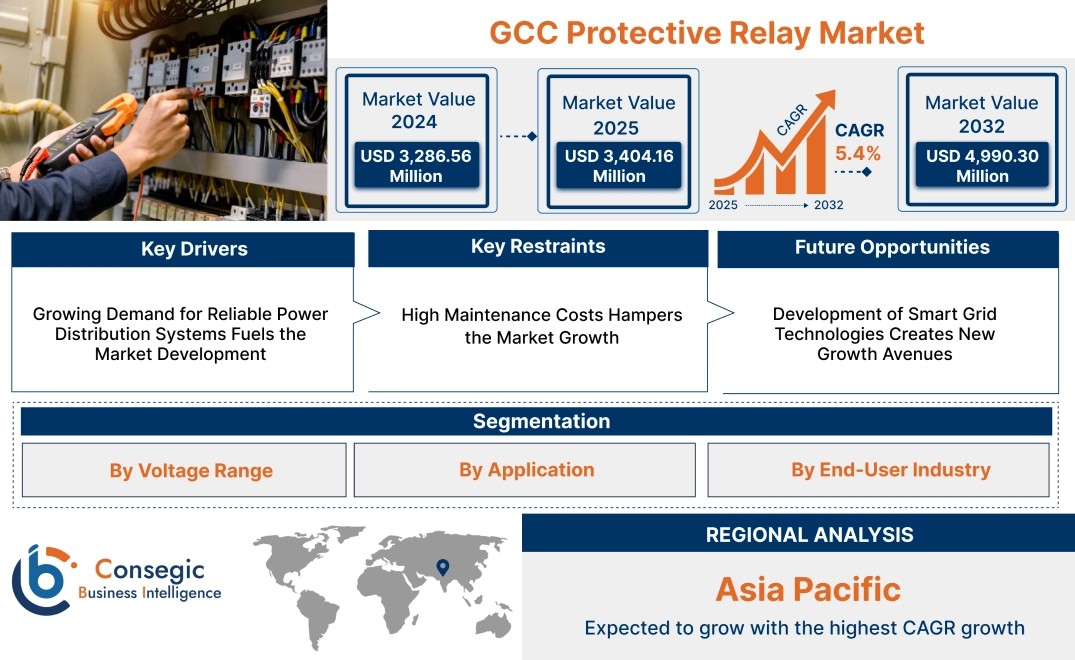
GCC Protective Relay Market size is estimated to reach over USD 4,990.30 Million by 2032 from a value of USD 3,286.56 Million in 2024 and is projected to grow by USD 3,404.16 Million in 2025, growing at a CAGR of 5.4% from 2025 to 2032.
GCC Protective Relay Market Scope & Overview:
A generator connection cubicle protective relay (GCC protective relay) is an advanced device designed to protect electrical generators and their connection systems from faults and abnormal operating conditions. ss
These protective relays are equipped with features like real-time monitoring, automated fault response, and integration with control systems. They are designed for compatibility with various generator types and capacities, ensuring reliable protection across diverse industrial and power generation applications. GCC protective relays are engineered for accuracy and durability, making them suitable for use in demanding environments where power system reliability is critical.
End-users include power generation facilities, industrial plants, and utility operators seeking efficient protection solutions to safeguard generators and maintain uninterrupted operations. These relays play a vital role in enhancing the safety and efficiency of power systems.
GCC Protective Relay Market Dynamics - (DRO) :
Key Drivers:
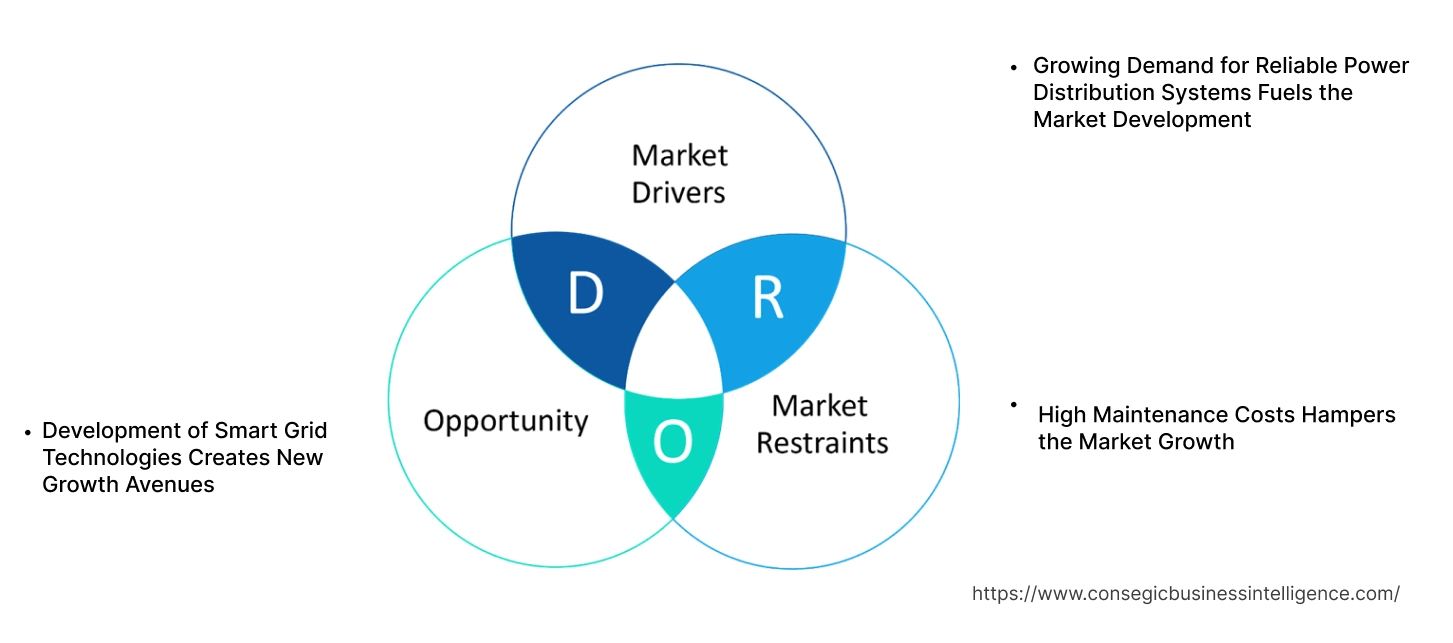
Growing Demand for Reliable Power Distribution Systems Fuels the Market Development
The growing requirement for reliable and uninterrupted power supply is driving the need for advanced protective relays, especially in industries with critical operations such as oil and gas, manufacturing, and utilities. These industries require consistent power to maintain productivity and avoid costly downtime. Generator connection cubicle protective relays play a crucial role in enhancing power system reliability by detecting faults and preventing potential damage to equipment. By ensuring that power distribution systems are protected from short circuits, overloads, or electrical faults, these relays help maintain smooth and efficient operations. Their role in safeguarding infrastructure reduces the risk of power outages, minimizes system failures, and ensures a continuous power supply, which is vital for industries where power disruptions can result in significant financial losses and operational disruptions. This growing need for reliability fuels the GCC protective relay market demand for advanced protection systems, as industries prioritize operational stability and security.
Key Restraints:
High Maintenance Costs Hampers the Market Growth
A significant restraint for the adoption of generator connection cubicle protective relays is the high maintenance costs associated with these advanced systems. While these relays provide essential protection and monitoring, their sophisticated technology often requires regular servicing, calibration, and updates to ensure optimal performance. This ongoing maintenance, including the need for specialized technicians, replacement parts, and periodic software updates, can add considerable operational expenses over the life of the system. In addition, the complexity of troubleshooting and repair, especially for systems integrated into larger, more intricate power grids, further increases maintenance costs. For smaller utilities or organizations with limited budgets, these costs may make it financially challenging to implement and sustain high-performance protective relay systems, potentially hindering the GCC protective relay market expansion.
Future Opportunities :
Development of Smart Grid Technologies Creates New Growth Avenues
As grids become more advanced with real-time data collection, fault monitoring, and remote diagnostics, the need for more sophisticated protective systems grows. These technologies enhance grid efficiency by allowing utilities to detect issues faster, manage energy distribution, and ensure continuous service. The increasing integration of generator connection cubicle relays into these smart grids helps facilitate seamless communication and automated control, improving overall system reliability and responsiveness. As the requirement for smarter, more efficient grid management systems increases, the growth of smart grid technologies will drive the adoption of advanced relays that provide real-time protection and data analysis. These relays are essential for optimizing grid performance and reducing downtime, positioning them as key components in modern power infrastructure. Therefore, the shift towards digital and automated solutions creates substantial GCC protective relay market opportunities.
GCC Protective Relay Market Segmental Analysis :
By Voltage Range:
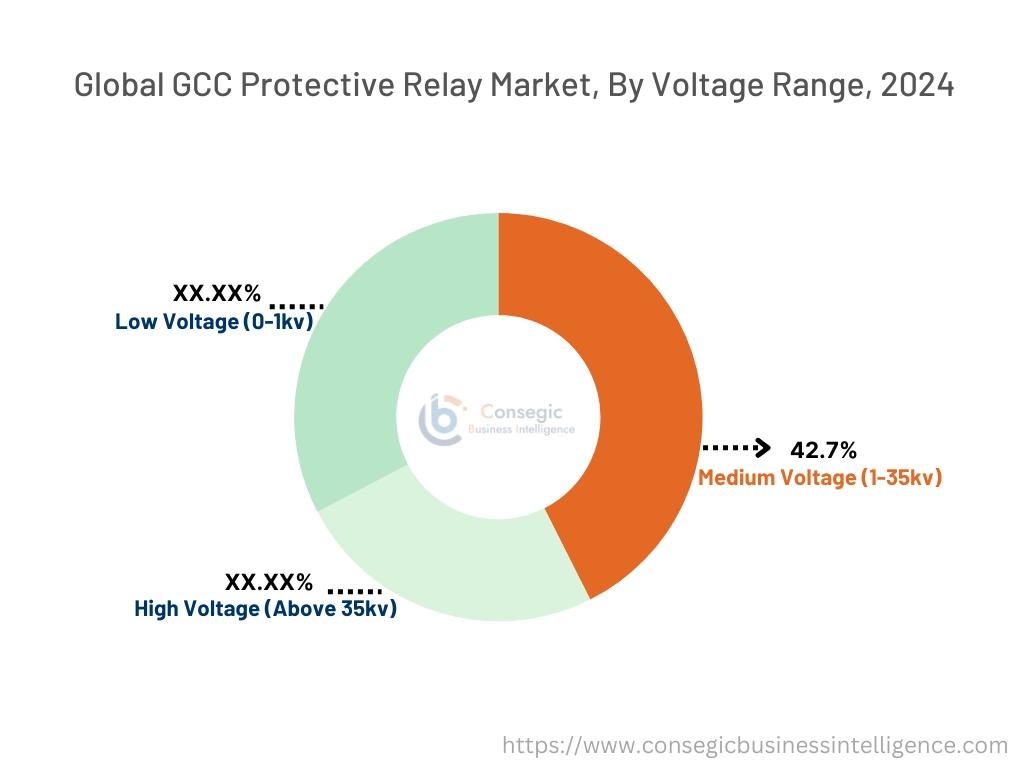
Based on voltage range, the market is segmented into low voltage (0-1kV), medium voltage (1-35kV), and high voltage (above 35kV).
The medium voltage (1-35kV) segment accounted for the largest revenue of 42.7% of the total GCC protective relay market share in 2024.
- Medium voltage protective relays are widely utilized across industries due to their versatility in protecting electrical equipment such as transformers, generators, and motors.
- These relays are essential for applications in industrial and commercial facilities, ensuring stable and secure power distribution.
- Medium voltage systems are increasingly integrated with smart technologies, allowing for advanced monitoring, fault detection, and remote management, which enhance operational efficiency.
- As per the market trends, with the rising focus on energy efficiency and the modernization of power infrastructure, the demand for medium voltage protective relays continues to rise, driving the GCC protective relay market growth.
The high voltage (above 35kV) segment is expected to grow at the fastest CAGR during the forecast period.
- High voltage protective relays are critical for large-scale power generation, transmission, and industrial applications where reliability and fault prevention are paramount.
- The expansion of renewable energy projects, such as wind and solar farms, has increased the deployment of high voltage protective relays to ensure grid stability and fault mitigation.
- Innovations in high voltage relays, including the integration of digital and numerical technologies, enable real-time fault analysis and enhanced protection.
- As per the GCC protective relay market analysis, government investments in high voltage transmission networks, especially in emerging economies, are driving the adoption of advanced protective relay systems.
By Application:
Based on application, the market is segmented into generator protection, transformer protection, motor protection, feeder protection, and others.
The generator protection segment accounted for the largest revenue of the total GCC protective relay market share in 2024.
- Protective relays are vital in generator systems to safeguard against faults such as overload, overcurrent, and voltage imbalances, ensuring uninterrupted power supply.
- The growth in reliance on backup power systems and distributed energy generation has driven the adoption of generator protection relays across industries.
- Advancements in generator relay technologies, such as digital and numerical relays, enable precise fault detection, reducing downtime and enhancing reliability.
- As per the GCC protective relay market trends, with the increasing investments in power generation infrastructure and renewable energy projects, the demand for generator protection relays continues to expand.
The motor protection segment is anticipated to grow at the fastest CAGR during the forecast period.
- Motor protection relays are crucial for preventing damage caused by overheating, phase failure, and voltage fluctuations in industrial motors.
- The industrial manufacturing sector, with its extensive use of motors for automation and production, drives significant demand for these relays.
- Technological advancements in motor protection relays, including remote monitoring and IoT integration, enable predictive maintenance and operational efficiency.
- As industries adopt energy-efficient motor systems and automation technologies, the role of motor protection relays becomes increasingly important in ensuring reliability and performance, further fueling the GCC protective relay market demand.
By End-User Industry:
Based on end-user industry, the market is segmented into oil & gas, industrial manufacturing, utilities, defense, and others.
The oil & gas segment accounted for the largest revenue share in 2024.
- The oil & gas sector relies heavily on protective relays to ensure the safety and reliability of critical equipment, such as compressors, pumps, and generators.
- Harsh operating conditions in oil fields and offshore platforms necessitate advanced protective systems to minimize equipment failures and operational downtime.
- The adoption of smart protective relays in oil & gas applications supports real-time fault detection and enhances overall safety.
- As per the GCC protective relay market analysis, increasing exploration and production activities, particularly in emerging regions, drive the need for robust protective relay systems in this sector.
The utilities segment is anticipated to grow at the fastest CAGR during the forecast period.
- Utilities deploy protective relays extensively for power generation, transmission, and distribution, ensuring grid stability and minimizing outages.
- The transition to renewable energy sources, such as solar and wind, has driven the integration of protective relay systems for fault detection and grid protection.
- Smart grid initiatives and the modernization of aging infrastructure further accelerate the adoption of advanced protective relay technologies.
- As per the GCC protective relay market trends, as utilities focus on achieving energy efficiency and reliability, the need for protective relay systems continues to grow across the power sector.
Regional Analysis:
The regions covered are North America, Europe, Asia Pacific, the Middle East and Africa, and Latin America.
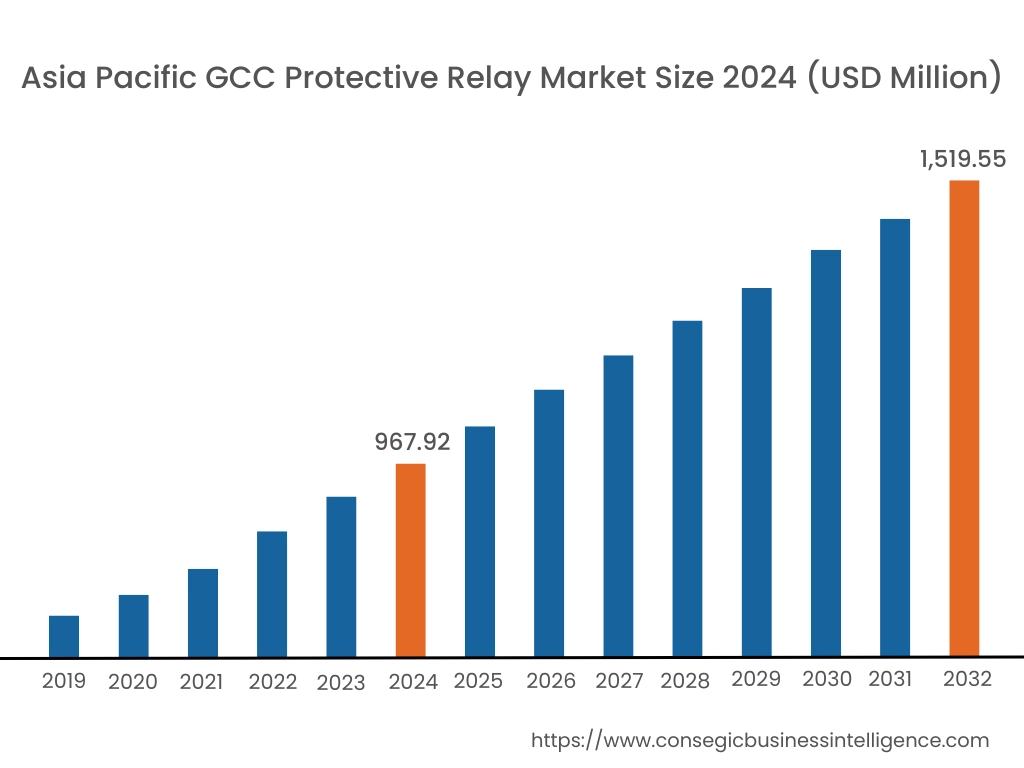
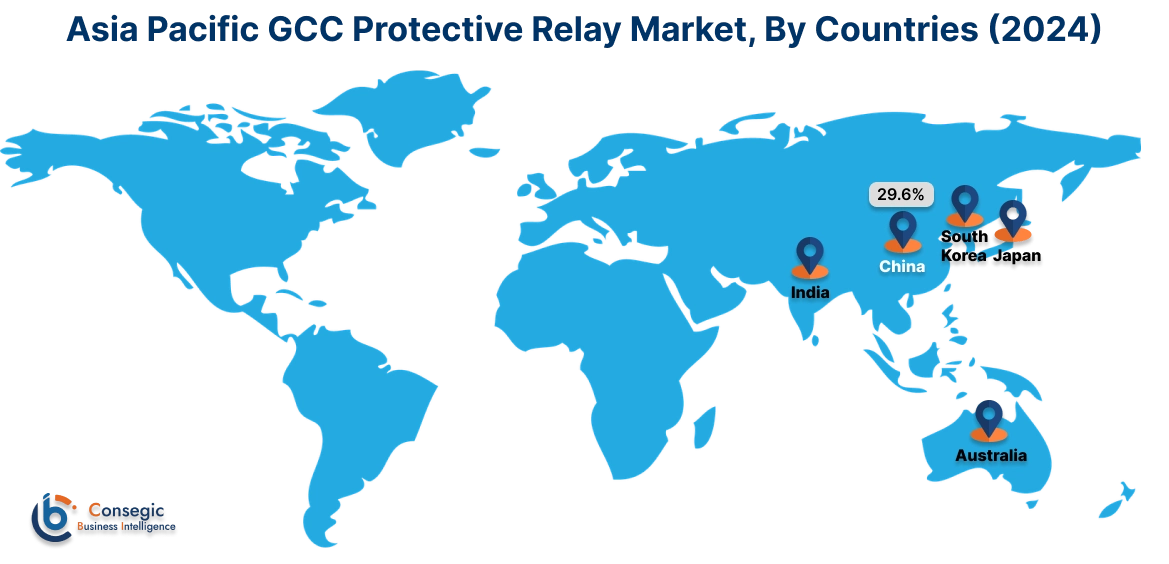
Asia Pacific region was valued at USD 967.92 Million in 2024. Moreover, it is projected to grow by USD 1,005.39 Million in 2025 and reach over USD 1,519.55 Million by 2032. Out of this, China accounted for the maximum revenue share of 29.6%. The Asia-Pacific region dominates the GCC protective relay market, attributed to rapid industrialization and urbanization leading to increased energy consumption. A prominent trend is the expansion of transmission and distribution networks to accommodate the rising electricity need. The market trends also indicates that government initiatives promoting infrastructure development and investments in power generation are contributing to GCC protective relay market growth in this region.
North America is estimated to reach over USD 1,617.36 Million by 2032 from a value of USD 1,090.18 Million in 2024 and is projected to grow by USD 1,127.03 Million in 2025. This region maintains a significant share in the GCC protective relay market, driven by substantial investments in transmission and distribution infrastructure aimed at replacing aging equipment. A notable trend is the increasing complexity of electrical circuits, necessitating the use of protective devices for safe and secure operations. Analysis indicates that the growth in electricity generation capacity to meet the needs of a rising population is a key factor influencing the GCC protective relay market expansion in North America.
European countries hold significant share in the market, with a strong emphasis on integrating renewable energy sources into the power grid. A significant trend is the development of smart grid technologies that require advanced protective relays to ensure grid stability and reliability. Analysis suggests that the focus on reducing carbon emissions and enhancing energy efficiency is driving the adoption of protective relays in this region.
In the Middle East and Africa, the GCC protective relay market is influenced by the adoption of advanced technologies to support infrastructure development and industrial diversification. The focus is on utilizing protective relays in energy-efficient solutions and smart building applications. Analysis suggests that collaborations with international technology providers are facilitating the transfer of knowledge and expertise, aiding in the establishment of local manufacturing capabilities.
Latin American countries are increasingly recognizing the importance of GCC protective relays in enhancing the reliability and safety of power systems. A notable trend is the modernization of existing power infrastructure to reduce transmission losses and improve efficiency. Analysis indicates that economic development and the pursuit of sustainable energy solutions are key factors influencing the GCC protective relay market opportunities in this region.
Top Key Players and Market Share Insights:
The gcc protective relay market is highly competitive with major players providing products and services to the national and international markets. Key players are adopting several strategies in research and development (R&D), product innovation, and end-user launches to hold a strong position in the global GCC Protective Relay market. Key players in the GCC Protective Relay industry include -
- Beckwith Electric (USA)
- Schweitzer Engineering Laboratories (SEL) (USA)
- GE Grid Solutions (USA)
- Siemens AG (Germany)
- Eaton Corporation (Ireland)
- Hubbell Incorporated (USA)
- Baker Hughes (USA)
- ABB Ltd. (Switzerland)
- Schneider Electric (France)
- Basler Electric (USA)
GCC Protective Relay Market Report Insights :
| Report Attributes | Report Details |
| Study Timeline | 2019-2032 |
| Market Size in 2032 | USD 4,990.30 Million |
| CAGR (2025-2032) | 5.4% |
| By Voltage Range |
|
| By Application |
|
| By End-User Industry |
|
| By Region |
|
| Key Players |
|
| North America | U.S. Canada Mexico |
| Europe | U.K. Germany France Spain Italy Russia Benelux Rest of Europe |
| APAC | China South Korea Japan India Australia ASEAN Rest of Asia-Pacific |
| Middle East and Africa | GCC Turkey South Africa Rest of MEA |
| LATAM | Brazil Argentina Chile Rest of LATAM |
| Report Coverage |
|
Key Questions Answered in the Report
What is the size of the GCC Protective Relay Market? −
The GCC Protective Relay Market size is estimated to reach over USD 4,990.30 Million by 2032 from a value of USD 3,286.56 Million in 2024 and is projected to grow by USD 3,404.16 Million in 2025, growing at a CAGR of 5.4% from 2025 to 2032.
What are the key segments in the GCC Protective Relay Market? +
The market is segmented by voltage range (low voltage, medium voltage, high voltage), application (generator protection, transformer protection, motor protection, feeder protection, others), and end-user industry (oil & gas, industrial manufacturing, utilities, defense, others).
Which segment is expected to grow the fastest in the GCC Protective Relay Market? +
The high voltage (above 35kV) segment is expected to grow at the fastest CAGR during the forecast period, driven by the expansion of renewable energy projects and the increased adoption of advanced protection systems for large-scale power generation and transmission.
Who are the major players in the GCC Protective Relay Market? +
Key players in the GCC Protective Relay market include Beckwith Electric (USA), Schweitzer Engineering Laboratories (SEL) (USA), Hubbell Incorporated (USA), Baker Hughes (USA), ABB Ltd. (Switzerland), Schneider Electric (France), Basler Electric (USA), GE Grid Solutions (USA), Siemens AG (Germany), Eaton Corporation (Ireland).
Overview
Reputation & Certifications


Our Services
- Market Intelligence & Forecasting
- Custom Research Solutions
- Market Entry Strategy
- Competitive Intelligence
- Customer Insights
- Industry Innovation Analysis
- Investment Advisory