Jump to Content
Geofoam Market - Size, Share, Industry Trends, and Forecasts (2025-2032)
Geofoam Market Size:
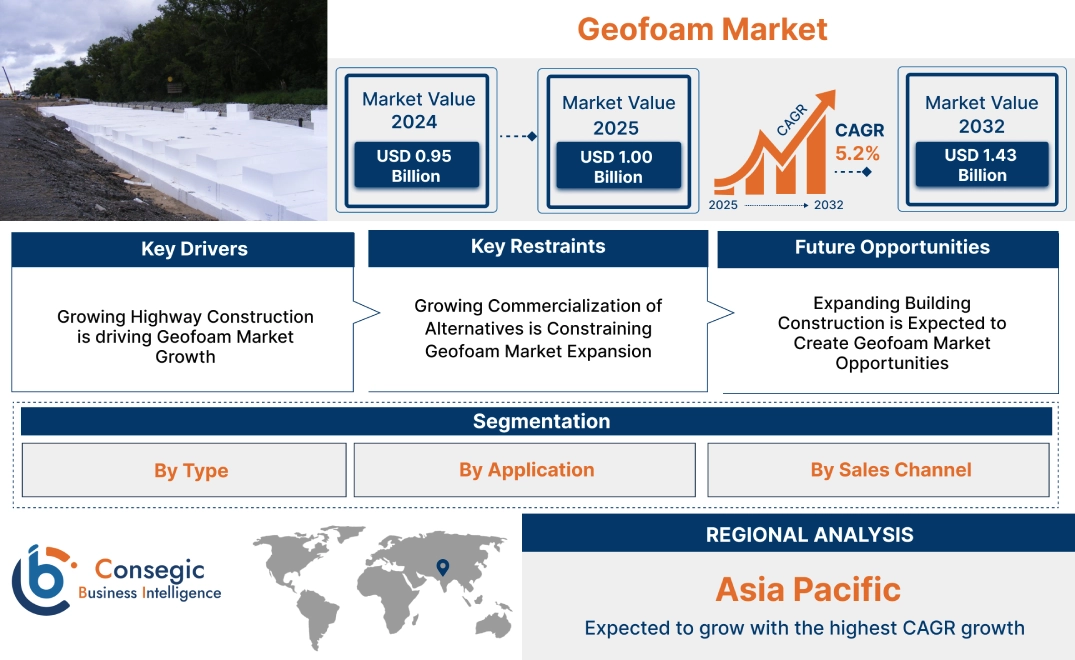
The geofoam market size is growing with a CAGR of 5.2% during the forecast period (2025-2032), and the market is projected to be valued at USD 1.43 Billion by 2032 from USD 0.95 Billion in 2024. Additionally, the market value for 2025 is attributed to USD 1.00 Billion.
Geofoam Market Scope & Overview:
Geofoam is a lightweight, rigid foam material that is available in two types as expanded polystyrene and extruded polystyrene. Expanded polystyrene (EPS) is made by expanding polystyrene beads with heat and a blowing agent while extruded polystyrene geofoam (XPS) is formed through an extrusion process, where polystyrene resin is melted and formed into a continuous foam board. Geofoam material offers several advantages such as low density, high compressive strength, and good thermal insulation properties. Due to these advantages, it is used in various applications such as road & highway construction, airport runways and taxiways, rail embankment, building foundations, and others. Additionally, this material is distributed through direct and indirect sales channels to construction units, airport companies, amongst others.
How AI is Impacting the Geofoam Market?
AI is significantly transforming the geofoam market by enhancing efficiency across the entire value chain. It optimizes geofoam design for construction projects through generative design, allowing for more precise material use and improved structural performance. In manufacturing, AI drives process optimization, predictive maintenance, and quality control, leading to reduced waste and lower production costs. Furthermore, AI improves supply chain management with accurate demand forecasting and optimized logistics. Its analytical capabilities also provide valuable market insights, facilitating better business strategies and promoting more sustainable practices by minimizing material consumption in design.
Geofoam Market Dynamics - (DRO):
Key Drivers:
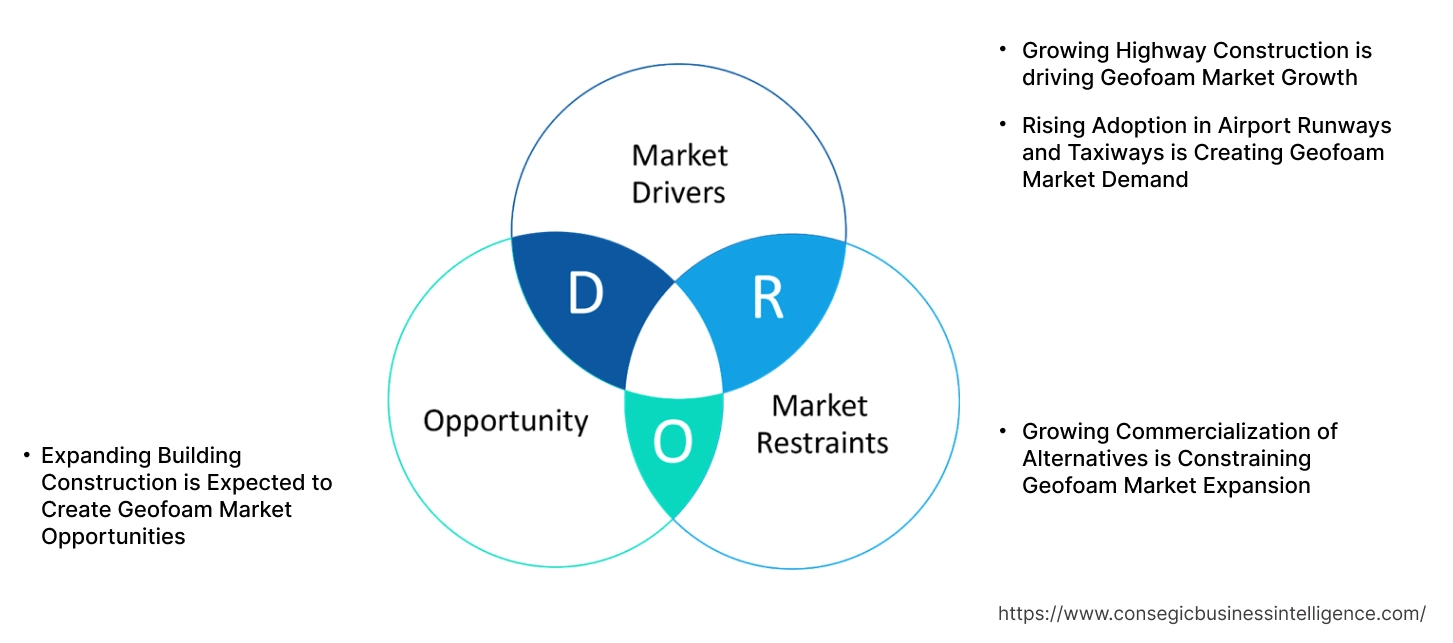
Growing Highway Construction is driving Geofoam Market Growth
The geofoam is used in highway construction as a fill material to reduce weight and costs, especially in areas with unstable soil. It provides stability in areas with soft or unstable ground, preventing settlement and damage to the highway construction. Additionally, the highway construction is growing due to several factors such as improving connectivity, lowering transport costs, and boosting the country's economic growth, furthermore, driving the market.
- According to American Road and Transportation Builders Association, the highway construction in the United States is increased by 16% in 2023 as compared to the year 2022. This growing highway construction is driving the use of geofoam as a filling material in areas with soft or unstable ground.
Hence, growing highway construction is leading to geofoam market expansion.
Rising Adoption in Airport Runways and Taxiways is Creating Geofoam Market Demand
In airport runways and taxiways, geofoam is increasingly used to reduce the overall weight of the runways and the load on the underlying soil. It also reduces taxiways construction costs and time compared to traditional methods, as it's easier to handle and requires less heavy equipment. Moreover, the investment in airport runways and taxiways is growing due to rising disposable income, affordable air travel, and increased domestic tourism, furthermore, driving the market.
- In 2024, European Investment Bank and Aena have invested USD 151 Million in airport runways and taxiways. This is leading to more airport runways and taxiways construction thereby driving the use of geofoam to reduce load on the underlying soil.
Thus, rising adoption in airport runways and taxiways is creating geofoam market demand.
Key Restraints:
Growing Commercialization of Alternatives is Constraining Geofoam Market Expansion
The commercialization of alternatives such as cellular concrete and geotechnical polyurethanes amongst others is growing. They provide similar functions to that of geofoam material. Cellular concrete is widely used in road and highway construction due to its lower production costs and easy installation. Furthermore, geotechnical polyurethanes are used in airport runways & taxiways, rail embankments to reduce noise and load on underground utilities. Additionally, traditional options such as geopolymer concrete, asphalt, gravel, and bricks are used in building foundations to provide structural integrity. Hence, the growing commercialization of alternatives is constraining the geofoam market growth due to low production cost and easy installation.
Future Opportunities:
Expanding Building Construction is Expected to Create Geofoam Market Opportunities
In building construction, geofoam is used to stabilize structures in earthquake prone areas, by preventing the soil liquefaction. It is also used as an effective acoustic insulator, reducing noise transmission between floors and walls. In addition to this, it is also used behind retaining walls to reduce lateral earth pressure. Moreover, companies are significantly investing in building projects due to rapid urbanization, technological advancements, and government support.
- In 2025, Elan Group announced an investment of USD 351 Million in building projects in India. This will lead to more construction of buildings thereby creating market opportunities for effective acoustic insulation.
Thus, expanding building construction is expected to create geofoam market opportunities.
Geofoam Market Segmental Analysis :
By Type:
Based on Type, the market is categorized into expanded polystyrene and extruded polystyrene.
Trends in Type:
- According to geofoam market trends, expanded polystyrene is extensively used due to environmental concerns and focus on sustainability.
- The adoption of extruded polystyrene is growing in waterproofing and roofing systems as per trends.
The expanded polystyrene segment accounted for the largest market share in the year 2024.
- Expanded polystyrene geofoam is made by expanding the polystyrene plastic polymers to form a white, closed-cell foam material.
- It is used to provide a stable base for bridge abutments and helps to distribute loads.
- Furthermore, environmental concerns and focus on sustainability in construction projects is growing. To cater this, manufacturers are adopting recycled material in the manufacturing of EPS foam.
- For instance, in 2024, HIRSCH Isolation launched EPS geofoam made with recycled materials to replace plastic polymer. It is reducing the carbon footprint associated with EPS, thereby driving sustainability in the market.
- Thus, as the incorporation of recycled material in expanded polystyrene is growing, the adoption of this foam is also increasing, in turn driving the segment.
The extruded polystyrene segment is expected to grow at the fastest CAGR over the forecast period.
- Extruded polystyrene geofoam is formed by extruding polystyrene polymers to form a white, closed-cell foam material.
- It is used to protect buried pipelines and utilities by reducing vertical stress and preventing collapses or breakages.
- It is also used for below-grade waterproofing and roofing systems that require insulation to be placed over a roof membrane.
- Furthermore, the adoption of roofing systems is growing due to increased construction activities, population growth, and advanced roofing materials. To cater this, construction companies are increasingly adopting XPS foam for insulation in their roofing systems.
- Hence, as adoption of roofing systems is expanding, the need for extruded polystyrene for insulation will also increase. This will drive the segment for the forecasted years.
By Application:
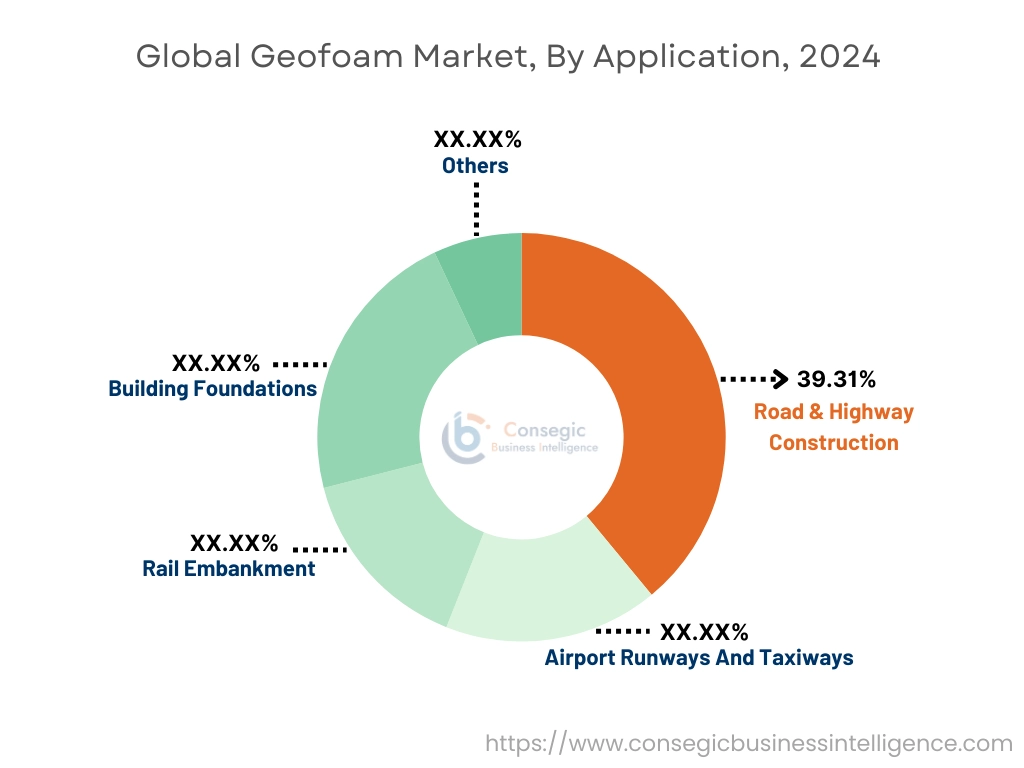
Based on Application, the market is categorized into road & highway construction, airport runways and taxiways, rail embankment, building foundations, and others.
Trends in Application:
- According to geofoam market trends, this material is widely used in road & highway construction to provide stable and resilient foundation.
- The adoption of geofoam is growing in building foundations for thermal insulation as per market trends.
The road & highway construction segment accounted for the largest market share of 39.31% in the year 2024.
- In road and highway construction, geofoam material is used as a sustainable material compared to traditional fill materials. It furthermore reduces the need for large-scale excavation and transportation of materials.
- It helps to increase the longevity of road and highway by providing a stable and resilient foundation.
- Additionally, this material reduces the risk of compact damage and stress on underlying or adjoining soil and structures.
- Furthermore, the need for strong and efficient roads is increasing due to increased traffic volume & heavy loads, rising trade, and other factors. To cater this, the government is increasingly adopting geofoam material to provide a stable and resilient foundation for road and highway.
- Hence, as demand for strong and efficient roads is growing, the need for this material is also increasing, in turn driving the segment.
The building foundations segment is expected to grow at the fastest CAGR over the forecast period.
- In building foundations, geofoam, particularly EPS is used to provide reduction in lateral pressure as well as to prevent settlement.
- It also provides insulation in the building foundation due to its ability to withstand high temperatures.
- Moreover, the need for insulation in building construction is growing due to increasing focus on energy efficiency and environmental regulations. To cater this, companies are investing in insulation material for building foundation.
- For instance, in 2022, Foam Holdings acquired Amvic and Concrete Block Insulating Systems. This strengthens the material portfolio of Foam Holdings including EPS geofoam material for building foundation.
- Hence, as demand for insulation materials is growing in building construction, the need for this material will also increase. This will drive the segment for the forecasted years.
By Sales Channel :
Based on Sales Channel, the market is categorized into direct sales and indirect sales.
Trends in Sales Channel:
- Direct sales channel increases brand awareness and lower overhead costs for manufacturers.
- Adoption of indirect sales channel is growing due to proliferation of retail stores as per market trends.
The direct sales segment accounted for the largest market share in the year 2024.
- Direct sales is a type of sales channel where products are sold directly to customers without any intermediaries.
- The manufacturers widely sold geofoam material through direct sales to construction units, airport companies, and government bodies. They prefer direct sales due to lower overhead costs and rapid market proliferation.
- Furthermore, direct sales channel increases brand awareness and customer loyalty. Due to this, direct sales of this material are expanding.
- For instance, Carlisle reported an increase of 13% in sales of building materials in 2024 as compared to the year 2023. This includes geofoam material which is directly sold to construction units, airport companies, and government bodies.
- Hence, as an increase in the need for building materials is observed, the direct sales of this compound are also increasing, in turn driving the segment.
The indirect sales segment is expected to grow at the fastest CAGR over the forecast period.
- Indirect sales is a type of sales channel where products are sold through intermediaries such as distributors, retailers or agencies.
- It furthermore includes retail sales and online sales where geofoam material is sold through retailers or through online marketplaces.
- Moreover, retail sales channel offers advantages such as customer data collection and personalized customer service.
- Also, this sales channel leads to greater supply chains options and a reduction in shipping costs. This is furthermore leading to increase in retail sales of geofoam material.
- Hence, as the adoption of retails sales is growing, the indirect sales of this material will also increase. This will drive the segment for the forecasted years.
Regional Analysis:
The regional segment includes North America, Europe, Asia Pacific, Middle East & Africa, and Latin America.
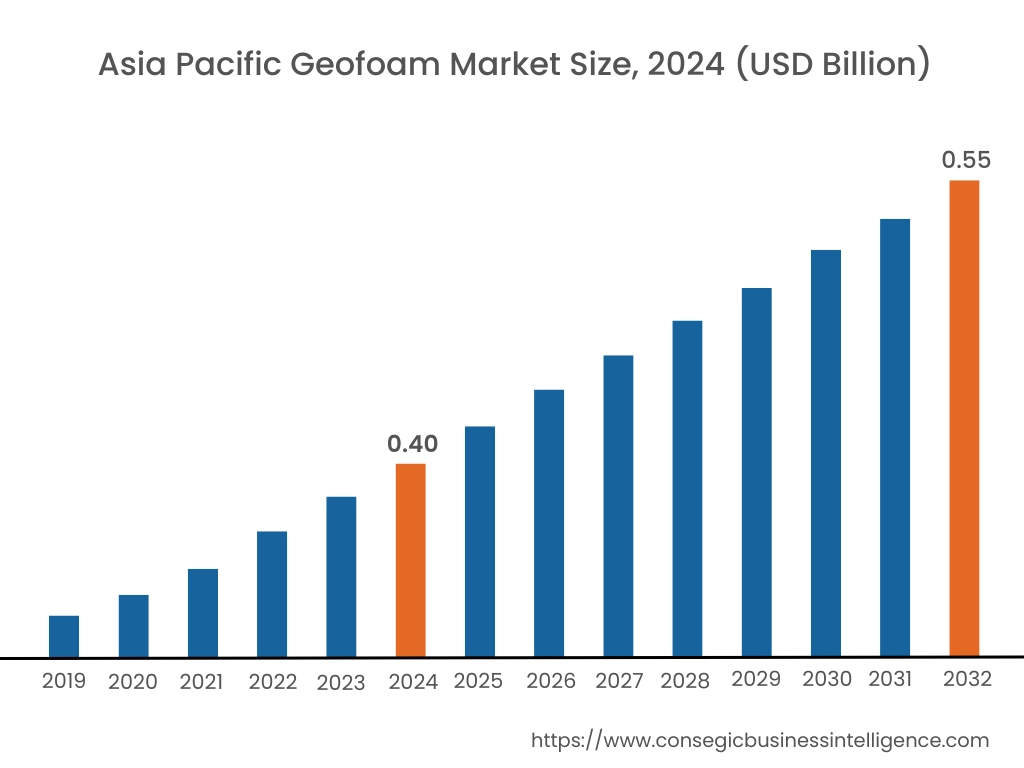
In 2024, Asia Pacific accounted for the highest market share at 42.07% and was valued at USD 0.40 Billion and is expected to reach USD 0.55 Billion in 2032. In Asia-Pacific, the China accounted for the highest geofoam market share of 37.46% during the base year of 2024. As per analysis, the Asia Pacific region holds a dominant position in the market due to expanding highway construction. In the highway construction, geofoam is used to reduce vibrations caused by traffic movement, reducing impact on nearby structures. It does not absorb water which prevents waterlogging and maintains the integrity of highways. Moreover, countries such as China, India, Japan, and South Korea are expanding their highway construction, furthermore, driving the market adoption.
- According to CEIC, the highway construction in China is increased by 2.8% in 2023 as compared to the year 2021. This growing highway construction is driving the use of geofoam to reduce vibrations caused by traffic movement.
Therefore, due to the above-mentioned factors, the Asia Pacific region is dominating in the market as per analysis.
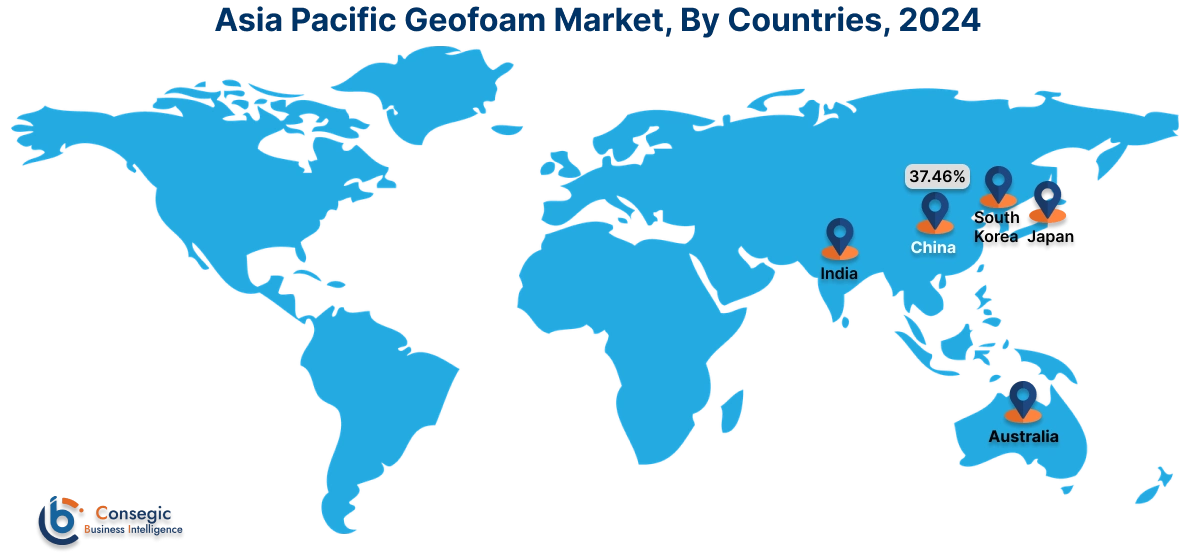
Europe is expected to witness the fastest CAGR of 7% over the forecast period of 2025-2032. According to geofoam market analysis, Europe region is growing considerably in the market driven by aviation industry. In the aviation, geofoam is applied in engineered material arrestor system to slow down the aircraft in case of runway overruns. It also reduces the load on underground utilities such as drainage pipes, fuel lines, electrical conduits beneath the airport taxiways and runways. Hence, the geofoam market share of Europe is expected to emerge rapidly through expansion of the aviation sector as per analysis.
According to geofoam market analysis, the North America region is growing considerably in the market driven by technological advancements. Advancement in polymerization and molding techniques have enhanced the efficiency, sustainability, and cost-effectiveness of the material. Innovations in automation and artificial intelligence driven process control are optimizing production and ensuring high-performance material for road construction and rail embankments. This is furthermore fueling the market growth in the region.
The Middle East & Africa region is experiencing moderate growth in the market driven by expanding building construction. In building construction, geofoam is used in underground to aid in water diversion and prevents hydrostatic pressure buildup. It is also used to prevent loads on underground infrastructure such as sewage lines and electric cables. In countries such as UAE, Saudi Arabia, and South Africa, building projects are expanding thereby driving the market growth across the region.
As per analysis, the market in Latin America is showcasing opportunities due to the expanding railway sector. In this sector, geofoam is used as a backfill material in railway embankments in combination with other materials. It is also used in vibration isolation trenches to reduce ground vibrations caused by high-speed trains. Additionally, in countries such as Brazil, Argentina, and Columbia, railway network is expanding. This is leading to market demand across the region.
Top Key Players & Market Share Insights:
The geofoam industry is highly competitive with major players providing products to the national and international markets. Key players are adopting several strategies in research and development (R&D) and material innovation to hold a strong position in the global geofoam market. Key players in the geofoam industry include-
- Carlisle (United States)
- Amvic Building Systems (Canada)
- Expol (New Zealand)
- Pacific Allied Products, Ltd. (United States)
- Plasti-Fab Ltd. (Canada)
- Atlas Roofing Corporation (United States)
- Insulation Company of America (United States)
- Foam Products Corporation (United States)
- Jablite (United Kingdom)
- ThermaFoam, LLC (United States)
Recent Industry Developments :
Mergers & Acquisitions:
- In 2024, Carlisle acquired PFB Holdco, Inc. with an investment of USD 259.5 Million. This will further strengthen the material portfolio of Carlisle including geofoam.
Geofoam Market Report Insights:
| Report Attributes | Report Details |
| Study Timeline | 2019-2032 |
| Market Size in 2032 | USD 1.43 Billion |
| CAGR (2025-2032) | 5.2% |
| By Type |
|
| By Application |
|
| By Sales Channel |
|
| By Region |
|
| Key Players |
|
| North America | U.S. Canada Mexico |
| Europe | U.K. Germany France Spain Italy Russia Benelux Rest of Europe |
| APAC | China South Korea Japan India Australia ASEAN Rest of Asia-Pacific |
| Middle East and Africa | GCC Turkey South Africa Rest of MEA |
| LATAM | Brazil Argentina Chile Rest of LATAM |
| Report Coverage |
|
Key Questions Answered in the Report
How big is the geofoam market? −
In 2024, the geofoam market is USD 0.95 Billion.
Which is the fastest-growing region in the geofoam market? +
Europe is the fastest-growing region in the geofoam market.
What specific segmentation details are covered in the geofoam market? +
Type, Application, and Sales Channel are covered in the geofoam market.
Who are the major players in the geofoam market? +
Carlisle (United States), Amvic Building Systems (Canada), and Atlas Roofing Corporation (United States) are some of the major players in the market.
Overview
Reputation & Certifications


Our Services
- Market Intelligence & Forecasting
- Custom Research Solutions
- Market Entry Strategy
- Competitive Intelligence
- Customer Insights
- Industry Innovation Analysis
- Investment Advisory