Jump to Content
Ground Source Heat Pump Compressors Market - Size, Share, Industry Trends, and Forecasts (2025-2032)
Ground Source Heat Pump Compressors Market Size:
Ground Source Heat Pump Compressors Market size is estimated to reach over USD 3.46 Billion by 2032 from a value of USD 2.45 Billion in 2024 and is projected to grow by USD 2.51 Billion in 2025, growing at a CAGR of 4.4% from 2025 to 2032.
Ground Source Heat Pump Compressors Market Scope & Overview:
Ground source heat pump compressors are core components in geothermal heating and cooling systems, responsible for circulating refrigerant and enabling thermal exchange between buildings and the ground. These compressors operate within closed-loop or open-loop systems, drawing consistent thermal energy from beneath the earth’s surface to regulate indoor temperatures year-round.
Available in scroll, rotary, and reciprocating designs, these compressors are engineered for quiet operation, variable speed control, and high seasonal efficiency. They are optimized to function under stable ground temperature conditions, enhancing energy output and system durability.
Ground source heat pump compressors contribute to reliable performance, reduced power consumption, and extended system lifespan. Their role in modulating pressure and facilitating heat transfer makes them essential for maintaining consistent comfort levels in residential, commercial, and institutional buildings. Their integration into ground-source systems supports both retrofits and new construction with an emphasis on thermal efficiency and operational cost savings.

Ground Source Heat Pump Compressors Market Dynamics - (DRO) :
Key Drivers:
Technological Advancements in Scroll, Rotary, and Variable-Speed Compressors Boost Market Growth
Recent advancements in scroll, rotary, and variable-speed compressor technologies have significantly enhanced the performance, reliability, and energy efficiency of ground source heat pump systems. Inverter-driven compressors enable precise modulation based on thermal load, improving part-load efficiency and reducing energy consumption during fluctuating demand cycles. Innovations such as oil-free magnetic bearings, vapor injection, and dual-stage compression are further extending compressor lifespan while supporting low-noise, compact designs. These enhancements are particularly critical in residential and commercial applications where comfort, efficiency, and space optimization are top priorities. The development of high-COP compressors that perform consistently in diverse climates is expanding system applicability across regions. As developers and homeowners seek long-term cost savings and sustainable heating solutions, the need for advanced compressor technologies is increasing, driving long-term ground source heat pump compressors market expansion.

Key Restraints:
Lack of Skilled Labor and Design Expertise for GSHP System Integration Hinders Market Expansion
Effective integration of ground source heat pump systems depends on accurate sizing, loop field configuration, and compressor selection based on building load profiles. However, a shortage of skilled installers and experienced HVAC designers limits successful deployment in several regions. Inadequate system design or incorrect compressor pairing results in sub-optimal performance, high energy consumption, and increased maintenance. This technical gap is more pronounced in emerging markets and small-scale retrofits where design standards and training infrastructure remain underdeveloped. As a result, project failures or inefficiencies reduce confidence in ground source heat pump technology, even in areas with regulatory support. Despite growing demand for low-carbon HVAC systems, the limited availability of qualified professionals continues to restrain ground source heat pump compressors market growth.
Future Opportunities :
Growth in Net-Zero Energy Buildings and Large Commercial Developments Presents Market Opportunities
The global shift toward net-zero energy buildings and climate-resilient infrastructure is creating strong demand for ground source heat pump systems with high-efficiency compressors. Large commercial projects—including airports, government buildings, universities, and mixed-use developments—are adopting centralized GSHP configurations to reduce operational carbon footprint and align with ESG goals. Compressors designed for scalable deployment, quiet operation, and high thermal lift are becoming central to these next-generation energy systems. Additionally, integration with thermal storage, smart grid interfaces, and load management systems further enhances compressor performance in large building envelopes. As green building certifications such as LEED, WELL, and BREEAM become mainstream, the role of energy-efficient compressors in achieving whole-building performance targets is gaining recognition. This transformation is opening scalable, value-driven ground source heat pump compressors market opportunities supported by necessity for high-performance and sustainable HVAC infrastructure.
Ground Source Heat Pump Compressors Market Segmental Analysis :
By Compressor Type:
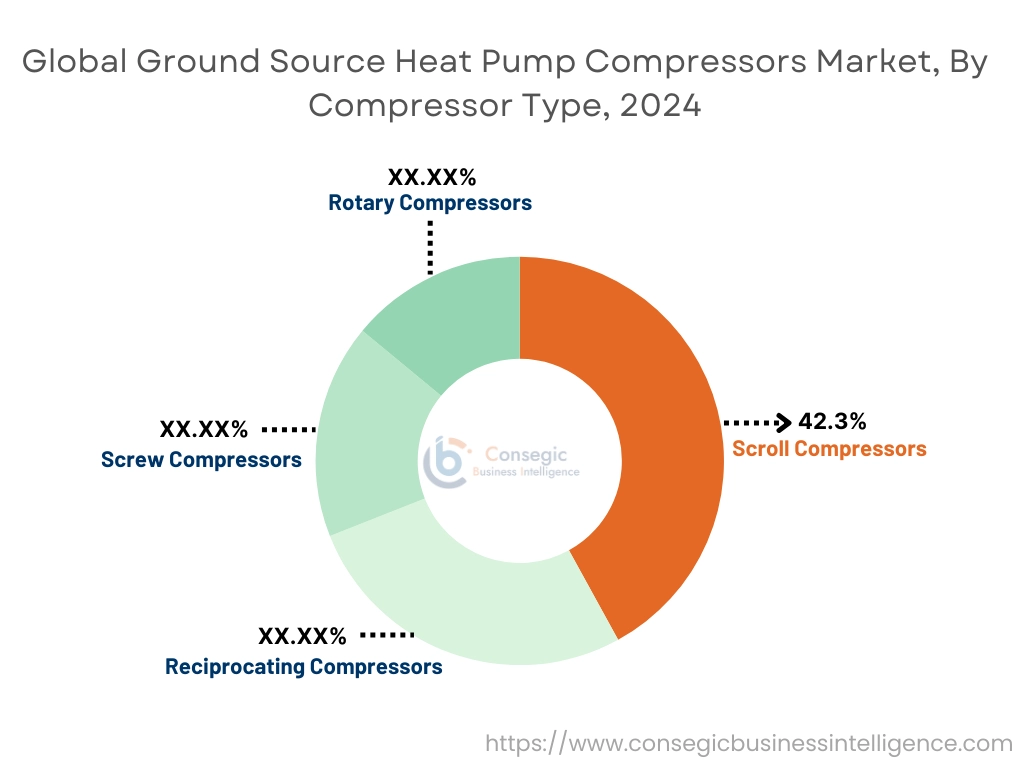
Based on compressor type, the market is segmented into scroll compressors, reciprocating compressors, screw compressors, and rotary compressors.
The scroll compressors segment accounted for the largest ground source heat pump compressors market share of 42.3% in 2024.
- Scroll compressors offer high efficiency, low noise, and reduced vibration, making them ideal for residential and commercial ground source heat pump applications.
- Their compact size and minimal maintenance requirements support long-term operational reliability in both open and closed-loop systems.
- The segment benefits from growing adoption in green building projects and smart HVAC systems.
- As per the ground source heat pump compressors market analysis, the strong efficiency profile of scroll technology sustains its widespread market presence.
The screw compressors segment is projected to grow at the fastest CAGR.
- Screw compressors are preferred in large-capacity commercial and industrial ground source systems due to their ability to handle continuous high loads.
- They offer stable performance and better energy regulation under variable load conditions.
- These compressors are increasingly adopted in infrastructure projects focused on thermal energy storage and large-area climate control.
- As per ground source heat pump compressors market trends, rising energy-efficiency mandates in commercial sectors are propelling this segment’s rapid development.
By Refrigerant Type:
Based on refrigerant type, the market is categorized into R410A, R407C, R134a, Propane (R290), and others.
The R410A segment accounted for the largest market share in 2024.
- R410A is widely used in heat pump systems due to its favorable thermodynamic properties and compatibility with scroll compressors.
- It offers high heat transfer efficiency and cooling capacity, making it suitable for both residential and light commercial systems.
- Despite increasing regulatory scrutiny, its usage continues where alternatives are yet to gain scale.
- As per ground source heat pump compressors market analysis, the segment holds strong due to global legacy installations and cost advantages.
The Propane (R290) segment is expected to register the fastest CAGR.
- R290 is a natural refrigerant with very low Global Warming Potential (GWP), aligning with F-gas regulations and sustainability objectives.
- It offers excellent energy performance and is increasingly preferred in environmentally conscious residential and commercial projects.
- Adoption is rising in Europe and Asia-Pacific where environmental regulations are more stringent.
- Ground source heat pump compressors market trends indicate that R290-based systems are gaining traction due to their low environmental impact.
By Application:
Based on application, the market is segmented into residential, commercial, and industrial.
The residential segment held the largest ground source heat pump compressors market share in 2024.
- Ground source heat pump compressors in residential systems offer quiet operation, low operating costs, and strong heating and cooling performance.
- Government subsidies and tax incentives are encouraging homeowners to adopt geothermal technologies.
- Requirement is especially strong in North America and Europe where cold climates increase reliance on efficient heating.
- Ground source heat pump compressors market demand in this segment is driven by energy cost savings and rising eco-conscious consumer behavior.
The commercial segment is projected to grow at the fastest CAGR.
- Commercial buildings, such as hotels, schools, and offices, benefit from scalable ground source systems with advanced control features.
- This segment supports long-term carbon reduction goals, helping institutions meet ESG and green certification targets.
- Increasing retrofitting of legacy HVAC systems in large buildings is creating opportunities for compressor upgrades.
- Ground source heat pump compressors market growth is supported by rising urban infrastructure investment and demand for sustainable cooling and heating.
By Distribution Channel:
Based on distribution channel, the market is segmented into OEMs, aftermarket, online retail, and distributors & dealers.
The OEMs segment accounted for the largest revenue share in 2024.
- OEMs supply compressors directly to ground source heat pump manufacturers, ensuring product compatibility and system integration.
- Strong relationships between compressor manufacturers and heat pump OEMs support volume sales and product customization.
- Innovation in variable-speed compressor technology is largely driven through OEM partnerships.
- Ground source heat pump compressors market demand from this channel is sustained by high-volume residential and commercial installations.
The online retail segment is projected to register the fastest CAGR.
- Digital sales platforms are increasingly used by technicians and contractors to source replacement parts and compressors for small-to-medium projects.
- Online channels provide broader product visibility, ease of comparison, and direct access to new technologies.
- This segment benefits from growth in the DIY market and the expansion of B2B e-commerce across the HVAC sector.
- Ground source heat pump compressors market expansion through online retail is being fueled by global digital transformation and logistics optimization.
Regional Analysis:
The regions covered are North America, Europe, Asia Pacific, the Middle East and Africa, and Latin America.
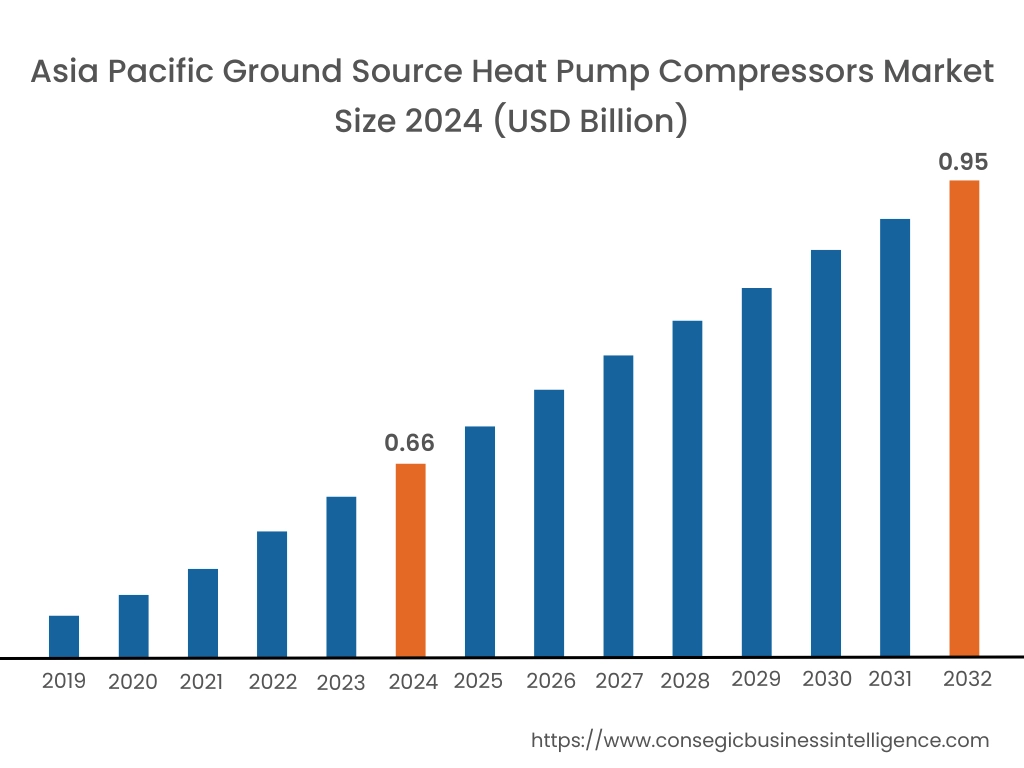
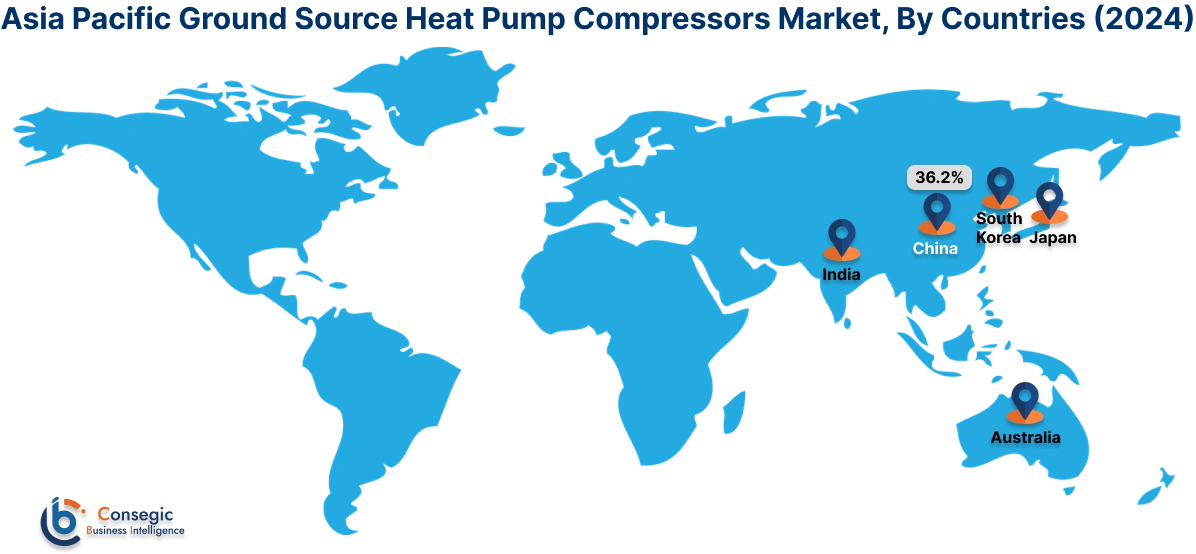
Asia Pacific region was valued at USD 0.66 Billion in 2024. Moreover, it is projected to grow by USD 0.68 Billion in 2025 and reach over USD 0.95 Billion by 2032. Out of this, China accounted for the maximum revenue share of 36.2%. Asia-Pacific is witnessing significant growth in the ground source heat pump compressors industry, led by technological innovation, energy security initiatives, and rapid urbanization. In China, large-scale government initiatives for green buildings are accelerating deployment of ground-source systems in both commercial and public infrastructure projects. Japan and South Korea are adopting highly compact and efficient compressors in space-constrained urban areas, with advanced control systems tailored to fluctuating heating and cooling loads. Market analysis also shows growing momentum in Australia, where sustainable construction and decarbonization roadmaps are fueling market penetration. The region’s strong manufacturing base and policy-driven implementation continue to support long-term adoption.
North America is estimated to reach over USD 1.15 Billion by 2032 from a value of USD 0.81 Billion in 2024 and is projected to grow by USD 0.84 Billion in 2025. North America remains a prominent region for ground source heat pump applications, especially in the United States and Canada, where residential and institutional sectors are investing in sustainable HVAC solutions. Market analysis shows rising adoption of high-efficiency compressors integrated into geothermal heat pump systems for both new constructions and deep-energy retrofits. Regional programs supporting clean heating, combined with tax incentives and energy rebate initiatives, are driving upgrades across suburban and rural properties. Continued growth is supported by rising awareness of energy savings and the need to reduce dependence on fossil-fuel-based heating and cooling technologies in cold and mixed-climate zones.
Europe is a highly mature and regulation-driven market where adoption is aligned with ambitious climate goals and strong governmental support for renewable heating technologies. Countries like Germany, Sweden, and the Netherlands are increasingly replacing gas boilers with heat pump systems, with a focus on low-noise, high-performance compressors suited for deep geothermal applications. Market analysis highlights increasing integration of inverter-driven compressors that deliver variable speed control and improved seasonal efficiency. The market opportunity in Europe is closely tied to retrofit mandates for aging buildings and the promotion of zero-emission residential developments under EU energy transition frameworks.
Latin America is an emerging region for ground source heat pump technologies, with increasing interest seen in countries such as Chile, Brazil, and Argentina. Market analysis indicates that the uptake of geothermal heating systems is gradually expanding in high-altitude and temperature-variable regions, where stable subsurface temperatures support efficient thermal exchange. Demand is also being driven by energy diversification policies and interest in reducing the operational costs of large buildings. The ground source heat pump compressors market opportunity here lies in expanding awareness, training local installers, and integrating scalable systems in urban planning initiatives and commercial developments.
The Middle East and Africa are showing early-stage adoption, with limited but growing interest in energy-efficient thermal systems that reduce dependence on conventional air conditioning and fossil fuel-based heating. In the UAE and Saudi Arabia, luxury residential and commercial projects are exploring closed-loop ground source heat pump systems for long-term sustainability. South Africa is also evaluating applications in eco-housing and municipal infrastructure. Market analysis reveals that awareness and cost barriers remain key challenges, but infrastructure investment and government-led green building initiatives are expected to unlock future needs. Growth in this region will depend on localized feasibility studies and demonstration projects to showcase system performance and savings.
Top Key Players and Market Share Insights:
The ground source heat pump compressors market is highly competitive with major players providing products and services to the national and international markets. Key players are adopting several strategies in research and development (R&D), product innovation, and end-user launches to hold a strong position in the global ground source heat pump compressors market. Key players in the ground source heat pump compressors industry include -
- Bosch Thermotechnology (Germany)
- Stiebel Eltron (Germany)
- Daikin Industries, Ltd. (Japan)
- Withair (China)
- Euroklimat (China)
- Viessmann Group (Germany)
- Climaveneta (Italy)
- GEA Refrigeration Technologies (Germany)
- Sanden Corporation (Japan)
- Mitsubishi Electric Corporation (Japan)
Recent Industry Developments :
Acquisitions:
- In February 2025, Swegon acquires American Geothermal, an American heat pump and chiller manufacturer. This acquisition enables Swegon to expand its presence in North America, across the United States and Canada.
Partnerships:
- In April 2025, Dandelion Energy, a leading home geothermal heating and cooling company, partnered with Lennar Corporation, a leading homebuilders firm, for a significant residential geothermal heat pump deployment in the United States.
Ground Source Heat Pump Compressors Market Report Insights:
| Report Attributes | Report Details |
| Study Timeline | 2019-2032 |
| Market Size in 2032 | USD 3.46 Billion |
| CAGR (2025-2032) | 4.4% |
| By Compressor Type |
|
| By Refrigerant Type |
|
| By Application |
|
| By Distribution Channel |
|
| By Region |
|
| Key Players |
|
| North America | U.S. Canada Mexico |
| Europe | U.K. Germany France Spain Italy Russia Benelux Rest of Europe |
| APAC | China South Korea Japan India Australia ASEAN Rest of Asia-Pacific |
| Middle East and Africa | GCC Turkey South Africa Rest of MEA |
| LATAM | Brazil Argentina Chile Rest of LATAM |
| Report Coverage |
|
Key Questions Answered in the Report
How big is the Ground Source Heat Pump Compressors Market? −
Ground Source Heat Pump Compressors Market size is estimated to reach over USD 3.46 Billion by 2032 from a value of USD 2.45 Billion in 2024 and is projected to grow by USD 2.51 Billion in 2025, growing at a CAGR of 4.4% from 2025 to 2032.
What specific segmentation details are covered in the Ground Source Heat Pump Compressors Market report? +
The Ground Source Heat Pump Compressors market report includes specific segmentation details for compressor type, refrigerant type, application and distribution channel.
What are the applications of the Ground Source Heat Pump Compressors Market? +
The application of the Ground Source Heat Pump Compressors Market are residential, commercial, and industrial.
Who are the major players in the Ground Source Heat Pump Compressors Market? +
The key participants in the Ground Source Heat Pump Compressors market are Bosch Thermotechnology (Germany), Stiebel Eltron (Germany), Viessmann Group (Germany), Climaveneta (Italy), GEA Refrigeration Technologies (Germany), Sanden Corporation (Japan), Mitsubishi Electric Corporation (Japan), Daikin Industries, Ltd. (Japan), Withair (China) and Euroklimat (China).
Overview
Reputation & Certifications


Our Services
- Market Intelligence & Forecasting
- Custom Research Solutions
- Market Entry Strategy
- Competitive Intelligence
- Customer Insights
- Industry Innovation Analysis
- Investment Advisory