Jump to Content
Hafnium Market - Size, Share, Industry Trends, and Forecasts (2025-2032)
Hafnium Market Size:
The Hafnium Market size is growing with a CAGR of 6.6% during the forecast period (2025-2032), and the market is projected to be valued at USD 133.51 Million by 2032 from USD 80.13 Million in 2024. Additionally, the market value for 2025 is attributed to USD 85.16 Million.
Hafnium Market Scope & Overview:
Hafnium is defined as a silvery-gray transition metal that is distinguished by its high melting point, high corrosion resistance, and notable neutron absorption capabilities. It is largely found along with zirconium in minerals like zircon. The extraction process conducted is of a complex nature due to their chemical similarity. This element's unique properties make it necessary element across several applications. Within the application segments, it serves as a crucial component in nuclear reactor control rods. Additionally, it is also advantageous in increasing the strength of superalloys that are used in jet engine turbines and form high-k dielectrics in advanced semiconductors. Additionally, it finds applications in plasma cutting and optical coatings, showcasing its versatility across several diverse applications.
How is AI Impacting the Hafnium Market?
AI is significantly impacting the hafnium market by enhancing various aspects of its production, supply chain, and application development. AI-driven tools optimize processes, improve quality control, and drive innovation, leading to increased efficiency and expanded market opportunities for hafnium. Also, AI-driven demand forecasting tools enable predictive analytics, real-time inventory tracking, and dynamic pricing mechanisms, optimizing supply chain efficiency. Further, AI-driven recycling technologies improve recycling rates and minimize waste, contributing to the circular economy.

Hafnium Market Dynamics - (DRO) :
Key Drivers:
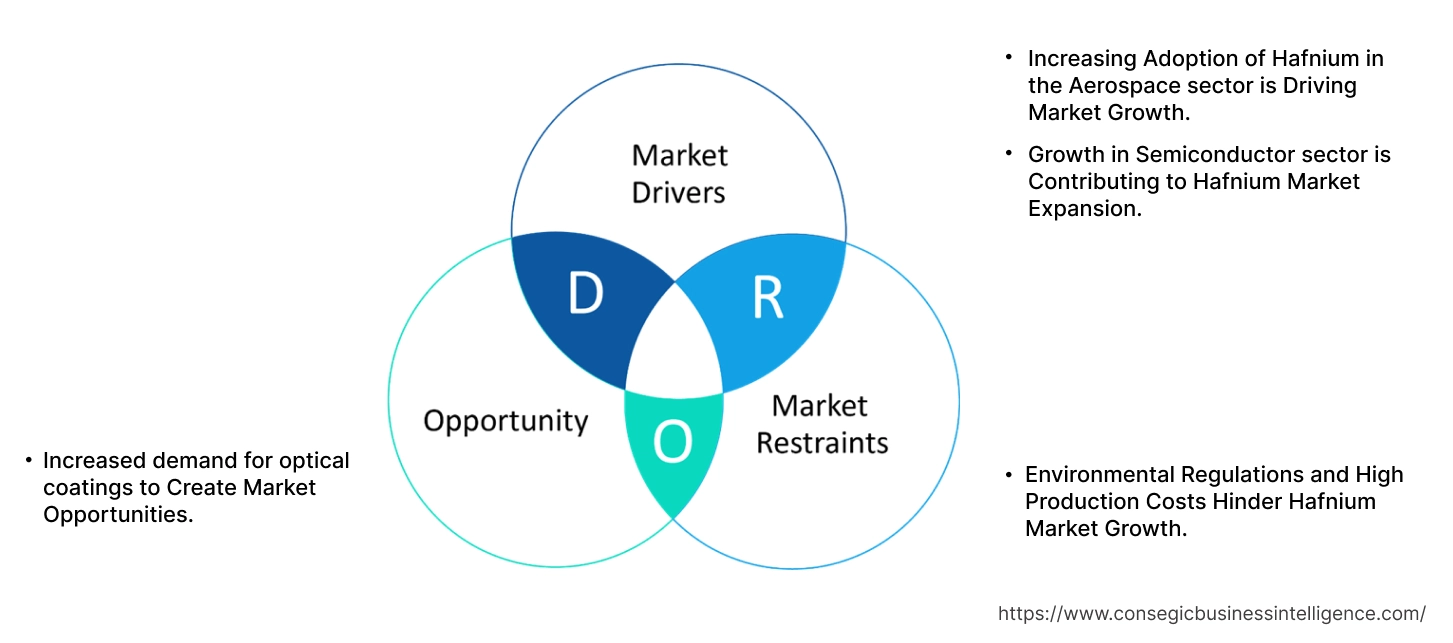
Increasing Adoption of Hafnium in the Aerospace sector is Driving Market Growth.
The growing demand for high-performance materials in the aerospace sector is highly contributing to the increasing adoption of hafnium. The aerospace sector consists of aircraft and spacecraft. As modern aircraft and spacecraft operate in extreme thermal and mechanical environments, the compounds high heat resistance and contribution to superalloy strength make is a suitable option for these applications. This enables the creation of more durable, reliable, and efficient components in the aerospace sector.
- For instance, according to International Air Transport Association, the need of air passenger traffic globally has increased by 11.6% in 2024 as compared to 2023 creating the need for more aircraft.
Thus, adoption of producing aircraft components is driving the hafnium market growth.
Growth in Semiconductor sector is Contributing to Hafnium Market Expansion.
The focus of key players in the semiconductor sector towards miniaturization and enhanced performance is one of the key factors contributing to the hafnium market expansion. As transistors shrink to atomic scales, hafnium oxide's (HfO2) play an important role as a high-k dielectric. This dielectric helps in mitigating leakage currents and increasing chip efficiency. The escalating global necessity for electronic devices, along with the progression of advancement of AI and HPC are contributing to the increase in chip production.
- For instance, according to Semiconductor Industry Association (SIA), the sale of semiconductors increased by 20.7% in 2024 as compared to 2023 with chips holding a significant sales volume.
Thus, this reliance on hafnium-based materials in development of next-generation semiconductors ensures a steady and growing market.
Key Restraints:
Environmental Regulations and High Production Costs Hinder Hafnium Market Growth.
The extraction process of hafnium requires high resources along with a necessity to adhere to the increasing environmental standards that are put forth to reduce pollution and ecological disruption. These regulations include waste disposal, chemical byproduct management, and emissions control. These regulations contribute to the increase in operational expenses and potential limitations on production volume. Furthermore, the complex nature of extracting this metal compound from zirconium, along with the limited availability drives up production costs, making it a premium material. The specialized equipment and purification processes required for its manufacture further contribute to this expense. Thus, the above-mentioned factors are contributing to the hindrance in market growth.
Future Opportunities :
Increased demand for optical coatings to Create Market Opportunities.
The growing preference for the inclusion of hafnium into optical coatings presents significant potential for upwards market trajectory in future years. HfO2 offers properties such as high refractive index and minimal light absorption, making it suitable for developing multilayer coatings with precise optical control. Moreover, its strong durability and stability caters to applications in demanding sectors such as aerospace and defense. This surge is fueled by the growing need for high-performance coatings in laser optics, precision filters amongst others.
- For instance, according to ELE Times, the equipment use for optical coating is expected to grow at a CAGR of 4% by the end of 2027, showcasing potential for the hafnium market trend over the forecast period.
Therefore, HfO2's distinct characteristics make it a critical material in turn creating lucrative hafnium market opportunities in future years.
Hafnium Market Segmental Analysis :
By Product Type:
Based on Product Type, the market is categorized into hafnium metal, hafnium oxide (HfO2), hafnium carbide (Huff), and others.
Trends in Product Type:
- The need for hafnium metal in aerospace and semiconductor sectors to remain moderate.
- The adoption of HfO2 as a high-k dielectric material in the semiconductor sector is increasing.
The Hafnium Metal segment accounted for the largest market share in 2024.
- The hafnium metal segment is dominating due to its use in critical applications within the nuclear and aerospace sectors.
- The element's strong property of neutron absorption makes it important for control rods in nuclear reactors. This contributes to its steady and substantial trend.
- Similarly, the reliance on hafnium-based superalloys in the aerospace sector for high-temperature components in jet engines further attributes to its dominance.
- For instance, according to Alkane Resources Ltd, U.S. and France, together contribute to roughly around 70% production share of hafnium metal across the globe.
- Thus, as per the analysis, the Hafnium metal dominates the Hafnium market trends.
The Hafnium Oxide segment is expected to grow at the fastest CAGR over the forecast period.
- The hafnium oxide (HfO2) segment is primarily driven by the focus of key players in the semiconductor sector towards developing miniaturized and enhanced performance semiconductors.
- As the need for advanced microchips surges, due to the increasing need for artificial intelligence, high-performance computing, and data centers, HfO2's role as a high-k dielectric material is growing.
- This compound's ability to reduce leakage currents and improve transistor efficiency in next-generation semiconductor nodes ensures its importance in the manufacturing process.
- Apart from semiconductors, the applications of HfO2 in advanced optical coatings due to the growth of augmented and virtual reality technologies also contribute significantly.
- Thus, according to market analysis, the HfO2 is expected to grow at the fastest rate in future years.
By Application:
The Application segment is categorized into superalloys, nuclear reactors, optical coatings, plasma cutting, semiconductors and others
Trends in the Application:
- The focus is on research into advanced superalloys that possess even higher heat resistance and durability.
- The growing preference for inclusion of HfO2 in laser optics, optical filters, anti-reflection coatings applications.
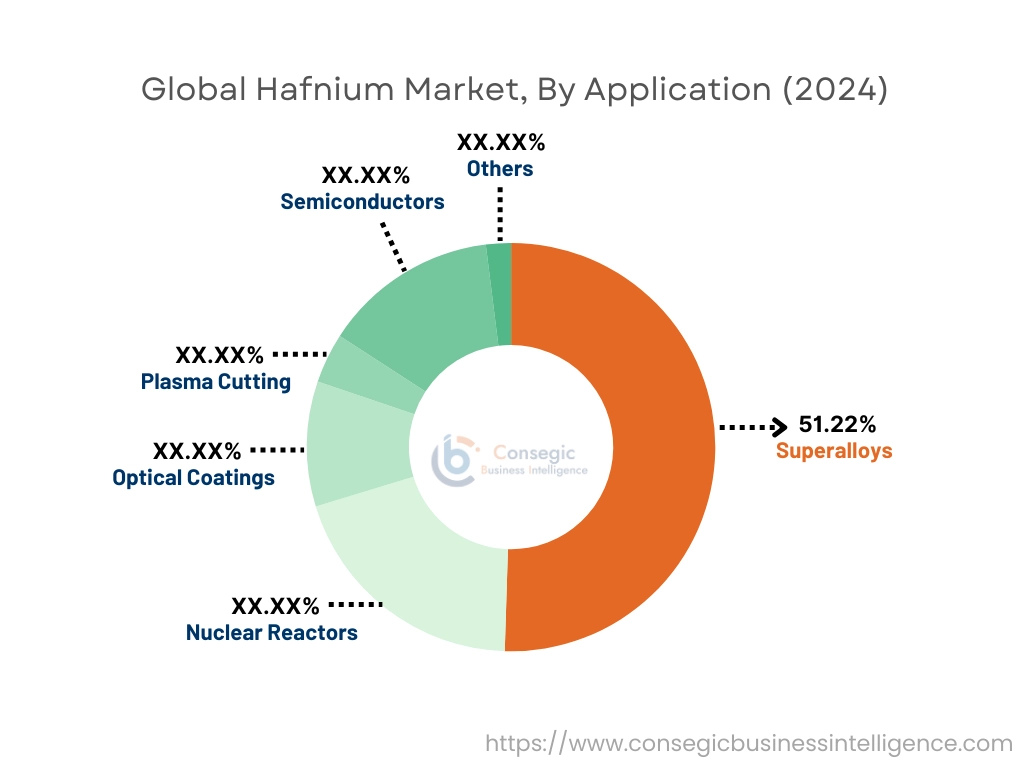
The superalloys agents segment accounted for the largest share of 51.22% in 2024.
- The superalloys segment continues to dominate the market due to its high adoption in the aerospace sector for high-temperature materials.
- Hafnium's unique capability to enhance the strength and durability of superalloys is crucial for jet engines and industrial gas turbines, which are contributing to their segmental dominance.
- For instance, in 2024, Rolls Royce received 273 orders of large jet engines with a lot of new orders from Indigo Korean Air Delta and VietJet.
- This robust requirement of commercial aircraft along with inclusion of compounds used in these alloys, ensures that the superalloys segment contributes significantly to the market.
- Thus, as per analysis the market revenue for this segment is the largest.
The optical imaging segment is expected to grow at the fastest CAGR over the forecast period.
- The optical imaging segment is driven by the growing adoption for high-performance optical coatings. This growth is primarily attributed to the distinct properties of HfO2, a material suitable for crafting advanced optical layers that enhance image clarity and durability.
- The established sectors of augmented and virtual reality rely on these optical systems in turn presenting potential for the adoption of this metal compound in the optical imaging sector.
- Moreover, the role of HfO2 in extreme ultraviolet (EUV) lithography further contributes to its trend.
- This confluence of factors are contributing positively to the inclusion of HfO2 in optical imaging applications in turn creating lucrative hafnium market opportunities.
Regional Analysis:
The regional segment includes North America, Europe, Asia Pacific, the Middle East and Africa, and Latin America.
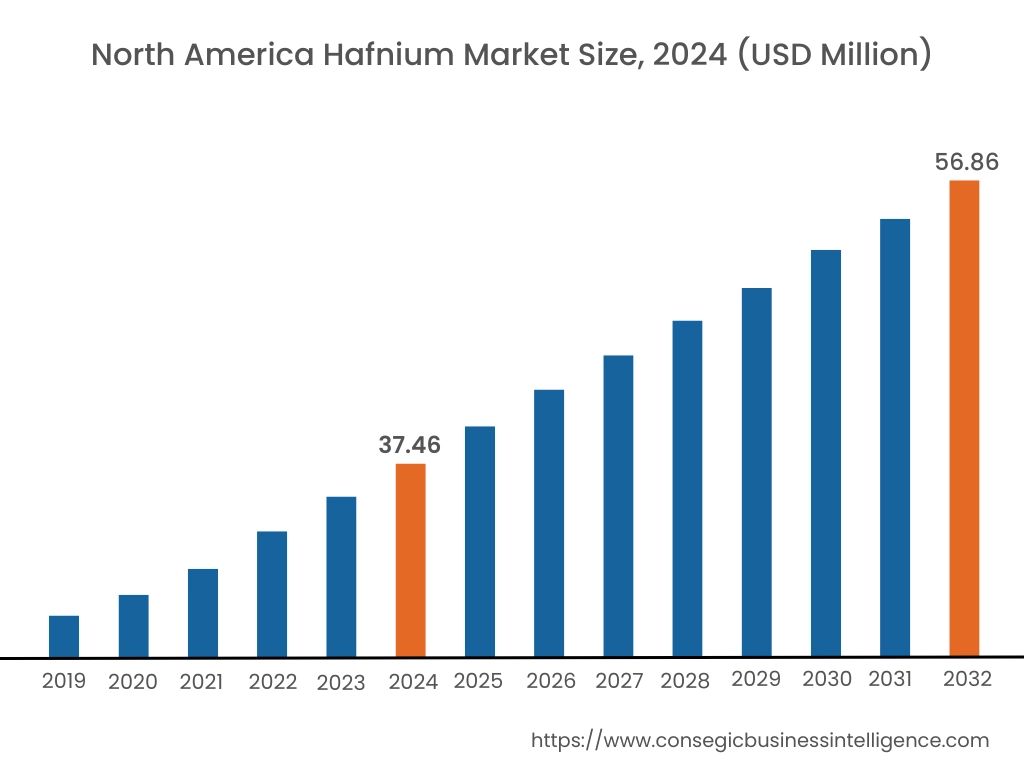
In 2024, North America accounted for the highest market share at 46.76% and was valued at USD 37.46 Million and is expected to reach USD 56.86 Million in 2032. In North America, U.S., accounted for the Hafnium market share of 75.04% during the base year of 2024. The North America's hafnium market share is dominating due to the strong aerospace and defense sectors, which need a consistent and substantial adoption. The region's production of advanced jet engines, military aircraft, and spacecraft requires high-performance superalloys, where the compounds high heat resistance and durability are important. This demand is further increased by the continuous technological advancements within the aerospace sector in both commercial and military aviation sectors.
- For instance, in 2024, Airbus delivered more than 750 commercial aircraft to more than 80 customers across the globe with U.S. being a prominent customer.
Thus, the aerospace sector’s strong presence in North America showcases dominant regional contribution of the hafnium market analysis.

In Asia Pacific, the Hafnium industry is experiencing the fastest growth with a CAGR of 9.1% over the forecast period due to the growing preference for the inclusion of HfO2 for advanced optical coatings. This trend is directly linked to the region's position as a global electronics manufacturing hub, where the production of smartphones, displays, and other consumer devices need high-quality coatings. Furthermore, the expansion of the semiconductor sector is contributing to the market trend. The region's increasing production of optical components along with its dominance in display manufacturing, further contributes to the need for HfO2.
Europe's hafnium market analysis is driven by a strong focus towards the development of advanced materials through research from established sectors. The region's strong research and development sector, followed by leading institutions and funding initiatives, drives the need for new alloys. This pursuit is particularly required in the aerospace and defense sectors, where companies like Airbus and Rolls-Royce demand high-performance materials for advanced jet engines and military applications. Similarly, the industrial gas turbine and nuclear energy sectors are driving the development of specialized hafnium alloys. Furthermore, key players in Europe are focusing on sustainability, which is leading to research and analysis of its recycling and environmentally friendly alloy production.
The Middle East and African (MEA) hafnium market demand is driven by the region's energy-intensive sector, primarily the oil and gas sector, which drives a substantial need for high-temperature alloys. Gas turbines for power generation, refining and petrochemical components, and drilling equipment all rely on hafnium-containing superalloys to withstand extreme conditions. The ongoing industrial development and large-scale infrastructure projects across the MEA region also contribute to the need for these specialized alloys.
The Latin American hafnium market demand is primarily focused by the semiconductor sector’s advancements. The region's consumer electronics market and increasing digitalization drive are indirectly having a positive impact on the requirement for this compound through imported semiconductors. However, the growing adoption of semiconductor-reliant technologies, such as telecommunications infrastructure and data centers are showcasing a developing reliance on hafnium-containing components.
Top Key Players & Market Share Insights:
The Global Hafnium Market is highly competitive with major players providing products to the national and international markets. Key players are adopting several strategies in research and development (R&D) and product innovation to hold a strong position in the global Hafnium market. Key players in the Hafnium industry include
- Framatome (France)
- American Elements (U.S.)
- China Nulear JingHuan Zirconium Industry Co. Ltd. (China)
- Phelly Materials Inc. (U.S.)
- Thermo Fisher Scientific Inc. (U.S.)
- Nanjing Yakutian Metal Technology Co. Ltd (China)
- Allegheny Technologies Incorporated (ATI) (U.S.)
- Alkane Resources Ltd (Australia)
- Chemsavers Inc. (U.S.)
Hafnium Market Report Insights:
| Report Attributes | Report Details |
| Study Timeline | 2019-2032 |
| Market Size in 2032 | USD 133.51 Million |
| CAGR (2025-2032) | 6.6% |
| By Product Type |
|
| By Application |
|
| By Region |
|
| Key Players |
|
| North America | U.S. Canada Mexico |
| Europe | U.K. Germany France Spain Italy Russia Benelux Rest of Europe |
| APAC | China South Korea Japan India Australia ASEAN Rest of Asia-Pacific |
| Middle East and Africa | GCC Turkey South Africa Rest of MEA |
| LATAM | Brazil Argentina Chile Rest of LATAM |
| Report Coverage |
|
Key Questions Answered in the Report
How big is the Hafnium market? −
In 2024, the Hafnium market is USD 80.13 Million.
Which is the fastest-growing region in the Hafnium market? +
Asia Pacific is the fastest-growing region in the Hafnium market.
What specific segmentation details are covered in the Hafnium market? +
By Product Type and Application segmentation details are covered in the Hafnium market.
Who are the major players in the Hafnium market? +
Framatome (France), American Elements (U.S.), Nanjing Youtian Metal Technology Co. Ltd (China), Allegheny Technologies Incorporated (ATI) (U.S.), Alkane Resources Ltd (Australia), Chemsavers Inc. (U.S.) are some of the major players in the market.
Overview
Reputation & Certifications


Our Services
- Market Intelligence & Forecasting
- Custom Research Solutions
- Market Entry Strategy
- Competitive Intelligence
- Customer Insights
- Industry Innovation Analysis
- Investment Advisory