Jump to Content
Hazmat Suits Market - Size, Share, Industry Trends, and Forecasts (2025-2032)
Hazmat Suits Market Size:
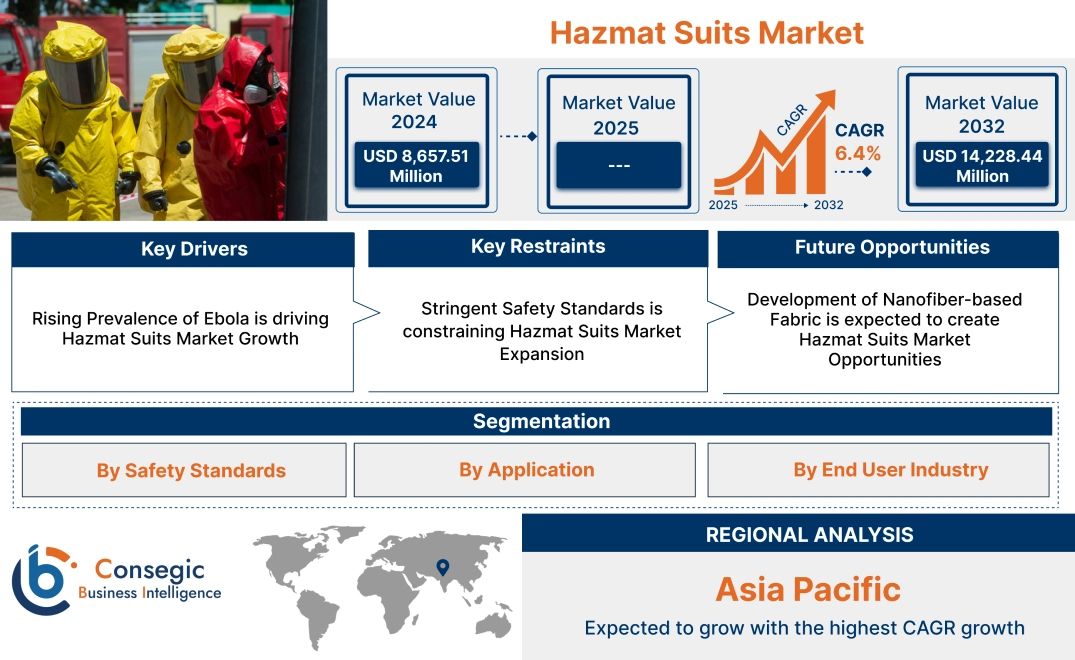
Hazmat suits market size is estimated to reach over USD 14,228.44 Million by 2032 from a value of USD 8,657.51 Million in 2024, growing at a CAGR of 6.4% from 2025 to 2032.
Hazmat Suits Market Scope & Overview:
Hazmat suits are specialized protective equipment designed to protect individuals from harmful substances, including chemicals, biological agents, radiological materials, and other hazardous materials. These suits are used in hazardous environments offering full-body protection to workers, emergency responders and healthcare personnel. Hazmat suits possess various characteristics such as chemical resistance, breathability, thermal protection, waterproof and mobility. There are different types of hazmat suites according to safety standards as level A, level B, level C, and level D. It is used in a wide range of applications such as infection control, chemical waste, biohazard & hazardous material, and others. Due to its protection against hazardous material, hazmat suits are used in different industries such as healthcare, oil & gas, mining & metallurgy, manufacturing, and others. It offers various advantages such as comprehensive protection, prevention of contamination, durability, and improved emergency response.
How is AI Impacting the Hazmat Suits Market?
AI-powered devices integrated into hazmat suits to monitor environmental conditions (gas levels, temperature, radiation), physiological data (heart rate, body temperature), and worker movements in real-time. Also, AI-powered systems can provide real-time feedback on potential dangers, helping workers make informed decisions and avoid hazardous situations. Moreover, AI analyze data to optimize workflows in hazardous environments, reducing unnecessary movement and exposure to risks. Further, AI is being used to develop new materials for hazmat suits with enhanced properties, such as improved breathability, flexibility, and resistance to chemicals and radiation.
Hazmat Suits Market Dynamics - (DRO) :
Key Drivers:
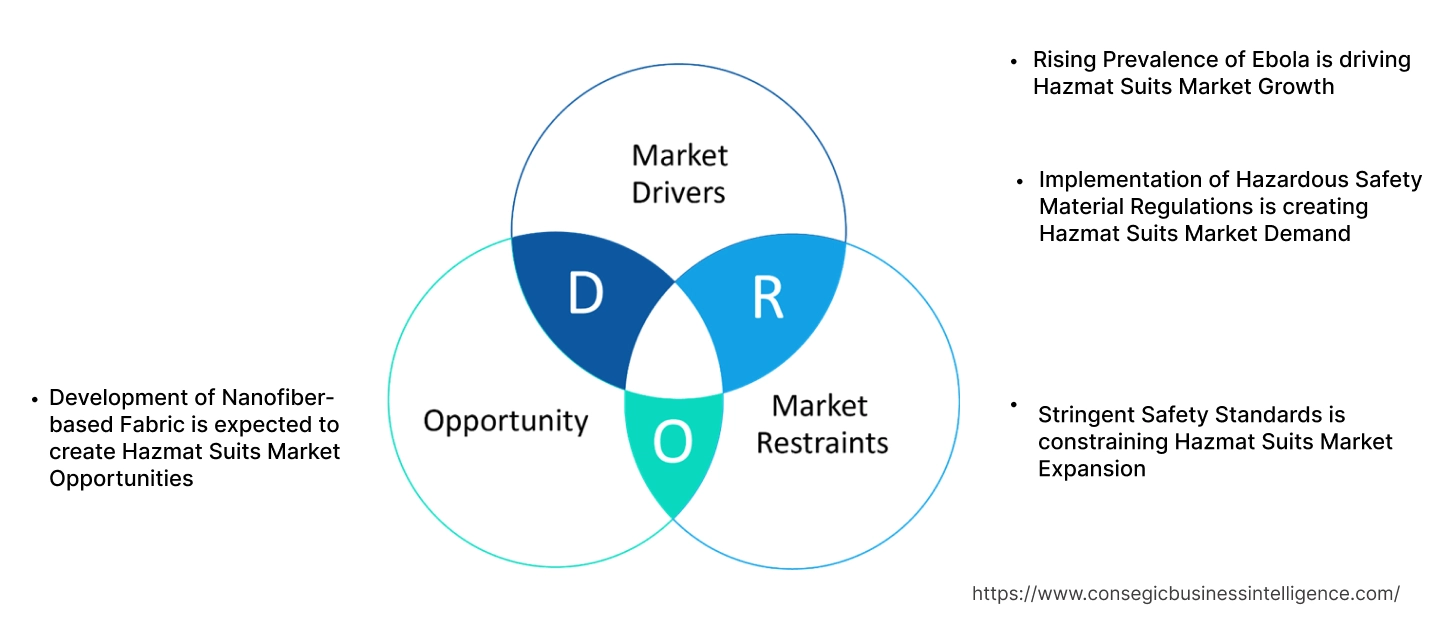
Rising Prevalence of Ebola is driving Hazmat Suits Market Growth
Ebola is a highly infectious viral disease that causes severe hemorrhagic fever and has a high mortality rate, transmitted through direct contact with bodily fluids of infected individuals or animals. The hazmat suits play a critical role in the protection of healthcare workers, researchers, and emergency responders, who are at the risk of exposure in Ebola. These suits are designed to protect against the high risk, highly contagious nature of the Ebola virus, ensuring safety during patient care and containment efforts.
- In 2023, according to Centers for Disease Control and Prevention, there are 164 cases of Ebola globally, representing about 7% increase in the Ebola cases as compared to the year 2020. The hazmat suits are crucial in an Ebola outbreak as they provide full-body protection, preventing direct contact with infected body fluids and reducing the risk of contamination in healthcare workers, responders, and researchers.
Thus, rising prevalence of Ebola cases is leading to hazmat suits market demand for preventing transmission of disease and effective patient care.
Implementation of Hazardous Safety Material Regulations is creating Hazmat Suits Market Demand
Hazardous safety material regulations are set of rules to ensure the safe and secure transportation of hazardous materials, minimizing risks to public health, property, and the environment. These regulations boost the need for high-quality hazmat suits, ensuring compliance with safety standards and safeguarding employees from potential chemicals spills, toxic exposure, and other risks associated with hazardous materials.
- In 2021, United States Department of Transportation implemented hazardous safety material regulations under the Pipeline and Hazardous Materials Safety Administration. It mandates the use of appropriate personal protective equipment like hazmat suits for workers, particularly those in industries such as transportation, shipping, and chemical handling.
Thus, implementation of hazardous safety material regulations is leading to hazmat suits market expansion ensuring compliance with safety standards and safeguarding employees from toxic exposure.
Key Restraints:
Stringent Safety Standards is constraining Hazmat Suits Market Expansion
Safety standards are significantly restrain in the market due to stringent requirements for the approval of usage of hazmat suits. The stringent safety standards is set by Occupational Safety and Health Administration (OSHA) and other regulatory bodies. It typically requires hazmat suits to meet high-performance criteria, including specific resistance to chemicals, biological agents and extreme conditions. This increases manufacturing costs, making the suits more expensive for the companies to purchase. Additionally, compliance with regulations requires regular testing and certifications, adding to the overall cost burden for the manufacturers. Furthermore, industries face problems with meeting these requirements, especially in regions where compliance enforcement is inconsistent.
Thus, stringent safety standards is constraining hazmat suits market growth due to high cost and performance requirements.
Future Opportunities :
Development of Nanofiber-based Fabric is expected to create Hazmat Suits Market Opportunities
Nanofiber-based fabric refers to textiles engineered with nanotechnology to enhance properties such as durability, breathability, and resistance to chemicals, microbes, and environmental hazards. The development of nanofiber-based fabric in hazmat suits offers superior protection against microscopic particles, pathogens, and hazardous chemicals.
- In 2024, Commonwealth Scientific and Industrial Research Organization (CSIRO) developed hazmat suits using nanofiber-based fabric. It is lightweight and breathable addressing key challenges like discomfort and heat stress. Nanofiber material enhances the durability and reusability of hazmat suits, reducing long-term costs for industries.
Thus, development of nanofiber based fabric is expected to create hazmat suits market opportunities by addressing key challenges like discomfort and heat stress.
Hazmat Suits Market Segmental Analysis :
By Safety Standards:
By safety standards, the market is divided into level A, level B, level C, and level D.
Trends in Safety Standards
- According to hazmat suits market trends, level C is widely used due to cost effectiveness and comfort.
- The use of Level A is rising in the market due to their superior protection against extreme exposure as per latest trends.
The level C accounted for the largest market share in the year 2024.
- Level C hazmat suits are designed to provide protection against hazardous materials in situations where the airborne concentration of contamination is known and respiratory protection is necessary but skin exposure is not a concern.
- These suits use an air-purifying respirator, along with full-body coverage and are cost effective.
- Level C hazmat suits are widely used in infection control environments due to their balance of comfort, practicality, and sufficient protection.
- Due to rising need, companies are investing in the production of level C hazmat suits.
- For instance, in 2023, OPEC CBRNe partnered with Avon Protection, a designer and manufacturer of level C hazmat suits. The partnership will combine Avon Protection’s materials innovation with OPEC CBRNe’ ability in developing high comfort, high protection level C hazmat suits enhancing user comfort.
- Thus, level C hazmat suits are dominating in the market due to their cost effectiveness and sufficient protection.
Level A is expected to grow at the fastest CAGR over the forecast period.
- Level A hazmat suits offer the highest protection, providing a fully encapsulated suit, including an airtight body suit, gloves, boots and self-contained breathing apparatus (SCBA) to protect against extreme exposure to toxic substances.
- These suits are used in environments where there is potential for skin contact with hazardous materials and where breathable air is compromised.
- Their use is driven by rising concerns industrial, environmental, and defense-related hazards such as chemical spills, biohazard exposure, and CBRN (chemical, biological, radiological, nuclear) threats.
- It is also essential for emergency responders and environmental cleanups, where exposure to hazardous materials is life-threatening.
- Thus, use of Level A hazmat is rising significantly due to their highest protection against chemicals spills, and biohazard exposure.
By Application:
By application, the market is divided into infection control, chemical waste, biohazard & hazardous material, and others.
Trends in Application
- According to hazmat suits market trends, hazmat suits are widely for infection control against airborne pathogens.
- Incorporation of hazmat suits are rising in chemical waste for workers safety from toxic chemical exposure as per market trends.
The infection control accounted for the largest market share in the year 2024.
- Infection control refers to the practices and procedures used to prevent the spread of infectious disease, especially in healthcare settings.
- Hazmat suits play a crucial role in infection control by providing a barrier between healthcare workers and infectious agents.
- Hazmat suits, particularly level C, are widely utilized in hospitals, clinics, laboratories and cleanroom environments for adequate protection against airborne pathogens and biological hazards.
- Further, companies are investing in the product expansion of these suits for infection control in laboratory and cleanroom environment.
- For instance, in 2024, Ansell Limited acquired Kimberly-Clark's Personal Protective Equipment (KCPPE) business. It includes Kimtech™ brand of hazmat suits for customers in laboratory and cleanroom environments to expand product portfolio and enhances its service capabilities to provide infection control against airborne pathogens.
- Thus, hazmat suits are widely used in infection control for adequate protection against airborne pathogens and biological hazards.
The chemical waste is expected to grow at the fastest CAGR over the forecast period.
- Chemical waste refers to any waste that contains chemicals or chemical compounds, typically hazardous in nature, and requires careful disposal due to its toxic, reactive, and corrosive properties.
- Use of hazmat suits in chemical waste is growing significantly, driven by increasing volume of hazardous chemicals generated across industries like manufacturing, pharmaceuticals, and agriculture.
- These suits are essential for protecting workers from toxic chemical exposure during disposal, cleanup, and treatment process.
- Additionally, the growing global focus on environmental sustainability and waste management regulations is pushing industries to adopt safety equipment for workers handling chemical waste.
- Thus, use of hazmat suits is growing in chemical waste for safety of workers and to avoid toxic chemical exposure.
By End User Industry:
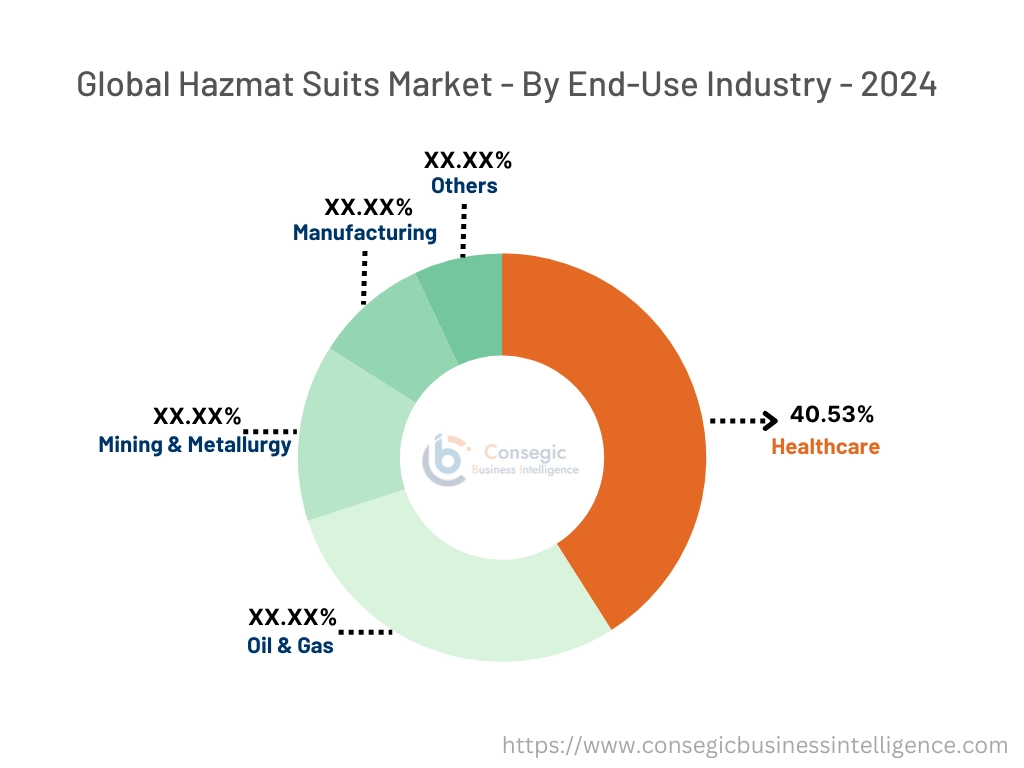
By end-use industry, the market is divided into healthcare, oil & gas, mining & metallurgy, manufacturing, and others.
Trends in End-Use Industry
- As per market trends, hazmat suits are widely used for the protection of healthcare workers from hazardous biological agents and infectious diseases.
- Use of hazmat suits is rising due to protection of employees from toxic chemicals, flammable substances.
Healthcare accounted for the largest market share of 40.53% in the year 2024.
- The healthcare industry refers to the collection of organizations and services that provide medical care and support to individuals.
- Hazmat suits are widely used in the healthcare industry to protect healthcare workers from hazardous biological agents, infectious diseases, and harmful substances.
- They are particularly used in hospitals, laboratories and during emergency response situations where the risk of exposure to pathogens is high.
- In addition, the healthcare regulations requiring the use of personal protective equipment in critical and laboratory settings contribute to the dominance of hazmat suits in the market.
- Thus, hazmat suits are widely used in the healthcare industry due to protection against biological agents and infectious diseases.
The oil & gas is expected to grow at the fastest CAGR over the forecast period.
- The oil & gas industry includes all the companies involved in the process of finding, drilling, extracting, refining, and distributing petroleum products including crude oi, natural gas, and their derivatives.
- The incorporation of hazmat suits in this industry is growing significantly driven by the increasing need for safety in hazardous environments where exposure to toxic chemicals, flammable substances, and extreme temperatures is common.
- Due to increasing need for safety equipment in oil & gas industry for protection against hazardous environments, companies are developing hazmat suits catering to this industry.
- For instance, in 2023, Dupont developed hazmat suits for Dow Louisiana. These suits are developed with the help of Normex comfort technology which provides lightweight, breathable, quick-drying fabric for extreme performance.
- Thus, use of hazmat suits is growing rapidly in the oil and gas industry for protection of workers against toxic chemicals and flammable substances.
Regional Analysis:
The regional segment includes North America, Europe, Asia Pacific, the Middle East and Africa, and Latin America.
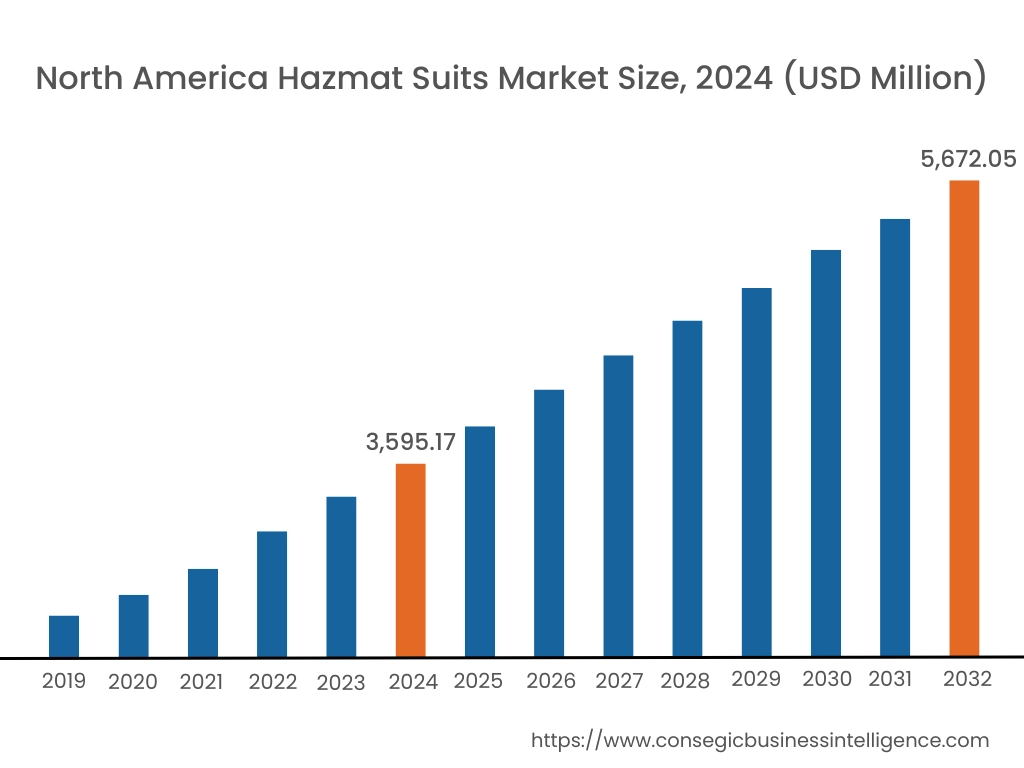
In 2024, North America accounted for the highest market share at 41.53% and was valued at USD 3,595.17 Million and is expected to reach USD 5,672.05 Million in 2032. In North America, United States accounted for the highest market share of 74.20% during the base year of 2024.
The hazmat suits market share of North America is significant due to presence of stringent safety regulations and high awareness regarding worker safety across industries. Regulatory bodies such as OSHA, Environmental Protection Agency, and the Department of Transportation enforce stringent guidelines mandating the use of protective equipment in hazardous environments. The region also benefits from advanced industrial infrastructure and a robust healthcare system, which significantly contributes to the proliferation of hazmat suits in sectors like chemical, manufacturing, and oil & gas. Further, the companies are investing in these suits for the incorporation in fire department for protection of workers against heat and flammable substances.
- In 2023, the United States Environmental Protection Agency announced a settlement with Univar Solutions USA Inc. As part of the settlement, Univar will spend USD 195,103 to purchase Hazmat suits under Supplemental Environmental Project for Denver Fire Department.
Thus, North America is leading in the market due to stringent safety hazardous regulations and advanced industrial infrastructure as per analysis.
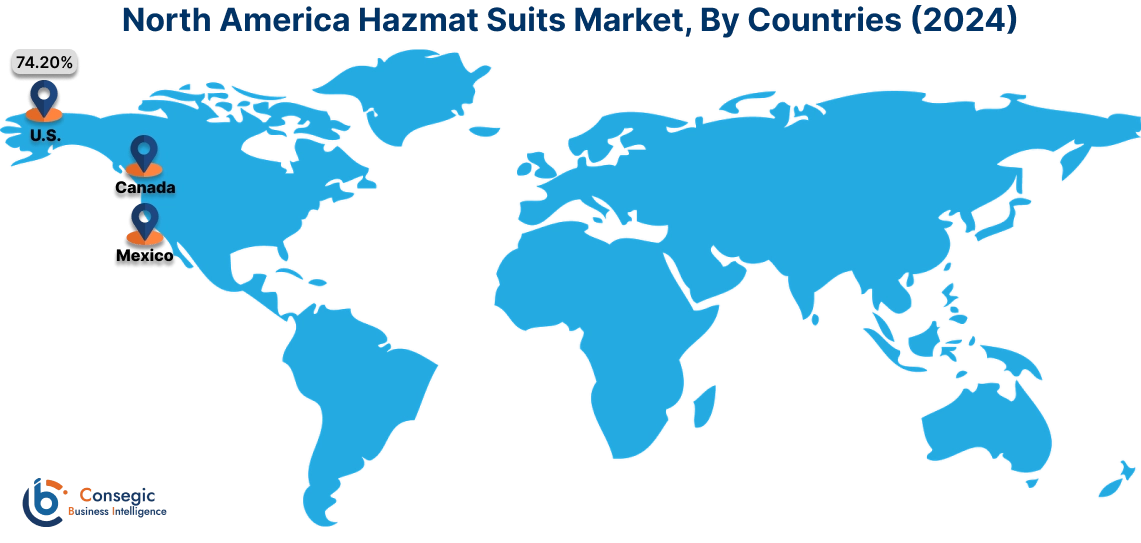
Asia-pacific is expected to witness the fastest CAGR of 7.2% over the forecast period of during 2025-2032. As per hazmat suits market analysis, Asia-Pacific region is experiencing rapid growth driven by expanding industrial base and rising awareness about worker safety. Key industries such as manufacturing, chemicals, pharmaceuticals, and oil & gas are driving the need for protective equipment, including hazmat suits for superior protection of workers. The region is also experiencing an increase in government regulations and safety standards, particularly in countries like China, India, and Japan. Additionally, the expanding healthcare sector in the region is also boosting the demand for hazmat suits for infection control for the transmission of disease. The rapid industrialization in the region combined with increasing investment in disaster management and environmental protection, is further expanding the market in the region.
Thus, Hazmat suits the market share of Asia-Pacific region is experiencing rapid growth in the market driven by rapid industrialization and rising awareness about worker safety as per analysis.
According to hazmat suits market analysis, the Europe region is experiencing steady growth in the region, driven by stringent workplace safety regulations and the increasing need for personal protective equipment across various industries. Countries like Germany, France, and United Kingdom are major contributors in the region due to their well-established industrial sectors, including chemicals, pharmaceuticals, and oil & gas where the use of hazmat suits is essential for workers safety. The healthcare sector in Europe also contributes significantly to the market demand due to high awareness of infection control and emergency preparedness. Additionally, the region’s focus on environmental protection and hazardous waste management is further boosting the market in the region.
The hazmat suits market in the Middle East and Africa region is experiencing steady growth driven by increasing industrialization and oil & gas exploration, and a rising focus on worker safety. The region’s robust oil & gas sector generates a significant need for hazmat suits to protect the workers from chemical exposure, gas leaks, and other hazardous conditions. Additionally, the healthcare sector is expanding, with a growing awareness of infection control and the need for protective equipment due to recurrent outbreaks of Ebola virus in parts of Africa. Governments and organizations are investing in safety measures, further accelerating the demand for high-quality hazmat suits in the region as per market analysis.
As per market analysis, the Latin America region is experiencing moderate growth in the market, driven by rising demand across industries such as healthcare, chemical, manufacturing and oil & gas. The region’s increasing industrialization coupled with a growing focus on worker safety, has led to the growing adoption of personal protective equipment including hazmat suits. Countries like Brazil and Mexico are major contributors in the market, driven by expanding healthcare infrastructure, oil & gas exploration activities, and the handling of hazardous chemicals. The outbreaks such as Zika virus in the region have further accelerated the demand for hazmat suits for the protection of healthcare workers.
Top Key Players and Market Share Insights:
The hazmat suits industry is highly competitive with major players providing products to the national and international markets. Key players are adopting several strategies in research and development (R&D) and product innovation to hold a strong position in the global hazmat suits market. Key players in the hazmat suits industry include-
- DuPont (United States)
- Kappler (United States)
- Kimberly-Clark Worldwide, Inc. (United States)
- Lakeland Industries Inc. (United States)
- Honeywell Inc. (United States)
- Dragerwerk AG & Co. KGaA (Germany)
- ANSELL LTD (Australia)
- 3M (United States)
- DGD HAZMAT (United States)
- Halyard Health Inc. (United States)
Recent Industry Developments :
Launches:
- In 2024, Kappler launched Zytron® 300 FR hazmat suit. It is the first and only protective suit to combine extensive chemical protection with secondaryflame-resistant
Hazmat Suits Market Report Insights :
| Report Attributes | Report Details |
| Study Timeline | 2019-2032 |
| Market Size in 2032 | USD 14,228.44 Million |
| CAGR (2025-2032) | 6.4% |
| By Safety Standards |
|
| By Application |
|
| By End-User Industry |
|
| By Region |
|
| Key Players |
|
| North America | U.S. Canada Mexico |
| Europe | U.K. Germany France Spain Italy Russia Benelux Rest of Europe |
| APAC | China South Korea Japan India Australia ASEAN Rest of Asia-Pacific |
| Middle East and Africa | GCC Turkey South Africa Rest of MEA |
| LATAM | Brazil Argentina Chile Rest of LATAM |
| Report Coverage |
|
Key Questions Answered in the Report
How big is the hazmat suits market? −
In 2024, the hazmat suits market is USD 8,657.51 million.
Which is the fastest-growing region in the hazmat suits market? +
Asia-Pacific is the fastest-growing region in the hazmat suits market.
What specific segmentation details are covered in the hazmat suits market? +
Safety standards, application, and end-use industry are covered in the hazmat suits market.
Who are the major players in the hazmat suits market? +
DuPont (United States), Kappler (United States), and Drägerwerk AG & Co. KGaA (Germany) are some of the major players in the market.
Overview
Reputation & Certifications


Our Services
- Market Intelligence & Forecasting
- Custom Research Solutions
- Market Entry Strategy
- Competitive Intelligence
- Customer Insights
- Industry Innovation Analysis
- Investment Advisory