Jump to Content
Laxatives Market - Size, Share, Industry Trends, and Forecasts (2025-2032)
Laxatives Market Size:
Laxatives Market size is estimated to reach over USD 11,567.91 Million by 2032 from a value of USD 7,149.53 Million in 2024 and is projected to grow by USD 7,465.41 Million in 2025, growing at a CAGR of 6.2% from 2025 to 2032.
Laxatives Market Scope & Overview:
Laxatives are pharmaceutical or natural compounds designed to promote bowel movements and relieve constipation. They function by softening stools, increasing stool bulk, or stimulating intestinal contractions. Laxatives are available in various forms, including tablets, powders, liquids, and suppositories, catering to diverse consumer preferences. They offer features like ease of use, quick action, and effectiveness in managing temporary or chronic constipation.
The benefits of laxatives include improved digestive health, relief from constipation, and enhanced bowel regularity. They are widely used in clinical settings, home care, and wellness industries. Applications of laxatives extend to healthcare facilities, pharmacies, and over-the-counter sales for individual use. The primary end-users include patients with gastrointestinal disorders, individuals on specific medications, and those undergoing post-surgical recovery. Laxatives play a vital role in digestive health management across medical and personal care sectors.

Laxatives Market Dynamics - (DRO) :
Key Drivers:
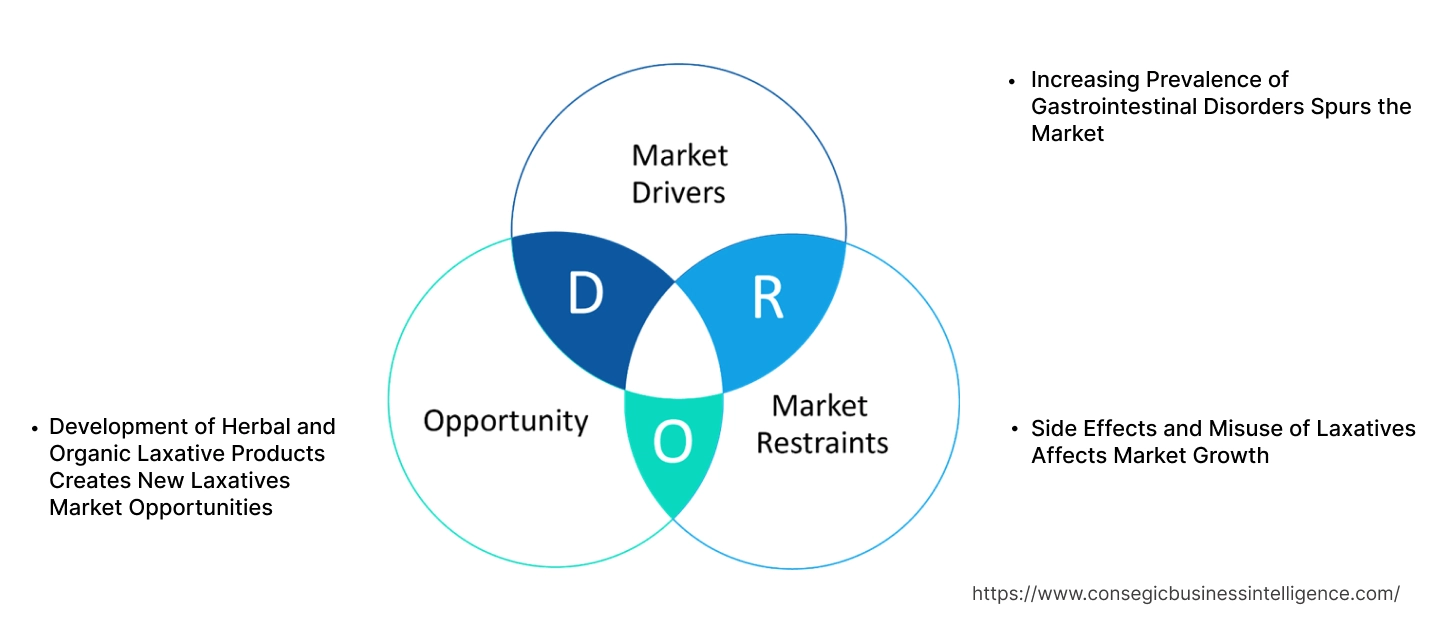
Increasing Prevalence of Gastrointestinal Disorders Spurs the Market
The rising incidence of gastrointestinal conditions, including chronic constipation and irritable bowel syndrome (IBS), significantly influences the laxatives market. These disorders often result from sedentary lifestyles, poor dietary habits, and aging populations. Laxatives, specifically osmotic and stimulant types, are frequently recommended as first-line treatments to alleviate symptoms and improve bowel regularity.
For instance, chronic constipation affects nearly 15% of the global population, driving laxatives market trend for effective laxative formulations. The convenience and efficacy of over-the-counter options contribute further to their widespread adoption.
Thus, the growing prevalence of gastrointestinal disorders strongly supports the laxatives market expansion.
Key Restraints:
Side Effects and Misuse of Laxatives Affects Market Growth
Frequent or prolonged use of laxatives can lead to side effects such as dehydration, electrolyte imbalance, and dependency. These issues are particularly common with stimulant laxatives, which alter intestinal motility. Misuse, often observed in individuals aiming for rapid weight loss or cleansing, exacerbates the problem.
For example, reports of laxative abuse among individuals with eating disorders highlight the associated health risks. These concerns have prompted regulatory authorities to tighten guidelines on laxative usage and labeling.
Consequently, the potential side effects and misuse of laxatives pose a significant challenge to laxatives market growth.
Future Opportunities :
Development of Herbal and Organic Laxative Products Creates New Laxatives Market Opportunities
The increasing consumer preference for natural and organic health solutions presents a significant laxatives market opportunity. Herbal laxatives, derived from natural ingredients such as senna, psyllium, and aloe, are gaining traction due to their perceived safety and minimal side effects.
For instance, ongoing research into plant-based compounds with laxative properties is paving the way for innovative product launches. Such products cater to health-conscious individuals seeking sustainable and gentle treatment options.
Hence, the development of herbal and organic laxatives is expected to create lucrative laxatives market growth opportunities for market players in the coming years.
Laxatives Market Segmental Analysis :
By Type:
Based on type, the market is segmented into bulk-forming laxatives, osmotic laxatives, stimulant laxatives, stool softeners, and others.
The bulk-forming laxatives sector accounted for the largest revenue in laxatives market share in 2024.
- Bulk-forming laxatives are considered the most commonly used and effective type.
- These laxatives work by absorbing water into the stool, thereby increasing the stool's volume and making it easier to pass.
- They are typically preferred for treating chronic constipation due to their gentle action, minimal side effects, and long-term effectiveness.
- These products are available over-the-counter, making them easily accessible for consumers, which further boosts their laxatives market share.
- Furthermore, their use in maintaining bowel regularity in patients with irritable bowel syndrome (IBS) and other gastrointestinal issues contributes significantly to their widespread use.
- Given their widespread use and proven efficacy, bulk-forming laxatives are likely to remain the dominant segment in the market.
- Therefore, according to laxatives market analysis, bulk-forming laxatives will continue to lead in terms of revenue due to their high laxatives market demand and broad range of applications, particularly for individuals seeking non-invasive solutions to manage chronic constipation.
The osmotic laxatives sector is anticipated to register the fastest CAGR during the forecast period.
- Osmotic laxatives work by drawing water into the intestines, softening the stool and making it easier to pass.
- They are often recommended for people with more severe constipation or for those with specific conditions such as IBS or acute constipation.
- This segment is expected to grow rapidly as the laxatives market demand for more effective and faster-acting laxatives increases, particularly in emergency care and hospital settings.
- The growing preference for osmotic laxatives, driven by their efficiency and quick action, positions them as a key growth driver in the market.
- Thus, according to laxatives market analysis, the osmotic laxatives sector is expected to experience rapid growth due to their fast-acting nature and rising adoption among consumers and healthcare providers alike.
By Route of Administration:
Based on the route of administration, the market is segmented into oral and rectal.
The oral route of administration accounted for the largest revenue share in 2024.
- Oral laxatives are the most common form, primarily because of their convenience and ease of use.
- These products come in various forms, such as tablets, capsules, liquids, and powders, catering to different preferences and needs.
- They are often recommended for individuals suffering from chronic constipation, as they offer a practical and non-invasive option for treatment.
- The availability of oral laxatives in over-the-counter formulations has also contributed to their widespread use. Moreover, their affordability and ease of access in both retail and online platforms drive their market dominance.
- Therefore, according to market analysis, the oral administration segment will continue to dominate the market as it offers convenient, cost-effective, and accessible solutions for individuals suffering from constipation.
The rectal route of administration is anticipated to register the fastest CAGR during the forecast period.
- Rectal administration of laxatives, such as suppositories and enemas, is commonly used for immediate relief of constipation or in more severe cases when oral laxatives may not be effective.
- These products are typically recommended for acute constipation, providing faster relief than oral alternatives. As the laxatives market trend for rapid relief from constipation increases, the rectal segment is expected to grow at a faster pace, especially in hospital and clinical settings where quick intervention is critical.
- Thus, according to market analysis, the rectal administration segment is likely to see the fastest growth due to its effectiveness in treating acute constipation and its rising use in emergency care settings.
By Indication:
Based on indication, the market is segmented into chronic constipation, acute constipation, irritable bowel syndrome (IBS), and others.
The chronic constipation segment accounted for the largest revenue share in 2024.
- Chronic constipation is a prevalent condition affecting a significant portion of the global population, especially among older adults.
- Laxatives, particularly bulk-forming and osmotic types, are commonly used to manage this condition.
- As people with chronic constipation often require ongoing treatment, this segment remains the largest contributor to the market.
- With increasing awareness about digestive health and the growing elderly population, the trend for laxatives to treat chronic constipation is expected to continue rising.
- Therefore, according to market analysis, chronic constipation will remain the leading indication, supported by its high prevalence and the long-term need for effective treatment options.
The irritable bowel syndrome (IBS) segment is anticipated to register the fastest CAGR during the forecast period.
- IBS is a functional gastrointestinal disorder that affects a significant portion of the population, especially women.
- Laxatives, particularly osmotic types, are frequently used to alleviate the symptoms of constipation-predominant IBS.
- As awareness about IBS grows, more individuals are seeking treatment options for managing this condition, which drives the trend for laxatives in this segment.
- The increasing number of IBS diagnoses is expected to result in the fastest growth for this segment.
- Thus, according to market analysis, IBS will experience the fastest growth in the laxatives market as more individuals seek effective treatments for this chronic and often debilitating condition.
By Dosage Form:
Based on dosage form, the market is segmented into tablets & capsules, powders, liquids, and suppositories.
The tablets & capsules segment accounted for the largest revenue share in 2024.
- Tablets and capsules are the most commonly used dosage forms for laxatives due to their convenience, portability, and ease of consumption.
- They are preferred by individuals who seek an easy and effective method of managing constipation, particularly for chronic cases.
- Tablets and capsules also have a long shelf life, contributing to their popularity. The widespread availability of these products in pharmacies and retail outlets supports their dominance in the market.
- Therefore, according to market analysis, tablets and capsules will continue to dominate the laxatives market due to their convenience, consumer preference, and long shelf life.
The powders segment is anticipated to register the fastest CAGR during the forecast period.
- Powdered laxatives, especially those used for osmotic action, are growing in popularity due to their ability to provide customizable dosages and rapid effectiveness.
- This form is particularly favored by individuals who may have difficulty swallowing pills or those seeking a more flexible treatment option.
- The rising awareness of digestive health and the growing preference for natural and effective products are expected to drive the trend for powdered laxatives at a fast pace.
- Thus, according to market analysis, the powders segment will experience rapid growth as it provides an effective, customizable, and flexible solution for consumers.
By End User:
Based on end-user, the market is segmented into hospitals & clinics, home care settings, and nursing homes.
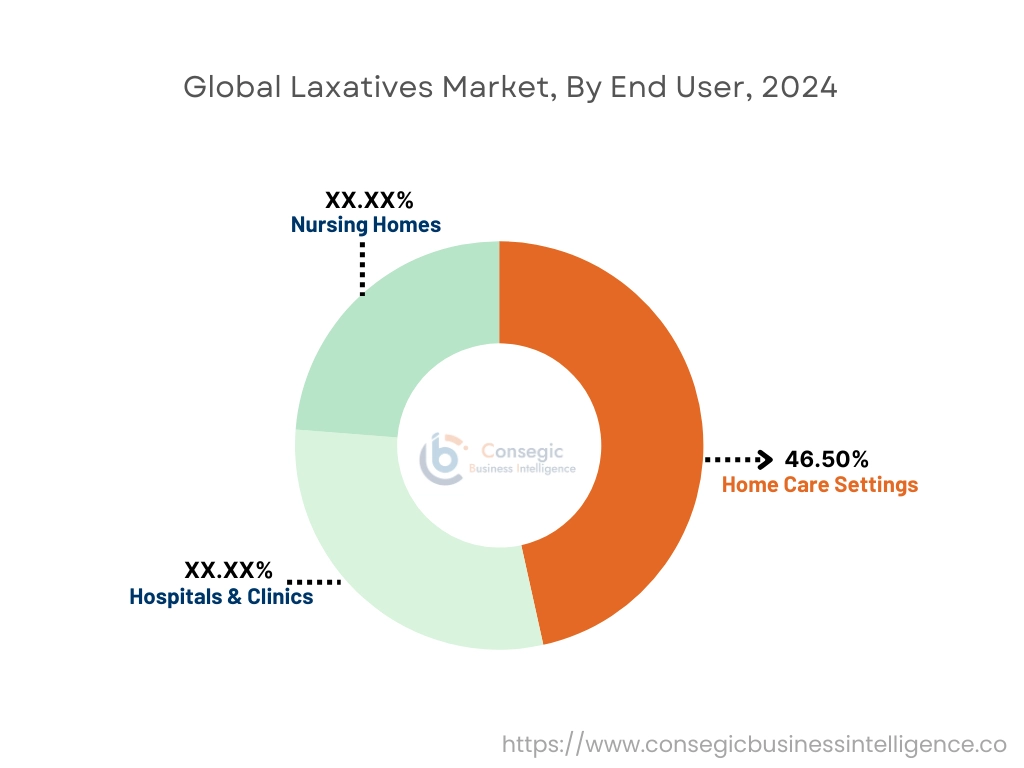
The home care settings segment accounted for the largest revenue share by 46.50% in 2024.
- Home care settings represent the largest end-user segment, as many individuals prefer to manage their constipation issues at home with over-the-counter laxatives.
- Home-based care offers convenience and affordability, with people opting for oral laxatives and other products that are easy to administer without medical supervision.
- As the aging population grows, the trend for home-based health solutions is expected to continue rising, thereby driving the growth of this segment.
- Therefore, according to market analysis, home care settings will continue to dominate the market due to the convenience, affordability, and accessibility of laxatives for home-based treatment.
The hospitals & clinics segment is anticipated to register the fastest CAGR during the forecast period.
- Hospitals and clinics represent a growing segment due to the increasing number of patients requiring acute care for constipation, particularly those with comorbid conditions or severe constipation.
- Laxatives administered in clinical settings are often more potent, with rectal routes of administration being common in hospitals.
- As the healthcare sector continues to expand, the trend for laxative treatments in hospitals and clinics is expected to grow at a rapid pace.
- Thus, according to market analysis, hospitals & clinics will register the fastest growth due to the rising demand for acute care treatments and clinical interventions in managing severe constipation.
Regional Analysis:
The regional segment includes North America, Europe, Asia Pacific, Middle East and Africa, and Latin America.

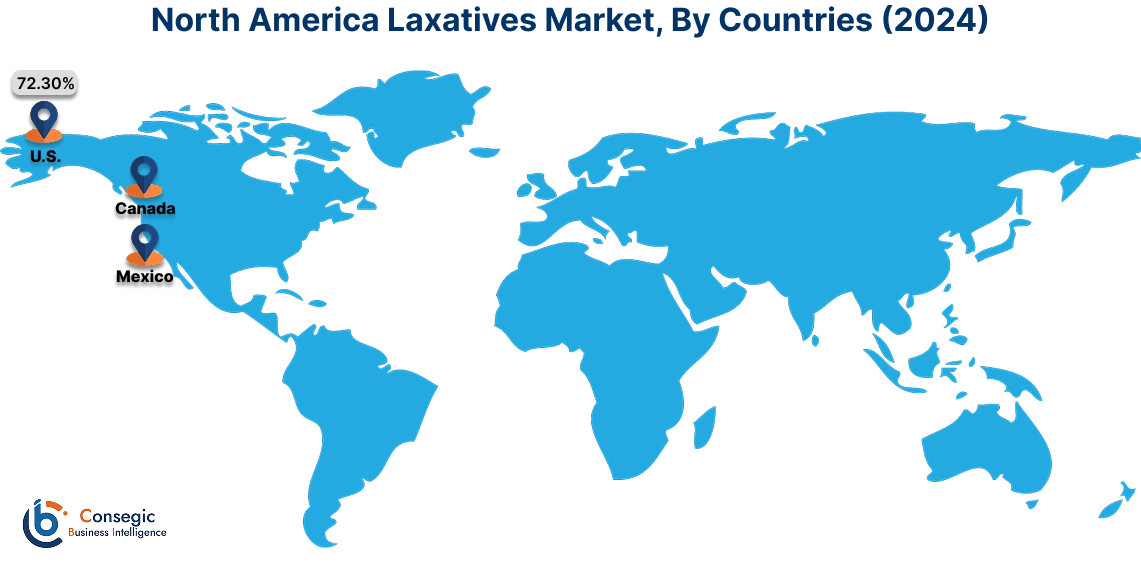
In 2024, North America was valued at USD 2,371.56 Million and is expected to reach USD 3,749.16 Million in 2032. In North America, the U.S. accounted for the highest share of 72.30% during the base year of 2024. North America is the leading market for laxatives, with the United States contributing the largest share. The high prevalence of constipation-related issues among the aging population fuels the trend for laxatives. The market benefits from robust healthcare infrastructure and increased consumer awareness about digestive health. The wide availability of over-the-counter laxative products in pharmacies and online platforms supports market growth. Additionally, the presence of key market players and ongoing innovations in laxative formulations further enhance the region's market performance.
In Asia Pacific, the market is experiencing the fastest growth with a CAGR of 6.6% over the forecast period. Asia-Pacific exhibits significant market potential for laxatives, driven by rising healthcare awareness and changing dietary habits. Countries like Japan, China, and India show increased demand for both over-the-counter and prescription-based laxative products. The aging population in Japan and China, combined with growing urbanization and sedentary lifestyles, contributes to the rise in constipation-related issues. However, the market faces challenges in certain parts of the region due to cultural preferences for natural remedies. Despite these challenges, the market is expected to see gradual expansion, with an increasing focus on both traditional and modern laxative solutions.
Europe holds a prominent position in the laxatives market, with countries such as Germany, the UK, and France seeing a high demand for these products. The region benefits from a well-established healthcare system and an increasing focus on preventive healthcare. A growing awareness of digestive health, particularly among older adults, supports market growth. The availability of a wide range of prescription and over-the-counter products across pharmacies, coupled with rising consumer preference for natural and organic laxatives, fuels demand. However, the market faces challenges with regulatory constraints and the preference for lifestyle changes over medication in certain European regions.
The Middle East and Africa (MEA) market for laxatives remains underdeveloped, with limited awareness and healthcare access in many areas. However, more affluent countries like the UAE and Saudi Arabia show growing demand for laxative products due to increasing healthcare awareness and a shift toward modern healthcare solutions. Lifestyle changes, such as poor diet and lack of exercise, contribute to the rising incidence of constipation-related issues in these regions. The market faces barriers due to a reliance on traditional medicine and cultural preferences for natural remedies. Despite these challenges, the demand for laxatives is expected to rise as healthcare systems continue to improve.
Latin America is witnessing steady demand for laxatives, particularly in countries like Brazil, Mexico, and Argentina. Increased awareness of gastrointestinal health, coupled with a rising incidence of constipation due to changing lifestyles and diets, contributes to market growth. The availability of affordable over-the-counter laxative products in pharmacies and supermarkets supports laxatives market expansion. However, the market faces challenges related to economic factors, with cost-conscious consumers in certain regions opting for cheaper alternatives or natural remedies. Despite these barriers, the increasing focus on improving digestive health and expanding access to healthcare services is expected to benefit the laxatives market in Latin America.
Top Key Players and Market Share Insights:
The Global Laxatives Market is highly competitive with major players providing products and services to the national and international markets. Key players are adopting several strategies in research and development (R&D), product innovation, and end-user launches to hold a strong position in the Global Laxatives Market. Key players in the Laxatives industry include-
- Bayer AG (Germany)
- Johnson & Johnson (United States)
- Himalaya Drug Company (India)
- Teva Pharmaceutical Industries Ltd. (Israel)
- AstraZeneca PLC (United Kingdom)
- Procter & Gamble Co. (United States)
- Sanofi S.A. (France)
- Abbott Laboratories (United States)
- GlaxoSmithKline PLC (United Kingdom)
- Pfizer Inc. (United States)
Recent Industry Developments :
Product Launches:
- In January 2025, an innovative vibrating capsule received FDA approval for the treatment of chronic constipation. This capsule contains a microchip that activates after ingestion, vibrating within the gastrointestinal tract to stimulate bowel movements non-pharmacologically. Clinical trials demonstrated its safety, tolerability, and effectiveness in improving bowel and abdominal symptoms.
Mergers and Acquisitions:
- In January 2023, Nuance Medical expanded its portfolio by acquiring Beutlich Pharmaceuticals, a move aimed at strengthening its position in the laxative market.
Laxatives Market Report Insights :
| Report Attributes | Report Details |
| Study Timeline | 2019-2032 |
| Market Size in 2032 | USD 11,567.91 million |
| CAGR (2025-2032) | 6.2% |
| By Type |
|
| By Route of Administration |
|
| By Indication |
|
| By Dosage Form |
|
| By End-User |
|
| By Region |
|
| Key Players |
|
| North America | U.S. Canada Mexico |
| Europe | U.K. Germany France Spain Italy Russia Benelux Rest of Europe |
| APAC | China South Korea Japan India Australia ASEAN Rest of Asia-Pacific |
| Middle East and Africa | GCC Turkey South Africa Rest of MEA |
| LATAM | Brazil Argentina Chile Rest of LATAM |
| Report Coverage |
|
Key Questions Answered in the Report
How big is the Laxatives Market? −
In 2024, the Laxatives Market was USD 7,149.53 million.
What will be the potential market valuation for the Laxatives Market by 2032? +
In 2032, the market size of Laxatives Market is expected to reach USD 11,567.91 million.
What are the segments covered in the Laxatives Market report? +
The type, route of administration, indication, dosage form, and end-user are the segments covered in this report.
Who are the major players in the Laxatives Market? +
Bayer AG (Germany), Johnson & Johnson (United States), Procter & Gamble Co. (United States), Sanofi S.A. (France), Abbott Laboratories (United States), GlaxoSmithKline PLC (United Kingdom), Pfizer Inc. (United States), AstraZeneca PLC (United Kingdom), Himalaya Drug Company (India), Teva Pharmaceutical Industries Ltd. (Israel) are the major players in the Laxatives market.
Overview
Reputation & Certifications


Our Services
- Market Intelligence & Forecasting
- Custom Research Solutions
- Market Entry Strategy
- Competitive Intelligence
- Customer Insights
- Industry Innovation Analysis
- Investment Advisory