Jump to Content
Laboratory Vacuum Pumps Market - Size, Share, Industry Trends, and Forecasts (2025 - 2032)
Laboratory Vacuum Pumps Market Size:
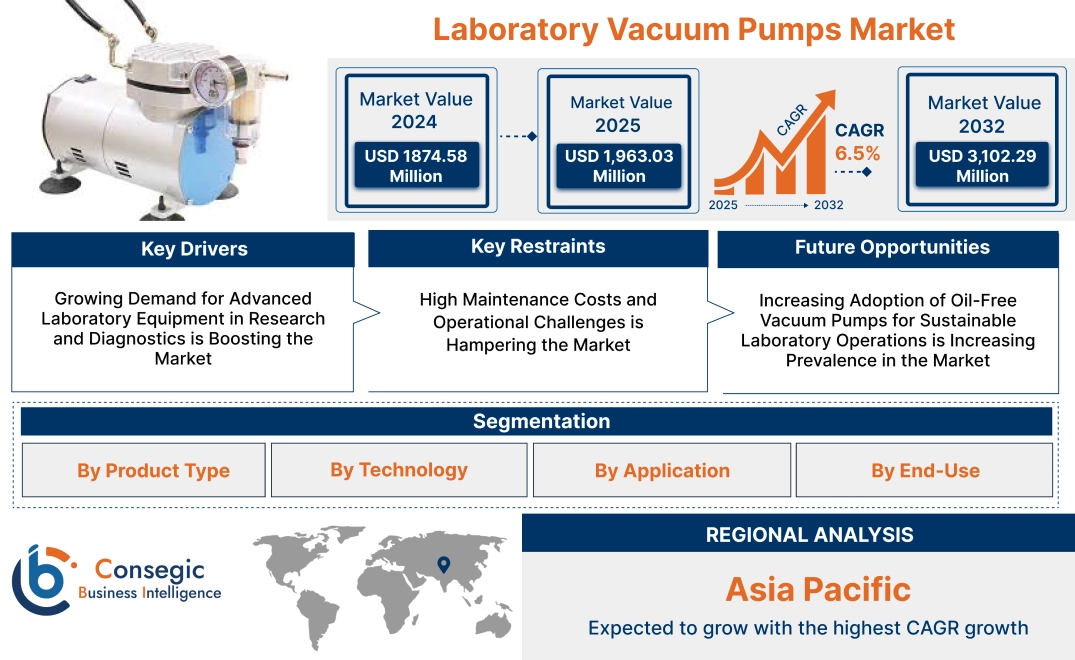
Laboratory Vacuum Pumps Market size is estimated to reach over USD 3,102.29 Million by 2032 from a value of USD 1874.58 Million in 2024 and is projected to grow by USD 1,963.03 Million in 2025, growing at a CAGR of 6.5% from 2025 to 2032.
Laboratory Vacuum Pumps Market Scope & Overview:
The laboratory vacuum pump devices are designed to create vacuum conditions for a variety of laboratory applications, including filtration, degassing, drying, and sample preparation. These pumps ensure precision and efficiency in scientific research, diagnostics, and industrial processes. Laboratory vacuum pumps are available in different types, such as rotary vane pumps, diaphragm pumps, and scroll pumps, tailored to specific applications.
Key characteristics of laboratory vacuum pumps include high performance, low noise levels, chemical resistance, and energy efficiency, ensuring reliability and longevity in demanding environments. The benefits include improved experiment accuracy, faster processing times, and reduced operational costs.
Applications span pharmaceuticals, chemical processing, biotechnology, and environmental testing, supporting activities such as mass spectrometry, gas chromatography, and vacuum distillation. End-users include academic research laboratories, pharmaceutical companies, and industrial facilities, driven by increasing investments in R&D, advancements in laboratory technologies, and growing demand for efficient vacuum solutions in modern laboratories.
Laboratory Vacuum Pumps Market Dynamics - (DRO) :
Key Drivers:
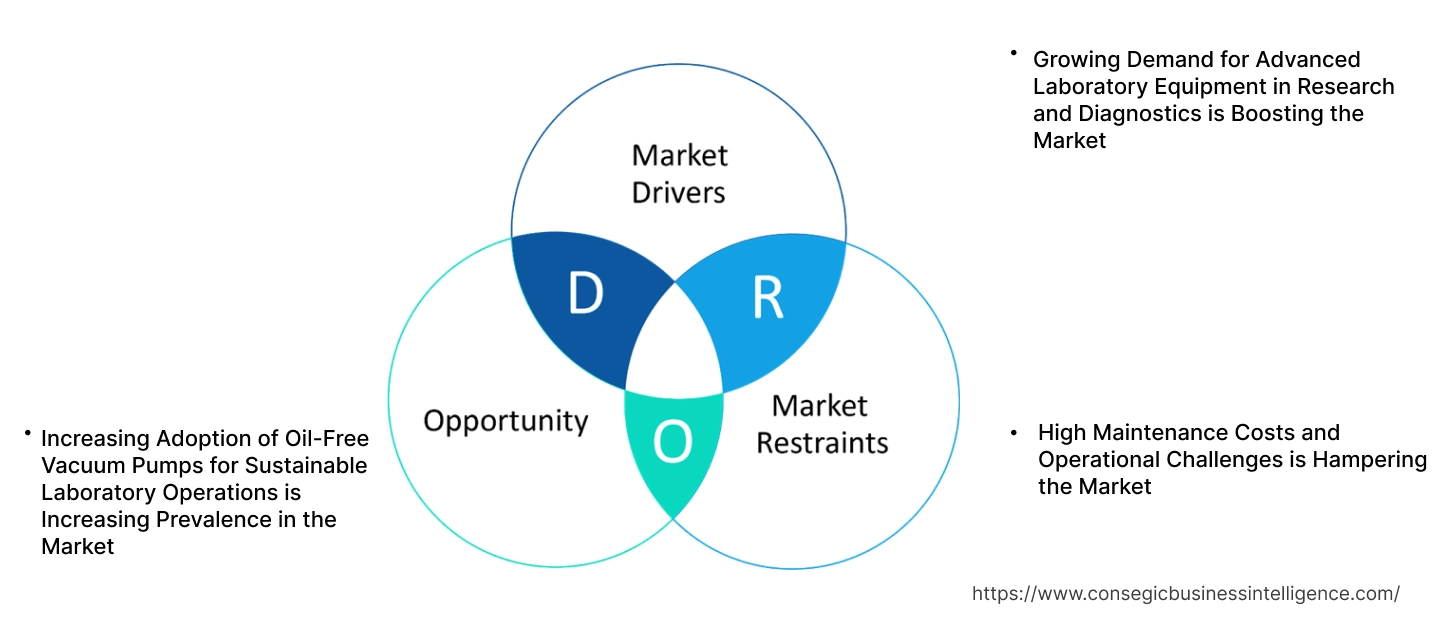
Growing Demand for Advanced Laboratory Equipment in Research and Diagnostics is Boosting the Market
The laboratory vacuum pumps market is being driven by the increasing trends for advanced laboratory equipment, fueled by the growth of research and diagnostic activities across various industries. Vacuum pumps are integral to applications such as vacuum filtration, drying, distillation, and evaporation, which are critical in pharmaceutical, chemical, and academic research laboratories. The rising focus on drug development, particularly in biologics and personalized medicine, has further propelled the need for high-performance vacuum pumps that ensure precise and efficient operations. Additionally, the expansion of diagnostic laboratories, driven by the increasing prevalence of chronic and infectious diseases, has bolstered the trends for vacuum pumps to support applications such as sample preparation and diagnostic testing.
Key Restraints:
High Maintenance Costs and Operational Challenges is Hampering the Market
Despite their widespread use, laboratory vacuum pumps face challenges related to high maintenance costs and operational issues, which act as restraints on market opportunities. Pumps require regular maintenance to ensure optimal performance, particularly in high-throughput laboratories where they are used extensively. Maintenance tasks, such as oil changes and component replacements, add to operational costs and may result in downtime, impacting laboratory productivity. Furthermore, the noise and heat generated by certain vacuum pump models can create unfavorable working conditions, leading laboratories to seek alternatives or limit usage. The complexity of integrating advanced vacuum pumps with existing laboratory systems also poses challenges, especially for smaller facilities with limited budgets.
Future Opportunities :
Increasing Adoption of Oil-Free Vacuum Pumps for Sustainable Laboratory Operations is Increasing Prevalence in the Market
The growing emphasis on sustainability and environmental responsibility presents a significant opportunity for the laboratory vacuum pumps market, particularly through the adoption of oil-free vacuum pumps. Unlike traditional oil-sealed pumps, oil-free pumps eliminate the need for regular oil changes, reducing maintenance costs and minimizing environmental impact. These pumps are ideal for applications requiring clean and contamination-free environments, such as in biopharmaceutical research, semiconductor manufacturing, and analytical chemistry. Additionally, advancements in oil-free pump technologies, such as the development of dry scroll and diaphragm pumps, are enhancing performance and energy efficiency, making them a preferred choice for modern laboratories. As laboratories increasingly prioritize eco-friendly operations and cost-effective solutions, the surge for oil-free vacuum pumps is expected to grow significantly.
These dynamics highlight the critical role of laboratory vacuum pumps in supporting advanced research and diagnostic activities, while addressing challenges related to maintenance and operational efficiency. The transition toward sustainable, oil-free solutions underscores the market's evolving priorities and presents significant opportunities for innovation and growth.
Laboratory Vacuum Pumps Market Segmental Analysis :
By Product Type:
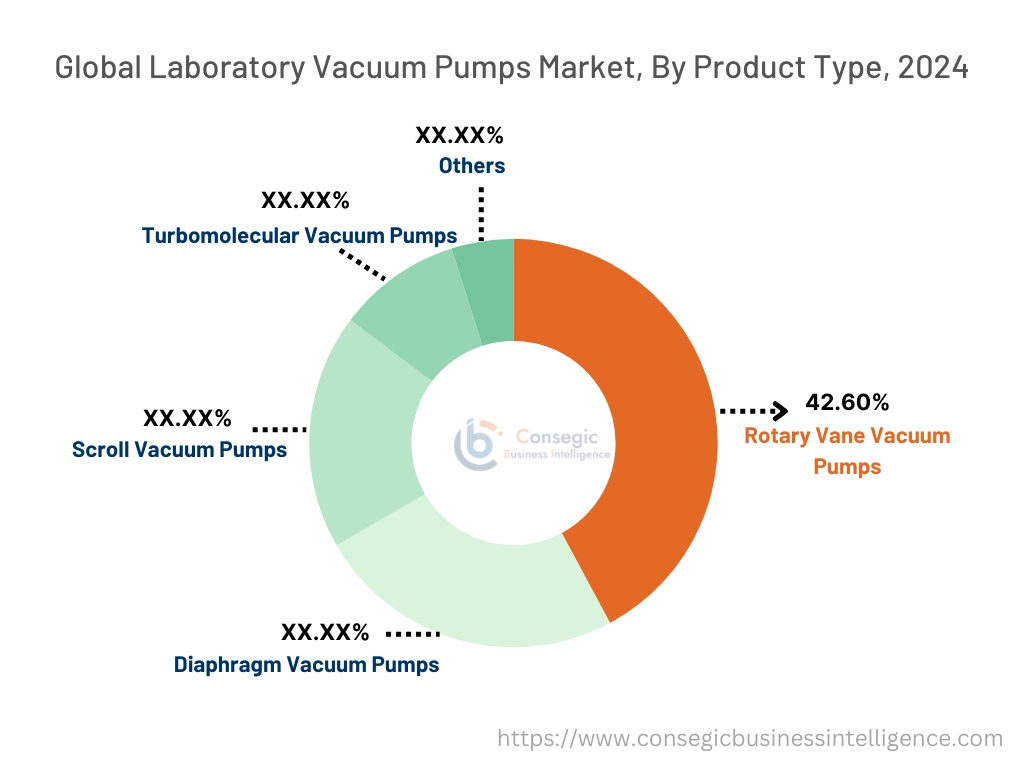
Based on product type, the market is segmented into rotary vane vacuum pumps, diaphragm vacuum pumps, scroll vacuum pumps, turbomolecular vacuum pumps, and others.
The rotary vane vacuum pumps segment accounted for the largest revenue in laboratory vacuum pumps market share of 42.60% in 2024.
- Rotary vane vacuum pumps are widely adopted due to their versatility and reliability in laboratory applications, including filtration and drying processes.
- Their ability to handle both dry and wet applications makes them a preferred choice in pharmaceutical and chemical laboratories.
- Increasing trends in rotary vane technology, such as noise reduction and improved energy efficiency, are driving laboratory vacuum pumps market demand.
- The rising use of rotary vane vacuum pumps in high-volume laboratory workflows contributes to their dominance in the market.
The scroll vacuum pumps segment is anticipated to register the fastest CAGR during the forecast period.
- Scroll vacuum pumps offer oil-free operation, making them ideal for sensitive applications in biotechnology and environmental testing laboratories.
- Growing development for eco-friendly and low-maintenance vacuum pump solutions is driving adoption of scroll pumps.
- Advancements in scroll pump technology, such as compact designs and enhanced durability, are boosting their market trends.
- Increasing use in applications requiring high vacuum performance, such as mass spectrometry, is expected to propel growth in this segment.
By Technology:
Based on technology, the market is segmented into dry vacuum pumps and wet vacuum pumps.
The dry vacuum pumps segment accounted for the largest revenue share in 2024.
- Dry vacuum pumps are preferred for their oil-free operation, reducing the risk of contamination in laboratory applications.
- Their adoption is growing in industries with stringent purity requirements, such as pharmaceutical and food laboratories.
- Technological advancements enabling higher efficiency and lower maintenance have bolstered their dominance.
- Increasing focus on sustainability and reduction of operational costs is driving laboratory vacuum pumps market demand for dry vacuum pumps.
The wet vacuum pumps segment is anticipated to register the fastest CAGR during the forecast period.
- Wet vacuum pumps are widely used in chemical laboratories for processes requiring liquid handling, such as distillation and filtration.
- Rising trends analysis for high-capacity vacuum systems in industrial laboratories is driving the adoption of wet pumps.
- Advancements in sealing and material technology have improved the reliability and lifespan of wet vacuum pumps.
- Growing use in applications requiring the handling of corrosive and volatile substances is expected to propel laboratory vacuum pumps market trends in this segment.
By Application:
Based on application, the market is segmented into filtration, evaporation, drying, degassing, distillation, and others.
The filtration segment accounted for the largest revenue in laboratory vacuum pumps market share in 2024.
- Filtration processes are critical in various laboratory workflows, particularly in pharmaceutical, chemical, and environmental testing.
- Vacuum pumps enhance filtration efficiency by accelerating liquid separation and reducing process times.
- Increasing development for precise and rapid filtration techniques in research and quality control applications is driving segment growth.
- Rising adoption of advanced filtration technologies in academic and industrial laboratories supports the dominance of this segment.
The drying segment is anticipated to register the fastest CAGR during the forecast period.
- Vacuum drying is essential in pharmaceutical and food laboratories for preserving sensitive substances without thermal degradation.
- The rising adoption of advanced vacuum drying systems in biotechnology research is driving trends in this segment.
- Growing trends for vacuum drying in environmental testing for sample preparation and moisture removal is boosting market expansion.
- Increasing investments in laboratory automation and drying equipment innovations are expected to propel this segment's growth.
By End-User:
Based on end-use, the market is segmented into pharmaceutical and biotechnology laboratories, chemical laboratories, food and beverage laboratories, environmental testing laboratories, academic and research institutes, industrial laboratories, and others.
The pharmaceutical and biotechnology laboratories segment accounted for the largest revenue share in 2024.
- These laboratories extensively use vacuum pumps for critical applications, including drug formulation, quality testing, and sample preparation.
- The growing demand for innovative biopharmaceuticals and vaccines has increased the need for efficient laboratory vacuum systems.
- Rising investment in pharmaceutical research and development globally is driving laboratory vacuum pumps market opportunities for high-performance vacuum pumps.
- Increasing focus on compliance with stringent regulatory standards in drug manufacturing supports the dominance of this segment.
The environmental testing laboratories segment is anticipated to register the fastest CAGR during the forecast period.
- Environmental testing laboratories rely on vacuum pumps for analyzing water, air, and soil samples for contaminants and pollutants.
- Rising global emphasis on environmental sustainability and stricter pollution monitoring regulations are driving development.
- Increasing adoption of vacuum pumps in advanced analytical techniques, such as gas chromatography, supports laboratory vacuum pumps market trends in this segment.
- Expansion of environmental testing facilities in emerging economies is expected to propel this segment's trends.
Regional Analysis:
The regions covered are North America, Europe, Asia Pacific, the Middle East and Africa, and Latin America.
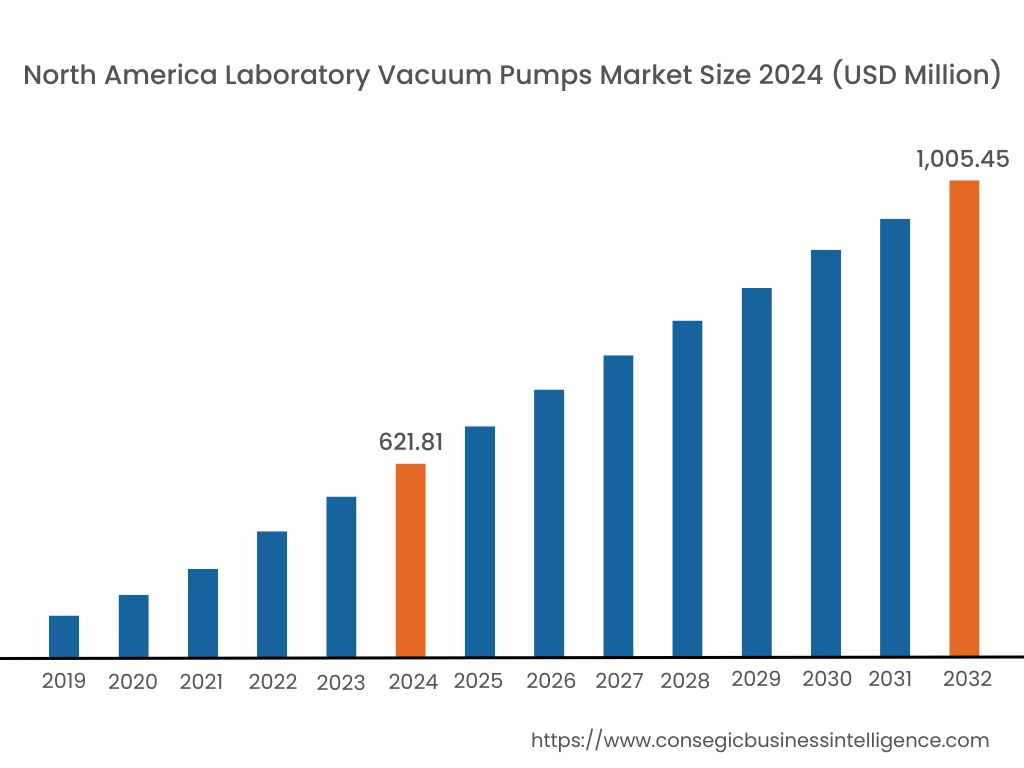
In 2024, North America was valued at USD 621.81 Million and is expected to reach USD 1,005.45 Million in 2032. In North America, the U.S. accounted for the highest share of 71.60% during the base year of 2024. North America holds a significant share in the global laboratory vacuum pumps market, driven by advanced research infrastructure, strong presence of pharmaceutical and biotechnology companies, and increasing investment in R&D. The U.S. leads the region due to high demand for vacuum pumps in laboratories conducting drug discovery, chemical analysis, and material research. As per the laboratory vacuum pumps market analysis, Canada contributes with growing investments in academic and industrial research laboratories, particularly in life sciences and environmental monitoring. However, the high cost of advanced vacuum pump systems may pose challenges for smaller laboratories.

In Asia Pacific, the market is experiencing the fastest growth with a CAGR of 6.9% over the forecast period. The laboratory vacuum pumps market analysis is fueled by rapid industrialization, increasing investments in research facilities, and the growing pharmaceutical and biotechnology sectors in China, India, and Japan. China dominates the market with rising opportunities for vacuum pumps in drug manufacturing, chemical synthesis, and academic research. India’s expanding pharmaceutical and life sciences industries drive the adoption of vacuum pumps for quality control and analytical purposes. Japan focuses on precision vacuum pump systems, leveraging its strong engineering capabilities for advanced research applications. However, affordability challenges and limited access to high-quality equipment in smaller facilities may hinder growth in certain areas.
Europe is a prominent market for laboratory vacuum pumps, supported by extensive research in pharmaceuticals, chemicals, and environmental sciences. Countries like Germany, France, and the UK are key contributors. Germany leads the market with its strong focus on precision manufacturing and advanced technologies in laboratory equipment. The regional analysis of France emphasizes the use of vacuum pumps in academic research and chemical testing laboratories, while the UK invests in innovations for analytical and diagnostic applications. However, stringent EU regulations on energy efficiency and emissions may challenge manufacturers to comply with standards while keeping costs competitive.
The Middle East & Africa region is witnessing steady development in the laboratory vacuum pumps market, driven by increasing investments in healthcare and environmental research. Countries like Saudi Arabia and the UAE are adopting advanced laboratory equipment, including vacuum pumps, to support growth in academic research and diagnostics. In Africa regional analysis, South Africa is an emerging market, focusing on improving access to laboratory technologies for environmental and industrial research. However, limited local manufacturing and reliance on imports for advanced systems may restrict laboratory vacuum pumps market expansion in the region.
Latin America is an emerging market for laboratory vacuum pumps, with Brazil and Mexico leading the region. Brazil’s growing pharmaceutical and chemical industries drive demand for vacuum pumps in analytical and quality control laboratories. Mexico focuses on expanding its industrial research infrastructure, particularly in environmental monitoring and materials testing. The region also sees increasing collaborations with international manufacturers to improve access to advanced laboratory technologies. However, inconsistent regulatory frameworks and economic instability may pose challenges to laboratory vacuum pumps market expansion in smaller economies.
Top Key Players and Market Share Insights:
The laboratory vacuum pumps market is highly competitive with major players providing products to the national and international markets. Key players are adopting several strategies in research and development (R&D), product innovation, and end-user launches to hold a strong position in the laboratory vacuum pumps market. Key players in the laboratory vacuum pumps industry include -
- Agilent Technologies, Inc. (United States)
- Edwards Vacuum (United Kingdom)
- Welch Vacuum (United States)
- Gardner Denver Holdings, Inc. (United States)
- Busch Vacuum Solutions (Germany)
- Pfeiffer Vacuum GmbH (Germany)
- ULVAC Technologies, Inc. (Japan)
- Atlas Copco AB (Sweden)
- KNF Neuberger GmbH (Germany)
- Leybold GmbH (Germany)
Recent Industry Developments :
Product Launches:
- In 2024, Saga Engineering Co., a leading manufacturer based in Ahmedabad, India, expanded its product line in the laboratory vacuum pumps market. The company introduced advanced Laboratory Vacuum Cum Pressure Pumps, designed to deliver both vacuum and pressure functionalities for diverse laboratory applications. Additionally, they unveiled Laboratory High Vacuum Pumps, featuring oil-immersed rotary vane technology, catering to high vacuum requirements in critical scientific processes. Saga's Vacuum Pumps for Laboratory Applications were also enhanced to ensure reliable performance across various laboratory settings.
Laboratory Vacuum Pumps Market Report Insights :
| Report Attributes | Report Details |
| Study Timeline | 2019-2032 |
| Market Size in 2032 | USD 3,102.29 Million |
| CAGR (2025-2032) | 6.5% |
| By Product Type |
|
| By Technology |
|
| By Application |
|
| By End-Use |
|
| By Region |
|
| Key Players |
|
| North America | U.S. Canada Mexico |
| Europe | U.K. Germany France Spain Italy Russia Benelux Rest of Europe |
| APAC | China South Korea Japan India Australia ASEAN Rest of Asia-Pacific |
| Middle East and Africa | GCC Turkey South Africa Rest of MEA |
| LATAM | Brazil Argentina Chile Rest of LATAM |
| Report Coverage |
|
Key Questions Answered in the Report
What is the projected size of the Laboratory Vacuum Pumps Market by 2032? −
Laboratory Vacuum Pumps Market size is estimated to reach over USD 3,102.29 Million by 2032 from a value of USD 1874.58 Million in 2024 and is projected to grow by USD 1,963.03 Million in 2025, growing at a CAGR of 6.5% from 2025 to 2032.2032.
What drives the growth of the Laboratory Vacuum Pumps Market? +
Key drivers include the increasing demand for advanced laboratory equipment in research and diagnostics, the expansion of pharmaceutical and biotechnology sectors, and the growing focus on environmental testing and sustainable laboratory operations.
What challenges does the market face? +
Challenges include high maintenance costs, operational issues such as noise and heat generation, and the complexity of integrating advanced vacuum pumps with existing laboratory systems.
Which product type dominates the market? +
The rotary vane vacuum pumps segment holds the largest market share due to their versatility and reliability across various laboratory applications, including filtration and drying.
Which product type is expected to grow the fastest? +
The scroll vacuum pumps segment is anticipated to register the fastest CAGR, driven by their oil-free operation, eco-friendly design, and suitability for sensitive applications like biotechnology and environmental testing.
Overview
Reputation & Certifications


Our Services
- Market Intelligence & Forecasting
- Custom Research Solutions
- Market Entry Strategy
- Competitive Intelligence
- Customer Insights
- Industry Innovation Analysis
- Investment Advisory