Jump to Content
Neurorehabilitation Gaming Systems Market - Size, Share, Industry Trends, and Forecasts (2025 - 2032)
Neurorehabilitation Gaming Systems Market Size:
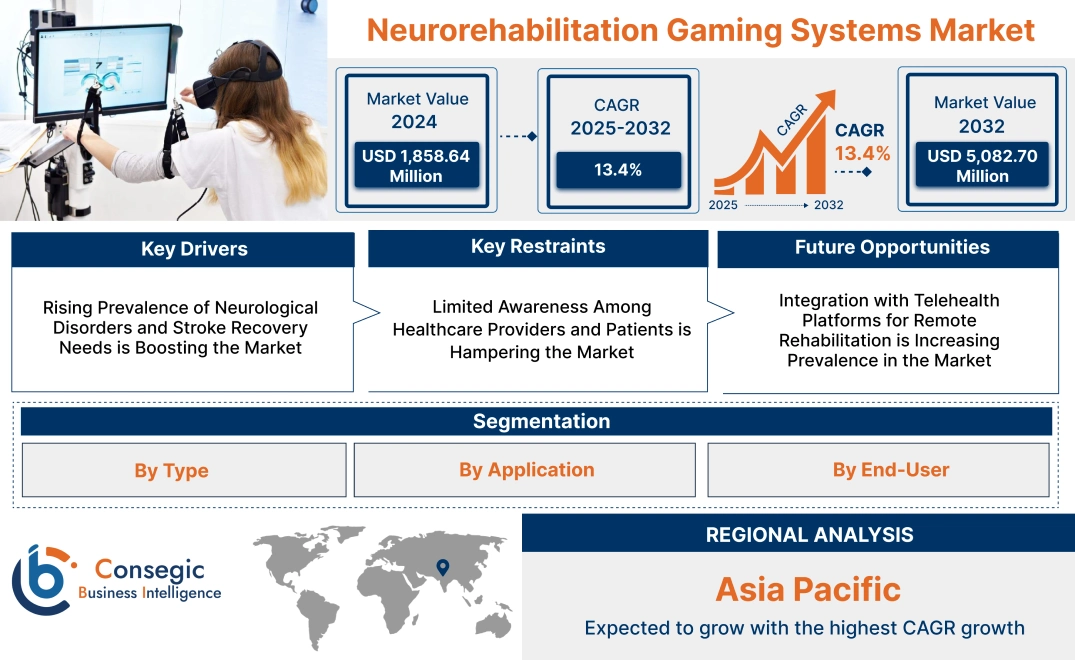
Neurorehabilitation Gaming Systems Market size is estimated to reach over USD 5,082.70 Million by 2032 from a value of USD 1,858.64 Million in 2024 and is projected to grow by USD 2,074.58 Million in 2025, growing at a CAGR of 13.4% from 2025 to 2032.
Neurorehabilitation Gaming Systems Market Scope & Overview:
The neurorehabilitation gaming systems are advanced therapeutic technologies that use interactive gaming systems to support recovery and rehabilitation in patients with neurological disorders or injuries. These systems integrate motion sensors, virtual reality (VR), and artificial intelligence (AI) to create engaging, patient-specific therapy exercises aimed at improving motor skills, cognitive function, and overall recovery outcomes. Key characteristics of neurorehabilitation gaming systems include real-time feedback, adaptability to individual patient needs, and a motivating, interactive environment for therapy. The benefits include enhanced patient engagement, improved rehabilitation efficiency, and remote therapy options for greater accessibility. Applications span stroke rehabilitation, traumatic brain injury recovery, and management of conditions like Parkinson’s disease and multiple sclerosis. End-users include rehabilitation centers, hospitals, and home-based care providers, driven by the increasing prevalence of neurological disorders, advancements in VR and AI technologies, and growing demand for personalized and effective rehabilitation solutions.
Neurorehabilitation Gaming Systems Market Dynamics - (DRO) :
Key Drivers:
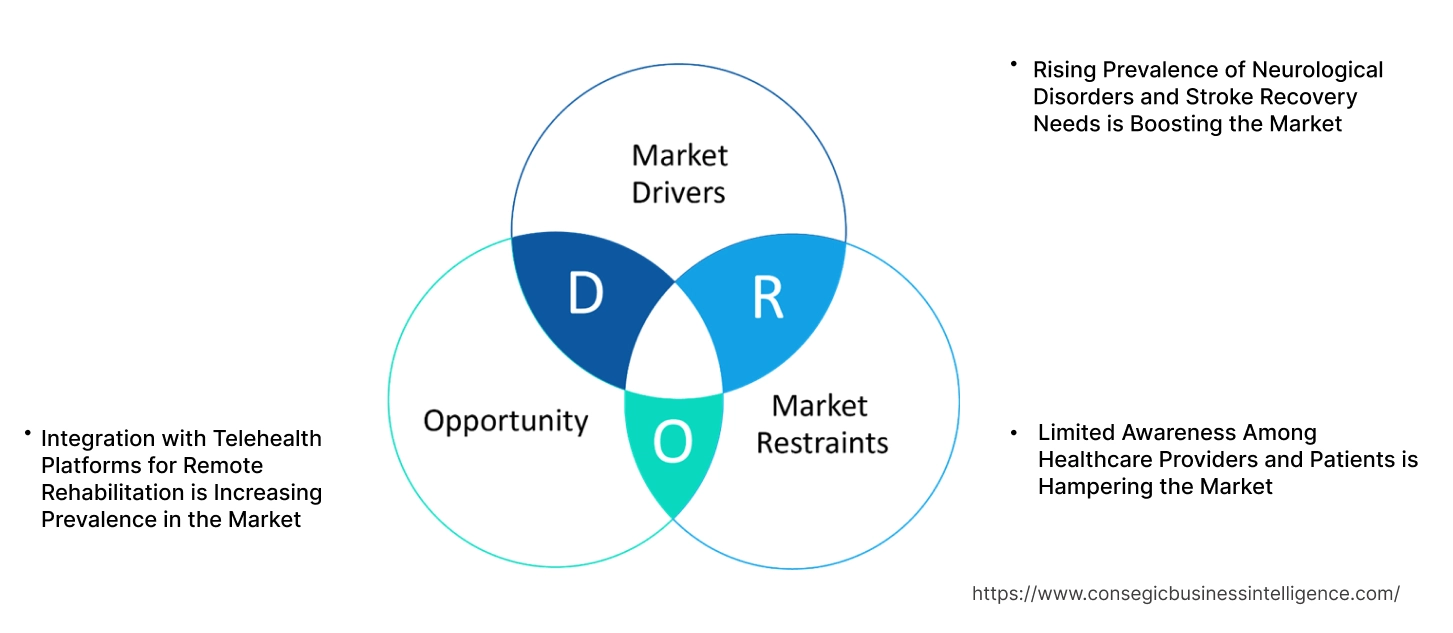
Rising Prevalence of Neurological Disorders and Stroke Recovery Needs is Boosting the Market
The increasing incidence of neurological disorders such as stroke, Parkinson's disease, and traumatic brain injuries is driving the need for effective rehabilitation solutions. Neurorehabilitation gaming systems provide an innovative and engaging approach to improving motor skills, cognitive functions, and coordination, addressing the growing trends for patient-centered therapies. These systems leverage interactive gaming experiences to enhance therapy adherence and improve outcomes for individuals recovering from neurological impairments.
Trends in personalized medicine and rehabilitation underscore the importance of tailored therapeutic interventions, making neurorehabilitation gaming systems an essential tool in modern healthcare. The analysis highlights their potential to fill critical gaps in traditional rehabilitation approaches, supporting both functional and emotional recovery.
Key Restraints:
Limited Awareness Among Healthcare Providers and Patients is Hampering the Market
Despite their effectiveness, neurorehabilitation gaming systems face challenges due to limited awareness among healthcare professionals and patients. Many providers are unfamiliar with these systems' benefits or lack the training to integrate them into traditional rehabilitation programs. Additionally, patients may perceive these systems as non-conventional or unnecessary, further hindering adoption.
Trends in healthcare education and advocacy are working to address these barriers, but consistent efforts are needed to increase awareness and acceptance. The analysis emphasizes the importance of targeted educational initiatives and collaborations with healthcare institutions to highlight the evidence-based benefits of these advanced rehabilitation tools.
Future Opportunities :
Integration with Telehealth Platforms for Remote Rehabilitation is Increasing Prevalence in the Market
The rise of telehealth solutions presents a transformative opportunity for neurorehabilitation gaming systems. These platforms enable patients to access therapy remotely, providing flexibility and convenience, especially for those in rural or underserved areas. The integration of gaming systems with telehealth platforms allows therapists to monitor progress, adjust treatment plans, and ensure continuity of care from a distance.
Trends in digital healthcare and remote patient engagement are driving the development of user-friendly and portable neurorehabilitation systems. Analysis suggests that by embracing telehealth integration, manufacturers can address accessibility challenges, expand their reach, and offer scalable solutions that align with the evolving needs of patients and healthcare providers.
Neurorehabilitation Gaming Systems Market Segmental Analysis :
By Type:
Based on type, the market is segmented into hardware systems and software solutions.
The hardware systems segment accounted for the largest revenue in the neurorehabilitation gaming systems market share in 2024.
- Hardware systems include specialized gaming consoles, motion sensors, and virtual reality (VR) equipment, which form the core components of gaming systems.
- The increasing neurorehabilitation gaming systems market opportunities in the adoption of advanced hardware systems in hospitals and rehabilitation centers for interactive therapy sessions are driving this segment.
- Rising neurorehabilitation gaming systems market demand for wearable and portable devices for home-based rehabilitation has further boosted the market for hardware systems.
- Continuous innovations in sensor technology and VR hardware are enhancing the precision and effectiveness of these systems, reinforcing their market dominance.
The software solutions segment is anticipated to register the fastest CAGR during the forecast period.
- Software solutions encompass interactive gaming applications and virtual platforms designed for therapeutic exercises tailored to neurological conditions.
- Increasing integration of artificial intelligence (AI) and machine learning (ML) in software solutions is improving personalization and patient engagement.
- The growing popularity of cloud-based platforms for remote neurorehabilitation therapy is driving demand for software solutions.
- Collaborations between gaming developers and healthcare providers to create evidence-based therapeutic games are further propelling growth in this segment.
By Application:
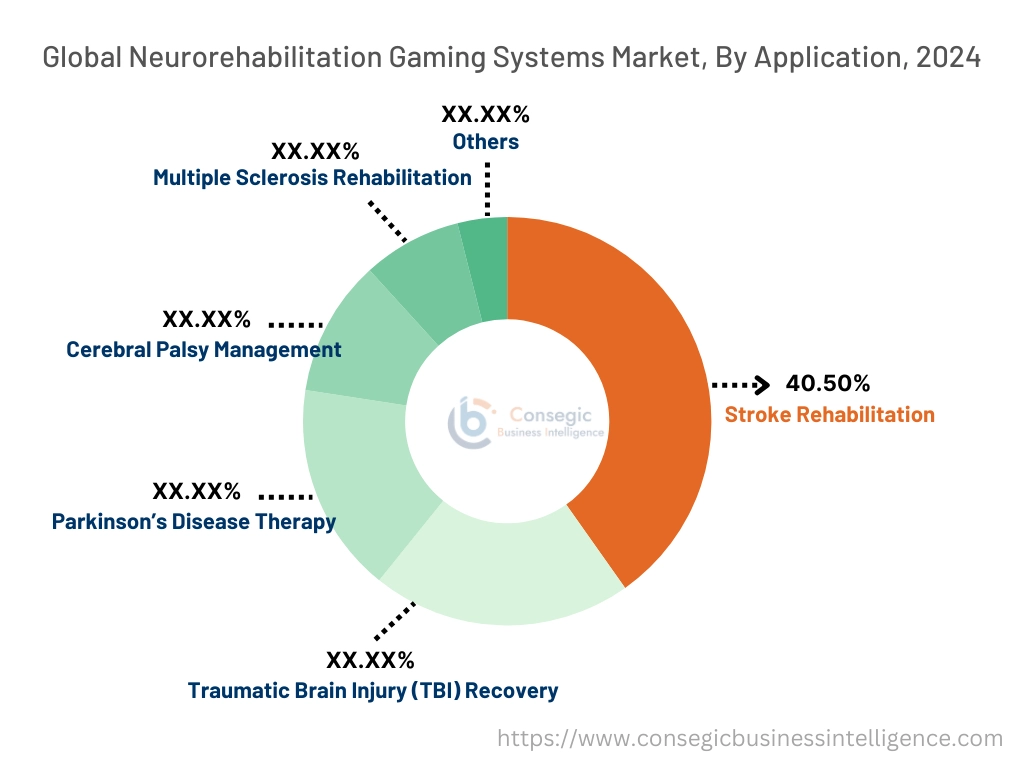
Based on application, the market is segmented into stroke rehabilitation, traumatic brain injury (TBI) recovery, Parkinson’s disease therapy, cerebral palsy management, multiple sclerosis rehabilitation, and others.
The stroke rehabilitation segment accounted for the largest revenue in neurorehabilitation gaming systems market share of 40.50% in 2024.
- Stroke rehabilitation relies heavily on neurorehabilitation gaming systems to promote motor recovery, cognitive function, and coordination in patients.
- The increasing global prevalence of stroke, coupled with rising awareness about the importance of early rehabilitation, is driving neurorehabilitation gaming systems market growth in this segment.
- Gaming systems provide engaging and repetitive tasks essential for neuroplasticity, making them an integral part of stroke recovery programs.
- Supportive government initiatives and funding for stroke management are further boosting the adoption of gaming-based rehabilitation solutions.
The traumatic brain injury (TBI) recovery segment is anticipated to register the fastest CAGR during the forecast period.
- Neurorehabilitation gaming systems offer interactive therapies for cognitive and physical rehabilitation in TBI patients, driving neurorehabilitation gaming systems market trends in this segment.
- Rising incidents of TBIs due to accidents and sports injuries have increased the focus on innovative recovery solutions.
- Gaming systems facilitate gradual recovery by combining physical exercises with cognitive challenges, ensuring holistic rehabilitation.
- Advancements in VR and augmented reality (AR) technologies tailored for TBI recovery are expected to propel neurorehabilitation gaming systems market growth in this segment.
By End-User:
Based on end-users, the market is segmented into hospitals, rehabilitation centers, homecare settings, and research institutes.
The rehabilitation centers segment accounted for the largest revenue share in 2024.
- Rehabilitation centers are the primary end-users of neurorehabilitation gaming systems, offering specialized care for neurological recovery.
- The availability of trained professionals and dedicated infrastructure in these centers supports the effective use of gaming systems for therapy.
- Increasing investments in modernizing rehabilitation facilities and incorporating advanced technologies are driving segment growth.
- The rising prevalence of neurological conditions requiring long-term rehabilitation has reinforced the demand for gaming systems in these centers.
The homecare settings segment is anticipated to register the fastest CAGR during the forecast period.
- The growing trend of home-based therapy, driven by convenience and cost-effectiveness, is fueling the adoption of neurorehabilitation gaming systems in home care settings.
- Portable and user-friendly gaming systems are enabling patients to continue rehabilitation exercises in the comfort of their homes.
- Integration of remote monitoring features in gaming systems allows healthcare providers to track patient progress, enhancing the appeal of home-based solutions.
- The increasing availability of affordable home-use gaming systems and supportive telehealth services are further propelling growth in this segment.
Regional Analysis:
The regions covered are North America, Europe, Asia Pacific, the Middle East and Africa, and Latin America.
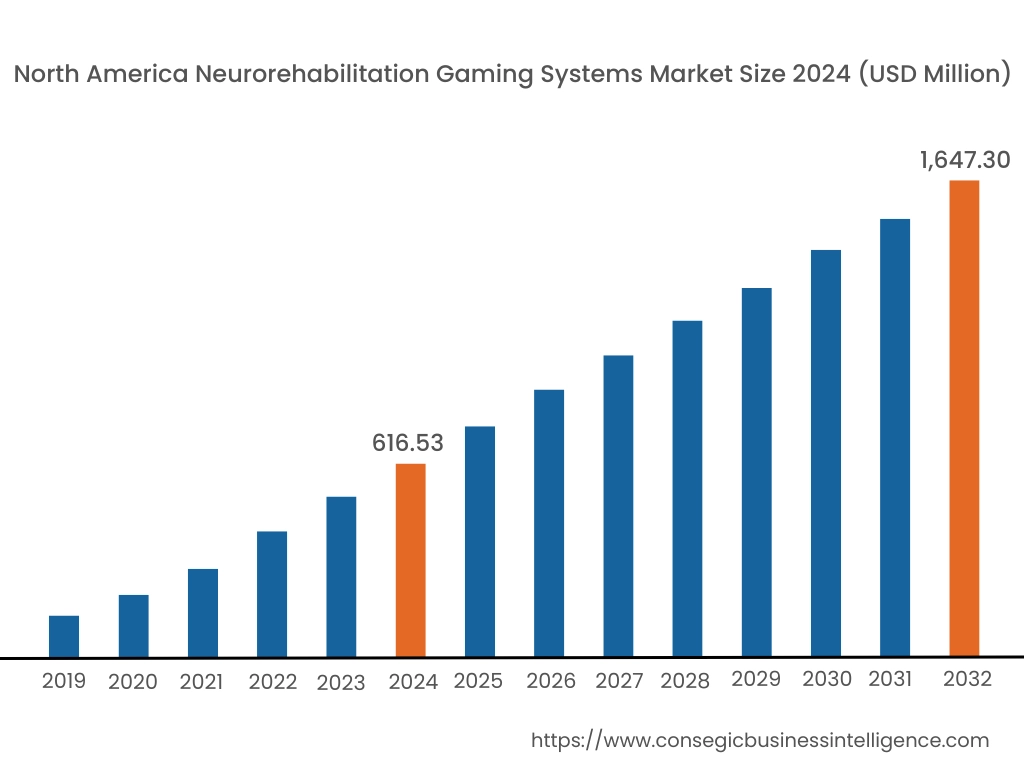
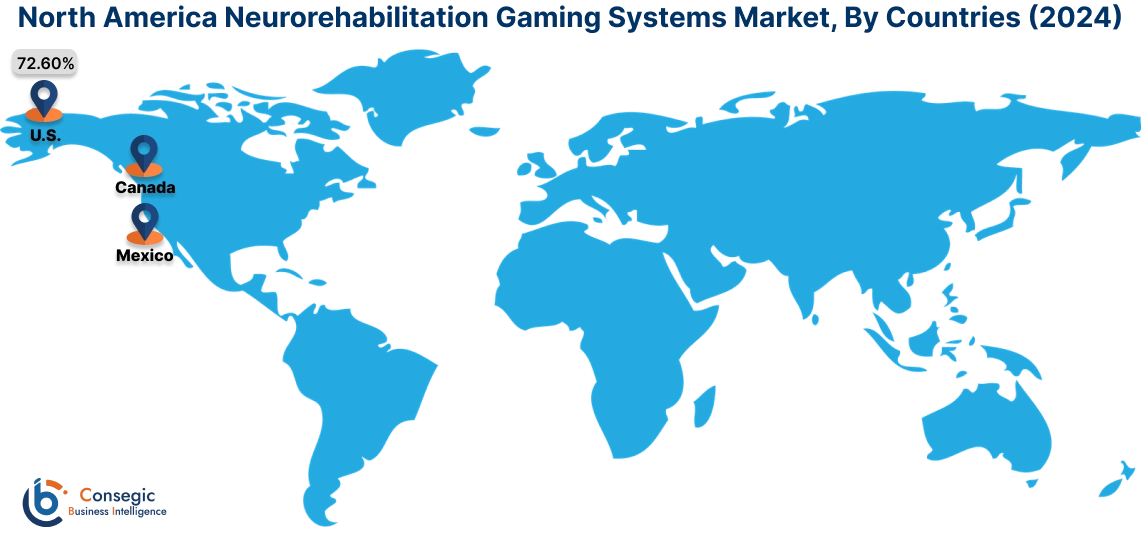
In 2024, North America was valued at USD 616.53 Million and is expected to reach USD 1,647.30 Million in 2032. In North America, the U.S. accounted for the highest share of 72.60% during the base year of 2024. North America holds a significant share in the global neurorehabilitation gaming systems market, driven by advanced healthcare infrastructure, high prevalence of neurological disorders, and increasing adoption of innovative rehabilitation technologies. As per the neurorehabilitation gaming systems market analysis, the U.S. leads the region due to strong investments in research and development, widespread use of virtual reality (VR) and gaming-based systems in rehabilitation centers, and growing awareness about personalized neurorehabilitation approaches. Canada contributes to the increasing adoption of gaming systems in treating stroke and traumatic brain injury patients. However, the high costs of these systems may limit accessibility in smaller rehabilitation facilities.
In Asia Pacific, the market is experiencing the fastest growth with a CAGR of 13.9% over the forecast period. The neurorehabilitation gaming systems market is fueled by rapid advancements in healthcare technology, rising incidence of stroke and neurodegenerative disorders, and increasing healthcare investments in China, Japan, and India. China dominates the region with a growing adoption of gaming-based rehabilitation in urban hospitals and clinics to address the rising prevalence of neurological disorders. India’s expanding healthcare sector drives trends for affordable and innovative rehabilitation tools in treating stroke and brain injury patients. Japan focuses on high-precision neurorehabilitation systems, leveraging its advanced robotics and VR technologies. However, limited awareness and affordability challenges in rural areas may hinder growth in some parts of the region.
Europe is a prominent market for neurorehabilitation gaming systems, supported by a growing aging population, increasing prevalence of neurodegenerative diseases, and strong government support for rehabilitation programs. Countries like Germany, the UK, and France are key contributors. Germany drives neurorehabilitation gaming systems market demand with advanced rehabilitation clinics integrating gaming technologies for stroke, Parkinson’s, and multiple sclerosis patients. The UK focuses on improving neurorehabilitation outcomes through public healthcare initiatives and partnerships with technology developers. France emphasizes the use of VR and gaming systems in physical therapy and neurological rehabilitation. However, budget constraints in public healthcare systems may limit adoption in certain areas.
The Middle East & Africa region is witnessing steady growth in the neurorehabilitation gaming systems market, driven by increasing investments in healthcare infrastructure and rising awareness about innovative rehabilitation techniques. In the Middle East, countries like Saudi Arabia and the UAE are adopting VR-based and gaming systems in specialized neurorehabilitation centers to improve patient outcomes. In Africa, South Africa is emerging as a key market, leveraging partnerships with international organizations to integrate gaming systems into rehabilitation programs for stroke and spinal cord injury patients. However, limited access to advanced technologies and high costs may restrict market development in certain parts of the region.
Latin America is an emerging market for neurorehabilitation gaming systems, with Brazil and Mexico leading the region. Brazil’s expanding healthcare sector and increasing prevalence of neurodegenerative diseases drive neurorehabilitation gaming systems market trends for innovative rehabilitation technologies. The analysis portrays Mexico's focus on improving access to neurorehabilitation services through partnerships with technology providers and government-led initiatives. The region is also exploring gaming-based systems as a cost-effective solution to enhance rehabilitation outcomes. However, economic instability and inconsistent healthcare infrastructure may pose challenges to neurorehabilitation gaming systems market expansion in smaller economies.
Top Key Players and Market Share Insights:
The neurorehabilitation gaming systems market is highly competitive with major players providing products to the national and international markets. Key players are adopting several strategies in research and development (R&D), product innovation, and end-user launches to hold a strong position in the neurorehabilitation gaming systems market. Key players in the neurorehabilitation gaming systems industry include -
- Neofect (South Korea)
- MindMaze SA (Switzerland)
- Kinestica d.o.o. (Slovenia)
- Virtualware Group (Spain)
- MIRA Rehab Limited (United Kingdom)
- Reflexion Health, Inc. (United States)
- Bioness Inc. (United States)
- Bright Cloud International Corp. (United States)
- Evolv Rehabilitation Technologies (Spain)
- Tyromotion GmbH (Austria)
Recent Industry Developments :
Collaborations:
- In September 2023, IHFC, in collaboration with iHub Anubhuti (IIIT Delhi), inaugurated the MCC. This state-of-the-art facility aims to provide education, training, and skill development for medical and engineering professionals, fostering research and development in medical robotics and healthcare devices.
Research And Development:
- In July 2024, the Indian Hub for Cobotics Foundation (IHFC), through its Research Entrepreneurship and Development for Youth (READY) program, supported the development of 'TOTO,' a mobile robotic platform for research and education. Created by the startup SeiAnmai Technologies, this initiative highlights IHFC's efforts to foster innovation and expand the ecosystem of indigenous cobotics solutions.
Neurorehabilitation Gaming Systems Market Report Insights :
| Report Attributes | Report Details |
| Study Timeline | 2019-2032 |
| Market Size in 2032 | USD 5,082.70 Million |
| CAGR (2025-2032) | 13.4% |
| By Type |
|
| By Application |
|
| By End-User |
|
| By Region |
|
| Key Players |
|
| North America | U.S. Canada Mexico |
| Europe | U.K. Germany France Spain Italy Russia Benelux Rest of Europe |
| APAC | China South Korea Japan India Australia ASEAN Rest of Asia-Pacific |
| Middle East and Africa | GCC Turkey South Africa Rest of MEA |
| LATAM | Brazil Argentina Chile Rest of LATAM |
| Report Coverage |
|
Key Questions Answered in the Report
What is the projected market size of the Neurorehabilitation Gaming Systems Market by 2032? −
Neurorehabilitation Gaming Systems Market size is estimated to reach over USD 5,082.70 Million by 2032 from a value of USD 1,858.64 Million in 2024 and is projected to grow by USD 2,074.58 Million in 2025, growing at a CAGR of 13.4% from 2025 to 2032.
What factors are driving the Neurorehabilitation Gaming Systems Market? +
Key drivers include the rising prevalence of neurological disorders, advancements in virtual reality (VR) and artificial intelligence (AI), and the increasing demand for personalized and engaging rehabilitation solutions.
What challenges does the market face? +
Challenges include limited awareness among healthcare providers and patients, high costs of advanced systems, and affordability issues in resource-constrained regions.
Which type of segment leads the market? +
The hardware systems segment leads the market due to its role as the core component of gaming systems, supported by increasing adoption in hospitals and rehabilitation centers.
Overview
Reputation & Certifications


Our Services
- Market Intelligence & Forecasting
- Custom Research Solutions
- Market Entry Strategy
- Competitive Intelligence
- Customer Insights
- Industry Innovation Analysis
- Investment Advisory