Jump to Content
Hematology Diagnostics Market - Size, Share, Industry Trends, and Forecasts (2025-2032)
Hematology Diagnostics Market Size:
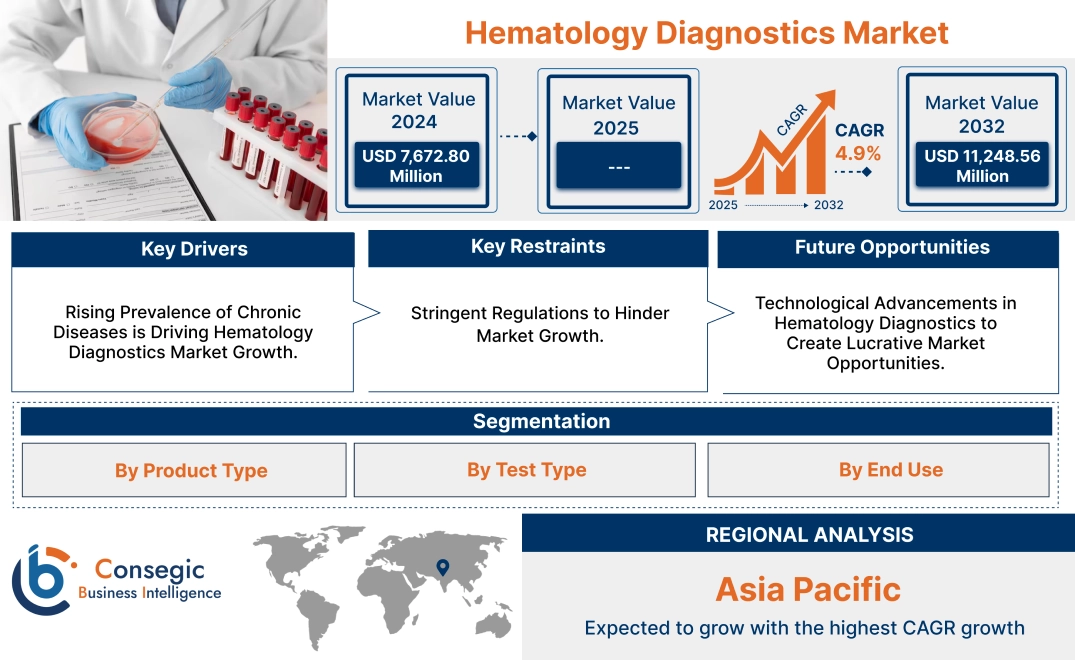
The Hematology Diagnostics Market size is growing with a CAGR of 4.9% during the forecast period (2025-2032), and the market is projected to be valued at USD 11,248.56 Million by 2032 from USD 7,672.80 Million in 2024.
Hematology Diagnostics Market Scope & Overview:
Hematology includes the study and analysis of blood components to diagnose and monitor various blood disorders. Hematology Diagnostics includes a variety of tests, including the complete blood count (CBC), platelet function testing, hemoglobin testing amongst others. These tests are important for identifying and managing several conditions, such as anemia, infections, blood clotting disorders, and leukemia.
The hematology diagnostics healthcare sector is experiencing significant growth driven by several factors. The rising prevalence of chronic diseases is a primary driver, requiring increased reliance on hematological assessments. Technological advancements such as automated analyzers, flow cytometry, and others are improving the accuracy, speed, and efficiency of these tests. Key players in the market include well-established players like Abbott Laboratories, Siemens Healthineers, and Roche Diagnostics.
Hematology Diagnostics Market Dynamics - (DRO) :
Key Drivers:
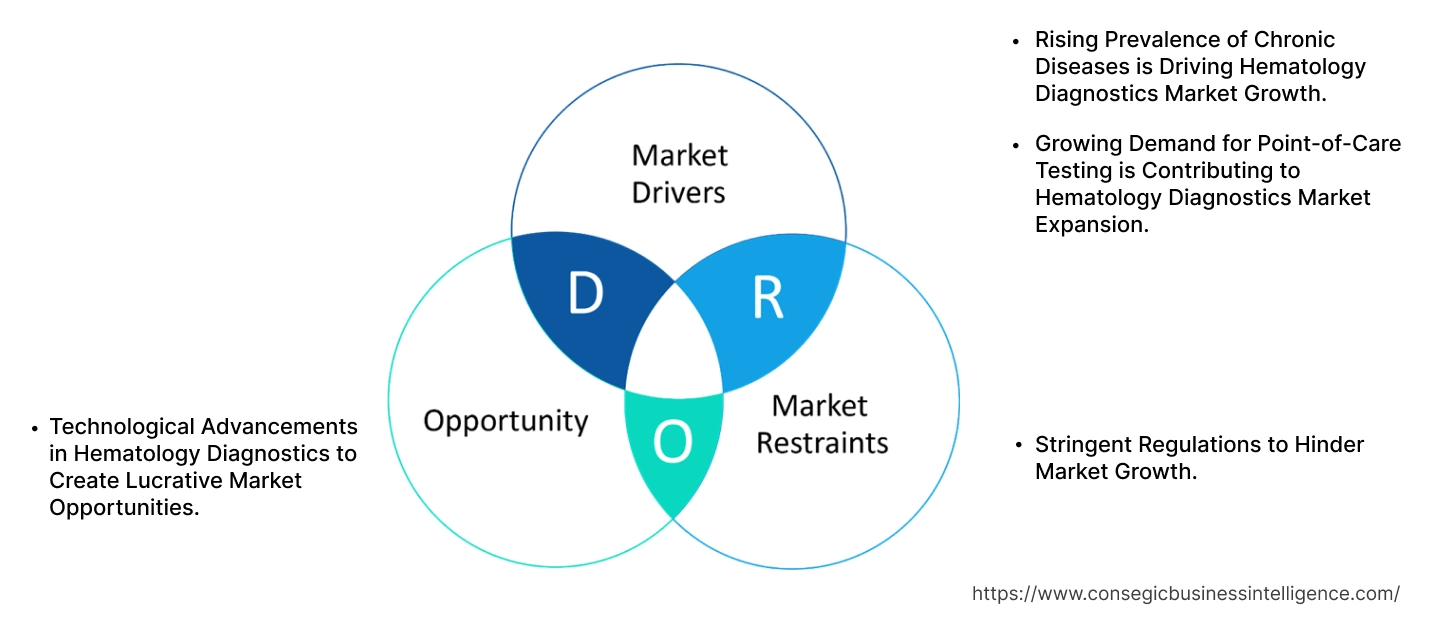
Rising Prevalence of Chronic Diseases is Driving Hematology Diagnostics Market Growth.
The rising prevalence of chronic diseases is a significant driver of the hematology diagnostics market growth. The management of chronic conditions such as cancer, diabetes, and autoimmune disorders requires frequent and comprehensive blood tests. These tests are vital for monitoring disease progression, identifying potential complications amongst others. Early disease detection, facilitated by regular blood tests, enables timely interventions and significantly improves the patient’s outcome.
- For instance, according to the analysis provided by the World Health Organization in 2022, cancer is a leading cause of death worldwide, accounting for nearly 10 million deaths in 2020, or nearly one in six deaths. The most common cancers are breast, lung, colon, rectum, and prostate cancers. Cancer-causing infections, such as human papillomavirus (HPV) and hepatitis, are responsible for approximately 30% of cancer cases in low- and lower-middle-income countries.
In summary, the increasing global rise of chronic diseases is directly fueling the need for advanced hematology diagnostic solutions.
Growing Demand for Point-of-Care Testing is Contributing to Hematology Diagnostics Market Expansion.
Point-of-care testing (POCT) refers to medical diagnostic tests conducted at or near the site of patient care. This approach enables rapid result generation, often within minutes. This facilitates immediate clinical decision-making and potentially improving patient outcomes. POCT is a significant driver of the hematology diagnostics market expansion. Common hematology tests performed at the point of care include hemoglobin, hematocrit, white blood cell count, and platelet function, enabling rapid diagnosis and monitoring of various blood disorders.
- For instance, in 2024, SelectScience reported that the successful implementation of point-of-care testing has demonstrated substantial cost savings, ranging from 8% to 25%, across various healthcare settings. Notably, most of these savings have been observed downstream in the patient care process.
- For instance, in 2022, Hilab introduced an innovative point-of-care hematology analyzer, integrating Internet of Things (IoT) capabilities and Artificial Intelligence.
Thus, as per analysis, as healthcare systems prioritize efficiency, patient-centered care, and cost-effectiveness, the adoption of POCT in hematology diagnostics is growing.
Key Restraints:
Stringent Regulations to Hinder Market Growth.
Stringent regulations within the hematology and pathology device market significantly hinder market trajectory. The stringent process for premarket approval and lengthy documentation requirements inherent in the regulatory landscape pose substantial hurdles for manufacturers. These hurdles include significant financial costs associated with research, development, and clinical trials necessary to demonstrate safety and efficacy. The fear of navigating these complex regulatory hurdles also discourages innovation and limits the development of novel technologies. These factors collectively create a difficult environment for the development and commercialization of innovative hematology and pathology devices, potentially slowing down advancements in this critical area of healthcare.
Future Opportunities :
Technological Advancements in Hematology Diagnostics to Create Lucrative Market Opportunities.
Technological advancements in hematology diagnostics, such as flow cytometry, molecular diagnostics, and artificial intelligence amongst others are contributing to the hematology diagnostics market opportunities. Flow cytometry provides precise cell analysis, while molecular diagnostics like PCR (Polymerase Chain Reaction) and NGS (Next-Generation Sequencing) facilitate the detection of genetic abnormalities. Additionally, AI-powered algorithms improve accuracy and efficiency in hematology analyzers.
- For instance, Agappe, one of the leading diagnostic technology companies from India, has launched hematology equipment. The equipment includes series such as the HX series, as well as the Mispa i200 Immunology CLIA analyzer.
The above-mentioned technological advancement, coupled with the growing adoption of personalized medicine and the increasing prevalence of chronic diseases, is expected to create lucrative hematology diagnostics market opportunities for innovative players in the hematology diagnostics sector.
Hematology Diagnostics Market Segmental Analysis :
By Product Type:
Based on Product Type, the market is categorized into instruments and consumables. Instruments are further categorized into analyzer, flow cytometers and others. Similarly, consumables are further categorized into reagents, calibrators, and others
Trends in the Product Type:
- Trend towards automated analyzers, offering higher throughput and improved accuracy.
- Flow cytometry is gaining traction, especially in immunophenotyping.
The instruments segment accounted for the largest market share in 2024 and is expected to grow with the highest CAGR over the forecast period.
- The Instruments are further categorized into analyzer, flow cytometers and others.
- Among the sub segments, hematology analyzers dominate the global market due to their high throughput, automation, and enhanced accuracy. These instruments significantly improve laboratory efficiency by processing numerous samples quickly and accurately.
- Advancements in technology, such as automated cell identification and AI-powered image recognition, minimize errors and improve diagnostic precision.
- For instance, in 2023, Siemens Healthineers introduced the Atellica HEMA 570 and 580 Analyzers, next-generation hematology analyzers designed to enhance laboratory efficiency.
- Therefore, as per hematology diagnostics market analysis, the increasing need for efficient and high-quality diagnostic services further drives the widespread adoption of these analyzers in clinical settings.
By Test Type:
The Test Type segment is categorized into complete blood count (cbc), platelet function testing, hemoglobin testing, and others
Trends in the Test Type:
- Growing awareness of bleeding disorders are driving adoption of platelet function tests.
- The rising prevalence of anemia is driving adoption of hemoglobin testing in both in clinical settings and point-of-care settings.
The Complete Blood Count (CBC) segment accounted for the largest market share in 2024.
- The complete blood count (CBC) holds a dominant position within the hematology diagnostics market share. This dominance is due to its crucial role as a fundamental screening tool for a wide variety of health conditions.
- The CBC, a comprehensive panel of tests, provides a comprehensive assessment of various blood components, including red blood cells, white blood cells, platelets, hemoglobin, and hematocrit. This comprehensive evaluation empowers healthcare professionals to gain valuable insights into an individual's overall health status.
- For instance, in 2022, over 1.5 billion CBC tests were conducted annually. Anemia, a significant global health concern affecting approximately 25% of the world's population, particularly prevalent in low and middle-income countries, further underscores the widespread need for CBC testing.
- This widespread utilization across diverse healthcare settings contributes significantly to the CBC's dominant position within the hematology diagnostics market demand.
The hemoglobin testing segment is expected to grow at the fastest CAGR over the forecast period.
- Hemoglobin testing is expected to be the fastest growth due to several key factors. Foremost, anemia, a condition characterized by low red blood cell count or hemoglobin levels, is a significant global health concern affecting a significant portion of the world's population.
- Additionally, accurate and timely hemoglobin testing plays a critical role in ensuring blood safety, making it essential for blood donation programs.
- Moreover, numerous global health initiatives aimed at addressing anemia are driving the need for widespread hemoglobin screening programs.
- These factors and trends collectively contribute to the significant potential of the hemoglobin testing segment within the hematology diagnostics market demand.
By End Use:
Based on end use, the market is categorized into hospitals and clinics, diagnostic laboratories, and others
Trends in the End Use:
- The rise of specialized diagnostic laboratories with advanced technologies and expertise.
- The expanding healthcare infrastructure and growing awareness of the importance of early disease detection in emerging markets
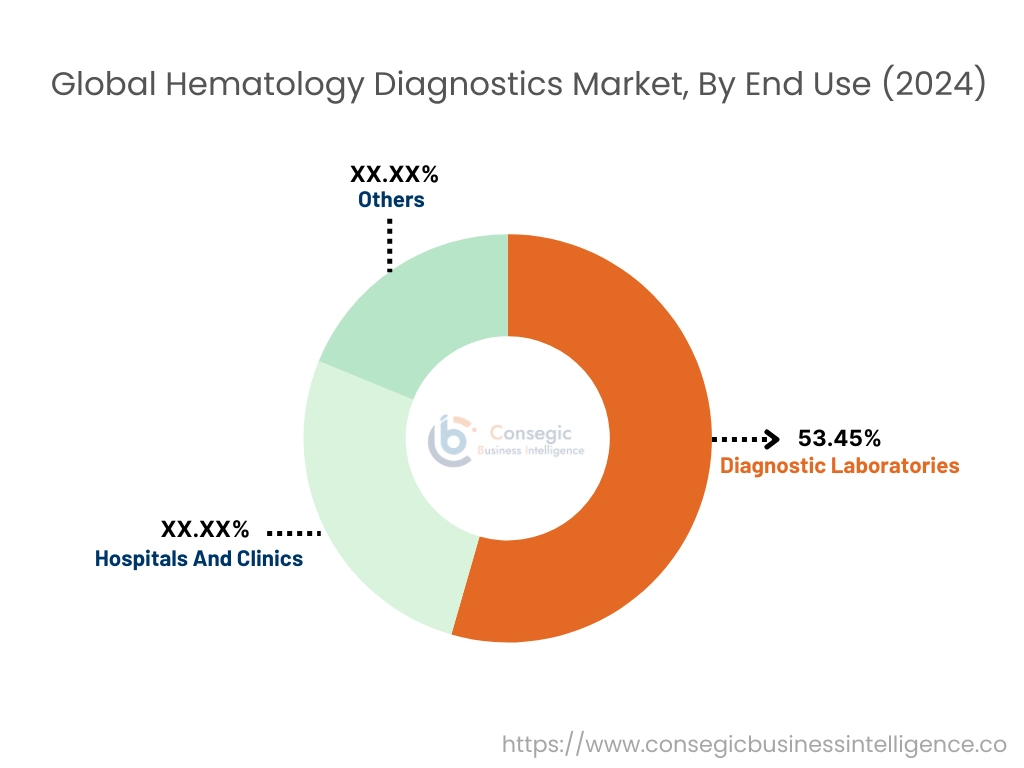
The Diagnostic Laboratories segment accounted for the largest market share of 53.45% in 2024 and is expected to grow with the highest CAGR over the forecast period.
- Diagnostic laboratories are key end use players, specializing in a wide array of hematology tests often requiring advanced technologies and specialized expertise not readily available in every hospital or clinic.
- This specialization, coupled with the increasing demand for complex and sophisticated testing, has fueled significant trajectory within the diagnostic laboratory segment.
- Factors such as the outsourcing of certain tests by hospitals to specialized laboratories, seeking to improve efficiency and access advanced technologies, further contribute to their trajectory.
- For instance, in 2024, KFSHRC introduced the most advanced hematology diagnostics laboratory in the MENA region, featuring cutting-edge processing systems and high-resolution multiparametric flow cytometry analyzers.
- Moreover, the continuous advancement of laboratory technologies, including high-throughput analyzers, flow cytometry, and molecular diagnostics, enables diagnostic laboratories to offer a broader range of tests with enhanced accuracy and precision.
Regional Analysis:
The regional segment includes North America, Europe, Asia Pacific, the Middle East and Africa, and Latin America.
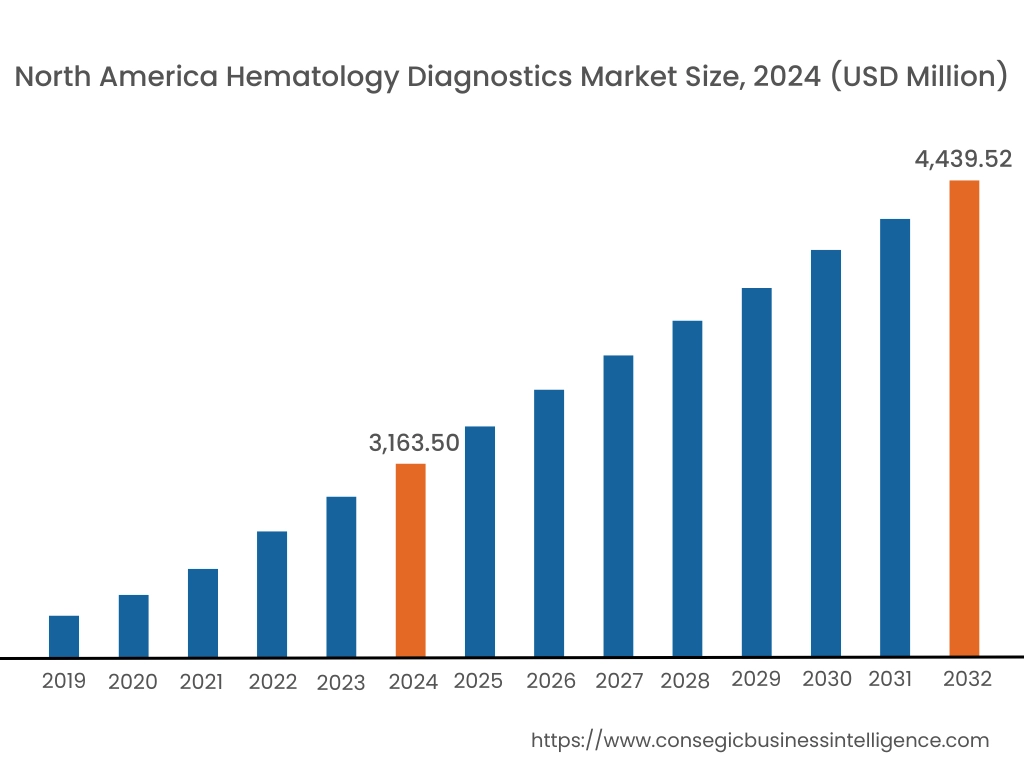
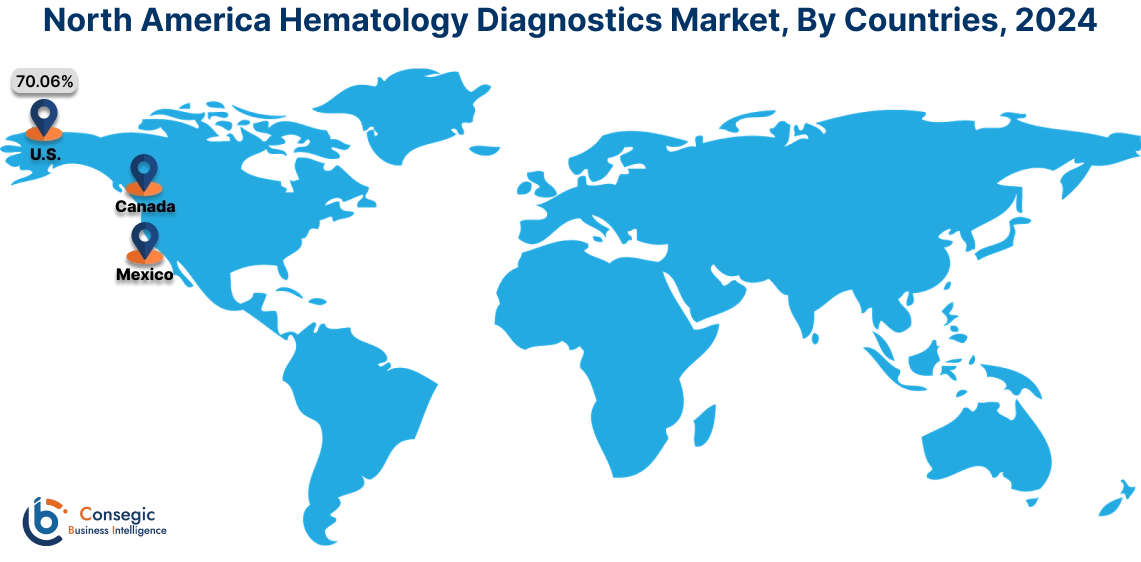
In 2024, North America accounted for the highest hematology diagnostics market share at 41.23% and was valued at USD 3,163.50 Million and is expected to reach USD 4,439.52 Million in 2032. In North America, the U.S. accounted for the hematology diagnostics market share of 70.06% during the base year of 2024.
North America currently dominates the global market driven by several key factors. The region boasts a robust healthcare infrastructure with advanced medical facilities, skilled professionals, and substantial healthcare expenditure, fostering the adoption and utilization of sophisticated diagnostic technologies. Additionally, the high prevalence of chronic diseases such as cancer, diabetes, and cardiovascular conditions within North America necessitates frequent hematological assessments, driving demand for diagnostic services.
- For instance, the National Center for Health Statistics reports that from August 2021 to August 2023, 9.3% of individuals aged 2 years and older in the United States experienced anemia.
Furthermore, the presence of numerous leading global players in the hematology diagnostics within the region further fuels innovation and hematology diagnostics market trend.
In Asia Pacific, the hematology diagnostics market is experiencing the fastest growth with a CAGR of 5.8% over the forecast period. The region is experiencing economic growth in many countries, leading to increased healthcare spending and improved access to healthcare industry services. Additionally, the rising prevalence of chronic diseases such as diabetes, cardiovascular diseases, and cancer within the region significantly increases the demand for hematological assessments for diagnosis, monitoring, and treatment. Hence, as per the above-mentioned factors, market in Asia Pacific is expected to grow at the fastest CAGR
The European market for hematology diagnostics is well-established. This well-established market is driven by several key factors. A few of the key factors are aging population within Europe is experiencing an increased incidence of age-related blood disorders, driving demand for diagnostic services. These conditions often require frequent monitoring through hematological tests. Furthermore, Europe is a hub for medical innovation, with significant investments in research and development within the field of hematology diagnostics. This strong emphasis on innovation fosters the development of cutting-edge technologies. These factors and trends combined drive the development and commercialization of advanced diagnostic solutions.
The Middle East and Africa represent an emerging region with substantial opportunities in the hematology diagnostics market analysis. The expansion of healthcare infrastructure across the region is a significant driver. Investments in new hospitals, clinics, and diagnostic centers are improving access to diagnostic services for a growing population, particularly in underserved areas. Additionally, the high prevalence of infectious diseases such as malaria and HIV/AIDS within this region necessitates increased reliance on hematological tests. These tests are crucial for diagnosis, monitoring disease progression, and assessing treatment efficacy. The increased awareness is leading to increased utilization of hematological tests for screening and early diagnosis of various health conditions.
Latin America presents a market with significant growth potential in the hematology diagnostics industry. This rise is driven by a combination of increased government spending on healthcare initiatives and the development of private healthcare sectors. This increased spending facilitates investments in healthcare infrastructure, leading to the establishment of new hospitals, clinics, and diagnostic centers. These developments significantly enhance access to diagnostic services for the growing population. Furthermore, the region is witnessing a significant rise in the prevalence of chronic diseases such as diabetes and cardiovascular diseases. These conditions often require frequent monitoring through hematological tests, driving a adoption of diagnostic services. This increasing prevalence of chronic diseases creates a fertile ground for the hematology diagnostics market trend within Latin America.
Top Key Players and Market Share Insights:
The global Hematology Diagnostics Market is highly competitive with major players providing products to the national and international markets. Key players are adopting several strategies in research and development (R&D) and product innovation to hold a strong position in the global Hematology Diagnostics market. Key players in the Hematology Diagnostics industry include-
- Siemens AG (Germany)
- Sysmex Corporation (Japan)
- Nihon Kohden Corporation (Japan)
- EKF Diagnostics Holdings Plc (UK)
- Abbott Laboratories (U.S.)
- Cardinal Health Inc. (U.S.)
- Danaher Corporation (U.S.)
- Hoffmann-La Roche Ltd. (Switzerland)
- Erba Mannheim (Germany)
- Shenzhen Mindray Bio-Medical Electronics Co. Ltd. (China)
Recent Industry Developments :
Product Launches:
- In 2024, Horiba introduces new hematology analyzers that integrate Erythrocyte Sedimentation Rate (ESR) testing, improving diagnostic capabilities with rapid results and comprehensive disease profiling.
- In 2024, Siemens Healthineers launches next-gen hematology analyzers called Atellica HEMA 570 and 580. They offer interfaces and multi-analyzer automation connectivity to reduce workflow roadblocks
Hematology Diagnostics Market Report Insights :
| Report Attributes | Report Details |
| Study Timeline | 2019-2032 |
| Market Size in 2032 | USD 11,248.56 Million |
| CAGR (2025-2032) | 4.9% |
| By Product Type |
|
| By Test Type |
|
| By End Use |
|
| By Region |
|
| Key Players |
|
| North America | U.S. Canada Mexico |
| Europe | U.K. Germany France Spain Italy Russia Benelux Rest of Europe |
| APAC | China South Korea Japan India Australia ASEAN Rest of Asia-Pacific |
| Middle East and Africa | GCC Turkey South Africa Rest of MEA |
| LATAM | Brazil Argentina Chile Rest of LATAM |
| Report Coverage |
|
Key Questions Answered in the Report
How big is the Hematology Diagnostics market? −
In 2024, the Hematology Diagnostics market is USD 7,672.80 Million.
Which is the fastest-growing region in the Hematology Diagnostics market? +
Asia Pacific is the fastest-growing region in the Hematology Diagnostics market.
What specific segmentation details are covered in the Hematology Diagnostics market? +
By Product Type, Test Type and End Use segmentation details are covered in the Hematology Diagnostics market.
Who are the major players in the Hematology Diagnostics market? +
Shenzhen Mindray Bio-Medical Electronics Co. Ltd. (China), Nihon Kohden Corporation (Japan), EKF Diagnostics Holdings Plc (UK) are some of the major players in the market.
Overview
Reputation & Certifications


Our Services
- Market Intelligence & Forecasting
- Custom Research Solutions
- Market Entry Strategy
- Competitive Intelligence
- Customer Insights
- Industry Innovation Analysis
- Investment Advisory