Jump to Content
HIV Drugs Market - Size, Share, Industry Trends, and Forecasts (2024 - 2031)
HIV Drugs Market Size:
HIV Drugs Market size is growing with a CAGR of 5.7% during the forecast period (2024-2031), and the market is projected to be valued at USD 52,504.67 Million by 2031 from USD 33,807.33 Million in 2023.
HIV Drugs Market Scope & Overview:
HIV stands for human immunodeficiency virus. It is a virus that attacks the body's immune system, specifically targeting CD4 cells, which are crucial for fighting off infections. HIV drugs, also known as antiretroviral medications, are medications that help control HIV infection. They work by interfering with the virus's ability to replicate. By reducing viral replication, these drugs help to restore and maintain a healthy immune system, enabling the body to fight off infections and diseases more effectively. Moreover, consistent adherence to these drugs prevents the progression of HIV to acquired immunodeficiency syndrome (AIDS), which is the most advanced stage of HIV infection. Additionally, these medications significantly reduce the risk of transmitting HIV to others, even through sexual contact or during pregnancy.

HIV Drugs MarketDynamics - (DRO) :
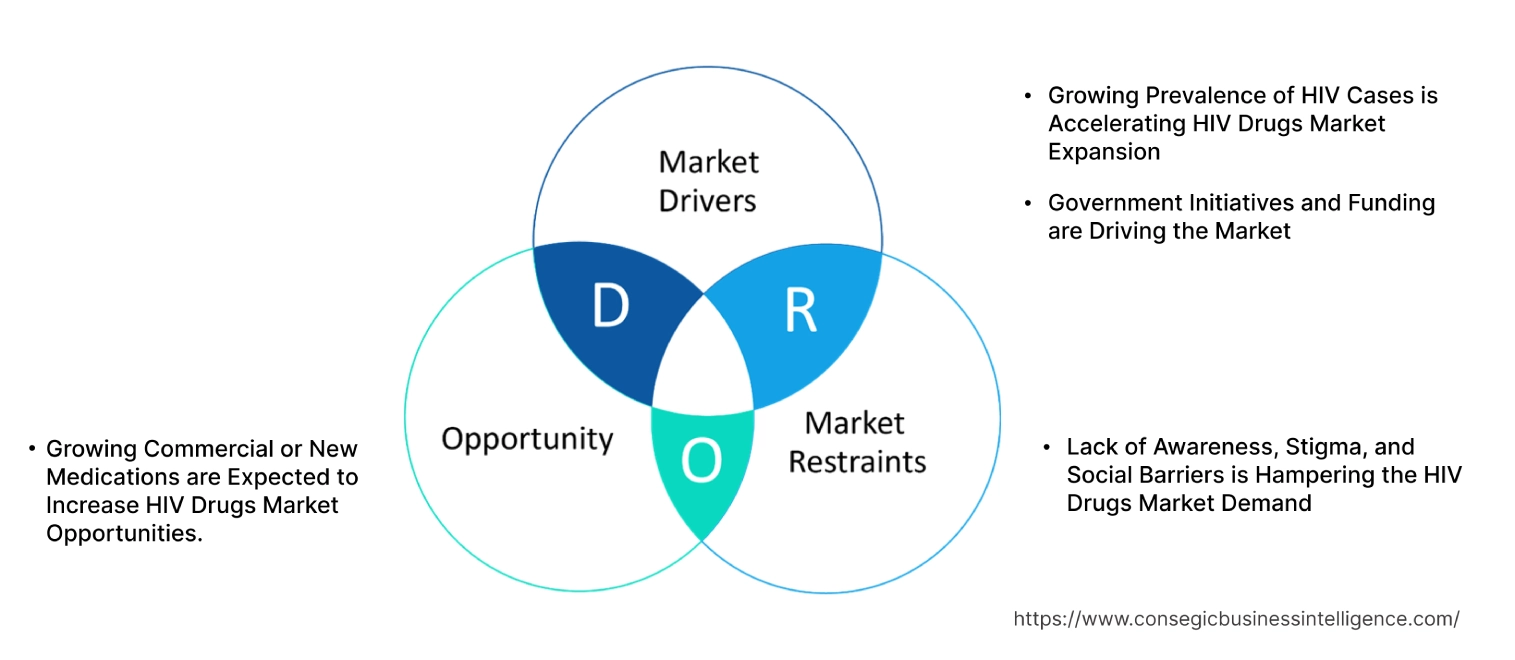
Key Drivers:
Growing Prevalence of HIV Cases is Accelerating HIV Drugs Market Expansion
Unprotected sexual activity remains a primary mode of HIV transmission, particularly among key populations such as men who have sex with men, sex workers, and transgender individuals. Moreover, without proper prevention measures, HIV is transmitted from an infected mother to her child during pregnancy, childbirth, or breastfeeding. Furthermore, sharing needles and syringes contaminated with HIV-infected blood contributes to the spread of the virus among people who inject drugs. All these factors have contributed to the prevalence of HIV infections.
- For instance, according to the data published by the World Health Organization, in 2023, an estimated 1.3 million individuals contracted HIV globally. As of the end of 2023, approximately 39.9 million people were living with HIV, including 1.4 million children and 38.6 million adults. This has driven the need for effective HIV drugs, positively impacting the market.
Overall, the persistent global HIV epidemic, driven by factors such as unprotected sex, and drug use is significantly boosting the HIV drugs market expansion.
Government Initiatives and Funding are Driving the Market
Governments worldwide are recognizing the significant public health impact of HIV/AIDS which has led them to implement various initiatives to combat the epidemic. They are allocating substantial funds to support HIV prevention, treatment, and care programs.
- For instance, in the fiscal year 2022, the federal government of the United States allocated an estimated USD 35.8 billion to fight HIV domestically. The majority of this funding was directed towards care and treatment, amounting to USD 28.7 billion, primarily through Medicaid and Medicare programs. This funding facilitates increased access to HIV drugs for individuals with newly diagnosed infections, ensuring timely and efficient treatment.
Moreover, there are substantial investments made to enhance access to antiretroviral medicines, ensuring affordability and availability for patients in low-income and underserved communities. Additionally, they are providing funding for research and development of new HIV medications, vaccines, and other innovative treatment strategies, which further drive HIV drugs market trends. Overall, government funding and initiatives are crucial in driving the market by supporting research, and improving access to treatment, thus driving the HIV drugs market growth.
Key Restraints :
Lack of Awareness, Stigma, and Social Barriers is Hampering the HIV Drugs Market Demand
Lack of awareness is a critical issue, particularly in low-income and rural areas, where knowledge about HIV/AIDS, its transmission, and available treatments remains limited. This gap results in delayed diagnosis and treatment, allowing the disease to progress and reducing the effectiveness of antiretroviral medicines. Moreover, stigma associated with HIV/AIDS also plays a detrimental role. Many individuals refrain from seeking testing or treatment due to fear of discrimination, ostracism, or loss of employment and social status. Such stigma is pervasive even in developed nations, where misinformation and prejudices persist despite widespread public health campaigns.
In addition to that, social barriers further exacerbate the problem. Marginalized groups, including sex workers, LGBTQ+ communities, and intravenous drug users, lack access to healthcare services due to systemic inequalities or discriminatory healthcare policies. These populations are disproportionately affected by HIV but remain underserved by the healthcare system. Together, these factors limit HIV drugs market demand by reducing the pool of diagnosed individuals and treatment adherence rates. Overall, analysis shows that the lack of awareness, stigma, and social barriers, which limit access to HIV testing, treatment, and care, significantly hampers the HIV drugs market trends.
Future Opportunities :
Growing Commercial or New Medications are Expected to Increase HIV Drugs Market Opportunities.
Ongoing research and advancements in medical science have led to the development of more effective and tolerable treatment regimens. Newer medications exhibit higher potency and better efficacy in reducing viral load and suppressing disease progression. Moreover, advancements in drug formulation and delivery systems have led to medications with fewer and milder side effects, improving patient compliance and quality of life. Additionally, the rise of preventative medication is another fueling factor for the upcoming years.
For instance,
- Gilead is developing lenacapavir, an injectable long-acting HIV medicine for prevention. Gilead plans to begin global regulatory filings for lenacapavir by the end of 2024, with a potential launch in 2025. Thus, upcoming approval will expand medicine options, thus positively impacting the market.
Furthermore, the increasing focus on next-generation therapies, such as broadly neutralizing antibodies (bNAbs) and gene-editing technologies, represents a shift towards potentially curative solutions, further increasing the HIV drugs market opportunities. Overall, according to market research analysis, ongoing research and development of innovative HIV medications, create potential for the HIV drugs market growth for the forecasted period.
HIV Drugs MarketSegmental Analysis :
By Drug Class:
Based on drug class, the market is categorized into nucleoside reverse transcriptase inhibitors (NRTIs), non-nucleoside reverse transcriptase inhibitors (NNRTIs), protease inhibitors (PIs), integrase inhibitors, combination medicines, and others.
Trends in the Drug Class:
- Growing focus on long-acting injectable medications for improved adherence.
- Increasing focus on prevention strategies, including PrEP and PEP.
The combination medicines segment accounted for the largest market share in 2023.
- Combination medicines, also known as fixed-dose combination (FDC) drugs, are a type of HIV medication that combines multiple antiretroviral drugs into a single pill. This approach simplifies treatment regimens, improving adherence and reducing the risk of medication errors.
- By reducing the number of pills, a patient needs to take daily, combination medicines significantly improve adherence to treatment.
- Combining different classes of antiretroviral drugs provides a synergistic effect, leading to more potent viral suppression and reduced risk of drug resistance.
- By optimizing drug dosages and formulations, combination medicines minimize side effects associated with individual drugs.
- Advancements in antiretroviral medicines, increased awareness, and testing, government initiatives, and funding are driving the segment. Moreover, the development of new and improved medications further drives segmental growth.
- For instance, in December 2023, Zydus Lifesciences Limited announced that it had obtained the final approval from the United States Food and Drug Administration (USFDA) for Darunavir Tablets in 600 mg and 800 mg dosages, along with tentative approval for the 75 mg and 150 mg variants, which are intended for the treatment of Human Immunodeficiency Virus (HIV-1).
- Thus, as per the analysis, players are accelerating the development and commercialization of innovative HIV medicines, thus driving the segment.
The nucleoside reverse transcriptase inhibitors (NRTIs) segment is expected to grow at the fastest CAGR over the forecast period.
- Nucleoside reverse transcriptase inhibitors (NRTIs) are a class of antiretroviral drugs used to treat HIV infection. They work by blocking reverse transcriptase, an enzyme HIV needs to replicate its genetic material.
- NRTIs incorporate themselves into the viral DNA during replication, causing chain termination, which stops further viral DNA synthesis. Common examples of NRTIs include tenofovir, emtricitabine, lamivudine, and abacavir.
- With years of use, NRTIs have a well-documented safety record. They are considered the backbone of many HIV treatment regimens due to their long history of effectiveness and reliability.Many NRTIs are available in once-daily formulations, making them convenient for patients to adhere to their treatment regimen.Also, they have a relatively low risk of developing resistance, which is crucial in maintaining long-term viral suppression.
- According to the market research analysis, as the number of people living with HIV continues to grow, the need for effective treatment options will remain strong, fueling segmental growth.
By Distribution Channel:
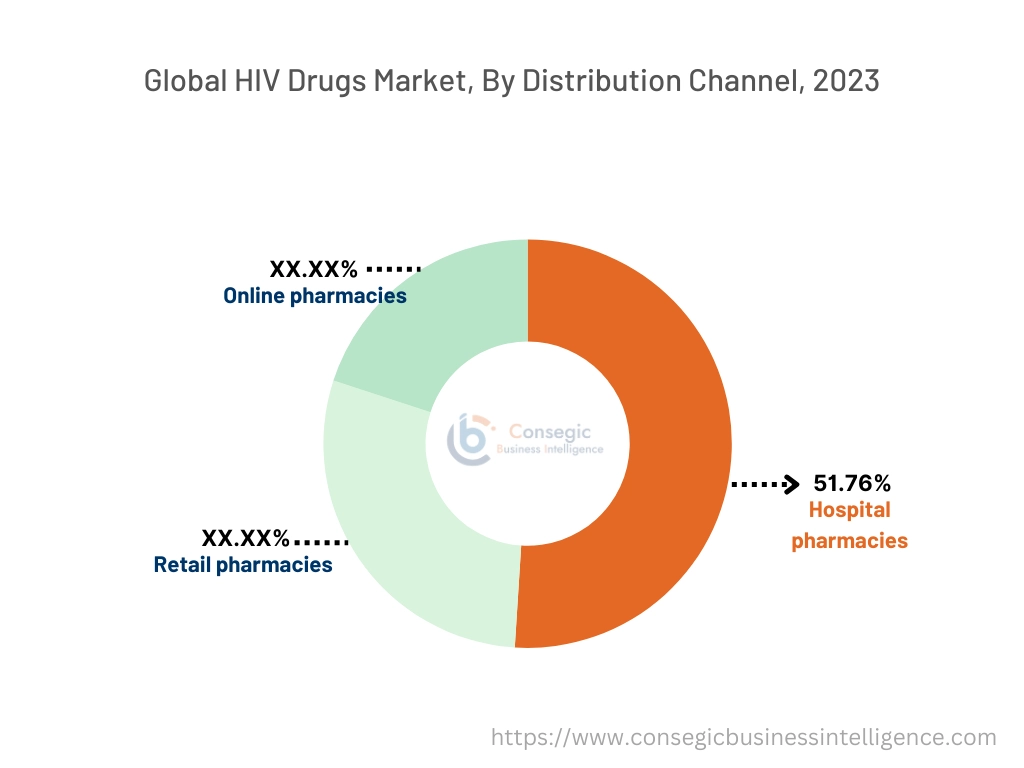
The distribution channel segment is categorized into hospital pharmacies, retail pharmacies, and online pharmacies.
Trends in the Distribution Channel:
- Growing online pharmacies to increase the convenience of HIV medications.
- Expanding access to HIV care and treatment in underserved populations.
The hospital pharmacies segment accounted for the largest market share of 51.76% in 2023.
- Hospital pharmacies are dominating due to several factors. They serve patients who visit healthcare facilities for HIV diagnosis, treatment, and follow-ups. This centralized access ensures patients receive their medications immediately after consultation with specialists.
- Moreover, hospitals are the first point of care for newly diagnosed HIV patients and those managing complications, making hospital pharmacies the primary source of HIV medications.
- Additionally, these pharmacies are equipped to handle complex HIV regimens, offering expert guidance on drug combinations, side effect management, and adherence counseling. Increased availability of new HIV medicines is driving the segment.
- For instance, in February 2022, ViiV Healthcare revealed that the US Food and Drug Administration (FDA) approved Cabenuva (cabotegravir, rilpivirine) to be administered every two months for the treatment of HIV-1 in adults who are virologically suppressed.
- Overall, hospital pharmacies remain a dominant force due to their centralized access, expertise in managing complex regimens, and role in providing immediate care to newly diagnosed patients.
The retail pharmacies segment is expected to grow at the fastest CAGR over the forecast period.
- Retail Pharmacies are community-based drugstores that provide prescription and over-the-counter medications to the general public. Examples include chains such as Walgreens, CVS, or independent pharmacies. They play a crucial role in the distribution of HIV medications by offering convenient access for patients managing chronic conditions such as HIV.
- Retail pharmacies are widely accessible, making it easier for patients to refill prescriptions without visiting a hospital. Extended operating hours further enhance accessibility.
- As HIV becomes more manageable with antiretroviral therapy (ART), many patients receive treatment in outpatient settings, increasing the adoption of retail pharmacy services. Many retail pharmacies now offer adherence programs, counseling, and reminders, improving treatment outcomes.
- In areas with limited hospital infrastructure, retail pharmacies bridge the gap, particularly in emerging markets. All these factors make it an emerging segment in the distribution channel growth for the upcoming years.
Regional Analysis:
The regional segment includes North America, Europe, Asia Pacific, the Middle East and Africa, and Latin America.
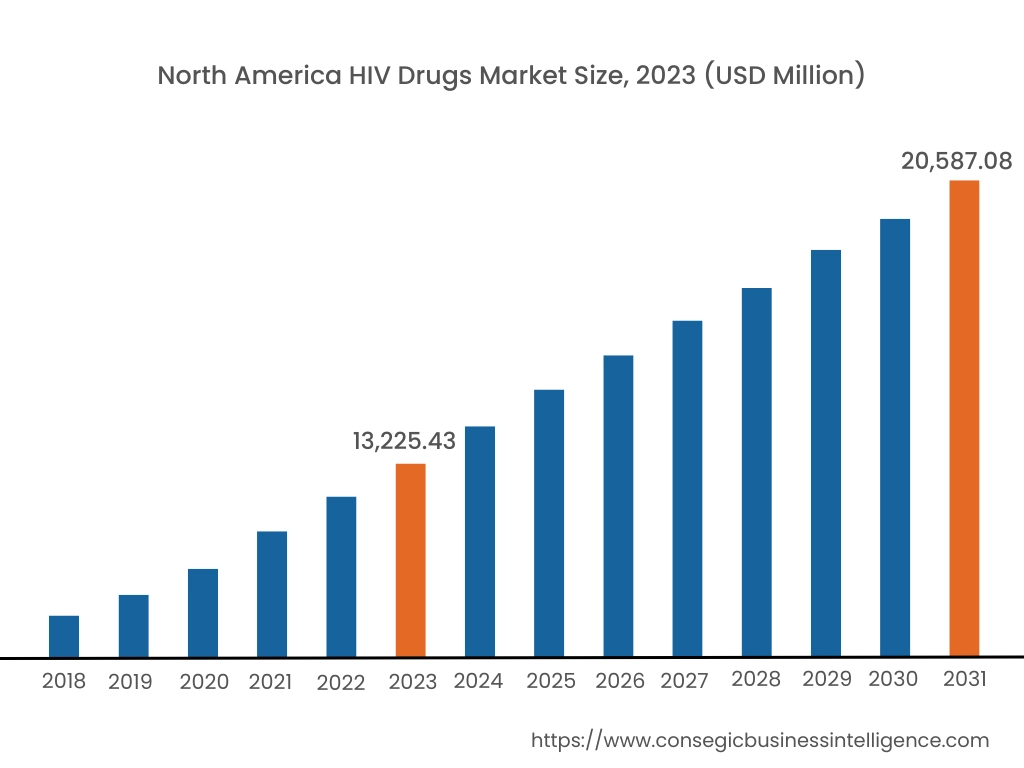
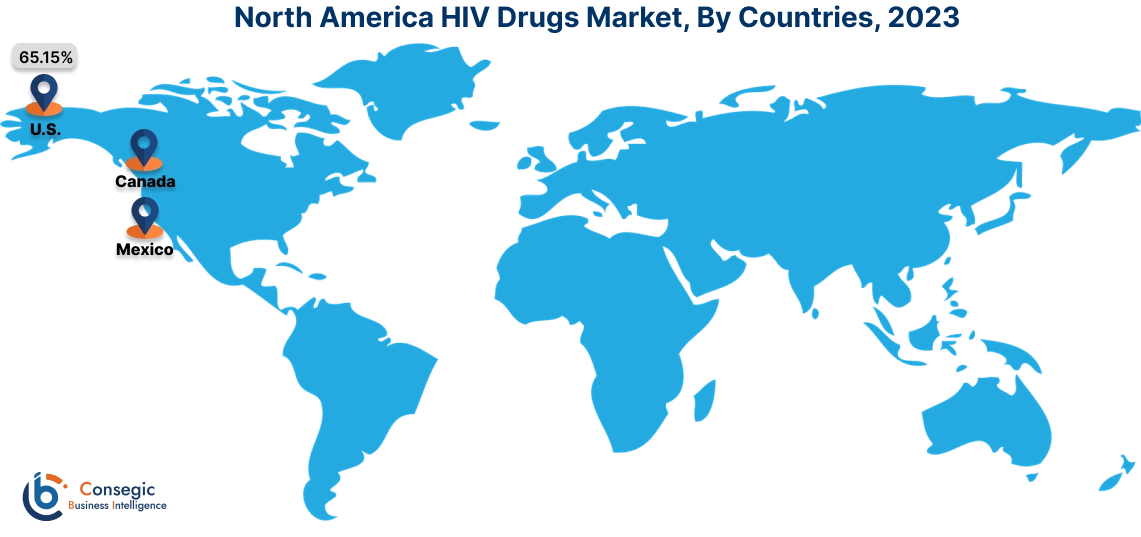
In 2023, North America accounted for the highest HIV drugs market share at 39.12% and was valued at USD 13,225.43 Million and is expected to reach USD 20,587.08 Million in 2031. In North America, the U.S. accounted for the highest HIV drugs market share of 65.15% during the base year of 2023. The dominance is driven by several key trends. The region has a high prevalence of HIV, with the United States contributing significantly to the patient population. This drives consistent demand for antiretroviral therapies (ARTs). Robust healthcare infrastructure and widespread access to advanced treatments further reinforce the market's strength. Additionally, several government programs ensure accessibility treatment, especially for low-income populations.
- For instance, in August 2024, the Biden-Harris Administration announced an allocation exceeding USD 1.4 billion aimed at delivering essential HIV medications and healthcare services to low-income individuals living with HIV.
Furthermore, North America houses major pharmaceutical industries actively developing innovative HIV drugs. These companies invest heavily in research and development (R&D), leading to the introduction of novel therapies such as integrase inhibitors and long-acting injectables, which boost market growth in regions. Overall, the high prevalence of HIV, robust healthcare infrastructure, government support, and ongoing pharmaceutical innovation drive North American HIV drugs Industry.
In Asia Pacific, the share of the HIV drugs market is experiencing the fastest growth with a CAGR of 6.2% over the forecast period. Asia and the Pacific remained the world's second-largest HIV epidemic after eastern and southern Africa, with an estimated 6.7 million people living with HIV. Moreover, several countries in the region, including Afghanistan, Bangladesh, Fiji, Laos, Papua New Guinea, and the Philippines, are experiencing growing HIV epidemics, driving medication demand. Additionally, the expansion of healthcare access, government initiatives, and international funding programs further accelerate the market in the region. Furthermore, the transition to dolutegravir medication, an oral care product, acts as a first-line treatment and is expected to improve treatment outcomes.
Europe's HIV drugs market analysis states several trends are responsible for the progress of the market in the region, characterized by advanced healthcare systems and widespread ART adoption. The eastern part of Europe faces a disproportionate burden, with 69% of new diagnoses occurring there in 2023. To combat HIV effectively, Europe is prioritizing increased testing and early diagnosis, expanding access to treatment and care, especially in Eastern Europe. Recent advancements in treatment include Truvada, a medication used for both HIV treatment and prevention (PrEP). Additionally, Gilead's Sunlenca, a twice-yearly injection, has been approved for people with multi-drug-resistant HIV, offering hope for those with limited treatment options.
The Middle East and Africa (MEA) HIV drugs market analysis states that sub-Saharan Africa has the highest global HIV burden, driving substantial demand for antiretroviral therapies (ARTs). Despite this, the region lags behind global standards in HIV treatment coverage, with only 49% of people living with HIV receiving antiretroviral therapy (ART). This early diagnosis trend will drive demand for medications in the upcoming years. Moreover, international organizations, such as the Global Fund, have provided crucial support to improve access to ART in the region. For instance, in Sudan, the Global Fund helped re-enroll thousands of people living with HIV who had dropped out of care due to the ongoing civil war.
Latin America's HIV drugs market is also emerging. While the Caribbean has seen a decline in new infections, overall Latin America saw a 9% increase from 2010 to 2023, with 120,000 new infections in 2023, driving demand for HIV medications. A significant 12% of people living with HIV remain undiagnosed, and late diagnosis is common. Despite these challenges, ART coverage has reached 73% in Latin America, a positive trend. On the prevention front, several countries have adopted PrEP policies, including branded and generic options. The growing HIV awareness and government initiatives surge the market in the region. Brazil leads the region with its universal healthcare model, offering free ART through public programs. Countries such as Mexico and Argentina are also investing in early diagnosis and treatment accessibility.
Top Key Players & Market Share Insights:
The HIV drugs market is highly competitive with major players providing products to the national and international markets. Key players are adopting several strategies in research and development (R&D) and product innovation to hold a strong position in the global HIV Drugs market. Key players in the HIV Drugs industry include-
- ViiV Healthcare (U.S.)
- Gilead Sciences, Inc. (U.S.)
- AbbVie Inc. (U.S.)
- Hetero Drugs (India)
- Theratechnologies Inc. (Canada)
- GlaxoSmithKline plc (U.K.)
- Merck & Co., Inc. (Germany)
- Bristol-Myers Squibb Company (U.S.)
- Janssen Pharmaceuticals (Belgium)
- Boehringer Ingelheim International GmbH (Germany)
Recent Industry Developments :
Agreement:
- Zyon Pharmaceutical company partnered with the Hebrew University of Jerusalem in 2023 to develop special peptides that force multiple copies of HIV DNA into a cell at once, which then activates the cell's self-destruction mechanism, effectively preventing the virus from spreading further within the infected person's body by killing the infected cells.
HIV Drugs Market Report Insights :
| Report Attributes | Report Details |
| Study Timeline | 2018-2031 |
| Market Size in 2031 | USD 52,504.67 Million |
| CAGR (2024-2031) | 5.7% |
| By Drug Class |
|
| By Distribution Channel |
|
| By Region |
|
| Key Players |
|
| North America | U.S. Canada Mexico |
| Europe | U.K. Germany France Spain Italy Russia Benelux Rest of Europe |
| APAC | China South Korea Japan India Australia ASEAN Rest of Asia-Pacific |
| Middle East and Africa | GCC Turkey South Africa Rest of MEA |
| LATAM | Brazil Argentina Chile Rest of LATAM |
| Report Coverage |
|
Key Questions Answered in the Report
How big is the HIV Drugs Market? −
In 2023, the HIV Drugs market is USD 33,807.33 Million.
Which is the fastest-growing region in the HIV Drugs Market? +
North America is the fastest-growing region in the HIV Drugs Market.
What specific segmentation details are covered in the HIV Drugs Market? +
Drug Class and Distribution Channel segmentation details are covered in the HIV Drugs Market
Who are the major players in the HIV Drugs Market? +
ViiV Healthcare (U.S.), Gilead Sciences, Inc. (U.S.), GlaxoSmithKline plc (U.K.), Merck & Co., Inc. (Germany), Bristol-Myers Squibb Company (U.S.), Janssen Pharmaceuticals (Belgium), Boehringer Ingelheim International GmbH (Germany), AbbVie Inc. (U.S.), Hetero Drugs (India), and Theratechnologies Inc. (Canada).
Overview
Reputation & Certifications


Our Services
- Market Intelligence & Forecasting
- Custom Research Solutions
- Market Entry Strategy
- Competitive Intelligence
- Customer Insights
- Industry Innovation Analysis
- Investment Advisory