Jump to Content
Hybrid Fibre Coaxial Market - Size, Share, Industry Trends, and Forecasts (2025 - 2032)
Hybrid Fibre Coaxial Market Size:
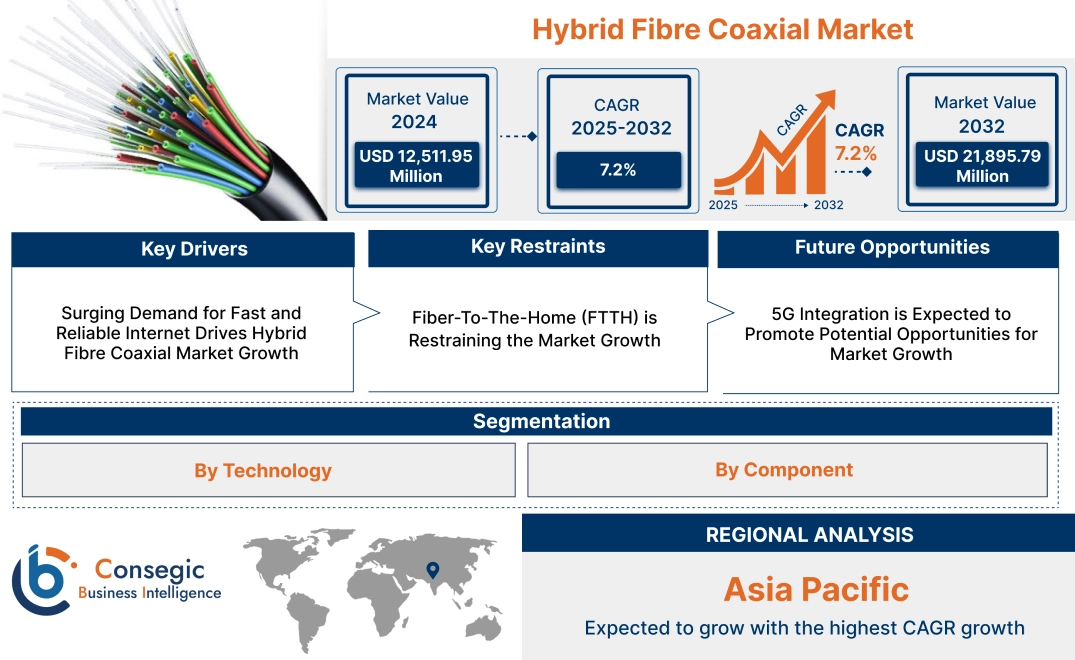
Hybrid Fibre Coaxial Market is estimated to reach over USD 21,895.79 Million by 2032 from a value of USD 12,511.95 Million in 2024 and is projected to grow by USD 13,200.86 Million in 2025, growing at a CAGR of 7.2% from 2025 to 2032.
Hybrid Fibre Coaxial Market Scope & Overview:
Hybrid Fibre-Coaxial is a combination of fibre optic and coaxial cable for efficient connectivity. Additionally, the cables offer long-distance transmission capabilities, low latency, and high bandwidth to ensure data transmission effectively across the network. The fibre optic and coaxial cable combinedly are used in distinct parts of the network to transport broadband content, such as voice, data, and video. Moreover, the HFC cables have the ability to carry remote power cost-effectively and require less labor and resources in turn driving the hybrid fibre coaxial market growth. Further, the ability to carry both power and data within a single cable drives the hybrid fibre coaxial market. Furthermore, characteristics including high-speed internet, scalability, cost-effectiveness, high-speed connectivity, and bi-directional communication among are driving the hybrid fibre coaxial market demand.
Hybrid Fibre Coaxial Market Dynamics - (DRO) :
Key Drivers:
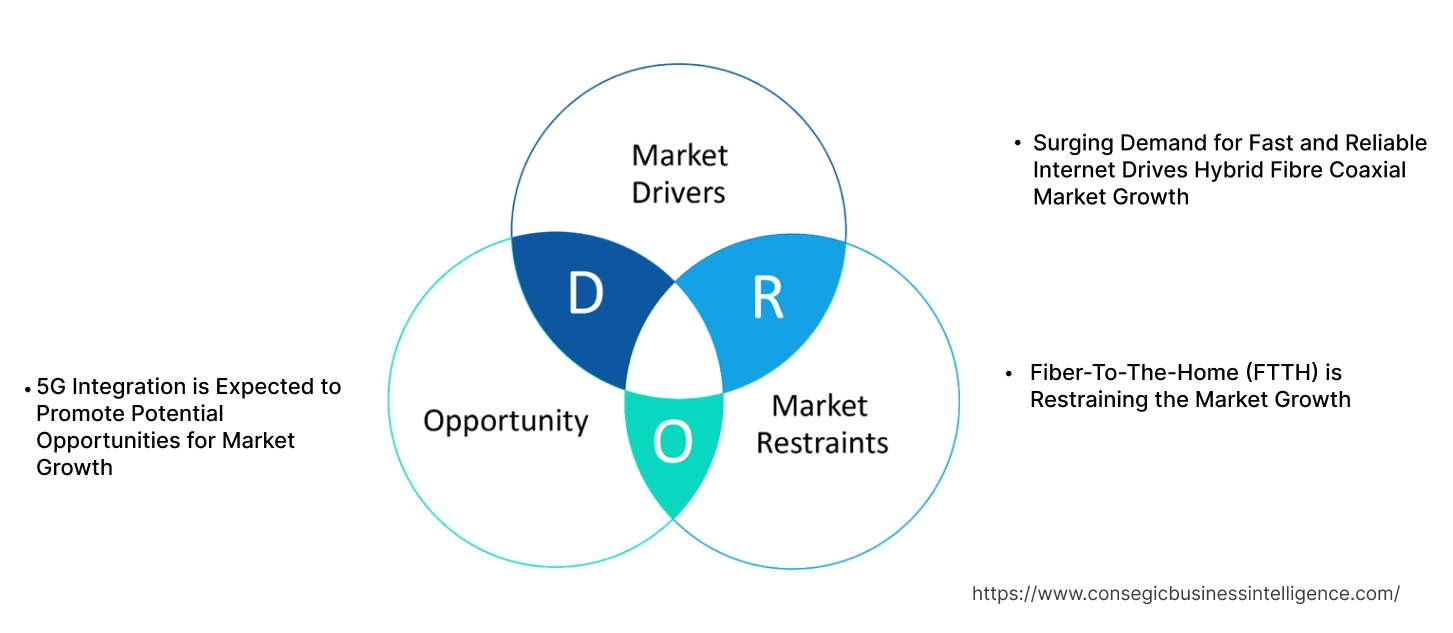
Surging Demand for Fast and Reliable Internet Drives Hybrid Fibre Coaxial Market Growth
The rapidly growing need for streaming, gaming, OTT platforms and remote work is boosting the need for high speed and reliable internet connection which in turn is fueling the hybrid fibre coaxial market demand. Additionally, the cables provide high speed connectivity and internet, driving the market adoption. Furthermore, digitalization across the globe is paving the way for the growth of network infrastructure in turn driving the market development. The system provides higher upload and download speed, which is essential to meet the expectations of consumers.
- For instance, in October 2024, nbn co ltd. achieved download speeds of up to 8.7 Gbps and with upload speeds reaching 1.5 Gbps during a live field trial of hybrid fibre coax network. Additionally, the system improves the performance, increase data capacity, reliability and resiliency.
Therefore, the growing need for faster and reliable internet as well as growing streaming, gaming and others are fueling the hybrid fibre coaxial market.
Key Restraints:
Fiber-To-The-Home (FTTH) is Restraining the Market Growth
FTTH is deployed directly from the service provider to the home, with the highest possible speeds and reliability and HFC deploys fiber to a node within a mile of the home or business. FTTH provide higher speed, lower latency, reliable connection, and improved streaming/ gaming among other in turn hindering the hybrid fibre coaxial market expansion. Additionally, FTTH provide equal upload speed as well as download speed which in turn enhances the work from home experience.
Therefore, the increasing adoption of FTTH is restraining the hybrid fibre coaxial market expansion.
Future Opportunities :
5G Integration is Expected to Promote Potential Opportunities for Market Growth
The 5G network requires robust infrastructure to provide high speed internet and integration with hybrid fibre coaxial system makes an attractive option to deliver high speed, low latency connections. Additionally, the integration reduces operating expenses, improvs throughput and reduces latency in turn propelling the hybrid fibre coaxial market opportunity. Further, the system have the ability to transmit all of the rapidly growing data volumes and growing AR/VR technology is driving the demand for integration between the network and system.
- For instance, in August 2024, AIR5 launched 5G-standards-based solution. The solution is designed for cable operators which provides 5G network architecture to seamlessly share hybrid fibre coax infrastructure with the industry’s current DOCSIS standard.
Hence, the 5G network integration is anticipated to increase the utilization of system in turn promoting hybrid fibre coaxial market opportunities during the forecast period.
Hybrid Fibre Coaxial Market Segmental Analysis :
By Technology:
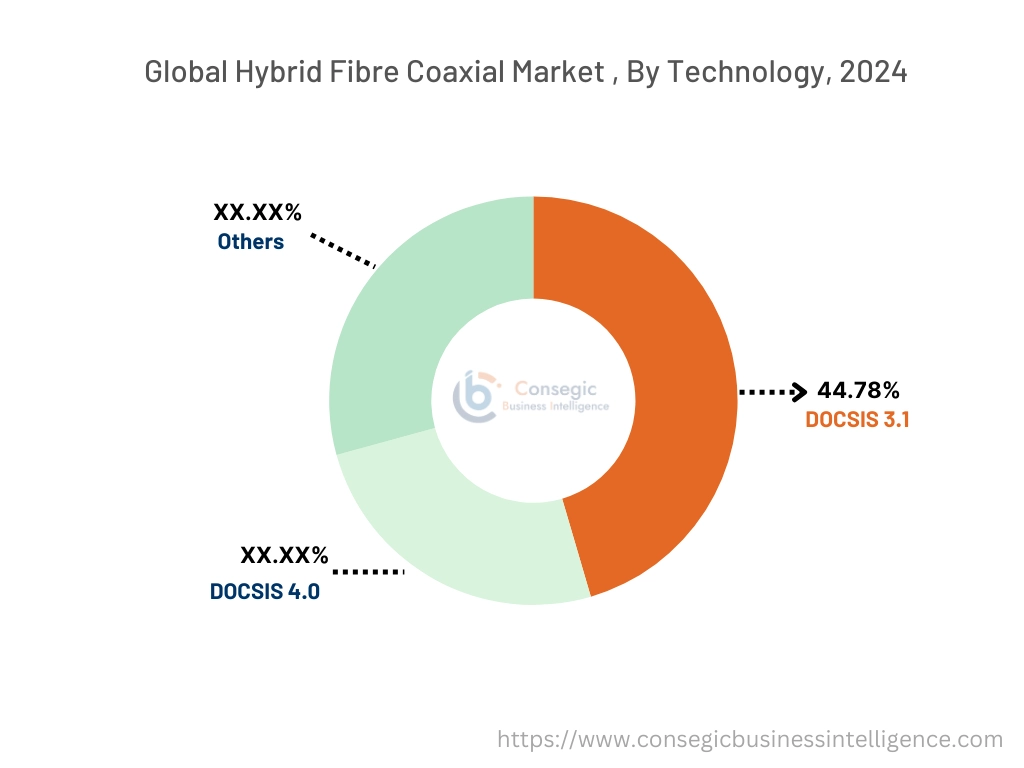
Based on technology, the market is segmented into DOCSIS 4.0, DOCSIS 3.1 and others.
Trends in the Technology:
- The trend towards rising adoption of AR/VR and autonomous vehicles is propelling the need for reduced latency and increased internet speed in turn is fueling the adoption of DOCSIS 4.0 technology.
- The DOCSIS 3.1 technology helps in upgrading network without replacing the existing infrastructure which reduces cost and saves time which in turn drives the hybrid fibre coaxial market trend.
DOCSIS 3.1 accounted for the largest revenue share of 44.78% in the year 2024.
- The growing adoption of 4K video streaming, video conferencing and multi-player online gaming is propelling the need for DOCSIS 3.1 technology embedded into hybrid fibre coax networks.
- The DOCSIS 3.1 technology is standard for hybrid fibre coaxial industry to provide high-quality internet with download speeds of up to 10 Gbps in turn driving the DOCSIS 3.1 technology.
- Further, the technology increases the capacity of existing hybrid fibre coax networks by over 50 percent and reduces latency which in turn fuels the adoption of DOCSIS 3.1 technology.
- For instance, in May 2023, PŸUR’s partnered with CommScope and braun telecom for the setup of DOCSIS 3.1 and R-PHY architecture. The deployment improved operational efficiencies, delivered faster speeds, and provided a better user-experience in Germany.
- Thus, as per the market analysis, the ability to provide faster data rates with reduced latency is driving the DOCSIS 3.1 technology which in turn fuels the hybrid fibre coaxial market size.
DOCSIS 4.0 is anticipated to register the fastest CAGR during the forecast period.
- The technology has the potential to support up to 6 Gbps upstream and up to 10 Gbps speeds downstream, over hybrid fibre coax networks.
- The DOCSIS 4.0 technology supports higher upstream speeds which is suitable for interactive video conferencing, health care applications, IoT and virtual reality among others in turn boosting the hybrid fibre coaxial market share.
- For instance, in October 2023, CommScope launched amplifier and optical node platforms with DOCSIS 4.0 which support up to 1.8 GHz in downstream and up to 684 MHz in upstream. The launch leverages expertise in HFC network design and paves the way for growth of 10G HFC networks.
- Therefore, as per the market analysis, the ability of DOCSIS 4.0 technology to support higher upstream capacity as well as downstream capacity is anticipated to boost the hybrid fibre coaxial market share during the forecast period.
By Component:
Based on material, the market is segmented into fixed wing and rotary wing.
Trends in the aircraft type:
- Rising adoption of fixed wing aircraft due to its longer flight range, higher speed capabilities, and, greater payload capacity.
- Factors including increasing investments in air defence platform and technological advancements in aircraft manufacturing are key determinants for driving the segmental growth of fixed wing and rotary wing aircraft.
The fixed wing segment accounted for the largest revenue in the overall market in 2024.
- Fixed wing aircraft refers to a type of aircraft with wings that remain stationary while generating the aircraft's lift.
- Fixed wing aircraft is capable of flight using wings that produce lift generated by the aircraft's forward air speed and the shape of the wings.
- Moreover, fixed wing aircraft offers a range of benefits including longer flight range and endurance, higher speed capabilities, greater payload capacity, improved stability in turbulent weather conditions, along with relatively lower maintenance and operational cost among others.
- For instance, in November 2022, Aurora Flight Sciences launched its new fixed-wing eVTOL (electric vertical take-off and landing) aircraft that is specifically designed for airborne ISR (intelligence, surveillance, and reconnaissance) missions.
- Therefore, increasing advancements associated with fixed wing aircraft are driving the Hybrid Fibre Coaxial Market growth.
The rotary wing segment is anticipated to register a significant CAGR growth during the forecast period.
- Rotary wing aircraft is a type of aircraft that is completely or partly sustained in the air by lifting rotors revolving around a vertical axis.
- Rotary wing aircraft typically include aircraft which consist of rotors that provide lift throughout the entire flight, such as helicopters, gyrodynes, and autogyros.
- Additionally, the primary benefits of rotary wing aircraft includes its ability to fly vertically, hover over a fixed position at a given height, and take off and land in a very small space.
- For instance, in December 2021, the French Armament General Directorate collaborated with Airbus for the procurement and development of military helicopters. The contract includes the development of 169 military helicopters specifically optimized for deployment in the French armed forces.
- Hence, the increasing development of rotary wing aircraft is anticipated to boost the Hybrid Fibre Coaxial Market size during the forecast period.
Regional Analysis:
The regions covered are North America, Europe, Asia Pacific, Middle East and Africa, and Latin America.
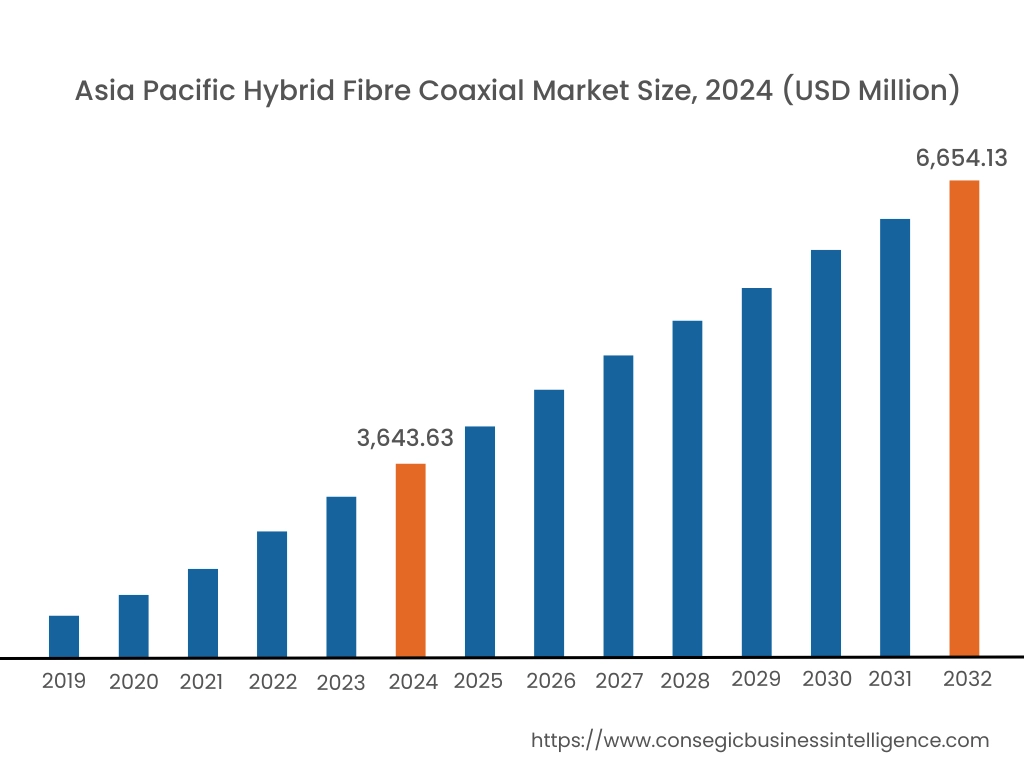
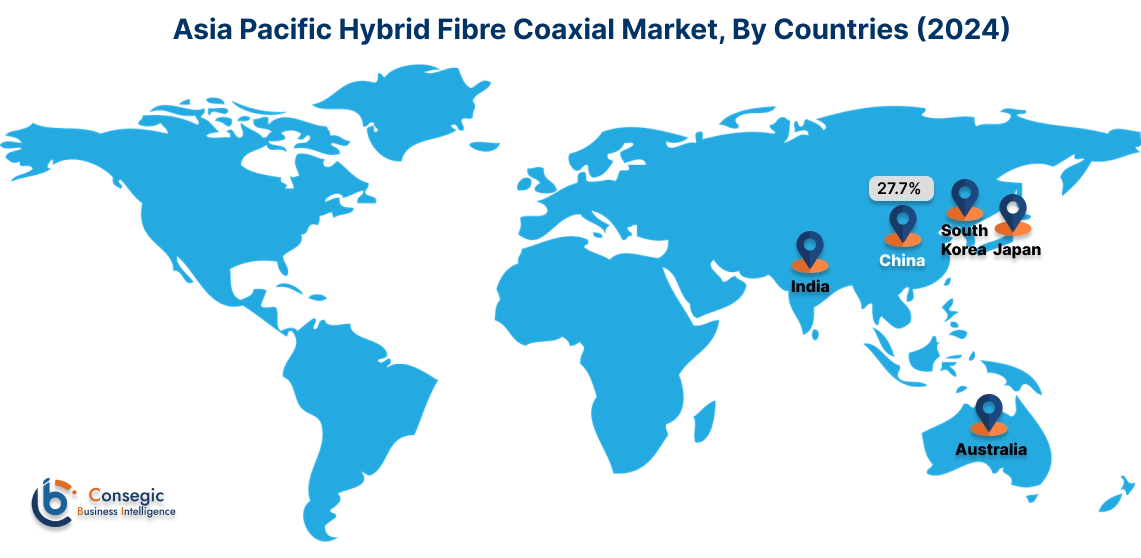
Asia Pacific region was valued at USD 3,643.63 Million in 2024. Moreover, it is projected to grow by USD 3,858.20 Million in 2025 and reach over USD 6,654.13 Million by 2032. Out of this, China accounted for the maximum revenue share of 27.7%. The regions market analysis is mainly driven by rapid penetration of internet in countries such as India and China, among others. Furthermore, affordable broadband service drives the hybrid fibre coaxial market in Asia Pacific region.
- For instance, in September 2023, Link Net, which is a leading provider of hybrid fibre coaxial cable and fiber-to-the-home service partners with Qwilt and Cisco. The partnership aims to extend the service offering to more than 3 million homes across Indonesia.
North America is estimated to reach over USD 6,905.93 Million by 2032 from a value of USD 3,880.03 Million in 2024 and is projected to grow by USD 4,099.49 Million in 2025. The Norh American region's growing demand for high-speed internet offer lucrative growth prospects for the market. Additionally, the growth adoption of streaming services, remote work environment and gaming culture is driving the market.
- For instance, in September 2024, Broadcom, Charter Communications and Comcast collaborated to develop unified DOCSIS chipsets. The chipset is designed to deliver upwards of 25 Gbps speeds over existing networks by expanding the supported bandwidth on hybrid fibre coax networks up to 3 GHz.
The regional trends analysis depicts that the deployment of broadband service in rural and semi-urban areas is driving the market progress in Europe. Additionally, the primary factor driving the market in the Middle East and African region is rapid urbanization as well as need for affordable internet solution. Further, the rising digitalization is paving the way for the progress of market trend in Latin America region.
Top Key Players and Market Share Insights:
The global hybrid fibre coaxial market is highly competitive with major players providing hybrid fibre coaxial to the national and international markets. Key players are adopting several strategies in research and development (R&D), product innovation, and end-user launches to hold a strong position in the hybrid fibre coaxial industry. Key players in the hybrid fibre coaxial market include-
- Shenzhen Sopto Technology Co., Ltd (China)
- VIAVI Solutions Inc. (USA)
- Multicom, Inc. (USA)
- Nics (Turkey)
- Sumlocable Inc. (China)
- HANGZHOU AITE CABLE CO., LTD. (China)
- Chengdu Datang Communication Cable, Co. Ltd. (China)
- Galaxy Electric (China)
- PCT International, Inc. (USA)
- Nokia (Europe)

Recent Industry Developments :
Product launches:
- In September 2023, Orange Belgium launched fiber network with HFC termination due to growing need for faster and reliable internet connectivity and provide gigabit internet speeds nationwide.
Partnerships & Collaborations
- In July 2024, Proximus, Wyre, Telenet and Fiberklaar collaborated by sign memorandum of understanding to provide hybrid fibre coax network of Wyre for approximately 0.7 million homes in Europe.
- In June 2023, Vantiva partnered with Orange Belgium for the deployment of Livebox. The livebox features DOCSIS 3.1 hybrid fibre coax gateway and Wi-Fi 6 extender booster.
- In January 2023, Orange Belgium partnered with Telenet for commercial wholesale agreement for 15 years which include hybrid fibre coax and future fiber to the home technologies.
Hybrid Fibre Coaxial Market Report Insights :
| Report Attributes | Report Details |
| Study Timeline | 2018-2032 |
| Market Size in 2032 | USD 21,895.79 Million |
| CAGR (2025-2032) | 7.2% |
| By Technology |
|
| By Component |
|
| By Region |
|
| Key Players |
|
| North America | U.S. Canada Mexico |
| Europe | U.K. Germany France Spain Italy Russia Benelux Rest of Europe |
| APAC | China South Korea Japan India Australia ASEAN Rest of Asia-Pacific |
| Middle East and Africa | GCC Turkey South Africa Rest of MEA |
| LATAM | Brazil Argentina Chile Rest of LATAM |
| Report Coverage |
|
Key Questions Answered in the Report
How big is the hybrid fibre coaxial market? −
The Hybrid Fibre Coaxial Market is estimated to reach over USD 21,895.79 Million by 2032 from a value of USD 12,511.95 Million in 2024 and is projected to grow by USD 13,200.86 Million in 2025, growing at a CAGR of 7.2% from 2025 to 2032.
What specific segmentation details are covered in the Hybrid fibre coaxial report? +
The hybrid fibre coaxial report includes specific segmentation details for technology, component, and regions.
Which is the fastest segment anticipated to impact the market growth? +
In the hybrid fibre coaxial market, the DOCSIS 4.0 is the fastest-growing segment during the forecast period due to ability to support higher upstream capacity as well as downstream capacity.
Who are the major players in the hybrid fibre coaxial market? +
The key participants in the hybrid fibre coaxial market are Shenzhen Sopto Technology Co., Ltd (China), VIAVI Solutions Inc. (USA), Multicom, Inc. (USA), Nics (Turkey), Sumlocable Inc. (China), HANGZHOU AITE CABLE CO., LTD. (China), Chengdu Datang Communication Cable, Co. Ltd. (China), Galaxy Electric (China), PCT International, Inc. (USA), Nokia (Europe) and others.
What are the key trends in the hybrid fibre coaxial market? +
The hybrid fibre coaxial market is being shaped by several key trends including trend towards rising adoption of AR/VR and autonomous vehicles is propelling the need for reduced latency and increased internet speed are the key trends driving the market.
Overview
Reputation & Certifications


Our Services
- Market Intelligence & Forecasting
- Custom Research Solutions
- Market Entry Strategy
- Competitive Intelligence
- Customer Insights
- Industry Innovation Analysis
- Investment Advisory