Jump to Content
ICP-OES Spectrometer Market - Size, Share, Industry Trends, and Forecasts (2024 - 2031)
ICP-OES Spectrometer Market Size:
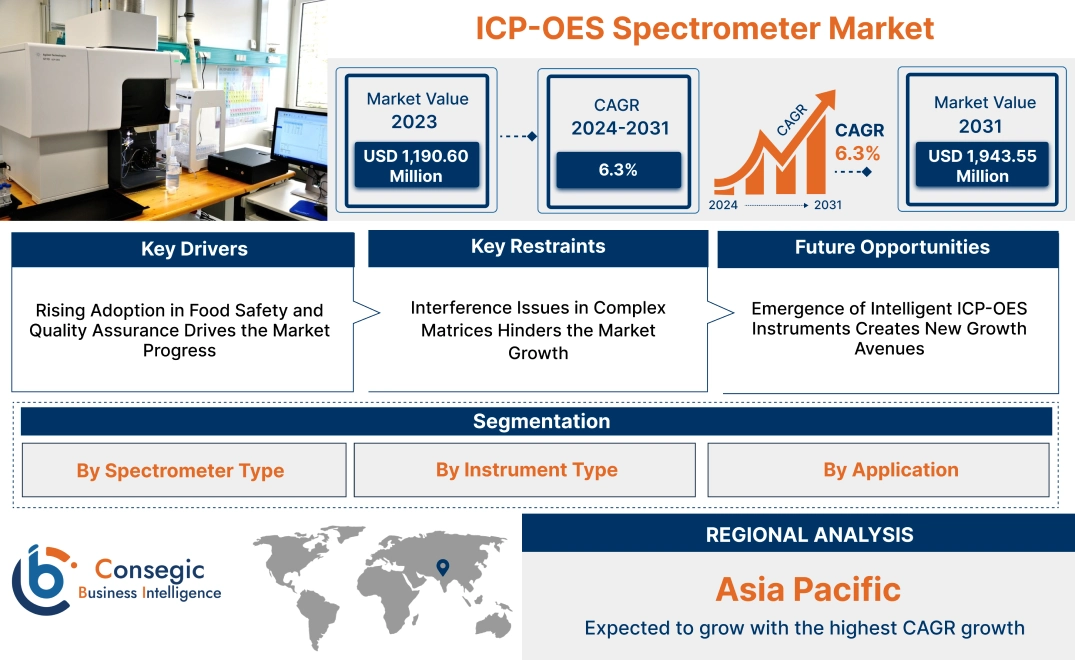
ICP-OES Spectrometer Market size is estimated to reach over USD 1,943.55 Million by 2031 from a value of USD 1,190.60 Million in 2023 and is projected to grow by USD 1,244.61 Million in 2024, growing at a CAGR of 6.3% from 2024 to 2031.
ICP-OES Spectrometer Market Scope & Overview:
An ICP-OES spectrometer, or inductively coupled plasma optical emission spectrometer, is an analytical instrument used to detect and measure the concentration of elements in a sample. It operates by ionizing the sample using plasma and analyzing the emitted light to determine the elemental composition. These spectrometers are widely employed in industries such as environmental monitoring, pharmaceuticals, metallurgy, and food and beverage testing for precise and reliable multi-element analysis.
ICP-OES spectrometers are valued for their high sensitivity, fast evaluation times, and capability to handle a wide range of sample types, including liquids, solids, and gases. These systems are equipped with features such as automated sampling, robust software for data analysis, and advanced detection capabilities, ensuring accuracy and efficiency in laboratory and field applications. Their ability to analyze trace elements makes them critical in quality control, research, and regulatory compliance activities.
End-users of these devices include environmental laboratories, research institutions, industrial manufacturers, and regulatory bodies, where accurate elemental analysis is essential for maintaining quality, safety, and operational efficiency.
ICP-OES Spectrometer Market Dynamics - (DRO) :
Key Drivers:
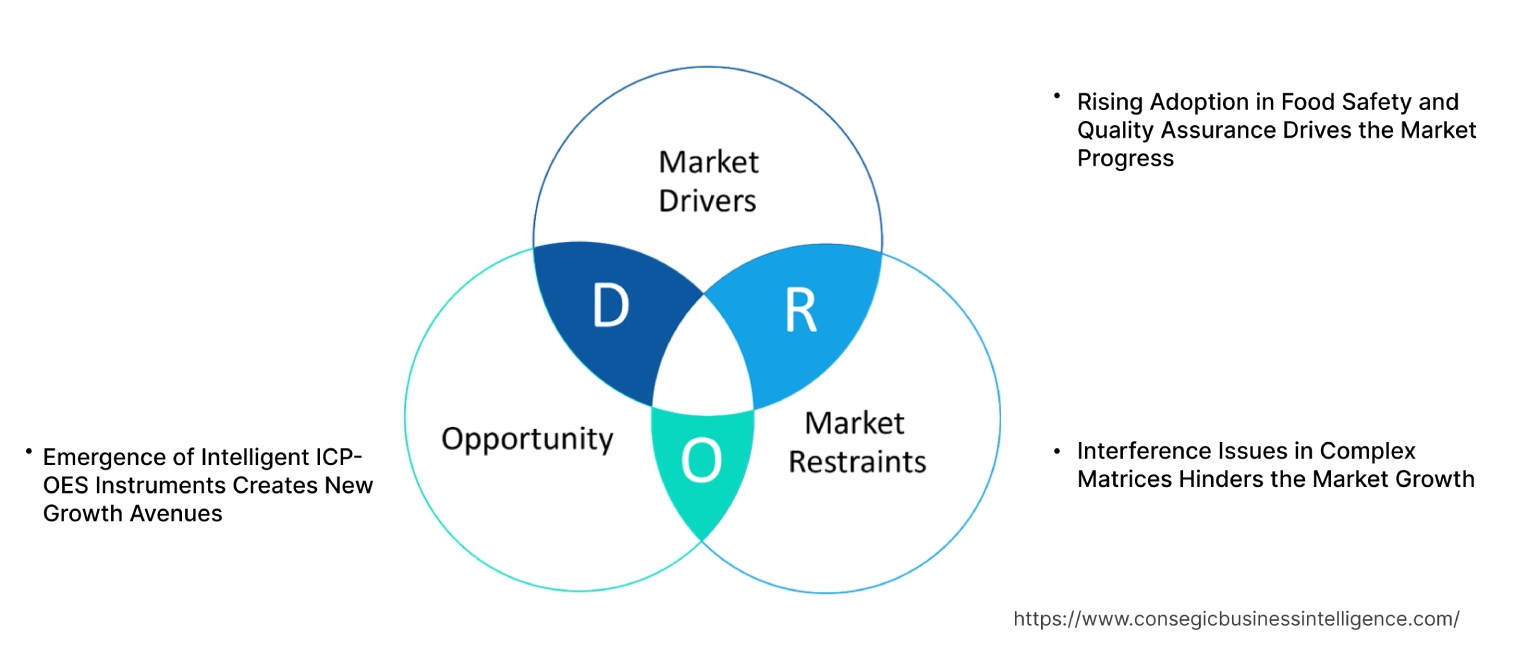
Rising Adoption in Food Safety and Quality Assurance Drives the Market Progress
The growing focus on food safety and quality assurance, spectrometry technologies are playing a crucial role in detecting harmful substances in food products. ICP-OES systems are increasingly used for precise analysis of heavy metals, pesticide residues, and other contaminants, ensuring compliance with international food safety regulations. These systems provide high sensitivity and accuracy, making them essential for identifying trace elements in complex food matrices. Export-driven markets, where stringent quality standards are mandatory, particularly benefit from these advanced analytical tools. Additionally, as consumer awareness of food safety grows, regulatory bodies and manufacturers are adopting these systems to meet evolving compliance requirements. Industries like agriculture, food processing, and packaging are increasingly relying on ICP-OES spectrometers to ensure the safety and quality of their products, driving demand for these solutions globally. This rising adoption highlights the critical role of advanced spectrometry in safeguarding public health and maintaining consumer trust, driving the ICP-OES spectrometer market growth.
Key Restraints:
Interference Issues in Complex Matrices Hinders the Market Growth
ICP-OES systems are renowned for their precision, but analyzing samples with complex matrices pose significant constraints. In such cases, spectral interference and matrix effects often arise, compromising the accuracy of the results. These interferences occur when components within the sample produce overlapping spectral lines or alter the plasma's behavior, leading to measurement errors. Industries dealing with samples containing diverse chemical compositions, such as environmental testing or mining, are particularly affected by these limitations. These challenges not only impact operational efficiency but also necessitate a higher level of technical expertise, creating barriers for widespread adoption. Thus, while ICP-OES systems remain indispensable in precise elemental analysis, their performance in complex matrices requires meticulous calibration and intervention, increasing the analytical burden. Hence, the aforementioned factors limit the ICP-OES spectrometer market demand.
Future Opportunities :
Emergence of Intelligent ICP-OES Instruments Creates New Growth Avenues
The integration of artificial intelligence (AI) and machine learning (ML) into spectrometry systems is paving the way for intelligent ICP-OES instruments. These advanced systems will autonomously identify and rectify potential errors, such as spectral interference or matrix effects, without requiring expert operator intervention. By enabling real-time decision-making and self-calibration, these intelligent instruments reduce the dependency on skilled personnel, making high-precision analysis more accessible to a broader range of industries. This innovation is particularly valuable in laboratories and industrial settings with limited technical expertise, streamlining workflows and improving efficiency. As industries prioritize automation and data-driven operations, the development and adoption of self-regulating ICP-OES systems present significant ICP-OES spectrometer market opportunities.
ICP-OES Spectrometer Market Segmental Analysis :
By Spectrometer Type:
Based on spectrometer type, the market is segmented into sequential ICP-OES and simultaneous ICP-OES.
The simultaneous ICP-OES segment accounted for the largest revenue of the total ICP-OES spectrometer market share in 2023.
- Simultaneous ICP-OES offers high-speed analysis by measuring multiple wavelengths at once, making it ideal for applications requiring rapid and precise results.
- The dominance of this segment is attributed to its extensive use in industries like environmental testing, where time-sensitive results are crucial.
- Advanced capabilities of simultaneous systems ensure greater accuracy and reproducibility, making them popular among laboratories and industrial users.
- Therefore, the widespread adoption of simultaneous ICP-OES systems is driven by their efficiency and compatibility with diverse analytical needs, contributing to the ICP-OES spectrometer market expansion.
The sequential ICP-OES segment is expected to grow at the fastest CAGR during the forecast period.
- Sequential systems are highly cost-effective, making them suitable for small-scale laboratories and research facilities with budget constraints.
- These spectrometers are preferred for applications requiring detailed analysis of individual elements or targeted testing.
- Advancements in sequential systems, including enhanced detection limits and automation, are expanding their usability across industries.
- As per the ICP-OES spectrometer market analysis, increasing adoption of sequential ICP-OES systems in academic and research institutions is boosting their growth trajectory.
By Instrument Type:
Based on instrument type, the market is segmented into benchtop and portable ICP-OES spectrometers.
The benchtop segment accounted for the largest revenue of the total ICP-OES spectrometer market share in 2023.
- Benchtop ICP-OES systems are widely adopted in laboratories due to their robust design, precision, and ability to handle high-volume analyses.
- These systems are extensively used in applications requiring advanced capabilities, such as pharmaceutical testing and industrial quality control.
- The dominance of this segment is driven by its integration with automated features, reducing manual intervention and improving accuracy.
- As per the ICP-OES spectrometer market trends, benchtop systems are increasingly favored for their ability to support complex multi-elemental analysis with high reproducibility.
The portable segment is expected to grow at the fastest CAGR during the forecast period.
- Portable ICP-OES systems are gaining traction for field-based applications, including environmental monitoring and on-site industrial testing.
- Their compact design and ease of use enable mobility without compromising analytical performance.
- These systems are preferred in industries with decentralized operations, such as mining and oil & gas, for real-time sample analysis.
- Increasing investments in portable spectrometer technology are driving their adoption across various sectors, which contribute towards ICP-OES spectrometer market growth.
By Application:
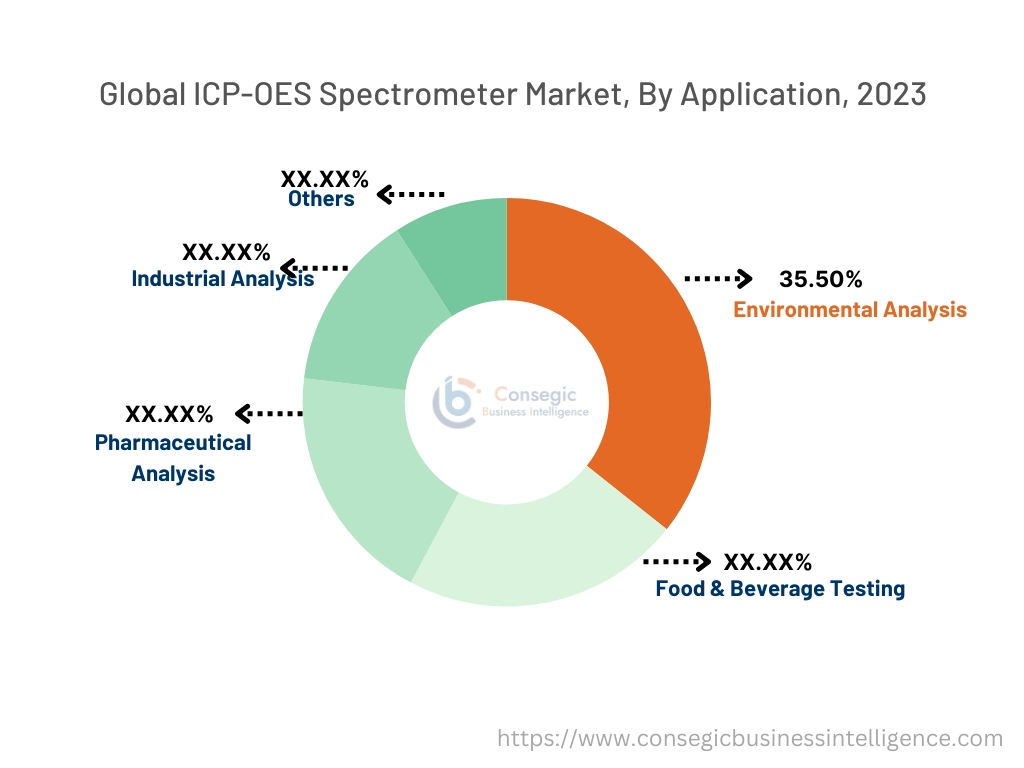
Based on application, the market is segmented into environmental analysis, food & beverage testing, pharmaceutical analysis, industrial analysis, and others.
The environmental analysis segment accounted for the largest revenue of 35.50% share in 2023.
- ICP-OES spectrometers play a critical role in detecting trace elements in water, soil, and air, ensuring compliance with environmental regulations.
- Increasing concerns over pollution and its impact on public health are fueling the adoption of ICP-OES systems for environmental testing.
- The segment’s dominance is attributed to its extensive use in monitoring heavy metals and contaminants in natural resources.
- As per the ICP-OES spectrometer market analysis, government mandates for environmental quality assessment are driving the demand for advanced analytical instruments.
The pharmaceutical analysis segment is expected to grow at the fastest CAGR during the forecast period.
- Pharmaceutical companies utilize ICP-OES spectrometers for quality control, raw material testing, and impurity profiling.
- The segment’s rapid growth is supported by stringent regulatory requirements for elemental analysis in drug manufacturing.
- Advancements in spectrometer technology ensure precise detection of trace elements, enhancing drug safety and efficacy.
- As per the ICP-OES spectrometer market trends, increasing R&D activities in the pharmaceutical industry are boosting the adoption of ICP-OES systems for analytical testing.
Regional Analysis:
The regions covered are North America, Europe, Asia Pacific, the Middle East and Africa, and Latin America.
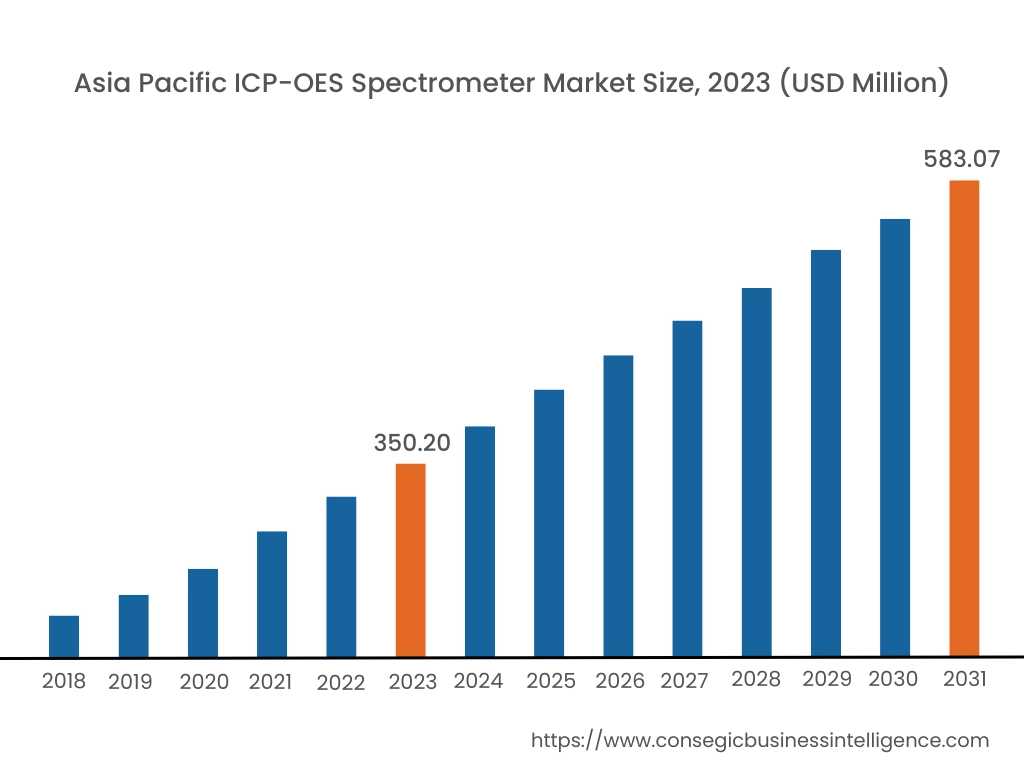
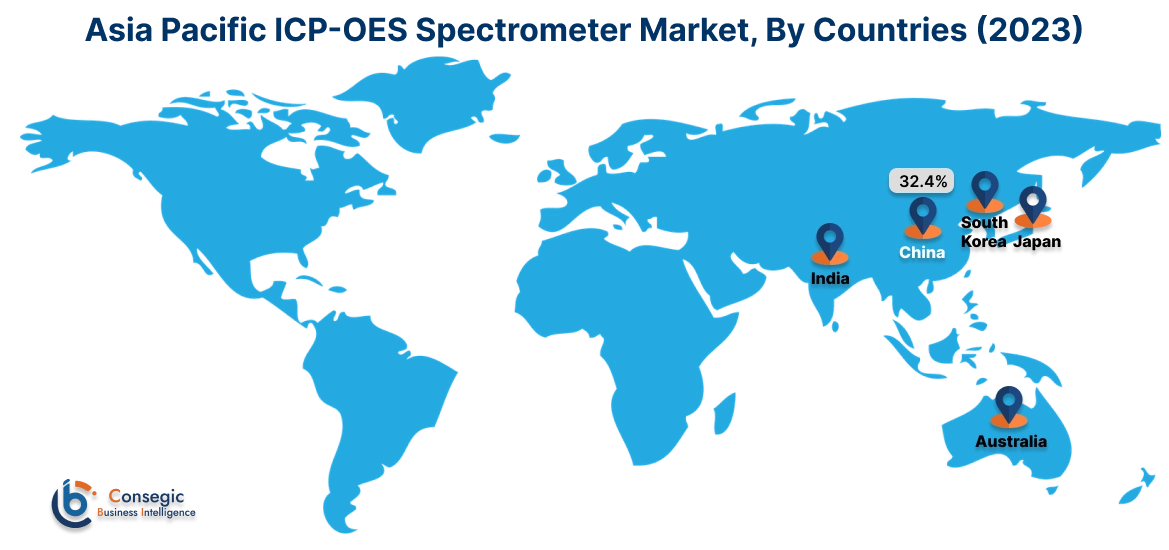
Asia Pacific region was valued at USD 350.20 Million in 2023. Moreover, it is projected to grow by USD 366.69 Million in 2024 and reach over USD 583.07 Million by 2031. Out of which, China accounted for the largest share of 32.4% in 2023. The Asia-Pacific region is experiencing rapid development in the ICP-OES spectrometer market, driven by industrialization and urbanization in countries such as China, Japan, and India. The expansion of the manufacturing sector and the rising demand for quality control have intensified the demand for accurate elemental analysis. Government initiatives promoting industrial efficiency further influence ICP-OES spectrometer market opportunities.
North America is estimated to reach over USD 639.43 Million by 2031 from a value of USD 395.75 Million in 2023 and is projected to grow by USD 413.34 Million in 2024. This region commands a significant portion of the ICP-OES spectrometer market, propelled by stringent environmental regulations and a robust energy industry. The United States, in particular, emphasizes precise measurement of elemental concentrations to ensure compliance with emission standards and optimize industrial processes. A notable trend is the integration of digital technologies and IoT connectivity, enabling real-time data collection and remote monitoring, thereby enhancing operational efficiency and boosting the ICP-OES spectrometer market demand.
Europe represents a substantial share of the global ICP-OES spectrometer market, with countries like Germany, France, and the United Kingdom leading in adoption due to their advanced industrial bases and focus on sustainable practices. The region's commitment to reducing environmental pollutants has led to increased utilization of ICP-OES spectrometers in monitoring and controlling emissions. The market trends indicate a growth in trend towards the deployment of portable ICP-OES spectrometers, offering flexibility across various industrial applications, fueling the ICP-OES spectrometer market expansion.
The Middle East & Africa region shows a growing interest in ICP-OES spectrometer solutions, particularly in the oil and gas sectors. Countries like Saudi Arabia and South Africa are investing in advanced spectrometric technologies to enhance resource management and comply with international standards. The market trends depicts an increasing trend towards adopting stationary ICP-OES spectrometers in large-scale industrial operations.
Latin America is an emerging market for ICP-OES spectrometers, with Brazil and Mexico being key contributors. The region's growing focus on industrial modernization and environmental monitoring has spurred the adoption of spectrometric solutions. Government policies aimed at enhancing industrial infrastructure influence market trends.
Top Key Players and Market Share Insights:
The ICP-OES Spectrometer market is highly competitive with major players providing products and services to the national and international markets. Key players are adopting several strategies in research and development (R&D), product innovation, and end-user launches to hold a strong position in the global ICP-OES Spectrometer market. Key players in the ICP-OES Spectrometer industry include –
- PerkinElmer Inc. (USA)
- Shimadzu Corporation (Japan)
- Teledyne Leeman Labs (USA)
- Analytik Jena AG (Germany)
- Horiba, Ltd. (Japan)
- GBC Scientific Equipment (Australia)
- Thermo Fisher Scientific (USA)
- Agilent Technologies, Inc. (USA)
- SPECTRO Analytical Instruments GmbH (Germany)
Recent Industry Developments :
Product Launches:
- In August 2024, Agilent Technologies introduced the Advanced Dilution System (ADS 2), an intelligent autodilutor designed to enhance laboratory workflows by integrating seamlessly with Agilent's autosamplers, ICP-OES, and ICP-MS instruments. This system aims to boost productivity, reduce costs, and improve efficiency in laboratories, particularly benefiting routine food, environmental, pharmaceutical testing, and advanced materials research such as battery development.
- In November 2023, SPECTRO Analytical Instruments launched the enhanced SPECTRO GENESIS ICP-OES, offering improved sensitivity, compact design, and advanced technology. Featuring dual side-on interface (DSOI) plasma observation, it ensures high accuracy across diverse applications, from wastewater to biodiesel. The system incorporates CMOS detectors, a robust 1700 W generator, and user-friendly ergonomics for efficient operation. Its compact design and energy-saving features make it an ideal, cost-effective solution for environmental, industrial, and academic elemental analysis.
ICP-OES Spectrometer Market Report Insights :
| Report Attributes | Report Details |
| Study Timeline | 2018-2031 |
| Market Size in 2031 | USD 1,943.55 Million |
| CAGR (2024-2031) | 6.3% |
| By Spectrometer Type |
|
| By Instrument Type |
|
| By Application |
|
| By Region |
|
| Key Players |
|
| North America | U.S. Canada Mexico |
| Europe | U.K. Germany France Spain Italy Russia Benelux Rest of Europe |
| APAC | China South Korea Japan India Australia ASEAN Rest of Asia-Pacific |
| Middle East and Africa | GCC Turkey South Africa Rest of MEA |
| LATAM | Brazil Argentina Chile Rest of LATAM |
| Report Coverage |
|
Key Questions Answered in the Report
What is the size of the ICP-OES Spectrometer Market? −
ICP-OES Spectrometer Market size is estimated to reach over USD 1,943.55 Million by 2031 from a value of USD 1,190.60 Million in 2023 and is projected to grow by USD 1,244.61 Million in 2024, growing at a CAGR of 6.3% from 2024 to 2031.
What are the key segments of the ICP-OES Spectrometer Market? +
The ICP-OES Spectrometer Market is segmented based on spectrometer type, instrument type, application, and region. The key spectrometer types include sequential ICP-OES and simultaneous ICP-OES. The instrument types are benchtop and portable ICP-OES spectrometers. The market is also segmented by application, with prominent sectors including environmental analysis, food and beverage testing, pharmaceutical analysis, industrial analysis, and others. Geographically, the market is divided into regions such as Asia-Pacific, Europe, North America, Latin America, and the Middle East & Africa.
Which is the fastest-growing segment in the ICP-OES Spectrometer Market? +
The sequential ICP-OES segment is expected to grow at the fastest CAGR during the forecast period. This is mainly due to its cost-effectiveness, making it suitable for small-scale laboratories and research institutions, alongside advancements in automation that are expanding its usability across various industries.
Who are the top key players in the ICP-OES Spectrometer Market? +
The ICP-OES Spectrometer Market is highly competitive, with key players including PerkinElmer Inc. (USA), Shimadzu Corporation (Japan), GBC Scientific Equipment (Australia), Thermo Fisher Scientific (USA), Agilent Technologies, Inc. (USA), SPECTRO Analytical Instruments GmbH (Germany), Teledyne Leeman Labs (USA), Analytik Jena AG (Germany), and Horiba, Ltd. (Japan).
Overview
Reputation & Certifications


Our Services
- Market Intelligence & Forecasting
- Custom Research Solutions
- Market Entry Strategy
- Competitive Intelligence
- Customer Insights
- Industry Innovation Analysis
- Investment Advisory