Jump to Content
Indoor Farming Robots Market - Size, Share, Industry Trends, and Forecasts (2024 - 2031)
Indoor Farming Robots Market Size:
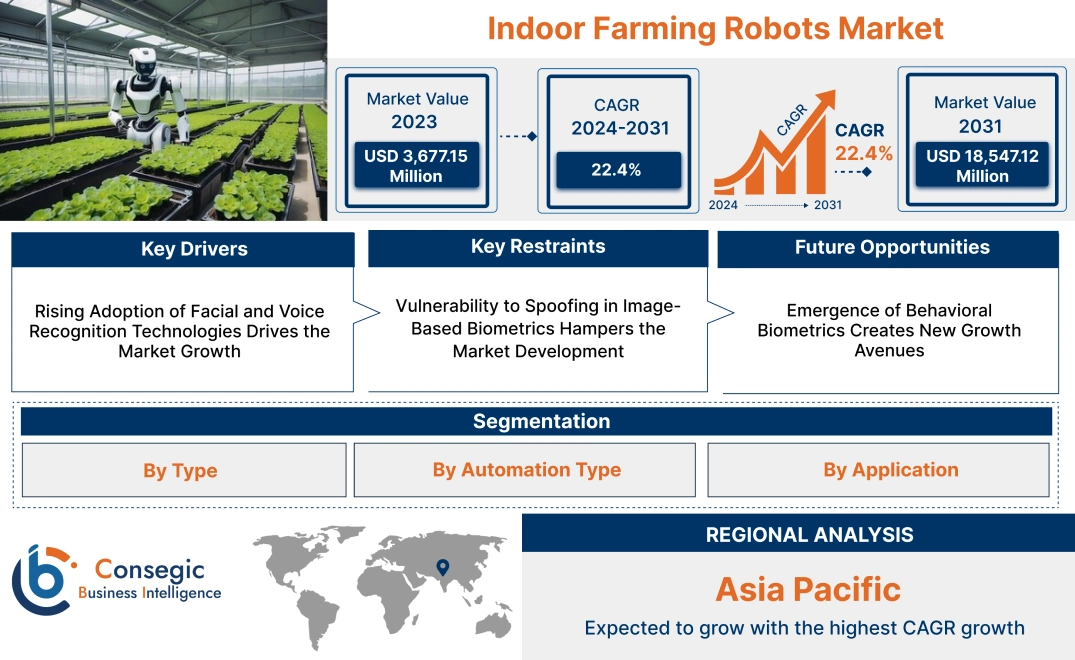
Indoor Farming Robots Market size is estimated to reach over USD 18,547.12 Million by 2031 from a value of USD 3,677.15 Million in 2023 and is projected to grow by USD 4,435.97 Million in 2024, growing at a CAGR of 22.4% from 2024 to 2031.
Indoor Farming Robots Market Scope & Overview:
Indoor farming robots are advanced automated systems designed to assist in various agricultural activities within controlled indoor environments. These robots are equipped with technologies such as sensors, cameras, and AI-driven algorithms to perform tasks such as planting, monitoring, harvesting, and maintaining crops with precision and efficiency. They are engineered to optimize resource utilization and enhance productivity in indoor farming setups like vertical farms, greenhouses, and hydroponic systems.
These robots come in various configurations, including autonomous mobile units, robotic arms, and drones, each tailored to specific farming needs. They integrate seamlessly with indoor farming systems to monitor crop health, manage irrigation, and apply fertilizers with minimal human intervention. Additionally, indoor farming robots are built to operate efficiently in confined spaces, offering scalability and adaptability for small and large farming operations.
End-users of indoor farming robots include commercial indoor farming operators, research institutions, and agricultural technology providers. These systems play a critical role in automating repetitive tasks, reducing labor costs, and ensuring consistent crop quality in controlled environments.
Indoor Farming Robots Market Dynamics - (DRO) :
Key Drivers:
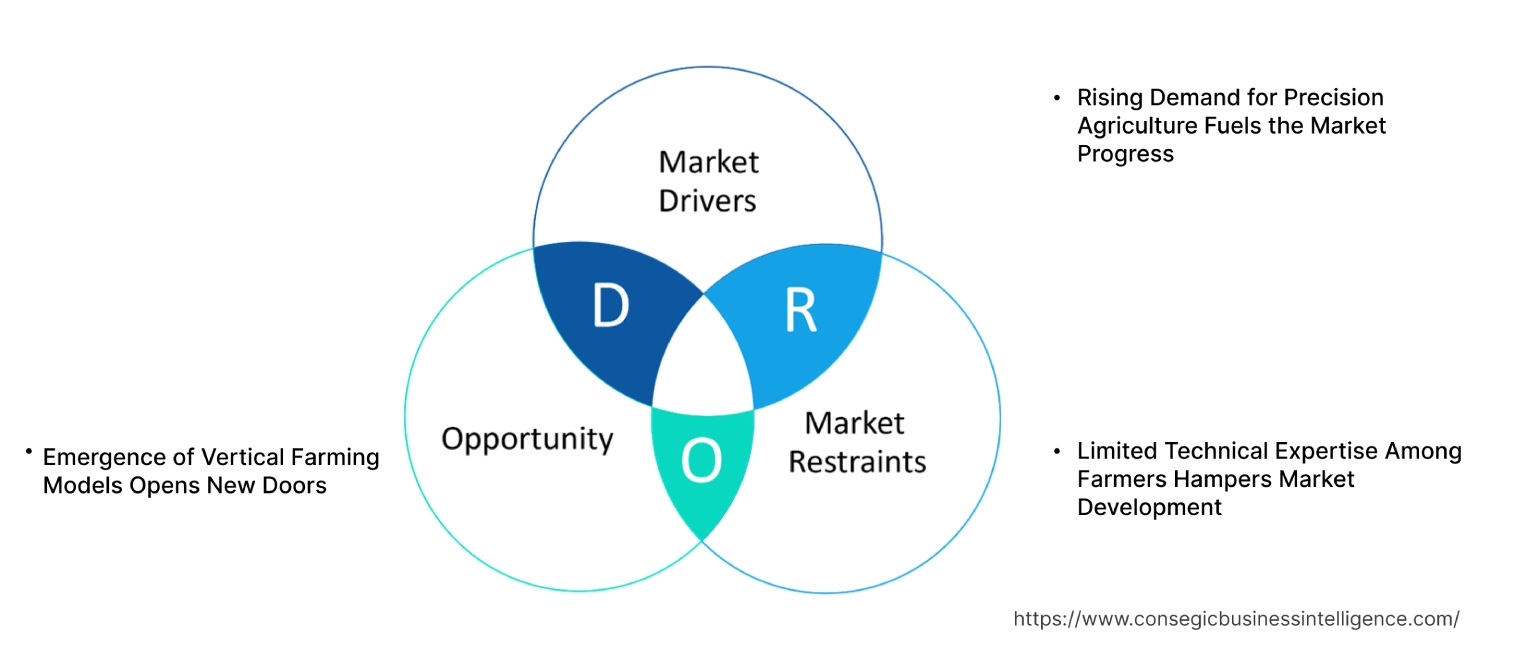
Rising Demand for Precision Agriculture Fuels the Market Progress
The rising demand for precision agriculture is driving the adoption of advanced robotic solutions in indoor farming. With limited arable land and the need to optimize agricultural output, precision techniques have become critical for maximizing yield. Indoor farming robots are equipped with advanced technologies, including computer vision, artificial intelligence, and machine learning, to perform essential tasks such as planting, monitoring, and harvesting with unmatched accuracy. These systems detect plant health, track growth patterns, and apply resources like water and nutrients efficiently, minimizing waste and enhancing productivity. The ability to automate labor-intensive tasks while maintaining consistent quality ensures sustainable crop management. As the agricultural industry shifts towards sustainability and resource optimization, the demand for indoor farming robots to implement precision agriculture practices continues to grow, particularly in urban and resource-constrained environments. Thus, the aforementioned factors proliferate the indoor farming robots market growth.
Key Restraints :
Limited Technical Expertise Among Farmers Hampers Market Development
Limited technical expertise among farmers and operators poses a significant barrier to adopting advanced indoor farming robotics. Many farmers lack the knowledge to effectively operate, troubleshoot, and maintain these sophisticated systems, which rely on technologies such as artificial intelligence, machine learning, and computer vision. This skills gap forces reliance on specialized technicians for installation, maintenance, and repairs, significantly increasing operational costs. For small and medium-scale indoor farms, the additional expenses associated with training or hiring technical staff strain budgets and hinder profitability. Moreover, the complexity of robotic systems leads to downtime during technical failures, further impacting productivity. As advanced automation continues to penetrate the agricultural industry, addressing the technical expertise constraints becomes essential to facilitate broader adoption and ensure efficient utilization of indoor farming robots, particularly in cost-sensitive farming operations. Thus, the above-mentioned factors are limiting the indoor farming robots market demand.
Future Opportunities :
Emergence of Vertical Farming Models Opens New Doors
The emergence of vertical farming models is creating substantial growth opportunities for robotic systems tailored to these innovative agricultural setups. Vertical Farming, characterized by growing crops in stacked layers within controlled environments, optimizes space utilization, particularly in urban areas where land is limited. Robots designed for vertical farms facilitate precise planting, real-time monitoring of crop health, and automated harvesting, reducing labor dependency and improving operational efficiency. Advanced technologies such as AI, machine vision, and robotics enable consistent resource allocation, such as water and nutrients, ensuring higher yield and better quality produce. These systems also address challenges associated with traditional farming, such as unpredictable weather and pest management, making them ideal for urban food production. As urbanization accelerates and the demand for sustainable farming practices grows, robotic solutions for vertical farming are expected to play a pivotal role in revolutionizing agriculture, creating significant indoor farming robots market opportunities.
Indoor Farming Robots Market Segmental Analysis :
By Type:
Based on type, the market is segmented into Robot Gripper, Cutting Robot, Robotic Fodder, Material Handling Robot, Incubators, Monitoring Drones, and Others.
The Robot Gripper segment held the largest revenue of the total indoor farming robots market share in 2023.
- Robot grippers are integral for indoor farming processes, especially in crop harvesting and material handling, as they ensure precise and gentle handling of delicate crops.
- Advanced robot grippers are equipped with AI and machine learning capabilities, enabling them to adapt to various crop types and reduce manual labor.
- The increased adoption of robot grippers is driven by their ability to enhance operational efficiency and reduce post-harvest losses in indoor farming environments.
- Thus, the analysis of segmental trends depicts that the dominance of this segment reflects the growing need for automation tools that streamline repetitive tasks and improve productivity in controlled farming settings, contributing to the indoor farming robots market expansion.
The Monitoring Drones segment is expected to grow at the fastest CAGR during the forecast period.
- Monitoring drones are being increasingly deployed to survey and analyze crop health, soil conditions, and environmental factors in real-time.
- These drones provide actionable insights through high-resolution imaging and advanced analytics, improving decision-making for crop management.
- The rapid progress of this segment is fueled by the rising adoption of precision farming techniques and the integration of IoT-enabled monitoring systems.
- As per market analysis, the adoption of monitoring drones is expected to expand further due to their efficiency in reducing labor costs and enhancing farming outcomes, which further encourages the indoor farming robots market demand.
By Automation Type:
Based on automation type, the market is segmented into Fully Autonomous and Semi-Autonomous systems.
The Fully Autonomous segment accounted for the largest revenue of the total indoor farming robots market share in 2023.
- Fully autonomous systems operate with minimal human intervention, making them ideal for large-scale indoor farming operations that prioritize efficiency and precision.
- These systems leverage AI and robotics to perform tasks such as seeding, fertilizing, and harvesting, significantly reducing manual labor and associated costs.
- The dominance of this segment reflects the increasing preference for advanced automation solutions that ensure consistent crop quality and maximize yield.
- As per the indoor farming robots market analysis, fully autonomous systems are widely adopted due to their ability to adapt to dynamic environmental conditions and optimize resource utilization in controlled farming setups.
The Semi-Autonomous segment is expected to grow at the fastest CAGR during the forecast period.
- Semi-autonomous systems provide flexibility by allowing human operators to control and adjust robotic functions for complex tasks.
- These systems are particularly beneficial for small-scale farmers and urban farming initiatives, where full automation may not be economically viable.
- The growth of this segment is driven by advancements in robotics and AI technologies, which enhance the efficiency and reliability of semi-autonomous systems.
- As per market trends, the segment’s rapid growth is supported by its affordability and ease of integration into existing indoor farming setups, fueling the indoor farming robots market growth.
By Application:
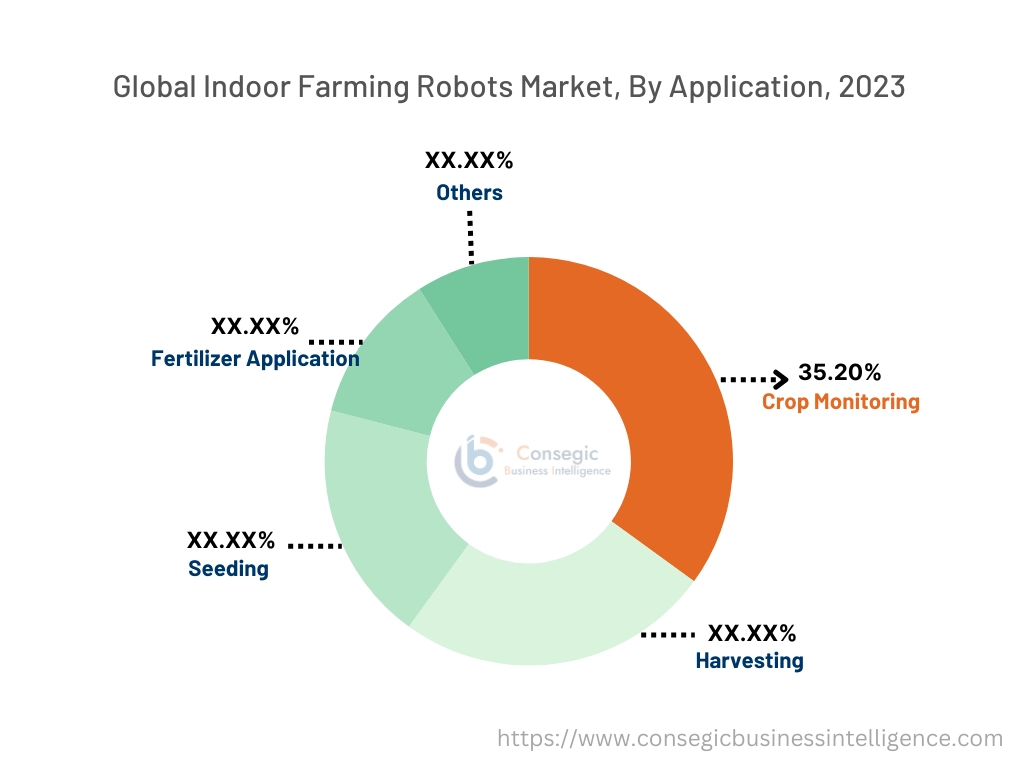
Based on application, the market is segmented into Crop Monitoring, Harvesting, Seeding, Fertilizer Application, and Others.
The Crop Monitoring segment accounted for the largest revenue of 35.20% share in 2023.
- Crop monitoring robots and drones utilize advanced imaging technologies and IoT sensors to assess plant health, detect diseases, and monitor environmental factors.
- The rapid growth of this segment is driven by the increasing adoption of data-driven farming practices and the integration of AI-based analytics.
- Crop monitoring systems enable farmers to optimize irrigation, fertilization, and pest control strategies, enhancing overall crop yield and quality.
- As per market analysis, the segment’s growth is fueled by the need for precision farming solutions that support sustainable agricultural practices in indoor environments, which facilitates the indoor farming robots market expansion.
The Harvesting segment is expected to grow at the fastest CAGR during the forecast period.
- Harvesting robots are equipped with advanced sensors and AI to identify and pick ripe crops with precision, reducing wastage and improving productivity.
- These robots are widely used in indoor farming to handle high-value crops, ensuring consistent quality and minimizing labor costs.
- The dominance of this segment reflects the increasing focus on automating labor-intensive tasks in controlled farming environments.
- As per the indoor farming robots market trends, harvesting robots are becoming indispensable tools in indoor farming, enabling growers to meet market needs for fresh produce efficiently.
Regional Analysis:
The regions covered are North America, Europe, Asia Pacific, the Middle East and Africa, and Latin America.
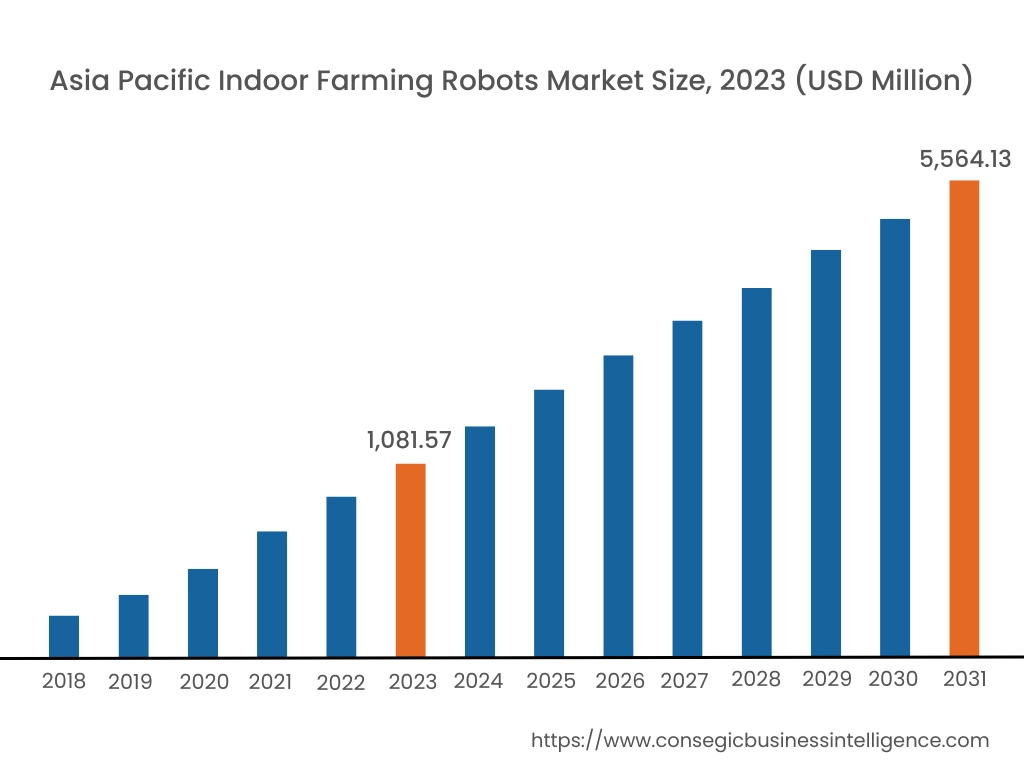
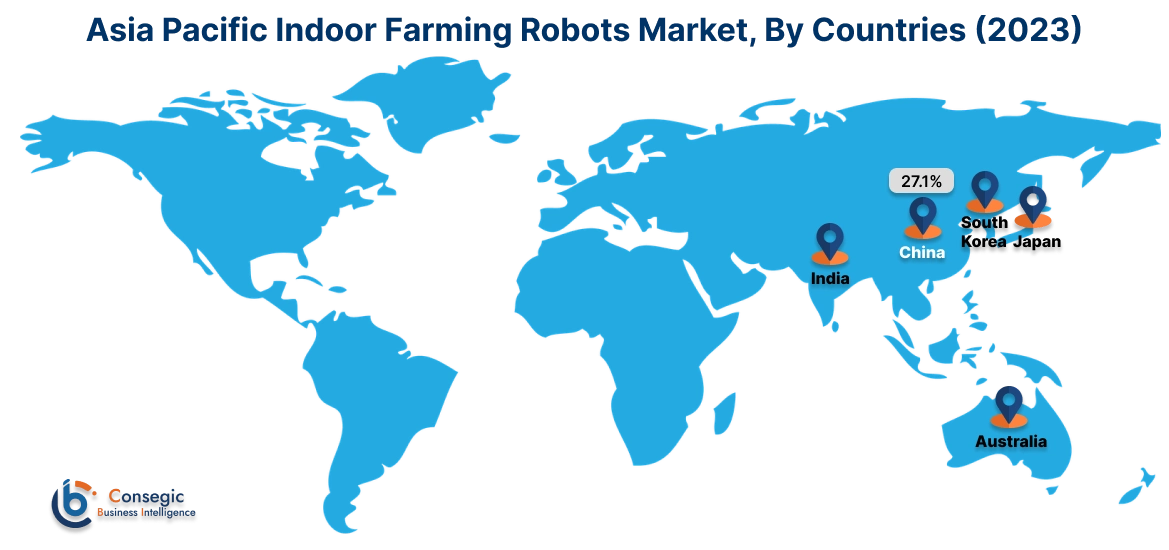
Asia Pacific region was valued at USD 1,081.57 Million in 2023. Moreover, it is projected to grow by USD 1,306.93 Million in 2024 and reach over USD 5,564.13 Million by 2031. Out of these, China accounted for the largest share of 27.1% in 2023. The Asia-Pacific region is witnessing rapid adoption of indoor farming robots, propelled by urbanization and the necessity for food security. Countries such as Japan and Singapore are investing in robotic solutions to address limited arable land and to ensure a steady food supply. As per the indoor farming robots market analysis, a significant trend includes the development of multi-functional robots that perform tasks ranging from planting to harvesting, thereby streamlining operations.
North America is estimated to reach over USD 6,102.00 Million by 2031 from a value of USD 1,222.25 Million in 2023 and is projected to grow by USD 1,473.22 Million in 2024. This region is at the forefront of adopting indoor farming robots, driven by a combination of labor shortages and a strong emphasis on sustainable agriculture. The United States, in particular, has seen a surge in the integration of robotic systems within indoor farming setups, aiming to enhance productivity and reduce reliance on manual labor. A notable trend is the collaboration between technology firms and agricultural producers to develop customized robotic solutions that cater to specific crop requirements, which drives the indoor farming robots market opportunities.
European countries are increasingly incorporating robotics into indoor farming, motivated by the pursuit of efficiency and environmental sustainability. Nations like the Netherlands and Germany are leveraging advanced robotic technologies to optimize space utilization and minimize resource consumption in controlled environments. Recent analysis indicates a growing trend towards the use of AI-powered robots capable of real-time monitoring and decision-making, thereby enhancing crop management practices.
In the Middle East, indoor farming robots are gaining traction as a means to overcome harsh climatic conditions and water scarcity. The United Arab Emirates, for instance, is implementing robotic systems in vertical farms to boost local food production. The indoor farming robots market trends show a shift towards integrating robotics with hydroponic systems to maximize yield while conserving resources.
Latin American countries are exploring the potential of indoor farming robots to enhance agricultural productivity and meet growing food demands. Brazil and Mexico are initiating projects that incorporate robotics into greenhouse farming, aiming to improve efficiency and crop quality. A notable trend is the focus on developing cost-effective robotic solutions tailored to local crops and conditions.
Top Key Players and Market Share Insights:
The Indoor Farming Robots market is highly competitive with major players providing products and services to the national and international markets. Key players are adopting several strategies in research and development (R&D), product innovation, and end-user launches to hold a strong position in the global Indoor Farming Robots market. Key players in the Indoor Farming Robots industry include –
- FarmBot Inc. (USA)
- Scythe Robotics (USA)
- Harvest Automation (USA)
- Visser Horti Systems BV (Netherlands)
- Postscapes (USA)
- OnRobot (Denmark)
- Javo (Netherlands)
- Root AI (USA)
- Metomotion (Israel)
Indoor Farming Robots Market Report Insights :
| Report Attributes | Report Details |
| Study Timeline | 2018-2031 |
| Market Size in 2031 | USD 18,547.12 Million |
| CAGR (2024-2031) | 22.4% |
| By Type |
|
| By Automation Type |
|
| By Application |
|
| By Region |
|
| Key Players |
|
| North America | U.S. Canada Mexico |
| Europe | U.K. Germany France Spain Italy Russia Benelux Rest of Europe |
| APAC | China South Korea Japan India Australia ASEAN Rest of Asia-Pacific |
| Middle East and Africa | GCC Turkey South Africa Rest of MEA |
| LATAM | Brazil Argentina Chile Rest of LATAM |
| Report Coverage |
|
Key Questions Answered in the Report
How big is the Indoor Farming Robots Market? −
Indoor Farming Robots Market size is estimated to reach over USD 18,547.12 Million by 2031 from a value of USD 3,677.15 Million in 2023 and is projected to grow by USD 4,435.97 Million in 2024, growing at a CAGR of 22.4% from 2024 to 2031.
What specific segmentation details are covered in the Indoor Farming Robots Market report? +
The market is segmented based on type (Robot Gripper, Cutting Robot, Robotic Fodder, Material Handling Robot, Incubators, Monitoring Drones, and Others), automation type (Fully Autonomous and Semi-Autonomous systems), application (Crop Monitoring, Harvesting, Seeding, Fertilizer Application, and Others), and region (Asia-Pacific, Europe, North America, Latin America, and the Middle East & Africa).
Which is the fastest-growing segment in the Indoor Farming Robots Market? +
The fastest-growing segment in the Indoor Farming Robots Market is the Monitoring Drones segment, driven by the increasing adoption of precision farming techniques and the integration of IoT-enabled monitoring systems, offering real-time crop health analysis and enhancing farming outcomes.
Who are the major players in the Indoor Farming Robots Market? +
The major players in the Indoor Farming Robots Market include FarmBot Inc. (USA), Scythe Robotics (USA), OnRobot (Denmark), Javo (Netherlands), Root AI (USA), Metomotion (Israel), Harvest Automation (USA), Visser Horti Systems BV (Netherlands), and Postscapes (USA).
Overview
Reputation & Certifications


Our Services
- Market Intelligence & Forecasting
- Custom Research Solutions
- Market Entry Strategy
- Competitive Intelligence
- Customer Insights
- Industry Innovation Analysis
- Investment Advisory