Jump to Content
Vrf Systems Market Size & Industry Share - Growth Trends & Forecasts (2026 - 2034)
VRF Systems Market Size:
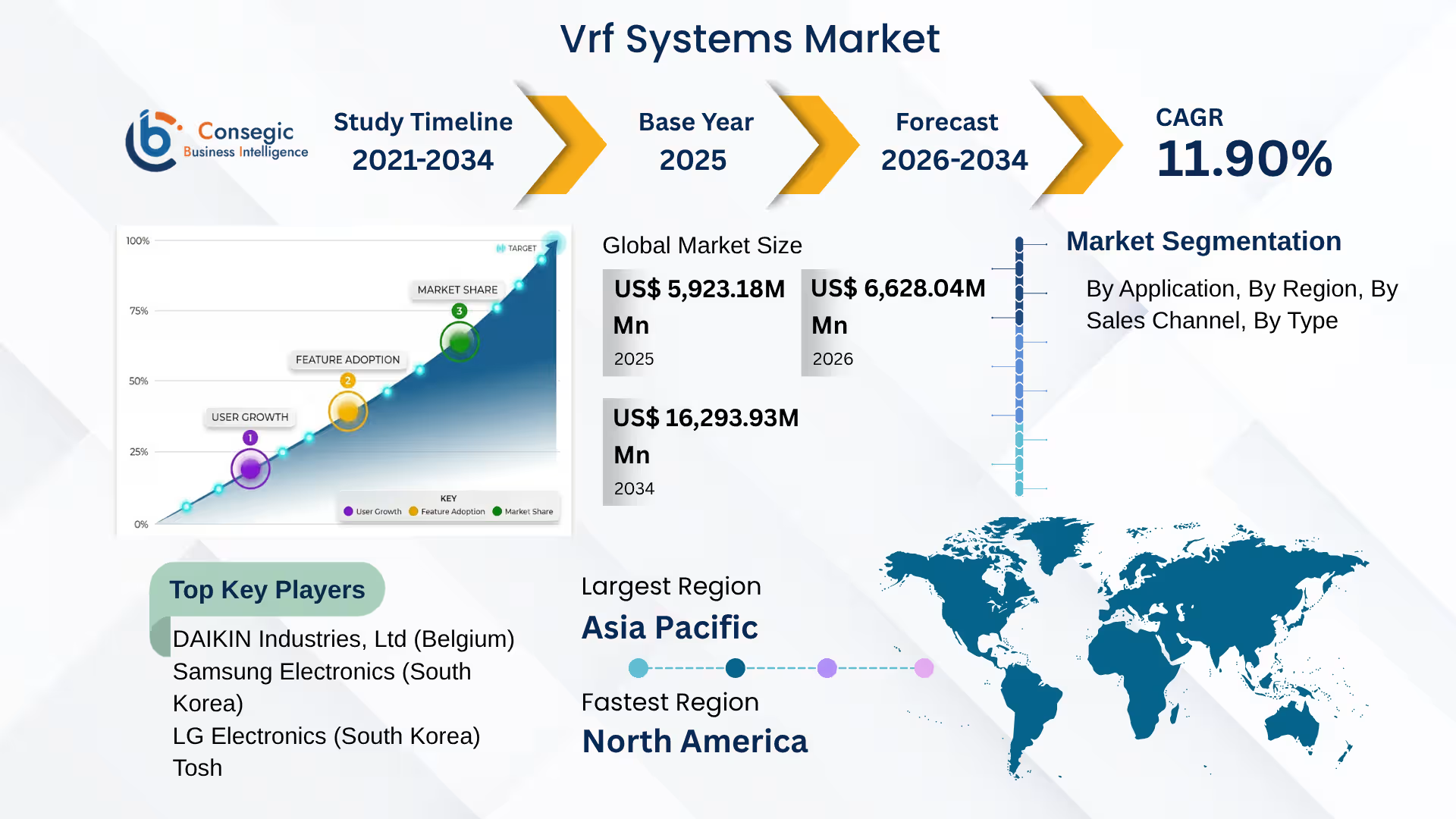
VRF Systems Market size is estimated to reach over 16,293.93 (US$M) by 2034 from a value of 5,923.18 (US$M) in 2025 and is projected to grow by 6,628.04 (US$M) in 2026, growing at a CAGR of 11.9% from 2026 to 2034, according to a recent report from Consegic Business Intelligence.
Key Market Insights & Trends:
- The market is expected to expand at a CAGR of 11.9% from 2024 to 2031.
- Asia-Pacific accounted for over 32.9% share in 2023, led by China.
- North America market is forecasted to reach USD 15,446.19 Million by 2031.
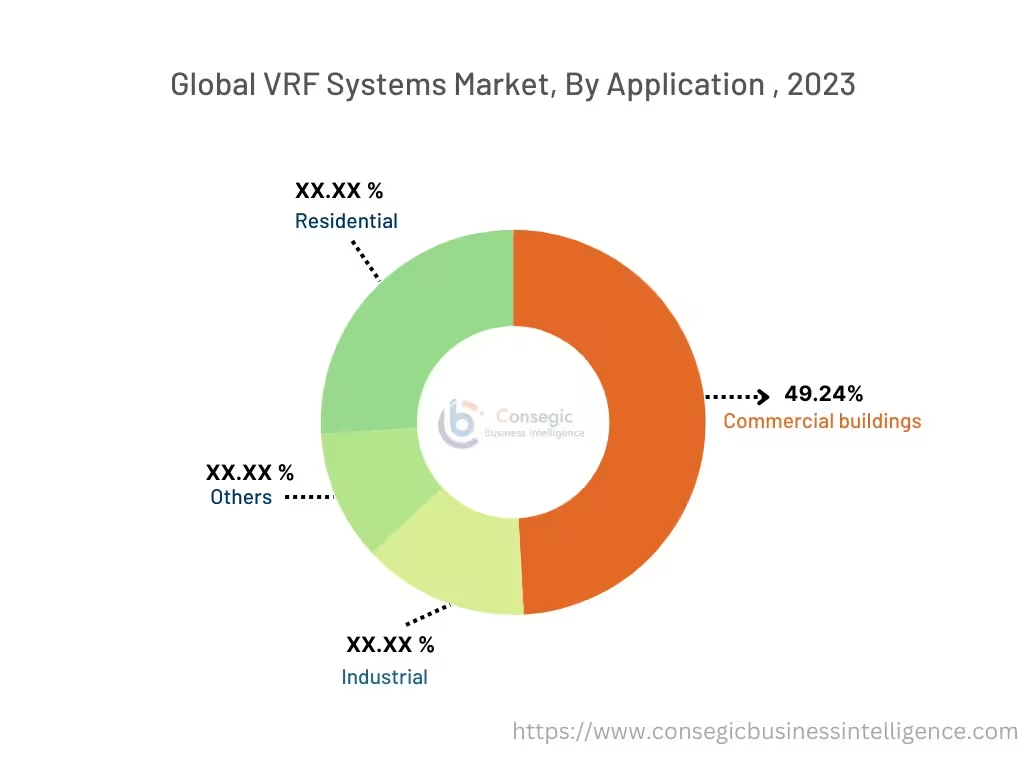
- Commercial buildings dominated with 49.24% market share in 2023.
- Heat Pump VRF systems held the largest segment share in 2023.
- Heat Recovery VRF is projected to be the fastest-growing segment.
- Urbanization is a primary driver, boosting HVAC installations across high-density cities.
- Installation costs range between USD 10,000 to USD 100,000, limiting adoption in cost-sensitive segments.
- AI-integrated VRF systems are emerging as a key innovation trend in smart buildings.
- Online sales channels are witnessing the fastest growth due to rising e-commerce adoption.
- Low-GWP refrigerants and sustainability regulations are reshaping product innovation strategies.
VRF Systems Market Scope & Overview:
Variable Refrigerant Flow (VRF) system refers to an air conditioning system that can cool or heat multiple rooms, a technology that circulates only the minimum amount of refrigerant needed during a single heating or cooling period. Additionally, this system offers a range of benefits including improved comfort, saving energy, ease of installation, and customizable operation, it consists of groups of smaller air handlers that can be individually controlled and piped back into the system. The above-mentioned benefits are primary determinants for deriving the expansion of the VRF systems market. Key market trends include increasing urbanization, integration with AI-driven building automation, and growing demand for sustainable infrastructure. Asia-Pacific dominates the market owing to rapid construction activities, while North America follows with regulatory-driven adoption. The shift toward low-GWP refrigerants and advanced heat recovery systems is further shaping the competitive landscape. Overall, the VRF systems industry is positioned for accelerated expansion, supported by technological innovation, regulatory mandates, and increasing infrastructure investments globally.
VRF Systems Market Dynamics Insights- (DRO) :
Key Drivers:
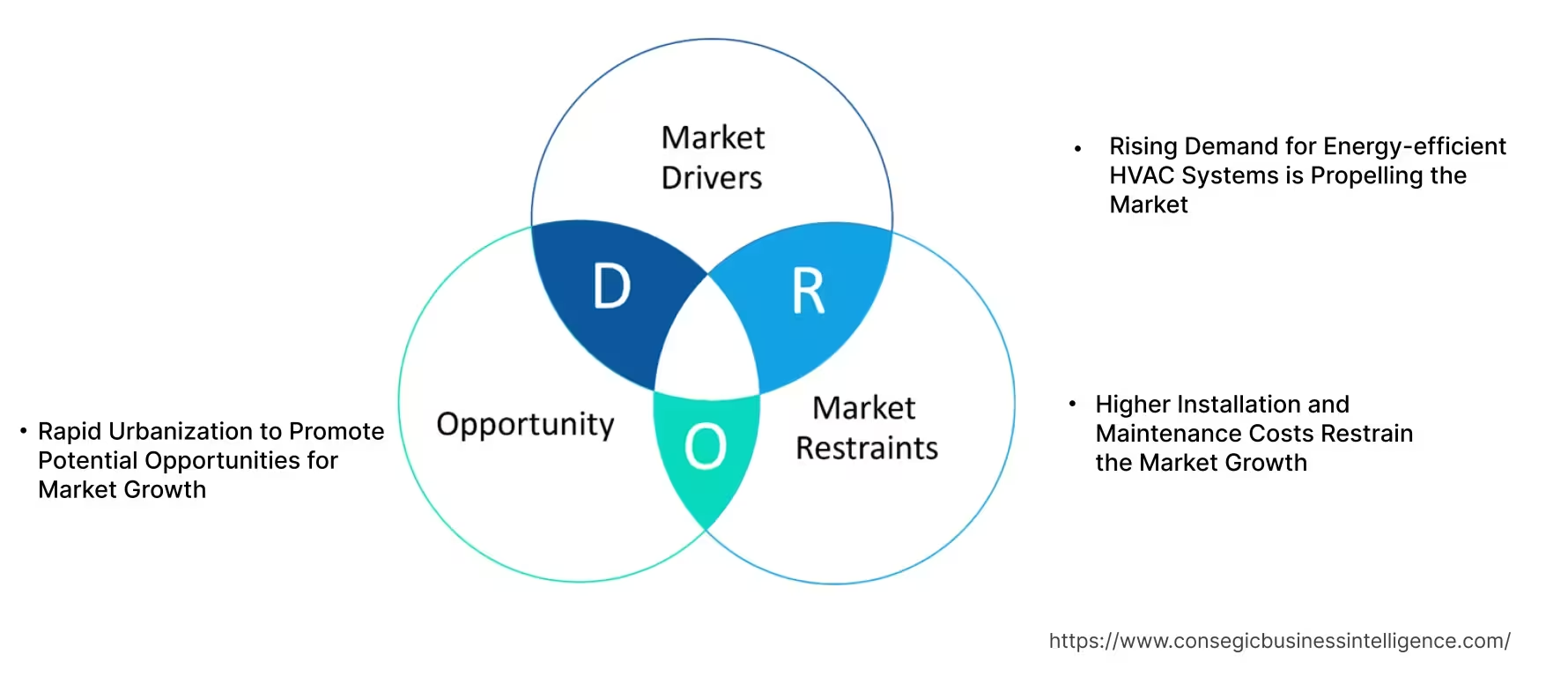
Rising Demand for Energy-efficient HVAC Systems is Propelling the Market
HVAC an acronym for Heating, Ventilation, and Air Conditioning systems includes VRF systems to regulate air quality. These systems are efficient and designed to provide the precise amount of cooling or heating needed in a space. Additionally, instead of disposing of the excess heat captured from the indoor units in cooling mode, it redirects the heat to the zones that require heating, allowing simultaneous heating and cooling.
Moreover, these systems offer numerous benefits that make them an outstanding HVAC solution for commercial and residential buildings. VRF solutions provide an ideal balance of performance, energy effectiveness, and space optimization, making them a preferred choice for modern buildings seeking innovative HVAC solutions.
- In Feb 2023, LG Electronics launched Multi V i Variable Refrigerant Flow, an HVAC solution. Designed for high-rise buildings including offices, schools, shopping centers, apartment complexes, and hotels, the energy-efficient Multi V I offers various intelligent features to lower energy usage and create a more pleasant indoor atmosphere, as well as a quieter outdoor environment, throughout the year.
Therefore, high-efficient systems collectively leverage HVAC solutions boosting the VRF systems market.
Key Restraints :
Higher Installation and Maintenance Costs Restrain the Market Growth
VRF systems despite long-term energy savings, often require specialized equipment leading to upfront investment prohibiting for consumers, and limiting market penetration, especially in cost-sensitive segments. These systems require specialized expertise for design, installation, and maintenance, posing challenges for contractors and increasing project timelines and costs.
- According to market analysis, the simpler system starts at around USD 10,000, while more complex installations can range from USD 20,000 to USD 100,000 or more, which is not feasible for certain customers residing in small buildings or private homes.
Hence, the analysis concludes that high installation costs and maintenance costs are significant obstacles to the expansion of the VRF systems market trend.
Future Opportunities Insights :
Rapid Urbanization to Promote Potential Opportunities for Market Growth
Urbanization increases the surge of construction of residential, commercial, and industrial buildings, all of which require efficient and flexible HVAC solutions. These systems are well suited to urban environments due to their compact design, which fits well in areas with limited space. The energy efficiency of these systems is another advantage, as urban areas often face high energy demand, they are designed to provide the precise amount of cooling or heating needed in a space.
- In Feb 2023, LG Electronics exhibited the latest heating, ventilation, and air conditioning (HVAC) solutions at AHR Expo 2023. The booth featured industry-leading VRF technology, energy-efficient heat pumps, indoor air quality solutions, and flexible building automation and connectivity products. These advancements contribute to urbanization by enhancing comfort and efficiency in both commercial and residential spaces.
Hence, rapid urbanization demands highly efficient compact design for HVAC solutions propelling the VRF systems market opportunities.
VRF Systems Market Segmental Analysis :
By Type:
Based on the type, the market is bifurcated into Heat Pump VRF and Heat Recovery VRF.
Trends in the VRF System type:
- Innovations including inverter-driven compressors and advanced control systems are enhancing the efficiency and performance of heat pump VRF.
- Healthcare and Hospitality sectors are increasingly adopting heat recovery due to their ability to maintain different temperature zones catering to individual needs.
The heat pump VRF segment accounted for the largest revenue share in the year 2023.
- VRF heat pump systems also known as 2-pipe VRF, provide heating and cooling to all indoor units through refrigerant pipes.
- The ability to both heat and cool spaces with precise temperature control makes preferred choice for the commercial sector.
- In September 2023, Johnson Controls-Hitachi Air Conditioning launched the Hitachi air365 Hybrid dual fuel system, which merges a heat pump and furnace to offer eco-friendly, cost-effective comfort throughout the year while cutting down on carbon emissions. The air365 Hybrid system includes an electric Hitachi Mini VRF heat pump as the main heating and cooling source, along with a dual fuel module that can be added to a gas furnace.
- Thus, as per the analysis utilizing the heat pump system segment to produce highly efficient, cost-effective HVAC solutions is driving the proliferation of the global VRF systems market trends.
The heat recovery VRF segment is anticipated to register the fastest CAGR growth during the forecast period.
- VRF heat recovery systems, also known as 3 pipe systems, work on three lines attached to the condenser unit that provide simultaneous heating and cooling.
- The 3 lines consist of one for cooling purposes, one for heating purposes, and the last one is a return line.
- These systems are highly efficient, capturing and redistributing waste heat, to reduce energy consumption and carbon emission.
- In July 2022, DAIKINintroduced VRV 5 Heat Recovery, a VRF technology with design and installation features and potential for lowering carbon emissions in commercial buildings and their environmental impact. Moreover, it provides both cooling and heating at the same time, offering personalized comfort and flexibility by moving heat from areas that need cooling to those that need higher temperatures.
- Consequently, the ability of VRF heat recovery to provide heating and cooling functions simultaneously with low carbon emission is accelerating the VRF systems market growth.
By Sales channel:
Based on the sales channel, the market is segmented into Distributors, Online, Retailers, Wholesalers, and Others.
Trends in the VRF system sales channel:
- Retailers are adopting omnichannel strategies that integrate online and offline sales channels, allowing customers to browse, purchase, and receive support and after-sales service through multiple platforms seamlessly.
The distributors segment accounted for the largest revenue share in the year 2023.
- Distributors have a broad network that covers large geographic areas, making systems more accessible to a diverse customer base, including the commercial and residential sectors.
- Distributors are leveraging digital tools to streamline operations for ordering, customer relationship management (CRM) systems and virtual training programs are becoming common.
- These offer additional services including technical support, system design assistance, installation, and after-sales services.
- Hence, these factors of distributors determine their dominance of the segment in the VRF systems market share.
The online segment is anticipated to register the fastest CAGR growth during the forecast period.
- Increasing expansion of E-commerce platforms is enabling consumers and businesses to research, compare, and purchase systems remotely with ease.
- Factors including convenience and accessibility, price comparisons and discounts, customization, product availability, and global reach are key aspects driving the expansion of the online segment.
- According to the analysis of the International Trade Administration, India's e-commerce revenue is expected to rise from USD 46.2 billion in 2020 to USD 136.47 billion by 2026 and is expected to become the world's fastest-growing e-commerce market
- Therefore, the trend suggests that online sales channel is expected to grow the global VRF systems market demand.
By Application:
Based on application the market is segmented into Residential, Commercial buildings, Industrial, and Others.
Trends in the VRF system application:
- VRF systems are increasingly being integrated with home automation systems to offer enhanced comfort and energy management through smart thermostats and remote-control features.
The commercial building segment accounted for the largest revenue share of 49.24% in 2023 and is anticipated to register the fastest CAGR growth during the forecast period.
- The commercial sector includes offices, retail stores, hotels, shopping malls, and others.
- The increasing demand for efficient HVAC solutions for these buildings is propelling the adoption of these systems.
- Additionally, an automation-controlled system for buildings to detect indoor climate and deliver optimized cooling and heating performance.
- In July 2021, Samsung Electronics launched a VM S2 VRF outdoor air conditioning unit with an integrated AI-controlled system for advanced climate control solutions to comfort commercial buildings.
- Thus, as per analysis the increasing demand for efficient HVAC solutions integrated with advanced automated control systems necessitates VRF systems in commercial buildings, boosting the industry expansion.
Regional Analysis Insights:
The regions covered are North America, Europe, Asia Pacific, Middle East and Africa, and Latin America.
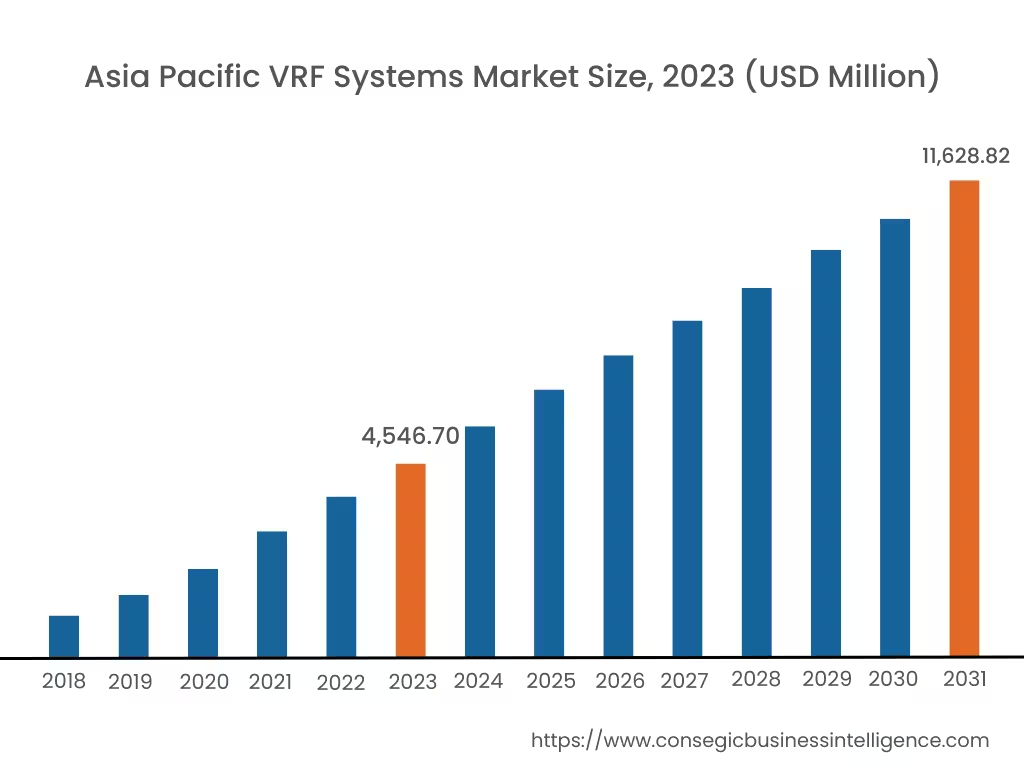
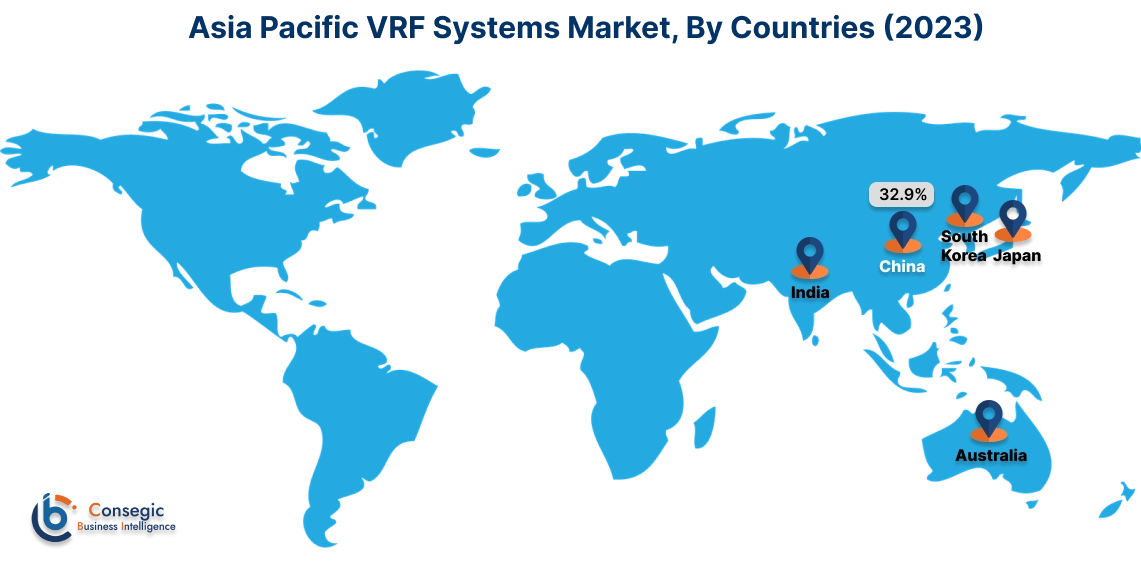
Asia Pacific is estimated to reach over USD 11,628.82 Million by 2031 from a value of USD 4,546.70 Million in 2023 and is projected to grow by USD 5,024.30 Million in 2024. Out of this, China accounted for the maximum revenue share of 32.9%.
The rapid urbanization in Asia Pacific nations including China, Japan, South Korea, and India, is fueling the need for modern, effective HVAC solutions in both residential and commercial areas. Moreover, the growing use of advanced technology in VRF, and integration with Artificial Intelligence for automated control, is driving the trend for VRF systems in the market.
- In July 2022, Samsung Electronics (South Korea) launched Artificial Intelligence (AI) enabled DVM S2 VRF in India for residential complexes, office spaces, and commercial buildings. These systems with AI algorithms to automate pressure-controlled systems, optimize cooling and heating performance, enhance energy efficiency, detect refrigerant leaks, and send alerts immediately so users can monitor and manage units.
North America region was valued at USD 6,260.13 Million in 2023. Moreover, it is projected to grow by USD 6,896.70 Million in 2024 and reach over USD 15,446.19 Million by 2031.
In North America, specifically in the United States and Canada, VRF systems are becoming more popular because of strict energy efficiency rules and construction regulations. These rules encourage the adoption of high-efficiency HVAC systems in both residential and commercial buildings.
- In May 2024, Lennox and Samsung formed a partnership named Samsung Lennox HVAC North America for Ductless Mini Split, AC, Heat Pump, and VRF HVAC Systems in the United States and Canada. The collaboration combines Samsung, a respected international brand with four decades of cutting-edge HVAC technology, and Lennox, a top North American HVAC OEM, and direct distribution expert, to offer exceptional heating and cooling solutions to consumers.
The Asia-Pacific region's growing surge in cloud infrastructure development and adoption, rising trend of remote workforces, and government-led initiatives to promote digital transformation are anticipated to show substantial growth in the VRF Systems Market.
According to the VRF systems market analysis, significant growth is expected in Europe. The area has a valuable architectural history with numerous old buildings in need of modern HVAC system upgrades. Therefore, VRF systems are being more commonly utilized for their efficiency and minimal impact on installation.
In the Middle East and Africa, the VRF systems market is poised for growth due to several key factors. Determinants including hot climate in the majority of regions necessitate efficient VRF systems for cooling performance.
Latin America is an emerging market with rising adoption of these systems across various buildings. Countries including Brazil, Argentina, and Mexico are at the forefront of industrial development, raising the efficient VRF systems market trend.
Top Key Players & Market Share Insights:
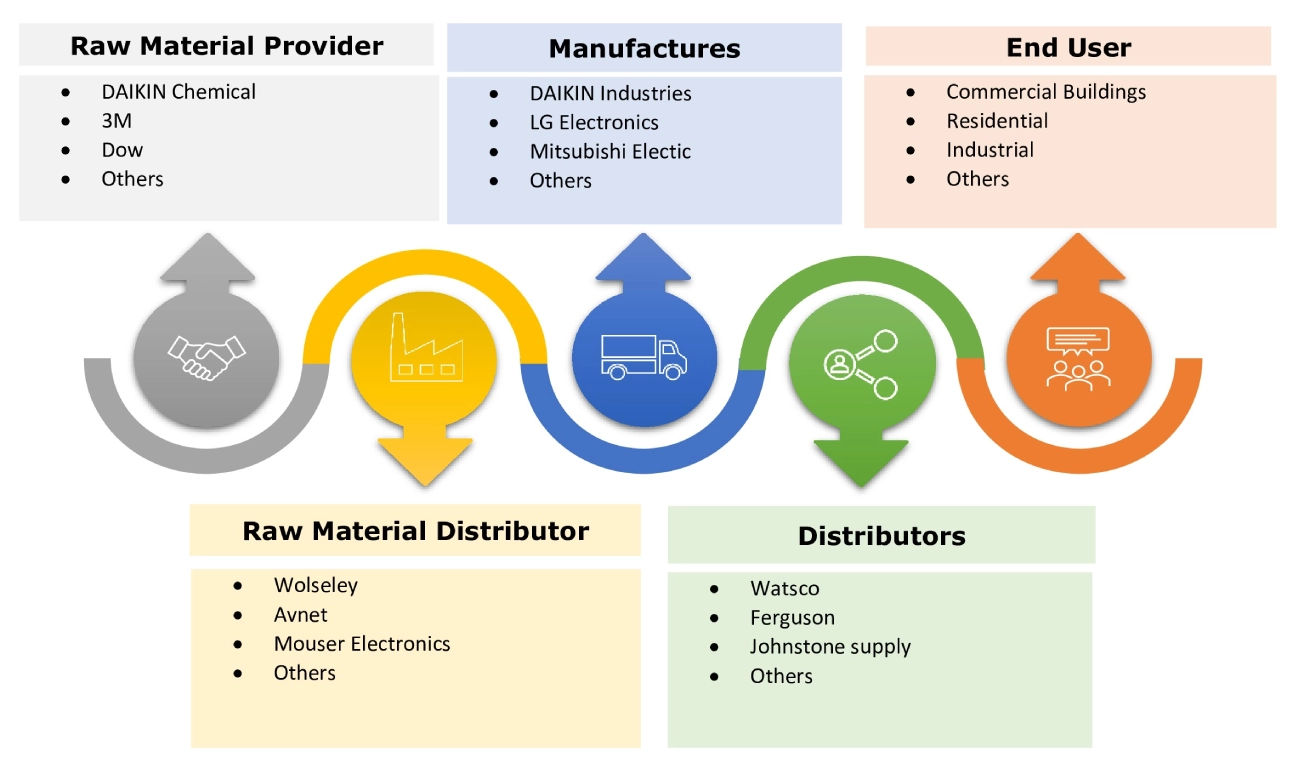
The VRF systems market is highly competitive with major players providing enhanced user experience, realism, and immersion to the national and international markets. Key players are adopting several strategies in research and development (R&D), product innovation, and end-user launches to hold a strong position in the VRF systems market. Key players in The VRF systems industry include-
- DAIKIN Industries, Ltd (Belgium)
- Samsung Electronics (South Korea)
- LG Electronics (South Korea)
- Toshiba Corporation (Japan)
- Mitsubishi Electric Corporation (Japan)
- Lennox International, Inc (US)
- Hitachi, LTD (Japan)
- Fujitsu General Limited (Japan)
- Panasonic(Japan)
- Emerson Electric Co. (US)
- The Whalen Company (US)
- Del-Air Mechanical (US)
- Midea (China)
Recent Industry Developments Insights:
Product Launches:
- In May of 2024, Lennox introduced low global warming potential (GWP) light commercial and ducted residential HVAC products to adhere to the low GWP Refrigerant regulations set for 2025. Switching to low global warming potential (GWP) refrigerants is a beneficial move for the environment, as it greatly decreases the effects of damaging greenhouse gases. This adjustment is in line with Lennox's commitment to sustainability and its dedication to supporting our communities and the environment.
- In November 2023, DAIKIN launched the VRV 5 system, an energy-efficient air-to-air heat pump for commercial buildings. Installing and utilizing it is simple and adaptable, assisting users in decreasing the direct and indirect environmental effects of commercial HVAC systems.
- In May 2023, Daikin introduced Trailblazer HP, an air-cooled scroll chiller incorporating VRF heat pump technology for providing electricity-driven heating and cooling in commercial buildings and industrial operations.
Announcements:
- In June 2024, Mitsubishi Electric, announced the launch of products utilizing low global warming potential (GWP) refrigerant, making a notable advance in environmental sustainability in light commercial and residential heating and air-conditioning solutions.
Business Expansion:
- In July 2024, Johnson Controls International declared the deal to sell Residential and Light Commercial (R&LC) HVAC business to the Bosch Group. The deal involves the Ducted business in North America and the worldwide Residential joint venture with Hitachi, Ltd. is part-owned by Johnson Controls (60%) and by Hitachi (40%). The complete transaction is worth USD 8.1 billion, with the Company's share being around USED 6.7 billion. As a component of the deal, Hitachi will keep specific ductless HVAC assets based in Shimizu, Japan.
VRF Systems Market Insights:
| Report Attributes | Report Details |
| Study Timeline | 2021-2034 |
| Market Size in 2034 | USD 16,293.93 Million |
| CAGR (2026-2034) | 11.90% |
| Base Year | 2025 |
| By Type |
|
| By Sales Channel |
|
| By Application |
|
| By Region |
|
| Key Players |
|
| North America | U.S. Canada Mexico |
| Europe | U.K. Germany France Spain Italy Russia Benelux Rest of Europe |
| APAC | China South Korea Japan India Australia ASEAN Rest of Asia-Pacific |
| Middle East and Africa | GCC Turkey South Africa Rest of MEA |
| LATAM | Brazil Argentina Chile Rest of LATAM |
| Report Coverage |
|
Key Questions Answered in the Report
What is the VRF Systems Market Size and Forecast? −
The VRF systems market size was valued at USD 18,849.68 Million in 2023 and is projected to reach USD 46,496.67 Million by 2031, growing at a CAGR of 11.9% from 2024 to 2031. This strong forecast reflects increasing investments in energy-efficient HVAC systems, urban infrastructure development, and regulatory push toward sustainability.
What are the key growth drivers of the VRF systems market? +
The primary growth drivers include rising demand for energy-efficient HVAC solutions, rapid urbanization, and increasing adoption of smart building technologies. VRF systems optimize energy usage by delivering precise heating and cooling, making them ideal for modern infrastructure. Additionally, government regulations promoting low-carbon technologies and energy conservation are accelerating market expansion.
Which region dominates the VRF systems market and why? +
Asia-Pacific dominates the VRF systems market due to rapid urbanization, large-scale infrastructure development, and strong adoption of advanced HVAC technologies. Countries such as China, Japan, and India are investing heavily in smart buildings and energy-efficient systems. Additionally, the presence of leading manufacturers and increasing integration of AI-based HVAC solutions further strengthen regional dominance.
Which region is the fastest growing in the VRF systems market? +
Asia-Pacific is also the fastest-growing region, driven by expanding urban infrastructure, increasing construction activities, and rising demand for energy-efficient cooling solutions. Government initiatives promoting green buildings and smart cities further accelerate adoption across emerging economies in the region.
What are the key segments in the VRF systems market? +
Key segments include Heat Pump VRF and Heat Recovery VRF by type, with heat pump leading in market share and heat recovery growing fastest. By application, commercial buildings dominate due to high HVAC requirements, while residential adoption is increasing. Sales channels include distributors, online platforms, and retailers, with distributors holding the largest share.
Why are VRF systems considered energy efficient? +
VRF systems are energy efficient because they adjust refrigerant flow based on real-time demand, reducing energy wastage. They also reuse heat from cooling processes for heating purposes, enabling simultaneous operation. This minimizes energy consumption compared to conventional HVAC systems, making them ideal for sustainable building solutions.
What are the major challenges in the VRF systems market? +
The major challenge is the high initial installation and maintenance cost, which ranges from USD 10,000 to USD 100,000. Additionally, these systems require specialized expertise for installation and servicing, increasing operational complexity. These factors limit adoption in small-scale residential applications and cost-sensitive markets.
Overview
Reputation & Certifications


Our Services
- Market Intelligence & Forecasting
- Custom Research Solutions
- Market Entry Strategy
- Competitive Intelligence
- Customer Insights
- Industry Innovation Analysis
- Investment Advisory