Jump to Content
Fertilizers Market Size & Industry Share - Growth Trends & Forecasts (2026 - 2034)
Fertilizers Market Size:
The Fertilizers market size was valued at 214.28 (US$B) in 2025 and is projected to grow from 220.92 (US$B) in 2026 to 282.04 (US$B) by 2034, at a CAGR of 3.1% from 2026 to 2034, according to a recent report from Consegic Business Intelligence.
Fertilizers Market Scope & Overview:
A fertilizer is any natural or synthetic material applied to soil or plant tissues to supply one or more essential plant nutrients, primarily Nitrogen (N), Phosphorus (P), and Potassium (K), in order to enhance crop growth and increase agricultural productivity. Benefits including increased crop yield enhanced crop quality soil fertility restoration and support for global food security are driving the market. Further, key trends driving the demand for agrochemicals include accelerating adoption of precision agriculture technologies to optimize input use, the growing shift toward bio-based and sustainable formulations, and the increasing reliance on herbicides due to rural labor shortages and rising wage costs.

How is AI Transforming the Fertilizers Market?
Artificial Intelligence is transforming the fertilizer market by enabling a fundamental shift from blanket application to Nutrient Intelligence. By analyzing massive datasets from drones, satellite imagery, IoT sensors, and historical weather patterns, AI algorithms precisely predict the exact type, dose, and timing of nutrients needed at specific spots within a field. This Variable Rate Technology (VRT) application maximizes Nutrient Use Efficiency (NUE), which boosts crop yields while simultaneously reducing input costs by minimizing fertilizer waste. Moreover, AI optimizes fertilizer production logistics and helps design new, sustainable bio-fertilizer formulations, driving both profitability and environmental responsibility by curbing runoff and emissions.
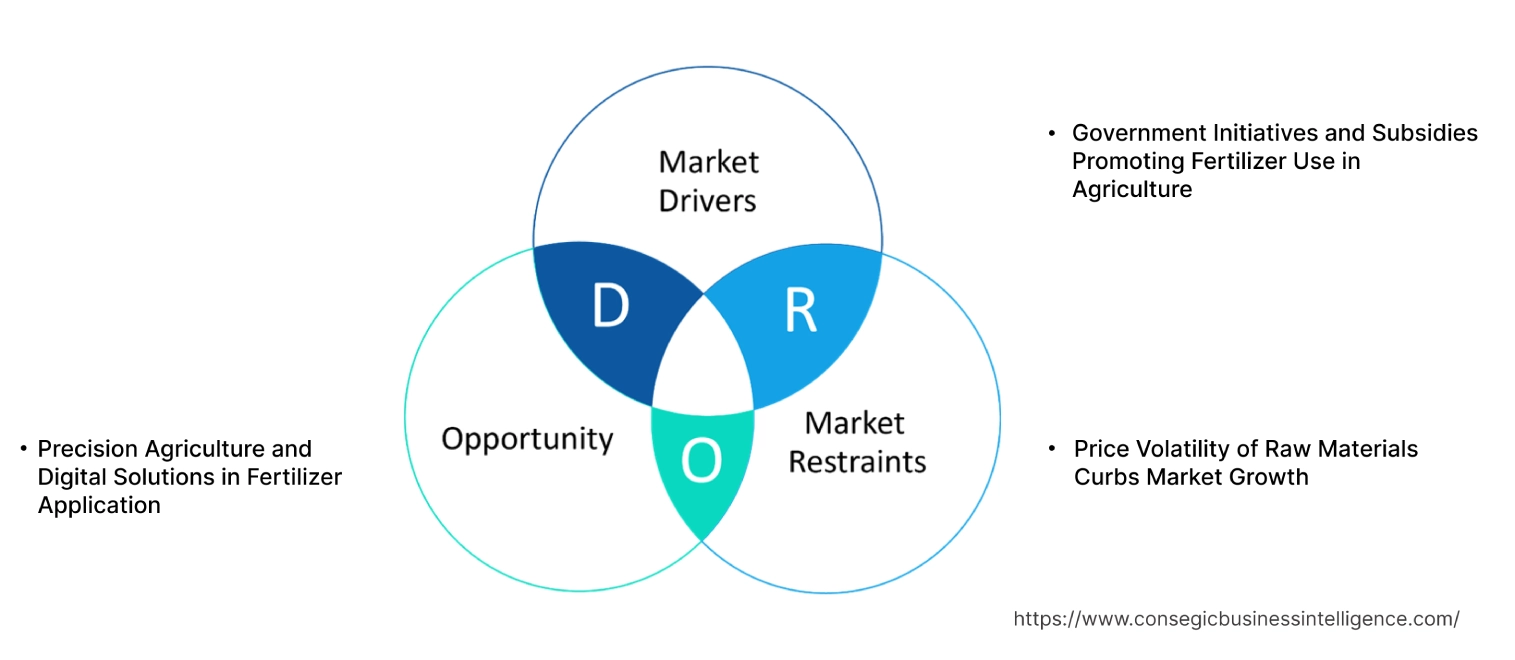
Fertilizers Market Dynamics - (DRO) :
Key Drivers:
Adoption of Precision Agriculture and Modern Farming Technique Drives the Fertilizers Market Growth
The adoption of precision agriculture, leveraging technologies like GPS mapping, drones, IoT sensors, and Variable Rate Technology (VRT), fundamentally drives the fertilizer market. Precision agriculture drives growth not by increasing overall volume, but by demanding a shift toward specialty, high-efficiency agrochemicals such as water-soluble, slow-release, and nano-fertilizer formulations. This focus on the "4R" principle (Right Source, Rate, Time, Place) maximizes Nutrient Use Efficiency (NUE), boosts yield on existing land, cuts waste, and significantly reduces the environmental impact associated with traditional, indiscriminate application methods.
- For instance, according to Association of Equipment Manufacturers, precision agriculture in U.S. has delivered substantial benefits across agriculture and the economy. It is currently credited with boosting annual crop production by 5%, with the potential for an additional 6% gain through wider adoption.
Thus, the rising need for enhanced-efficiency agrochemicals, water-soluble agrochemicals, and other specialty products contribute significantly in driving the market size.
Key Restraints :
Volatility of Raw Material Prices and Soil Degradation are Limiting the Market
The fertilizer market is severely constrained by the high volatility of raw material prices, particularly for natural gas (critical for nitrogen production), phosphate rock, and potash. Geopolitical conflicts and energy price spikes translate directly into unaffordable fertilizer costs, forcing farmers to reduce application rates or forgo essential nutrients, which negatively impacts overall consumption and agricultural productivity. Furthermore, widespread soil degradation resulting from excessive, imbalanced chemical fertilizer use has reduced the soil's natural capacity to utilize nutrients, necessitating even higher and less efficient input levels. This vicious cycle of price uncertainty and declining soil health limits sustainable market expansion.
Future Opportunities :
Rapid Growth in Bio-Agrochemicals and Focus on Micronutrient Drives Fertilizers Market Opportunities
Growing consumer demand for organic, residue-free food, coupled with government policies supporting sustainable farming, is pushing the adoption of microbial-based products that naturally enhance soil fertility and reduce reliance on synthetic chemicals. Simultaneously, the focus on specialized micronutrients (like Zinc, Boron, and Iron) is intensifying. Further, widespread soil depletion due to intensive farming has made balanced fertilization crucial, leading manufacturers to develop premium chelated and foliar-applied micronutrient blends that efficiently address specific deficiencies, thereby improving crop quality and supporting bio-fortification efforts.
- For instance, in May 2024, Fresh Del Monte and Vellsam Materias Bioactivas formed a partnership to produce bio-agrochemicals from fruit residues, launching an innovative plant in Kenya.
Thus, accelerated innovation and commercialization of specialized, value-added products like bio- agrochemicals and high-efficiency micronutrient blends drive the fertilizers market opportunities.
Fertilizers Market Segmental Analysis :
By Type:
Based on the type, the market is segmented into complex fertilizers and straight fertilizers.
Trends in the Type:
- Governments in developing economies are increasingly incentivizing or subsidizing the use of complex agrochemicals over single-nutrient straight agrochemicals to promote better crop management and higher yields, driving the fertilizers market trends.
- Straight agrochemicals offer a straightforward, cost-effective way to make a targeted, high-concentration supplementation, which in turn drives the fertilizers market size.
Straight fertilizers accounted for the largest revenue share in the year 2024.
- Nitrogenous agrochemicals, particularly urea, maintain the largest market due to their high nutrient concentration, low cost, and essential role in maximizing yields of staple crops like rice, wheat, and corn, which in turn drives the fertilizers market share.
- There is a rising growth in straight phosphatic and potassic products, which is being driven by targeted, government-supported programs, in turn driving the market.
- Further, there is a significant emphasis on using straight fertilizers in an enhanced form, which means applying nitrification inhibitors or using slow/controlled-release coatings on products like urea, which subsequently propels the market.
- Therefore, based on analysis, the aforementioned trends are projected to drive the market during the forecast period.
Complex fertilizers is anticipated to register the fastest CAGR during the forecast period.
- There is a rising trend where farmers prefer complex nourishments to address widespread soil deficiencies and restore the balance of NPK plus micronutrients, which in turn drives the fertilizers market share.
- Further, complex blends are increasingly customized for site-specific or crop-specific needs, enabling efficient use through precision agriculture technologies like GPS and variable rate application.
- Furthermore, manufacturers are focusing on developing Enhanced Efficiency Fertilizers (EEFs), such as slow-release and controlled-release complex agrochemicals, to improve nutrient uptake and minimize environmental loss, which in turn drives the fertilizers market trends.
- Thus, as per the fertilizers market analysis,the adoption of specialty formulations, the shift to balanced nutrition, and precision farming integration are driving the market.
By Form:
Based on the form, the market is bifurcated into dry fertilizers and liquid fertilizers.
Trends in the Form:
- There is a growing trend of manufacturers launching new liquid bio-agrochemicals and bio-stimulants that promote soil health and sustainable nutrient delivery, driving the fertilizers market demand.
- Increasing use of precision farmingtools, such as Variable Rate Technology (VRT), is optimizing the application and placement of dry granular agrochemicals, which in turn drives the fertilizers market growth.
Dry fertilizers accounted for the largest revenue share in the year 2024.
- These plant nutrients maintain the largest market globally due to their high nutrient concentration and cost-effectiveness for large-scale staple crop production, which in turn drives the market.
- Further, advantages including longer shelf life, lower storage costs, and easier bulk handling and transportation are driving the market.
- Furthermore, adoption of customized dry blends that incorporate secondary nutrients (like sulfur) and micronutrients is increasing, which is driving the market.
- Thus, as per analysis, significant dominance, ease of handling, and adoption of specialized blends are driving the market.
Liquid fertilizers is anticipated to register the fastest CAGR during the forecast period.
- The liquid segment is the fastest-growing form, driven by its perfect compatibility with modern precision tools like fertigation (drip irrigation) and foliar spraying.
- Further, farmers are increasingly adopting liquid agrochemicals for high-value and specialty crops that require rapid, on-demand nutrient availability during critical growth stages, in turn propelling the fertilizers market expansion.
- Furthermore, liquid products allow farmers to easily and quickly mix precise, customized nutrient solutions on-farm to address real-time changes in crop needs.
- Therefore, based on analysis, the surge due to precision agriculture and the need for immediate nutrient uptake are anticipated to boost the growth of the market during the forecast period.
By Source:
Based on the source, the market is bifurcated into inorganic fertilizers and organic fertilizers.
Trends in the Source:
- Increasing consumer health consciousness and a preference for chemical-free, organic food, driving the fertilizers market demand.
- Governments are actively promoting organic and sustainable agriculture through subsidies, grants, and environmental regulations which in turn drive the market.
Inorganic fertilizers accounted for the largest revenue share in the year 2024 and is anticipated to register a substantial CAGR during the forecast period.
- There is a growing focus on products like Controlled-Release Fertilizers (CRFs) and slow-release options, which in turn drive the market.
- Further, there is an increasing adoption of nano-plant nutrients as they offer high nutrient use efficiency at lower application rates, which in turn drives the fertilizers industry.
- Furthermore, inorganic agrochemicals are increasingly being used in conjunction with smart farming technologies, such as GPS spreaders, variable-rate applications, and IoT-based soil monitoring.
- Thus, as per fertilizers market analysis, integration with precision agriculture, adoption of nano-plant nutrient, and others are driving the market.
By Application Mode:
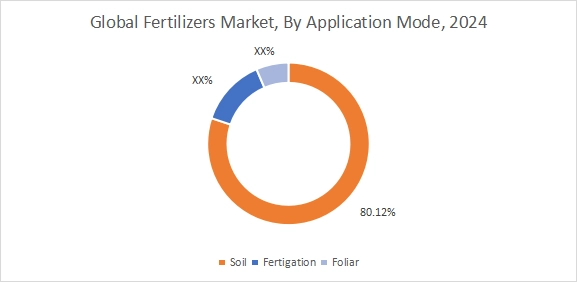
Based on the application mode, the market is segmented into soil, fertigation, and foliar.
Trends in the application mode:
- Foliar application is increasingly popular for its ability to correct in-season nutrient deficiencies, which in turn drive the fertilizers market expansion.
- Fertigation is the dominant application mode for protected agriculture (greenhouses) and high-value field crops due to its superior control, which in turn propels the fertilizers market.
Soil accounted for the largest revenue share of 80.12% in the year 2024 and is anticipated to register the fastest CAGR during the forecast period.
- Soil application mode is the primary route for introducing live microbial and bio-agrochemicals, which drive the market.
- Further, to combat losses from leaching and volatilization, conventional soil-applied agrochemicals (like urea) are being replaced by stabilized products using inhibitors.
- Furthermore, the development of consistent, pelletized, or granulated organic agrochemicals that can be easily applied with conventional farm equipment, overcoming the logistical challenges of applying bulky, inconsistent traditional organic matter.
- Thus, based on analysis, focus on granular and coated organic products and integration of microbial and bio-agrochemicals are driving the market.
Regional Analysis:
The regions covered are North America, Europe, Asia Pacific, Middle East and Africa, and Latin America.
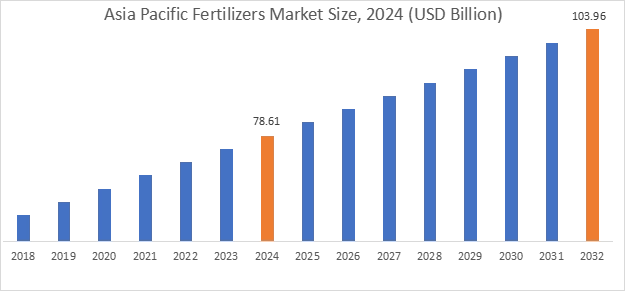
Asia Pacific region was valued at USD 78.61 Billion in 2024. Moreover, it is projected to grow by USD 80.45 Billion in 2025 and reach over USD 103.96 Billion by 2032. Out of this, China accounted for the maximum revenue share of 33.84%. The market growth for plant nutrients is mainly driven by the increasing need to maximize crop yields to meet the food demand of its rapidly expanding and urbanizing population, compounded by decreasing arable land and supportive government policies.

- For instance, in April 2024, Mahadhan Agritech Limited, a subsidiary of Deepak Fertilisers and Petrochemicals Corporation Limited (DFPCL), has partnered with the Israel-based Haifa Group, a leading global supplier of specialty plant nutrients. The agreement aims to promote high-performing specialty agrochemicals in India and other countries to enhance crop quality and productivity.
-
North America is estimated to reach over USD 70.31 Billion by 2032 from a value of USD 53.80 Billion in 2024 and is projected to grow by USD 55.01 Billion in 2025. The North American market is primarily driven by the continued development of major field crops like corn and soybeans and the accelerating adoption of precision agriculture techniques to boost nutrient use efficiency and sustainability.
- For instance, in January 2023, Sumitomo Chemicalannounced its decision to acquire FBSciences Holdings, Inc. (FBS), a U.S. company specializing in the biostimulant business. This acquisition is intended to further expand Sumitomo Chemical's existing biorationals business, which includes naturally-derived agricultural materials.
The regional analysis depicts stringent environmental regulations and transition towards sustainable agriculture industry in Europe is driving the market. Additionally, the factors driving the market in the Middle East and African region are increasing government initiatives to modernize agricultural practices and rising investments in agricultural infrastructure to enhance food security. Further, increasing agricultural mechanization to improve efficiency and productivity is paving the way for the progress of market in Latin America region.
Top Key Players & Market Share Insights:
The global fertilizers market is highly competitive with major players providing solutions to the national and international markets. Key players are adopting several strategies in research and development (R&D), product innovation, and end-user launches to hold a strong position in the fertilizers industry. Key players in the global fertilizers market include-
- Nutrien Ltd.(Canada)
- The Mosaic Company(U.S.)
- Yara International ASA(Norway)
- CF Industries Holdings, Inc. (U.S.)
- Haifa Group (Israel)
- OCP S.A. (Morocco)
- ICL Group Ltd. (Israel)
- EuroChem Group AG (Switzerland)
- K+S Aktiengesellschaft (Germany)
- SABIC Agri-Nutrients Company (Saudi Arabia)
- Coromandel International Ltd. (India)
Recent Industry Developments :
Product Launch
In February 2025, Haifa North West Europe introduced a new product, Haifa Soluble DUO, at the HortiContact event. This innovative water-soluble fertilizer is specifically designed for fertigation and allows growers to increase calcium input without adding extra nitrogen, chlorides, or sulfates.
Market Expansion
In August 2024, ICL Group Ltd., announced a significant step in its worldwide development by signing a five-year distribution agreement with AMP Holdings Group Co. Ltd., a major agricultural distributor in China.
Fertilizers Market Report Insights :
| Report Attributes | Report Details |
| Study Timeline | 2021-2034 |
| Market Size in 2034 | USD 282.04 Billion |
| CAGR (2026-2034) | 3.10% |
| Base Year | 2025 |
| By Type |
|
| By Form |
|
| By Source |
|
| By Application Mode |
|
| By Region |
|
| Key Players |
|
| North America | U.S. Canada Mexico |
| Europe | U.K. Germany France Spain Italy Russia Benelux Rest of Europe |
| APAC | China South Korea Japan India Australia ASEAN Rest of Asia-Pacific |
| Middle East and Africa | GCC Turkey South Africa Rest of MEA |
| LATAM | Brazil Argentina Chile Rest of LATAM |
| Report Coverage |
|
Key Questions Answered in the Report
How big is the fertilizers market? −
The fertilizers market is estimated to reach over USD 265.33 Billion by 2032 from a value of USD 202.90 Billion in 2024 and is projected to grow by USD 207.45 Billion in 2025, growing at a CAGR of 3.1% from 2025 to 2032.
What specific segmentation details are covered in the fertilizers report? +
The fertilizers report includes specific segmentation details for site, type, form, source, application mode, and regions.
Which is the fastest segment anticipated to impact the market growth? +
In the fertilizers market, liquid fertilizers segment is the fastest-growing during the forecast period.
Who are the major players in the fertilizers market? +
The key participants in the fertilizers market are Nutrien Ltd. (Canada), The Mosaic Company (U.S.), Yara International ASA (Norway), CF Industries Holdings, Inc. (U.S.), Haifa Group (Israel), OCP S.A. (Morocco), ICL Group Ltd. (Israel), EuroChem Group AG (Switzerland), K+S Aktiengesellschaft (Germany), SABIC Agri-Nutrients Company (Saudi Arabia), Coromandel International Ltd. (India), and others.
What are the key trends in the fertilizers market? +
The fertilizers market is being shaped by several key trends including increasing global food demand from a growing population, the shift towards sustainable and eco-friendly farming practices, the adoption of precision agriculture technologies, and the volatility of raw material prices.
Overview
Reputation & Certifications


Our Services
- Market Intelligence & Forecasting
- Custom Research Solutions
- Market Entry Strategy
- Competitive Intelligence
- Customer Insights
- Industry Innovation Analysis
- Investment Advisory