Jump to Content
Precision Farming Market - Size, Share, Industry Trends, and Forecasts (2025-2032)
Precision Farming Market Size:
Precision Farming Market size is estimated to reach over USD 28.57 Billion by 2032 from a value of USD 11.96 Billion in 2024 and is projected to grow by USD 13.12 Billion in 2025, growing at a CAGR of 11.5% from 2025 to 2032.
Precision Farming Market Scope & Overview:
Precision farming, also known as prescription farming, is a method of managing agriculture by using detailed location-based information to improve how tasks are done in the field. It uses tools like GPS-guided machines, drones, and systems that adjust the amount of seed, fertilizer, or chemicals applied, based on conditions in different parts of the field. This helps farmers use resources more effectively by adapting to differences in soil, crop health, and weather patterns across the land.
System architectures typically involve a combination of in-field sensors, drone imaging, geospatial mapping software, and control systems mounted on agricultural machinery. These technologies allow real-time monitoring and execution of site-specific decisions, enabling producers to target resources precisely where they are needed. In many cases, data from past seasons is combined with satellite images to guide future decisions and evaluate results.
Prescription farming supports operational decision-making by linking environmental variability with equipment automation and geodata analytics. End-users of this technique include large-scale farms, growers of specialty crops, and agricultural consultants who focus on consistency and control in production.

Precision Farming Market Dynamics - (DRO) :
Key Drivers:
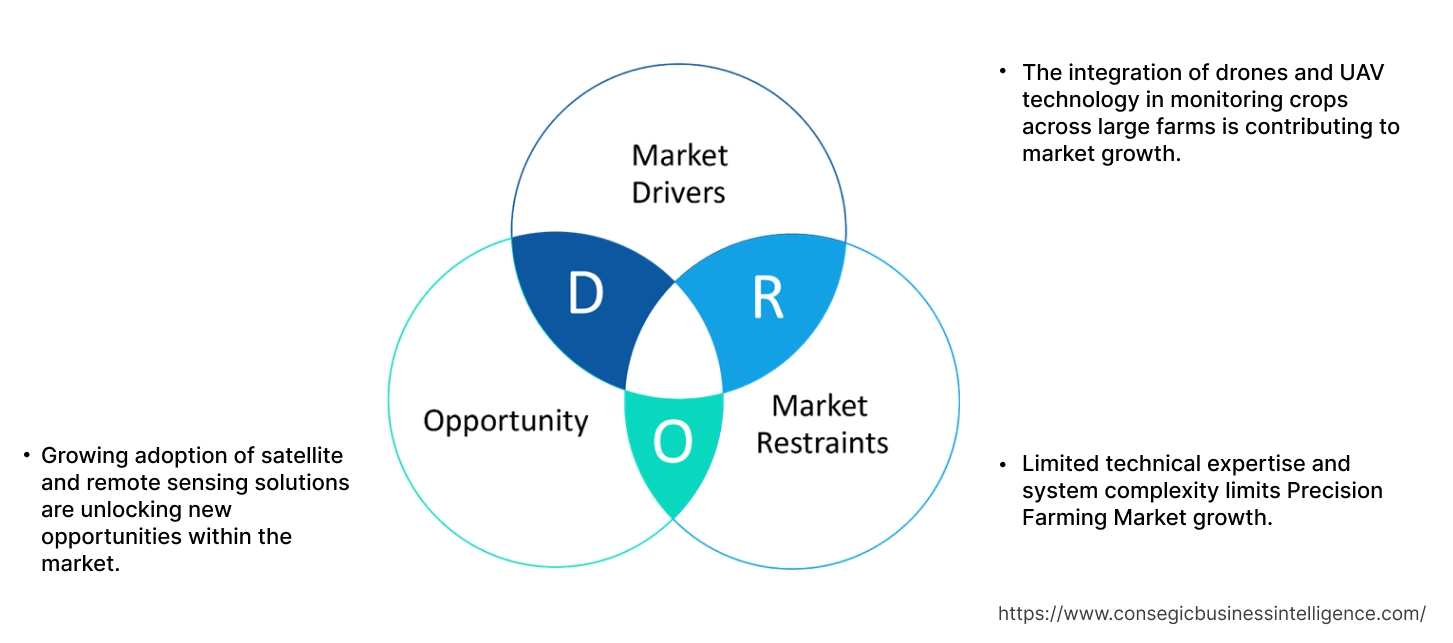
The integration of drones and UAV technology in monitoring crops across large farms is contributing to market growth.
Drones and UAVs cover large areas of crops in farms, making them a vital tool for large-scale agriculture applications. Advanced multispectral cameras and sensors allow farmers to obtain real-time information on the health of plants, identify diseases, and gauge soil conditions, all across large crop areas. Traditional methods of monitoring crops have been time-consuming and were especially less effective on larger scaled farms. UAVs provide a bird’s-eye view, allowing farmers to make more informed decisions by pinpointing areas requiring attention. Drones also offer the ability to perform precise interventions, such as targeted pest control and efficient fertilization, which helps optimize resources and reduce waste.
- For instance, in January 2025, General Aeronautics (GA) successfully raised an undisclosed amount to leverage precision agriculture solutions and deploy innovative and affordable drone technologies in its Series A+ funding round led by Fowler Westrup India. This funding will allow GA to transform precision agriculture by scaling drone production.
The ability for drones and UAVs to monitor vast areas of crops and give actionable advice is altering crop management practices especially in industries with high volume inputs such as for managing grains, increasing operational efficiency, crop yield, and waste elimination, significantly propelling market progress.
Key Restraints:
Limited technical expertise and system complexity limits Precision Farming Market growth.
Precision farming involves advanced technologies, such as IoT sensors, data analytics, and automated machinery, which require specialized knowledge to operate, interpret, and manage farming techniques. Many farmers, particularly those in less technologically advanced areas, lack the technical expertise to fully utilize these systems, limiting their ability to gain the full benefits. The complicated process of integrating different technologies and interpreting complex data adds an additional layer of difficulty. Moreover, the scarcity of trained technicians for regular maintenance and troubleshooting further exacerbates the problem. This skills gap creates barriers for many farmers, preventing them from adopting prescription farming solutions that could significantly enhance their productivity and sustainability. Therefore, the large inaccessible education and training for farmers in rural areas impedes market growth and limits their potential.
Future Opportunities :
Growing adoption of satellite and remote sensing solutions are unlocking new opportunities within the market.
Satellite imagery, combined with data analytics, allows to track changes in crop development, identify potential issues like pest infestations or nutrient deficiencies, and optimize irrigation. These technologies will assist farmers to gather valuable insights directly on their phones about crop health, soil conditions, and environmental factors without requiring frequent on-site visits. Additionally, this system also provide detailed, highly-resolved images of fields without being invasive, making it useful for monitoring extremely large areas. As the cost of satellite services continues to decrease, these solutions are becoming increasingly accessible to small and medium-scale farms.
- For instance, in October 2023, CNH Industrial announced that it has completed the purchase of Hemisphere GNSS (Hemisphere), the global satellite navigation technology leader at the price of USD $175 million. This acquisition will allow CNH to expand and enhance automation across wide range of agriculture applications.
Therefore, the ability to predict crop yields and make data-driven decisions will improve farm productivity and resource allocation. This growth in remote sensing applications are driving the global precision farming market opportunities.
Precision Farming Market Segmental Analysis :
By Component:
Based on Component, the market is categorized into Hardware (GPS/GNSS Devices, Sensors, Drones & UAVs, Control Systems and Others), Software (Precision Agriculture Software, Farm Management Systems, Data Analytics Platform, Agronomic Decision Support Tools, and Others), and Services.
The Hardware segment holds the largest revenue of the overall Precision Farming Market share in the year 2024.
- Hardware forms the backbone of precision farming systems, including GPS receivers, sensors, drones, control devices, and guidance systems.
- These devices are widely used for crop monitoring, soil analysis, yield mapping, and machinery automation on farms of all sizes.
- Major adoption of GNSS-enabled tractors, soil probes, and UAVs has driven consistent demand and leading OEMs are integrating multispectral sensors and wireless telemetry into their equipment offerings, further strengthening hardware deployment.
- According to the precision farming market analysis, its foundational role in collecting farm data and enabling automation, hardware remains the largest segment, fueling the precision farming market expansion.
The Software segment is expected to grow at the fastest CAGR during the forecast period.
- Precision farming software is rapidly advancing, enabling real-time data processing, decision support, and field-level prescription through AI and analytics.
- Farm management platforms now support data visualization, yield forecasting, automated reporting, and integration with IoT-enabled machinery.
- Cloud-based solutions with mobile accessibility are gaining popularity among mid-scale farms for planning irrigation, input application, and harvest schedules.
- As per the market analysis, the AI and machine learning embedded into crop models and software platforms evolving from monitoring tools fuel the global precision farming market development.
By Technology:
Based on Technology, the market is categorized into Guidance Systems, Remote Sensing, Variable Rate Technology (VRT), Data Management, and Others.
The Guidance Systems holds the largest revenue of the overall Precision Farming Market share in the year 2024.
- GPS and GNSS-based guidance systems are heavily used for automated steering, equipment navigation, and repeatable field operations.
- These technologies reduce overlap, fuel usage, and labor while improving planting accuracy and spraying efficiency.
- Guidance technology also supports real-time kinematic (RTK) positioning and geofencing, helping prevent crop damage during machine movement.
- According to the precision farming market analysis, the widespread use of guidance systems in tractor automation and cost savings by reducing crop damage, significantly fuels the market growth.
The Variable Rate Technology (VRT) segment is expected to grow at the fastest CAGR during the forecast period.
- VRT allows farmers to apply inputs such as fertilizer, seed, and pesticides at varying rates across different zones within a field.
- The technology improves resource efficiency, reduces environmental impact, and enhances yield by responding to real-time field data.
- OEMs are integrating VRT into seed drills, planters, and sprayers that communicate with field sensors and prescription maps.
- The rising trend for sustainability and technological advances in VRT industry have substantially driven the precision farming market demand.
By Application:
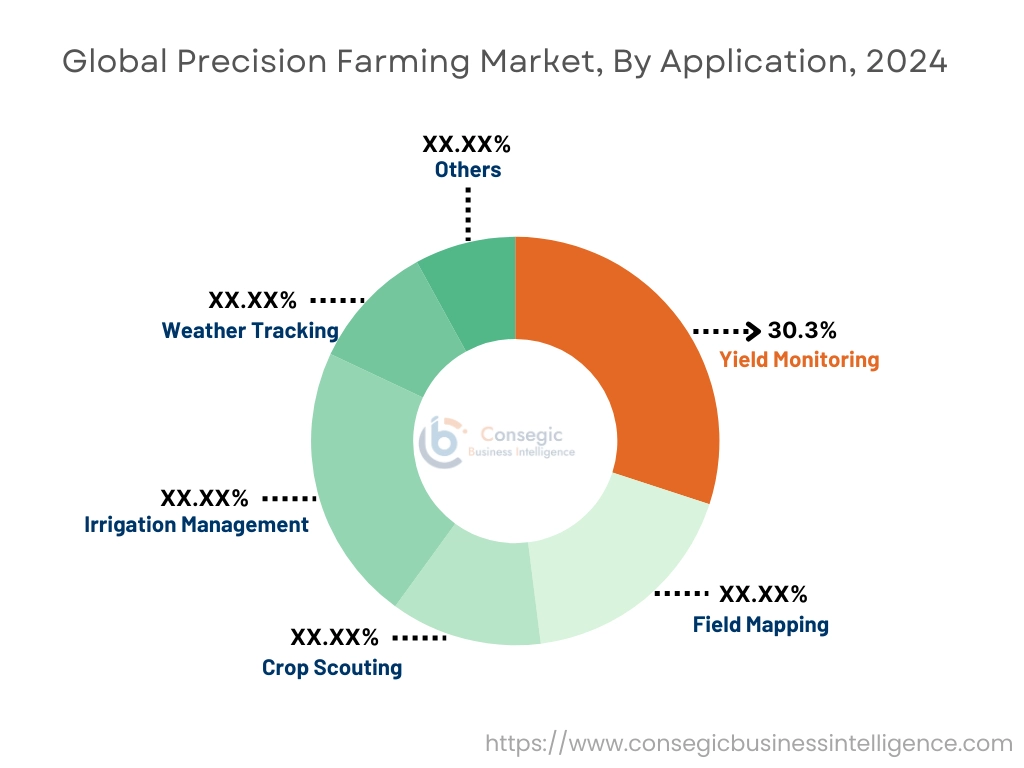
Based on Application, the market is categorized into Yield Monitoring, Field Mapping, Crop Scouting, Irrigation Management, Weather Tracking, and Others.
The Yield Monitoring segment holds the largest revenue of the overall Precision Farming Market share of 30.3% in the year 2024.
- Yield monitoring systems collect real-time data during harvesting to assess spatial yield variability and inform future planting decisions.
- These systems are crucial for evaluating hybrid performance, soil fertility response, and field productivity.
- Yield maps created from this data are integrated into prescription farming models for precise nutrient and seed management.
- Thus, the high demand of yield monitoring in post-season planning and input calibration, significantly drives the precision farming market trends.
The Irrigation Management segment is expected to grow at the fastest CAGR during the forecast period.
- Precision irrigation systems use soil moisture sensors, climate models, and weather forecasts to determine optimal watering schedules and volumes.
- These tools improve water use efficiency, reduce runoff, and prevent crop stress, especially in water-scarce regions.
- IoT-enabled drip systems, valve controls, and mobile irrigation dashboards are being deployed across high-value crops and greenhouse operations.
- For instance, in July 2023, John Deere announced the acquisition of Smart Apply, a precision spraying equipment company. The Smart Apply Intelligent Spray Control System improves spraying applications, enabling reduced chemical use and runoff, optimizing high-value crop yield.
- According to the market analysis, the shifting trend of irrigation management for water conservation as it becomes a key agronomic and regulatory goal is significantly fueling the global precision farming market expansion.
By End-Use:
Based on End-Users, the market is categorized into farmers, agricultural cooperatives, agribusinesses, and research & academic institutions.
The Farmers segment holds the largest revenue share of the overall Precision Farming Market in the year 2024.
- Individual growers and farmers form the largest segment due to widespread adoption of GPS-enabled machinery, field mapping tools, and real-time yield monitoring on operational farms.
- Prescription farming systems help optimize seeding, fertilizer use, and irrigation at the field level, increasing productivity while reducing input costs.
- This segment includes both small-scale farmers using modular digital tools and large farm operators running fully automated systems across hundreds of hectares.
- For instance, in April 2024, AGCO Corporation announced a joint venture transaction with Trimble, forming a new company called PTx Trimble. This partnership will help better serve the Farmers with factory fit and retrofit application, leveraging the precision agriculture market.
- Thus, the high demand for farmers due to their direct operational control and ability to measure ROI on a per-acre basis significantly drives the precision farming market trends.
The Agribusinesses segment is expected to grow at the fastest CAGR during the forecast period.
- Agribusinesses, including input suppliers, food processors, commodity traders, and contract farming organizations, are emerging as the fastest-growing end-user group.
- These entities are adopting prescription farming tools to standardize farm practices across their supply chains and ensure consistent quality and traceability.
- Agri-tech platforms for enterprises integrating yield forecasting, remote field monitoring, and supply chain analytics are gaining traction in corporate farming operations.
- The rising consumer demand for sustainably sourced produce and increased accountability in food supply chains is significantly fueling the global precision farming market opportunities.
Regional Analysis:
The regions covered are North America, Europe, Asia Pacific, Middle East and Africa, and Latin America.
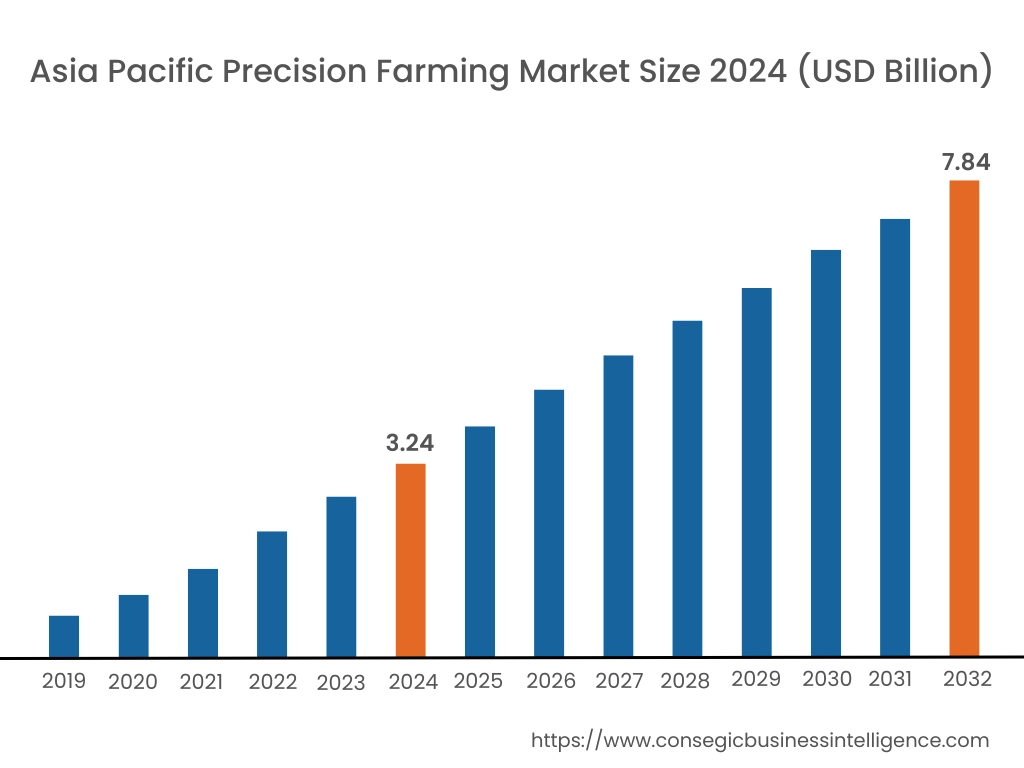
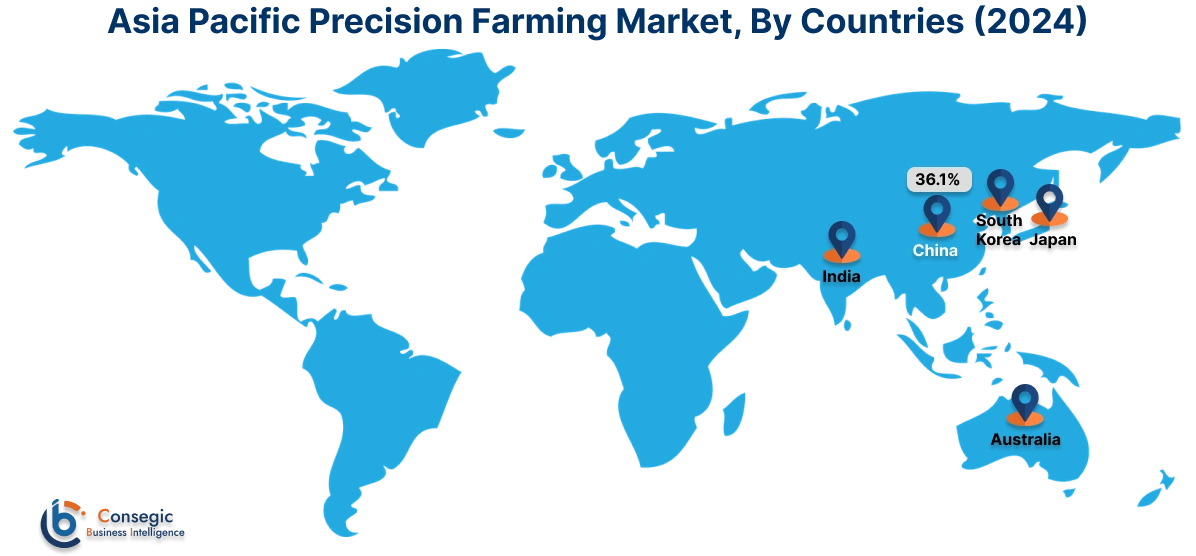
Asia Pacific region was valued at USD 3.24 Billion in 2024. Moreover, it is projected to grow by USD 3.56 Billion in 2025 and reach over USD 7.84 Billion by 2032. Out of this, China accounted for the maximum revenue share of 36.1%.
Asia-Pacific region is predominated by agricultural practices mainly in countries like China, India, Indonesia and Australia. Additionally, diverse climatic conditions and rapid urbanization the development of locally tailored solutions that combine advanced sensors with mobile connectivity in agricultural powerhouses such as China and India are steering the shift toward precision-based farming approaches.
- For instance, in January 2025, the International Rice Research Institute (IRRI) collaborated with XAG, a smart agriculture technology leader to leverage agricultural automation and advancements in the Philippines. This will allow the use of drone technology to improve rice-based cropping systems through experimentation and research.
Furthermore, the shifting trend on integrating automation and robotics for enhanced crop management in countries like Japan and South Korea, fuels the market in this region. Analysis of the market showed that government initiatives and strong local innovation have significantly driven the precision farming market demand.
North America is estimated to reach over USD 9.52 Billion by 2032 from a value of USD 3.98 Billion in 2024 and is projected to grow by USD 4.36 Billion in 2025.
In North America, dynamic shift toward technologically advanced farming methods, where precision agriculture is increasingly supported by smart sensor networks and real‑time data platforms boosts market growth. The integration of automated systems that optimize irrigation, fertilization, and other key practices and the enhanced use of mapping and imaging technologies in major agricultural areas such as the United States and Canada propels market demand.
- For instance, in January 2025, Topcon Agriculture, a pioneer in precision agriculture announced a strategic distribution agreement with PFG America. The agreement will allow PFG America to distribute Topcon’s wide range of solutions, including GPS-guided equipment, variable rate application technology, correction services, data-to-cloud technology, and data management software to farmers to optimize inputs, increase yield, and improve the overall farm management systems.
Furthermore, the collaboration between technology innovators and farmers is accelerating the adoption of these precision tools significantly driving the precision farming industry in this region.
Europe exhibits a strong presence in the market due to the sustainability goals and environmental regulations that promote efficient resource utilization in this region. A significant trends is the adoption of cutting‑edge sensor and control technologies that enable precise management of fields and integration of digital analytics and remote monitoring for crop health across countries like Germany and France, as well as emerging practices in Spain and Italy have propelled market development. Analysis of the market showed that policy initiatives aimed at reducing environmental impact are encouraging farmers to adopt these new methods, significantly boosting the precision farming market in this region.
Across the Middle East and Africa, agriculture is adapting to the challenges posed by arid climates and resource scarcity by turning to smart technologies. A significant trend observed in this region is the deployment of sensor‑driven irrigation systems combined with digital monitoring to conserve water in areas such as Israel and parts of Southern Africa. Analysis of the market showed that use of mobile-based analytical tools that help optimize crop inputs and targeted policy support aimed at sustainable practices have fueled the precision farming market in this region.
In Latin America, the shifting trend for efficient resource use and precision management. A significant trend in this region is the adoption of advanced digital mapping and sensor technologies in leading countries such as Brazil and Argentina, which help in managing diverse agricultural zones. Additionally, the emergence of remote sensing tools that enable farmers to fine‑tune irrigation and nutrient delivery based on real‑time field data and adoption of sustainable practices sustainability drives precision farming market growth in this region.
Top Key Players and Market Share Insights:
The Precision Farming Market is highly competitive with major players providing products and services to the national and international markets. Key players are adopting several strategies in research and development (R&D), product innovation, and end-user launches to hold a strong position in the global Precision Farming Market. Key players in the Precision Farming industry include -
- Deere & Company (United States)
- Trimble Inc. (United States)
- AGCO Corporation (United States)
- Raven Industries (United States)
- XAG Co., Ltd.(China)
- Topcon Positioning Systems (Japan)
- CNH Industrial (United Kingdom)
- AG Leader Technology (United States)
- CropX Technologies (Israel)
- Climate LLC (United States)
Recent Industry Developments :
Partnerships and Collaborations:
- In April 2023, Bosch BASF Smart Farming announced the partnership with AGCO Corporation to integrate smart spraying technology on Fendt Rogator sprayers. The farmers, with the help of this technology will be able to enable targeted spraying during different time and weather conditions. Further, integrated technologies like sophisticate sensoring and automated sensitivity thresholds will allow efficient herbicide management.
Precision Farming Market Report Insights:
| Report Attributes | Report Details |
| Study Timeline | 2019-2032 |
| Market Size in 2032 | USD 28.57 Billion |
| CAGR (2025-2032) | 11.5% |
| By Component |
|
| By Technology |
|
| By Application |
|
| By End-Uses |
|
| By Region |
|
| Key Players |
|
| North America | U.S. Canada Mexico |
| Europe | U.K. Germany France Spain Italy Russia Benelux Rest of Europe |
| APAC | China South Korea Japan India Australia ASEAN Rest of Asia-Pacific |
| Middle East and Africa | GCC Turkey South Africa Rest of MEA |
| LATAM | Brazil Argentina Chile Rest of LATAM |
| Report Coverage |
|
Key Questions Answered in the Report
How big is the Precision Farming Market? −
Precision Farming Market size is estimated to reach over USD 28.57 Billion by 2032 from a value of USD 11.96 Billion in 2024 and is projected to grow by USD 13.12 Billion in 2025, growing at a CAGR of 11.5% from 2025 to 2032.
What specific segments are covered in the Precision Farming Market? +
The Precision Farming Market specific segments for Component, Technology, Application, End-Users and Region.
Which is the fastest-growing region in the Precision Farming Market? +
Asia pacific is the fastest growing region in the Precision Farming Market.
What are the major players in the Precision Farming Market? +
The key players in the Precision Farming Market are Deere & Company (United States), Trimble Inc. (United States), AGCO Corporation (United States), Raven Industries (United States), Topcon Positioning Systems (Japan), CNH Industrial (United Kingdom), AG Leader Technology (United States), CropX Technologies (Israel), Climate LLC (United States), XAG Co., Ltd.(China), and others.
Overview
Reputation & Certifications


Our Services
- Market Intelligence & Forecasting
- Custom Research Solutions
- Market Entry Strategy
- Competitive Intelligence
- Customer Insights
- Industry Innovation Analysis
- Investment Advisory