Jump to Content
Vertical Farming Market Size & Industry Share - Growth Trends & Forecasts (2026 - 2034)
Vertical Farming Market Size:
The Vertical Farming market size was valued at 7,128.51 (US$M) in 2025 and is projected to grow from 8,867.86 (US$M) in 2026 to 50,860.66 (US$M) by 2034, at a CAGR of 24.4% from 2026 to 2034, according to a recent report from Consegic Business Intelligence.
Vertical Farming Market Scope & Overview:
Vertical farming takes place in controlled indoor environments, where plants are cultivated on stacked shelves to optimize space. This approach enables the production of crops and medicinal plants within vertical layers inside buildings such as skyscrapers, warehouses, or even repurposed shipping containers. By reducing dependence on weather conditions, specialized labor, and natural soil fertility, it ensures more efficient water use and a steady, reliable yield round. This controlled environment also reduces the risks of diseases and pests. Advanced monitoring technologies support plant growth and harvesting by tracking each stage of development.
How is AI Transforming the Vertical Farming Market?
AI is transforming the vertical farming market by automating and optimizing controlled environment agriculture systems through data analysis from sensors and computer vision. Also, AI integration enables precision management of lighting, water, and nutrients for optimal plant growth, leading to higher yields and reduced resource consumption. Further, AI enhances efficiency by automating labour-intensive tasks such as harvesting, monitoring for pests and diseases, and predicting yields, thereby cutting operating costs and improving profitability.

Vertical Farming Market Dynamics - (DRO) :
Key Drivers:
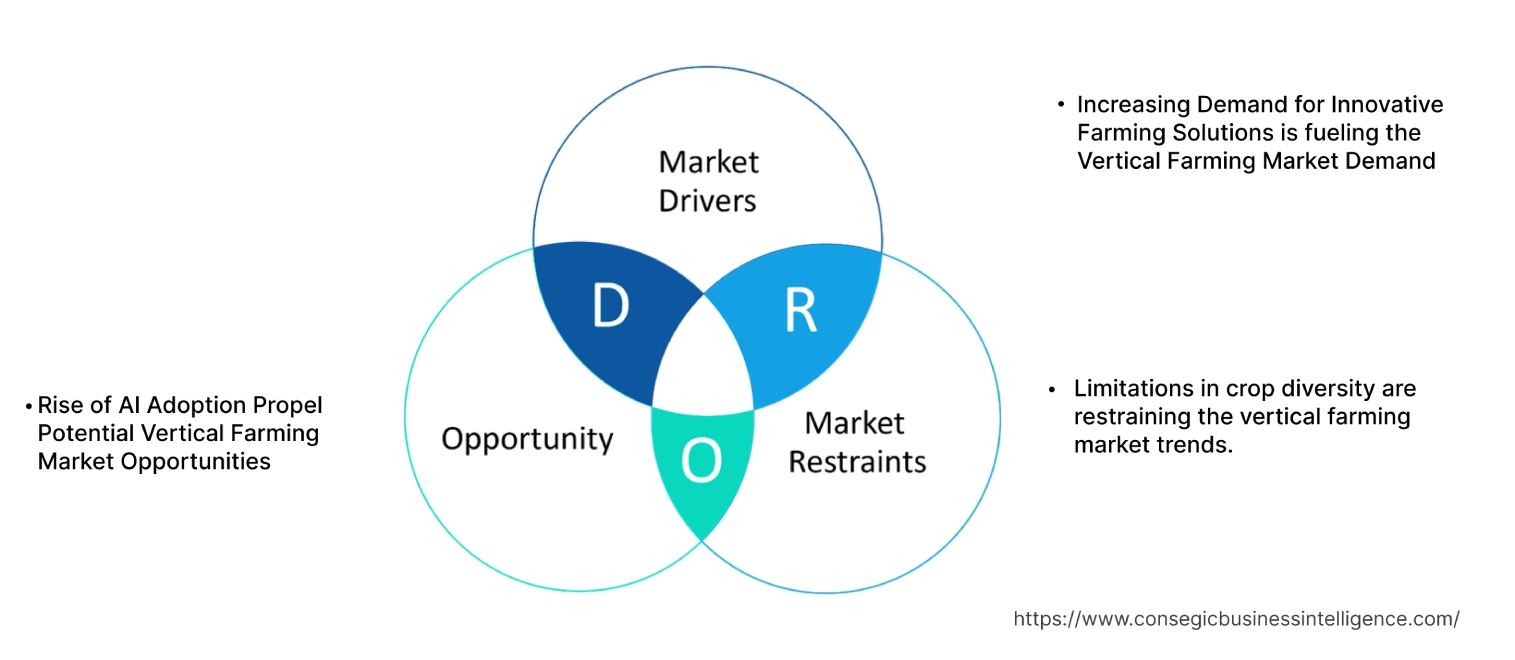
Increasing Demand for Innovative Farming Solutions is fueling the Vertical Farming Market Demand
The rapid progress in the global population is driving demand for more sustainable and efficient agricultural practices. This increase puts immense pressure on food supply chains, leading to a heightened need for innovative farming solutions. The demand for densely populated areas for food is increasing daily to overcome these and maximize land use efficiency is driving the market. As cities grow, the potential of vertical farms also expands, providing ample prospects for companies to invest in technologies that support high-yield and resource-efficient crop production.
- In February 2024, Masdar City collaborated with Alesca Technologies to develop an indoor vertical farm catering to climate change and food security.
Therefore, the rising advancements and partnerships associated with improving quality and sustainability are driving the vertical farming market size.
Key Restraints :
Limitations in crop diversity are restraining the vertical farming market trends.
In vertical farms, only leafy greens and herbs are cultivated because they require less time, unlike staple crops such as wheat or soybeans. High energy consumption for artificial lighting and climate control systems also add to operational costs, making them less viable for large-scale crops. Protein-rich plants are not feasible in this farming as the cost associated with it is relatively high. Additionally, the need for precise environmental management limits its application for diverse crop types, posing a restraint on the sector's scalability.
Thus, the analysis states that to lack of crop diversity is hindering the vertical farming market growth.
Future Opportunities :
Rise of AI Adoption Propel Potential Vertical Farming Market Opportunities
The integration of AI in vertical farming is presenting substantial development opportunities by enhancing efficiency and productivity. AI technologies enable precise monitoring and control of essential parameters such as light, temperature, and humidity, creating optimal conditions for plants. Due to the integration of AI, it becomes easier for farmers to analyze massive amounts of data to improve crop yields significantly by early detection and optimizing resources efficiently. AI-driven solutions are becoming more accessible, and the farming industry is expected to achieve higher yields with lower environmental impact, in turn supporting vertical farming market expansion.
- According to GreenState, their basil production increased by 20% by integrating the SCADA system with AI and the IoT in vertical farms.
Hence, the rising technological advancements in farming such as the integration of AI are driving the vertical farming market opportunities.
Vertical Farming Market Segmental Analysis :
By Structure:
Based on the structure, the market is segmented into building-based and shipping container-based.
Trends in the structure:
- There is a rising trend for climate-controlled containers for year-round crop production.
- The growing trend of large-scale indoor vertical farms is transforming urban retail places, meeting the rising needs of urban populations.
The shipping container base accounted for the largest revenue share in the year 2023.
- Shipping container-based uses repurposed shipping containers as controlled, modular growing spaces for crops, often incorporating hydroponics or aeroponics systems.
- It offers scalability, mobility, energy efficiency, reduced land use, and a sustainable solution for urban agriculture, allowing year-round crop production in a small footprint.
- It is used for urban farming, and food production in remote areas, and in areas with limited space. Shipping container farms are ideal for growing high-value crops like leafy greens, microgreens, and herbs.
- For instance, Agrinam Acquisition Corporation ordered 95 container farms in 2023 from Freight Farms, an emerging innovative Agtech company.
- Thus, the analysis states that the rising adoption of advanced agricultural technologies is driving the market.
The building-based segment is anticipated to register the fastest CAGR during the forecast period.
- Building-based farming utilizes the vertical space in existing buildings, such as warehouses or office buildings, to grow crops using hydroponics, aeroponics, or soil-based methods in controlled indoor environments.
- It maximizes urban space usage, reduces transportation costs related to the overall farming process, and provides sustainable production and local food.
- Building-based farming is usually seen in urban areas, as it supports growing crops like leafy greens and herbs for local consumption.
- Therefore, the rising adoption of building-based vertical farms in urban areas is anticipated to boost the vertical farming market trends during the forecast period.
By Component:
Based on the components, the market is segmented into lighting systems, irrigation and fertigation systems, climate control, sensors, and others.
Trends in the component:
- LED lighting systems are in trend for offering energy efficiency and optimized light spectrum for plant growth.
- Advanced irrigation technologies such as drip and misting systems are being used to provide adequate amounts of water and reduce overall consumption.
The sensors accounted for the largest revenue in the vertical farming market share in the year 2023.
- Sensors in farming provide real-time data to automate and optimize growing conditions.
- They help maintain precise environmental control, enhancing crop yield, and quality, and maximizing space efficiency.
- By monitoring factors such as light, temperature, and nutrients, sensors reduce resource waste and improve sustainability in farming.
- Sensor helps in the early detection of issues including nutrient deficiency, minimizing crop losses, reducing costs, and enhancing overall farm productivity.
- In March 2021, Monnit launched ALTA Soil Moisture Sensor, which helps farmers by sending alerts about soil conditions instantly over mobile phones.
- Thus, the analysis states that the rising advancements in sensors for controlling and monitoring intensity, radiation, temperature, and others are driving the vertical farming market demand.
The climate control segment is anticipated to register the fastest CAGR during the forecast period.
- Climate control in farming involves the use of systems to regulate temperature, humidity, carbon dioxide levels, and light, in turn creating an optimal growing environment for plants.
- Climate control technology helps farmers adapt to unpredictable weather conditions and meet the increasing demand for fresh produce.
- It ensures consistent crop quality, enables year-round production, reduces resource waste, and minimizes disease risks by controlling environmental factors.
- In vertical farms, greenhouses, and indoor agriculture, climate control systems allow precise environmental management for high-value crops.
- For instance, Grov Technologies launched Olympus Tower Farm, a cutting-edge controlled environment agriculture system that utilizes lighting technology for controlling indoor climate.
- Therefore, the rising advancement associated with smart agricultural techniques for controlling the climate is anticipated to boost the market during the forecast period.
By Growth:
Based on the growth, the market is segmented into aeroponics, hydroponics, and aquaponics.
Trends in the growth:
- The adoption of aquaponics is driven by multiple factors including a rising focus on sustainability and organic farming to reduce the need for pesticides and chemicals.
- Hydroponic farming is driven by various benefits such as lower water consumption, environmental benefits, and others.
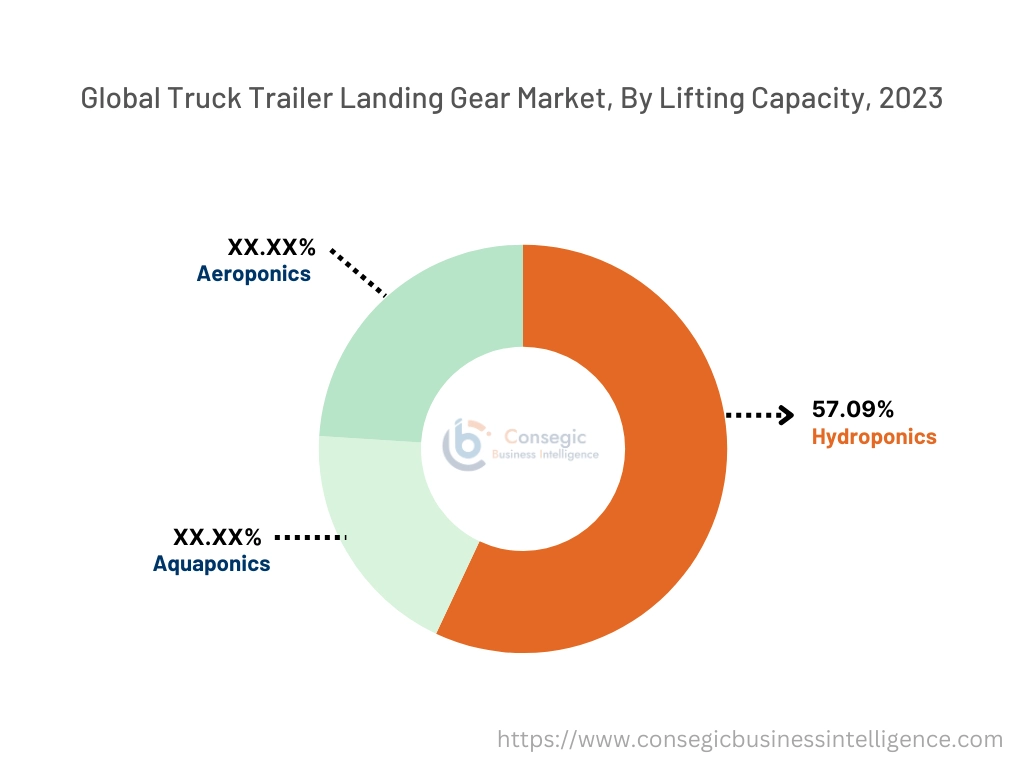
Hydroponics accounted for the largest revenue in vertical farming market share of 57.09% in the year 2023 and is anticipated to register the fastest CAGR during the forecast period.
- In hydroponics, plants are grown using a water-based nutrient solution instead of soil.
- The plants are planted in a small plastic container on a substrate made of rock wool or coconut fiber.
- Vertical hydroponics farming reduces the need for herbicides and pesticides, which are harmful to human health.
- The consumption of water in hydroponics farming is less compared to conventional soil-based agriculture, as the water is reused and recirculated.
- In December 2020, Dilmah Conservation partnered with AiGrow for climate-controlled agricultural techniques like hydroponics to increase water efficiency.
- Thus, the analysis states that the rising advancements and collaboration for improving traditional farming are set to drive vertical farming market growth.
Regional Analysis:
The regions covered are North America, Europe, Asia Pacific, the Middle East and Africa, and Latin America.
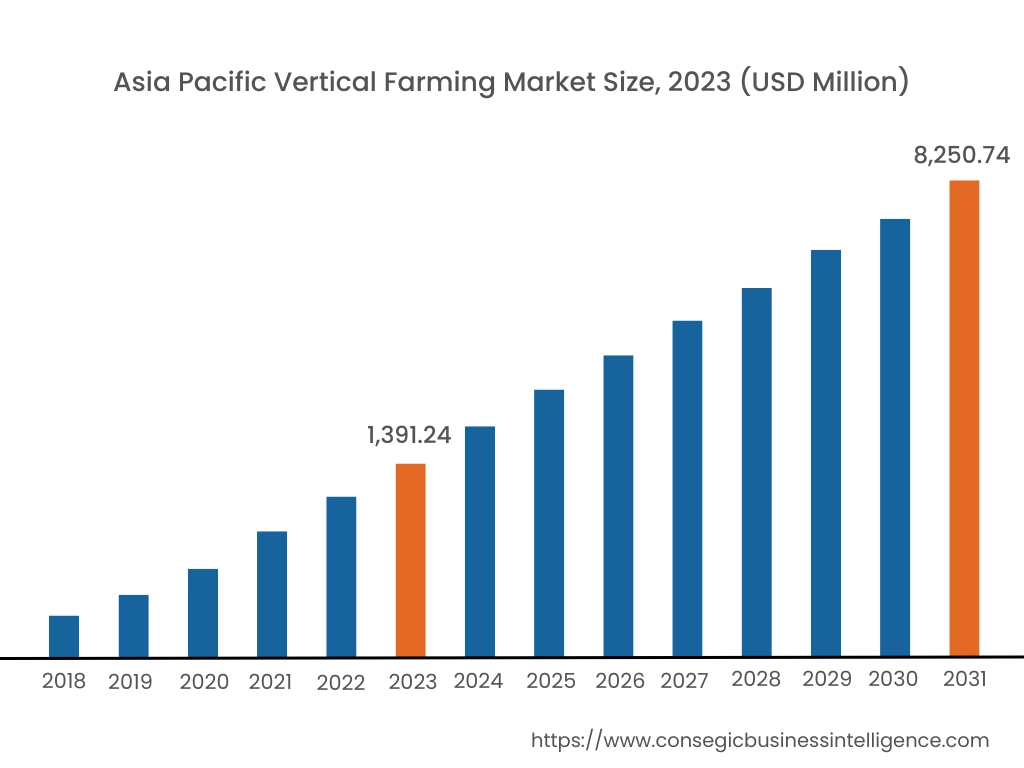
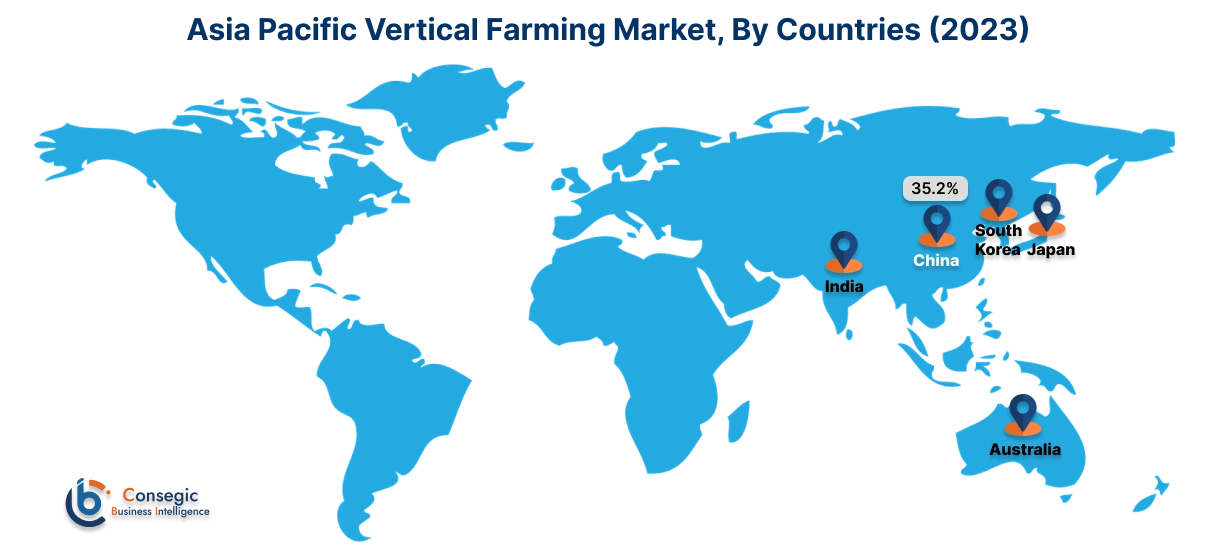
Asia Pacific region was valued at USD 1,391.24 Million in 2023. Moreover, it is projected to grow by USD 1,785.32 Million in 2024 and reach over USD 8,250.74 Million by 2031. Out of this, China accounted for the maximum revenue share of 35.2%.
The Asia Pacific region leads due to rapid technological advancements, increasing consumer demand for sustainable food sources, and rising investments in innovative farming solutions in turn accelerating the adoption of vertical farming practices across the region.
- For instance, the Indian government is expanding its horticulture mission to include hydroponics, aquaponics, and other modern farming techniques to boost agricultural production.
North America is estimated to reach over USD 8,985.19 Million by 2031 from a value of USD 1,551.54 Million in 2023 and is projected to grow by USD 1,986.99 Million in 2024. As per the vertical farming market analysis, it is growing due to the ability to produce more food on the same piece of land. Additionally, vertical farming is on the rise due to limited farming land and the increasing need for fresh produce which is set to drive the market in North America during the forecast period.
- For instance, in January 2024, AmHydro (American Hydroponics), a provider of hydroponic growing systems partnered with Ryzee, an Agtech startup for the development of an all-in-one farm optimization platform.
Additionally, according to the global vertical farming market analysis, Europe is anticipated to witness substantial development. The region is backed by well-developed technology infrastructure along with growing investments in eco-friendly farming solutions and others across the region.
Moreover, the Middle East & Africa is poised for moderate development. The determinants affecting the expansion include shipping container-based and building-based, and high investments from governments in Saudi Arabia and UAE are the major factors driving the vertical farming market size.
Further, the Latin American region is experiencing a rise in the vertical farming industry, backed by a rising need for sustainable solutions for intensive crop production to increase food security. Countries such as Brazil, Argentina, and others are representing the cumulative vertical farming market expansion in the region.
Top Key Players & Market Share Insights:
The vertical farming market is highly competitive with major players providing wireless communications solutions to the national and international markets. Key players are adopting several strategies in research and development (R&D), product innovation, and end-user launches to hold a strong position in the vertical farming market. Key players in the vertical farming industry include-
- AeroFarms (US)
- Freight Farms (US)
- Osram (Germany)
- Everlight Electronics (Taiwan)
- Heliospectra AB (Sweden)
- Sky Greens (Singapore)
- Signify (Netherlands)
- Spread (Japan)
- Plenty (US)
- Valoya (Finland)
Recent Industry Developments :
Product Launches:
- In September 2024, Plenty Unlimited Inc. launched a vertical farm for berries to grow indoors and produce 4 million pounds of strawberries yearly in 40,000 sq ft.
Partnerships & Collaborations:
- In December 2023, Senn Brothers partnered with AmplifiedAg to provide a software platform, modular farm infrastructure, and farm management advisory services.
Vertical Farming Market Report Insights :
| Report Attributes | Report Details |
| Study Timeline | 2021-2034 |
| Market Size in 2034 | USD 50,860.66 Million |
| CAGR (2026-2034) | 24.40% |
| Base Year | 2025 |
| By Structure |
|
| By Component |
|
| By Growth |
|
| By Region |
|
| Key Players |
|
| North America | U.S. Canada Mexico |
| Europe | U.K. Germany France Spain Italy Russia Benelux Rest of Europe |
| APAC | China South Korea Japan India Australia ASEAN Rest of Asia-Pacific |
| Middle East and Africa | GCC Turkey South Africa Rest of MEA |
| LATAM | Brazil Argentina Chile Rest of LATAM |
| Report Coverage |
|
Key Questions Answered in the Report
How big is the Vertical Farming market? −
The Vertical Farming market was valued at USD 4,610.46 million in 2023 and is projected to grow to USD 26,419.27 by 2031.
Which is the fastest-growing region in the Vertical Farming market? +
Asia-Pacific is the region experiencing the most rapid growth in the Vertical Farming market.
What specific segmentation details are covered in the Vertical Farming report? +
The Vertical Farming report includes specific segmentation details for structure, component, growth, and region.
Who are the major players in the Vertical Farming market? +
The key participants in the Vertical Farming market are Signify (Netherlands), Freight Farms (US), AeroFarms (US), Sky Greens (Singapore), Spread (Japan), Plenty (US), Valoya (Finland), Osram (Germany), Everlight Electronics (Taiwan), and Heliospectra AB (Sweden).
Overview
Reputation & Certifications


Our Services
- Market Intelligence & Forecasting
- Custom Research Solutions
- Market Entry Strategy
- Competitive Intelligence
- Customer Insights
- Industry Innovation Analysis
- Investment Advisory