Jump to Content
In-Memory Analytics Market - Size, Share, Industry Trends, and Forecasts (2025-2032)
In-Memory Analytics Market Size:
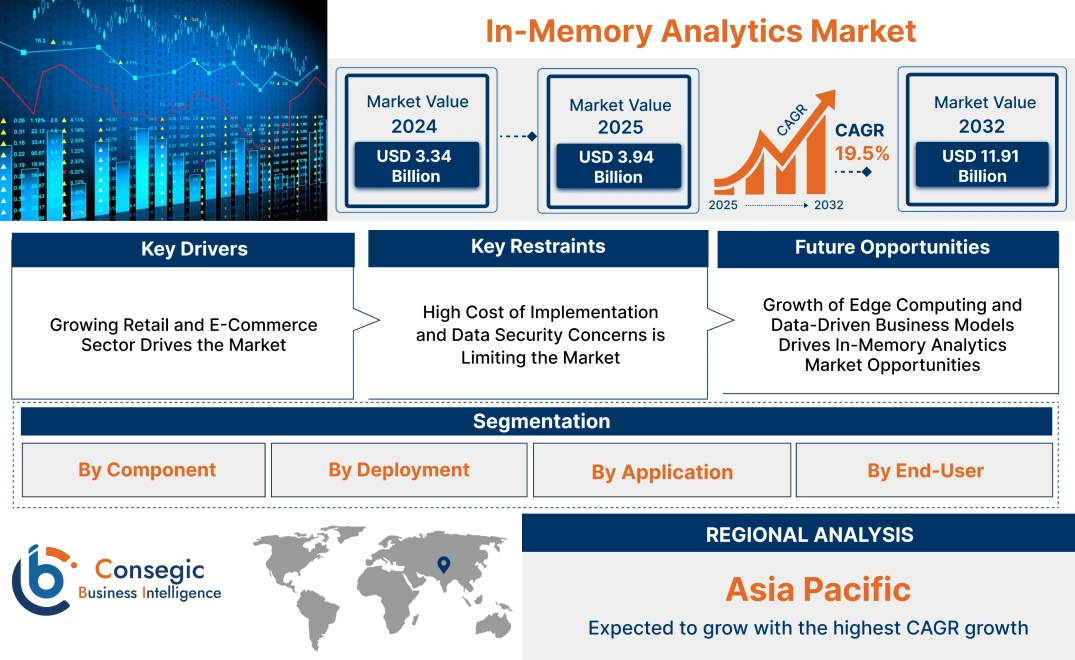
In-Memory Analytics Market Size is estimated to reach over USD 11.91 Billion by 2032 from a value of USD 3.34 Billion in 2024 and is projected to grow by USD 3.94 Billion in 2025, growing at a CAGR of 19.5% from 2025 to 2032.
In-Memory Analytics Market Scope & Overview:
In-memory analytics is a data processing technique that stores and analyzes data directly in a computer's RAM, enabling extremely fast query responses and real-time insights. Benefits including accelerated decision-making, enhanced operational efficiency, improved customer experience, and real-time fraud detection among others are driving the in-memory analytics market size. Further, analytics system is used for a wide range of applications including real-time fraud detection, personalized customer experience delivery, high-frequency trading analysis, supply chain optimization, network performance monitoring, and rapid scenario planning. Overall, the market is experiencing rapid rise due to factors including increasing volume and velocity of data, demand for real-time insights, proliferation of cloud-based analytics platforms, and need for faster decision-making.
In-Memory Analytics Market Dynamics - (DRO) :
Key Drivers:
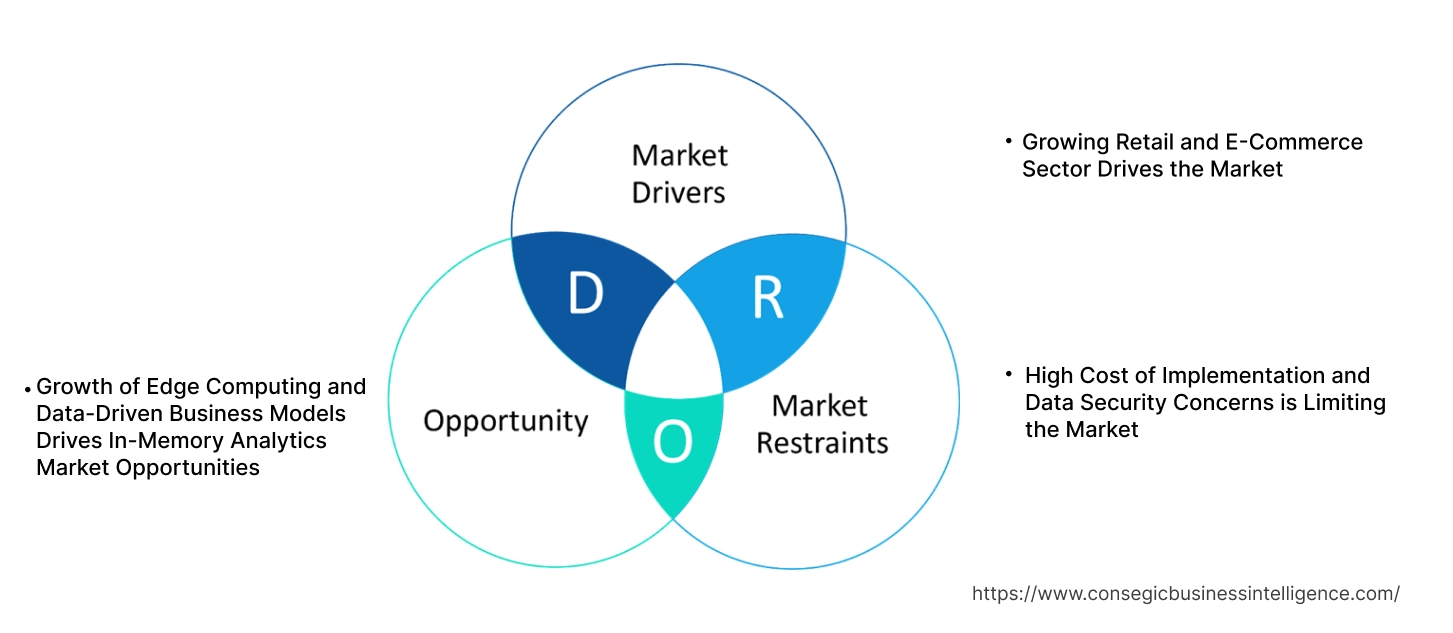
Growing Retail and E-Commerce Sector Drives the Market
The expanding retail and e-commerce sector significantly fuels the in-memory analytics market share. The sector thrives on rapid data-driven decisions as online retailers require instantaneous analysis of vast customer data for personalized recommendations, dynamic pricing, and fraud detection. Further, real-time inventory management is crucial for avoiding stockouts and optimizing logistics. Moreover, need for immediate insights into sales data, customer preferences, and supply chain dynamics necessitates the need for in-memory technologies.
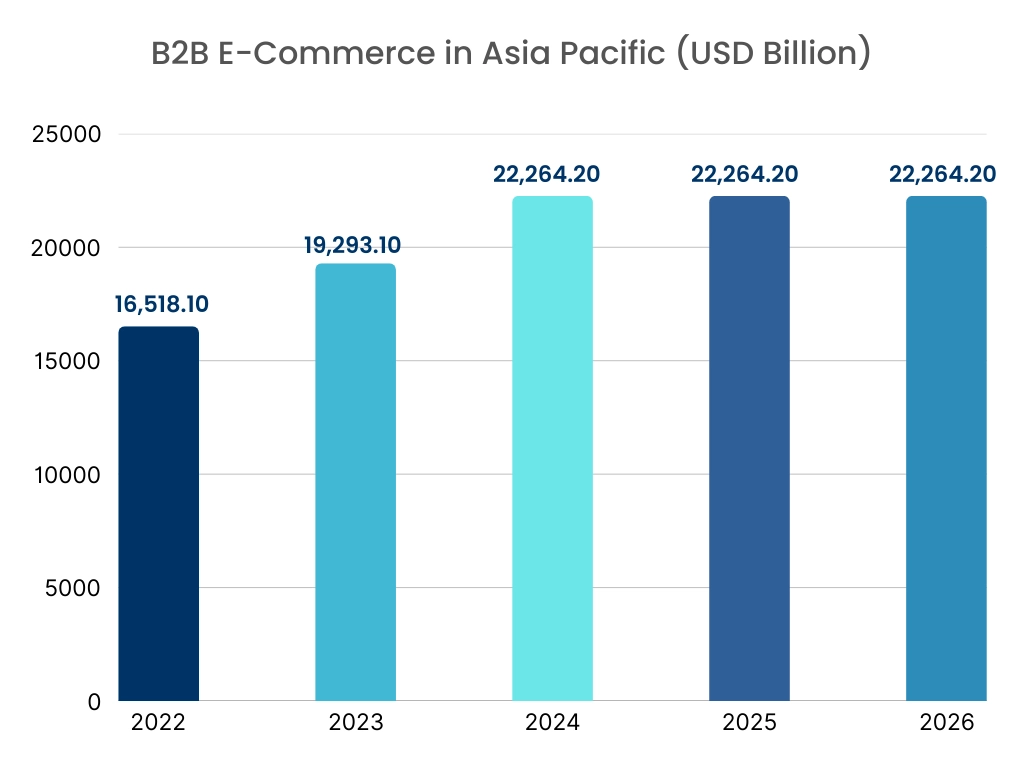
- For instance, according to International Trade Administration, Asia Pacific region is experiencing a surge in e-commerce, with B2B growth outpacing the global average at 15% annually and the overall market projected to exceed USD 28.9 trillion by 2026.
Thus, the growth of retail and e-commerce is driving the in-memory analytics market expansion.
Key Restraints:
High Cost of Implementation and Data Security Concerns is Limiting the Market
The high cost of implementation and data security concerns are significant restraints in the adoption of analytic systems. The deployment of in-memory systems necessitates substantial investments in high-capacity RAM and specialized hardware, creating a financial barrier, particularly for smaller organizations. Further, the complexity of integrating these systems with existing infrastructure adds to the overall cost. Furthermore, storing vast amounts of sensitive data in memory raises critical security vulnerabilities. Thus, the need for robust security measures and high upfront cost limits widespread adoption and thereby hindering the market.
Future Opportunities :
Growth of Edge Computing and Data-Driven Business Models Drives In-Memory Analytics Market Opportunities
The surge in edge computing, driven by the need for real-time data processing is fueling the in-memory analytics market share. As businesses adopt data-driven models, they require instant insights from massive, rapidly changing datasets. Edge computing generates vast amounts of data at the network's edge, necessitating high-speed analysis.
- For instance, March 2025, Ditto, a mobile database company specializing in edge device connectivity, secured USD 82 Billion in an oversubscribed Series B funding round, raising its valuation to USD 462 Billion.
Further, in-memory analytics, with its ability to process data directly in RAM, provides the speed required for time-sensitive applications. This synergy creates significant growth opportunities, enabling businesses to leverage edge data for immediate decision-making and operational efficiency, thereby driving the in-memory analytics market opportunities.
In-Memory Analytics Market Segmental Analysis :
By Component:
Based on the component, the market is segmented into hardware, software and service.
Trends in the Component:
- There's a shift towards cloud-native in-memory databases that offer scalability, flexibility, and cost-effectiveness which in turn drives the in-memory analytics market trends.
- Software solutions are focusing on real-time data streaming and processing, allowing organizations to analyze data as it's generated in turn driving the need for in-memory analytics.
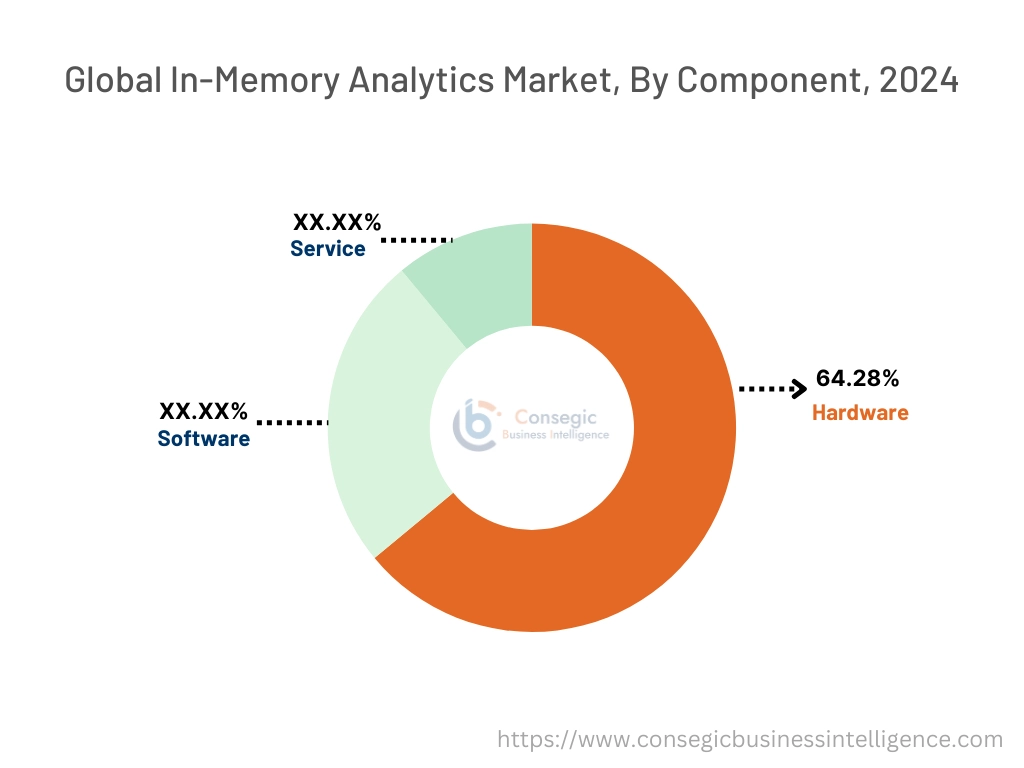
Hardware accounted for the largest revenue share of 64.28% in the year 2024.
- The continuous advancement in RAM technology is driving the ability to process larger datasets in which in turn drives the in-memory analytics market size.
- Further, growing integration of analytic systems with specialized processors, such as GPUs and FPGAs is driving the hardware component.
- Thus, increased RAM capacity and integration with specialized processors is driving the hardware component of market.
Service is anticipated to register the fastest CAGR during the forecast period.
- The demand for managed services is growing as organizations seek to reduce the complexity and cost of deploying and managing analytics solutions.
- Further, there’s a growing need for consulting and implementation services to help organizations design and deploy in-memory analytics solutions that meet their specific needs which in turn drives the in-memory analytics market demand.
- Therefore, aforementioned factors are expected to drive the in-memory analytics market trends during the forecast period.
By Deployment:
Based on the deployment, the market is bifurcated into On-Premise and Cloud.
Trends in the Deployment:
- Increasing focus on combining on-premises analytics system with cloud-based resources for specific workloads or data which in turn fuels the in-memory analytics market expansion.
- Growing adoption of on-premise deployment in banking, government and others is fueling the in-memory analytics market growth.
On-Premise Deployment accounted for the largest revenue share in the year 2024.
- The on-premise solution offers better control over infrastructure and data which in turn drives the in-memory analytics market demand.
- Further, stringent rules and regulations as well as compliance are boosting the need for on-premise deployment.
- For instance, SAP AG offers SAP HANA which is a unique, high-speed database that stores data in memory, enabling real-time analytics and transactions on a single system. The platform can be deployed both on cloud and on-premise.
- Thus, as per in-memory analytics market analysis, stringent rules and regulations are driving the on-premise deployment which in turn fuels the in-memory analytics market growth.
Cloud deployment is anticipated to register the fastest CAGR during the forecast period.
- The rise in serverless computing is driving the adoption of serverless in- analytics systems which in turn offer greater scalability, cost-effectiveness, and ease of management.
- Further, cloud-based analytics platforms are increasingly integrating with AI and machine learning services which in turn boost cloud deployment.
- Therefore, based on in-memory analytics market analysis, AI/ML integration and rise in serverless computing is anticipated to boost the market during the forecast period.
By Application:
Based on the application, the market is segmented into fraud detection and prevention, customer analytics, risk management, supply chain management, real-time decision making, and others.
Trends in the Application:
- Increasing adoption in supply chain management for real-time inventory optimization, predictive demand forecasting, and real-time logistics tracking
- Facilitating real-time monitoring of regulatory requirements and ensuring compliance is driving the market trend.
Fraud Detection and Prevention accounted for the largest revenue share in the year 2024.
- Real-time behavioral analysis to detect anomalies and suspicious patterns is driving the market.
- Further, machine learning algorithms are being integrated to develop sophisticated fraud scoring models that can adapt to evolving fraud tactics which in turn drives the market.
- Thus, real-time behavioral analytics and AI integration is driving the market during forecast period.
Customer Analytics is anticipated to register the fastest CAGR during the forecast period.
- Analytics system enables businesses to deliver personalized offers and recommendations to customers in real-time, based on their current behavior and preferences which in turn boosts the in-memory analytics industry.
- Further, customers are being segmented in real time, so that marketing and sales teams can react instantly to changes in customer behavior which in turn drives the market.
- For instance, InetSoft Technology Corp offers in-memory data analytics which provides the advantage of processing massive datasets without lag, performing rapid complex analyses, enabling real-time insights and predictions, and unifying diverse data for simultaneous, multi-user querying.
- Therefore, personalized real-time offers and real time customer segmentation are anticipated to boost the market during the forecast period.
By End-User:
Based on the end-user, the market is segmented into BFSI, retail and e-commerce, manufacturing, healthcare, telecommunications and IT, and others.
Trends in the end-user:
- Increasing adoption in manufacturing sector for predictive maintenance, real-time quality control, and supply chain optimization.
- Increasing adoption in IT and Telecommunication sector for real-time analysis of network traffic is driving the market.
BFSI accounted for the largest revenue share in the year 2024 and is anticipated to register the fastest CAGR during the forecast period.
- Increasing trends of instantaneous risk assessments and calculations for trading, lending, and insurance underwriting are driving the market.
- Further, adoption of AI-powered fraud detection and risk management systems is fueling the market
- Furthermore, analyzing customer data in real-time to providing personalized financial advice and offers is driving the market.
- Thus, risk management and integration of AI is driving the market during forecast period.
Regional Analysis:
The regions covered are North America, Europe, Asia Pacific, the Middle East and Africa, and Latin America.
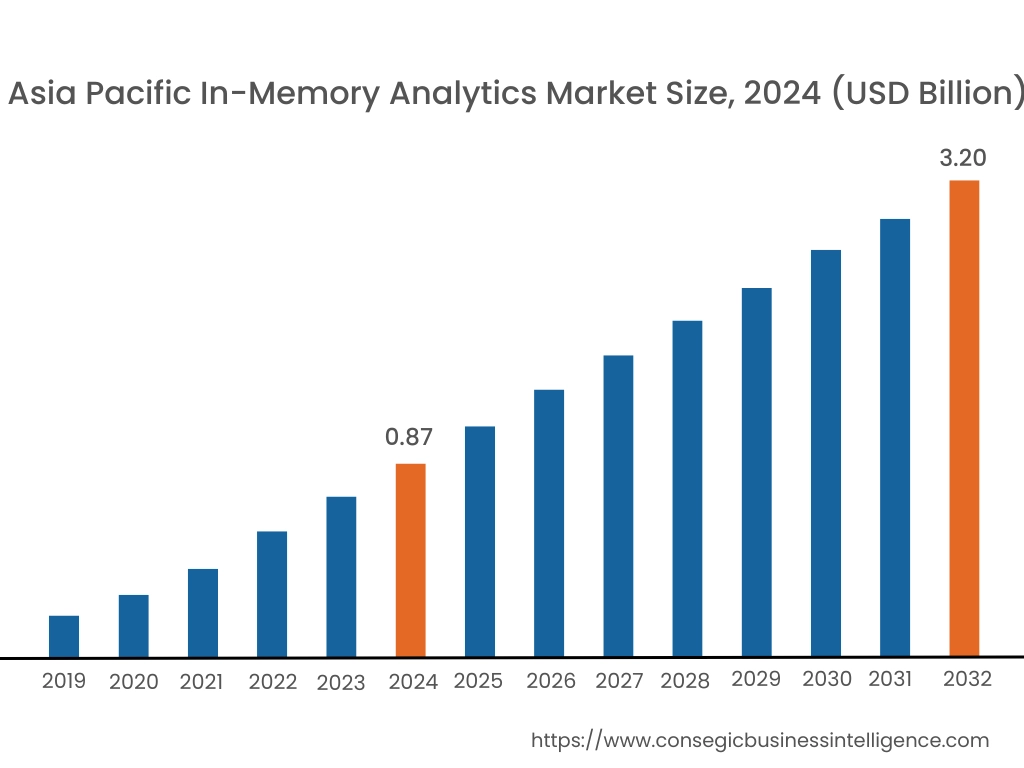
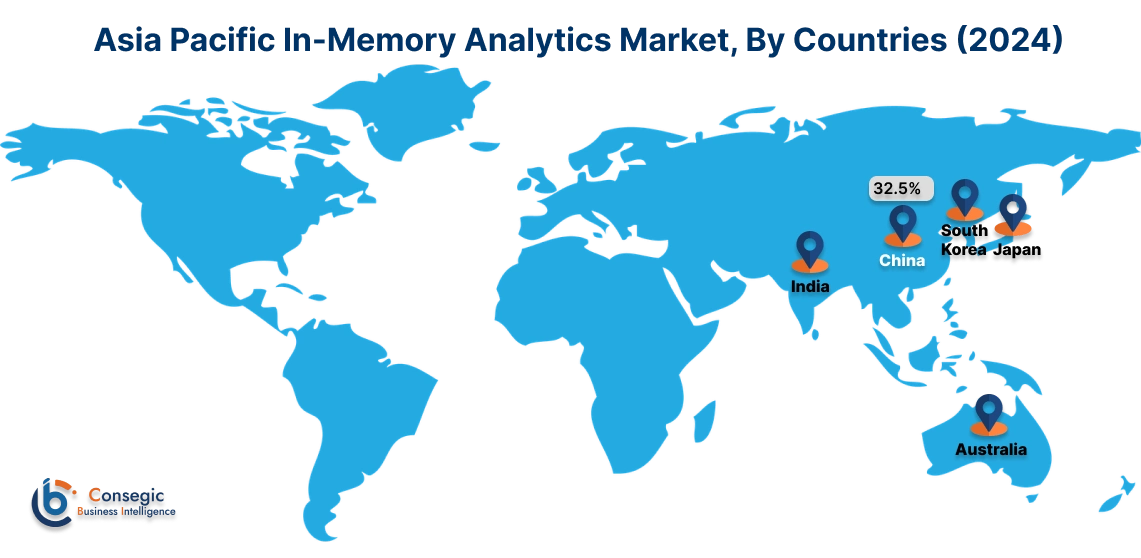
Asia Pacific region was valued at USD 0.87 Billion in 2024. Moreover, it is projected to grow by USD 1.03 Billion in 2025 and reach over USD 3.20 Billion by 2032. Out of this, China accounted for the maximum revenue share of 32.5%. The market is mainly driven by region's rapid digitalization which generates a vast volume of data. Additionally, the increasing adoption of cloud-based solutions, and the growth of the retail sector further propel this market's expansion.
- For instance, according to IBEF, by 2030, India's retail market is predicted to surpass USD 1.8 trillion, a significant increase from USD 779 billion in 2019, reflecting a consistent 9% growth rate.
North America is estimated to reach over USD 3.90 Billion by 2032 from a value of USD 1.11 Billion in 2024 and is projected to grow by USD 1.30 Billion in 2025. The North American region's market is driven by increasing need for real-time data processing in key industry like BFSI and retail. Additionally, strong technological infrastructure and high adoption rate of advanced analytics is driving the market.
- For instance, in April 2023, SAP AG a major player in the market released SAP HANA 2.0 SPS 07 update which focuses on reduced costs, improved scalability, reliability, and enhanced user experience. Further, the release includes enhancements in backup and recovery, storage, support tooling, security, machine learning, data provisioning, and modeling.
The regional trends analysis depicts that the increasing demand for real-time data processing and faster insights to support digital transformation initiatives across various industries in Europe is driving the market. Additionally, the primary factor driving the market in the Middle East and African region is growing adoption of cloud computing. Further, digital transformation across various sectors including finance, telecommunications, and government is paving the way for the progress of market trends in Latin America region.
Top Key Players and Market Share Insights:
The global in-memory analytics market is highly competitive with major players providing solutions to the national and international markets. Key players are adopting several strategies in research and development (R&D), product innovation, and end-user launches to hold a strong position in the in-memory analytics industry. Key players in the in-memory analytics market include-
- InetSoft Technology Corp. (US)
- SAP SE (Germany)
- IBM Corporation (US)
- Oracle (US)
- SAS Institute Inc. (US)
- ActiveViam (France)
- Amazon Web Services, Inc. (US)
- Cloud Software Group, Inc. (US)
- Exasol (Germany)
- Software AG (Germany)
Recent Industry Developments :
Product Launches:
- In May 2024, AWS released EC2 High Memory U7i instances, a new cloud offering with DDR5 memory, up to 32TiB RAM, and 896 vCPUs. Powered by 4th Gen Intel Xeon processors, these instances provide significantly increased performance and better price-performance compared to previous models, making them ideal for large in-memory databases.
In-Memory Analytics Market Report Insights :
| Report Attributes | Report Details |
| Study Timeline | 2019-2032 |
| Market Size in 2032 | USD 11.91 Billion |
| CAGR (2025-2032) | 19.5% |
| By Component |
|
| By Deployment |
|
| By Application |
|
| By End-User |
|
| By Region |
|
| Key Players |
|
| North America | U.S. Canada Mexico |
| Europe | U.K. Germany France Spain Italy Russia Benelux Rest of Europe |
| APAC | China South Korea Japan India Australia ASEAN Rest of Asia-Pacific |
| Middle East and Africa | GCC Turkey South Africa Rest of MEA |
| LATAM | Brazil Argentina Chile Rest of LATAM |
| Report Coverage |
|
Key Questions Answered in the Report
How big is the in-memory analytics market? −
The in-memory analytics market is estimated to reach over USD 11.91 Billion by 2032 from a value of USD 3.34 Billion in 2024 and is projected to grow by USD 3.94 Billion in 2025, growing at a CAGR of 19.5% from 2025 to 2032.
What specific segmentation details are covered in the In-Memory Analytics report? +
The in-memory analytics report includes specific segmentation details for component, deployment, application, end-user, and region.
Which is the fastest segment anticipated to impact the market growth? +
In the in-memory analytics market, cloud deployment is the fastest-growing segment during the forecast period due to benefits including scalability, flexibility, and cost-effectiveness.
Who are the major players in the In-Memory Analytics market? +
The key participants in the in-memory analytics market are InetSoft Technology Corp. (US), SAP SE (Germany), IBM Corporation (US), Oracle (US), SAS Institute Inc. (US), ActiveViam (France), Amazon Web Services, Inc. (US), Cloud Software Group, Inc. (US), Exasol (Germany), Software AG (Germany) and others.
What are the key trends in the in-memory analytics market? +
The in-memory analytics market is being shaped by several key trends including increasing demand for real-time analytics, exponential growth of data volume, rise of cloud-based in-memory analytics, and integration of AI and machine learning.
Overview
Reputation & Certifications


Our Services
- Market Intelligence & Forecasting
- Custom Research Solutions
- Market Entry Strategy
- Competitive Intelligence
- Customer Insights
- Industry Innovation Analysis
- Investment Advisory