Jump to Content
In-Vehicle AI Robot Market - Size, Share, Industry Trends, and Forecasts (2025-2032)
In-Vehicle AI Robot Market Size:
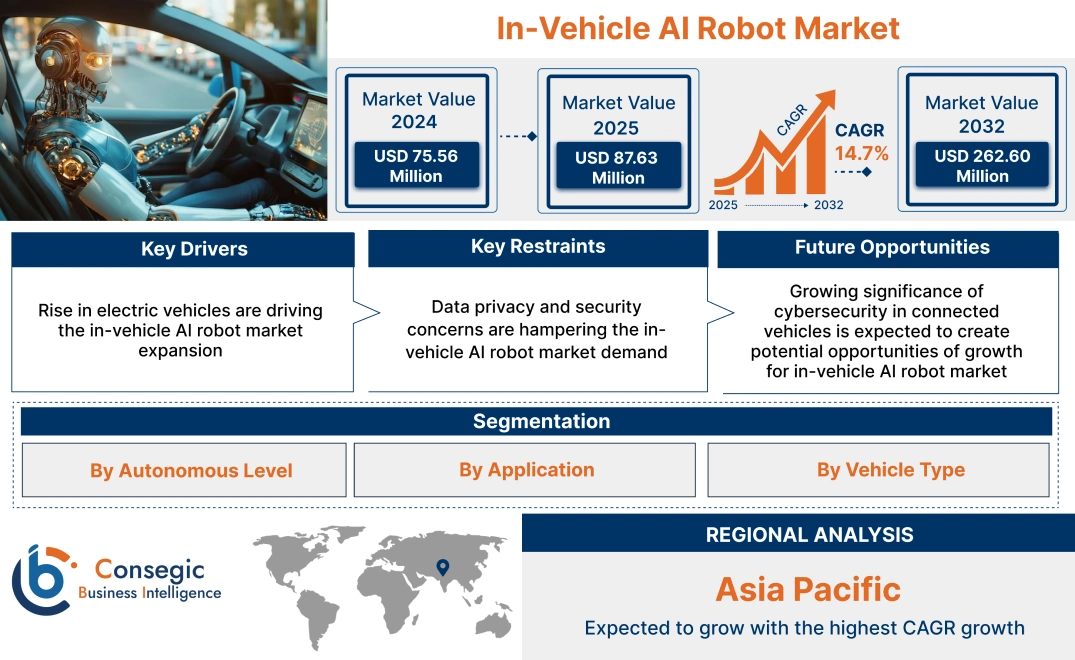
In-Vehicle AI Robot Market Size is estimated to reach over USD 262.60 Million by 2032 from a value of USD 75.56 Million in 2024 and is projected to grow by USD 87.63 Million in 2025, growing at a CAGR of 14.7% from 2025 to 2032.
In-Vehicle AI Robot Market Scope & Overview:
The in-vehicle AI robot market is an emerging sector set to transform the automotive industry. These smart companions, driven by artificial intelligence, aim to improve safety, comfort, and entertainment in vehicles. As automotive firms strive to remain competitive in a changing market, the integration of artificial intelligence (AI) has emerged as a strategic priority throughout the industry. AI provides significant benefits that enhance efficiency, safety, and personalization across various automotive activities, including vehicle manufacturing, ridesharing, and insurance claims processing.
In-Vehicle AI Robot Market Dynamics - (DRO) :
Key Drivers:
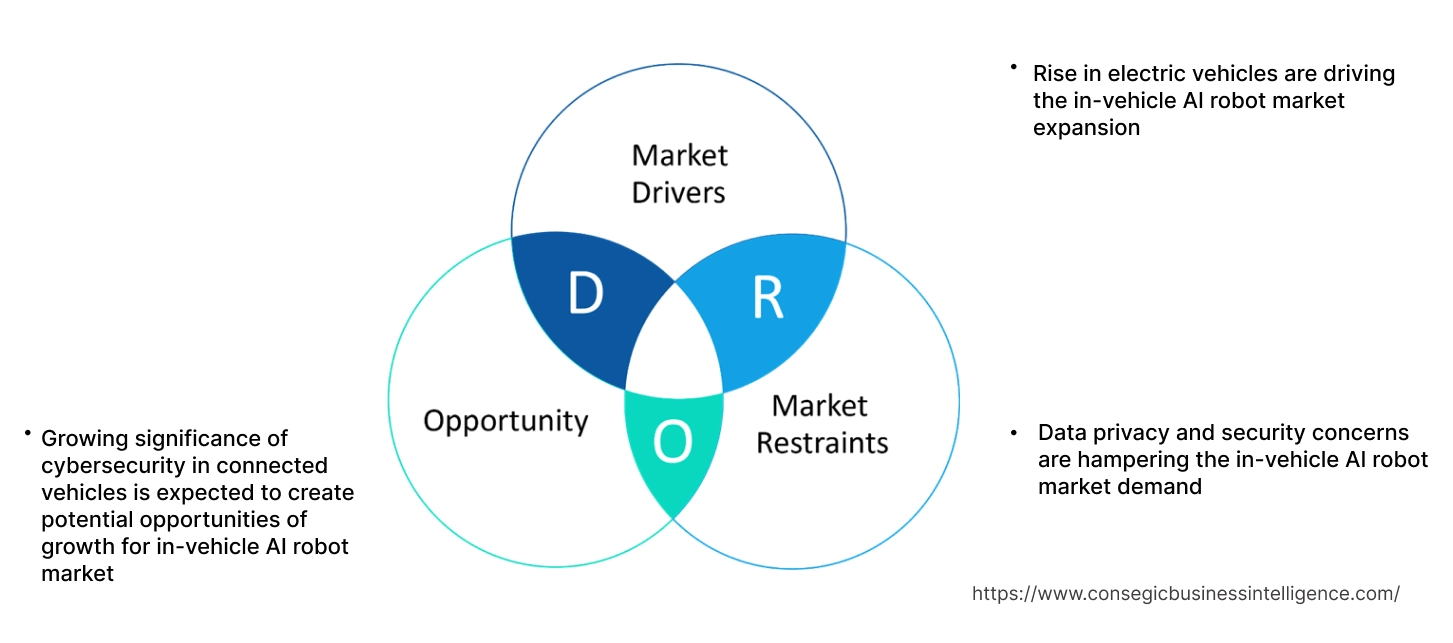
Rise in electric vehicles are driving the in-vehicle AI robot market expansion
The global transition to sustainable and electric mobility is driving the adoption of in-vehicle AI robots. The growth of the electric vehicle (EV) market is transforming the automotive industry, emphasizing eco-friendly and energy-efficient transportation solutions. As consumers increasingly choose electric vehicles for their environmental advantages and cost-effectiveness, the integration of in-vehicle AI robots complements the innovative image associated with EVs. These AI robots can aid EV drivers in various aspects of their journeys, such as optimizing routes to enhance electric range, locating nearby charging stations, and delivering real-time energy consumption data. As the EV market expands, these AI robots are set to become essential elements of electric vehicles, providing a harmonious combination of sustainability, technology, and tailored support for drivers and passengers.
- For instance, according to IEA, electric car sales experienced variation across regions and powertrains, yet China remained the dominant player. In 2022, battery electric vehicle (BEV) sales in China rose by 60% compared to 2021, reaching 4. 4 million units, while plug-in hybrid electric vehicle (PHEV) sales nearly tripled to 1. 5 million units.
Thus, according to the in-vehicle AI robot market analysis, the rise in developments and trends in electric vehicles are driving the in-vehicle AI robot market size.
Key Restraints:
Data privacy and security concerns are hampering the in-vehicle AI robot market demand
A key challenge in the in-vehicle AI robot market is related to concerns over data privacy and security. As these AI robots increasingly connect with external networks, cloud platforms, and various devices, they manage significant amounts of sensitive information, including personal preferences, biometric data, location information, and voice recordings. This situation raises serious issues regarding the privacy and security of such data. Additionally, with the ongoing evolution of data privacy regulations, such as the General Data Protection Regulation (GDPR) and other regional frameworks, manufacturers must ensure compliance to avert legal consequences. Striking a balance between the seamless operation of these AI robots and robust data protection measures requires ongoing innovation and collaboration with cybersecurity experts. Addressing these concerns is not only essential for regulatory compliance but is also vital for establishing and preserving consumer trust. Moreover, manufacturers should prioritize transparency in data usage, implement strong security protocols, and communicate effectively with users to reassure them that their personal information is managed responsibly and securely. These factors and analysis are progressing the in-vehicle AI robot market trends.
Future Opportunities :
Growing significance of cybersecurity in connected vehicles is expected to create potential opportunities of growth for in-vehicle AI robot market
In connected vehicles, the significance of cybersecurity is becoming increasingly critical. As vehicles become more integrated with the internet and external networks, they face heightened risks of cybersecurity threats, including unauthorized access, data breaches, and potential manipulation of essential vehicle systems. In-vehicle AI robots, which are fundamental components of intelligent automotive systems, manage and store sensitive information about users, their preferences, and possibly even biometric data. The emphasis on cybersecurity aims to implement strong measures to protect this information and prevent unauthorized access. It includes encryption protocols, secure communication channels, and intrusion detection systems. Further, manufacturers are prioritizing secure software development practices, over-the-air (OTA) updates, and partnerships with cybersecurity experts to proactively address potential threats. As the automotive sector advances towards greater autonomy and connectivity, the focus on cybersecurity in in-vehicle AI robots is crucial for ensuring that intelligent automotive systems remain resilient against cyber threats, thereby protecting the privacy and safety of vehicle occupants.
- For instance, in January 2025, NVIDIA’s DRIVE AGX Hyperion, an autonomous vehicle platform, has been approved safety assessments by TUV Rehinland and TUV SUD. The platform encompasses the DriveOS automotive operating system and reference board design, system-on-a-chip (SoC), an active safety and level 2+ driving stack, and a sensor suite. In addition to this, it will facilitate the compliance of advanced automotive systems with robust, AI-driven functionalities to the stringent functional safety and cybersecurity standards of the automotive sector.
Thus, based on the above analysis and trends, the growing significance of cybersecurity is driving the in-vehicle AI robot market opportunities.
In-Vehicle AI Robot Market Segmental Analysis :
By Autonomous Level:
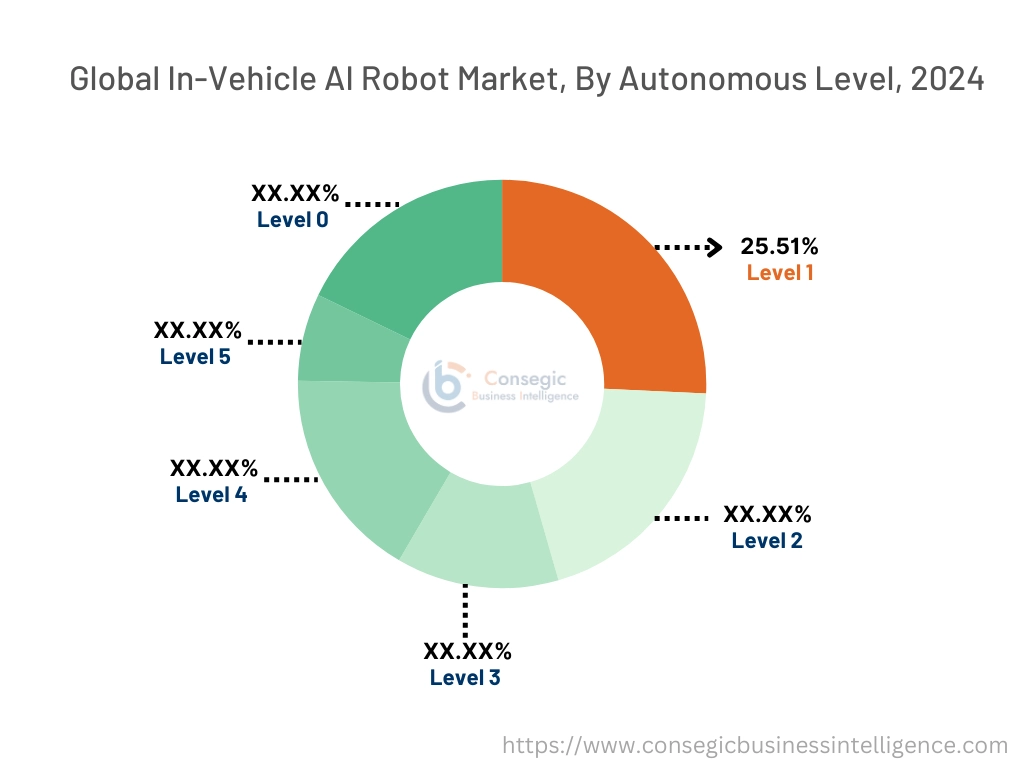
Based on the autonomous level, the market is segmented into level 0, level1, level 2, level 3, level 4, and level 5.
Trends in the autonomous level:
- Ongoing advancements in AI and machine learning algorithms are empowering these AI robots to execute more intricate tasks, including real-time object detection, path planning, and decision-making.
- Automakers are increasingly prioritizing the delivery of a seamless and intuitive user experience with these AI robots, integrating natural language processing, voice recognition, and personalized settings.
Level 1 segment accounted for the largest revenue share of 25.51% in the year 2024 and is expected to register the highest CAGR during the forecast period.
- The growing demand for advanced systems, such as night vision systems, and sign recognition systems are expected to impact the overall growth of the segment.
- Mid-priced cars are outfitted with fundamental components that are designed and produced to meet consumer preferences. A steady rise in demand for compact and mid-sized vehicles featuring advanced safety characteristics is anticipated to drive the development of the driver assistance (Level 1) segment.
- For instance, in October 2024, Qualcomm announced the partnership with Google, to bring AI-powered voice assistants to vehicles using Snapdragon Digital Chassis. This collaboration seeks to improve driver safety and personalization through fatigue monitoring, real-time navigation, and route recommendations. These AI systems will operate independently of the driver's phone, ensuring a seamless experience directly from the vehicle's interface.
- Thus, trends and analysis in the driver assistance (Level 1) segment would further drive the in-vehicle AI robot market size during the forecast period.
By Application:
Based on the application, the market is segmented into driver assistance, infotainment, fleet Management, vehicle health monitoring, predictive maintenance, voice recognition and in-car connectivity, advanced driver assistance system (ADAS) integration, augmented reality (AR) and heads-up display, automotive insurance, passenger experience, and others.
Trends in the application:
- The emergence of connected cars, equipped with sophisticated sensors and high-bandwidth connectivity, generates extensive data for AI algorithms to utilize in enhancing performance and the driving experience.
- The incorporation of in-vehicle AI robots with the Internet of Things (IoT) and 5G networks facilitates real-time data exchange, remote control, and improved connectivity.
- The advancement of fully autonomous vehicles is propelling major progress in AI technologies, including sensor fusion, path planning, and decision-making.
Advanced Driver Assistance System (ADAS) integration segment accounted for the largest revenue share in the year 2024 and is expected to register the highest CAGR during the forecast period.
- Vehicle electrification is generating significant growth opportunities in vehicle automation. Consequently, many market leaders are making substantial investments in autonomous vehicle technology. The incorporation of Advanced Driver Assistance Systems (ADAS) is a key requirement for vehicle automation. The use of various ADAS sensors, such as Radar, LIDAR, and cameras, is anticipated to enable companies to achieve near-accurate vehicle automation.
- Governments are focusing on developing legislative policies and regulations to oversee users. Governments are proposing measures to mandate and encourage the installation of ADAS components in vehicles to reduce the rising incidence of road accidents in numerous countries.
- The advanced driver assistance system minimizes distractions and supports the driver through artificial intelligence and other cutting-edge technologies. The swift integration of advanced technology in software algorithms, mapping, processors, cameras, and sensors has enhanced the functionality of advanced driver assistance systems in vehicles. Due to the ongoing emphasis on improving the safety and security of drivers and passengers and reducing road fatalities, manufacturers are incorporating ADAS into cars, thereby increasing the demand for these systems in the automotive sector.
- For instance, in January 2025, Hexagon launched Virtual Test Drive X, a cloud solution to assess, train, and validate ADAS and autonomous vehicles. Utilising hyperscale computing and automation, the solution enables the automotive sector to validate the quality and function of software against real-world scenarios automatically and accelerate the safe mobility innovations.
- Thus, trends such as government regulations and rising vehicle electrification, analysis, and developments would further supplement the in-vehicle AI robot market growth during the forecast period.
By Vehicle Type:
Based on the vehicle type, the market is segmented into passenger vehicles and commercial vehicles.
Trends in the vehicle type:
- Global governments have implemented proactive strategies to encourage the adoption of electric vehicles (EVs). Countries such as China, India, France, and the United Kingdom have established objectives to eliminate petrol and diesel vehicles by 2040.
- Major market participants are increasing their production capabilities, complying with strict emission standards while countries like China, India, Japan, and South Korea have revealed intentions to prohibit the sale of new internal combustion engines.
The passenger vehicle segment accounted for the largest revenue share in the year 2024.
- Passenger cars constitute a substantial segment of the in-vehicle autonomous vehicle market. Within this category, various subcategories are recognized to address the diverse types and preferences of consumers. These subcategories include SUVs, premium and luxury passenger cars, as well as compact and mid-sized vehicles. Each subcategory serves specific consumer needs and preferences, ranging from spacious family automobiles to high-performance luxury models.
- In the upcoming years, the passenger car market is anticipated to further evolve, with advancements such as autonomous driving technologies, connected car features, and enhanced safety systems gaining prominence. These innovations not only enrich the driving experience but also aim to bolster road safety and alleviate traffic congestion.
- The emergence of mobility-as-a-service (MaaS) is reshaping perceptions of vehicle ownership, potentially resulting in a decline in private car ownership in favour of shared transportation solutions.
- For instance, in August 2024, Mobileye announced the partnership with Zeekr, to integrate Mobileye technologies into next generation Zeekr models. The expanded collaboration will empower Zeekr engineers to leverage Mobileye’s technologies and development tools more effectively for data validation, facilitating the efficient delivery of software upgrades to customers. Furthermore, this partnership will expedite the rollout of comprehensive automated driving solutions for other Mobileye clients in China.
- The autonomous driving technologies and connected car features would further supplement the global in-vehicle market during the forecast period.
Commercial vehicles segment is anticipated to register the fastest CAGR during the forecast period.
- The global commercial vehicles segment is experiencing growth driven by advancements in infrastructure and industrialization across various regions. As nations invest in infrastructure projects like road construction, highway expansion, and urban development, the demand for commercial vehicles increases. These vehicles play a crucial role in transporting construction materials, equipment, and personnel to project sites, thereby facilitating the progress of infrastructure endeavours.
- Industrialization in emerging economies is further fuelling the market. As these economies undergo rapid urbanization and industrial development, the need for effective transportation solutions to support manufacturing, distribution, and logistics intensifies. Commercial vehicles, including trucks, vans, and buses, are vital for transporting raw materials, finished products, and personnel within and between industrial areas.
- Thus, advancements and trends in infrastructure and industrialization would further supplement the global market during the forecast period.
Regional Analysis:
The global market has been classified by region into North America, Europe, Asia-Pacific, MEA, and Latin America.
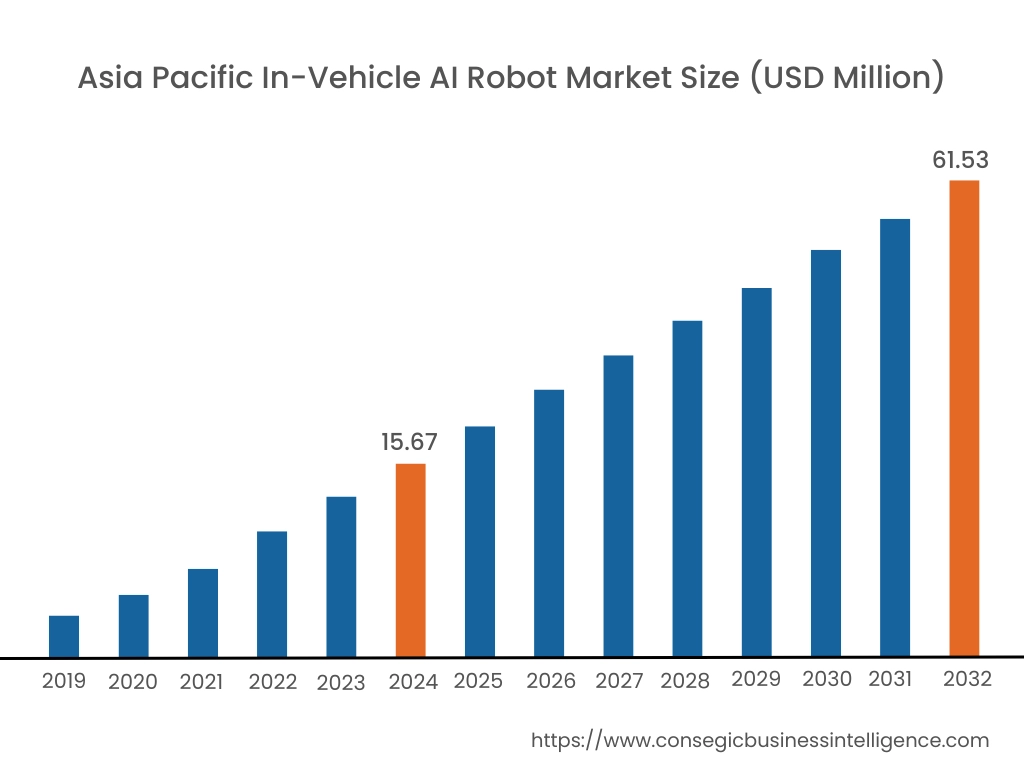
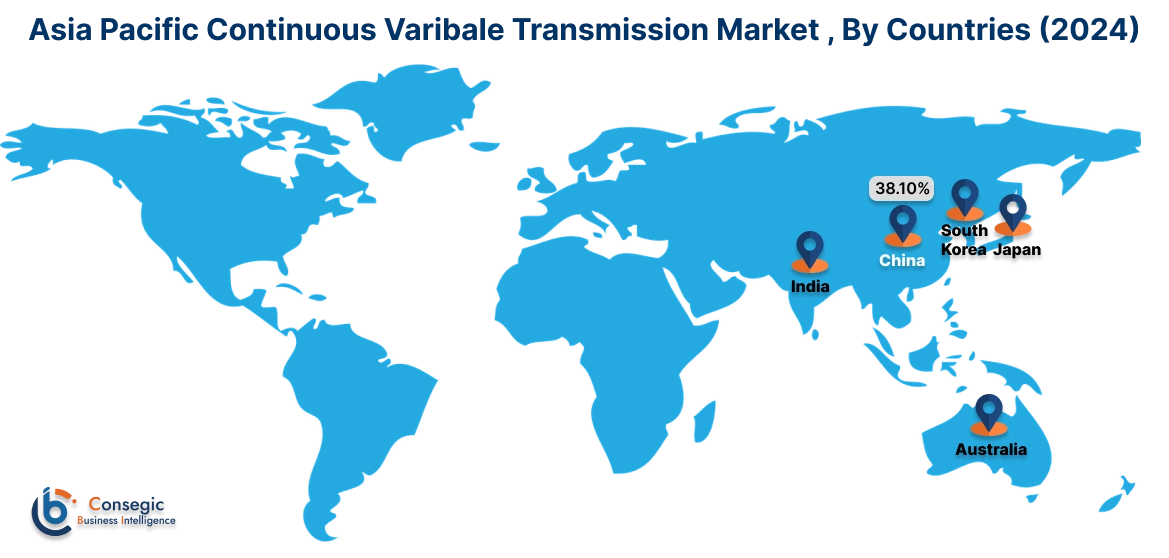
Asia Pacific in-vehicle AI robot market expansion is estimated to reach over USD 61.53 million by 2032 from a value of USD 15.67 million in 2024 and is projected to grow by USD 18.37 million in 2025. Out of this, the Chinese market accounted for the maximum revenue split of 38.10%. The Asia-Pacific region is becoming a significant market for AI robots, driven by the swift growth of the automotive sector, especially in countries like China, Japan, and South Korea. Factors such as rising vehicle production, increasing urbanization, and heightened consumer demand for connected and autonomous vehicles are propelling market development in this area. Additionally, government initiatives to encourage electric vehicles and smart transportation systems are further enhancing the adoption of in-vehicle AI technologies. Governments in Asia-Pacific regions are promoting the adoption of battery electric vehicles (BEVs), plug-in hybrid electric vehicles (PHEVs), and, in certain nations, more efficient vehicles to reduce emissions in the transportation sector. The IBEF indicates that India could emerge as a leader in shared mobility by 2030, creating opportunities for electric and autonomous vehicles. These factors are expected to further drive the regional in-vehicle AI robot market share in the coming years.
- For instance, in June 2023, Ministry of Industry and Information Technology, China has announced its plan to support the commercial development of higher autonomous driving technology and level 3 projects. The government aims to collaborate with various companies, develop infrastructure for cellular vehicle-to-everything technology, and initiate level 3 pilot projects.
North America in-vehicle AI robot market is estimated to reach over USD 86.92 million by 2032 from a value of USD 25.27 million in 2024 and is projected to grow by USD 29.28 million in 2025. The regional development is driven by technological advancements in the automotive sector and the presence of key automotive players. North America possesses a strong robotics ecosystem featuring leading market participants, esteemed research institutions, and a skilled workforce. This setting fosters collaboration, knowledge sharing, and innovation in robotics technologies, thereby expediting the development and adoption of advanced robotic solutions for automotive manufacturing. The region is home to a vigorous automotive sector, with major car manufacturers and suppliers operating production facilities across the area. The need for automation and robotics in automotive manufacturing stems from the need to improve productivity, quality, and competitiveness in the face of global market challenges. These factors would further drive the regional in-vehicle AI robot market share during the forecast period.
- For instance, in January 2023, NXP Semiconductors launched a new series, SAF85xx, which is designed for automated driving systems and next-generation ADAS. The series integrates advanced radar detection and processing technologies into a single device. Further, it caters to short and long-range radar applications that meet increasingly stringent safety standards.
According to the in-vehicle AI robot industry analysis, the European countries are experiencing substantial progress in the in-vehicle AI robot market, driven by stringent vehicle safety and emissions regulations, alongside the presence of prominent automotive OEMs and technology providers. The region's advanced automotive manufacturing capabilities and strong R&D infrastructure further facilitate the adoption of AI-driven technologies in vehicles. Moreover, rising investments in autonomous driving technology and smart mobility solutions are enhancing market progression in the region. Additionally, Latin America is experiencing gradual progression in the adoption of in-vehicle AI robots, though at a slower rate than other regions. Contributing factors include improving economic conditions, increasing disposable income, and heightened awareness of vehicle safety and connectivity. However, challenges such as infrastructure limitations and economic instability in certain countries prevent the market from reaching its full potential. Furthermore, the UAE is swiftly establishing itself as a center for AI innovation, particularly in the automotive sector. Dubai's RTA (Roads and Transport Authority) is at the forefront of autonomous vehicle implementation, aiming for 25% of all transportation in the city to be autonomous by 2030. The UAE’s emphasis on AI in the automotive sector aligns with its sustainability objectives. By 2030, AI-driven electric vehicles are projected to account for a considerable split of the country's automotive market, contributing to a reduction in carbon emissions and reliance on fossil fuels.
Top Key Players and Market Share Insights:
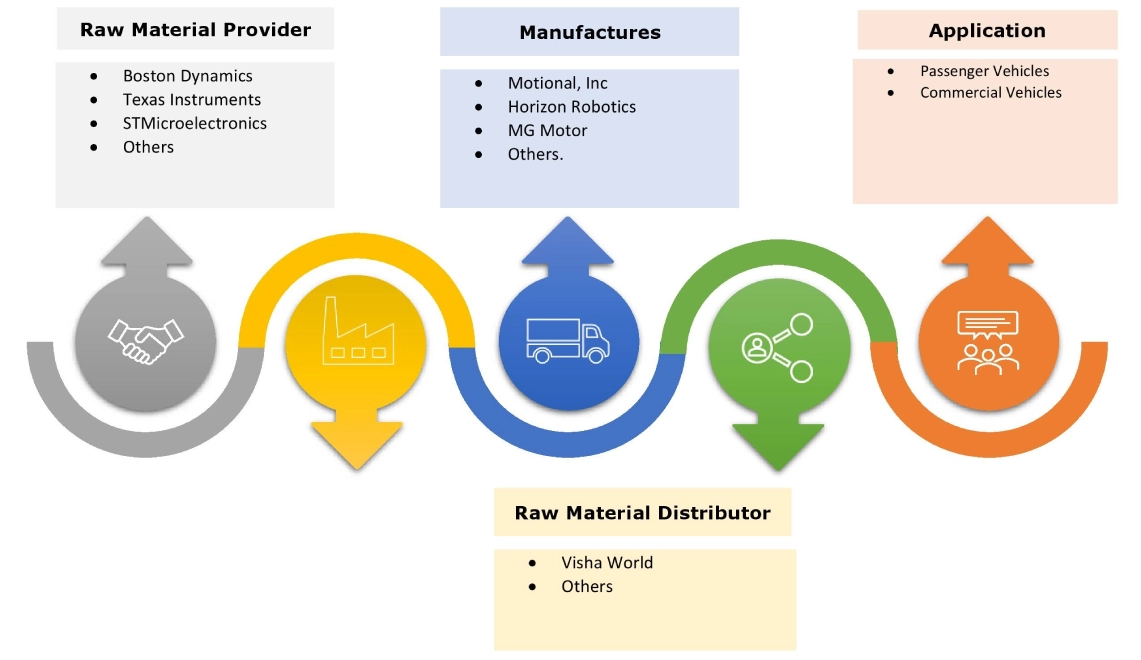
The global in-vehicle AI robot market is highly competitive with major players providing solutions to the national and international markets. Key players are adopting several strategies in research and development (R&D), product innovation, and end-user launches to hold a strong position in the market. Key players in the in-vehicle AI robot industry includes-
- Motional, Inc. (U.S.)
- Nauto (U.S.)
- Starship Technologies (U.S.)
- Mobileye Global Inc. (Israel)
- Cruise LLC (Israel)
- MG Motor (China)
- Horizon Robotics (China)
- AutoX Inc. (U.S.)
- Predii (U.S.)
- Robert Bosch GmbH (Germany)
Recent Industry Developments :
Expansion:
- In November 2022, Continental AG has opened its largest ABS, ADAS, and component R&D facility in Bengaluru. This center plays a crucial role in advancing software for radar-based driver assistance systems and single-channel ABS systems, typically employed in smaller-capacity motorcycles.
In-Vehicle AI Robot Market Report Insights :
| Report Attributes | Report Details |
| Study Timeline | 2019-2032 |
| Market Size in 2032 | USD 262.60 Million |
| CAGR (2025-2032) | 14.7% |
| By Autonomous Level |
|
| By Application |
|
| By Vehicle Type |
|
| By Region |
|
| Key Players |
|
| North America | U.S. Canada Mexico |
| Europe | U.K. Germany France Spain Italy Russia Benelux Rest of Europe |
| APAC | China South Korea Japan India Australia ASEAN Rest of Asia-Pacific |
| Middle East and Africa | GCC Turkey South Africa Rest of MEA |
| LATAM | Brazil Argentina Chile Rest of LATAM |
| Report Coverage |
|
Key Questions Answered in the Report
How big is the In-Vehicle AI Robot market? −
In-Vehicle AI Robot Market Size is estimated to reach over USD 262.60 Million by 2032 from a value of USD 75.56 Million in 2024 and is projected to grow by USD 87.63 Million in 2025, growing at a CAGR of 14.7% from 2025 to 2032.
Which is the fastest-growing region in the In-Vehicle AI Robot market? +
Asia-Pacific is the region experiencing the most rapid growth in the market. Governments in the region are actively promoting the development and adoption of autonomous vehicles through supportive policies, funding initiatives, and regulatory frameworks.
What specific segmentation details are covered in the In-Vehicle AI Robot report? +
The in-vehicle AI robot report includes specific segmentation details for autonomous level, application, vehicle type, and region.
Who are the major players in the In-Vehicle AI Robot market? +
The key participants in the market are Motional Inc. (U.S.) (U.S.), Nauto (U.S.), MG Motor (China), Horizon Robotics (China), AutoX Inc. (U.S.), Predii (U.S.), Robert Bosch GmbH (Germany), Starship Technologies (U.S.), Mobileye Global Inc. (Israel), Cruise LLC (Israel), and others.
Overview
Reputation & Certifications


Our Services
- Market Intelligence & Forecasting
- Custom Research Solutions
- Market Entry Strategy
- Competitive Intelligence
- Customer Insights
- Industry Innovation Analysis
- Investment Advisory