Jump to Content
Industrial Minerals Market - Size, Share, Industry Trends, and Forecasts (2025-2032)
Industrial Minerals Market Size:
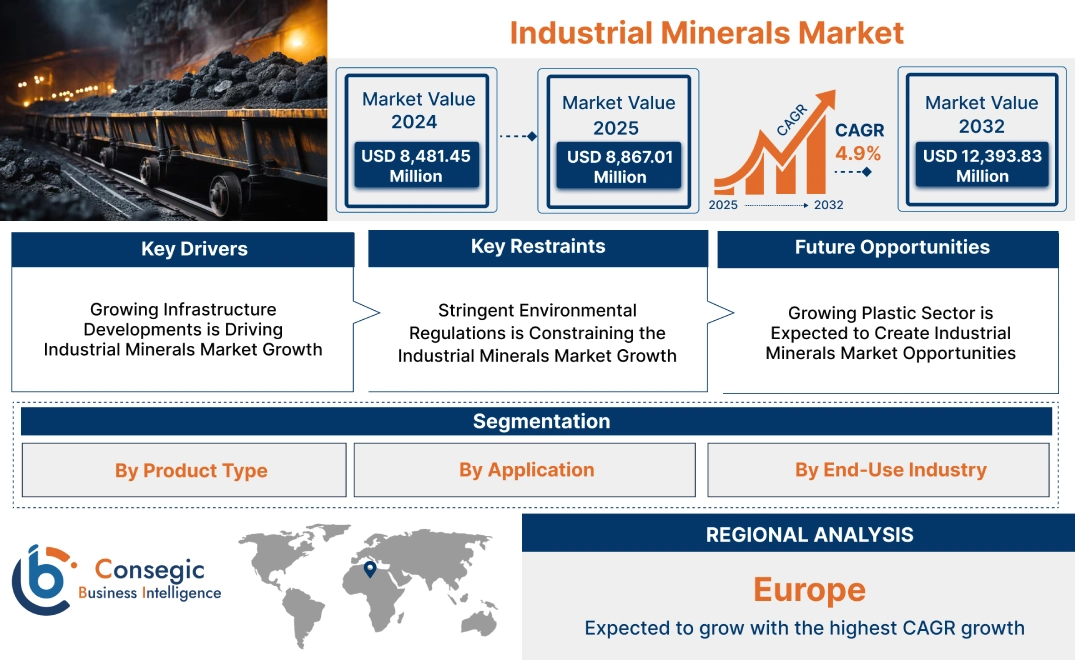
The industrial minerals market size is growing with a CAGR of 4.9% during the forecast period (2025-2032), and the market is projected to be valued at USD 12,393.83 Million by 2032 from USD 8,481.45 Million in 2024. Additionally, the market value for the 2025 attributes to USD 8,867.01 Million.
Industrial Minerals Market Scope & Overview:
Industrial minerals are naturally occurring, non-metallic minerals that are mined and processed for their physical properties. There are different types of these minerals such as limestone, silica, barite, feldspar, and others. These minerals exhibited properties such as hardness, absorbency, thermal resistance, and chemical stability. Due to these physical properties, industrial minerals are used in several applications such as building materials, ceramics & glass, fertilizers, semiconductors, and others. Industrial minerals are used as fillers, abrasives, insulation material in several industries such as construction, plastic, and others. Due to growing demand in manufacturing, electronics, and environmental applications, the use of industrial minerals is increasing thereby driving the market.
Industrial Minerals Market Dynamics - (DRO) :
Key Drivers:
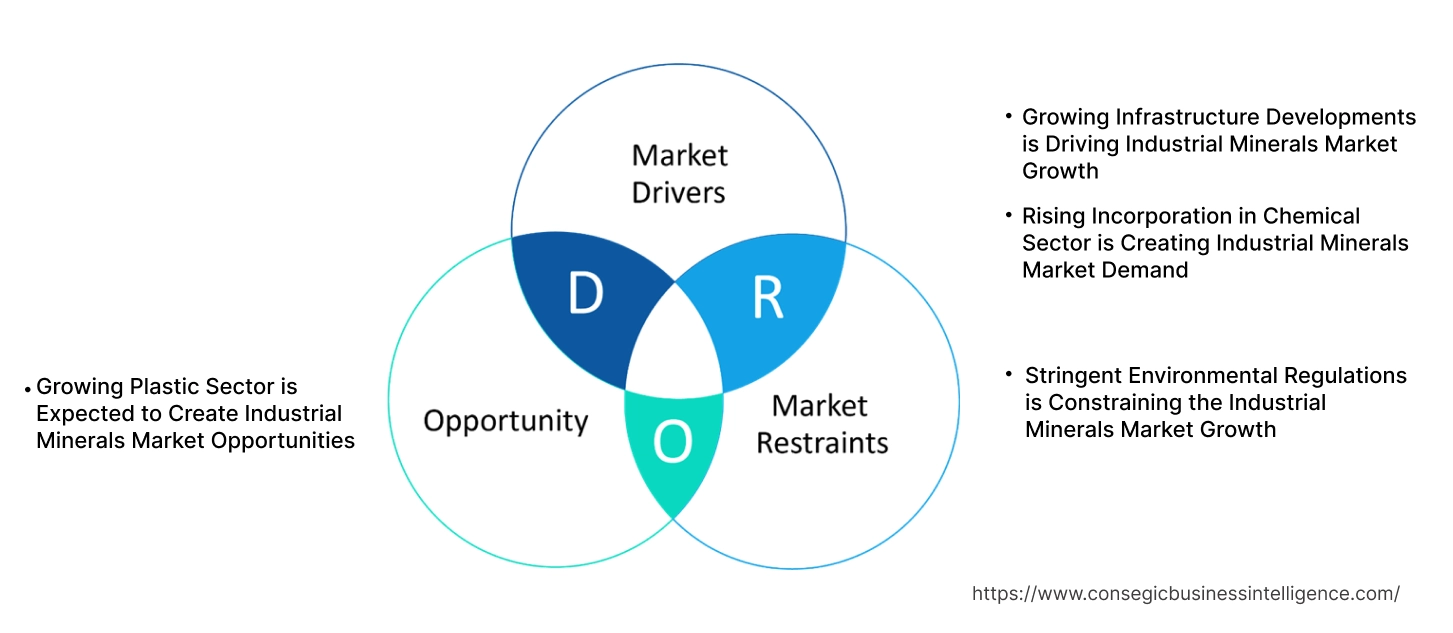
Growing Infrastructure Developments is Driving Industrial Minerals Market Growth
Infrastructure development includes construction of highways, bridges, roads and other structures. Industrial minerals such as limestone, clay, gypsum, and silica are used in the infrastructure development to provide strength and durability to structures. Further, industrial development is growing due to rising population, urbanization, and government support. To cater this, production of industrial minerals is rising, further driving the market.
- In 2023, according to United States Geological Survey, the industrial minerals production in the United States is increased by 4% as compared to the year 2022.
Thus, production of industrial minerals is growing due to growing infrastructural development leading to industrial minerals market demand.
Rising Incorporation in Chemical Sector is Creating Industrial Minerals Market Demand
The industrial minerals such as sodium chloride, barite, and dolomite are used in chemical sector as raw material for producing fertilizers, chlorine, caustic soda & deicing solutions. They helps with acid formation, adsorption, and filtration in the chemical production. Further, due to rising population, increased research & developments, and government initiatives chemical sector is growing.
- In 2023, according to BASF, the chemical sector in China exhibited increase of 7.5% as compared to the year 2022. This is leading to utilization of industrial minerals for pH regulation and catalysis during the chemical production.
Hence, incorporation of industrial minerals is growing in chemicals sector to produce various chemicals such as deicing solutions leading to industrial minerals market expansion.
Key Restraints:
Stringent Environmental Regulations is Constraining the Industrial Minerals Market Growth
Environmental regulations are significantly restraining the market, as they require stringent compliance during manufacturing, usage and disposal of properties. Governments are enforcing policies to reduce carbon emissions, prevent land degradation, and control water pollution. This has led to higher compliance costs, mandating companies to invest in eco-friendly mining technologies and wastewater treatment facilities. With the growing focus on sustainability, mining companies are required to adopt eco-friendly practices, invest in cleaner technologies and explore renewable sources. Additionally, permit restrictions and land-use regulations limit access to mineral-rich regions thereby impacting the production and operational efficiency. Thus, environmental regulations are restraining market growth due to regulatory standards and high cost.
Future Opportunities :
Growing Plastic Sector is Expected to Create Industrial Minerals Market Opportunities
The plastic sector refers to the production and trade of plastic-based materials. Industrial minerals such as calcium carbonate, talc, silica, and clay are used as fillers, reinforcements, and functional additives in the plastic sector. Due to cost effectivity and government initiatives, plastic sector is witnessing significant growth.
- According to Plastindia Foundation, plastics sector in India is anticipated to grow at a compound annual growth rate of 6.6% from 2023 to 2029. This growth will create further opportunities for the market to improve plastic strength and durability.
Thus, plastic sector is expanding due to government investment further leading to industrial minerals market opportunities.
Industrial Minerals Market Segmental Analysis :
By Product Type:
Based on product type, the market is categorized into limestone, silica, barite, feldspar, and others.
Trends in Product Type:
- According to industrial minerals market trends, limestone is extensively utilized for steel manufacturing, construction and industrial chemicals.
- Adoption of graphite is growing in drilling activities for the formulation of drilling mud as per market trends.
The limestone segment accounted for the largest market share in the year 2024.
- Limestone is a white or light grey sedimentary rock made of calcium carbonate.
- It is extensively utilized as a raw material in construction, steel manufacturing and chemical sector.
- Also, limestone is used in glass production, soil conditioning, and power plants for flue gas desulfurization.
- Further, construction is growing due to population growth, rising disposable incomes. To cater for this demand in construction, production of limestone is growing.
- For instance, in 2022, according to Indian Bureau of Mines, the production of limestone in India is increased by 12.50% as compared to the year 2021.
- This increased production of limestone is leading to market demand through more supply in various sectors including agriculture, renewable energy, and others.
- Hence, limestone segment is dominating in the market due to economic development and urbanization.
The barite segment is expected to grow at the fastest CAGR over the forecast period.
- Barite is a type of industrial mineral which consist of barium sulphate. It typically occurs as colorless prismatic crystals or thin white flakes.
- Barite exhibits high density, chemical inertness, and has ability to absorb X-rays.
- It is majorly used is petroleum sector as a weighting material in the formulation of drilling mud.
- Increased drilling activities in the oil and gas sector, rising demand for eco-friendly drilling fluids, and the expanding use in healthcare and industrial applications has led to the more use of barite.
- Hence, use of barite is growing due to increased drilling activities further driving the segment.
By Application :
Based on application, the market is categorized into building materials, ceramics & glass, fertilizers, semiconductor, and others.
Trends in Application:
- As per industrial minerals market trends, minerals such as limestone, sand, and gravel are widely used in building materials for strength and durability.
- Use of industrial minerals is growing in fertilizers manufacturing for pH regulation, catalysis, as per market trends.
The building materials segment accounted for the largest market share in the year 2024.
- Building material referred to any material that is used for construction purposes.
- Industrial minerals such as limestone, sand, and gravel are used as raw substance in building materials for building roads, bridges, buildings, and other infrastructure.
- These minerals provide strength, durability, and essential properties in building materials thereby increasing their applicability for construction.
- Further, industrial minerals enhance fire resistance, insulation, and structural integrity in building materials.
- Due to growing construction the need for effective building materials is expanding further driving the segment.
- Thus, building materials segment is dominating in the market supported by growing construction and need for effective building materials.
The semiconductors segment is expected to grow at the fastest CAGR over the forecast period.
- Semiconductors are materials which have conductivity between conductors and nonconductors or insulators.
- Industrials minerals such as silica, neodymium and lanthanum are used in the production of semiconductors to improve electrical conductivity and performance.
- Further, digitalization and technological advancements has led to the increased adoption of semiconductors in electronics. To cater to this demand governments are investing in research and innovation of semiconductors.
- For instance, in 2024, according to European Commission, an investment of USD 233 million is made by European Union for research and innovation of semiconductors. This investment will lead to more consumption of industrial minerals in semiconductors manufacturing to enhance electrical conductivity.
- Hence, due to government support production of semiconductors is expanding further the segment.
By End-Use Industry:
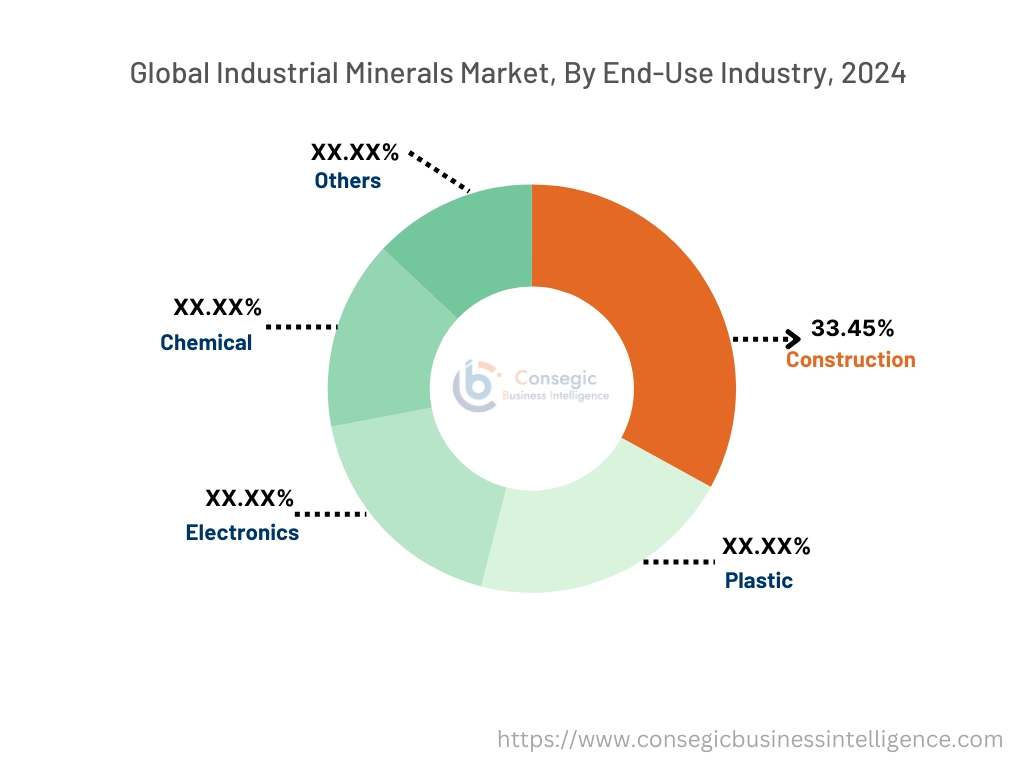
Based on end-use industry, the market is categorized into construction, plastic, electronics, chemical, and others.
Trends in End-Use Industry:
- As per market trends, industrial materials are extensively used in the construction of roads, bridges, and highways.
- Use of industrial materials is growing in chemical manufacturing to enhance stability, processing efficiency, and cost effectivity.
The construction segment accounted for the largest market share of 33.45% in the year 2024.
- The construction sector refers to the planning, building, and maintenance of buildings, highways, and other physical structures.
- Industrial minerals particularly limestone is a key ingredient in cement and concrete, providing strength and durability to structures.
- Also minerals such as gypsum, silica is used in infrastructural development such as road construction, bridges, and foundations.
- Due to urbanization and economic development, infrastructure is growing. To cater this, government is investing in infrastructural development.
- For instance, in 2024, according to United States Department of Transportation, United States Administration invested USD 1.8 billion in infrastructure development. This is leading to more use of industrial materials in construction of road, bridges, and highways.
- Thus, construction segment is dominating in the market due to government investment and infrastructural development.
The chemical segment is expected to grow at the fastest CAGR over the forecast period.
- The chemical sector comprises the companies and other organizations that develop and produce industrial, specialty and other chemicals.
- The industrial minerals such sulfur and phosphates are key ingredients in fertilizers, acids, and industrial chemicals which enhance stability, processing efficiency, and cost effectiveness.
- Minerals such as limestone are widely used in pH regulation, water treatments, and manufacturing lime & soda ash.
- Also, the use of industrial minerals such as kaolin and bentonite is growing as catalysts, adsorbents, and filtration agents in refining and chemical synthesis.
- Thus, to enhance chemical process efficiency and cost effectiveness use of industrial minerals is growing in chemicals manufacturing, further driving the segment.
Regional Analysis:
The regional segment includes North America, Europe, Asia Pacific, Middle East & Africa, and Latin America.
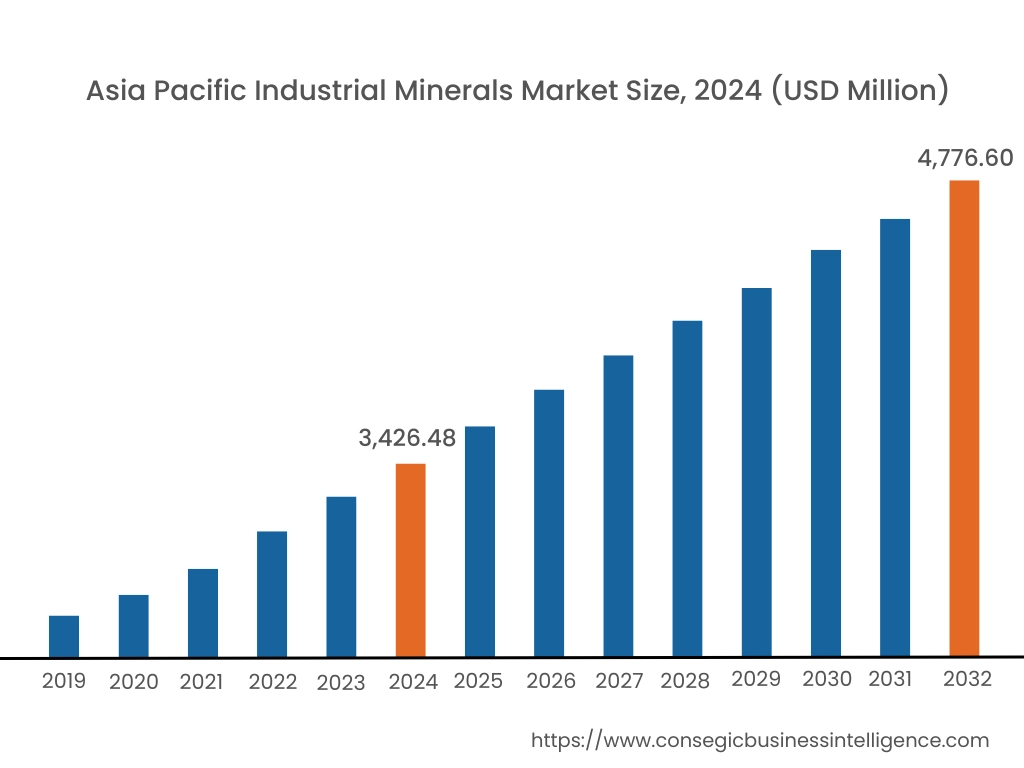
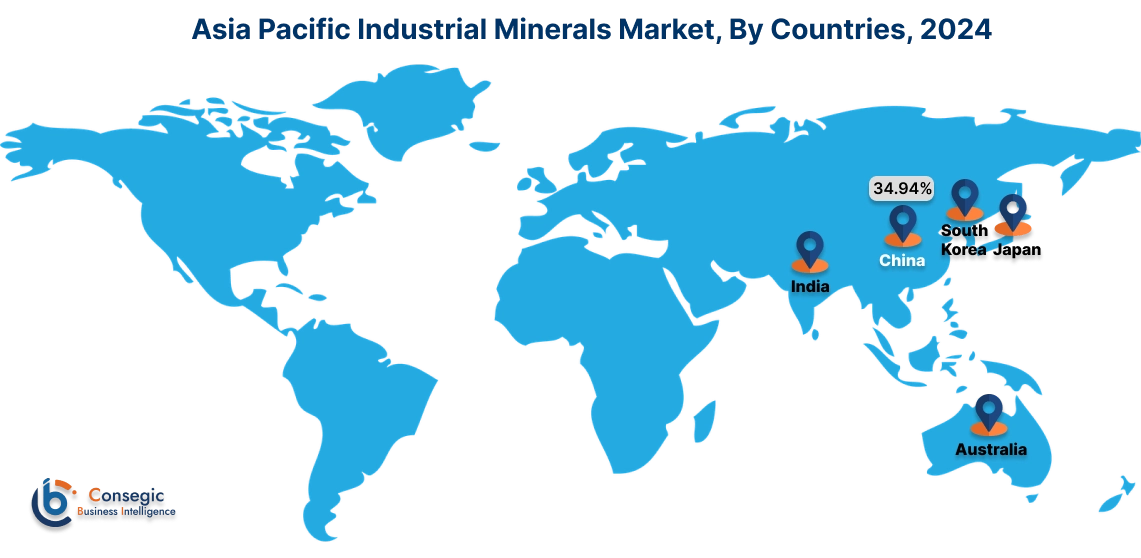
In 2024, Asia-Pacific accounted for the highest market share at 40.4% and was valued at USD 3,426.48 Million and is expected to reach USD 4,776.60 Million in 2032. In Asia-Pacific, the China accounted for the highest market share of 34.94% during the base year of 2024. The industrial minerals market share of Asia Pacific is major due to the electronics sector. The industrial minerals are extensively utilized in electronics production as a raw material in microchips and integrated circuits. Due to changing lifestyle, urbanization use of electronics is growing. To cater this, countries such as China, India, Japan, and South Korea are expanding their electronics production.
- In 2023, according to NITI Aayog, electronics production is increased by 110% in India from the year 2017. This is driving the adoption of industrial minerals in electronics production to enhance electrical conductivity and efficiency.
Therefore, the Asia Pacific region is dominating in the market supported by expanding electronics sector and government support as per analysis.
Europe is expected to witness the fastest CAGR of 6% over the forecast period of 2025-2032. According to industrial minerals market analysis, Europe is growing considerably driven by stringent environmental regulations and strong focus on sustainability. The region is adopting electric vehicles to reduce pollution and environmental impact. This is driving the adoption of industrial minerals such as lithium, graphite, and bentonite which are used in electric vehicle batteries and energy storage. The region is also implementing regulations on air purification, water treatment, and industrial emissions, further driving the market. Hence, industrial minerals market share of Europe is expected to emerge rapidly through stringent regulations and adoption of electric vehicles as per analysis.
As per industrial minerals market analysis, the North America region is growing rapidly driven by advancements in technology. Advancement in mining sector such as 3D mapping, advanced drilling systems are improving the extraction of the industrial minerals. Further the surge in the use of autonomous vehicles and drones for surveillance and exploration is providing detailed mapping of mining sites, including hard to reach areas.
The Middle East & Africa region is experiencing moderate growth in the market driven by growing petrochemical sector. This sector is driving the use of industrial minerals in the formulation of mud drilling. Minerals such as bentonite and calcium carbonate are used in drilling fluids, refining processes, and weighting materials. The government is also investing in drilling activities further leading to industrial minerals market expansion as per analysis.
As per market analysis, Latin America is growing steadily in the market driven by rising disposable incomes and steady economic development across the region. Increasing urbanization and industrialization has led to more construction thereby driving the adoption of industrial minerals in building materials. Countries such as Brazil, Mexico, and Argentina are leading the market supported by growing population, expanding industrialization and infrastructure development.
Top Key Players and Market Share Insights:
The industrial minerals industry is highly competitive with major players providing products to the national and international markets. Key players are adopting several strategies in research and development (R&D) and product innovation to hold a strong position in the global industrial minerals market. Key players in the industrial minerals industry include-
- Mosaic (United States)
- Alara Resources (Australia)
- Invictus Gold Ltd. (Australia)
- Columbus Copper Corp. (Canada)
- Anatolia Energy Ltd (Canada)
- First Quantum Minerals Ltd. (Canada)
- Koza Altin Isletmeleri (Turkey)
- Stratex International. P.l.c. (United Kingdom)
- Gentor Resources Inc (Canada)
- Alamos Gold Inc (Canada)
Recent Industry Developments :
Mergers and Acquisitions:
- In 2022, KaMin LLC acquired kaolin minerals business of BASF. Kaolin is industrial minerals widely used in ceramics, paper coating, and rubber manufacturing. This acquisition strengthens the product portfolio and distribution in industrial mineral business of KaMin LLC.
Industrial Minerals Market Report Insights :
| Report Attributes | Report Details |
| Study Timeline | 2019-2032 |
| Market Size in 2032 | USD 12,393.83 Million |
| CAGR (2025-2032) | 4.9% |
| By Product Type |
|
| By Application |
|
| By End-Use Industry |
|
| By Region |
|
| Key Players |
|
| North America | U.S. Canada Mexico |
| Europe | U.K. Germany France Spain Italy Russia Benelux Rest of Europe |
| APAC | China South Korea Japan India Australia ASEAN Rest of Asia-Pacific |
| Middle East and Africa | GCC Turkey South Africa Rest of MEA |
| LATAM | Brazil Argentina Chile Rest of LATAM |
| Report Coverage |
|
Key Questions Answered in the Report
How big is the industrial minerals market? −
In 2024, the industrial minerals market is USD 8,481.45 million.
Which is the fastest-growing region in the industrial minerals market? +
Europe is the fastest-growing region in the industrial minerals market.
What specific segmentation details are covered in the industrial minerals market? +
Product Type, Application, and End-Use Industry are covered in the industrial minerals market.
Who are the major players in the industrial minerals market? +
Mosaic (United States), Alara Resources (Australia), First Quantum Minerals Ltd. (Canada) are some of the major players in the market.
Overview
Reputation & Certifications


Our Services
- Market Intelligence & Forecasting
- Custom Research Solutions
- Market Entry Strategy
- Competitive Intelligence
- Customer Insights
- Industry Innovation Analysis
- Investment Advisory