Jump to Content
Industrial Wastewater Treatment Market - Size, Share, Industry Trends, and Forecasts (2025-2032)
Industrial Wastewater Treatment Market Size:
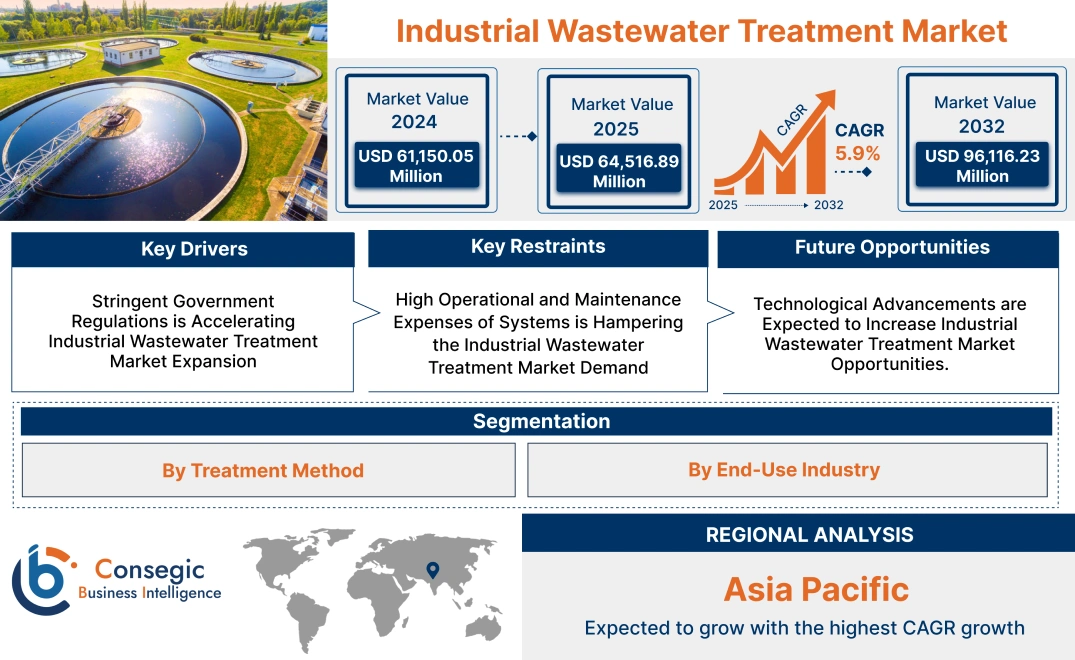
Industrial Wastewater Treatment Market size is growing with a CAGR of 5.9% during the forecast period (2025-2032), and the market is projected to be valued at USD 96,116.23 Million by 2032 from USD 61,150.05 Million in 2024. Additionally, the market value for the 2025 attributes to USD 64,516.89 Million.
Industrial Wastewater Treatment Market Scope & Overview:
Industries such as oil & gas, food & beverage, pulp & paper, chemicals, pharmaceuticals, and textiles produce large amounts of wastewater. This contains chemicals, heavy metals, and organic waste. Without proper treatment, this wastewater pollutes rivers and harm aquatic life. It also causes health problems. Industrial wastewater treatment is the process of removing harmful pollutants from this water before releasing it into the environment. It enables water to be reused. It also helps industries comply with environmental regulations. Also, it reduces reliance on freshwater sources. Various methods are used for the treatment. This includes physical, chemical, biological, and advanced technologies.
Industrial Wastewater Treatment Market Dynamics - (DRO) :
Key Drivers:
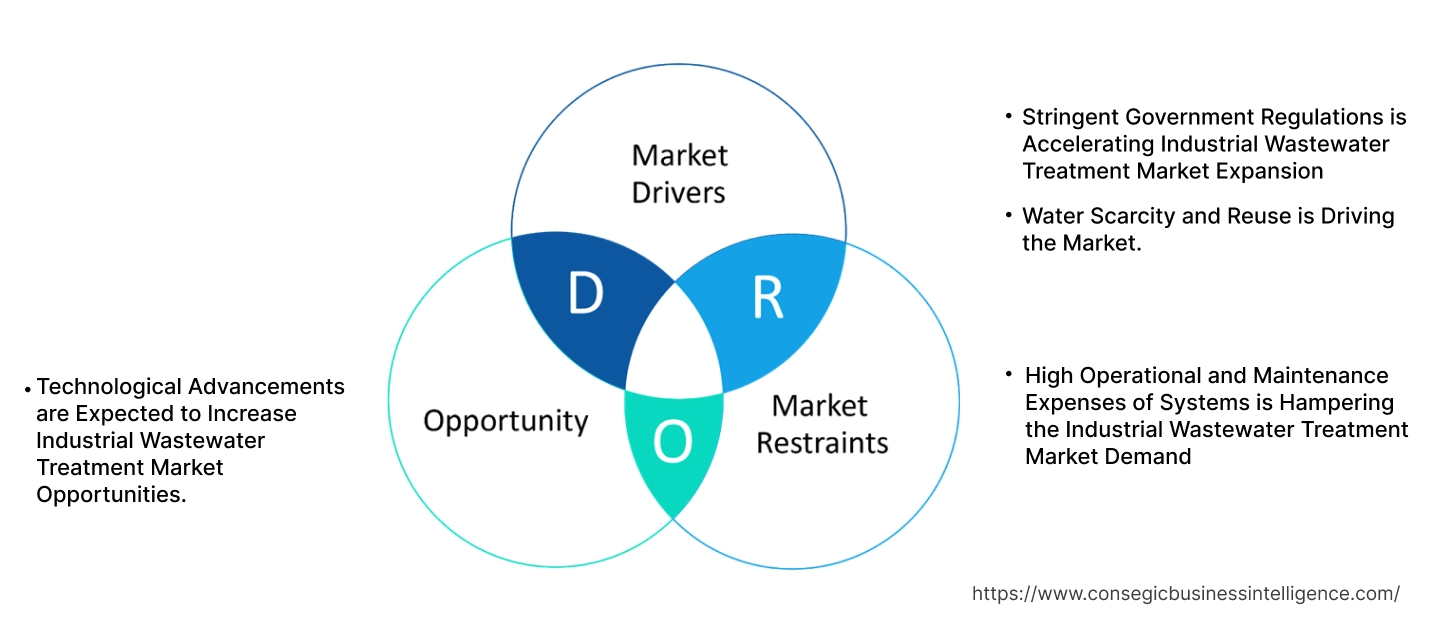
Stringent Government Regulations is Accelerating Industrial Wastewater Treatment Market Expansion
Industries such as chemicals, textiles, and others release harmful pollutants like heavy metals, toxic chemicals, and organic waste into water bodies. If untreated, this wastewater contaminates drinking water. It also harms aquatic life and causes serious health issues. Governments are understanding these negative impacts. To prevent this, they are enforcing strict rules on wastewater treatment for industries.
For instance,
- In 2023, The U.S. Environmental Protection Agency launched Effluent Guidelines Program Plan 15. This limited the discharge of per- and polyfluoroalkyl substances (PFAS) from industrial sources. This has increased utilization of wastewater treatment in industries to meet regulatory standards.
Overall, the stringent government regulations are significantly boosting the industrial wastewater treatment market expansion.
Water Scarcity and Reuse is Driving the Market.
There is rapid population increase, and urbanization observed globally. These factors have required increased water resources for domestic and industrial use. Many industries such as power plants, food processing, and textiles are using large amounts of water for production. Also, climate change, overuse and wastage have disturbed water management practices. All these factors have led to water scarcity.
For instance,
- According to an article published by Org, in 2024, over 700 million people worldwide currently lack access to water. This scarcity is leading industries to recycle and reuse their wastewater to reduce wastage, thus driving the market share.
Thus, water scarcity and reuse are accelerating the global industrial wastewater treatment market growth.
Key Restraints:
High Operational and Maintenance Expenses of Systems is Hampering the Industrial Wastewater Treatment Market Demand
Industrial wastewater treatment systems require regular maintenance and high operational cost. This is a big hurdle for companies. Advanced technologies such as reverse osmosis (RO), membrane bioreactors (MBRs), and chemical treatment need expensive filters, chemicals, and energy to work properly. Over time, the membranes and filters get clogged and need replacement. This increased the costs. Moreover, running a wastewater treatment plant also requires skilled workers to monitor systems, test water quality, and repair equipment. In many industries, energy costs for pumping, heating, and treating wastewater are high. This makes treatment more expensive. Hence, the high operational and maintenance expenses are hampering the industrial wastewater treatment market demand.
Future Opportunities :
Technological Advancements are Expected to Increase Industrial Wastewater Treatment Market Opportunities.
New technologies are making industrial wastewater treatment more efficient, cost-effective, and eco-friendly. Advanced systems such as membrane bioreactors (MBRs), reverse osmosis (RO), and electrocoagulation are helping industries to remove pollutants more effectively while using less energy. Moreover, nanofiltration is proving to be effective in removing organic materials, bacteria, and viruses. Additionally, the incorporation of AI technology is also changing the market landscape.
For instance,
- According to a study published by the National Center for Biotechnology Information, in 2024, smart sensors are providing real-time monitoring of water quality and flow rates. AI analyzes real-time data to improve treatment, predict maintenance, and cut energy use. This creates potential for the market.
Overall, technological advancements are expected to increase industrial wastewater treatment market opportunities.
Industrial Wastewater Treatment Market Segmental Analysis :
By Treatment Method:
Based on treatment method, the market is categorized into physical, chemical, biological, and advanced.
Trends in Treatment Method:
- Hybrid systems are combining different treatment methods such as biological followed by advanced treatment. They are becoming more common to achieve specific water quality targets.
- Advanced treatment methods such as reverse osmosis, nanofiltration, and membrane bioreactors are gaining importance.
The biological segment accounted for the largest market share in 2024.
- Biological segment dominated the industrial wastewater treatment market trends. It is further divided into aerobic, anaerobic, and other processes.
- In aerobic processes, microorganisms use oxygen to decompose organic waste.
- In anaerobic, microorganisms work without oxygen breaking down waste and producing biogas (methane). There are new product innovations with improved features.
- For instance, in 2023, Biogill launched the Max 2, 4, and 6 biological wastewater treatment solution. These advanced products are simple to install, operate, and maintain. They are less energy intensive and cost-effective. These types of launches are increasing reach.
- Overall, as per the market analysis, the new product innovations are driving a segment in industrial wastewater treatment market growth.
The advanced segment is expected to grow at the fastest CAGR over the forecast period.
- Advanced is an emerging segment in the market trends. It is further categorized into reverse osmosis, ultrafiltration, nanofiltration, and others.
- These modern technologies remove contaminants more effectively than traditional methods.
- These methods are helping industries in achieving zero liquid discharge (ZLD), and high-purity water reuse.
- They are also helping in removal of tough pollutants such as heavy metals, microplastics, and pharmaceuticals.
- Other advantages include better water recycling and lower chemical use, and reduced sludge production.
- According to market analysis, the rising demand from pharmaceuticals, semiconductors, and chemical sectors will drive segmental growth for the upcoming years.
By End-Use Industry:
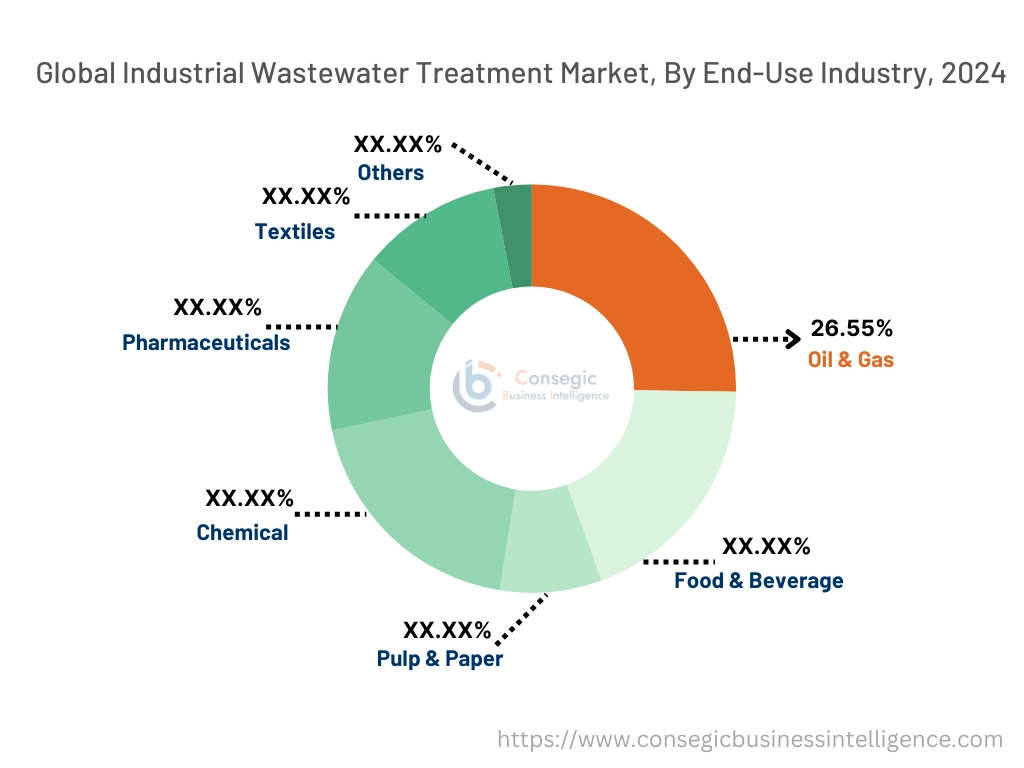
Based on end-use industry, the market is categorized into oil & gas, food & beverage, pulp & paper, chemical, pharmaceuticals, textiles, and others.
Trends in the End-Use Industry:
- Food and beverage companies are adopting industrial wastewater treatment systems that recover valuable nutrients such as nitrogen and phosphorus for reuse as fertilizers or other products.
- The pulp and paper sector are moving towards closed-loop systems. They minimize water discharge and maximize water reuse.
The oil & gas segment accounted for the largest market share of 26.55% in 2024.
- Oil & gas segment dominated the industrial wastewater treatment market trends. It involves exploration, extraction, refining, and distribution of petroleum products.
- Wastewater treatment in oil & gas is used in drilling operations, refineries, and produced water management.
- Techniques such as chemical treatment, membrane filtration, and biological processes remove oil, heavy metals, and toxic chemicals.
- The treatment provides advantages such as reducing environmental pollution, complying with regulations, enabling water reuse, and lowering operational costs.
- Overall, as per the market analysis, there is growing global energy requirements and increasing offshore drilling and shale gas extraction. It is leading to higher wastewater generation. This is driving segmental growth in the industrial wastewater treatment industry.
The chemical segment is expected to grow at the fastest CAGR over the forecast period.
- The chemical sector is emerging in market trends. It generates large amounts of wastewater containing toxic chemicals and heavy metals.
- Wastewater treatment is used in manufacturing plants, specialty chemical production, and petrochemical refineries.
- Common methods include chemical precipitation, advanced oxidation, and membrane filtration.
- Increasing industrialization and rising demand for specialty chemicals is leading to sector growth.
- For instance, according to the Stalwart International, the global textile chemicals is expected to grow at a CAGR of 11% by 2028. This will increase the need for wastewater treatment systems for water recycling and reusage.
- Thus, as per the market analysis, the expanding chemicals sector requiring will drive segmental growth for the forecasted years.
Regional Analysis:
The regional segment includes North America, Europe, Asia Pacific, the Middle East and Africa, and Latin America.
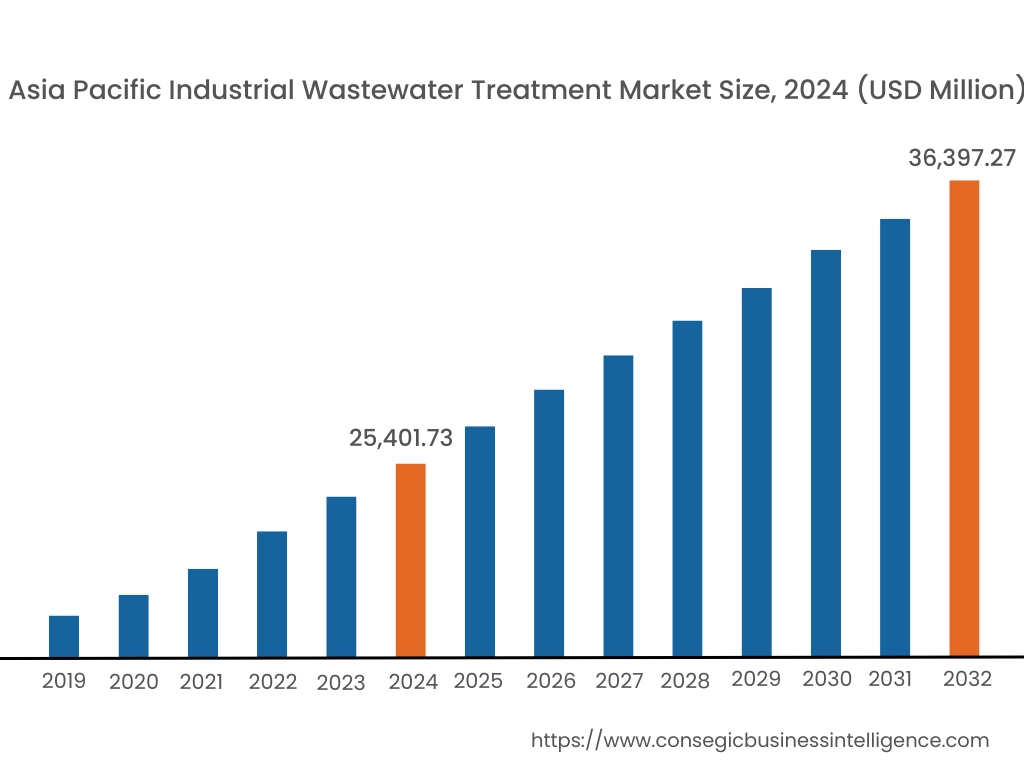
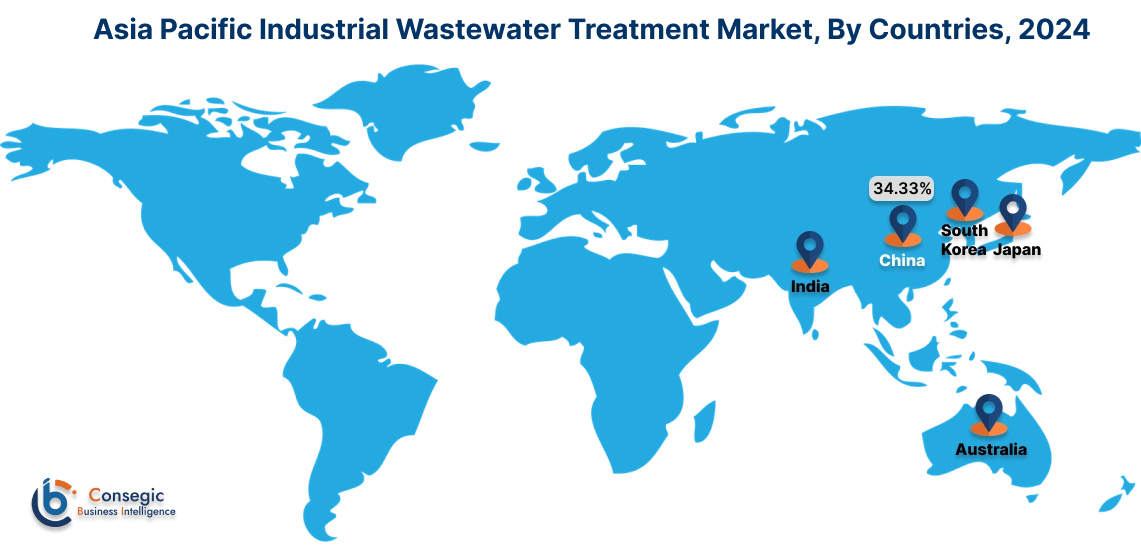
In 2024, Asia Pacific accounted for the highest industrial wastewater treatment market share at 41.54% and was valued at USD 25,401.73 Million and is expected to reach USD 36,397.27 Million in 2032. In Asia Pacific, the China accounted for the industrial wastewater treatment market share of 34.33% during the base year of 2024. There is increased drug production in the region. This is leading to wastewater generation, which contains toxic pollutants. Governments are enforcing strict laws to prevent contamination of water sources. This is driving the market. Moreover, APAC faces severe water shortages, especially in China, India, and Southeast Asia, due to high population growth and industrial expansion.
For instance,
- According to an article published by the East Asia Forum, in 2024, India, despite being home to 18% of the global population, possesses only 4% of the world's water resources. This has led industries to use wastewater treatment solutions to recycle n reuse water.
Overall, growing usage in the pharmaceutical sector and water scarcity is driving the market in the region.
In Europe, the industrial wastewater treatment market is experiencing the fastest growth with a CAGR of 8.3% over the forecast period. Europe has some of the strictest environmental laws, such as the EU Water Framework Directive and Industrial Emissions Directive, which require industries to properly treat wastewater before discharge. Governments are imposing heavy fines on companies that fail to meet pollution limits. This is driving the market in the region. Moreover, Europe is a leader in wastewater treatment innovation, with companies adopting membrane bioreactors (MBRs), artificial intelligence (AI)-based monitoring, and Zero Liquid Discharge (ZLD) systems. These technologies reduce pollution, lower operating costs, and improve water reuse efficiency.
North America’s industrial wastewater treatment market analysis states that several trends are responsible for the progress of the market in the region. Countries such as the U.S. and Canada, has a strong oil & gas sector. There is increasing in shale gas extraction, refining, and petrochemical production. These activities produce large amounts of contaminated wastewater which contain oil, heavy metals, and chemicals. They are requiring industrial wastewater treatment solutions, thus driving market in region. Moreover, governments are offering financial support, tax benefits, and grants to industries investing in sustainable wastewater treatment. Programs such as the Clean Water State Revolving Fund (CWSRF) are helping industries to upgrade their treatment plants.
The Middle East and Africa (MEA) industrial wastewater treatment market analysis states that the region is also witnessing several trends for notable surge. The chemical sector in MEA is growing rapidly, especially in Saudi Arabia, UAE, and South Africa, due to rising demand for petrochemicals, fertilizers, and specialty chemicals. These industries produce wastewater containing toxins. This requiring advanced treatment solutions is driving the market in region. Moreover, MEA governments are promoting wastewater treatment projects through funding, subsidies, and infrastructure development. Public-private partnerships (PPPs) are also helping industries adopt modern treatment technologies.
Latin America's industrial wastewater treatment market size is also emerging. Countries such as Brazil, Mexico, and Colombia, has a growing textile and apparel sector. Textile factories use large amounts of water for dyeing, bleaching, and fabric processing. This generates wastewater with dyes and other toxic metals. This is requiring manufacturers to adopt chemical, biological, and membrane filtration treatments, thus driving market in region. Moreover, the food & beverage sector in the region is expanding due to higher demand for processed foods and beverages. This sector produces wastewater containing oils and suspended solids, requiring proper treatment before discharge.
Top Key Players and Market Share Insights:
The Industrial Wastewater Treatment market is highly competitive with major players providing products to the national and international markets. Key players are adopting several strategies in research and development (R&D) and product innovation to hold a strong position in the global Industrial Wastewater Treatment market. Key players in The Industrial Wastewater Treatment industry include-
- Aquatech International (U.S.)
- BioGill (Australia)
- Suez S.A. (France)
- Siemens Water Technologies (U.S.)
- Veolia Water Technologies (U.S.)
- WaterProfessionals (U.S.)
- Culligan International (U.S.)
- Thermax (India)
- Pentair, Inc. (U.S.)
- Xylem Water Solution (U.S.)
Recent Industry Developments :
Product Launches:
- In September 2024, Aquacycl launched its patented product called SulfideFix. It utilizes natural sulfate, reducing bacteria to eliminate up to 99% of hydrogen sulfide gas (HS2) from wastewater tanks.
- In May 2024, Synagro launched SynaPure wastewater treatment system. It is designed to provide sustainable and cost-effective solutions for treating complex influent streams. It removes contaminants such as organic and inorganic pollutants, total suspended solids, heavy metals, PFAS, and pathogens.
Industrial Wastewater Treatment Market Report Insights :
| Report Attributes | Report Details |
| Study Timeline | 2019-2032 |
| Market Size in 2032 | USD 96,116.23 Million |
| CAGR (2025-2032) | 5.9% |
| By Treatment Method |
|
| By End-Use Industry |
|
| By Region |
|
| Key Players |
|
| North America | U.S. Canada Mexico |
| Europe | U.K. Germany France Spain Italy Russia Benelux Rest of Europe |
| APAC | China South Korea Japan India Australia ASEAN Rest of Asia-Pacific |
| Middle East and Africa | GCC Turkey South Africa Rest of MEA |
| LATAM | Brazil Argentina Chile Rest of LATAM |
| Report Coverage |
|
Key Questions Answered in the Report
How big is the Industrial Wastewater Treatment market? −
In 2024, the Industrial Wastewater Treatment market is USD 61,150.05 Million.
Which is the fastest-growing region in the Industrial Wastewater Treatment market? +
Europe is the fastest-growing region in the Industrial Wastewater Treatment market.
What specific segmentation details are covered in the Industrial Wastewater Treatment market? +
Treatment Method, and End-Use Industry segmentation details are covered in the Industrial Wastewater Treatment market.
Who are the major players in the Industrial Wastewater Treatment market? +
Aquatech International (U.S.), BioGill (Australia), WaterProfessionals (U.S.), Culligan International (U.S.), Thermax (India), and Pentair, Inc. (U.S.) are some major players in the market.
Overview
Reputation & Certifications


Our Services
- Market Intelligence & Forecasting
- Custom Research Solutions
- Market Entry Strategy
- Competitive Intelligence
- Customer Insights
- Industry Innovation Analysis
- Investment Advisory