Jump to Content
Investment Casting Market - Size, Industry Share, Growth Trends and Forecasts (2026 - 2034)
Investment Casting Market Size:
Investment Casting Market is estimated to reach over USD 28.11 Billion by 2034 from a value of USD 17.78 Billion in 2025 and is projected to grow by USD 18.44 Billion in 2026, growing at a CAGR of 4.8% from 2026 to 2034.
Investment Casting Market Key Takeaways
- Growing demand for lightweight, high-precision components is driving market growth.
- Asia Pacific dominated the market due to strong manufacturing and aerospace activities.
- Silica-sol was the leading process segment because of its high accuracy and quality.
- Aerospace & defense was the largest end-use industry.
- 3D printing, automation, and AI are improving casting efficiency and quality.
- Precision Castparts, Howmet Aerospace, and CIREX were key market players.
Investment Casting Market Scope & Overview:
Investment casting is a manufacturing process where a disposable wax pattern is coated with a ceramic shell to create a mold, which is then filled with molten metal. This technique is highly valued for its ability to produce complex, high-precision, and near-net-shape components that require minimal additional machining. A large number of industries require casting parts, including aerospace & defense, automotive, energy & power, medical, industrial, and others. Further, key trends driving the market include the rapid integration of additive manufacturing (3D printing) to create complex wax patterns and ceramic molds, which significantly reduces lead times and tooling costs. Additionally, there is a strong shift toward digitalization and automation, with foundries increasingly adopting AI-driven process control, robotic shell-building, and digital twins to enhance precision, consistency, and yield in critical applications.

Investment Casting Market Market Dynamics - (DRO):
Market Drivers:
Growing Focus on Automotive Lightweighting Drives the Market
The automotive sector’s significant focus on lightweighting is driven by the growing need to improve fuel efficiency, reduce CO2 emissions, and extend the range of electric vehicles. These needs act as a primary catalyst for the market. Further, by enabling the production of high-strength components with near-net-shape precision, the technology allows manufacturers to consolidate complex assemblies into single parts, significantly reducing overall vehicle mass without compromising structural integrity. Moreover, as automakers shift from heavy iron components to lightweight aluminum and advanced alloys, this process provides the necessary design flexibility to meet stringent performance, thermal management, and efficiency standards.
- For instance, according to the International Energy Agency (IEA), global electric vehicle market is experiencing a significant surge, with sales surpassing 17 million units in 2024. Also, momentum is projected to accelerate through 2025, with deliveries expected to exceed 20 million vehicles.
Thus, integration of lightweight alloys, enhanced material utilization, and the ability to manufacture complex, consolidated geometries contribute significantly to the rise in the investment casting market size.
Market Restraints:
High Production Costs and Raw Material Volatility are Limiting the Market Growth
High production costs and raw material volatility act as significant constraints on the casting market, largely due to the process's labor-intensive and energy-demanding nature. The process is inherently capital-intensive, requiring expensive ceramic materials and consistent climate-controlled environments that drive up operational expenses. Furthermore, the market relies on high-purity specialty alloys like nickel, cobalt, and titanium, whose prices are subject to frequent geopolitical and commodity market fluctuations. This instability compresses foundry margins, discourages capital investment in capacity expansion, and makes it difficult for manufacturers to maintain predictable pricing for their clients.
Market Opportunities:
Increasing Incorporation of Additive Manufacturing, Digitalization, and Automation Drives the Investment Casting Market Opportunities
The integration of additive manufacturing, digitalization, and automation is fundamentally transforming the market, creating significant opportunities for enhanced operational efficiency and design innovation. Additive manufacturing, specifically 3D printing, allows foundries to produce complex wax patterns directly from CAD data, eliminating the need for expensive, time-consuming traditional hard tooling. This capability drastically reduces lead times and enables cost-effective production for low-volume, highly complex, or customized components. Simultaneously, the adoption of robotics and artificial intelligence streamlines labor-intensive stages such as shell building, gating, and finishing. Furthermore, digital simulation tools predict casting defects before production, while real-time data analytics improve process control, consistency, and overall quality, ultimately fostering a more agile and sustainable manufacturing ecosystem. Thus, the aforementioned market factors are expected to drive the market opportunities during the forecast period.
Investment Casting Market Segmental Analysis:
By Process Type:
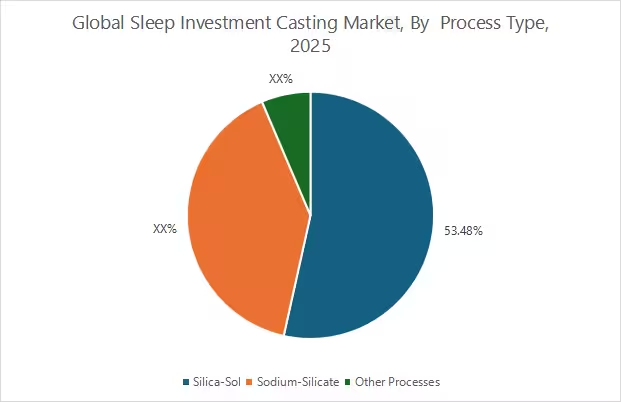
Based on the process type, the market is segmented into silica-sol, sodium-silicate, and other processes.
Trends in the Process Type:
- The adoption of robotic shell-building systems is rising, which helps maintain consistent shell quality and reduces human error during the multi-stage coating process, which is driving the market trends.
- To combat raw material price volatility, major producers are increasingly investing in captive raw material sourcing to stabilize production costs, which in turn drives the market.
Silica-sol accounted for the largest revenue share of 53.48% in the year 2025.
- Industry players are adopting new ceramic shell systems that improve thermal resistance and significantly reduce metal penetration defects, which in turn drives the market.
- Further, OEMs are increasingly specifying silica-sol casting to achieve tighter dimensional tolerances, effectively minimizing or eliminating the need for expensive secondary machining.
- Furthermore, foundries are moving beyond visual inspection by integrating AI-driven quality inspection and automated sensors to monitor shell drying and furnace parameters in real time, which in turn drives the investment casting market trends.
- Thus, as per the market analysis, advanced ceramic shell formulations, digital integration, and others are driving the market.
Sodium-silicate is anticipated to register the fastest CAGR during the forecast period.
- Manufacturers are leveraging sodium-silicate for their lower tooling and processing costs, which in turn drives the investment casting market expansion.
- Further, there is a strong trend toward adopting digitalized process control systems and low-emission furnaces, which improve the cost competitiveness and production efficiency of the traditional water glass method, which subsequently propels the market.
- Furthermore, as environmental regulations tighten, sodium-silicate foundries are increasingly implementing waste reduction and energy-efficient practices, which in turn drives the market.
- Therefore, based on analysis, the aforementioned factors are anticipated to boost the market during the forecast period.
By Material:
Based on the material, the market is segmented into superalloys, steel, aluminum, titanium, and others.
Trends in the Material:
- Rising need for lightweight aluminum castings for battery housings, motor frames, and structural components as automakers prioritize vehicle weight reduction, which is expected to drive the investment casting market demand.
- Increasing certification of superalloys for high-efficiency turbines and hydrogen-ready power generation equipment, driving the investment casting market share.
Steel accounted for the largest revenue share in the year 2025.
- Foundries are transitioning to sustainable, scrap-based decarbonization and low-carbon casting technologies to achieve carbon neutrality.
- Further, devices now feature smartphone-like color touchscreens and voice-guided setups, making it easier for adult users to manage their own therapy at home, which subsequently propels the market.
- Furthermore, due to high CPAP abandonment rates, there is a significant shift toward oral appliances and implantable neurostimulation devices, which in turn drives the market.
- Thus, as per the investment casting market analysis, personalized combination therapy, advanced user interfaces, and others are driving the market.
Titanium is anticipated to register the fastest CAGR during the forecast period.
- Increasing use in aerospace components, due to its exceptional strength-to-weight ratio and ability to perform in high-temperature environments, which in turn drives the market growth.
- Further, growing adoption of biocompatible, corrosion-resistant orthopedic implants and surgical instruments, supported by aging global demographics, drives the investment casting industry.
- Furthermore, foundries are moving toward high-purity titanium sponge and master alloy integration to ensure material consistency, which in turn drives the market.
- Therefore, based on analysis, the aforementioned trends are anticipated to boost the market during the forecast period.
By End User:
Based on the end user, the market is segmented into aerospace & defense, automotive, energy & power, medical, industrial, and others.
Trends in the End User:
- The transition to EVs is a primary growth driver, with foundries producing complex aluminum and titanium components, which in turn drives the investment casting market growth.
- An aging global population and rising incidences of musculoskeletal conditions are driving sustained demand for biocompatible, high-precision titanium and cobalt-chrome castings, which in turn drives the market.
Aerospace & Defense accounted for the largest revenue share in the year 2025 and is anticipated to register a significant CAGR during the forecast period.
- There is increasing commercial aircraft production and rising defense procurement, which is creating multi-year order backlogs, driving foundries to prioritize capacity additions and process upgrades.
- Further, the demand is surging for superalloy components capable of enduring extreme temperatures, which in turn drives the market.
- Furthermore, leading suppliers are adopting digital twins, AI-based inspection, and automated finishing to meet OEM qualification cycles and reduce total cost of ownership, which reduces upfront costs and increases long-term patient engagement.
- Thus, based on analysis, the aforementioned factors are anticipated to boost the growth of the market during the forecast period.
Investment Casting Market Regional Analysis:
The regions covered are North America, Europe, Asia Pacific, Middle East and Africa, and Latin America.
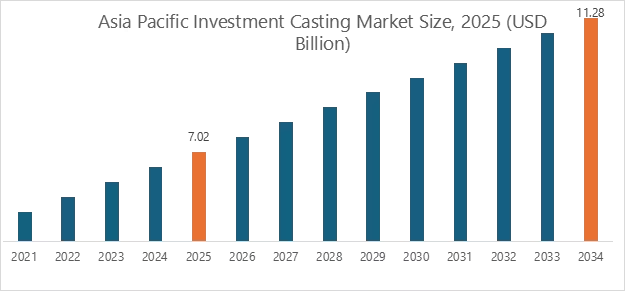
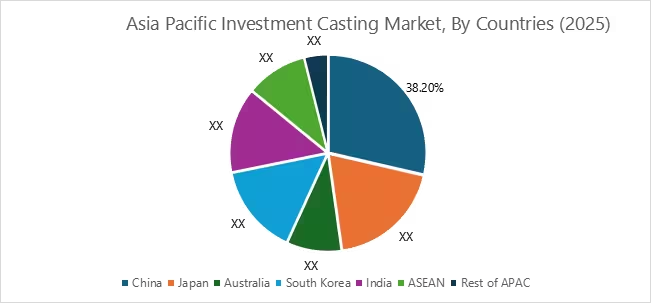
The Asia Pacific region was valued at USD 7.02 Billion in 2025. Moreover, it is projected to grow by USD 7.29 Billion in 2026 and reach over USD 11.28 Billion by 2034. Out of this, China accounted for the maximum revenue share of 38.20%. The market growth is mainly driven by the steady and sustainable expansion of the region's automotive, aerospace, and industrial machinery manufacturing sectors. This demand is further supported by the presence of a vast network of manufacturing facilities, particularly in China, India, Japan, and South Korea.
For instance,according to the International Energy Agency (IEA), China solidified its global dominance in the EV sector during 2024, with electric vehicles capturing nearly 50% of the nation's total automotive market. The country sold 11 million units of EVs, which in turn drives the bearing market.
North America is estimated to reach over USD 7.37 Billion by 2034 from a value of USD 4.65 Billion in 2025 and is projected to grow by USD 4.82 Billion in 2026. The North American market is primarily driven by rising demand from the aerospace and defense sectors, which rely on the process to produce high-precision, complex, and lightweight components like turbine blades and structural parts. This market is further supported by the region's robust automotive and industrial manufacturing base, as well as an increasing focus on advanced metallurgy, digital foundry technologies, and localized supply chains.
For instance, in March 2021, the Government of United States allotted approximately USD 752.9 billion budget for national defence for FY 2022, among which USD 715 billion was allocated for the U.S. Department of Defence.
The regional trends analysis depicts that stringent regulation and sustained need for high-precision components in the aerospace, automotive, and energy sectors in Europe are driving the market. Additionally, the factors driving the market in the Middle East and African region are technological advancements and steady need from the oil and gas sector alongside government-led industrialization and infrastructure development initiatives. Further, an expanding industrial base and increasing requirement for precision components within the automotive and aerospace sectors in the Latin America region are driving the market.
Top Key Players & Market Share Insights:
The global investment casting market is highly competitive, with major players providing solutions to the national and international markets. Key players are adopting several strategies in research and development (R&D), product innovation, and end-user launches to hold a strong position in the investment casting industry. Key players in the market include-
- Precision Castparts Corp.(U.S.)
- Howmet Aerospace Inc(U.S.)
- CIREX (Netherlands)
- Wolfensberger AG (Switzerland)
- Brukar Inc. (Canada)
- Precision Investment Castings Ltd (UK)
- Aero Metals (U.S.)
- Milwaukee Precision Casting, Inc. (U.S.)
- MetalTek International (U.S.)
- Consolidated Precision Products (U.S.)
Recent Industry Developments:
Acquisition
- In December 2025, Howmet Aerospace entered into a definitive agreement to acquire Consolidated Aerospace Manufacturing (CAM) from Stanley Black & Decker. This strategic acquisition enhances Howmet’s portfolio of high-tech, mission-critical aerospace fasteners and fluid fittings while increasing the company’s exposure to key defense and aerospace platforms.
Investment Casting Market Report Insights:
| Report Attributes | Report Details |
| Study Timeline | 2021-2034 |
| Market Size in 2034 | USD 28.11 Billion |
| CAGR (2026-2034) | 4.8% |
| By Process Type |
|
| By Material |
|
| By End User |
|
| By Region |
|
| Key Players |
|
| Report Coverage |
|
Key Questions Answered in the Report
How big is the investment casting market? −
The market is estimated to reach over USD 28.11 Billion by 2034 from a value of USD 17.78 Billion in 2025 and is projected to grow by USD 18.44 Billion in 2026, growing at a CAGR of 4.8% from 2026 to 2034.
What specific segmentation details are covered in the report? +
The report includes specific segmentation details for process type, material, end user, and regions.
Which is the fastest segment anticipated to impact the market growth? +
In the market, sodium-silicate is the fastest-growing segment during the forecast period.
Who are the major players in the market? +
The key participants in the market are Precision Castparts Corp. (U.S.), Howmet Aerospace Inc (U.S.), CIREX (Netherlands), Wolfensberger AG (Switzerland), Brukar Inc. (Canada), Precision Investment Castings Ltd (UK), Aero Metals (U.S.), Milwaukee Precision Casting, Inc. (U.S.),MetalTek International (U.S.), Consolidated Precision Products (U.S.), and others.
What are the key trends in the market? +
The market is being shaped by several key trends including rapid integration of digital manufacturing and automation, including robotic shell-building and AI-driven quality inspection. Additionally, the industry is increasingly prioritizing sustainability and advanced material adoption, such as high-performance superalloys and additive manufacturing, to meet stringent environmental regulations.
Overview
Reputation & Certifications


Our Services
- Market Intelligence & Forecasting
- Custom Research Solutions
- Market Entry Strategy
- Competitive Intelligence
- Customer Insights
- Industry Innovation Analysis
- Investment Advisory