Jump to Content
Life Jacket Market - Size, Share, Industry Trends, and Forecasts (2025-2032)
Life Jacket Market Size:
Life Jacket Market size is estimated to reach over USD 2.03 Billion by 2032 from a value of USD 1.46 Billion in 2024 and is projected to grow by USD 1.50 Billion in 2025, growing at a CAGR of 4.2% from 2025 to 2032.
Life Jacket Market Scope & Overview:
A life jacket, also known as a personal flotation device (PFD), is a safety device designed to keep a person afloat in water, significantly increasing their chances of survival in case of an emergency. It is a piece of equipment that looks like a jacket filled with air or light material designed to help someone float if they fall in water. It come in various types such as inherently buoyant, inflatable and hybrid. These various types are designed for different activities and water conditions, such as general boating, watersports, or offshore activities. They are designed to provide buoyancy and are typically made from buoyant materials like foam or inflatable chambers and are worn like a vest or jacket, helping individuals stay afloat and keep their head and mouth above the water, even if they are unconscious. They automatically turn the bearer into a face-up position, keeping the mouth and nostrils clear of the water preventing the risk of drowning. Their primary end-user industries include water sports, boating, military and safety operations, and oil and gas industries.
How is AI Impacting the Life Jacket Market?
AI is revolutionizing the life jacket market by enabling intelligent, personalized products and smarter manufacturing processes. It's enhancing safety through advanced features like GPS tracking and automatic inflation, while also driving comfort with ergonomic designs. In manufacturing, AI optimizes production lines for efficiency and quality, and in market research, it provides deep consumer insights to tailor product offerings. Additionally, AI-driven automation streamlines cutting, sewing, and assembly processes, significantly improving consistency and scalability in production.

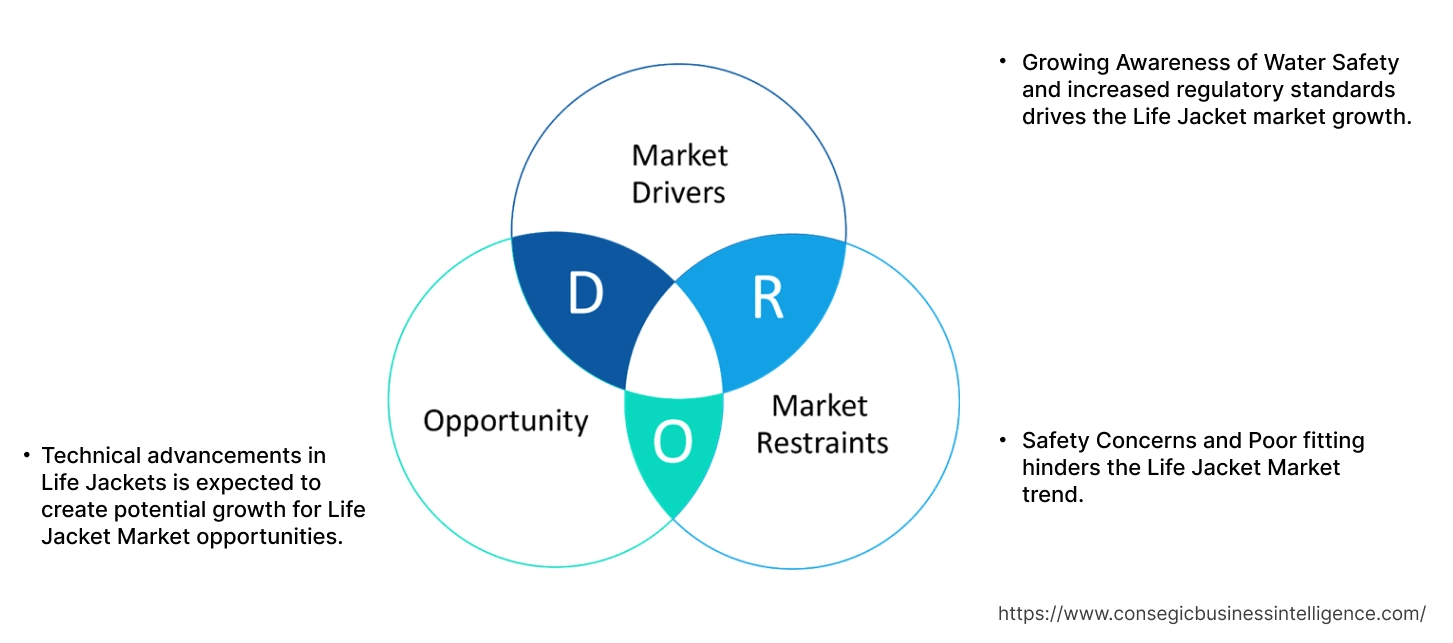
Life Jacket Market Dynamics - (DRO):
Key Drivers:
Growing Awareness of Water Safety and increased regulatory standards drives the Life Jacket market growth.
There is a growing awareness and increased trend of life jackets, driven by factors like the rising popularity of water sports and a heightened focus on safety, leading to a larger market for these essential safety items. The increasing popularity of water sports tourism is a major driver, as people engage in more water-based activities, they need safety equipment like life vests. Heightened awareness of water safety and the importance of personal flotation devices (PFDs) is also contributing to the market's growth.
With increasing awareness of water safety and growing regulatory pressure, there is an increased requirement for certified vests that comply with international safety standards. These regulations ensure that marine vests are designed to meet specific safety criteria, including buoyancy, durability, and visibility in various water conditions. The enforcement of these standards has led to an increase in the need for high-quality marine vests that meet or exceed safety requirements.
- For instance, in December 2024, the Queensland Government announced the changes in the lifejacket laws. To increase water safety, new regulations made wearing a life vest mandatory when boating alone or only with children under 12 years, crossing designated coastal bars on an open ship and on an open area of a boat of any length and on certain craft, nighttime boating, between sunset and sunrise on an open boat.
Thus, rising safety awareness and regulatory standards are resulting in the life jacket market expansion.
Key Restraints:
Safety Concerns and Poor fitting hinders the Life Jacket Market trend.
While they are essential for water safety, poorly fitted or poorly maintained ones poses risks. Some inflatable vests have disadvantages, such as the need for manual inflation, and inadequacy for children under 16. A tight jacket restricts movement and cause discomfort, potentially leading to fatigue and difficulty in an emergency and a loose one slides up over the head, potentially allowing the wearer to submerge, or not provide enough buoyancy. Torn Fabric, Broken Buckles, or Loose Straps compromises the vest's ability to provide buoyancy and support. Different types of jackets are designed for specific activities and environments. Using the wrong type leads to inadequate flotation. Also prolonged exposure to sunlight degrades the material and reduce buoyancy.
Thus, the safety concerns associated with them due to ill-fitting affects the Life Jacket Market demand.
Future Opportunities:
Technical advancements in Life Jackets is expected to create potential growth for Life Jacket Market opportunities.
Recent technical advancements in these jackets include features like automatic inflation upon water immersion, GPS tracking for location, and integrated communication systems to enhance safety and rescue efforts. The newer models incorporate inflatable chambers that automatically inflate when submerged in water. This feature is particularly crucial for individuals who are incapacitated or unconscious, ensuring immediate buoyancy. These inflatable vests are also lightweight and compact, making them comfortable to wear for extended periods.
Smart vests equipped with GPS trackers allows rescue teams to pinpoint the location of the wearer in case of an emergency. Some models also include built-in communication devices, such as radios or satellite communication systems, enabling the wearer to send distress signals or communicate directly with rescuers. This technology is especially vital in severe weather conditions or large bodies of water where traditional search and rescue efforts may be hindered.
Other features such as inclusion of LED lights to improve visibility in dark or rough conditions, smart sensors to monitor wearer’s vital signs, water temperature, and location, also have great potential.
- In October 2023, ThrowRaft, a pioneering force in water safety and rescue equipment, took center stage and made a significant splash at the National Association of State Boating Law Administrators (NASBLA) 2023 Conference held in Denver, CO last week, unveiling its groundbreaking patents pending Neutral Buoyancy PFD technology. This innovative life-saving device is meticulously designed to meet the specific needs of law enforcement and first responders operating in aquatic environments.
Thus, the technical advancement of these vests shows a surge in future Life Jacket Market Opportunities.
Life Jacket Market Segmental Analysis :
By Product Type:
Based on product type, the market is segmented into inherently buoyant, inflatable, and hybrid.
The inherently buoyant segment accounted for the largest revenue in the Life Jacket Market share in 2024 and is anticipated to have the highest CAGR during the forecast period.
- An inherently buoyant vest, also known as a Type I or Type II PFD, is constructed with materials that naturally float, providing immediate flotation without any action from the wearer, and are suitable for various water conditions and activities.
- This style of life vest is primarily made of materials that inherently float, like closed-cell foam (PVC or polyethylene).
- Inherently buoyant flotation devices are exceptionally durable and come in a wide range of sizes. They usually outlast other life vest styles.
- They are known for their durability and longevity and are suitable for a variety of water conditions, including rough or isolated waters where rescue may be delayed.
- These are popular due to their ease of use (no need for inflation) and wide applications in areas like construction, fire safety, and aviation.
- In January 2024, Astral unveiled its latest innovation in performance and sustainability with the introduction of the YTV 2.0 – the fifth addition to Astral’s premier collection of vests that features a bluesign approved 100% recycled polyester shell.
- Thus, the inherently buoyant segment is in trend due to their widespread use and are expected to be the fastest growing segment in the market.
By Material:
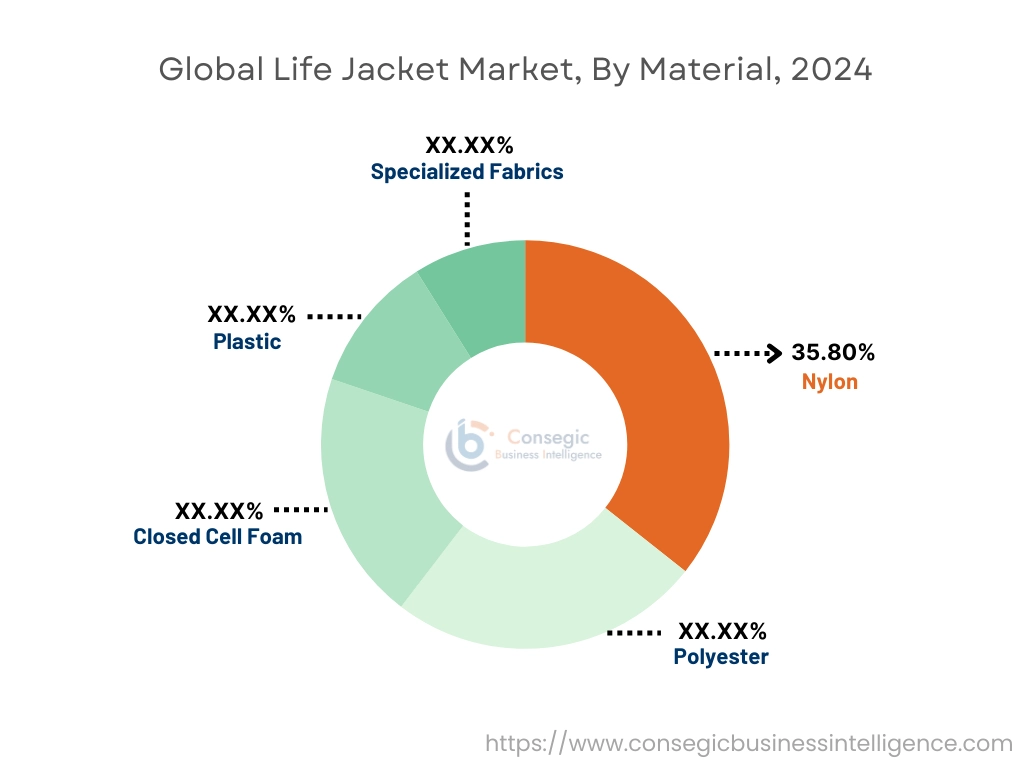
Based on material, the market is segmented into Nylon, Polyester, closed cell foam, plastic, and specialized fabrics.
The Nylon segment accounted for the largest revenue share in the Life Jacket Market of 35.80% in 2024.
- Nylon is used for life vests because it is a durable, water-resistant, and quick-drying material, making it suitable for the harsh conditions which these jackets are exposed to.
- It is known for its ability to quickly shed water and moisture, ensuring that the jacket dries swiftly after exposure to water. This feature is particularly advantageous for individuals engaging in water activities where they get wet frequently.
- Nylon is known for its strength and resistance to wear and tear, ensuring the jacket withstands prolonged use and exposure to the elements.
- It is naturally resistant to water damage, which is crucial for a vest that will be submerged.
- Nylon is coated with materials like TPU (Thermoplastic Polyurethane) to enhance its water resistance and durability. Lifejackets and other personal buoyancy aids typically use one- and two-sided TPU-coated nylons.
- Thus, the quick-drying functionality of nylon makes it the most used material in the market.
The Closed-cell Foam is anticipated to have the highest CAGR during the forecast period.
- Closed-cell foam, like polyethylene or PVC foam, is a primary material in life vests due to its inherent buoyancy and ability to resist water absorption, ensuring reliable flotation even when punctured or submerged.
- It has tiny, isolated air pockets within its structure, making it inherently buoyant and capable of floating.
- Closed-cell foam panels are strategically placed within the jacket to provide flotation. The foam panels are often encased in water-resistant fabric like nylon or neoprene.
- They are durable and resistant to compression and deterioration, even under pressure and are lightweight materials, making these jackets comfortable to wear.
- For instance, in April 2024, Astral, the leader in equipment designed for high performing wilderness athletes, introduces the Indus, the world’s first freestyle-inspired high float life vest. Built on over three decades of experience, the all-new Indus uses Astral’s Foam Tectonics architecture from Astral’s GreenJacket, the current safety and performance standard for rescue PFDs.
- Thus, the increasing use of closed-cell foam in inflatable vests is expected to grow significantly in the market.
By Sales channel:
Based on sales channel, the market is segmented into offline retailers and online retailers.
The offline retailers segment accounted for the largest revenue in the Life Jacket Market.
- Offline retail currently dominates the market due to factors like the need for physical inspection and fitting, consumer preference for immediate purchase, and the presence of specialized stores that cater to water sports enthusiasts.
- Consumers often prefer to physically try on and inspect the product before making a purchase to ensure proper fit and suitability for their needs.
- Many consumers, particularly those engaged in water sports activities, seek immediate access to life vests. Offline retail allows for instant purchase and use.
- Offline retail, particularly in the form of sporting goods stores and marine retailers, often employs knowledgeable staff who can provide advice and guidance on selecting the right jacket for specific activities and needs.
- Thus, the requirement for physical inspection and fitting makes then the largest revenue share holder further driving the market.
The online retailer segment is anticipated to have the highest CAGR during the forecast period.
- Online retail provides benefits such as increased convenience, wider product selection, and the rise of online shopping for safety equipment, especially as water sports tourism and safety awareness grow.
- Online platforms offer 24/7 accessibility, allowing customers to browse and purchase vests from anywhere, anytime.
- Online retailers often carry a broader range of life vests types, sizes, and brands than traditional brick-and-mortar stores, catering to diverse needs.
- Online retailers often offer competitive pricing and promotions, which can attract customers seeking cost-effective options.
- Thus, the online retailers segment is expected to be the fastest growing market.
By End-Use:
Based on end-use, the market is segmented into water sports, boating and sailing, safety operations and military.
The water sports segment accounted for the largest revenue share in the Life Jacket Market in 2024 and is anticipated to be the fastest growing in the forecast period.
- The market analysis shows the growing popularity of water sports such as boating, fishing, jet skiing, paddleboarding, kayaking, and more, are becoming increasingly popular worldwide, leading to a surge in requirement for safety equipment, including personal floatation devices.
- As more people engage in water sports and recreational activities, the need for reliable and high-quality PFDs are expected to rise, leading to market extension and innovation.
- Drowning is a serious risk in aquatic activities, and vests are crucial for ensuring safety and preventing accidents. They are one of the most effective ways to prevent drowning, especially for weak swimmers, non-swimmers, or those in dangerous water conditions.
- Many regulatory bodies around the world mandate the use of life vests for certain water activities, increasing the requirement for reliable and high-quality vests.
- For instance, in July 2024, The WSIA in partnership with the National Marine Manufacturers Association (NMMA) and the Blue Earth County Sheriffs Office hosted a life jacket giveaway during kids day at the Blue Earth County Fair. This collaboration is essential to ensuring that every individual engaging in water activities has the necessary knowledge and tools to safeguard their well-being. The event aims to raise awareness about safe boating practices, featuring the distribution of free life vests to attendees.
- Thus, the trend of water sports such as boating, kayaking, and paddleboarding are driving the Life Jacket market growth.
Regional Analysis:
The regions covered are North America, Europe, Asia Pacific, the Middle East and Africa, and Latin America.
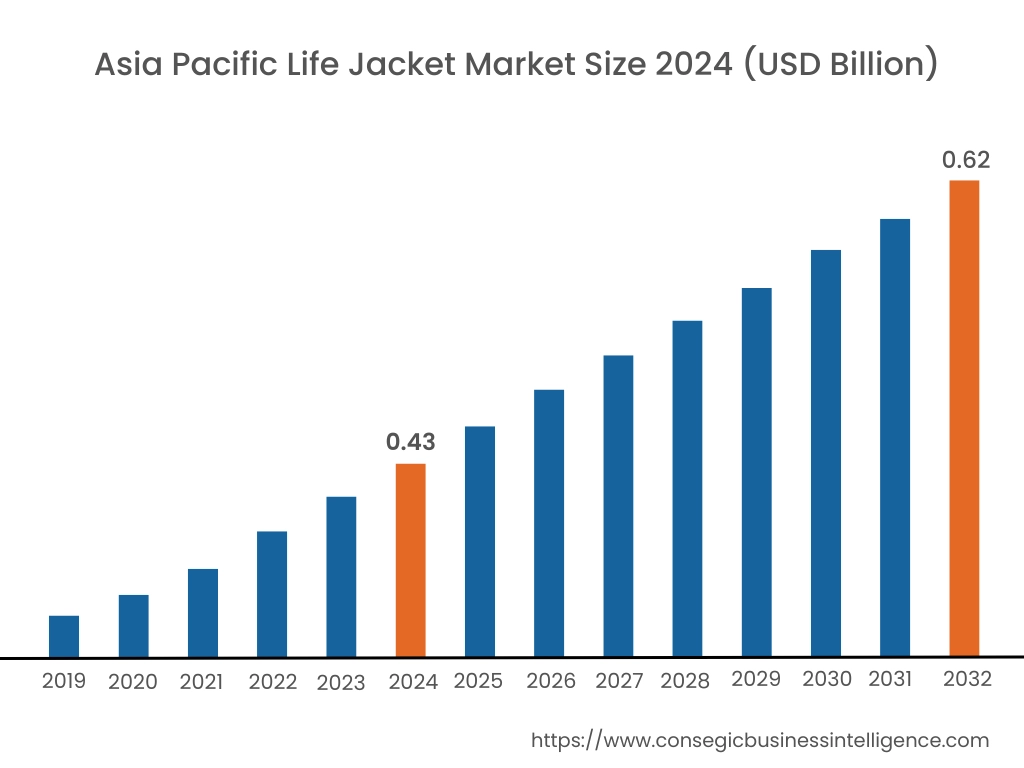
Asia Pacific region was valued at USD 0.43 Billion in 2024. Moreover, it is projected to grow by USD 0.44 Billion in 2025 and reach over USD 0.62 Billion by 2032. Out of this, China accounted for the maximum revenue share of 34.8%.
The Asia-Pacific region is experiencing a rise in trend of PFD utilization, driven by factors like growing tourism, water sports, and maritime activities, making it a fast-growing market for these jackets.
This region, with its extensive coastlines, is seeing a surge in coastal tourism and water sports activities. This includes activities like boating, fishing, jet skiing, and paddleboarding, which are becoming increasingly popular. The tourism sector is developing comprehensive protocols and regulations to ensure the safety of tourists and participants in water activities, leading to increased use for safety equipment like PFDs. The growing maritime business in the region, including shipping and fishing, also contributes to the demand for these jackets as essential safety equipment for crew and passengers. Government initiatives to promote tourism and maritime industries are also playing a role in boosting the utilization for life vests.
- For instance, Jiaxing Rongsheng Lifesaving Equipment Co., Ltd., located in Jiaxing, are professional manufacturer and supplier of marine life jackets, immersion suit/survival suits, lifebuoy ring and lifeguard accessories, etc.
Thus, the life jacket market analysis shows the emergence of APAC region in the Life Jacket market.

North America is estimated to reach over USD 0.66 Billion by 2032 from a value of USD 0.48 Billion in 2024 and is projected to grow by USD 0.50 Billion in 2025.
North America is a well-developed region and the largest revenue share holder in the global life jacket market, with a strong focus on safety and consumer demand increasing the trend of these life vests.
The market is experiencing evolution due to factors like rising awareness of water safety, the popularity of water sports, and the implementation of safety regulations, particularly for recreational boating. It is a region with a high level of participation in water-related activities, including swimming, boating, kayaking, and other water sports. This increased involvement has led to a greater focus on water safety and the importance of wearing vests. Public awareness campaigns and educational initiatives are also contributing to this shift, emphasizing the risks associated with water sports and the need for safety gear.
In the US, the Coast Guard mandates that all persons on board recreational vessels wear these vests thus benefitting the Life Jacket Industry. This regulation, along with similar measures in other parts of North America, has spurred demand for life vests. The progression of the market in Canada is driven by increased awareness of water safety, rising participation in recreational water activities, and regulatory measures promoting the use of these jackets.
- For instance, in May 2024, the Alabama Law Enforcement Agency’s (ALEA) Marine Patrol Division joined organizations across the nation to participate and observe National Safe Boating Week, a global initiative. To promote water and boating safety, the Alabama Marine Patrol Division offered a tip of Wearing a Coast Guard-approved Life Jacket while boating, fishing, or participating in water sports.
Thus, the life jacket market analysis highlights the dominance of North American region in the market.
The European market is experiencing growth due to rising participation in water sports, increased safety awareness, and maritime safety regulations, as well as the growth of the tourism sector and water parks. More Europeans are engaging in water sports like kayaking, rafting, and boating, leading to a higher need for vests as essential safety equipment. Europe's large number of water parks and the potential for the tourism sector contribute to the expansion of the market. The trend of water sports infrastructure and tourism in the UK contributes to the need for PFDs.
Stringent safety regulations and compliance requirements in the maritime sector contribute to the requirement for PFDs, ensuring that vessels and individuals are equipped with the necessary safety gear. Public and private organizations are educating people about the risks of water sports and the importance of wearing vests.
The growth of micro-firms and small- and medium-sized enterprises in the Life Jackets industry positively impacts demand.
Thus, the market analysis shows the popularity of life vests in the European region for water sports and due to stringent safety regulations, which is driving the Life jacket market expansion.
The global life jacket market is experiencing robust growth, with the Middle East and Africa (MEA) region showing promising potential, driven by factors like the increasing popularity of water sports tourism and growing safety consciousness. The rising popularity of water sports tourism in the MEA region is a significant driver of life vest demand. The development of comprehensive protocols by the tourism sector to ensure the smooth operation of all types of tourism activities has accelerated the demand for protective gear, including PFDs.
Thus, the market analysis shows the emerging trend of personal floatation devices due to government regulations and tourism is boosting the market.
In Latin America, life vests, or personal flotation devices (PFDs), are crucial for safety during water activities and are increasingly used for recreational boating, fishing, and water sports, with growing emphasis on their importance in reducing drowning incidents. They are a vital tool for preventing drowning, providing buoyancy, and increasing the chances of survival in case of an accident. They are commonly used by boaters and fishers for safety on rivers, lakes, and oceans.
Thus, the market analysis shows that the emerging trend of PFDs due to its use in recreational boating and fishing is boosting the market.
Top Key Players & Market Share Insights:
The Life Jacket market is highly competitive with major players providing products and services to the national and international markets. Key players are adopting several strategies in research and development (R&D), product innovation, and end-user launches to hold a strong position in the global Life Jacket market. Key players in the Life Jacket industry include –
- Viking (Denmark)
- Hansen Protection (Norway)
- SeaSafe Systems Ltd (UK)
- Stormy Lifejackets Pty Ltd. (Australia)
- Grand Ocean Marine Co., Ltd. (China)
- Survival Systems International (US)
- Survitec Group (UK)
- Dongguan Bestway Sports Goods Co., Ltd. (China)
- Onyx Outdoor (UK)
- Majestic Marine & Engineering Services (India)
Recent Industry Developments :
Product Launch:
- For instance, in March 2024, Northwest River Supplies (NRS), the world’s leading supplier of equipment and apparel for water recreation, safety and rescue, proudly announces the launch of its highly anticipated suite of innovative new products, set to revolutionize the outdoor industry and enhance the adventure experience for enthusiasts worldwide. They developed all new PFDs specifically designed to fit all genders and body types thanks to the new NRS Orbit Fit System.
Life Jacket Market Report Insights:
| Report Attributes | Report Details |
| Study Timeline | 2019-2032 |
| Market Size in 2032 | USD 2.03 Billion |
| CAGR (2025-2032) | 4.2% |
| By Product Type |
|
| By Material |
|
| By Sales Channel |
|
| By End-Use |
|
| By Region |
|
| Key Players |
|
| North America | U.S. Canada Mexico |
| Europe | U.K. Germany France Spain Italy Russia Benelux Rest of Europe |
| APAC | China South Korea Japan India Australia ASEAN Rest of Asia-Pacific |
| Middle East and Africa | GCC Turkey South Africa Rest of MEA |
| LATAM | Brazil Argentina Chile Rest of LATAM |
| Report Coverage |
|
Key Questions Answered in the Report
What are Life Jackets? −
Life jackets, also known as Personal Floatation Device (PFD), are safety devices designed to keep a person afloat in water, increasing their survival chance during an emergency. It looks like a jacket containing air or light material. They provide buoyancy and are made from materials such as foam or inflatable chambers.
What are the major drivers of market growth? +
The growing awareness of water safety and increased regulatory standards drive the Life jacket market. The growing awareness due to factors such as rising water sports popularity and towering focus on safety drives the market. With the growing regulatory pressure, the requirement of certified vests have increased significantly for international safety compliance.
What specific segmentation details are covered in the Life Jacket market report, and how is the dominating segment impacting market growth? +
The Life Jacket market is segmented on the basis of product type, material, sales channel, and End-Use. In the End-Use segment, water sports is the dominating sub-segment, due to the heightened popularity of water sports such as boating, jet skiing, paddleboarding, and kayaking. Public engagement in these water sports activities leads to market growth for Life Jackets.
Who are the major players in the Life Jacket market? +
Viking (Denmark), Hansen Protection (Norway), Survival Systems International (US), Survitec Group (UK), Dongguan Bestway Sports Goods Co., Ltd. (China), Onyx Outdoor (UK), Majestic Marine & Engineering Services (India), SeaSafe Systems Ltd (UK), Stormy Lifejackets Pty Ltd. (Australia), Grand Ocean Marine Co., Ltd. (China).
Overview
Reputation & Certifications


Our Services
- Market Intelligence & Forecasting
- Custom Research Solutions
- Market Entry Strategy
- Competitive Intelligence
- Customer Insights
- Industry Innovation Analysis
- Investment Advisory