Jump to Content
Lower GI Series Market - Size, Share, Industry Trends, and Forecasts (2025-2032)
Lower GI Series Market Size:
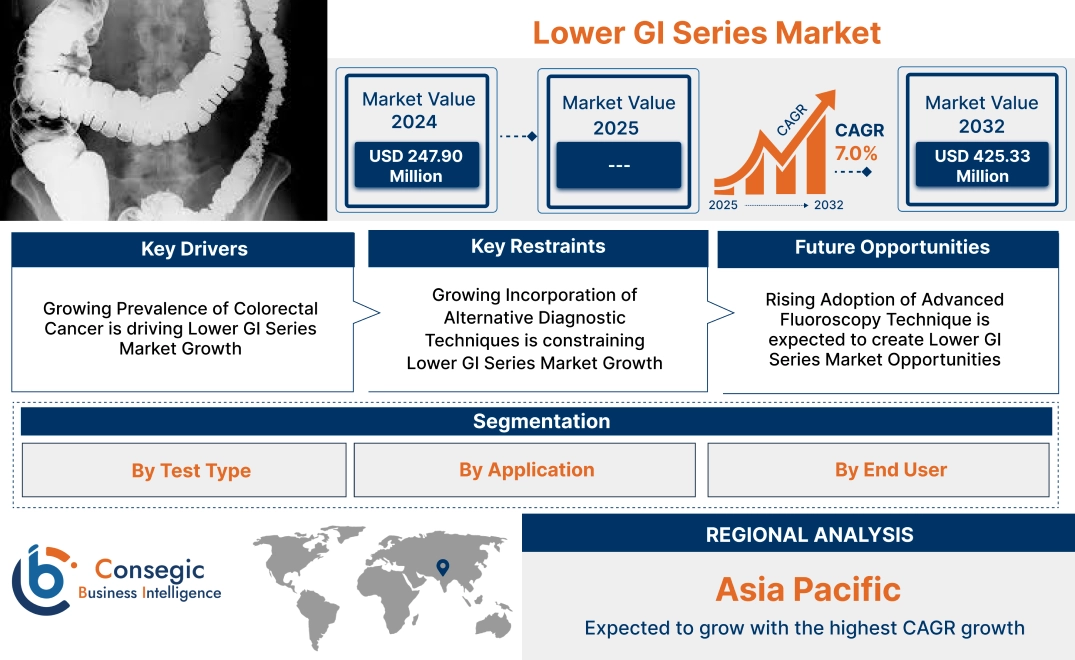
Lower GI series market size is estimated to reach over USD 425.33 Million by 2032 from a value of USD 247.90 Million in 2024, growing at a CAGR of 7.0% from 2025 to 2032.
Lower GI Series Market Scope & Overview:
Lower GI series is a diagnostic imaging test used to examine and diagnose problems related to lower gastrointestinal tract. During this test, a barium sulfate contrast agent is introduced into the rectum, coating the intestinal lining and making it visible on X-rays. Lower GI series is generally of two types as double-contrast test and single-contrast test. Due to clear and detailed visualization of colon and rectum, lower GI series is used in detection of wide range of conditions such as gastroenteritis, colon polyps, tumors, strictures, ulcerative colitis, and others. It offers various advantages including detailed imaging, cost-effectivity, real-time monitoring and accurate diagnosis. Growing adoption of modern diagnostic technology and growing emphasis on early detection of diseases like colorectal cancer, ulcerative colitis is driving the demand in the lower GI series market.
Lower GI Series Market Dynamics - (DRO) :
Key Drivers:
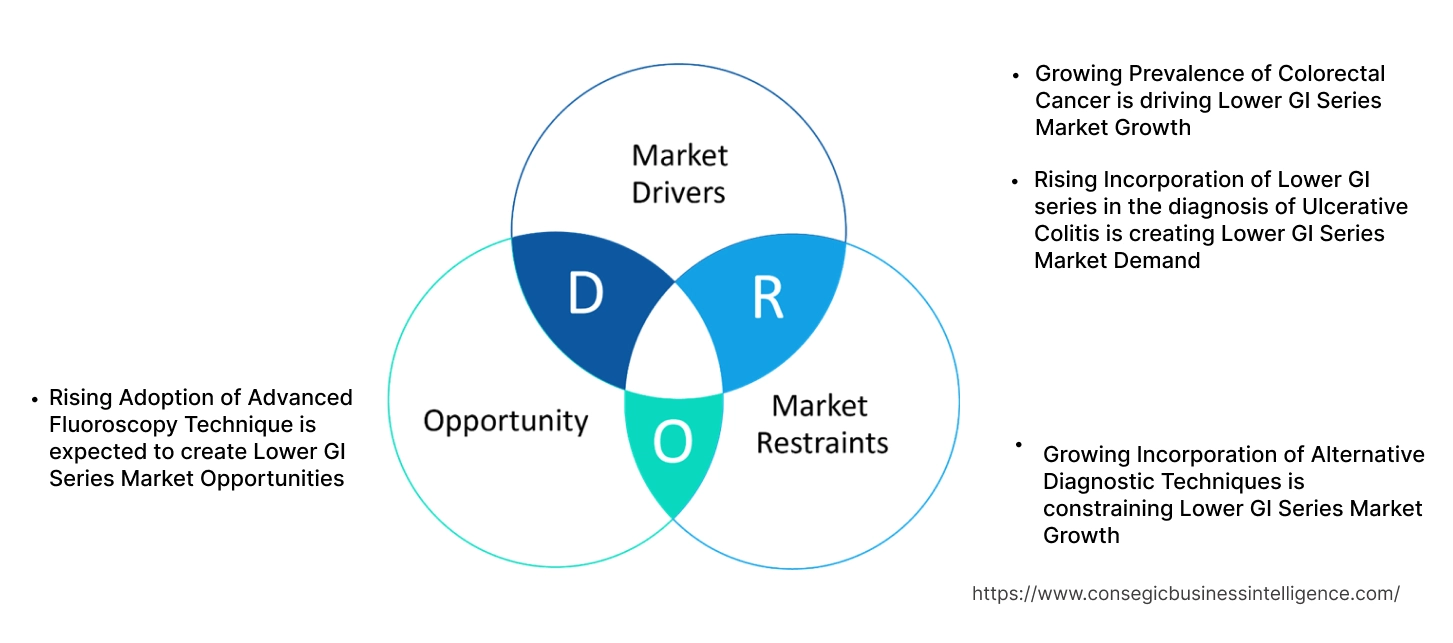
Growing Prevalence of Colorectal Cancer is driving Lower GI Series Market Growth
Colorectal cancer is a type of cancer that affects the colon or rectum. It develops from certain polyps or growths in the inner lining of the colon or rectum. The lower GI series, particularly double contrast, is widely used to detect colorectal cancer providing clear and detailed view of colon and rectum to find abnormal growth. The prevalence of colorectal cancer is rising due to several factors such as low-fiber & high-fat diet, alcohol consumption, and tobacco use further driving the market.
- In 2023, according to American Cancer Society, 153,020 individuals were diagnosed with the colorectal cancer in the United States. Lower GI series is used in the diagnosis of colorectal cancer which provides clear visualization of the colon and rectum’s inner lining for detailed examination.
Thus, rising prevalence of colorectal cancer is leading to lower GI series market demand due to the need for clear and detailed examination of the colon and rectum.
Rising Incorporation of Lower GI series in the diagnosis of Ulcerative Colitis is creating Lower GI Series Market Demand
Ulcerative colitis is an inflammatory bowel disease that causes chronic inflammation and ulcers in the superficial lining of the large intestine. Ulcerative colitis occurs due to the combination of genetics, immune system, and environmental factors. The use of lower GI series is growing in the diagnosis of ulcerative colitis to provide detailed visualization of colorectal mucosa in the patients.
- In 2023, according to National Institute of Health, prevalence of ulcerative colitis is estimated to be 5 million cases around the world. Lower GI series is increasingly adopted in the diagnosis of ulcerative colitis to diagnose the extent of inflammation and any related complications in the patients.
Thus, rising incorporation of lower GI series in the diagnosis of ulcerative colitis is leading to lower GI series market expansion by providing detailed visualization and extent of inflammation in the large intestine and rectum.
Key Restraints:
Growing Incorporation of Alternative Diagnostic Techniques is constraining Lower GI Series Market Growth
The incorporation of alternative diagnostic techniques such as colonoscopy, computer tomography (CT) scan and magnetic resonance imaging (MRI) is restraining the market. Colonoscopy provides a direct visualization of the colon, allowing for biopsy and immediate treatment, making it more comprehensive than lower GI series. Similarly, CT colonography and MRI offer highly detailed images of the colon without the need for invasive procedures or contrast agents. These alternatives also reduce the potential discomfort and risk associated with the lower GI series, such as radiation exposure and bowel irritation. Further, preference for CT scan, colonoscopy, and MRI is increasing for their improved accuracy, convenience and non-invasive nature, constraining the lower GI series market expansion.
Thus, growing incorporation of alternative technologies such as colonoscopy, CT scan, and MRI is constraining the market due to lower risk and patient discomfort.
Future Opportunities :
Rising Adoption of Advanced Fluoroscopy Technique is expected to create Lower GI Series Market Opportunities
Fluoroscopy is a medical imaging technique that provides real-time X-ray images, allowing continuous visualizations of internal organs and tissues during diagnostic or therapeutic procedures. It is integral in the lower GI series test as it provides real-time X-ray imaging, enabling healthcare professionals to examine the structure and function of lower gastrointestinal tract. Advanced fluoroscopy technique enhances the precision and accuracy of this test, essential for diagnosing conditions such as gastrointestinal cancers, ulcers, and polyps.
- In 2024, Gibraltar Health Authority opened fluoroscopy suite at St Bernard’s Hospital. This fluoroscopy suite will provide advanced fluoroscopy technique with real-time X-ray imaging and high-quality videos for the procedures such as lower GI series, micturating cystograms and others.
Thus, growing adoption of rising adoption of advanced fluoroscopy technique is expected to create lower GI series market opportunities by enhancing its precision and imaging capabilities.
Lower GI Series Market Segmental Analysis :
By Test Type:
By test type, the market is divided into double-contrast and single-contrast.
Trends in Test Type:
- According to lower GI series market trends, double contrast is widely used for the detailed visualization of colon and rectum market due to its superior diagnostic capabilities.
- Adoption of single-contrast lower GI series is increasing due to less procedure time and adverse effects on the patients as per market trends.
The double-contrast accounted for the largest market share in the year 2024.
- Double-contrast lower GI series test is a test that uses both barium (a contrasting agent) and an air to enhance the visualization of the colon and rectum’s inner lining for detailed examination.
- It is particularly effective in detective abnormalities, such as small polyps, tumors, and mucosal irregularities, making it more accurate than single-contrast test.
- The double contrast test is widely used in the market due to its superior diagnostic capabilities and widespread application in colorectal cancer, inflammatory bowel disease, and others.
- Further, rising cases of inflammatory bowel disease is driving the need for lower GI series for accurate and clear diagnosis.
- For instance, in 2024, according to Centers for Disease Control and Prevention, prevalence of inflammatory bowel disease is estimated between 2.4 and 3.1 million in the United States. Double-contrast lower GI series test is widely used in inflammatory bowel disease due to its ability to provide clear and detailed examinations.
- Thus, double-contrast test is widely used in the market due to its detailed and clear examinations.
The single contrast is expected to grow at the fastest CAGR over the forecast period.
- Single-contrast lower GI series is a test where a barium sulphate solution is injected into the lower gastrointestinal tract to coat the colon and rectum, enabling clear X-ray imaging of the area’s structure and abnormalities.
- It is especially valuable in detecting structural issues like strictures, large polyps, tumors, and diverticula.
- Single-contrast test is experiencing proliferation due to its cost effectiveness, faster procedure time and its suitability for elderly or critically ill patients.
- Advancement in fluoroscopy technology have also enhanced the precision and efficiency of this test, further boosting its use.
- Thus, the use of single-contrast test is rising in the market due to its cost-effectiveness and faster procedure time.
By Application:
By application, the market is divided into gastroenteritis, colon polyps, tumors, strictures, ulcerative colitis, and others.
Trends in Application
- As per lower GI series market trends, lower GI series is widely used in the diagnosis of colorectal cancer for the detailed images of colon and rectum.
- Use of lower GI series is growing in the diagnosis of ulcerative colitis for confirmation and in-depth visualization as per market trends.
The tumors accounted for the largest market share in the year 2024.
- Tumors are abnormal growth of the tissue which occurs in any part of the body including gastrointestinal tract and it is either benign or malignant.
- Lower GI series is widely used test in the diagnosis of tumors, particularly colorectal cancer which uses x-rays and barium to view the colon and rectum.
- The growing prevalence of colorectal cancer and rising awareness about its early detection is contributing to the use of this test.
- For instance, in 2024, according to Colorectal Cancer Alliance, there is 152,810 people in the U.S. which are diagnose with colorectal cancer. Lower GI series particularly double-contrast is used in the diagnosis of colorectal cancer to provide clear and detailed visualization of abnormal growth in the colon and rectum.
- Thus, lower GI series is widely used in the diagnosis of tumors due to rising cases and growing emphasis on early tumor detection among individuals.
The ulcerative colitis is expected to grow at the fastest CAGR over the forecast period.
- Ulcerative colitis is an inflammatory bowel disease that causes chronic inflammation and ulcers in the superficial lining of the large intestine.
- The adoption of lower GI series is rising in the ulcerative colitis to provide clear and detailed visualization of the intestine and rectum to confirm the diagnosis and ruling out other gastrointestinal disorders.
- The growing focus on early diagnosis and treatment of ulcerative colitis is further boosting the demand for lower GI series.
- Additionally, advancement in fluoroscopy and modern imaging technologies such as digital imaging systems are contributing to the market.
- Thus, adoption of lower GI series is rising in the ulcerative colitis diagnosis to provide clear and detailed examination of extent of inflammation in the patients.
By End User:
By end-user, the market is divided into hospitals, clinics, diagnostic laboratories, and others.
Trends in End-User:
- As per market trends, hospitals are widely using lower GI series due to advanced imaging technology and availability of skilled radiologists.
- Diagnostic laboratories are largely adopting lower GI series supported by technological advancement and modern imaging technology as per market trends.
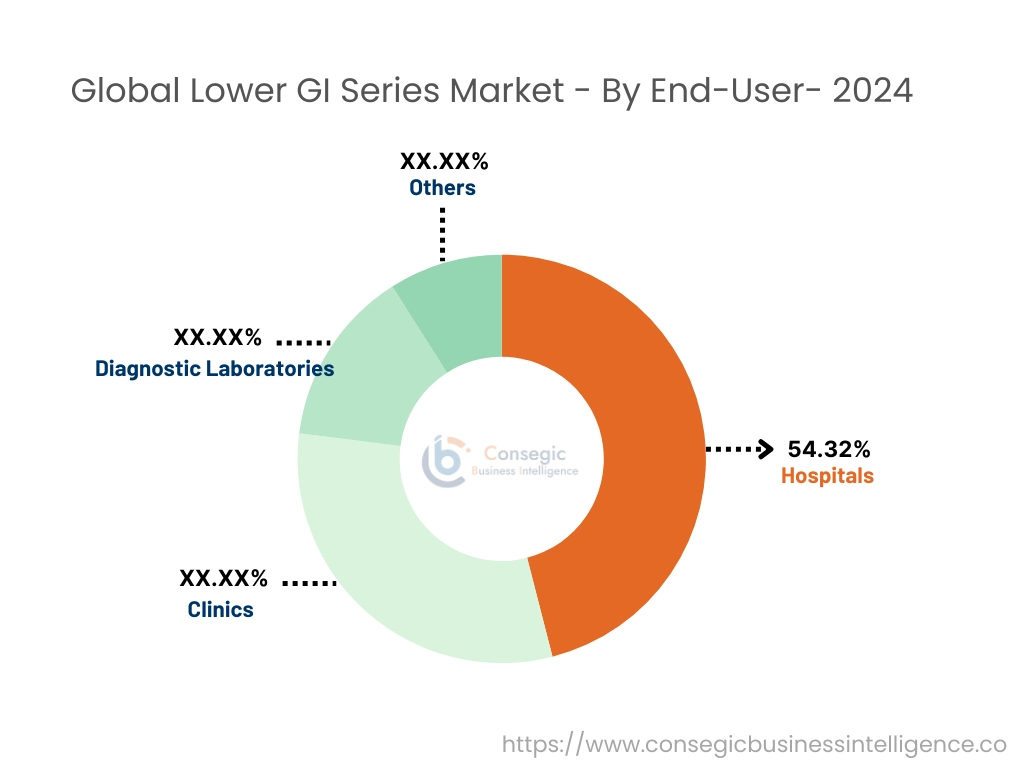
The hospitals accounted for the largest market share of 54.32% in the year 2024.
- A hospital is a healthcare facility that provides medical and nursing careas well as medical supplies to patients.
- Lower-GI series test is widely used in the hospitals due to their well-established infrastructure and advanced imaging technologies.
- Hospitals are the primary providers of diagnostic services, offering comprehensive care to patients with gastrointestinal disorders.
- Furthermore, the expanding hospital market in countries contributes to the growing demand for lower GI series.
- For instance, in 2024, according to India Brand Equity Foundation, the hospital market in India projected to grow at 8.0% from 2024 to 2032. Lower-GI series test are widely used in the hospitals due to availability of highly killed radiologists and gastroenterologists which ensures accurate diagnosis and treatment.
- Thus, hospitals are widely using lower GI series due to advanced infrastructure and modern imaging technologies.
The diagnostic laboratories are expected to grow at the fastest CAGR over the forecast period.
- Diagnostic laboratories are specialized facilities where medical tests, including imaging and pathology, are conducted to detect and monitor the disease.
- The use of lower GI series is growing in diagnostic laboratories due to their specialized focus and technological advancement.
- These laboratories are increasingly equipped with modern imaging technology such as fluoroscopy and digital imaging systems, to provide accurate and timely results.
- The proliferation of diagnostic laboratories in the market is also driven by partnership with healthcare providers, insurance companies, and government to support large-scale screening initiatives.
- Thus, diagnostic laboratories are increasingly adopting lower GI series to detect and monitor gastrointestinal disorders like colon polyps, colorectal cancer, and others.
Regional Analysis:
The regional segment includes North America, Europe, Asia Pacific, the Middle East and Africa, and Latin America.
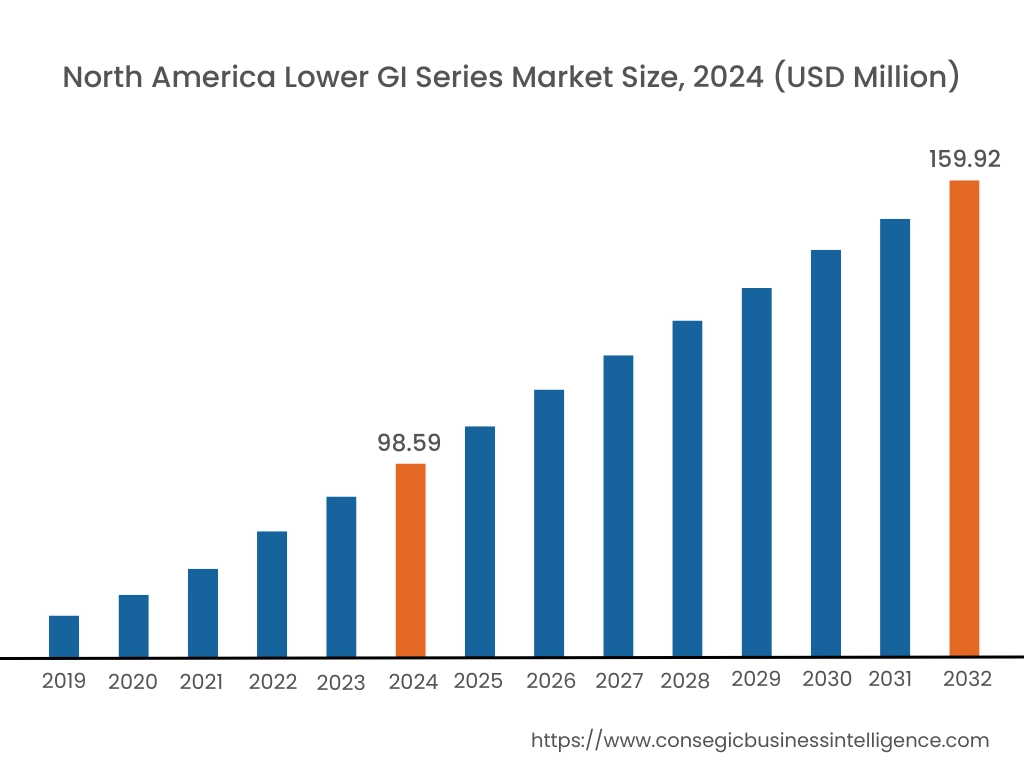
In In 2024, North America accounted for the highest market share at 39.77% and was valued at USD 98.59 Million and is expected to reach USD 159.92 Million in 2032. In North America, United States accounted for the highest market share of 71.44% during the base year of 2024.
The lower GI series market share of North America is significant due to well-established healthcare industry and rising government initiatives. The region benefits from advanced healthcare technology and growing adoption of digital imaging systems. Governments and healthcare providers in the region is forming partnerships to provide lower GI series in the treatment of ulcerative colitis, colon polyps, crohn’s disease, and colorectal cancer. Moreover, the rising prevalence of crohn’ disease cases in the region is driving the market.
- In 2022, according to MedlinePlus, prevalence of crohn’ disease in North America is 100 to 300 per 100,000 people. The lower GI series is used in the diagnosis of crohn’s disease to provide detailed and clear visualization of inflammation in the colon and rectum.
Thus, North America is leading in the market due to rising healthcare investments and growing adoption of digital imaging systems as per market analysis.

Asia-pacific is expected to witness the fastest CAGR of 8.3% over the forecast period of during 2025-2032.
As per lower GI series market analysis, Asia-Pacific region is experiencing rapid growth in the market driven by high prevalence of colorectal cancer, ulcerative colitis in countries like China, India, and Japan. The region’ s growing population and urbanization also contribute to increased healthcare demand, including lower GI series. The diagnostic laboratories in the region are largely incorporating lower GI series tests for the accurate and confirm diagnosis of gastrointestinal abnormalities. Additionally, the advancement in healthcare technology and improved accessibility in both rural and urban areas is expanding the market. Thus, the lower GI series market share of Asia-Pacific is expanding due to rising prevalence of colorectal cancer and improved healthcare infrastructure as per market analysis.
According to lower GI series market analysis, Europe region is experiencing steady proliferation in the market driven by high prevalence of colorectal cancer and advanced imaging technologies. The hospitals and clinics in the region are well equipped with modern diagnostic technology and skilled radiologists along with digital healthcare infrastructure. Clinics and diagnostic laboratories in the region are playing an important role in making lower GI series accessible to patients with gastrointestinal disorders. Research and developments in the region are focused on improving the fluoroscopy and reducing side effects associated with long-term use of contrast agents which further boosts the market in the region.
The Middle East and Africa region is experiencing gradual proliferation in the market, driven by increasing awareness, improving healthcare infrastructure and rising healthcare investments. The region is experiencing rapid proliferation in colorectal cancer cases along with strictures, further driving the need for lower GI series for the accurate diagnosis. Countries like Dubai, UAE, and South Arica are major contributors in the market where advanced hospitals and government organizations provide access to advanced imaging techniques. The diagnostic laboratories and private clinics in the region are widely adopting lower GI series for the treatment of gastrointestinal disorders such as tumors, polyps, and gastroenteritis as per analysis.
As per analysis, the market is growing steadily in Latin America driven by improving healthcare infrastructure and increasing adoption of advanced imaging techniques. Key factors driving growth include a higher prevalence of colorectal cancer and aging population. Countries like Brazil, Mexico, and Argentina are major contributors in the market due to advanced imaging technology centers and rising healthcare investments. The rise of diagnostic laboratories and private clinics has significantly impacted the availability of lower GI series for the patients. Additionally, the growing awareness of early cancer detection, alongside government support is expected to drive the market in the region.
Top Key Players and Market Share Insights:
The lower GI series industry is highly competitive with major players providing services in national and international markets. Key players are adopting several strategies in research and development (R&D) and product innovation to hold a strong position in the global lower GI series market. Key players in the lower GI series industry include-
- Allied Digestive Health (United States)
- Midstate Radiology Associates (United States)
- Gastro Health (United States)
- GI Alliance (United States)
- Akumin Inc. (United States)
- The Johns Hopkins Hospital (United States)
- Mount Sinai (United States)
- Stanford Health Care (United States)
- Fujifilm Medical (Japan)
- CRH Medical (Canada)
Recent Industry Developments :
Partnerships and Collaborations:
- In 2023, GI alliance partnered with Digestive Health Center expanding GI Alliance’s presence in Mississippi. It will lead to expansion of various tests including lower GI series for the patients in Ocean Springs.
Lower GI Series Market Report Insights :
| Report Attributes | Report Details |
| Study Timeline | 2019-2032 |
| Market Size in 2032 | USD 425.33 Million |
| CAGR (2025-2032) | 7.0% |
| By Test Type |
|
| By Application |
|
| By End User |
|
| By Region |
|
| Key Players |
|
| North America | U.S. Canada Mexico |
| Europe | U.K. Germany France Spain Italy Russia Benelux Rest of Europe |
| APAC | China South Korea Japan India Australia ASEAN Rest of Asia-Pacific |
| Middle East and Africa | GCC Turkey South Africa Rest of MEA |
| LATAM | Brazil Argentina Chile Rest of LATAM |
| Report Coverage |
|
Key Questions Answered in the Report
How big is the lower GI series market? −
In 2024, the lower GI series market is USD 247.90 million.
Which is the fastest-growing region in the lower GI series market? +
Asia-Pacific is the fastest-growing region in the lower GI series market.
What specific segmentation details are covered in the lower GI series market? +
Test type, application, and end-user are covered in the lower GI series market.
Who are the major players in the lower GI series market? +
Allied Digestive Health (United States), Midstate Radiology Associates (United States), and The Johns Hopkins Hospital (United States) are some of the major players in the market.
Overview
Reputation & Certifications


Our Services
- Market Intelligence & Forecasting
- Custom Research Solutions
- Market Entry Strategy
- Competitive Intelligence
- Customer Insights
- Industry Innovation Analysis
- Investment Advisory