Jump to Content
LTE Chipset Market - Size, Share, Industry Trends, and Forecasts (2025-2032)
LTE Chipset Market Size:
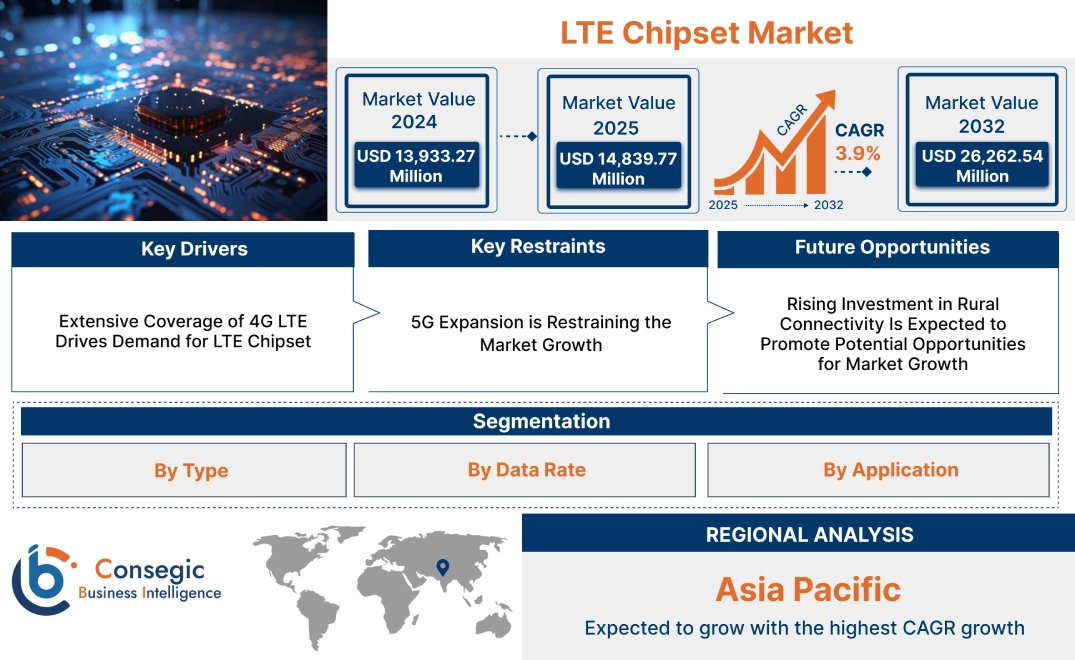
LTE Chipset Market is estimated to reach over USD 26,262.54 Million by 2032 from a value of USD 13,933.27 Million in 2024 and is projected to grow by USD 14,839.77 Million in 2025, growing at a CAGR of 9.1% from 2025 to 2032
LTE Chipset Market Scope & Overview:
LTE stands for long-term evolution in the wireless broadband standard. LTE chips are devices which integrate RF components, digital signal processing capabilities, protocol stacks, and interfaces to enable devices to connect to LTE cellular networks. Additionally, LTE chipset have evolved from 3GPP Release 8 to 4G LTE chipset. Moreover, the chipsets are of two types including standalone and integrated chipsets. And are commonly utilized in smartphones, laptops, wearable devices and others. The key benefits of adopting chipsets include high-speed communication, wireless transmission, high security, high reliability and easy to maintain among others in turn driving the LTE chipset market growth. Additionally, the data rate of chipsets comes in various types such as LTE Cat1 to LTE Cat 12 and others. Further, the faster download and upload speed of online content which in turn supports businesses increase productivity is driving the LTE chipset market demand.
LTE Chipset Market Dynamics - (DRO) :
Key Drivers:
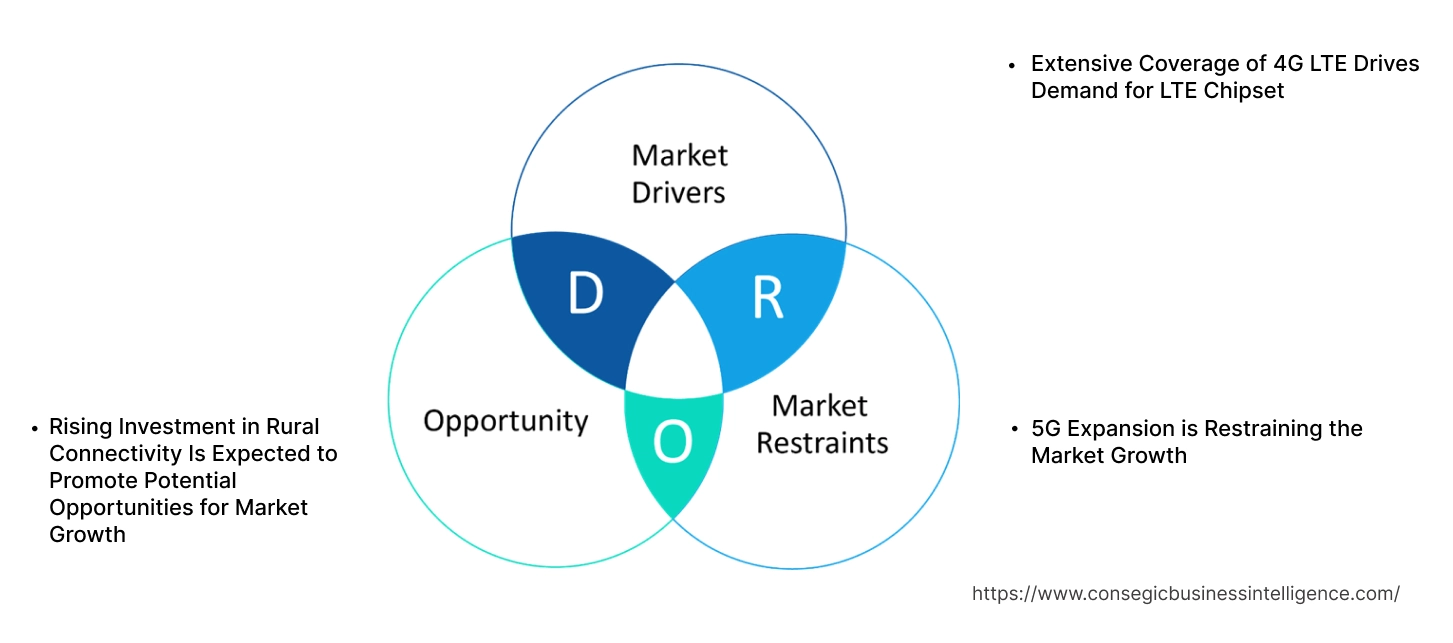
Extensive Coverage of 4G LTE Drives Demand for LTE Chipset
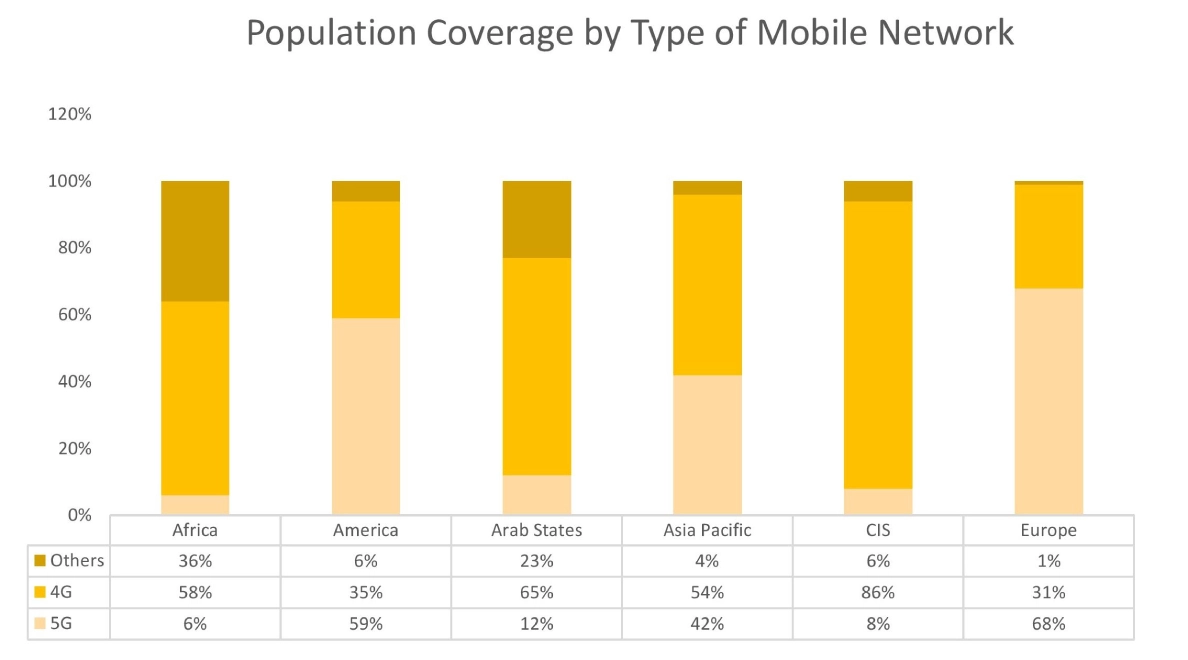
The mobile broadband network is available to 95% of the world population with an extensive coverage of LTE across the globe as compared to 5G and other broadband network which in turn is driving the LTE chipset industry. Moreover, the key factors driving the adoption of 4G LTE include wide coverage, high-speed internet, stable and reliable connections, and affordable data plans driving the LTE chipset market growth. Further, the widespread availability of 4G LTE with fast and consistent experience drives the LTE chipset market demand.
- For instance, According to International Telecommunication Union , Population coverage by type of mobile network across the globe is segregated by 38% for 5G and 52% for 4G in the year 2023.
Thus, the widespread availability of 4G LTE with fast and consistent experience as well as mobile broadband network is available to 95% of the world population is driving the market progressively across the globe.
Key Restraints:
5G Expansion is Restraining the Market Growth
5G deliver faster speeds of up to 1Gbps, enabling activities such as HD video streaming, VR experiences, and downloads while LTE offers speeds of up to 100Mbps in turn hindering the LTE chipset market expansion. Also, LTE supports up to 1000 devices per cell tower and 5G handle higher number of devices per cell in turn improving network performance and hindering the LTE chipset market expansion. Moreover, the key factors which drive the adoption of 5G and hinder the LTE adoption include capacity, latency and speed among others.
Therefore, the high costs of raw materials utilized in the manufacturing of discrete semiconductors are restraining the market growth.
Future Opportunities :
Rising Investment in Rural Connectivity Is Expected to Promote Potential Opportunities for Market Growth
The rising government investment in telecom infrastructure development in the rural and semi urban areas is driving the LTE chipset market opportunities. Additionally, some parts of the countries such as India and Africa operate on 2G and 3G network which in turn propels the LTE chipset market opportunities. Further, companies are significantly investing the rural infrastructure development with the support from government to expand 4G capabilities which is driving the market progress across the region.
- For instance, in January 2025, African Development Bank partnered by providing USD 160 million loan to AXIAN Telecom . The loan aims to modernize and expand AXIAN Telecom network infrastructure, with a focus on 4G and 5G deployment in nine African countries.
Hence, the increasing investment in network infrastructure is anticipated to increase the utilization of 4G in turn promoting prospects for market growth during the forecast period.
LTE Chipset Market Segmental Analysis :
By Type:
Based on the type, the market is bifurcated into standalone chipset and integrated chipset.
Trends in the Type:
- The integration of LTE chips with 5G network capabilities is driving the LTE chipset market trend.
- The miniaturization of advanced LTE chips is driving the LTE chipset market trend.
Integrated Chipset accounted for the largest revenue share in the year 2024 and is anticipated to register the fastest CAGR during the forecast period.
- LTE chips are integrated into various devices, including smartphones, tablets, laptops, IoT devices, and automotive applications in turn driving the LTE chipset market share.
- Further, the integrated chipsets enhance network capacity and performance which in turn boost the LTE chipset market size.
- For instance, in May 2024, GCT Semiconductor Holding Inc. launched integrated LTE chipset with multi-mode . The chipset is operating in Cat 4, Cat-M1, and non-terrestrial networks among others for providing global coverage over land, sea, and air.
- Thus, according to the LTE chipset market analysis, integrated chipsets enhance network capacity and performance which in turn is driving the LTE chipset market.
By Data Rate:
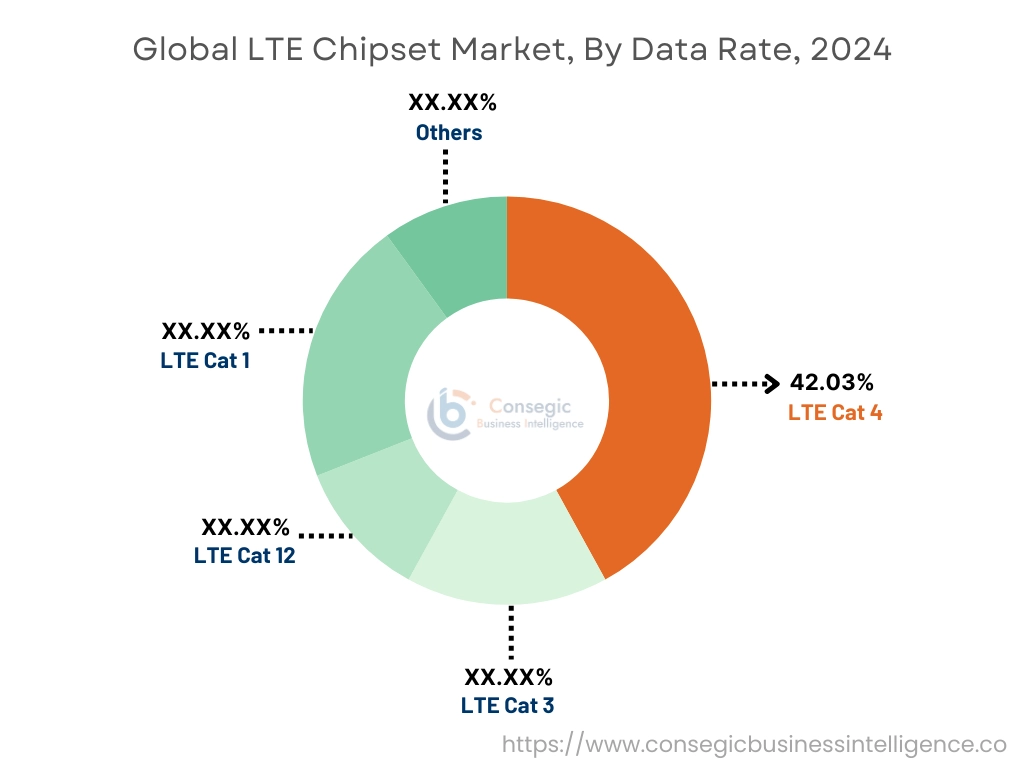
Based on the data rate, the market is segmented into LTE Cat 1, LTE Cat 4, LTE Cat 3, LTE Cat 12 and others.
Trends in the Data Rate:
- The trend towards allowing smart devices to connect to the Internet via Wi-Fi, by using SIM cards in areas with 4G cellular coverage is driving the LTE Cat 12 segment progress.
- The trend towards rising adoption of point of sale terminals, smart meters, and asset tracking devices is driving the demand for LTE Cat 1 segment.
LTE Cat 4 accounted for the largest revenue share of 42.03% in the year 2024 is anticipated to register the fastest CAGR during the forecast period.
- LTE cat 4 is preferred in areas where the transmission distance is relatively scattered, and the data communication rate is relatively high with supports uplink data rates of up to 50Mbps and downlink data rates of up to 150Mbps.
- Moreover, the characteristics of LTE Cat 4 include fast speed, support modulation methods and MIMO technology, relatively small coverage, suitable for high-bandwidth and low-latency applications among others.
- Further, the rising demand for better user experiences in streaming, browsing, and communication is driving the growth of LTE Cat 4 segment which in turn boosts the LTE chipset market size.
- Furthermore, the reduced latency and enhanced network capacity drives adoption in applications such as smartphones and others are driving the LTE Cat 4 segment progress which in turn is boosting the LTE chipset market share.
- For instance, in July 2023, Quectel Wireless Solutions launched SC696S series which is the latest generation of multi-mode smart LTE Cat 4 modules. The device features a built-in Linux operating system with Wi-Fi and Bluetooth capabilities.
- Thus, according to the LTE chipset market analysis, the reduced latency and enhanced network capacity is driving the LTE Cat 4 segment progress.
By Application:
Based on the application, the market is segmented into smartphone, tablets, laptop, wearable devices and others.
Trends in the Application:
- The trend towards rising adoption of tablets in rural smart classroom is propelling the integration of LTE chips into the devices is in turn driving the market progress.
- The trends towards rising need for enhancing real time user experience by allowing users to receive calls and messages with the help of smartwatches is driving the progress of market.
Smartphone accounted for the largest revenue share in the year 2024.
- Smartphones are integrated with both LTE and 5G network capabilities in turn driving the market progress. Also, the evolving consumer electronics industry is driving the adoption of LTE chips which in turn is fueling market progress.
- Further, the key factors driving the adoption of smartphone segment include government initiatives, reduced cost and rising disposable income.
- Furthermore, LTE integrated into smartphone support data, VoLTE, instant messaging and video in turn driving the LTE chipset market progress.
- For instance, According to IBEF , India's smartphone exports further rose by 42% reaching a value of USD 15.6 billion and becoming the country’s fourth-largest export item in 2023-24.
- Thus, as per the market analysis, factors such as government initiatives, reduced costs and rising disposable income are driving the adoption of smartphones which in turn is boosting the market progress.
Wearable Devices is anticipated to register the fastest CAGR during the forecast period.
- Wearable devices require broad range of cellular connectivity to meet the mobility demands of customers.
- Moreover, LTE smartwatches connect to cellular networks independently for activities such as calls, send texts, and even access the internet without a smartphone.
- Further, the rising adoption of smartwatches, AR/VR devices among others is driving the need for integrating LTE technology for seamless connectivity solutions.
- For instance, in February 2024, CrisisGo partnered with Samsung to introduce 2-way emergency communication application on Samsung smartwatches. The smartwatch features 4G/LTE and Wi-Fi, ensuring seamless communication in any environment.
- Therefore, as per the market analysis, the rising adoption of smartwatches, AR/VR devices among others is anticipated to boost the market during the forecast period.
Regional Analysis:
The regions covered are North America, Europe, Asia Pacific, Middle East and Africa, and Latin America.
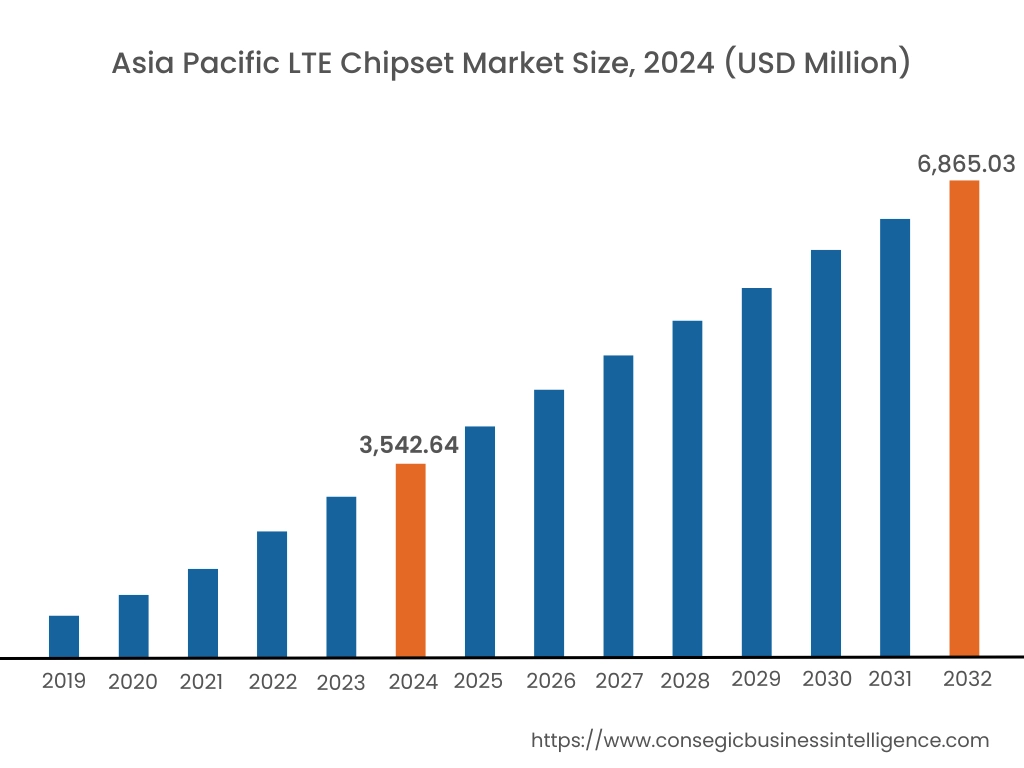
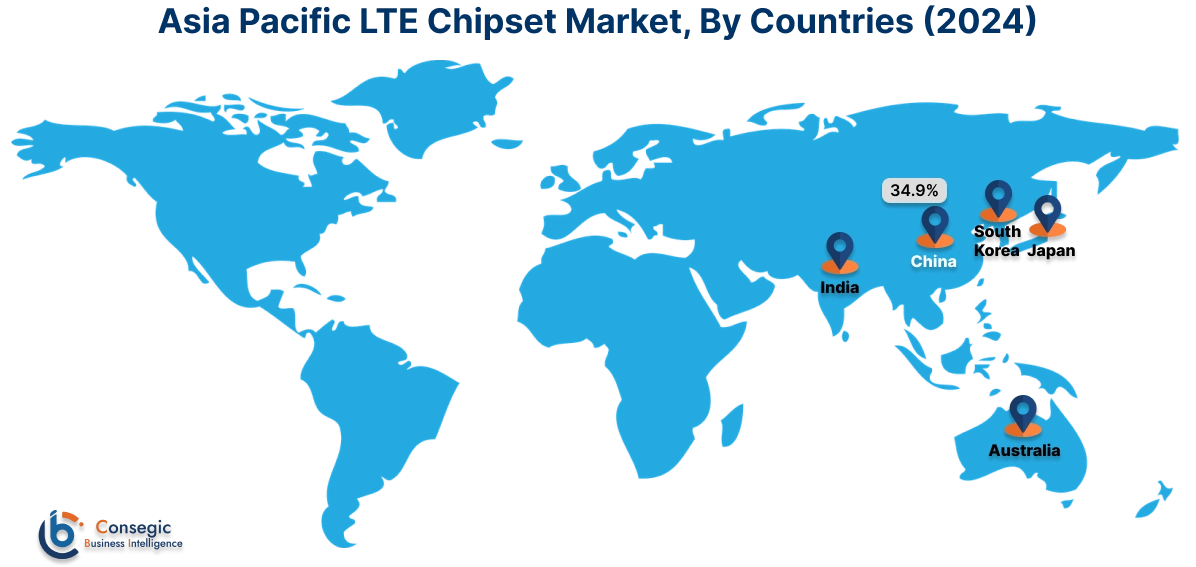
Asia Pacific region was valued at USD 3,542.64 Million in 2024. Moreover, it is projected to grow by USD 3,781.96 Million in 2025 and reach over USD 6,865.03 Million by 2032. Out of this, China accounted for the maximum revenue share of 34.9%. The market analysis shows that the advancements in telecommunications technology in the Asia Pacific region are driving the market progress. Furthermore, as per the market analysis, widespread adoption of mobile broadband services is projected to drive the market evolution in Asia Pacific region during the forecast period.
- For instance, in May 2023, According to the Ministry of External Affairs, India, telecom operators added 6.2 million new 4G subscriptions in March 2023 in turn driving the market development.
North America is estimated to reach over USD 9,454.51 Million by 2032 from a value of USD 5,049.93 Million in 2024 and is projected to grow by USD 5,375.46 Million in 2025. The North American region's growing need for fast and reliable internet connection offer lucrative growth prospects for the market. Additionally, higher penetration of LTE across the region is driving market progress.
- For instance, in October 2023, Cavli Wireless based out in USA, launched CQS290 smart cellular IoT android module which features a series of LTE Cat 4 android smart modules.
The regional evaluation depicts that the rising infrastructure development for enhancing cellular network capabilities is driving the market in Europe. Additionally, the key factor driving the market is increasing penetration of cellular network infrastructure development in the Middle East and African region. Further, the rising adoption of smartphones and wearable devices is paving the way for the progress of market in Latin America region.
Top Key Players and Market Share Insights:
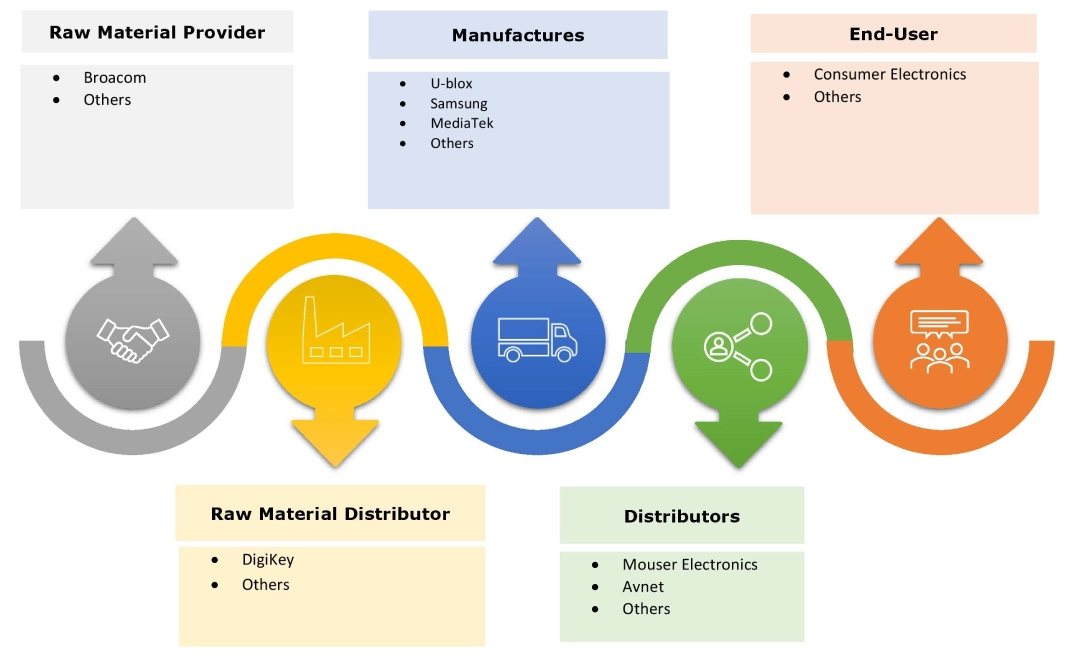
The global LTE chipset market is highly competitive with major players providing LTE chipset to the national and international markets. Key players are adopting several strategies in research and development (R&D), product innovation, and end-user launches to hold a strong position in the LTE chipset industry. Key players in the LTE chipset market include-
- Intel Corporation (USA)
- Samsung (South Korea)
- Renesas Electronics Corporation (Japan)
- Skyworks Solutions, Inc. (USA)
- GCT Semiconductor Holding, Inc (USA)
- Qualcomm Technologies, Inc. (USA)
- U-blox (Switzerland)
- Huawei Technologies Co., Ltd. (China)
- MediaTek (Taiwan)
- Infineon Technologies AG (Germany)
Recent Industry Developments :
Product Launches:
- In November 2024, u-blox launched LTE Cat 1bis module , which is designed to improve the robustness, reliability, and resilience of IoT applications. Also, it provides ability to switch between best network in terms of coverage and cost.
- In February 2024, u-blox launched SARA-R52 and LEXI-R52 series , which is an LTE-M modules with integrated GNSS designed to boost industrial connectivity.
Partnerships & Collaborations:
- In June 2023, Nokia partnered with DXC Technology to launch DXC Signal Private LTE and 5G Solution. The aim of the launch is to offer companies solutions to organizations requiring high-bandwidth, low-latency wireless networks to support and other requirements.
LTE Chipset Market Report Insights :
| Report Attributes | Report Details |
| Study Timeline | 2019-2032 |
| Market Size in 2032 | USD 26,262.54 Million |
| CAGR (2025-2032) | 9.1% |
| By Type |
|
| By Data Rate |
|
| By Application |
|
| By Region |
|
| Key Players |
|
| North America | U.S. Canada Mexico |
| Europe | U.K. Germany France Spain Italy Russia Benelux Rest of Europe |
| APAC | China South Korea Japan India Australia ASEAN Rest of Asia-Pacific |
| Middle East and Africa | GCC Turkey South Africa Rest of MEA |
| LATAM | Brazil Argentina Chile Rest of LATAM |
| Report Coverage |
|
Key Questions Answered in the Report
What are the key trends in the LTE chipset market? −
The LTE chipset market is being shaped by several key trends including trend towards rising adoption of tablets in rural smart classrooms is propelling the integration of LTE chips into the devices as well as rising adoption of point of sale terminals, smart meters, and asset tracking devices are the key trends driving the market.
Who are the major players in the LTE chipset market? +
The key participants in the LTE chipset market are Intel Corporation (USA), Samsung (South Korea), Qualcomm Technologies, Inc. (USA), U-blox (Switzerland), Huawei Technologies Co., Ltd. (China), MediaTek (Taiwan), Infineon Technologies AG (Germany), Renesas Electronics Corporation (Japan), Skyworks Solutions, Inc. (USA), GCT Semiconductor Holding, Inc (USA) and others.
Which is the fastest segment anticipated to impact the market growth? +
In the LTE chipset market, the LTE Cat 4 is the fastest-growing segment during the forecast period due to rising demand for better user experiences in streaming, browsing, and communication as well as reduced latency and enhanced network capacity drives adoption in application such as smartphone and others.
How big is the LTE chipset market? +
The LTE Chipset Market is estimated to reach over USD 26,262.54 Million by 2032 from a value of USD 13,933.27 Million in 2024 and is projected to grow by USD 14,839.77 Million in 2025, growing at a CAGR of 9.1% from 2025 to 2032.
What specific segmentation details are covered in the LTE chipset report? +
The LTE chipset report includes specific segmentation details for type, data rate, application, and regions.
Overview
Reputation & Certifications


Our Services
- Market Intelligence & Forecasting
- Custom Research Solutions
- Market Entry Strategy
- Competitive Intelligence
- Customer Insights
- Industry Innovation Analysis
- Investment Advisory