Jump to Content
Machine Translation Market - Size, Share, Industry Trends, and Forecasts (2025-2032)
Machine Translation Market Size:
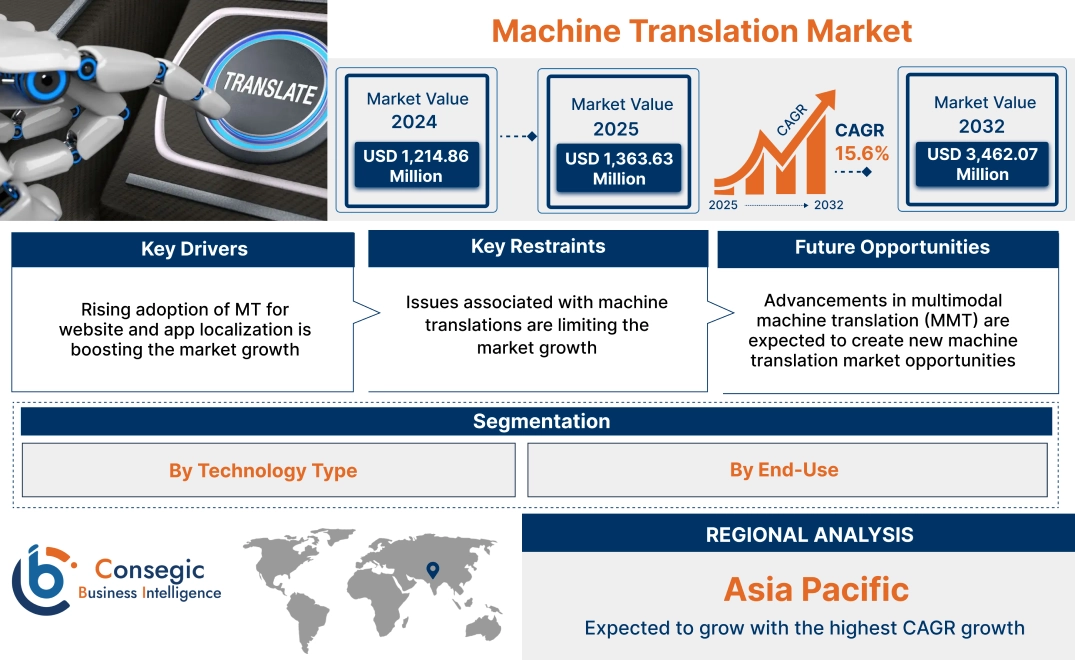
Machine Translation Market size is estimated to reach over USD 3,462.07 Million by 2032 from a value of USD 1,214.86 Million in 2024 and is projected to grow by USD 1,363.63 Million in 2025, growing at a CAGR of 15.6% from 2025 to 2032.
Machine Translation Market Scope & Overview:
Machine translation (MT) translates text from one language into other using tools and techniques. The technology is dependent on natural language processing and machine learning algorithms. MT processes and translates large amounts of text very quickly. Moreover, MT significantly reduce translation costs, particularly for large volumes of content, as it eliminates the need for extensive human labor. It allows businesses to optimize resources by automating the translation process, freeing up human translators for more complex tasks. MT enables businesses to reach a wider global audience by translating content into multiple languages. It facilitates communication and collaboration with individuals from different linguistic and cultural backgrounds. MT helps to make information and resources accessible to individuals who speak different languages. Therefore, the above factors are further driving the market demand.
Machine Translation Market Dynamics - (DRO) :
Key Drivers:
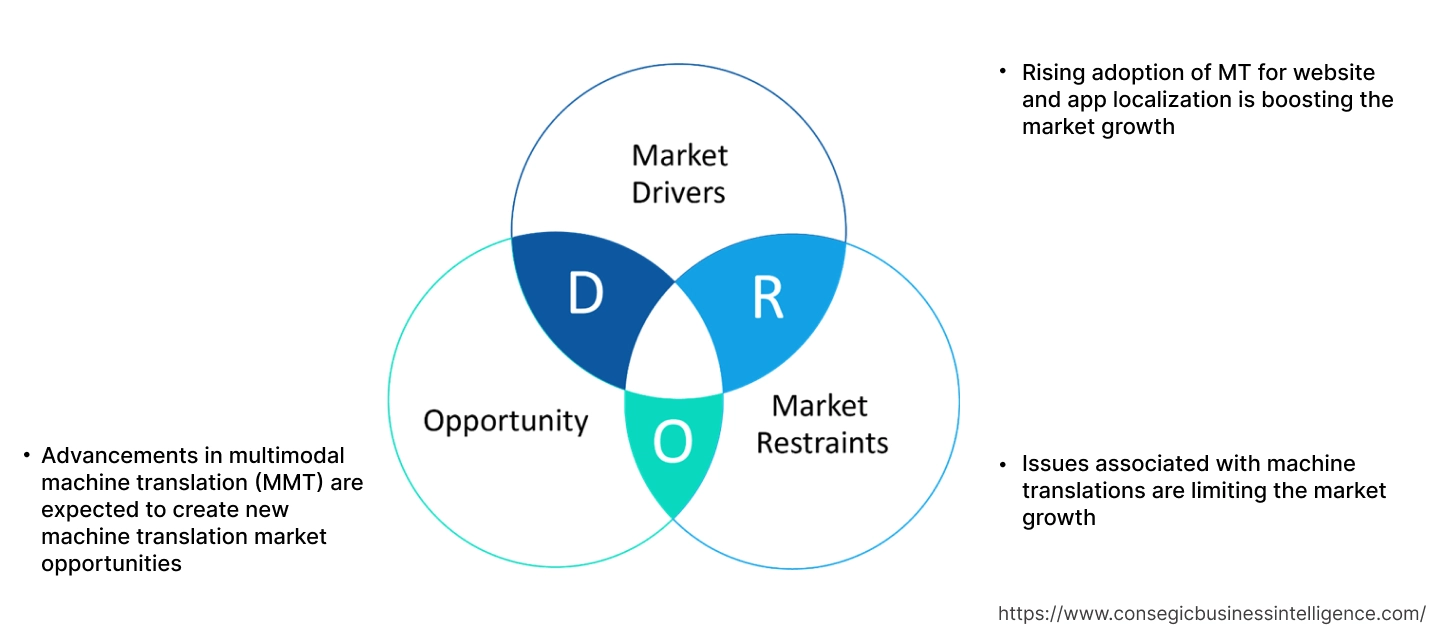
Rising adoption of MT for website and app localization is boosting the market growth
Machine translation helps businesses adapt their websites, apps, and marketing materials for different cultures and regions, ensuring a user-friendly experience for international audiences. It translates user interfaces, error messages, and help documentation into multiple languages, making software accessible to a wider global audience. MT translates product descriptions, reviews, and customer support, making it easier for international customers to understand and purchase merchandise.
- For instance, in November 2024, Translated launched Lara, an AI-powered translation tool for teams, individuals, and enterprises. The tool is trained using 1.2M NVIDIA GPU hours and using a cluster of 25 million real-world translations by professional translators.
Thus, the aforementioned factors are boosting the adoption of machine translating tools, in turn, driving the machine translation market growth.
Key Restraints:
Issues associated with machine translations are limiting the market growth
Machines often produce literal translations that sound unnatural or even senseless, specifically when dealing with idioms and colloquialisms. Machine translating systems often produce translations with grammatical errors or awkward phrasing. In certain cases, machines struggle to understand the context of a sentence or passage, leading to inaccurate translations. MT often fails to capture the nuances of language, such as sarcasm, irony, or emotional tone.
Moreover, MT systems may not be aware of cultural differences or sensitivities, leading to misunderstandings or even offense. Machines struggle to translate technical or specialized language, requiring domain adaptation or post-editing. Thus, the market analysis shows that the aforementioned factors are restraining the machine translation market demand.
Future Opportunities :
Advancements in multimodal machine translation (MMT) are expected to create new machine translation market opportunities
Apart from text-only translation, MMT also translates information from images, videos, or audio, to improve translation accuracy and fluency. By leveraging visual or auditory cues, MMT aims to produce more accurate and contextually relevant translations, particularly in situations where text alone is insufficient. Moreover, there are various techniques including visual encoding, audio processing, and multimodal fusion.
- For instance, in June 2024, AWS presented a dataset for multi-modal document translation. The dataset integrates visual encoders with large language models (LLMs), leading to the development of multi-modal MT model. These models are capable of handling textually and visually complex tasks.
Thus, the ongoing advancements in machine translating techniques are projected to drive machine translation market opportunities during the forecast period.
Machine Translation Market Segmental Analysis :
By Technology Type:
Based on the technology type, the market is segmented into rule-based machine translation (RBMT), statistical machine translation (SMT), and neural machine translation (NMT).
Trends in the Technology Type:
- Rising demand of NMT for better translation in different languages in real-time is booting the machine translation market size.
- Increasing trend in adoption of RBMT for high accuracy in specific domains, consistency, and control over linguistic output is driving the market growth.
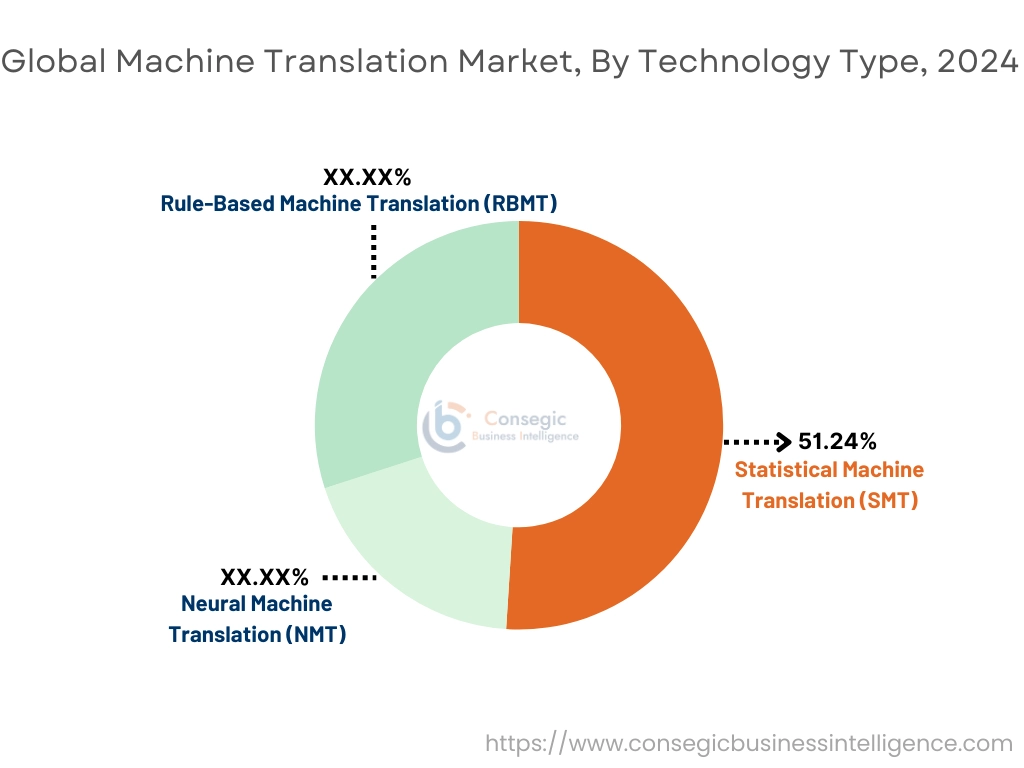
The statistical machine translation (SMT) segment accounted for the largest revenue share of 51.24% in the machine translation market share in 2024.
- SMT uses statistical models to translate text, learning from large datasets of parallel texts to predict the most suitable translation.
- SMT relies heavily on analyzing existing human translations to build statistical models and aims to find the most probable translation of a source sentence by considering various factors and their probabilities.
- Moreover, SMT often uses phrase-based models, where translations are built by aligning and translating phrases rather than individual words.
- SMT automatically learn translation rules from data, reducing the need for manual rule-writing and is able to adapt to different languages and domains by training on relevant data.
- SMT handle large volumes of text and language pairs, making it suitable for various translation tasks.
- Therefore, the market analysis depicts that the wide spread adoption of SMT is driving the machine translation market growth.
The neural machine translation (NMT) segment is expected to register the fastest CAGR during the forecast period.
- NMT uses artificial neural networks to automatically translate text from one language to another, predicting the likelihood of a sequence of words. NMT offer improvements in fluency and adequacy as compared to other methods.
- NMT treats the entire translation process as a single, integrated task, training all components jointly to maximize translation performance.
- Moreover, NMT learns from training data quickly, adapts to new situations, and are able to handle large amounts of data and complex language pairs.
- For instance, in April 2022, AppTek launched NMT system. The system integrates metadata as inputs and allows more accurate user-influenced translations.
- Thus, the market analysis shows that rising advancements related to NMT system are expected to boost the machine translation market trends during the forecast period.
By End-Use:
Based on the end use, the market is segmented into military & defense, retail & e-commerce, IT & telecommunication, travel & tourism, healthcare, BFSI, and others.
Trends in the End Use:
- Rising trend in adoption of MT in BFSI to provide accurate and factual information to customers in their native language is boosting the machine translation market size.
- Increasing trend in adoption of MT in military and defense to enable real-time translation of foreign language information and to facilitate communication between allied forces is propelling the market.
The IT & telecommunication segment accounted for the significant revenue share in the machine translation market share in 2024.
- In IT & telecommunications, MT allows enterprises to communicate efficiently and in preferred language of clients and consumers.
- Moreover, the availability of websites and mobile applications in different languages enhances user engagement and brand performance, which are key aspects driving the market demand.
- For instance, in September 2024, Reddit enhanced its machine translating feature to more than 35 new countries. The users are able to translate the entire feed including comments and posts to their Reddit set language from a community’s original language.
- Therefore, the market analysis depict that the wide applications of MT in IT & telecommunications sector are boosting the machine translation market demand.
The healthcare segment is expected to register the significant CAGR during the forecast period.
- MT in healthcare offers a low-cost solution to overcome language barriers, enabling communication between healthcare providers and patients who speak different languages.
- MT is useful for translating simple or routine information including discharge instructions or patient portal messages.
- For instance, Systran offers machine translating solutions for life sciences and healthcare sector. The solutions use AI-powered process that tackles complex linguistic and technical pieces of content. Moreover, the solutions provide quick and accurate translations following all security regulations.
- Thus, the market analysis depicts that the aforementioned factors are expected to boost the machine translation market trends during the forecast period.
Regional Analysis:
The regions covered are North America, Europe, Asia Pacific, the Middle East and Africa, and Latin America.
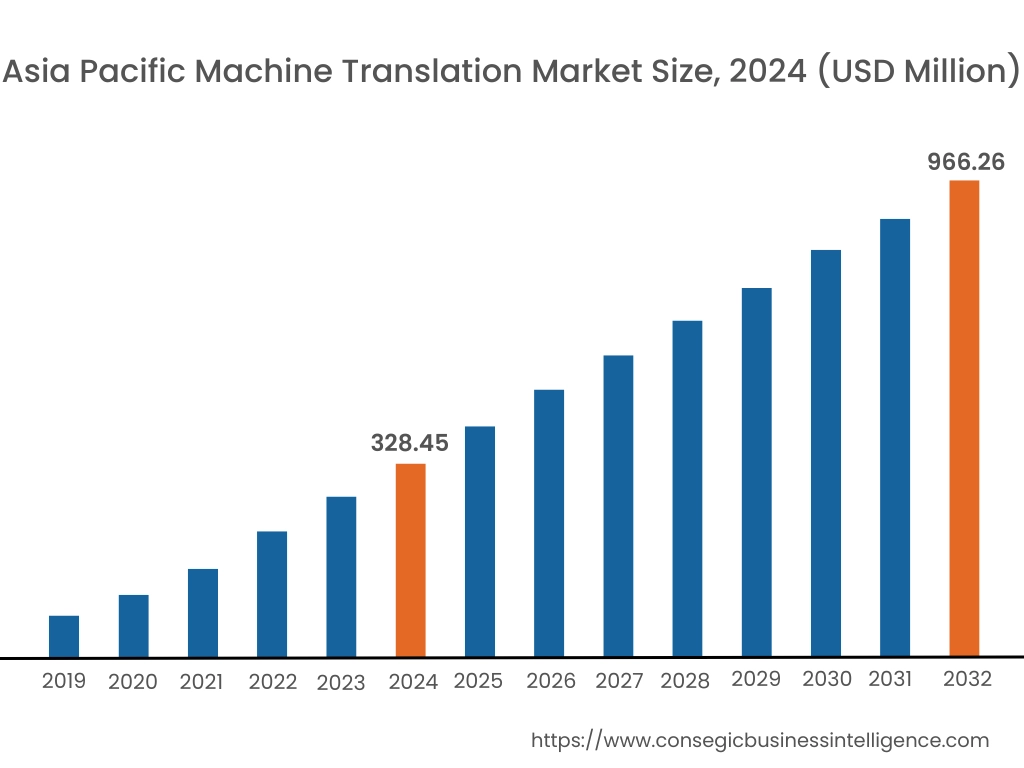
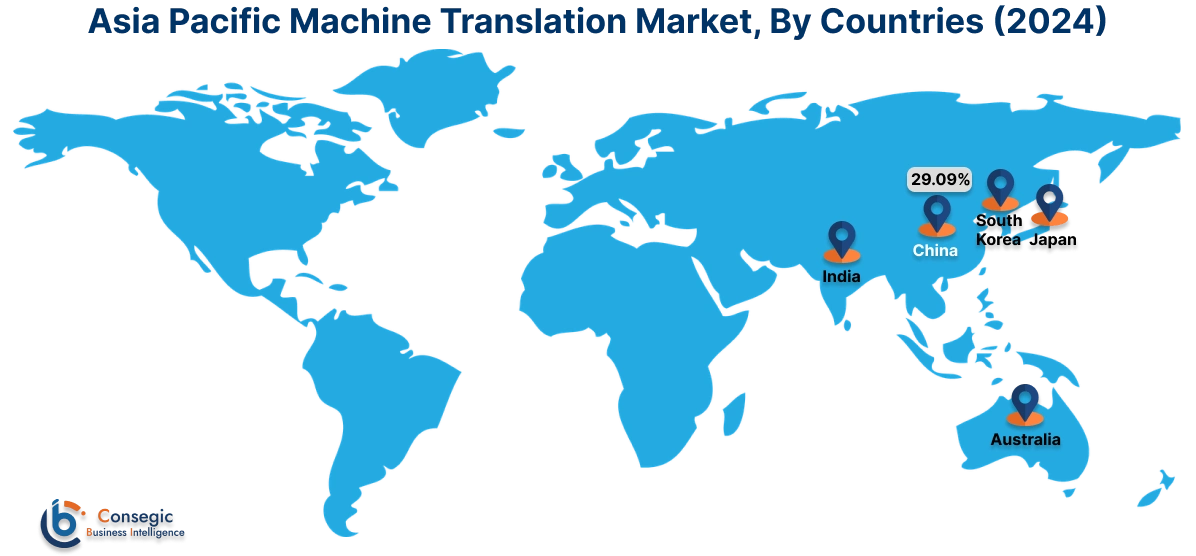
Asia Pacific region was valued at USD 328.45 Million in 2024. Moreover, it is projected to grow by USD 369.66 Million in 2025 and reach over USD 966.26 Million by 2032. Out of this, China accounted for the maximum revenue share of 29.09%. The machine translation market analysis shows that the market in the region is growing due to rising usage of e-commerce platforms in rural areas. This leads to adoption of machine translating tools and techniques to provide clear communication and information in user preferred language.
- For instance, in November 2024, DIGITAL HEARTS Co., Ltd. launched its translation services powered by ELLA. The system is designed for games, using Asian languages including traditional Chinese, simplified Chinese, and Korean. Therefore, the analysis shows that the aforementioned factors are responsible for the market growth in Asia-Pacific region.
North America is estimated to reach over USD 1,250.85 Million by 2032 from a value of USD 441.07 Million in 2024 and is projected to grow by USD 494.88 Million in 2025. The market is primarily driven by factors including the well-established IT & telecommunications, military and defense, and healthcare industries that require translation for efficient communication with other countries.
- For instance, in September 2024, NVIDIA, a U.S based company, launched translation AI and multilingual speech microservices. The services allow developers to integrate generative AI into apps for MT in 30 languages, with transcription and text-to-speech competencies. Thus, the aforementioned factors are driving the machine translation market expansion in North America.
The machine translation market analysis shows that in Europe, the market is growing due to rising travel and tourism industry in the region, leading to adoption of machine translating tools and techniques for real-time translation allowing travelers to seamlessly communicate with the local people. In Latin America, Middle East and Africa, the market is primarily growing due to factors including rising need for translating content, improving communication, and increasing productivity. Thus, the aforementioned factors and trends are responsible for the machine translation market expansion in the region.
Top Key Players and Market Share Insights:
The machine translation industry is highly competitive with major players providing solutions and services to the national and international markets. Key players are adopting several strategies in research and development (R&D), product innovation, and end-user launches to hold a strong position in the global machine translation market. Key players in the machine translation industry include -
- IBM Corporation (US)
- DeepL SE (Germany)
- CSOFT International Inc. (US)
- Omniscien Technologies Inc. (Singapore)
- SDL PLC (UK)
- Babylon Software Ltd. (Israel)
- Microsoft Corporation (US)
- Honyaku Center Inc. (Japan)
- Lionbridge Technologies Inc. (US)
- Cloudwords Inc. (US)
Recent Industry Developments :
Product Launch:
- In September 2024, DeepL launched AI glossary generator for business translations. The solution allows users to create custom translation glossaries with a file upload, in turn reducing the need for manual work.
Machine Translation Market Report Insights:
| Report Attributes | Report Details |
| Study Timeline | 2019-2032 |
| Market Size in 2032 | USD 3,462.07 Million |
| CAGR (2025-2032) | 15.6% |
| By Technology Type |
|
| By End-Use |
|
| By Region |
|
| Key Players |
|
| North America | U.S. Canada Mexico |
| Europe | U.K. Germany France Spain Italy Russia Benelux Rest of Europe |
| APAC | China South Korea Japan India Australia ASEAN Rest of Asia-Pacific |
| Middle East and Africa | GCC Turkey South Africa Rest of MEA |
| LATAM | Brazil Argentina Chile Rest of LATAM |
| Report Coverage |
|
Key Questions Answered in the Report
How big is the machine translation market? −
Machine Translation Market size is estimated to reach over USD 3,462.07 Million by 2032 from a value of USD 1,214.86 Million in 2024 and is projected to grow by USD 1,363.63 Million in 2025, growing at a CAGR of 15.6% from 2025 to 2032.
What are the major segments covered in the machine translation market report? +
The segments covered in the report are technology type, end use, and region.
Which region holds the largest revenue share in 2024 in the machine translation market? +
North America holds the largest revenue share in the machine translation market in 2024.
Who are the major key players in the machine translation market? +
The major key players in the market are IBM Corporation (US), DeepL SE (Germany), Babylon Software Ltd. (Israel), Microsoft Corporation (US), Honyaku Center Inc. (Japan), Lionbridge Technologies Inc. (US), Cloudwords Inc. (US), CSOFT International Inc. (US), Omniscien Technologies Inc. (Singapore), SDL PLC (UK), and others.
Overview
Reputation & Certifications


Our Services
- Market Intelligence & Forecasting
- Custom Research Solutions
- Market Entry Strategy
- Competitive Intelligence
- Customer Insights
- Industry Innovation Analysis
- Investment Advisory