Jump to Content
Private 5g Network Market - Size, Share, Industry Trends, and Forecasts (2025-2035)
Private 5g Network Market:
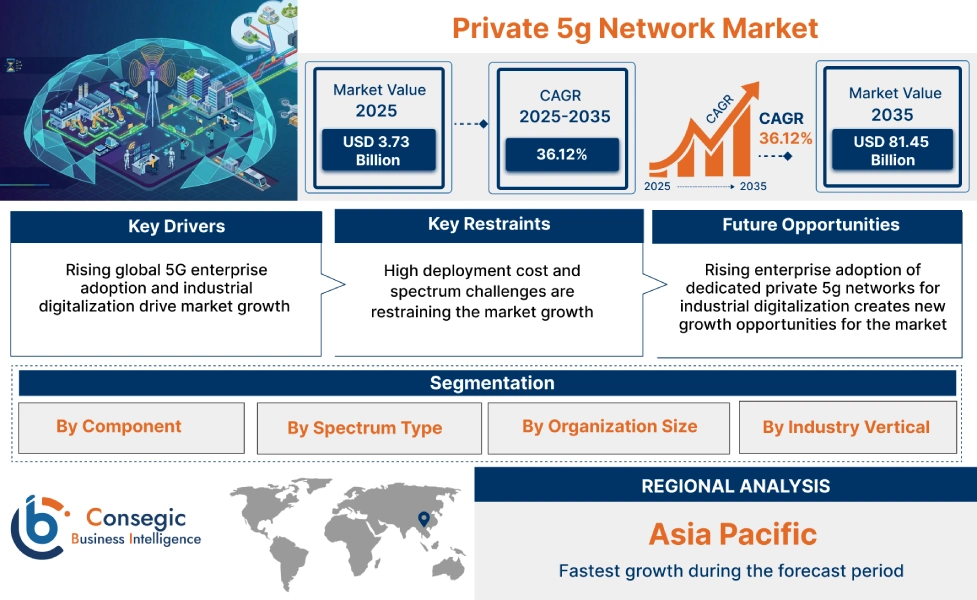
Private 5g Network Market size is estimated to reach over USD 81.45 Billion by 2035 from a value of USD 2.74 Billion in 2024 and is projected to grow by USD 3.73 Billion in 2025, growing at a CAGR of 36.12% from 2025 to 2035
Private 5g Network Market Scope & Overview:
Private 5G networks are cellular networks that are specifically designed for certain enterprises or industrial facilities to provide secure, high-speed, and low-latency connectivity. These networks are used for applications such as industrial automation, smart manufacturing, remote control, and real-time data analysis. They provide better control, security, and performance than public networks.
The market is growing due to the growing adoption of Industry 4.0 technology and the need for secure enterprise connectivity. The manufacturing, energy, logistics, and mining industries are adopting private networks to enhance their efficiency. Edge computing and IoT technology are further fueling the growth of the market.
Market Size & Forecast
- 2024 Market Size : USD 2.74 Billion
- 2025 Market Size : USD 3.73 Billion
- 2035 Evaluate Market Size : USD 81.45 Billion
- CAGR (2025-2035) : 36.12%
How is AI Impacting the Private 5g Network Market?
AI uses machine learning to analyze network traffic patterns and optimize spectrum allocation, which improves network performance and reduces latency in private 5G deployments. Also, AI helps enterprises monitor network health in real time by detecting anomalies and potential security threats, which enhances reliability and data protection. In addition, AI enables predictive maintenance of the network infrastructure by detecting a degradation in performance, which helps to minimize downtime. In addition, AI can be used for autonomous network management through intelligent orchestration and dynamic resource allocation, which can be used to improve efficiency in industrial and enterprise environments.
Regional Analysis:
North America, Europe, Asia Pacific, the Middle East and Africa, and Latin America are the regions of coverage.
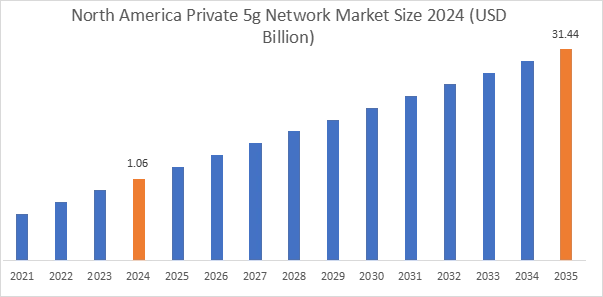
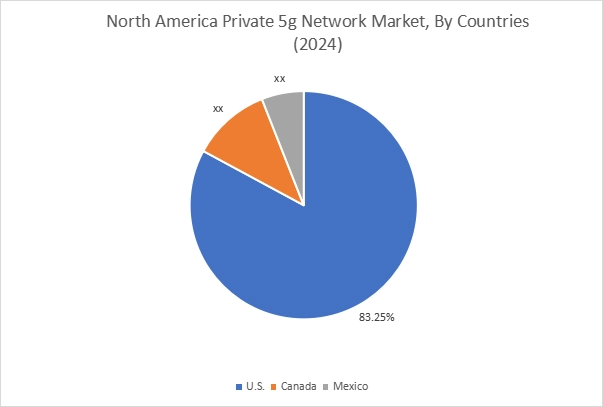
In 2024, the North America region has the largest market share of 38.60% and is valued at USD 1.06 Billion, and is expected to reach USD 31.44 Billion by 2035. In the North America region, the U.S. has the largest market share of 83.25% in the base year of 2024. The North America private 5G network market is driven by the exclusive use of the Citizens Broadband Radio Service (CBRS) spectrum and the increasing investment of enterprises in the U.S. in industrial connectivity. The manufacturing facilities, ports, and energy companies are adopting private 5G networks to support automation, predictive maintenance, and secure wireless communication.
- For instance, in September 2025, Hitachi Rail, in collaboration with Ericsson and GlobalLogic, rolled out a private 5G network at the digital factory of Hitachi Rail in Maryland, U.S. The roll-out of the private 5G network enables real-time monitoring of production, as well as connected devices, and enhances efficiency in the production process, thus marking the first instance of private 5G infrastructure deployment at the enterprise level in North America.
In Asia Pacific, the private 5G network market is projected to witness the fastest growth over the forecast period. Asia Pacific private 5G network market growth is supported by large-scale industrial automation, smart manufacturing programs, and port digitization projects across China, Japan, and South Korea. Organizations in the automotive, electronics, mining, and logistics sectors are implementing private 5G networks for low-latency communication, robotics control, and real-time data analytics, thereby driving market growth.
- For example, In January 2024, NEC Corporation expanded the commercial use of its private 5G solutions for enterprises in Japan, with a focus on the manufacturing, logistics, and smart factory sectors. NEC has been actively supplying standalone private 5G systems to industrial facilities to support automation and low-latency communication use cases.
The Europe private 5G network market is fueled by the spectrum allocation reserved for industry use, smart factory plans in Germany, and port automation plans in Northern Europe. Companies are incorporating private networks into their manufacturing and energy business processes to enhance control, availability, and data security.
Latin America private 5G network market is fueled by industrial transformation plans and the need for secure enterprise communication in Brazil and Chile. Mining, oil and gas, and port operations are evaluating dedicated network deployments to improve site-level communication and monitoring capabilities.
The Middle East & Africa private 5G network market is driven by smart city initiatives, industrial diversification plans, and digital oilfield implementations in the UAE and Saudi Arabia. Enterprises are adopting private 5G networks to enhance automation, surveillance, and critical communication networks.
Private 5g Network Market Segmental Analysis:
By Component:
Based on component, the private 5G network market is segmented into hardware, software, and services.
Trends in the Component:
- The increasing demand for secure and low-latency connectivity in industrial environments is driving investment in 5G hardware infrastructure.
- The growing need for network management, orchestration, and security is fueling the adoption of private 5G software platforms.
Hardware accounted for the largest revenue share in the year 2024.
- The hardware consists of small cells, radio units, core network equipment, routers, and antennas. These are the basic components of a private 5G network.
- Enterprises with critical business operations prefer the use of licensed spectrum. This improves the network performance and security.
- In addition, enterprises with high capital budgets can afford the entire 5G infrastructure.
- Thus, as per the private 5G network market analysis, strong infrastructure requirements are driving dominance of the hardware segment.
Services segment is anticipated to register the fastest CAGR during the forecast period.
- Services include consulting, integration, deployment, and maintenance support. These services ensure smooth network implementation.
- Enterprises require technical expertise to design and optimize private 5G networks. This supports segment growth.
- Additionally, the increasing complexity of network configurations is driving demand for managed services.
- Further, ongoing monitoring and security management needs are accelerating service adoption.
- Therefore, as per the market analysis, rising demand for expert support and network optimization is expected to boost the services segment during the forecast period.
By Spectrum Type:
Based on spectrum type, the private 5G network market is segmented into licensed spectrum, unlicensed spectrum, and shared spectrum.
Trends in the Spectrum Type:
- The increasing need for secure and interference-free connectivity is driving demand for licensed spectrum.
- The growing availability of shared spectrum models is encouraging enterprises to deploy private 5G networks at lower cost.
Licensed Spectrum accounted for the largest revenue share in the year 2024.
- Licensed spectrum offers exclusive frequency channels for use by enterprises. This ensures high reliability and no interference.
- Enterprises with mission-critical operations favor the use of licensed spectrum. This enhances network performance and security.
- Moreover, government backing for enterprise spectrum allocation is fueling the growth of this market.
- Moreover, industries such as manufacturing, energy, and defense demand reliable and high-capacity connectivity.
- Thus, as per the private 5G network market analysis, high reliability and security advantages are driving dominance of licensed spectrum.
Shared Spectrum is anticipated to register the fastest CAGR during the forecast period.
- Shared spectrum allows multiple users to access spectrum under regulated frameworks. It reduces deployment costs.
- This business model is ideal for enterprises that want flexible and cost-effective private 5G networks.
- Additionally, increasing government initiatives to open mid-band spectrum for enterprise use are supporting growth.
- Further, shared spectrum enables faster deployment compared to fully licensed bands.
- Therefore, as per the market analysis, cost efficiency and regulatory support are expected to boost the shared spectrum segment during the forecast period.
By Organization Size:
Based on organization size, the private 5G network market is segmented into large enterprises and small & medium enterprises.
Trends in the Organization Size:
- The growing investment capability in large enterprises is propelling the early adoption of private 5G networks.
- The growing availability of managed and subscription-based 5G solutions is supporting adoption among small & medium enterprises.
Large Enterprises accounted for the largest revenue share in the year 2024.
- Large enterprises use private 5G networks to enable automation, robotics, and real-time data analytics. These use cases demand low latency and high reliability.
- They have large facilities like factories, seaports, and warehouses. This further boosts the demand for dedicated connectivity.
- Moreover, large capital budgets enable the investment in complete 5G infrastructure.
- In addition, the growing emphasis on digital transformation and Industry 4.0 projects is fueling the segment growth.
- Thus, as per the private 5G network market analysis, high infrastructure demand and investment capacity are driving dominance of large enterprises.
Small & Medium Enterprises are anticipated to register the fastest CAGR during the forecast period.
- SMEs are increasingly adopting the use of private 5G. This improves the efficiency of the business operations.
- The fact that cloud-managed and scalable solutions are available has lessened the initial investment burden.
- In addition, the growing awareness of secure enterprise networks is also fueling adoption.
- Moreover, telecom operators are providing flexible deployment options for smaller enterprises.
- Therefore, as per the market analysis, affordability and scalability are expected to boost adoption among small & medium enterprises during the forecast period.
By Industry Vertical:
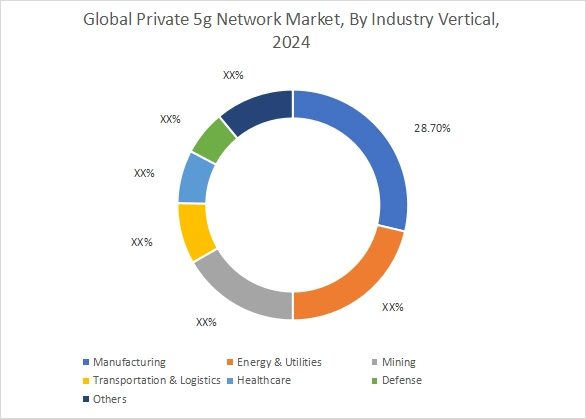
Based on industry vertical, the private 5G network market is segmented into manufacturing, energy & utilities, mining, transportation & logistics, healthcare, defense, and others.
Trends in the Industry Vertical:
- The increasing use of automation and smart factory solutions is driving the adoption rate in the manufacturing sector.
- The growing need for secure and reliable communication in critical infrastructure is also fueling adoption in the energy, mining, and defense industries.
Manufacturing accounted for the largest revenue share of 28.7% in the year 2024.
- Manufacturing facilities require low-latency and high-speed connectivity. This supports robotics and real-time monitoring.
- Private 5G enables seamless communication between machines and control systems. It improves operational efficiency.
- Moreover, the increasing adoption of Industry 4.0 projects is also accelerating the deployment of private 5G networks in factories.
- Further, the requirement for data security and network control is also pushing the adoption of private networks among manufacturers.
- Thus, as per the private 5G network market analysis, increasing industrial automation is driving dominance of the manufacturing segment.
Mining is anticipated to register the fastest CAGR during the forecast period.
- Mining operations are often located in remote areas. They require reliable and wide-area connectivity.
- Private 5G supports autonomous vehicles and remote monitoring systems. This improves worker safety.
- Additionally, real-time data transmission helps in operational control and risk reduction.
- Further, increasing focus on digital transformation in mining is supporting segment growth.
- Therefore, as per the market analysis, rising adoption of automation and safety solutions is expected to boost the mining segment during the forecast period.
Private 5g Network Market Dynamics - (DRO):
Key Drivers:
Rising global 5G enterprise adoption and industrial digitalization drive market growth
The market for the private 5G network is growing as a result of the rising demand from enterprises for secure and high-performance connectivity. The manufacturing, energy, mining, and logistics sectors are adopting dedicated 5G networks to support automation, robotics, and real-time data processing. Such applications demand low latency, high bandwidth, and high network control, which cannot be ensured by public networks.
The industrial digital transformation is driving investment in private wireless infrastructure. Industries are using connected sensors, autonomous vehicles, and AI-based monitoring systems. This drives the need for reliable and localized 5G coverage in industrial environments.
- For example, according to the Ericsson Mobility Report (2024), the total number of 5G subscriptions worldwide is predicted to exceed 5.6 billion by 2029, which reveals the rapidly evolving 5G ecosystem that supports the development of enterprise and private networks.
Therefore, the trend of increasing adoption of 5G and digitalization in the industries is driving the investments in the private 5G network infrastructure.
Key Restraints:
High deployment cost and spectrum challenges are restraining the market growth
Private 5G networks require significant investments in infrastructure. The companies have to install small cells, core networks, and edge computing. The hardware, licensing, and maintenance costs are high. This makes it difficult for small and medium-sized businesses to adopt. Spectrum availability is another issue. Access to dedicated spectrum is region-dependent. Getting approval from the regulatory authority is a complex and time-consuming process. This leads to delays in deployment in many areas.
Therefore, high deployment cost and spectrum-related issues are restraining the private 5G network market expansion.
Future Opportunities:
Rising enterprise adoption of dedicated private 5g networks for industrial digitalization creates new growth opportunities for the market
The increasing need for secure, low-latency, and high-capacity connectivity is creating strong growth opportunities in the private 5G network market. Industry verticals such as manufacturing, logistics, and energy are embracing the use of private 5G networks to facilitate automation, robotics, real-time monitoring, and smart factory solutions. Organizations are choosing private networks to have better control over data, reliability, and security compared to public networks.
- For example, in February 2026, NTT DATA and Ericsson collaborated to accelerate the adoption of enterprise private 5G networks by combining Ericsson’s 5G solution with NTT DATA’s integration and managed service know-how for industrial digital transformation projects.
Thus, the increasing enterprise shift toward dedicated 5G infrastructure for digital operations is expected to drive new network deployments, thereby promoting future opportunities in the private 5G network market during the forecast period.
Top Key Players & Market Share Insights:
The market for private 5G networks is relatively competitive, with the leading telecommunication equipment suppliers and technology companies providing secure and customized connectivity solutions to organizations in the domestic as well as global markets. The major players are adopting a variety of methods in research and development, innovation in networks, collaborations, and pilots to maintain a competitive advantage in the market for private 5G networks.
The companies are working on mission-critical connectivity, low-latency communications, industrial automation integration, and scalable enterprise networks. The key players operating in the private 5G network market are:
- Huawei Technologies Co., Ltd. (China)
- Ericsson (Sweden)
- Nokia Corporation (Finland)
- Samsung Electronics Co., Ltd. (South Korea)
- Cisco Systems, Inc. (U.S.)
- Qualcomm Incorporated (U.S.)
- ZTE Corporation (China)
- NEC Corporation (Japan)
- Fujitsu Limited (Japan)
- Hewlett Packard Enterprise (U.S.)
Recent Industry Developments:
- In October 2024, NEC Corporation has announced the successful implementation of its private 5G system to enable secure and high-speed enterprise networking for critical operations. The implementation has further enhanced NEC’s strengths in providing end-to-end private 5G network infrastructure for industrial transformation.
- In February 2025, Samsung Electronics and Hyundai Motor Company have successfully completed the world’s first RedCap trial on a private 5G network to improve smart manufacturing connectivity. The trial has shown simplified device design and lower power consumption, making private 5G more scalable in the industrial sector.
Private 5g Network Market Report Insights:
| Report Attributes | Report Details |
|---|---|
| Study Timeline | 2019-2035 |
| Market Size in 2035 (USD Billion) | USD 81.45 Billion |
| CAGR (2025-2035) | 36.12% |
| By Component |
|
| By Spectrum Type |
|
| By Organization Size |
|
| By Industry Vertical |
|
| By Region |
|
| Key Players |
|
| Report Coverage |
|
Key Questions Answered in the Report
How big is the private 5g network market? −
The private 5g network marketsize is estimated to reach over USD 81.45 Billion by 2035 from a value of USD 2.74 Billion in 2024 and is projected to grow by USD 3.73 Billion in 2025, growing at a CAGR of 36.12% from 2025 to 2035.
Which segmentation details are covered in the private 5G network report? +
The private 5G network report includes specific segmentation details for component, spectrum type, organization size, industry vertical, and regions.
Which is the fastest segment anticipated to impact the market growth? +
In the private 5G network market, the mining segment is anticipated to be the fastest-growing segment during the forecast period as private 5G supports autonomous vehicles and remote monitoring systems in mining operations.
Who are the major players in the private 5g network market? +
The key participants in the private 5g network marketare Huawei Technologies Co., Ltd. (China), Ericsson (Sweden), Nokia Corporation (Finland), Samsung Electronics Co., Ltd. (South Korea), Cisco Systems, Inc. (U.S.), Qualcomm Incorporated (U.S.), ZTE Corporation (China), NEC Corporation (Japan), Fujitsu Limited (Japan), Hewlett Packard Enterprise (U.S.), and others.
What are the key trends in the private 5g network market? +
The private 5G network market is being shaped by several key trends including rising enterprise demand for secure and low-latency connectivity, increasing integration with edge computing platforms, growing adoption in mission-critical industrial environments, and expanding regulatory support for private spectrum allocation.
Overview
Reputation & Certifications


Our Services
- Market Intelligence & Forecasting
- Custom Research Solutions
- Market Entry Strategy
- Competitive Intelligence
- Customer Insights
- Industry Innovation Analysis
- Investment Advisory