Jump to Content
Magneto Resistive Ram Market Size & Industry Share - Growth Trends & Forecasts (2026 - 2034)
Magneto Resistive RAM Market Size:
The Magneto Resistive RAM market size was valued at 2,582.38 (US$M) in 2025 and is projected to grow from 3,646.33 (US$M) in 2026 to 57,614.69 (US$M) by 2034, at a CAGR of 41.2% from 2026 to 2034, according to a recent report from Consegic Business Intelligence.
Magneto Resistive RAM Market Scope & Overview:
Magneto Resistive RAM is a non-volatile memory that utilizes a magneto-resistive effect to store data, where the resistance of material changes in response to an external magnetic field. It has the ability to retain data even when the power is switched off, making it a reliable option for applications that require data persistence. Additionally, it offers impressive speed for both read and write operations, often outperforming traditional flash memory. Moreover, it boasts higher endurance handling more write cycles before wearing out, this durability, combined with low power consumption makes it preferable for battery-operated devices and embedded systems. The aforementioned features of magneto-resistive RAM are major determinants for increasing their deployment in aerospace, automotive, robotics, and other industries.

Magneto Resistive RAM Market Dynamics - (DRO) :
Key Drivers:
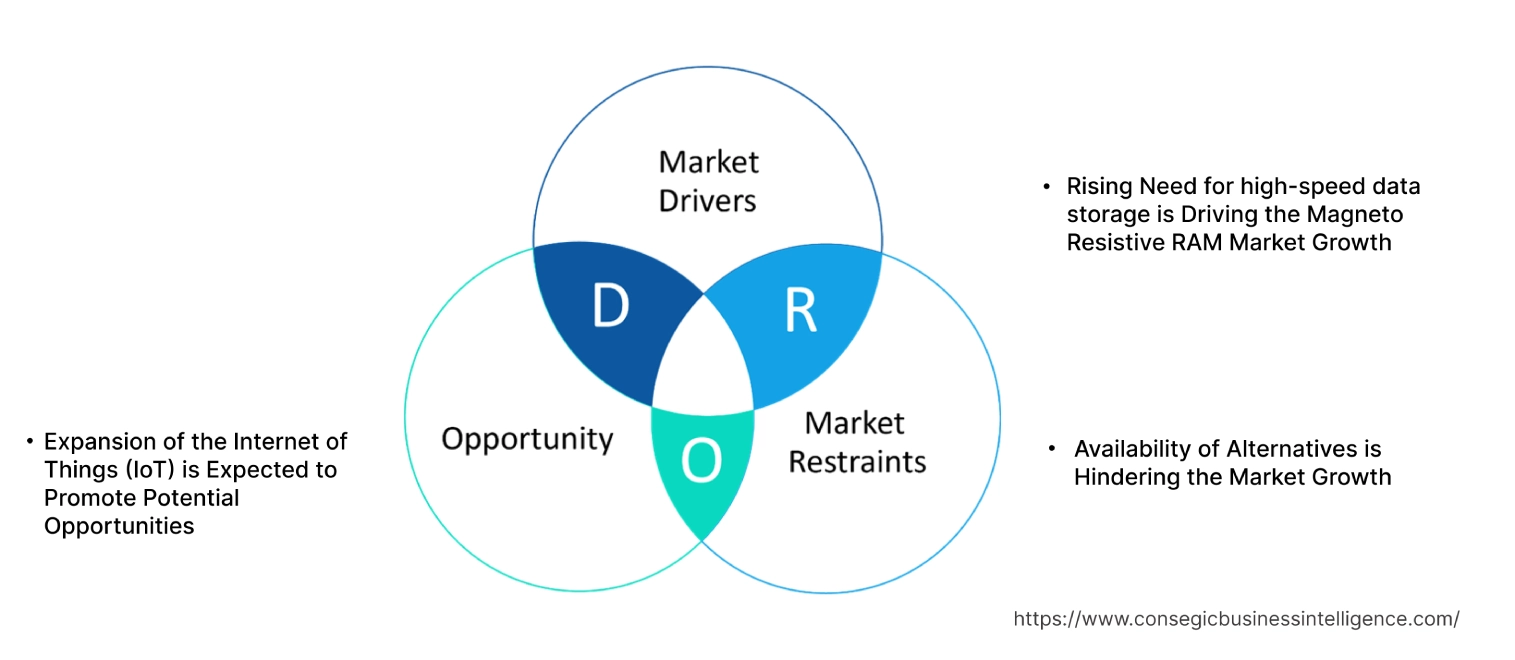
Rising Need for high-speed data storage is Driving the Magneto Resistive RAM Market Growth
As data-intensive applications proliferate across various industries, the demand for memory solutions that provide rapid access to large volumes of data has never been more critical. Applications including artificial intelligence, machine learning, real-time analytics, and high-performance computing require memory systems that can handle vast amounts of data quickly. MRAM addresses this challenge by offering faster read and write speeds, significantly reducing the time needed to access and process data. Additionally, it has the ability to operate at high speeds while maintaining data integrity ensuring that critical applications function seamlessly.
Key Restraints :
Availability of Alternatives is Hindering the Market Growth
The presence of alternative memory technologies poses a significant restraint to the growth of the magneto-resistive RAM market. Established options including Flash memory , EEPROM, FRAM, ReRAM, and DRAM are widely available to cater to various application needs. Traditional memory solutions like DRAM and NAND flash memory are well-established, with extensive research, development, and deployment. Their mature supply chains and cost-effective production methods give them a competitive edge over MRAM. Additionally, ongoing advancements in existing memory technologies continue to enhance their performance and efficiency. Innovations such as 3D NAND, FRAM, and advanced DRAM designs can further diminish the attractiveness of MRAM as a viable alternative.
- In April 2024, Samsung announced enhancements to its V-NAND Flash Memory, emphasizing improved speed and efficiency, which could deter companies from considering magneto-resistive RAM for similar applications.
Hence, ongoing advancements in the alternative memory solution are posing significant restraints for the magneto resistive RAM market demand.
Future Opportunities :
Expansion of the Internet of Things (IoT) is Expected to Promote Potential Opportunities
The expansion of the Internet of Things (IoT) presents a significant opportunity for magneto-resistive RAM, driven by the increasing prevalence of connected devices across various sectors. IoT devices require fast data processing capabilities to manage the large volumes of data they generate and transmit. Additionally, it offers rapid read and write speeds, enabling real-time processing of data and ensuring timely responses in applications including smart home automation and industrial control systems. Moreover, industrial sensors used in manufacturing or logistics must withstand vibrations, temperature fluctuations, and other harsh conditions. The resilience of MRAM ensures that data integrity is maintained, contributing to the overall reliability of these systems.
- In May 2022, Everspin Technologies, Inc. launched EMxxLX into its portfolio of xSPI products. It is a high-performance Spin-transfer Torque (SST) Magneto-resistive RAM persistent memory solution. It provides densities ranging from 8Mbit up to 64Mbit, specifically designed for use in industrial IoT to withstand industrial temperature and embedded systems applications.
Furthermore, MRAM's unique combination of speed, efficiency, and durability positions it as an essential component for future IoT applications, enabling seamless data collection and analysis across a multitude of devices. Therefore, the aforementioned features of these RAMs in the future in industrial IoT are expected to proliferate the magneto resistive RAM market opportunities.
Magneto Resistive RAM Market Segmental Analysis :
By Type:
Based on type, the market is segmented into Toggle MRAM and Spin-Transfer Torque MRAM (STT-MRAM).
The STT-MRAM segment accounted for the largest revenue share and the fastest CAGR during the forecasted period in 2023.
The segment is further categorized into breast augmentation, liposuction, eyelid surgery, and others.
- Spin-Transfer Torque MRAM (STT-MRAM) is a newer, more advanced type of MRAM technology that offers significant advantages in terms of speed, endurance, and scalability compared to traditional Toggle MRAM.
- STT-MRAM utilizes spin-polarized current for writing data, enabling higher efficiency and lower power consumption.
- The increasing demand for non-volatile memory solutions in data-intensive applications such as enterprise storage, cloud computing, and automotive systems is driving the adoption of STT-MRAM.
- Additionally, the scalability of STT-MRAM makes it suitable for integration into next-generation memory architectures, supporting its dominant position in the market.
- For instance, Renesas Electronics Corporation introduced the M1016204 series, a high-performance non-volatile SST MRAM. It features a high-speed Quad SPI interface up to 108MHz, superior reliability, more than 20-year data retention, and operates at 1.8V from -40oC to + 150oC industrial temperature.
- Thus, as per the analysis, SST-MRAM's superior performance and versatility are driving and anticipated to fuel the magneto resistive RAM market trends.
By Offering:
Based on the offering, the market is segmented into stand-alone and embedded solutions.
The stand-alone MRAM segment accounted for the largest revenue share of the total magneto resistive RAM market share in 2023.
- Stand-alone MRAM solutions are widely used in enterprise storage, automotive, and industrial applications due to their high-speed data retention, non-volatility, and endurance.
- These memory modules are often deployed in environments where fast, reliable, and persistent memory is required.
- The increasing need for high-performance memory in data centers, combined with the growing adoption of MRAM as a replacement for traditional DRAM and SRAM in critical applications, is driving the dominance of the stand-alone segment.
- Thus, the segmental trends analysis depicts that stand-alone MRAM dominates the market, driven by its extensive use in enterprise storage and automotive applications, where high-performance, non-volatile memory solutions are essential, boosting the magneto resistive RAM market demand.
The embedded MRAM segment is anticipated to register the fastest CAGR during the forecast period.
- Embedded MRAM is increasingly being integrated into system-on-chip (SoC) designs for consumer electronics and industrial applications, offering improved performance and reduced power consumption compared to conventional embedded memory options.
- The shift towards embedded non-volatile memory (eNVM) in semiconductor manufacturing, particularly for applications requiring high-speed data access and minimal power usage, is propelling the segment.
- The rise of IoT devices and the need for reliable, low-power memory in wearable technology further support the rapid adoption of embedded MRAM.
- For instance, in May 2023, NXP and TSMC collaborated to develop the first automotive 16nm FinFET-embedded MRAM. This technology successfully meets the stringent requirements of automotive applications, featuring one-million cycle endurance, support for solder reflow processes, and an impressive 20-year data retention at 150°C.
- Thus, the segmental trends analysis concludes that embedded MRAM is expected to grow rapidly due to its integration in advanced SoC designs, proliferating the magneto resistive RAM market trends.
By Application:
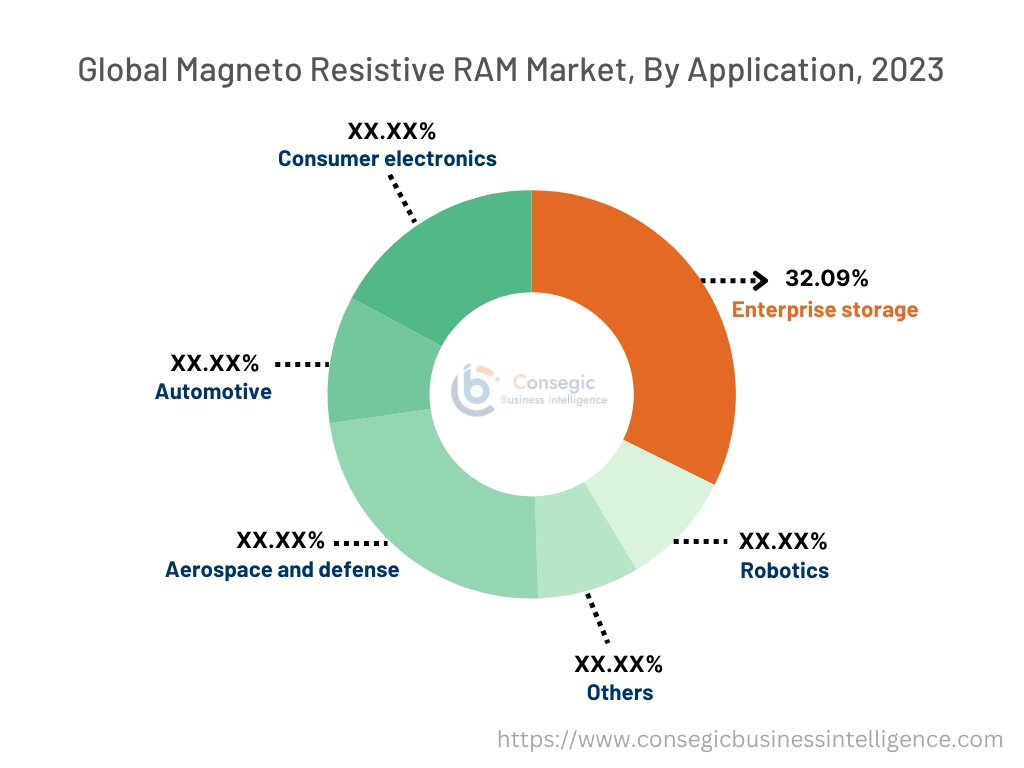
Based on application, the market is segmented into aerospace and defense, automotive, consumer electronics, enterprise storage, robotics, and others.
The enterprise storage segment accounted for the largest revenue share of 32.09% of the overall magneto resistive RAM market share in 2023.
- Enterprise storage systems demand high-speed, durable, and non-volatile memory solutions, making MRAM an ideal choice.
- As the volume of data generated by enterprises continues to grow exponentially, there is a strong need for memory technologies that can enhance storage performance while reducing power consumption.
- The deployment of MRAM in enterprise storage solutions, including solid-state drives (SSDs) and high-speed caches, supports its dominant position in this segment.
- Thus, the segmental trends depicts that enterprise storage leads the market, driven by the need for fast, durable, and energy-efficient memory solutions in data centers and cloud computing environments.
The automotive segment is anticipated to register the fastest CAGR during the forecast period.
- The automotive industry is increasingly adopting MRAM technology for advanced driver assistance systems (ADAS), infotainment, and electronic control units (ECUs) that require reliable, high-speed memory.
- The non-volatility and endurance of MRAM make it suitable for applications where data integrity and reliability are critical, especially in safety-related automotive systems.
- As the trend towards autonomous driving and connected vehicles accelerates, the demand for robust memory solutions like MRAM is expected to increase rapidly, supporting the growth of this segment.
- The automotive segment is expected to grow rapidly, driven by the increasing demand for reliable, high-speed memory solutions in ADAS, infotainment, and critical electronic control systems, boosting the magneto resistive RAM market opportunities.
Regional Analysis:
The regions covered are North America, Europe, Asia Pacific, the Middle East and Africa, and Latin America.
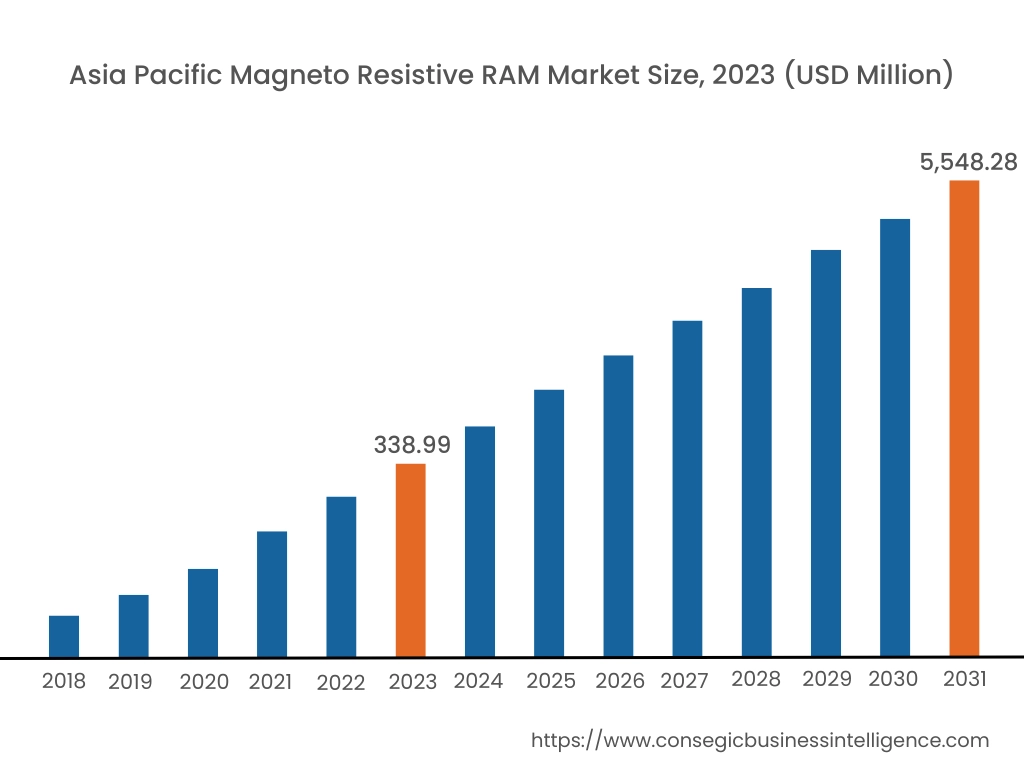
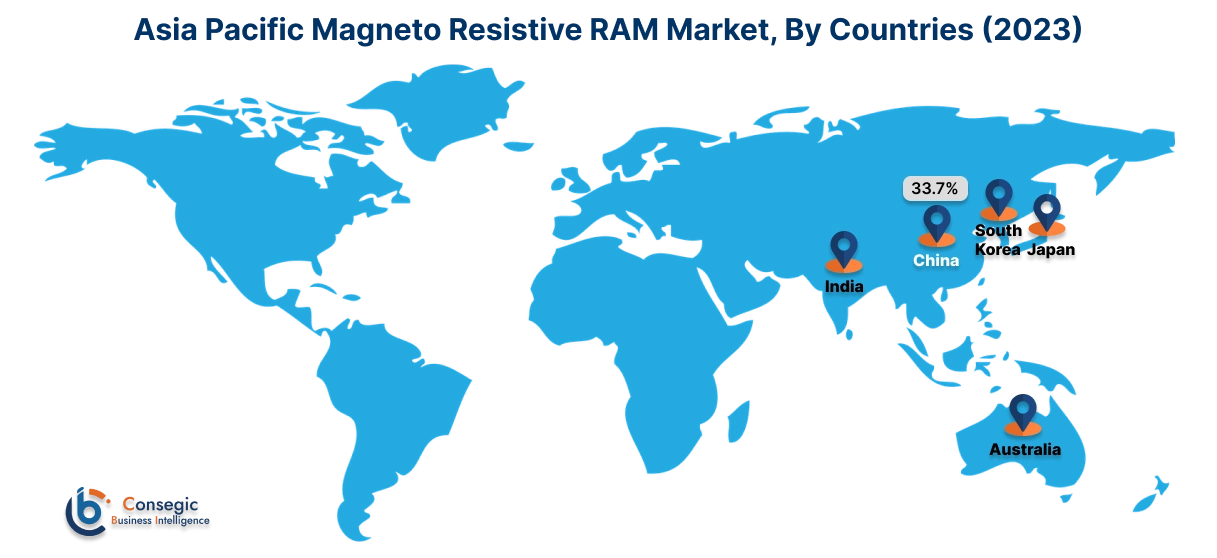
Asia Pacific region was valued at USD 338.99 Million in 2023. Moreover, it is projected to grow by USD 473.98 Million in 2024 and reach over USD 5,548.28 Million by 2031. Out of this, China accounted for the maximum revenue share of 33.7%. The Asia-Pacific region is anticipated to witness the highest growth rate in the MRAM market. Countries including Japan, South Korea, and China are at the forefront of semiconductor manufacturing and technological innovation. The rising usage of consumer electronics, along with the expansion of IoT devices, is driving the need for efficient memory solutions including SST-MRAM. Moreover, the push towards smart cities and automation in various industries enhances the growth prospects for MRAM in this region.
North America is estimated to reach over USD 7,062.76 Million by 2031 from a value of USD 444.46 Million in 2023 and is projected to grow by USD 619.89 Million in 2024. As per the magneto resistive RAM market analysis, North America currently holds the largest share of magneto-resistive RAM, driven by significant investments in research and development, as well as the presence of major technology companies. The United States and Canada, in particular, have seen a surge in demand for high-performance memory solutions in data centers, automotive applications, and advanced computing. Additionally, the growth of AI and IoT technologies is further propelling the adoption of spin-transfer torque magneto-resistive RAM in various sectors, making the region a key player in MRAM advancements.
- In May 2021,Avalanche Technology and Falcon Electronics announced a distribution agreement. This agreement empowered Falcon to offer Avalanche's Space Grade spin-transfer torque magneto-resistive RAM product portfolio to its customers in North America. The lineup encompasses serial and parallel interface persistent memory devices.
The regional trends portray that Europe is experiencing substantial growth in the MRAM market, primarily due to the increasing focus on automotive technology and industrial automation. Countries including Germany and France are leading the way with innovations in automotive electronics and smart manufacturing systems.
In Latin America, the magneto resistive RAM market expansion is still in its nascent stages but shows promise due to increasing investments in technology infrastructure and digital transformation initiatives. Countries including Brazil and Mexico are gradually adopting advanced memory solutions in sectors such as telecommunications and consumer electronics.
Top Key Players & Market Share Insights:
The magneto resistive RAM market is highly competitive with major players providing non-volatile memory solutions to the national and international markets. Key players are adopting several strategies in research and development (R&D), product innovation, and end-user launches to hold a strong position in the global magneto resistive RAM market. Key players in the magneto resistive RAM industry include-
- Everspin Technologies, Inc. (USA)
- Infineon Technologies AG (Germany)
- Qualcomm Technologies, Inc. (US)
- Toshiba Corporation (Japan)
- NVE Corporation (USA)
- Micron Technology, Inc. (USA)
- ON Semiconductor Corporation (USA)
- Western Digital Corporation (USA)
- Avalanche Technology, Inc. (USA)
- Renesas Electronics Corporation (Japan)
- Semtech Corporation (USA)
- Fujitsu Limited (Japan)
- STMicroelectronics N.V. (Switzerland)
- IBM Corporation (USA)
- GlobalFoundries Inc. (USA)
Recent Industry Developments :
Product Developments:
- In February 2024, Renesas unveils an embedded STT-MRAM test chip with over 200 MHz random-read access and 10.4 MB/s write throughput, fabricated on a 22-nm process for high-performance MCUs. These advancements were showcased at ISSCC 2024, emphasizing MRAM's potential for IoT and AI applications.
- In January 2024, Everspin expands its industrial STT-MRAM EMxxLX family, introducing 4Mb to 64Mb densities, smaller packaging with 37% area savings, and an extended temperature range (-40°C to 105°C). Offering 400 MB/s bandwidth, it suits IoT, aerospace, medical, and more.
Partnerships & Collaborations:
- In August 2024, Everspin secured a $9.25M contract with Frontgrade Technologies to supply PERSYST MRAM technology for developing Strategic Radiation Hardened (SRH) eMRAM macros, aimed at advancing aerospace and defense electronics.
- In January 2024, ITRI and TSMC developed an advanced SOT-MRAM array chip with innovative computing-in-memory architecture, consuming just 1% of STT-MRAM's power. Presented at IEDM 2023, this technology enables 10-nanosecond speeds, ideal for AI, 5G, and HPC applications, strengthening Taiwan's semiconductor leadership.
Magneto Resistive RAM Market Report Insights :
| Report Attributes | Report Details |
| Study Timeline | 2021-2034 |
| Market Size in 2034 | USD 57,614.69 Million |
| CAGR (2026-2034) | 41.20% |
| Base Year | 2025 |
| By Type |
|
| By Offering |
|
| By Application |
|
| By Region |
|
| Key Players |
|
| North America | U.S. Canada Mexico |
| Europe | U.K. Germany France Spain Italy Russia Benelux Rest of Europe |
| APAC | China South Korea Japan India Australia ASEAN Rest of Asia-Pacific |
| Middle East and Africa | GCC Turkey South Africa Rest of MEA |
| LATAM | Brazil Argentina Chile Rest of LATAM |
| Report Coverage |
|
Key Questions Answered in the Report
How big is the Magneto Resistive RAM Market? −
In 2023, the Magneto Resistive RAM market was USD 1,298.27 million.
What will be the potential market valuation for the Magneto Resistive RAM by 2031? +
In 2031, the market size of Magneto Resistive RAM market is expected to reach USD 20,465.82 million.
What are the segments covered in the Magneto Resistive RAM market report? +
Their type, offering, and end users are the segments covered in this report.
Who are the major players in the Magneto Resistive RAM market? +
Everspin Technologies, Inc. (USA), Infineon Technologies AG (Germany), Avalanche Technology, Inc. (USA), Renesas Electronics Corporation (Japan), Qualcomm Technologies, Inc. (US), Toshiba Corporation (Japan), NVE Corporation (USA), Semtech Corporation (USA), Fujitsu Limited (Japan), STMicroelectronics N.V. (Switzerland), and Micron Technology, Inc. (USA) are the major players in the Magneto Resistive RAM market.
Overview
Reputation & Certifications


Our Services
- Market Intelligence & Forecasting
- Custom Research Solutions
- Market Entry Strategy
- Competitive Intelligence
- Customer Insights
- Industry Innovation Analysis
- Investment Advisory