Jump to Content
Mandelic Acid Market Size, Demand & Strategic Outlook by Type, Application, Distribution Channel & Region | (2026 - 2034)
Mandelic Acid Market Size:
According to Consegic Business Intelligence, the mandelic acid market size was valued at USD 360.14 Million in 2025, and it is projected to grow from USD 412.36 Million in 2026 to USD 1218.20 Million by 2034, with a CAGR of 14.5% during the forecast period (2026-2034).
Mandelic Acid Market Scope & Overview:
The mandelic acid is a type of alpha hydroxy acid (AHA) which is derived from bitter almonds. It is a white crystalline solid that is soluble in water and polar organic solvents. It has different types based on molecular weight such as DL type, D type, and L type. This acid offers several advantages such as skin exfoliation, hyperpigmentation reduction, and anti-inflammation. Due to these advantages, mandelic acid is used in various end-use industries such as pharmaceuticals, cosmetics & personal care, food & beverages, chemical, and others. This acid is distributed through direct and indirect sales channels to drug manufacturers, cosmetic companies, and food processing companies.

What Are the Emerging Trends in the Mandelic Acid Market?
Growing Preference for Gentle and Barrier-Friendly Chemical Exfoliants
Consumer demand is shifting toward skincare products that deliver visible results without compromising skin health, driving the adoption of mandelic acid in cosmetic formulations. Due to its larger molecular structure, mandelic acid penetrates the skin more gradually than many other alpha hydroxy acids (AHAs), making it suitable for sensitive, acne-prone, and hyperpigmentation-prone skin. This trend aligns with the broader industry focus on maintaining the skin barrier while providing effective exfoliation. Manufacturers are increasingly incorporating mandelic acid into serums, toners, peels, and creams to meet growing demand for low-irritation skincare solutions. Regulatory guidance from the U.S. Food and Drug Administration (FDA) regarding the safe use and labeling of AHA-containing cosmetics is also encouraging the development of consumer-friendly formulations that emphasize both efficacy and safety.
Increasing Use of Mandelic Acid in Multi-Functional Acne and Pigmentation Solutions
The market is witnessing growing demand for skincare products that address multiple concerns with a single active ingredient. Mandelic acid is gaining wider acceptance in formulations designed to treat acne, post-inflammatory hyperpigmentation, uneven skin tone, and early signs of aging simultaneously. Its exfoliating and antibacterial properties allow manufacturers to develop products that improve skin texture while minimizing irritation compared to stronger chemical exfoliants. As ingredient-conscious consumers increasingly seek clinically supported skincare solutions, cosmetic brands are expanding portfolios featuring mandelic acid across both professional dermatology treatments and over-the-counter skincare products. This trend continues to strengthen as consumers prioritize scientifically validated ingredients with broad therapeutic benefits.
Advancements in Clean, Science-Backed, and Sustainable Cosmetic Formulations
Innovation in cosmetic formulation is increasingly centered on combining proven efficacy with sustainability and regulatory compliance. Manufacturers are investing in evidence-based ingredients that support clean-label product development while meeting evolving consumer expectations for environmentally responsible skincare. Mandelic acid, commonly derived from bitter almonds, aligns well with this shift due to its established safety profile and compatibility with modern skin barrier-focused formulations. Ongoing research into sustainable cosmetic ingredients and formulation technologies is encouraging companies to combine mandelic acid with hydrating, barrier-supporting, and naturally derived ingredients to develop next-generation skincare products that deliver improved performance without increasing skin sensitivity.
Mandelic Acid Market Dynamics - (DRO) :

Mandelic Acid Market Key Drivers:
The High Prevalence of Rosacea is Driving Market Growth
Rosacea is a common skin condition that causes flushing or long-term redness on the face. The mandelic acid is widely incorporated in the treatment of rosacea due to its skin hydrating and exfoliating properties. It reduces visible redness and flushing associated with rosacea flare-ups. The cases of rosacea is high due to hormonal changes, unhealthy lifestyle, pollution and other factors further driving the market.
- According to a study conducted by Pierre Fabre Laboratories, the global prevalence of rosacea is 5% in 2024. This high prevalence of rosacea is driving the use of this acid in the treatment to improve skin hydration and exfoliation.
Thus, the high prevalence of rosacea is leading to market expansion.
Rising Adoption in Food Processing Sector is Creating Mandelic Acid Market Demand
In the food processing sector, mandelic acid is used as a food additive and preservative. It also expands shelf-life in food products due to its antifungal and antimicrobial properties. The food processing sector is expanding due to the rising global population and increasing awareness of nutrition further driving market growth.
- According to Ministry of Food Processing Industries, the food processing sector is expanded at an average annual growth rate (AAGR) of around 7.26% from 2015 to 2022 in India. This growing food processing sector is driving the use of mandelic acid to expand the shelf-life in food products.
Thus, rising adoption in the food processing sector is creating market demand.
Mandelic Acid Industry Restraints:
Growing Commercialization of Alternatives is Constraining Market Growth
The commercialization of alternatives such as salicylic acid, glycolic acid amongst others is growing. They provide similar functions to that of mandelic acid. Salicylic acid is widely used in cosmetics, pharmaceuticals and food products due to its lower production costs and greater availability. Furthermore, glycolic acid is preferred in cosmetics due to better thickening and moisturizing properties, further reducing reliance. Additionally, other exfoliating agents such as alpha arbutin and azelaic acid are widely used in skincare products due to their deeper skin penetration ability. Hence, the growing commercialization of alternatives is constraining market demand due to low cost and greater availability.
Emerging Opportunities in the Mandelic Acid Market:
New Product Innovations are Expected to Create Market Opportunities
Product innovations are increasing the applicability of mandelic acid. It includes face cream and body wash. Companies are widely adopting this acid in their face creams due to its antibacterial properties. The new range of bodywash offered by the companies also contains this acid due to its gentle exfoliating properties. Moreover, companies are also incorporating this acid in their daily skincare products.
- In 2024, Cetaphil launched skincare products range including cleanser, lotion and cream. These products include mandelic acid, gluconolactone and other ingredients for daily exfoliation. The improvement in skin tone and retention of skin moisture in sensitive skin will further boost the adoption of these products.
Thus, product innovations in daily skincare products are expected to create mandelic acid industry opportunities.
Mandelic Acid Market Segmental Insights:
Type Insights:
Based on type, the market is categorized into DL type, D type, and L type.
Trends in Type:
- According to mandelic acid market trends, DL type is extensively used in cosmetics to promote skin renewal.
- The adoption of L type is growing in the production of chiral drug as per market trends.
The DL type segment accounted for the largest market share in the year 2024.
- The DL type is a racemic mixture containing equal amounts of the D and L enantiomers of mandelic acid.
- It offers advantages such as balanced performance, cost-effectiveness and greater availability.
- It is widely used in cosmetics to promote skin renewal, to improve skin texture, and to treat conditions such as acne and hyperpigmentation.
- Furthermore, increase in disposable income, rising influence of social media, and focus on self-care is growing. This is leading to increased consumption of cosmetic products.
- For instance, according to CBI Ministry of Foreign Affairs, the retail sales of cosmetic products wherein DL type is one the most preferred acid as an ingredient, increased by 9% in Europe in 2023 as compared to the year 2022. This is driving the use of DL type in cosmetics to improve skin condition.
- Hence, as the consumption of cosmetic products is growing, it is inturn driving the segment.
The L type segment is expected to grow at the fastest CAGR over the forecast period.
- The L-type mandelic acid has a larger molecular size compared to other types and offers gentle exploitation on the skin.
- It works by increasing cell turnover which reduces the appearance of acne as well as skin damage.
- This type is also used in chiral drug synthesis to enhance drug efficacy and lower side effects.
- Furthermore, focus on patient safety and need for better therapeutic drugs is growing. To cater for this, pharmaceutical companies are incorporating L-type in chiral drug synthesis to enhance drug efficacy.
- Hence, as production of chiral drug is growing, the need for L-type mandelic acid to lower drug side effects is also increasing. This will drive the segment for the forecasted years.
End-User Analysis :
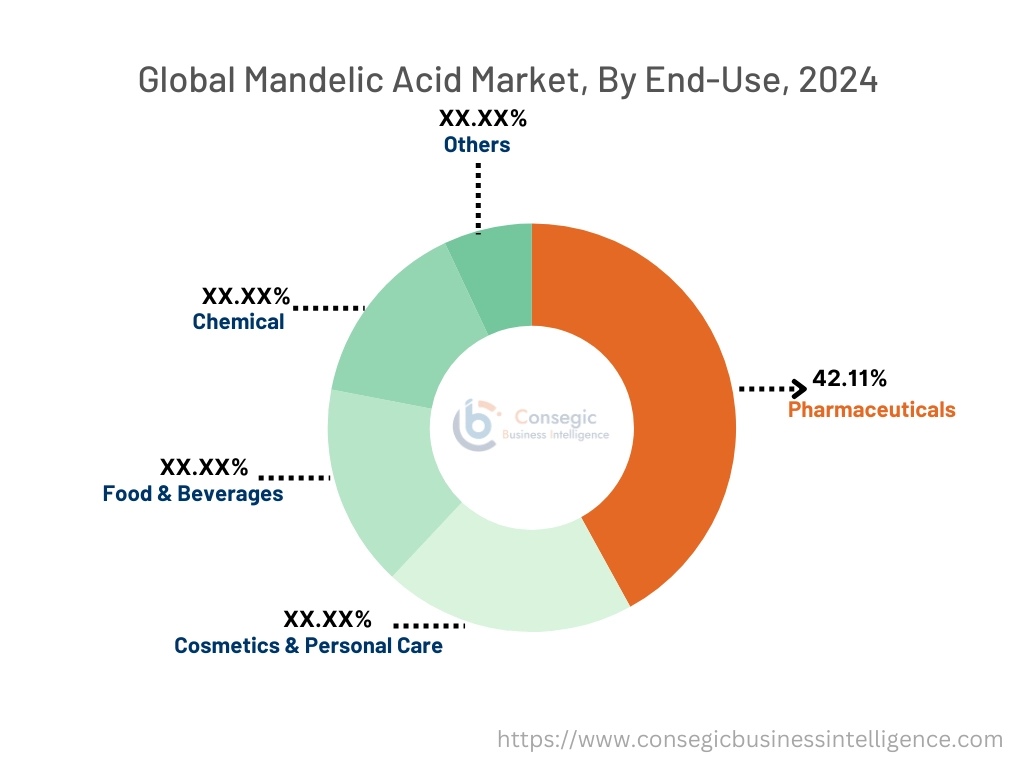
Based on end-use, the market is categorized into pharmaceuticals, cosmetics & personal care, food & beverages, chemical, and others.
Trends in End-Use:
- As per mandelic acid industry trends, the acid is widely used in the drug treatment of acne vulgaris due to its antimicrobial properties.
- The use of mandelic acid is growing in clean beauty products to provide gentle exfoliation as per market trends.
The pharmaceuticals segment accounted for the largest market share of 42.11% in the year 2024.
- In pharmaceuticals, mandelic acid is widely used as a resolving agent in the production of cardiovascular medications and antibiotics.
- It is also used in the drug treatment of acne vulgaris to improve skin texture and hydration.
- The cases of acne vulgaris is high due to hormonal changes, unhealthy lifestyle, pollution and other factors.
- For instance, according to British Journal of Dermatology, acne vulgaris is affecting around 9.4% of the global population in 2022. This high prevalence of acne vulgaris is driving the use of this acid in the treatment to enhance skin hydration.
- Thus, cases of acne vulgaris is growing which is driving the use of this acid to enhance skin texture, thereby driving the segment.
The cosmetics & personal care segment is expected to grow at the fastest CAGR over the forecast period.
- In cosmetics and personal care, mandelic acid is widely used in moisturizers, anti-acne treatments and face washes due to its antimicrobial, antioxidant, and moisturizing properties.
- Its key advantage is its ability to provide gentle exfoliation in irritating and sensitive skin conditions.
- It is incorporated in clean beauty products due to its gentle cleansing and anti-ageing properties.
- Furthermore, the consumer preference for clean beauty products and dermatologically tested formulations is growing. To cater for this companies are incorporating mandelic acid in their personal care products.
- Thus, consumer preference for dermatologically tested formulations is growing, which is requiring this acid for cleansing purposes. This will drive the segment for the forecasted years.
Sales Channel Insights :
Based on sales channel, the market is categorized into direct sales and indirect sales.
Trends in Sales Channel:
- Direct sales channel ensures bulk and consistent product supply to drug manufacturers, cosmetic companies, and food processing units.
- Adoption of indirect sales channel is growing due to easy shopping experience and expansion of digital media as per market trends.
The direct sales segment accounted for the largest market share in the year 2024.
- Direct sales is a type of sales channel where products are sold directly to customers without any intermediaries.
- Mandelic acid is widely sold through direct sales to chemical companies, drug manufacturers, and cosmetics companies. They prefer direct procurement to ensure steady supply and lower costs.
- These sales channels also lead to higher margins and better control over the brand image.
- Additionally, the focus on building strong customer relationships and customer satisfaction is growing. This leads to an increase in direct sales of this acid to ensure a consistent supply.
- Hence, direct sales are expanding due to growing focus on building customer relationships, thereby driving the segment.
The indirect sales segment is expected to grow at the fastest CAGR over the forecast period.
- Indirect sales is a type of sales channel where products are sold through intermediaries such as distributors, retailers or agencies.
- It further includes retail sales and online sales where mandelic acid is sold through retailers or through online marketplaces to drug manufacturers, cosmetic companies, and food processing units.
- Further, online sales offer advantages such as convenience, wider product selection, and personalized shopping experience. This is leading to more online sales in countries.
- For instance, according to Global Times, the online sales in China is increased by 11% in 2023 as compared to the year 2022. This includes mandelic acid which is distributed through online marketplaces to drug manufacturers, cosmetic companies, and food processing units.
- Thus, the adoption of online sales is growing, supported by wider product selection. This will drive the segment for the forecasted years.
Regional Insights:
The regional segment includes North America, Europe, Asia Pacific, Middle East & Africa, and Latin America.
North America Mandelic Acid Market Insights: Largest Region with market share of 40.11%
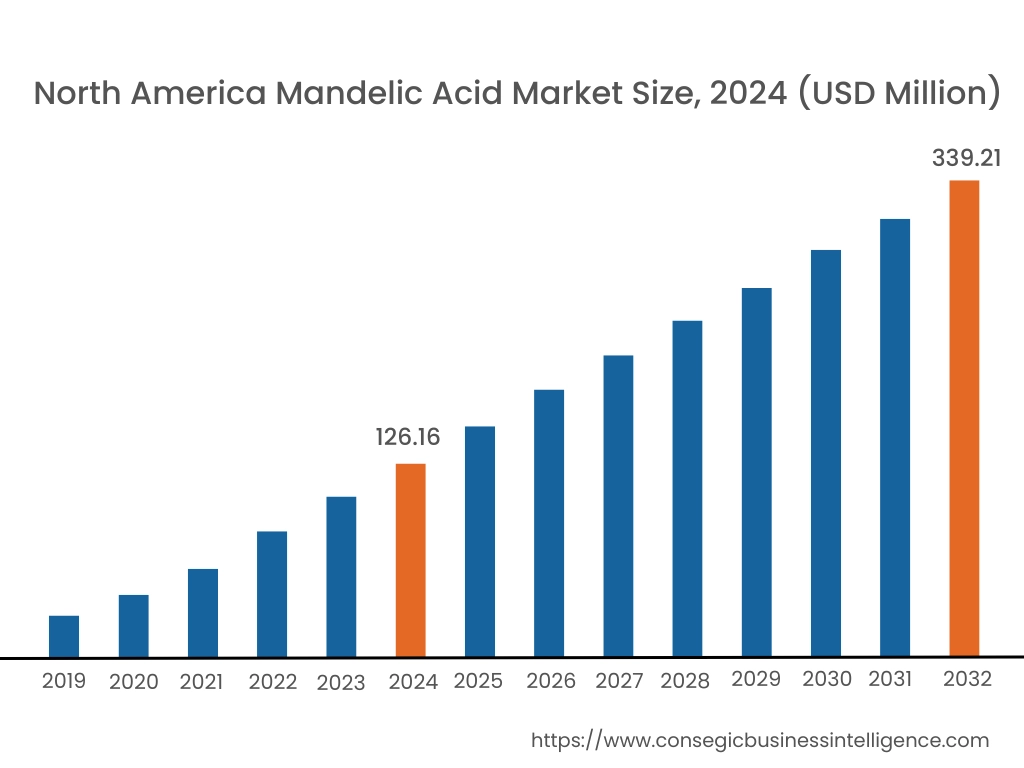
In 2024, North America accounted for the highest market share at 40.11% and was valued at USD 126.16 Million and is expected to reach USD 339.21 Million in 2032. In North America, United States accounted for the highest mandelic acid market share of 70.38% during the base year of 2024. As per analysis, North America region holds a dominant position in the market due to expanding the cosmetics & personal care sector along with its utilization in the pharmaceutical industry. Mandelic acid is used in sulphate-free and premium skin care products such as facewash and cleansers due to its cleansing properties. It also supports hair growth and nourishments though its antifungal and natural moisturizing properties. Moreover, companies in the region are incorporating mandelic acid in their personal care products.
- In 2024, Naturium launched Energizer Body Wash in United States. It contains fermented sugar cane and mandelic acid that helps to neutralize and fight body odor.
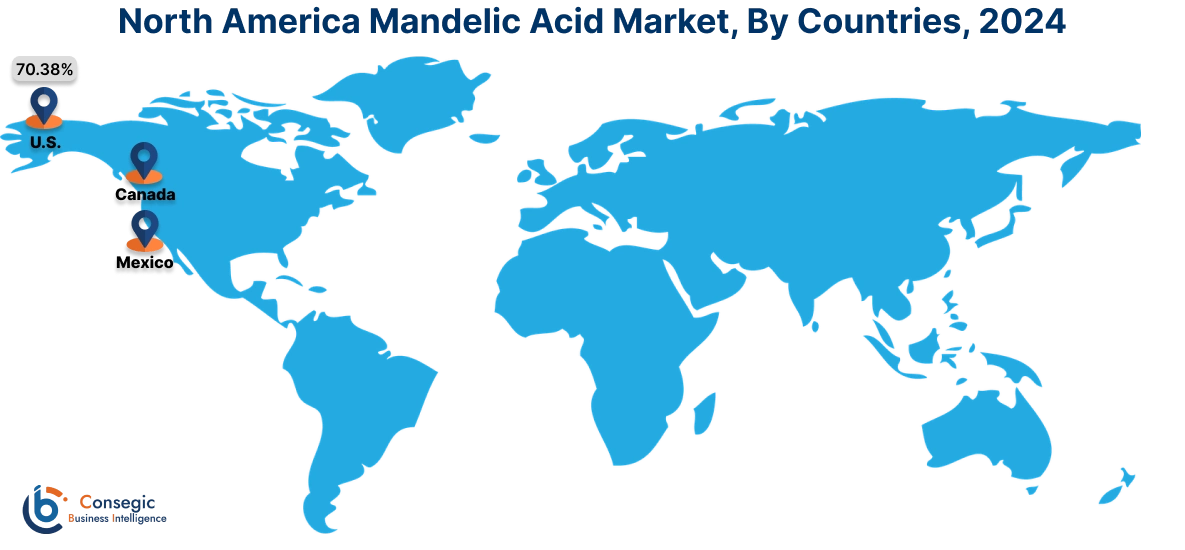
Therefore, due to the above-mentioned factors, North America region is dominating in the market as per analysis.
Asia Pacific Industry Insights: Fatest Growing Market with a CAGR of 16.9%
Asia Pacific is expected to witness the fastest CAGR of 16.9% over the forecast period of 2026-2034. According to mandelic acid industry analysis, the Asia Pacific region is growing rapidly driven by advancements in technology. Advancement in hydrolysis processes and sustainable bio catalytic method have enhanced the performance, cost-effectiveness and sustainability of this acid. Countries such as China, India, Japan, and South Korea are major contributors in the market due to adoption of 3D printing and artificial intelligence driven process control. These are increasing operational efficiency and ensuring high quality acid for various applications such as face serum and antibacterial drugs. Hence, mandelic acid market share of Asia Pacific is expected to emerge rapidly through technological advancements as per analysis.
According to market analysis, Europe region is growing considerably in the market driven by expanding pharmaceutical industry. The mandelic acid is used as an intermediate in the local anesthetics to improve biocompatibility. It is also used in painkillers to reduce pain and inflammation. Additionally, the investment in the pharmaceutical sector is also growing further boosting the market growth across the region.
LAMEA Mandelic Acid Market
The Middle East & Africa region is experiencing moderate demand in the market driven by the food & beverages sector. In this sector, mandelic acid is used as a flavoring agent in fruit-based and fermented products. It is also used in dietary supplements due to its antioxidant and gut-friendly properties. The consumers in the region prefer dietary supplements for the enhancement of nutrition, thereby driving the market demand.
As per market analysis, Latin America is experiencing steady growth in the market driven by the expanding chemical sector. In this sector, mandelic acid is used in the development of biodegradable polymers and specialty resins. It is also used as a precursor in the synthesis of fine chemicals, dye, and specialty fragrances. In countries such as Brazil and Argentina chemical manufacturing plants are expanding. This is leading to mandelic acid market expansion across the region.
Top Key Players & Market Share Insights:
The mandelic acid industry is highly competitive with major players providing products to the national and international markets. Key players are adopting several strategies in research and development (R&D) and product innovation to hold a strong position in the global market. Key players in the mandelic acid industry include-
- Merck KGaA (Germany)
- Spectrum Chemical (United States)
- Arkema Group (France)
- Guangzhou Tinci Materials Technology Co., Ltd. (China)
- Clariant (Switzerland)
- Evonik Industries AG (Germany)
- Thermo Fisher Scientific Inc. (United States)
- Solvay SA (Belgium)
- Pure Chemistry Scientific (United States)
- Dow Chemical Company (United States)
Recent Industry Developments :
Product Launch:
- In 2024, AFFOREST launched Jackfruit-based facewash in India. It contains mandelic acid that prevents premature ageing as well as fights acne and soothes irritated skin.
Mandelic Acid Market Report Insights:
| Report Attributes | Report Details |
| Study Timeline | 2021-2034 |
| Market Size in 2034 | USD 1,218.20 Million |
| CAGR (2026-2034) | 14.5% |
| By Type |
|
| By End-Use |
|
| By Sales Channel |
|
| By Region |
|
| Key Players |
|
| North America | U.S. Canada Mexico |
| Europe | U.K. Germany France Spain Italy Russia Benelux Rest of Europe |
| APAC | China South Korea Japan India Australia ASEAN Rest of Asia-Pacific |
| Middle East and Africa | GCC Turkey South Africa Rest of MEA |
| LATAM | Brazil Argentina Chile Rest of LATAM |
| Report Coverage |
|
Key Questions Answered in the Report
How big is the mandelic acid market? −
According to Consegic Business Intelligence, the mandelic acid market size was valued at USD 360.14 Million in 2025, and it is projected to grow from USD 412.36 Million in 2026 to USD 1218.20 Million by 2034, with a CAGR of 14.5% during the forecast period (2026-2034).
Which is the fastest-growing region in the mandelic acid market? +
Asia-Pacific is the fastest-growing region in the mandelic acid market.
What specific segmentation details are covered in the mandelic acid market? +
Type, End-Use and Sales Channel are covered in the mandelic acid market.
Who are the major players in the mandelic acid market? +
Merck KGaA (Germany), Spectrum Chemical (United States), and Evonik Industries AG (Germany) are some of the major players in the market.
Overview
Reputation & Certifications


Our Services
- Market Intelligence & Forecasting
- Custom Research Solutions
- Market Entry Strategy
- Competitive Intelligence
- Customer Insights
- Industry Innovation Analysis
- Investment Advisory