Jump to Content
Marine Chartplotter Market - Size, Share, Industry Trends, and Forecasts (2025 - 2032)
Marine Chartplotter Market Size:
Marine Chartplotter Market size is estimated to reach over USD 1,231.60 Million by 2032 from a value of USD 724.38 Million in 2024 and is projected to grow by USD 761.17 Million in 2025, growing at a CAGR of 6.9% from 2025 to 2032.
Marine Chartplotter Market Scope & Overview:
A marine chartplotter is a navigation device designed to assist mariners in plotting courses, determining positions, and navigating waterways with precision. These devices integrate GPS technology with electronic charts to provide real-time mapping and navigation information. Marine chartplotters are widely used in recreational boating, commercial shipping, and fishing vessels to enhance safety and efficiency during marine operations.
These devices are available in various formats, from standalone units to multi-function displays that integrate additional features such as radar, sonar, and autopilot systems. They are designed with user-friendly interfaces, high-resolution screens, and customizable settings to cater to different maritime requirements. The capability to overlay charts with real-time data ensures accurate navigation, even in challenging marine conditions.
End-users of these devices include leisure boaters, commercial fleet operators, and professional fishermen seeking reliable navigation solutions. Marine chartplotters play a vital role in ensuring safe and efficient maritime operations across diverse applications.
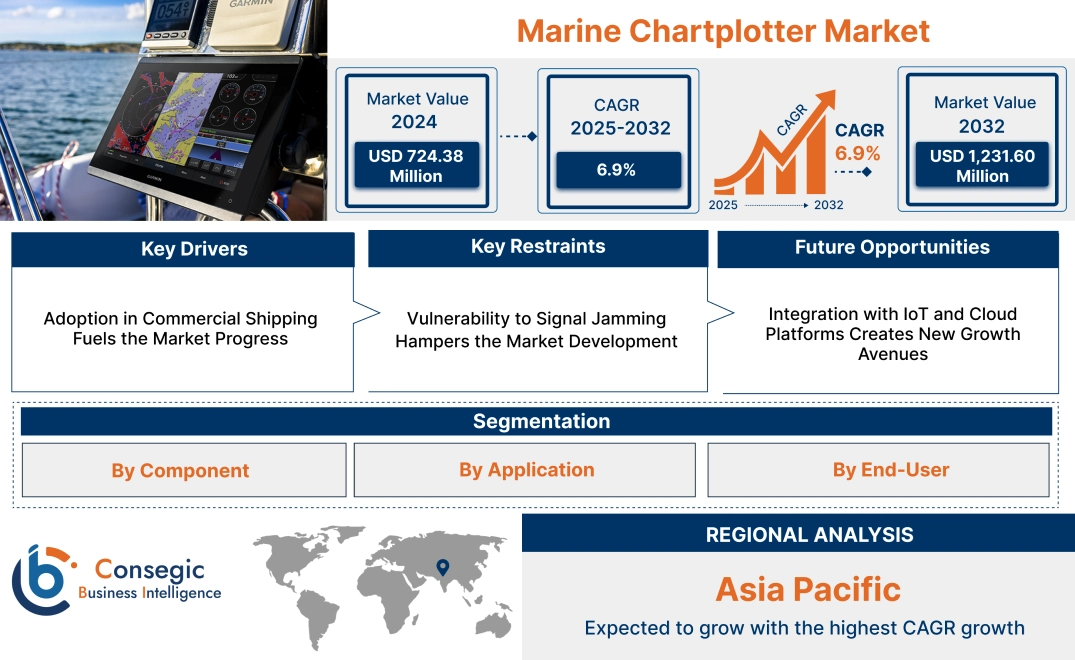
Marine Chartplotter Market Dynamics - (DRO) :
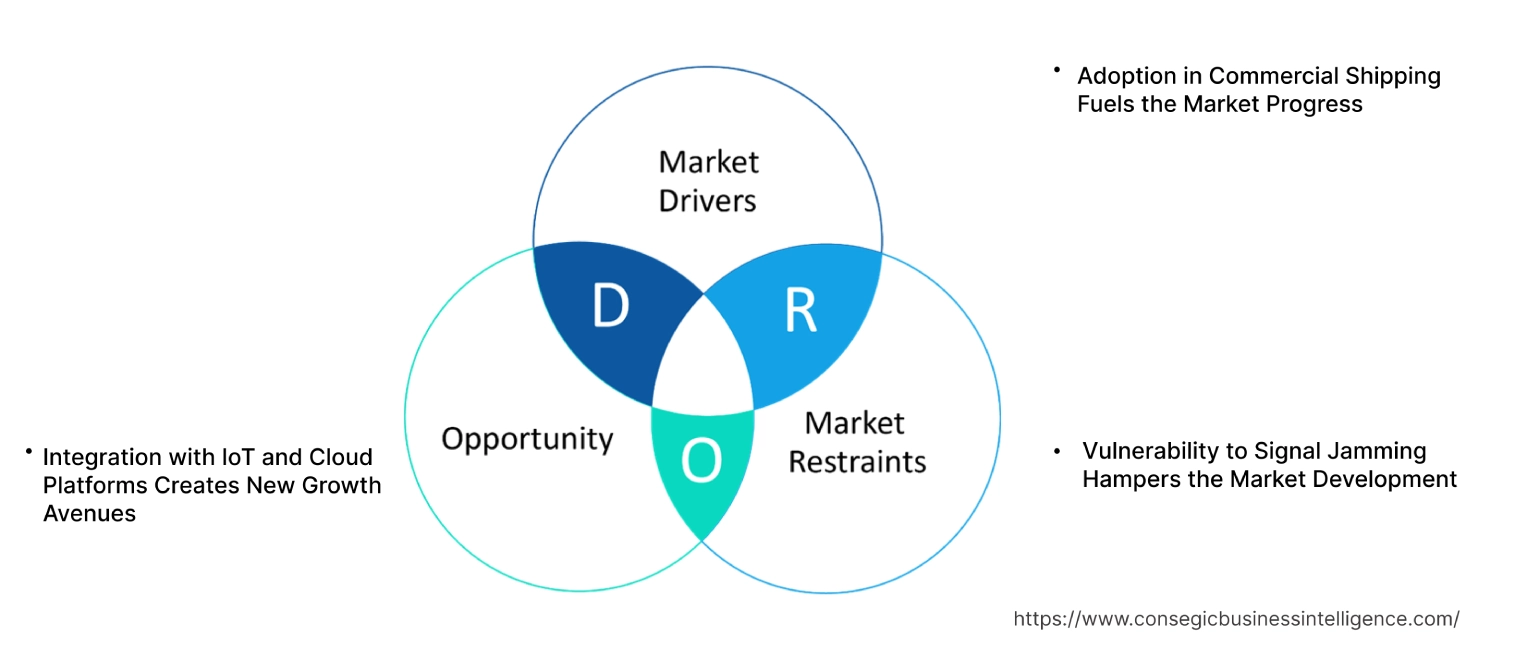
Key Drivers:
Adoption in Commercial Shipping Fuels the Market Progress
The commercial shipping sector is embracing advanced navigation technologies to enhance operational efficiency and comply with stringent safety regulations. Chartplotters equipped with features like route optimization and real-time weather updates are proving invaluable in reducing fuel consumption, minimizing travel time, and improving overall voyage planning. These systems provide precise navigation, ensuring vessels avoid hazardous areas and adhere to international maritime safety standards. The integration of advanced sensors and connectivity also allows for seamless data exchange between ships and shore-based facilities, enabling better fleet management. As the shipping industry prioritizes sustainable and efficient operations, the adoption of digital tools like chartplotters is rapidly becoming a necessity, driving marine chartplotter market growth.
Key Restraints:
Vulnerability to Signal Jamming Hampers the Market Development
Chartplotters that rely on GPS signals for navigation are susceptible to signal interference caused by radio waves, cellular communication, and chirp jammers. This vulnerability distorts location data, leading to inaccuracies in navigation and route planning. In critical maritime operations, such disruptions pose risks to vessel safety and operational efficiency.
Moreover, intentional jamming by malicious actors in congested waterways or sensitive areas further compromises the reliability of chartplotters, creating constraints for users dependent on uninterrupted GPS connectivity. Addressing this limitation requires additional investments in anti-jamming technologies, increasing the overall cost of deployment. Thus, the aforementioned factors are hindering the marine chartplotter market demand.
Future Opportunities :
Integration with IoT and Cloud Platforms Creates New Growth Avenues
The integration of Internet of Things (IoT) technology and cloud platforms are transforming the functionality of modern chartplotters. IoT-enabled chartplotters will connect to a network of sensors and devices on a vessel, providing real-time data on navigation, fuel levels, engine performance, and weather conditions. By syncing with cloud platforms, these systems facilitate remote monitoring and data sharing, enabling seamless fleet management. This capability is particularly advantageous for commercial shipping companies, allowing them to optimize routes, monitor vessel health, and reduce operational costs.
Moreover, the ability to access and analyze historical and real-time data improves decision-making and enhances the safety of marine operations. As the maritime industry embraces digital transformation, IoT-integrated chartplotters present significant advancements for developing smarter and more connected vessel ecosystems, boosting the marine chartplotter market opportunities.
Marine Chartplotter Market Segmental Analysis :
By Component:
Based on the component, the market is segmented into hardware and software.
The hardware segment accounted for the largest revenue of the total marine chartplotter market share in 2024.
- Hardware components, including screens, GPS modules, and navigation sensors, form the backbone of chartplotter systems, ensuring real-time navigation and precise mapping.
- The integration of high-definition displays with touch functionality enhances usability for both commercial and recreational users.
- Advancements in hardware durability, including water resistance and rugged designs, make them suitable for harsh marine environments.
- The analysis of segmental trends depicts that the dominance of this segment is attributed to the essential role of robust hardware in delivering reliable navigation solutions, especially in critical maritime operations, contributing to the marine chartplotter market expansion.
The software segment is projected to register the fastest CAGR during the forecast period.
- Innovative software solutions provide features like route optimization, weather updates, and marine traffic data, enhancing navigation efficiency.
- The rising adoption of AI-powered chartplotter software for predictive analytics supports its adoption across various end-user segments.
- Frequent software updates with enhanced mapping and safety features drive recurring revenue opportunities for providers.
- As per marine chartplotter market analysis, the segment’s rapid growth is driven by the increasing reliance on intelligent software solutions to improve decision-making in marine navigation.
By Application:
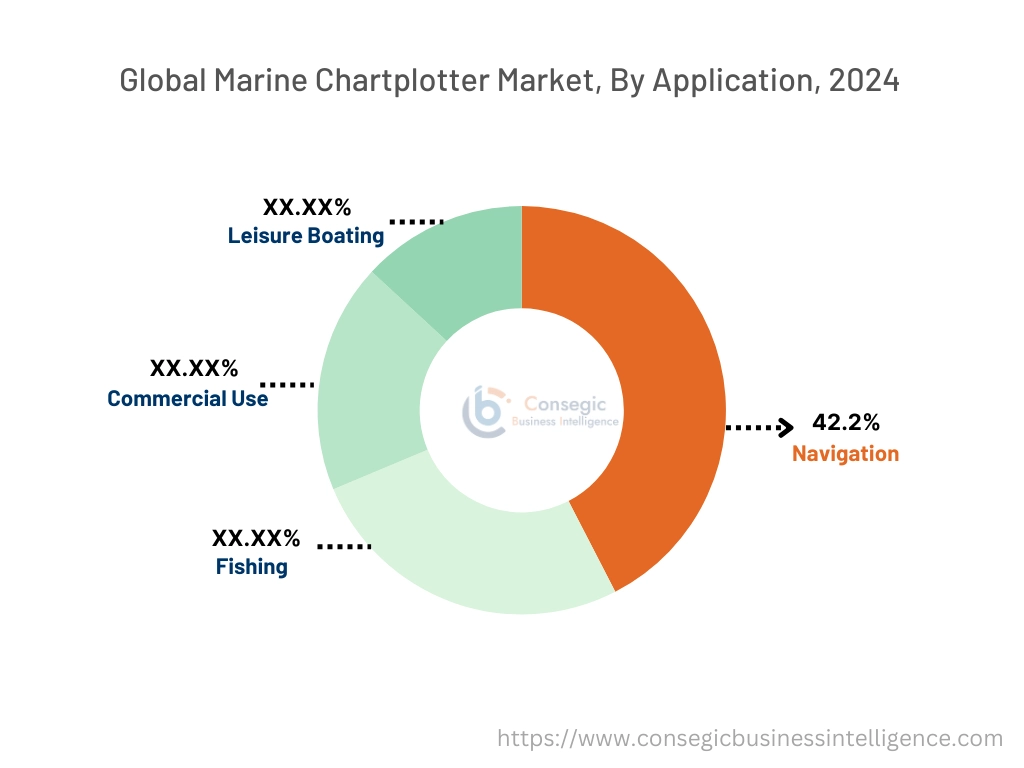
Based on the application, the market is segmented into navigation, fishing, commercial use, and leisure boating.
The navigation segment held the largest revenue of 42.2% of the total marine chartplotter market share in 2024.
- Navigation systems provide crucial data on real-time positioning, aiding in safe and efficient maritime operations.
- The integration of advanced chartplotters with GPS and radar systems ensures accurate route planning for long-distance travel.
- This segment benefits from high adoption among commercial vessels and naval fleets that prioritize operational safety.
- As per the marine chartplotter market trends, the dominance of the navigation segment reflects its critical importance in ensuring seamless maritime operations for various vessel types.
The fishing segment is anticipated to grow at the fastest CAGR during the forecast period.
- Chartplotters designed for fishing applications offer sonar integration and fish-finding capabilities, improving efficiency for both commercial and recreational fishers.
- The adoption of advanced features such as depth tracking and water temperature monitoring supports its increasing popularity.
- The rising demand for sustainable fishing practices further boosts the use of chartplotters for resource management.
- The growth of this segment is attributed to its tailored solutions for maximizing productivity in fishing activities, which further fuels the marine chartplotter market demand.
By End User:
Based on the end user, the market is segmented into commercial vessels, recreational boats, and naval vessels.
The commercial vessels segment accounted for the largest revenue share in 2024.
- Commercial vessels rely heavily on chartplotters for real-time navigation, route optimization, and compliance with maritime safety regulations.
- Features such as weather tracking and fuel management integration enhance operational efficiency for cargo ships and tankers.
- The increasing global shipping activity, driven by international trade, supports the dominance of this segment.
- As per the market analysis, the commercial vessels segment’s leadership is reinforced by its critical role in ensuring safe and efficient maritime operations on a large scale, fueling the marine chartplotter market growth.
The recreational boats segment is expected to register the fastest CAGR during the forecast period.
- Recreational boat owners are increasingly adopting chartplotters with user-friendly interfaces and integrated entertainment features.
- The rising popularity of leisure boating and water sports among consumers in developed regions supports the segment’s rapid expansion.
- Lightweight and portable chartplotters tailored for small boats contribute to the segment’s growth.
- As per segmental trends analysis, the growth trajectory of the recreational boats segment is driven by the rising consumer interest in enhancing safety and convenience during leisure activities, driving the marine chartplotter market expansion.
Regional Analysis:
The regions covered are North America, Europe, Asia Pacific, the Middle East and Africa, and Latin America.
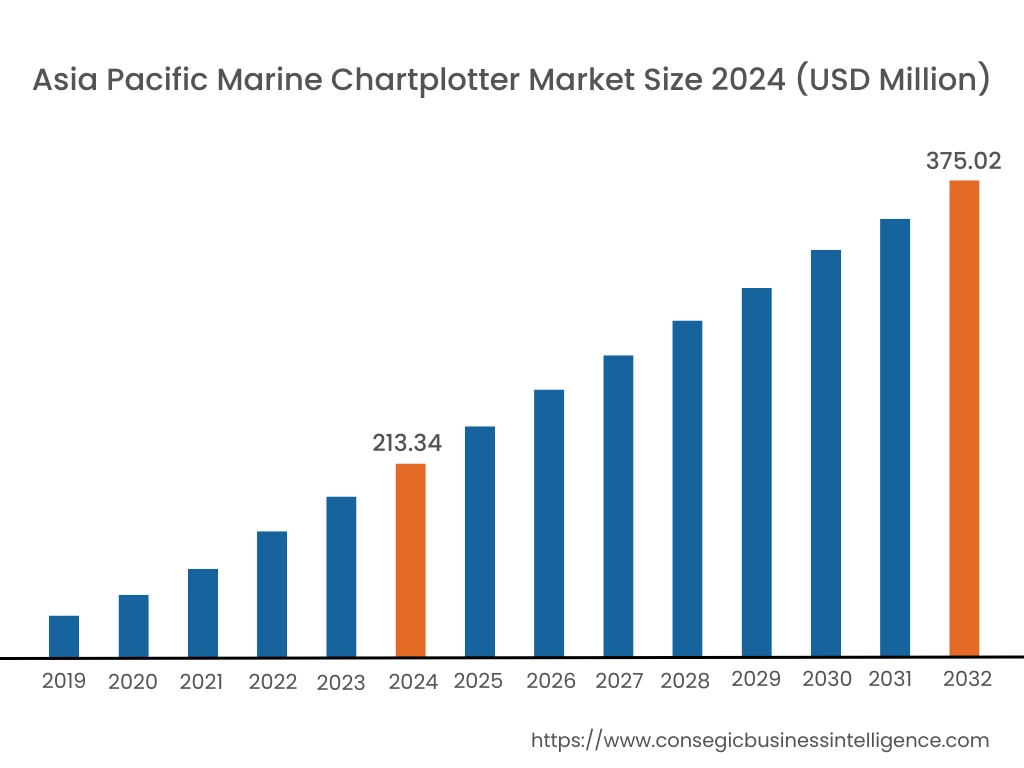
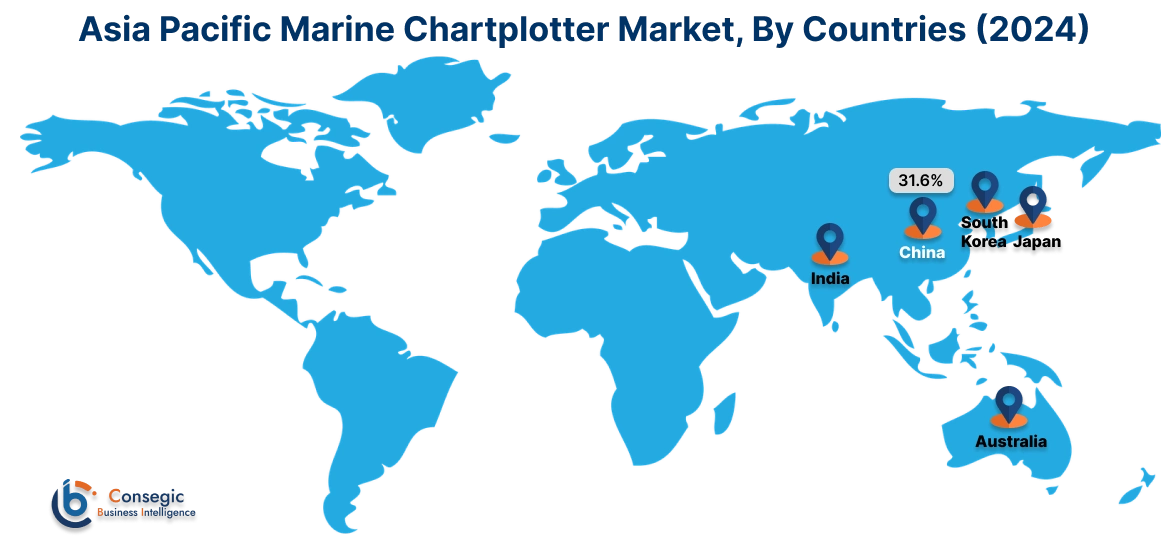
Asia Pacific region was valued at USD 213.34 Million in 2024. Moreover, it is projected to grow by USD 224.80 Million in 2025 and reach over USD 375.02 Million by 2032. Out of this, China accounted for the maximum revenue share of 31.6%. Asia-Pacific is emerging as a high-potential market, primarily due to expanding maritime trade activities and increasing recreational boating in countries like China, Japan, and South Korea. Government initiatives supporting maritime safety and infrastructure development further drive market adoption. The analysis highlights a growing trend of incorporating automation and AI-based features into chartplotter systems, catering to commercial shipping and leisure boating sectors, creating significant marine chartplotter market opportunities.
North America is estimated to reach over USD 399.16 Million by 2032 from a value of USD 240.28 Million in 2024 and is projected to grow by USD 252.00 Million in 2025. This region is a prominent contributor to the marine chartplotter market, driven by extensive adoption of advanced navigation technologies for both recreational and commercial vessels. The presence of well-established marine infrastructure, coupled with rising interest in leisure boating, strengthens the demand for precise and efficient navigation solutions. As per the marine chartplotter market analysis, the integration of advanced features like GPS connectivity and real-time mapping is a significant trend in this region.
Europe is a key region for marine chartplotters, with a strong focus on recreational boating and maritime tourism. The growing adoption of eco-friendly and energy-efficient navigation systems aligns with the region’s sustainability goals. The marine chartplotter market trends indicate a rising preference for compact and multifunctional chartplotter devices, particularly in recreational and small-scale fishing applications. The region also benefits from robust regulatory frameworks promoting maritime safety and technology adoption.
In the Middle East & Africa region, the marine chartplotter market is gaining traction in commercial shipping and offshore oil exploration industries. Increasing focus on navigation accuracy and safety in busy shipping routes is a key driver. Trends suggest a gradual adoption of advanced chartplotters integrated with satellite communication systems to support long-distance maritime operations.
Latin America is steadily emerging as a key market for marine chartplotters, with Brazil and Mexico leading adoption. Growing interest in recreational boating and fishing activities, alongside increasing commercial shipping operations, is driving demand. Trends indicate a rising inclination towards portable and user-friendly chartplotter devices tailored to smaller vessels and coastal applications.
Top Key Players and Market Share Insights:
The Marine Chartplotter market is highly competitive with major players providing products and services to the national and international markets. Key players are adopting several strategies in research and development (R&D), product innovation, and end-user launches to hold a strong position in the global Marine Chartplotter market. Key players in the Marine Chartplotter industry include -
- Garmin Ltd. (USA)
- Raymarine (a division of FLIR Systems) (USA)
- Si-Tex Marine Electronics (USA)
- Koden Electronics Co., Ltd. (Japan)
- JRC (Japan Radio Co., Ltd.) (Japan)
- Navico Group (Simrad, Lowrance, B&G) (USA)
- Furuno Electric Co., Ltd. (Japan)
- Humminbird (a brand of Johnson Outdoors) (USA)
- Standard Horizon (a brand of Yaesu) (Japan)
- Icom Inc. (Japan)
Recent Industry Developments :
Product Launches:
- In September 2024, Garmin unveiled the GPSMAP 9500, a black box chartplotter offering 4K compatibility, 7x faster processing, and gigabit-speed Garmin BlueNet networking. It supports seamless integration of onboard systems like sonar, radar, cameras, and digital switching, enhancing vessel connectivity and entertainment. Features include Auto Guidance+ routing, engine monitoring, and 360-degree camera views. Compatible with Garmin smartwatches and voice control, it streamlines navigation with third-party monitor flexibility and customized interfaces. Designed for advanced marine operations.
- In January 2023, Garmin introduced the ECHOMAP UHD2 series, offering 6”, 7”, and 9” touchscreens with keyed assist. Features include Ultra High-Definition sonar, preloaded Garmin Navionics+ mapping, wireless data sharing, and LiveScope sonar compatibility. With vibrant color options, advanced routing via Auto Guidance+, and streamlined device connectivity, these chart plotters modernize marine navigation. Updated designs provide improved clarity, usability, and portability.
Marine Chartplotter Market Report Insights :
| Report Attributes | Report Details |
| Study Timeline | 2019-2032 |
| Market Size in 2032 | USD 1,231.60 Million |
| CAGR (2025-2032) | 6.9% |
| By Component |
|
| By Application |
|
| By End User |
|
| By Region |
|
| Key Players |
|
| North America | U.S. Canada Mexico |
| Europe | U.K. Germany France Spain Italy Russia Benelux Rest of Europe |
| APAC | China South Korea Japan India Australia ASEAN Rest of Asia-Pacific |
| Middle East and Africa | GCC Turkey South Africa Rest of MEA |
| LATAM | Brazil Argentina Chile Rest of LATAM |
| Report Coverage |
|
Key Questions Answered in the Report
What is the size of the Marine Chartplotter market? −
Marine Chartplotter Market size is estimated to reach over USD 1,231.60 Million by 2032 from a value of USD 724.38 Million in 2024 and is projected to grow by USD 761.17 Million in 2025, growing at a CAGR of 6.9% from 2025 to 2032.
What are the key segments in the Marine Chartplotter market? +
The Marine Chartplotter market is segmented based on component, application, end-user, and region. By component, the market includes hardware and software. The application segment covers navigation, fishing, commercial use, and leisure boating. By end-user, the market is divided into commercial vessels, recreational boats, and naval vessels. The market is also segmented by region, including Asia-Pacific, Europe, North America, Latin America, and the Middle East & Africa.
Which segment is expected to grow the fastest in the Marine Chartplotter market? +
The fishing segment is anticipated to grow at the fastest CAGR during the forecast period. This growth is driven by chartplotters designed for fishing applications, offering sonar integration, fish-finding capabilities, depth tracking, and water temperature monitoring, making them increasingly popular among both commercial and recreational fishers.
Who are the major players in the Marine Chartplotter market? +
The key players in the Marine Chartplotter market include Garmin Ltd. (USA), Raymarine (a division of FLIR Systems) (USA), Navico Group (Simrad, Lowrance, B&G) (USA), Furuno Electric Co., Ltd. (Japan), Humminbird (a brand of Johnson Outdoors) (USA), Standard Horizon (a brand of Yaesu) (Japan), Icom Inc. (Japan), Si-Tex Marine Electronics (USA), Koden Electronics Co., Ltd. (Japan), and JRC (Japan Radio Co., Ltd.) (Japan).
Overview
Reputation & Certifications


Our Services
- Market Intelligence & Forecasting
- Custom Research Solutions
- Market Entry Strategy
- Competitive Intelligence
- Customer Insights
- Industry Innovation Analysis
- Investment Advisory