Jump to Content
Massive Mimo Market Size & Industry Share - Growth Trends & Forecasts (2026 - 2034)
Massive MIMO Market Size:
The Massive MIMO market size was valued at 7,513.63 (US$M) in 2025 and is projected to grow from 10,331.25 (US$M) in 2026 to 1,32,000.11 (US$M) by 2034, at a CAGR of 37.5% from 2026 to 2034, according to a recent report from Consegic Business Intelligence.
Massive MIMO Market Scope & Overview:
Massive MIMO (multiple-input multiple-output) is a multi-user MIMO technology that provides services to wireless terminals in high-motion environments. In Massive MIMO an array of antennas is equipped with base stations to serve a large number of terminals at the same time-frequency domain. MIMO uses spatial multiplexing in which data signals are divided into streams and then sent over to receiving antennas at the same time period and frequency. Further, by adding more antenna arrays, M-MIMO improves as well as increases spectral efficiency. Furthermore, the flexibility of network coverage increases, and network operators get the added benefit of vertical and horizontal coverage based on the requirement.

Massive MIMO Market Dynamics - (DRO) :
Key Drivers:
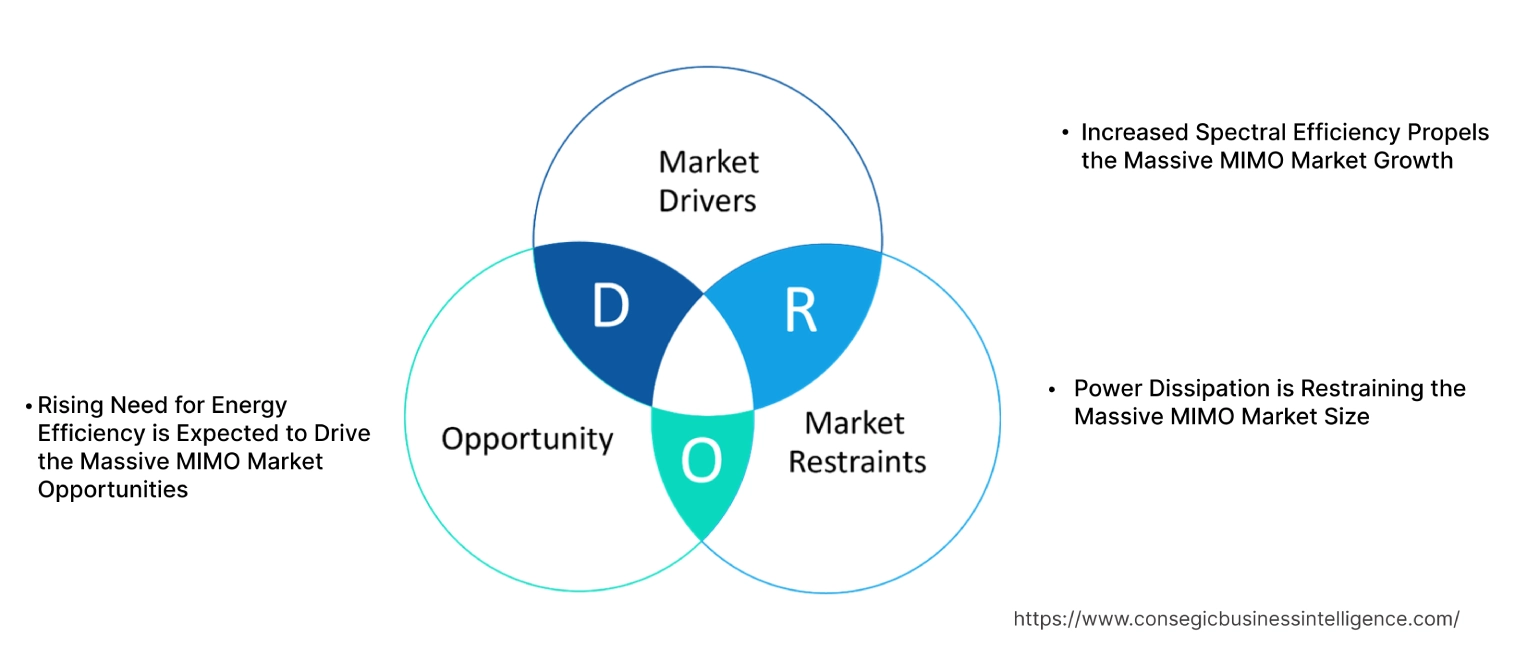
Increased Spectral Efficiency Propels the Massive MIMO Market Growth
The number of antennas is more on a radio compared to traditional MIMO which enables improved spectrum usage. Spectrum efficiency per cell is improved by creating multiple paths for transmission between the base stations and the end devices such as computers, laptops, routers, and others. Further, by improving the overall spectral density a greater number of users are served simultaneously. Also, by dividing signals into small packets and sending them to multiple receiving antennas overall transmission time is reduced and spectrum efficiency is achieved.
- For instance, in October 2021, Samsung Electronics launched a Massive MIMO radio that supports both two mid bands spectrum, C-Band (3.75GHZ to 3.98GHZ) and CBRS (3.55GHZ to 3.7GHZ) to maximize network capacity.
Thus, the rising demand for efficient use of spectrums is driving the Massive MIMO market size.
Key Restraints :
Stringent rules and regulations restrain respiratory care devices market growth.
The rising number of antennas in an array decreases the corresponding space between antennas, thereby packing the entire hardware into a smaller space. For example, 64 radio frequency paths are required by 32T32R and the spacing between the antennas is approximately 4.2 cm. Due to more antennas and RF paths lot of heat is dissipated. This results in overheating and swift functioning of the equipment.
Hence, the rising number of antennas has led to power dissipation in M-MIMO in turn hindering the Massive MIMO market expansion.
Future Opportunities :
Rising Need for Energy Efficiency is Expected to Drive the Massive MIMO Market Opportunities
As there are multiple input and multiple output antennas between the base stations and the end devices, it raises the average and peak cell throughput. Telecom operators are increasingly focusing on reducing energy consumption while maintaining high data speeds. Moreover, by enabling reduced power consumption while simultaneously adapting channel capacity for the increasing traffic, M-MIMO is providing efficient management of energy.
- For instance, in August 2024, Fujitsu collaborated with Qualcomm and developed an O-RAN (Open RAN) of 64T64R Massive MIMO Radio Unit using Qualcomm’s QRU100 5G Ran platform which improved energy efficiency while maintaining high-speed data rates.
Thus, as per the Massive MIMO analysis, rising collaboration and advancements for efficient energy solutions are driving the global Massive MIMO market opportunities.
Massive MIMO Market Segmental Analysis :
By Antenna Arrays:
Based on antenna arrays, the market is segmented into 8T8R, 16T16R, 32T32R, 64T64R, and others.
Trends in the Antenna Arrays:
- Rising trend in deployment of 8T8R by the telecom operators to swiftly launch 5G services on 2300MHz or 2600MHz.
- Telecom operators are widely adopting 16T16R in rural areas for introducing 5G internet services.
The 64T64R accounted for the largest revenue share of the total Massive MIMO market share in 2023 and is anticipated to register the fastest CAGR during the forecast period.
- 64T64R stands for 64 transmit, 64 receive antenna ports which enables adaptation of radiation pattern for the antenna array in densely populated areas to provide internet services.
- In wireless communication, 64T64R increases the overall spectrum and energy efficiency of a system to improve the user’s 5G experience.
- 64T64R supports multiple users and devices which enables high capacity to wireless networks.
- For instance, in February 2023, MaxLinear, a 5G wireless infrastructure provider collaborated with Airgain to develop a 64T64R Massive MIMO radio unit reference design.
- According to the analysis, the rising collaborations and partnerships for advancements in wireless communication are driving the Massive MIMO market growth.
By Spectrum:
Based on spectrum, the market is segmented into TDD and FDD.
Trends in the Spectrum:
- FDD is in trend because a smaller number of base stations are required to cover the area.
- Telecom operators are using TDD technology for fast and swift rollout of 5G services.
TDD accounted for the largest revenue at % of the overall market share in 2023 and is anticipated to register the fastest CAGR during the forecast period.
- TDD (Time Division Duplex) utilizes the same frequency for uplink and downlink which enables the same channel effects.
- TDD takes significantly less channel estimation time compared to FDD which enables more time for data transmission.
- TDD technology is used for 5G deployments to improve spectrum efficiency which is bolstered by downlink and uplink signals over the same frequency.
- For instance, in October 2022, ZTE collaborated with AIS to launch and develop advanced 5G solutions including sub-6GHz TDD Massive MIMO AUU with reduced power consumption by up to 25%.
- Therefore, the rising developments and advancements for 5G advanced solutions are driving the Massive MIMO market trends.
By Network:
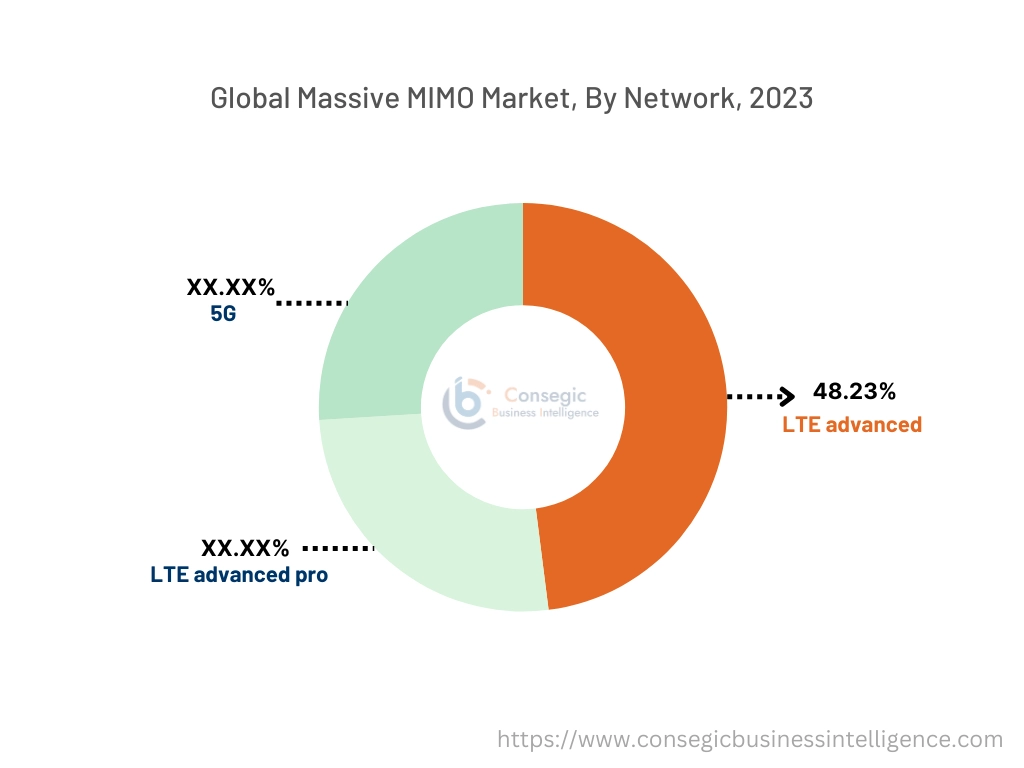
Based on the network, the market is segmented into LTE advanced, LTE advanced pro, and 5G.
Trends in the Network:
- Rising adoption of LTE advanced is growing due to increasing demand in internet-based industrial applications.
- 5G integration enables massive industrial benefits including real-time data processing, machine-to-machine communication, and fast download and upload speeds.
LTE advanced accounted for the largest revenue share of 48.23% of the total share in 2023.
- LTE (Long Term Evolution) advanced refers to an advanced version of 4G systems which is defined by 3GPP a group of telecommunication associations, the uplink speed in LTE advanced is more than 500 Mbps, and the downlink speed is 1 Gbps.
- LTE Advanced has various benefits including the ability to operate in hybrid topology networks where computers, routers, and user equipment are interconnected in bus, star, mesh, and other topologies.
- M-MIMO technology significantly enhances LTE advanced networks by using multiple antennas for input and output to increase signal strength.
- For instance, in November 2022, ZTE Corporation, a provider of telecommunication technology collaborated with Jazz and deployed 4G FDD Massive MIMO using ZTE’s 5G technology.
- According to the analysis, the rising collaborations and partnerships for advancements in LTE advanced networks are driving the Massive MIMO market growth.
5G is anticipated to register the fastest CAGR during the forecast period.
- M-MIMO in 5G wireless technology leads to increased performance and improves the overall network experience of the user by integrating multiple antennas in the transmitter and receiver section.
- 5G delivers various benefits including high data speeds, massive network capacity, low latency, reliability and others to enhance customer experience.
- Integration of MIMO with 5G wireless technology enables improved signal-to-noise ratio and increases throughput.
- For instance, in February 2024, Airtel collaborated with Ericsson for the deployment of 5G infrastructure in India using Ericsson’s 100,000 Massive MIMO 5G RAN (Radio Access Network).
- According to the analysis, the rising partnerships for the swift rollout of 5G wireless technology are driving the Massive MIMO market trends.
Regional Analysis:
The regions covered are North America, Europe, Asia Pacific, the Middle East and Africa, and Latin America.
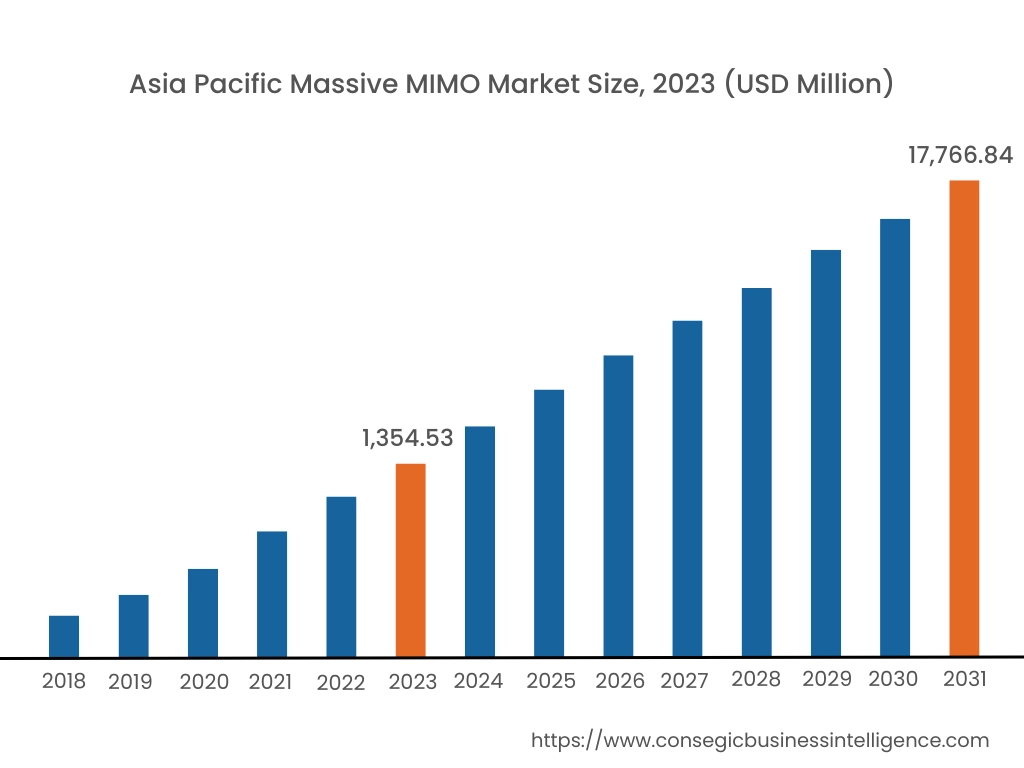
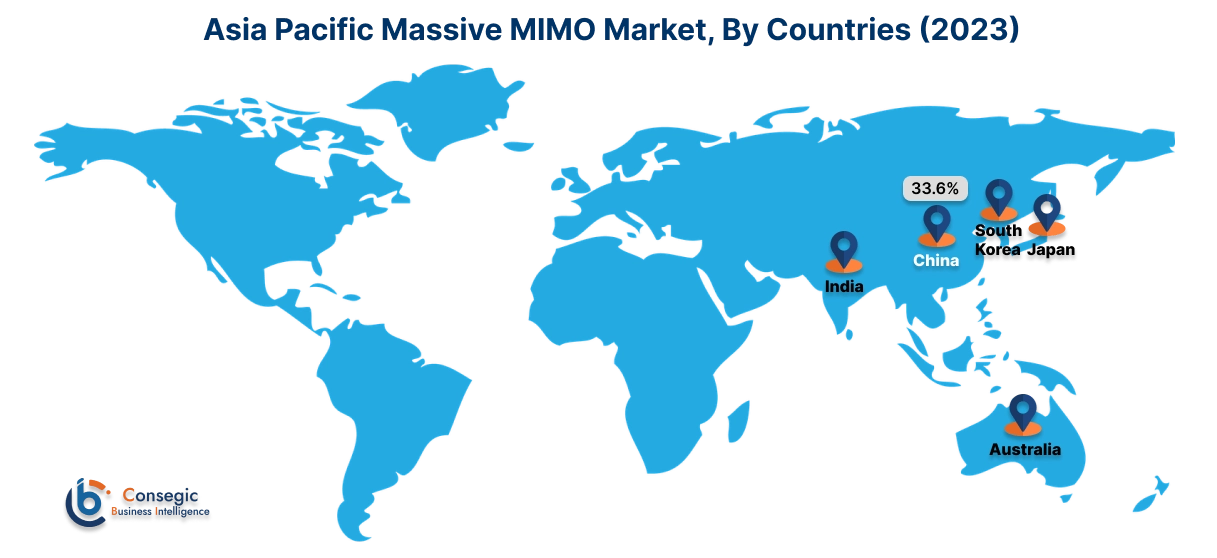
Asia Pacific region was valued at USD 1,354.53 Million in 2023. Moreover, it is projected to grow by USD 1,842.45 Million in 2024 and reach over USD 17,766.84 Million by 2031. Out of this, China accounted for the maximum revenue share of 33.6%. As per the Massive MIMO market analysis, the rising adoption of Massive MIMO especially in countries like China, India, and Japan for the quick rollout of 5G services is growing. The rapid development and growing investments in the telecommunication industry are accelerating the Massive MIMO market expansion.
- For instance, in January 2023, Reliance launched 5G network services across all six states in the northeast circle of India, in turn driving the M-MIMO market.
North America is estimated to reach over USD 15,938.87 Million by 2031 from a value of USD 1,246.86 Million in 2023 and is projected to grow by USD 1,692.31 Million in 2024. In North America, the growth of the Massive MIMO industry is driven by the rising demand for high-speed data and constant connectivity for various industrial applications such as data centers, cloud computing, remote offices, and others to increase flexibility. Rising trend for ultra-low latency in businesses for indoor coverage is also driving the market growth. Hence, the increased investment in 5G network technology is massively contributing to the Massive MIMO market demand.
- For instance, in August 2023, Nokia launched a single-band AirScale Osprey Massive MIMO product for telecom operators in North America to increase performance with flexibility in deployment.
The regional analysis depicts that the smart city initiatives and the prevalence of 5G in all European households driving the Massive MIMO market demand in Europe. Further, as per the market analysis, the primary factor driving the growth of the market in the Middle East and African region is the increasing investment in the telecommunication sector for improving connectivity and development of infrastructure projects. The rising investments in IT projects are accelerating the demand for constant connectivity, in turn driving the market growth in the Latin America region.
Top Key Players & Market Share Insights:
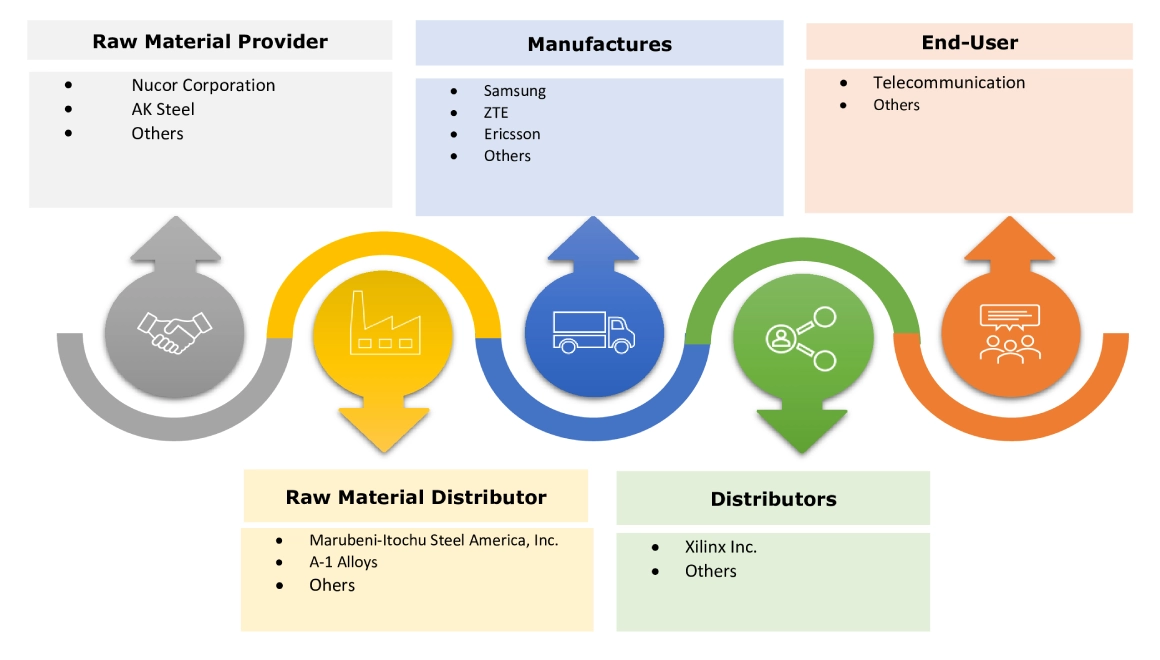
The Massive MIMO market is highly competitive with major players providing services to the national and international markets. Key players are adopting several strategies in research and development (R&D), product innovation, and end-user launches to hold a strong position in the global Massive MIMO market. Key players in the Massive MIMO industry include -
Recent Industry Developments :
Product launches:
- For instance, in February 2023, Nokia launched Habrok radios powered by ReefShark SoC (System-on-Chip), available in both antenna array options including Habrok 32 (32 TRX) and Habrok 64 (64 TRX) versions.
- For instance, in February 2024, Mavenir unveiled OpenBeam Massive MIMO Radio which is powered by Qualcomm’s QRU100 5G radio access network platform.
Massive MIMO Market Report Insights :
| Report Attributes | Report Details |
| Study Timeline | 2021-2034 |
| Market Size in 2034 | USD 132,000.11 Million |
| CAGR (2026-2034) | 37.50% |
| Base Year | 2025 |
| By Antenna Arrays |
|
| By Spectrum |
|
| By Network |
|
| By Region |
|
| Key Players |
|
| North America | U.S. Canada Mexico |
| Europe | U.K. Germany France Spain Italy Russia Benelux Rest of Europe |
| APAC | China South Korea Japan India Australia ASEAN Rest of Asia-Pacific |
| Middle East and Africa | GCC Turkey South Africa Rest of MEA |
| LATAM | Brazil Argentina Chile Rest of LATAM |
| Report Coverage |
|
Key Questions Answered in the Report
How big is the Massive MIMO system market? −
The Massive MIMO system market was valued at USD 3,972.14 Million in 2023 and is projected to grow to USD 50,776.90 Million by 2031.
Which is the fastest-growing region in the Massive MIMO system market? +
Asia-Pacific is the region experiencing the most rapid growth in the Massive MIMO system market.
What specific segmentation details are covered in the Massive MIMO system report? +
The Massive MIMO system report includes specific segmentation details for antenna array, spectrum, network, and region.
Who are the major players in the Massive MIMO system market? +
The key participants in the Massive MIMO market are Samsung (South Korea), Huawei (China), Nokia (Finland), Verizon (U.S.), ZTE (China), Airtel (India), Zillnk (China), Tejas Networks (India), Comba (China), and Ericsson (Sweden).
Overview
Reputation & Certifications


Our Services
- Market Intelligence & Forecasting
- Custom Research Solutions
- Market Entry Strategy
- Competitive Intelligence
- Customer Insights
- Industry Innovation Analysis
- Investment Advisory