Jump to Content
Medical Imaging Systems Market - Size, Share, Industry Trends, and Forecasts (2025 - 2035)
What are Medical Imaging Systems?
Medical imaging systems are devices that help in the diagnosis and treatment of diseases. Medical imaging systems include devices such as X-rays, CT scans, MRI, and ultrasound. The medical imaging industry involves manufacturing, software integration, and installation of medical imaging systems.
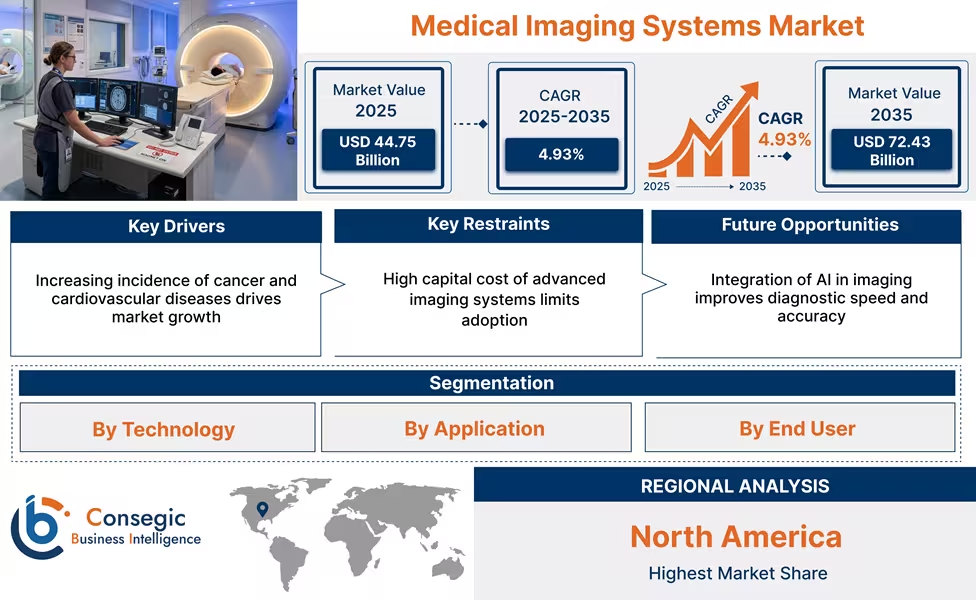
As per our analysts, the medical imaging systems market is valued at USD 42.64 billion in 2024 and is projected to reach USD 72.43 billion by 2035, registering a CAGR of 4.93% during 2025–2035. This is driven owing to the increase in the need for early diagnosis, and the increase in the need for accurate imaging for diagnosis and treatment is boosting the medical imaging industry. The increase in the number of cancer, cardiovascular, and neurological diseases is boosting the medical imaging industry.
Key Insights
- The Global Medical Imaging Systems Market size was USD 44.75 billion in 2025.
- The medical imaging industry is expected to grow at a CAGR of 4.93% from 2025 to 2035.
- The global market valuation is expected to reach USD 72.43 billion by 2035.
- North America accounted for the largest regional share of the Medical Imaging Systems Market in 2024.
Segmentation Analysis:
The medical imaging systems market is segmented based on technology, application, and end user. Each segment reflects specific adoption trends across diagnostic practices and healthcare infrastructure.
By Technology
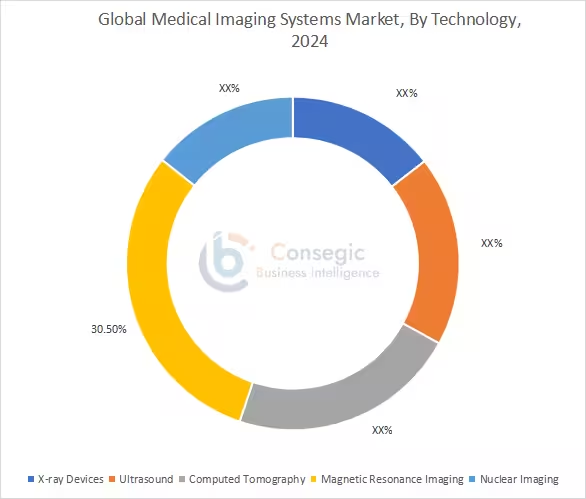
The market includes X-ray devices, ultrasound, CT, MRI, and nuclear imaging.
Dominant Segment
Magnetic Resonance Imaging (MRI)
Largest revenue share of 30.5% in 2024. High demand for soft tissue imaging increases adoption. Hospitals prefer MRI for complex diagnostics. High-field systems improve imaging capability.
Fastest Growing
Computed Tomography (CT)
Fastest CAGR during the forecast period. CT supports rapid imaging in emergency care. Increasing use in oncology and cardiology supports demand. Multi-slice technology improves accuracy.
By Application
The market includes cardiology, oncology, neurology, orthopedics, gastroenterology, and gynecology.
Dominant Segment
Orthopedics
Largest revenue share in 2024. Rising cases of fractures and arthritis increase imaging demand. X-ray and MRI support accurate diagnosis. Growth in orthopedic procedures drives usage.
Fastest Growing
Cardiology
Fastest CAGR during the forecast period. Rising cardiovascular disease burden increases imaging demand. CT and ultrasound support cardiac diagnostics. Aging population supports segment growth.
By End User
The market includes hospitals, diagnostic imaging centers, and others.
Dominant Segment
Hospitals
Largest revenue share in 2024. High patient volume means an increase in imaging procedures. Advanced technologies can support complex diagnostics. Multi-specialty hospitals expand imaging capacity.
Fastest Growing
Diagnostic Imaging Centers
Fastest CAGR during the forecast period. Rising demand for outpatient diagnostics supports growth. Centers focus on specialized services. Private investments expand diagnostic networks.
Drivers
Increasing incidence of cancer and cardiovascular diseases drives market growth
The increasing number of patients with cancer and cardiovascular diseases is creating a higher demand for diagnostic imaging in various healthcare facilities. Various hospitals and imaging centers are increasing their imaging facilities to enable the early detection of diseases. Various imaging technologies, including CT, MRI, and ultrasound, are commonly used to diagnose complex diseases.
There is going to be a steep increase in cancer cases in the coming years, which would increase the demand for advanced imaging systems in various healthcare facilities. For instance, in February 2025, the World Health Organization projected that there would be an increase in cancer cases to 35 million by 2050, which is 77% higher than in 2022.
Growing aging population increases need for continuous disease monitoring
The growing number of elderly people in the population also implies that the incidence of chronic conditions such as cardiovascular disease, cancer, and neurological conditions will rise. This will require the expansion of diagnostic imaging services. Hospitals and diagnostic imaging centers seek to add imaging services in order to manage the long-term monitoring of chronic conditions.
World Health Organization, in the year 2030, 1 in 6 people worldwide will be 60 years of age or older, and the number of people in this age category will rise from 1 billion in 2020 to 1.4 billion. As a result, demand for imaging systems continues to increase across aging-driven healthcare markets.
Rising healthcare expenditure improves access to advanced imaging systems
An increase in healthcare expenditure will also mean more investment in advanced diagnostic equipment. More funds are allocated by hospitals, both in the public and private sector to procure imaging equipment such as MRI and CT scan machines.
According to the Centers for Medicare & Medicaid Services, in 2024, healthcare spending in the United States rose by 7.2%, reaching USD 5.3 trillion or USD 15,474 per capita, which is 18.0% of the GDP. Therefore, healthcare facilities invest in more diagnostic services, which in turn encourages more medical imaging system adoption.
Challenges
High capital cost of advanced imaging systems limits adoption
Advanced medical imaging technologies demand high capital costs for purchasing and installing the system. Extra costs for maintaining the system further increase the cost of owning the system. Budget constraints on small healthcare facilities, such as hospitals and diagnostic centers, hinder the adoption of medical imaging systems, especially in developing countries. Financial constraints limit the adoption of high-end medical imaging systems, which affects the market.
Opportunities
Integration of AI in imaging improves diagnostic speed and accuracy
The integration of artificial intelligence improves the efficiency of image analysis. It also reduces the time required for diagnosis. Artificial intelligence-based solutions aid radiologists in detecting abnormalities more precisely. Healthcare centers use artificial intelligence-based imaging solutions to improve the efficiency of workflow and minimize diagnostic errors.
For example, in December 2025, GE HealthCare introduced its Imaging 360 solution, which is AI-enabled and aims to improve the efficiency of workflow in imaging services. Therefore, the demand for intelligent imaging solutions increases.
Growth of tele-radiology services creates market opportunities
Expansion of tele-radiology services supports remote diagnosis and improves access to specialist consultations. Digital imaging platforms enable radiologists to review images securely from remote locations, which improves reporting efficiency. Increasing investments and technology collaborations are accelerating adoption of AI-enabled tele-radiology systems, which drives demand for advanced imaging infrastructure.
For instance, in November 2025, Konica Minolta Healthcare partnered with Transparent Imaging to launch Exa Teleradiology with AI-driven and cloud-based capabilities, which is increasing demand for advanced digital imaging infrastructure.
Regional Scenario:
The industry includes regions such as North America, Europe, Asia Pacific, the Middle East and Africa, and Latin America.
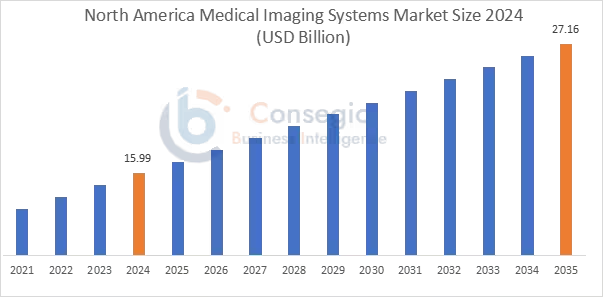
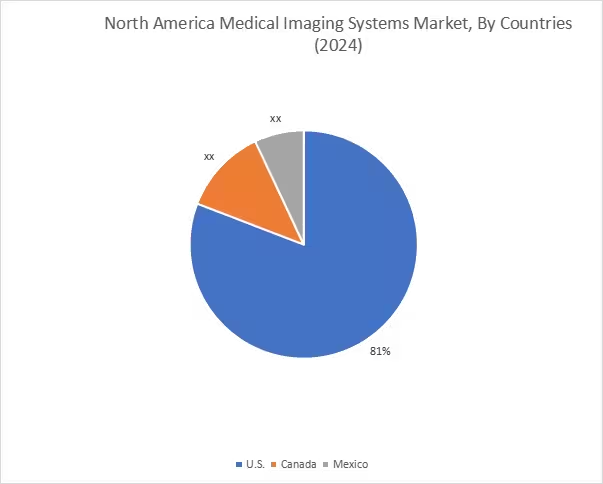
North America dominated the market with the highest market share of 37.5% in 2024 and recorded USD 15.99 billion in revenue, which is expected to grow to USD 27.16 billion by 2035. The US market accounted for 81% of the total market share in the region, backed by its robust healthcare infrastructure and the increasing use of MRI, CT, and digital imaging modalities.
Recent product approvals and the rise of cloud imaging are also boosting the market in the region. For example, in March 2026, GE HealthCare received FDA 510(k) clearance for its next-generation diagnostic viewer, which enables cloud-based radiology workflows.
Asia Pacific is expected to grow at the highest rate in this segment due to the expansion of hospital infrastructure and increasing investments in imaging technologies. In the region, China is increasing the adoption of advanced diagnostic technologies, whereas Japan and India are growing steadily in high-precision imaging and diagnostic technologies. New product launches in CT, mammography, and X-ray systems are fueling the growth in the region.
For instance, In January 2026, FUJIFILM India introduced four cutting-edge diagnostic imaging, advanced healthcare IT solutions, including CT, mammography, X-ray, and HCIT at IRIA 2026.
Regulatory Framework
North America:
- The U.S. Food and Drug Administration regulates imaging systems through 510(k) clearance and PMA pathways.
- Strict compliance with radiation safety standards is enforced by the U.S. Nuclear Regulatory Commission.
- Reimbursement policies under Centers for Medicare & Medicaid Services influence adoption of imaging procedures.
- Data privacy laws such as HIPAA are applicable to the management of patient imaging data.
- Mexico has regulations related to medical devices under COFEPRIS.
Europe:
- EU’s Medical Device Regulation is applicable to the approval and commercialization of imaging devices.
- It is mandatory to have CE marking to enter the market in the European Union countries.
- Radiation protection standards are regulated by the European Commission’s directives.
- GDPR is applicable to the management of patient imaging data securely.
Asia Pacific:
- China follows the National Medical Products Administration approval system.
- Japan follows a very strict regulatory system, and this is carried out by the Pharmaceuticals and Medical Devices Agency.
- India follows a regulatory approval system carried out by the Central Drugs Standard Control Organization.
- Governments are focusing on enhancing radiation safety and device quality standards for better diagnostic results.
Rest of World
- Brazil follows the ANVISA approval system for imaging devices.
- The regulatory process for approvals is carried out by the Saudi Food and Drug Authority.
- UAE follows medical device regulations under the Ministry of Health and Prevention.
Competitive Landscape and Key Market Participants:
The medical imaging systems industry's competitive landscape is moderately fragmented, and there are a number of companies that are offering medical imaging equipment and software. The companies are looking to increase their offerings for various medical imaging technologies. The number of partnerships between medical imaging companies and healthcare service providers is increasing, and the competition in the medical imaging systems industry is increasing as companies are looking to invest in medical imaging equipment and digital diagnostic tools.
Key participants in the medical imaging systems market include:
- GE HealthCare Technologies Inc.– US
- Siemens Healthineers AG– Germany
- Koninklijke Philips N.V.– Netherlands
- Canon Medical Systems Corporation – Japan
- Fujifilm Holdings Corporation – Japan
- Shimadzu Corporation – Japan
- Samsung Medison Co., Ltd. – South Korea
- Hitachi Ltd. – Japan
- Hologic, Inc. – US
- Carestream Health, Inc. – US
Latest Developments:
- In March 2026, Philips has announced its new Rembra CT at ECR 2026, which has an 85 cm bore, AI-powered detector, and the ability to produce up to 106 images per second.
- In January 2025, Siemens Healthineers has announced its diagnostic imaging solutions at AOCR 2025 in Chennai, which include the company’s helium-free 1.5T MRI with the MAGNETOM Flow, SOMATOM Pro.Pulse Dual Source CT, the MULTIX Impact E X-ray, and AI-based ACUSON Maple and Sequoia ultrasound solutions.
Medical Imaging Systems Market Report Insights:
| Report Attributes | Report Details |
|---|---|
| Study Timeline | 2019-2035 |
| Market Size in 2035 (USD Billion) | USD 72.43 Billion |
| CAGR (2025-2035) | 4.93% |
| By Technology |
|
| By Application |
|
| By End User |
|
| By Region |
|
| Key Players |
|
| Report Coverage |
|
Key Questions Answered in the Report
How big is the medical imaging systems market? −
The medical imaging systems market sizeis estimated to reach over USD 72.43 Billion by 2035 from a value of USD 42.64 Billion in 2024 and is projected to grow by USD 44.75 Billion in 2025, growing at a CAGR of 4.93% from 2025 to 2035.
Which segmentation details are covered in the medical imaging systems report? +
The medical imaging systems report includes specific segmentation details for technology, application, end user, and regions.
Which is the fastest segment anticipated to impact the market growth? +
Magnetic resonance imaging is the fastest growing segment due to rising demand for high-resolution diagnostics.
Who are the major players in the medical imaging systems market? +
The key participants in the medical imaging systems marketare GE HealthCare Technologies Inc. (US), Siemens Healthineers AG (Germany), Koninklijke Philips N.V. (Netherlands), Canon Medical Systems Corporation (Japan), Fujifilm Holdings Corporation (Japan), Shimadzu Corporation (Japan), Samsung Medison Co., Ltd. (South Korea), Hitachi Ltd. (Japan), Hologic, Inc. (US), Carestream Health, Inc. (US), and others.
What are the key trends in the medical imaging systems market? +
Adoption of AI-enabled imaging systems and growth of tele-radiology services are shaping the market.
Overview
Reputation & Certifications


Our Services
- Market Intelligence & Forecasting
- Custom Research Solutions
- Market Entry Strategy
- Competitive Intelligence
- Customer Insights
- Industry Innovation Analysis
- Investment Advisory