Jump to Content
Meningococcal Vaccine Market - Size, Share, Industry Trends, and Forecasts (2025-2032)
Meningococcal Vaccine Market Size:
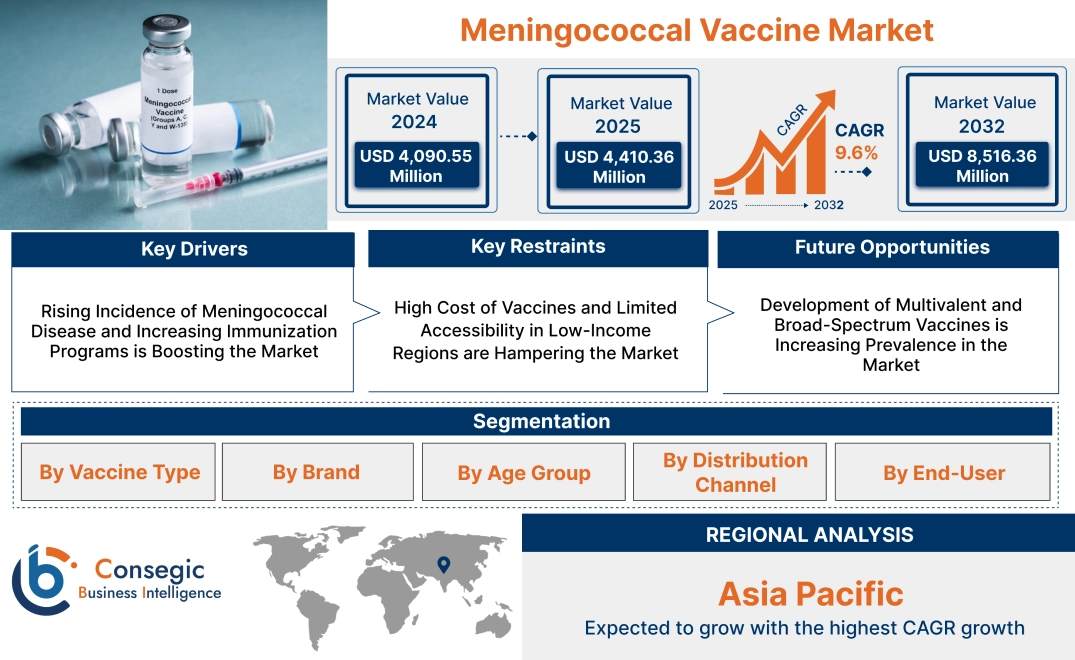
Meningococcal Vaccine Market size is estimated to reach over USD 8,516.36 Million by 2032 from a value of USD 4,090.55 Million in 2024 and is projected to grow by USD 4,410.36 Million in 2025, growing at a CAGR of 9.6% from 2024 to 2032.
Meningococcal Vaccine Market Scope & Overview:
The meningococcal vaccine is designed to prevent meningococcal infections caused by Neisseria meningitidis, a leading cause of bacterial meningitis and septicemia. These vaccines are critical in reducing morbidity and mortality associated with meningococcal disease, particularly in high-risk populations such as children, adolescents, and individuals in outbreak-prone regions. The market encompasses conjugate vaccines, polysaccharide vaccines, and recombinant protein-based vaccines targeting various serogroups like A, B, C, W, and Y.
Key characteristics of meningococcal vaccines include high immunogenicity, safety profiles, and efficacy in preventing both sporadic cases and outbreaks. The benefits include long-lasting immunity, reduced disease transmission, and support for global vaccination campaigns aimed at eradicating meningococcal disease.
Applications span routine immunization programs, travel vaccines for individuals visiting endemic regions, and outbreak management during meningitis epidemics. End-users include hospitals, clinics, and public health organizations, driven by increasing awareness of vaccine-preventable diseases, rising implementation of immunization programs, and growing investment in vaccine development for broader serogroup coverage.
Meningococcal Vaccine Market Dynamics - (DRO) :
Key Drivers:
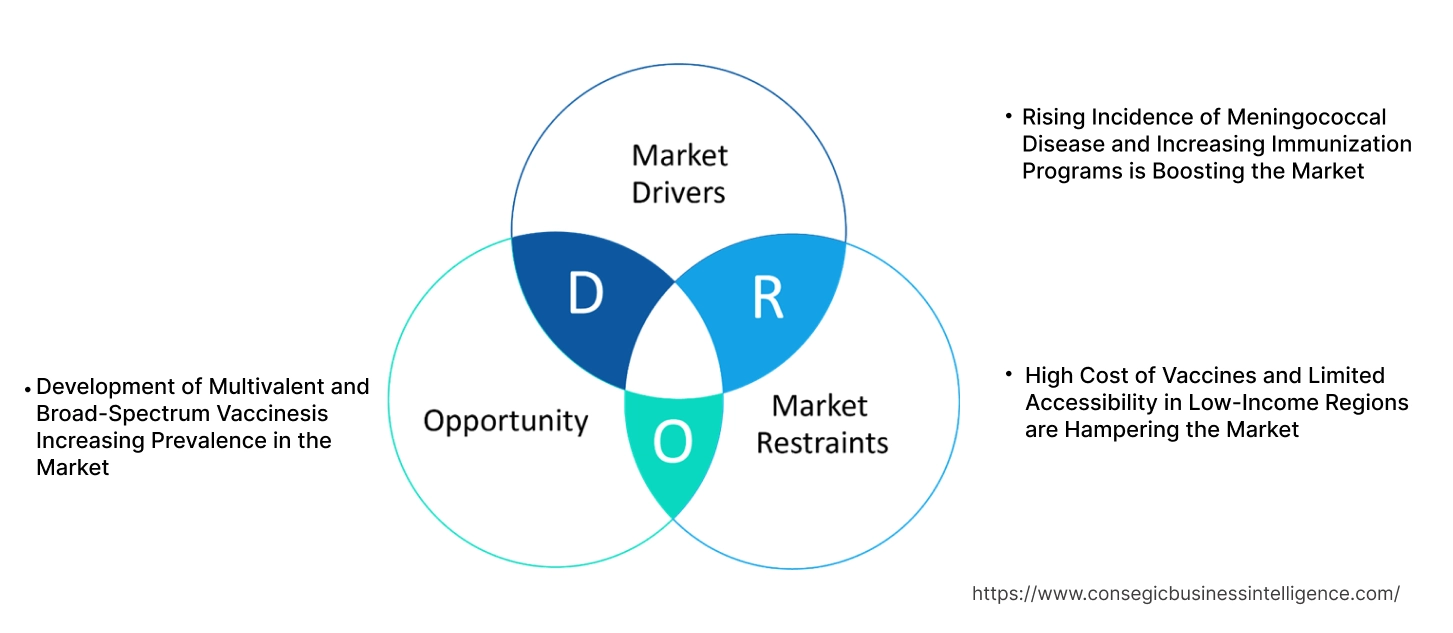
Rising Incidence of Meningococcal Disease and Increasing Immunization Programs is Boosting the Market
The growing incidence of meningococcal disease, caused by Neisseria meningitidis, is a significant driver for the meningococcal vaccine market. This life-threatening bacterial infection, which can lead to meningitis and septicemia, has prompted governments and healthcare organizations worldwide to prioritize immunization programs. Vaccines targeting serogroups A, B, C, W, and Y have proven effective in preventing outbreaks, particularly in high-risk regions such as Sub-Saharan Africa's "meningitis belt." The increasing incorporation of meningococcal vaccines into national immunization schedules and routine pediatric vaccination programs has significantly boosted meningococcal vaccine market demand. Furthermore, periodic disease outbreaks and the growing emphasis on travel immunization, particularly for international travelers to endemic regions or pilgrims, have further propelled the market.
Key Restraints:
High Cost of Vaccines and Limited Accessibility in Low-Income Regions are Hampering the Market
A critical restraint in the meningococcal vaccine market is the high cost of vaccines, particularly for conjugate and recombinant vaccines, which limits accessibility in low- and middle-income countries. While initiatives like Gavi, the Vaccine Alliance, have improved affordability and coverage in resource-limited settings, a substantial portion of the global population still lacks access to these vaccines. The reliance on cold chain infrastructure for vaccine storage and transportation adds another layer of complexity, particularly in remote areas with underdeveloped healthcare systems. These barriers reduce the overall vaccination rate and hinder meningococcal vaccine market expansion, especially in regions where the disease burden is highest.
Future Opportunities :
Development of Multivalent and Broad-Spectrum Vaccines is Increasing Prevalence in the Market
The development of multivalent vaccines that target multiple meningococcal serogroups presents a significant opportunity for the market. Multivalent vaccines, such as MenACWY and MenB combinations, simplify immunization schedules by reducing the number of doses required while providing broader protection. The ongoing research and development of next-generation vaccines aim to improve efficacy, extend protection duration, and address emerging serogroups. Additionally, advancements in adjuvant technologies and recombinant DNA platforms are facilitating the production of more effective and affordable vaccines. These innovations are particularly valuable for high-risk populations, such as infants, adolescents, and immunocompromised individuals. Manufacturers investing in multivalent vaccine development are well-positioned to capitalize on the growing demand for comprehensive immunization solutions.
These dynamics highlight the increasing importance of meningococcal vaccination in global public health initiatives, driven by rising disease incidence and expanding immunization programs. While challenges related to cost and accessibility persist, the development of multivalent vaccines and innovative production technologies presents a promising path for meningococcal vaccine market growth and improved disease prevention worldwide.
Meningococcal Vaccine Market Segmental Analysis :
By Vaccine Type:
Based on vaccine type, the market is segmented into polysaccharide vaccines, conjugate vaccines, combination vaccines, and MenB vaccines.
The conjugate vaccines segment accounted for the largest revenue in meningococcal vaccine market share in 2024.
- Conjugate vaccines are highly effective in providing long-lasting immunity against multiple serogroups of meningococcal bacteria.
- Increasing adoption in national immunization programs due to their superior efficacy and safety profile supports segment dominance.
- Rising awareness and global initiatives for mass immunization campaigns against meningococcal meningitis drive meningococcal vaccine market trends for conjugate vaccines.
- Advancements in vaccine technology to target emerging serotypes further bolster this segment's growth.
The MenB vaccines segment is anticipated to register the fastest CAGR during the forecast period.
- MenB vaccines are gaining traction due to their targeted efficacy against serogroup B, which is responsible for invasive meningococcal disease.
- Growing focus on vaccinating adolescents and young adults, who are at higher risk of MenB infection, is driving meningococcal vaccine market trends.
- Rising prevalence of MenB outbreaks globally has highlighted the importance of this vaccine category.
- Increasing approvals and launches of MenB vaccines in emerging markets are expected to propel trends.
By Brand:
Based on brand, the market is segmented into Menactra, Menveo, Trumenba, Bexsero, and others.
The Menactra segment accounted for the largest revenue share in 2024.
- Menactra is widely used for immunizing against meningococcal serogroups A, C, Y, and W-135, making it a leading vaccine brand.
- High adoption rates in routine vaccination schedules across developed and developing countries contribute to its dominance.
- Strong distribution networks and widespread availability have further boosted Menactra’s market share.
- Ongoing promotional campaigns and government support for Menactra have strengthened its position in the market.
The Bexsero segment is anticipated to register the fastest CAGR during the forecast period.
- Bexsero, a MenB vaccine, is gaining popularity due to its ability to protect against meningitis caused by serogroup B.
- Rising approvals in various countries for inclusion in immunization schedules are driving meningococcal vaccine market demand.
- Increasing focus on adolescent and young adult vaccination programs globally supports trends in this segmental analysis.
- Expanding awareness campaigns by healthcare organizations about MenB prevention are expected to propel Bexsero’s market trends.
By Age Group:
Based on age group, the market is segmented into infants, children, adolescents, and adults.
The adolescents segment accounted for the largest revenue in meningococcal vaccine market share in 2024.
- Adolescents represent a key demographic for meningococcal vaccination due to their increased risk of infection during communal living situations.
- Immunization campaigns targeting high schools and colleges have significantly contributed to the dominance of this segmental analysis.
- Strong recommendations by public health authorities for adolescent meningococcal vaccination are driving advancement.
- The rising prevalence of meningococcal outbreaks among this age group supports segment trends.
The infants segment is anticipated to register the fastest CAGR during the forecast period.
- Infants are highly susceptible to meningococcal infections, making early vaccination critical for disease prevention.
- Increasing inclusion of meningococcal vaccines in routine infant immunization schedules is driving demand.
- Rising awareness among parents about the benefits of early vaccination against meningitis supports trends.
- Expanding healthcare access and immunization programs in emerging markets are expected to propel growth in this segment.
By Distribution Channel:
Based on distribution channel, the market is segmented into hospital pharmacies, retail pharmacies, online pharmacies, and government & non-governmental organizations (NGOs).
The government & NGOs segment accounted for the largest revenue share in 2024.
- Governments and NGOs play a crucial role in mass vaccination campaigns, particularly in meningitis-prone regions.
- Support from global organizations like WHO and Gavi for meningococcal vaccination programs drives advancement in this segment.
- Increasing funding and collaborations for immunization initiatives in low- and middle-income countries bolster meningococcal vaccine market opportunities.
- The focus on reducing the burden of meningitis epidemics in Sub-Saharan Africa further supports dominance.
The online pharmacies segment is anticipated to register the fastest CAGR during the forecast period.
- Online pharmacies offer convenience and accessibility, particularly for urban populations seeking immunization-related products.
- Growing adoption of e-commerce platforms for healthcare products, including vaccines, is driving meningococcal vaccine market growth.
- Expanding partnerships between online retailers and vaccine manufacturers are improving product availability.
- Increasing awareness about the availability of vaccines through digital channels is expected to propel meningococcal vaccine market opportunities.
By End-User:
Based on end-user, the market is segmented into hospitals, specialty clinics, vaccination centers, and research institutes.
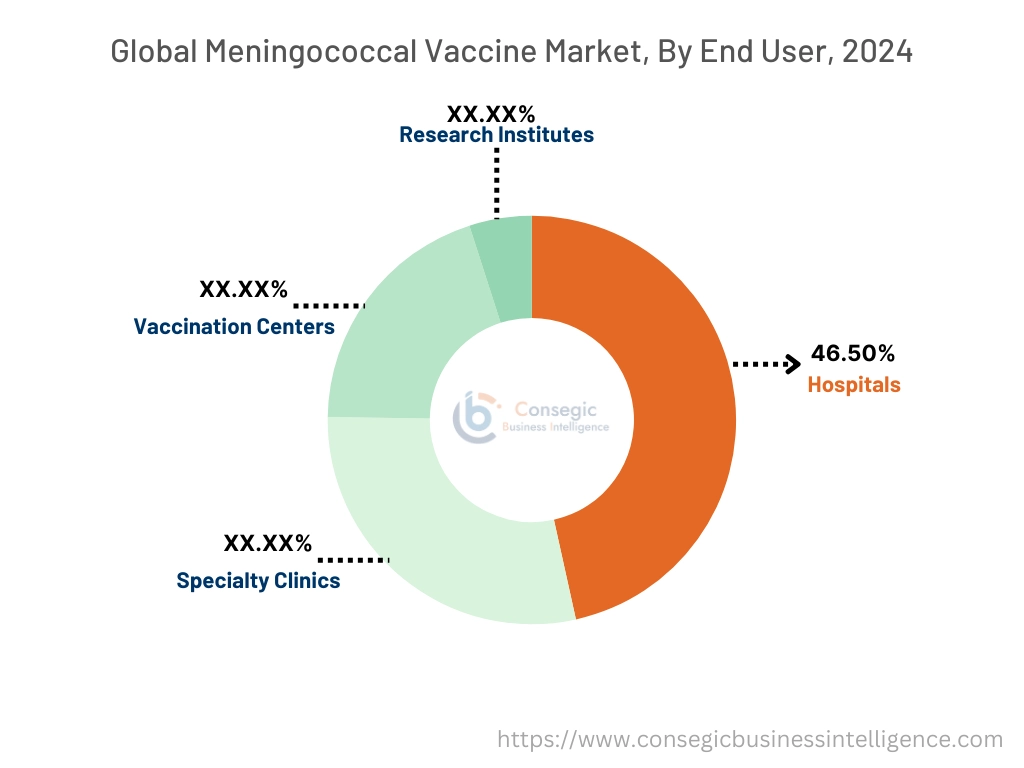
The hospitals segment accounted for the largest revenue share of 46.50% in 2024.
- Hospitals are the primary centers for administering meningococcal vaccines, especially for high-risk individuals.
- Availability of trained healthcare professionals and advanced vaccination facilities supports the dominance of this segment.
- Rising hospital-based immunization programs for children and adolescents contribute to growth.
- Increasing hospital admissions for meningitis cases and post-exposure vaccination further bolster this segment.
The vaccination centers segment is anticipated to register the fastest CAGR during the forecast period.
- Vaccination centers, including government and private clinics, are expanding their role in routine immunization schedules.
- Rising awareness campaigns and community outreach programs by vaccination centers drive demand.
- Increasing preference for dedicated vaccination facilities due to shorter waiting times and specialized care supports growth.
- Expanding infrastructure for vaccination centers in rural and semi-urban areas is expected to propel trends in this segment.
Regional Analysis:
The regions covered are North America, Europe, Asia Pacific, the Middle East and Africa, and Latin America.
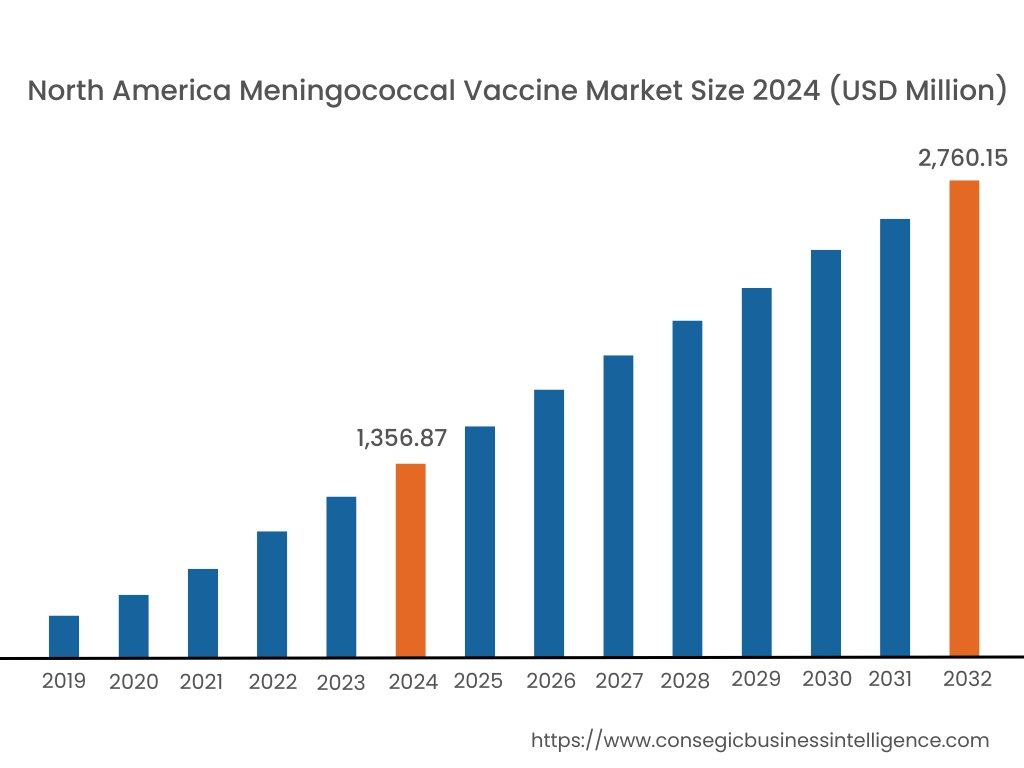
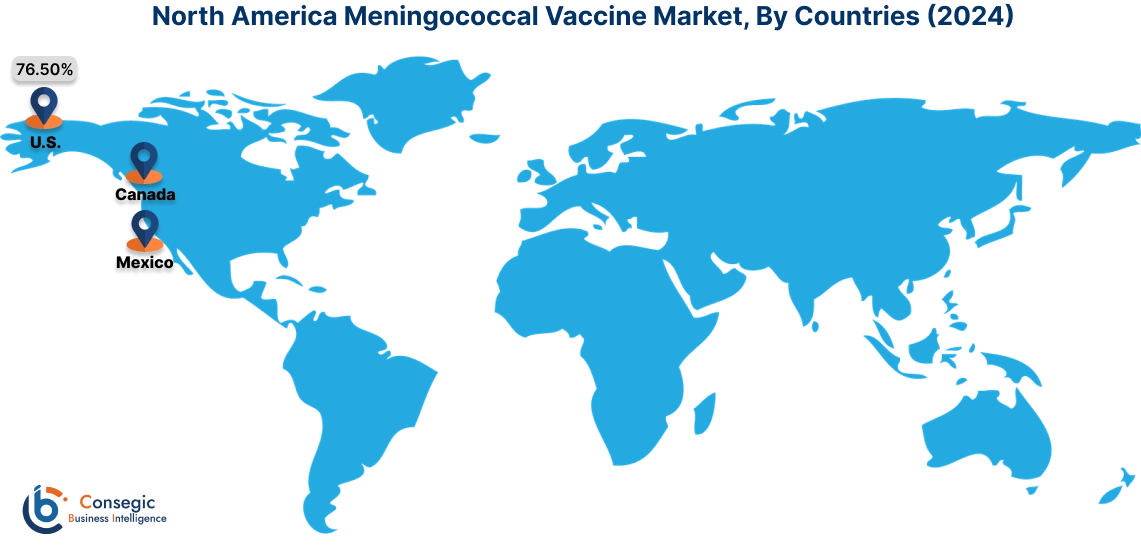
In 2024, North America was valued at USD 1,356.87 Million and is expected to reach USD 2,760.15 Million in 2032. In North America, the U.S. accounted for the highest share of 76.50% during the base year of 2024.
North America holds a significant stake in the global meningococcal vaccine market, driven by strong government immunization programs, high awareness about meningococcal diseases, and advanced healthcare infrastructure. The U.S. leads the region due to routine immunization schedules for adolescents and travelers, as well as increasing adoption of conjugate and multicomponent vaccines. As per the meningococcal vaccine market analysis, Canada contributes with rising vaccination coverage and public health campaigns promoting meningococcal disease prevention. However, the high cost of advanced vaccines may limit accessibility for some low-income populations.
In Asia Pacific, the market is experiencing the fastest growth with a CAGR of 10.1% over the forecast period. The meningococcal vaccine market analysis, is fueled by rising healthcare investments, increasing awareness about vaccine-preventable diseases, and government efforts to expand immunization coverage in China, India, and Southeast Asia. China dominates the region with large-scale vaccination programs targeting schoolchildren and high-risk groups. India’s expanding healthcare infrastructure supports growing demand for affordable vaccines, particularly in rural areas. Japan emphasizes advanced meningococcal vaccines for travelers and military personnel, leveraging its strong R&D capabilities. However, limited access to vaccines in remote areas and cost constraints may hinder growth in certain parts of the region.
Europe has a prominent meningococcal vaccines industry, supported by robust immunization programs, increasing awareness of meningitis outbreaks, and government-led vaccination initiatives. Countries like Germany, the UK, and France are key contributors. The UK analysis drives demand with its extensive use of meningococcal conjugate vaccines in national immunization schedules. Germany focuses on adolescent vaccination programs and meningitis outbreak prevention, while France emphasizes vaccination for high-risk groups such as travelers and military personnel. However, vaccine hesitancy in certain populations and high costs of vaccines may pose challenges in some regions.
The Middle East & Africa region is witnessing steady market growth, driven by increasing healthcare investments and government initiatives to address meningitis outbreaks. Countries like Saudi Arabia and the UAE mandate meningococcal vaccination for Hajj pilgrims and travelers, ensuring high demand for conjugate vaccines. In Africa, the Meningitis Belt (spanning countries like Nigeria and Chad) sees significant vaccination campaigns led by global health organizations to prevent epidemics. However, limited local production capabilities and reliance on international funding may restrict broader market development in the region.
Latin America is an emerging market for meningococcal vaccines, with Brazil and Mexico leading the region. Brazil’s national immunization program includes meningococcal vaccination for infants and adolescents, driving expansion for conjugate and multicomponent vaccines. As the regional analysis, Mexico focuses on expanding access to meningitis prevention through public health initiatives and partnerships with global vaccine manufacturers. The region also benefits from increasing awareness campaigns about meningococcal disease prevention. However, economic instability and inconsistent healthcare policies in smaller economies may pose challenges to meningococcal vaccine market expansion.
Top Key Players & Market Share Insights:
The meningococcal vaccine market is highly competitive with major players providing products and services to the national and international markets. Key players are adopting several strategies in research and development (R&D), product innovation, and end-user launches to hold a strong position in the global meningococcal vaccine market. Key players in the meningococcal vaccine industry include -
- Pfizer Inc. (United States)
- Sanofi S.A. (France)
- Walvax Biotechnology Co., Ltd. (China)
- Bharat Biotech International Ltd. (India)
- Hualan Biological Engineering Inc. (China)
- GlaxoSmithKline plc (United Kingdom)
- Merck & Co., Inc. (United States)
- Serum Institute of India Pvt. Ltd. (India)
- Biomed Pvt. Ltd. (Russia)
- Bio-Manguinhos/Fiocruz (Brazil)
Recent Industry Developments :
Innovation and Development:
- In April 2024, Nigeria became the first country to introduce Men5CV, a pentavalent conjugate vaccine that protects against five strains of meningococcus bacteria (A, C, Y, W, and X). This development is a significant milestone in the global fight against meningitis, particularly in the African meningitis belt, where the disease has been a major public health challenge. The introduction of Men5CV is expected to enhance protection against meningococcal disease, contributing to the World Health Organization's goal of defeating meningitis by 2030.
Meningococcal Vaccine Market Report Insights:
| Report Attributes | Report Details |
| Study Timeline | 2019-2032 |
| Market Size in 2032 | USD 8,516.36 Million |
| CAGR (2025-2032) | 9.6% |
| By Vaccine Type |
|
| By Brand |
|
| By Age Group |
|
| By Distribution Channel |
|
| By End-User |
|
| By Region |
|
| Key Players |
|
| North America | U.S. Canada Mexico |
| Europe | U.K. Germany France Spain Italy Russia Benelux Rest of Europe |
| APAC | China South Korea Japan India Australia ASEAN Rest of Asia-Pacific |
| Middle East and Africa | GCC Turkey South Africa Rest of MEA |
| LATAM | Brazil Argentina Chile Rest of LATAM |
| Report Coverage |
|
Key Questions Answered in the Report
What is the projected size of the Meningococcal Vaccine Market by 2031? −
Meningococcal Vaccine Market size is estimated to reach over USD 8,516.36 Million by 2032 from a value of USD 4,090.55 Million in 2024 and is projected to grow by USD 4,410.36 Million in 2025, growing at a CAGR of 9.6% from 2024 to 2032.
What factors are driving the Meningococcal Vaccine Market? +
The market is primarily driven by the rising incidence of meningococcal disease and the increasing implementation of immunization programs globally. Vaccines targeting multiple serogroups (A, B, C, W, and Y) are key to managing outbreaks and reducing disease transmission, particularly in high-risk regions such as Sub-Saharan Africa.
What challenges are restraining market growth? +
High vaccine costs and limited accessibility in low-income regions are significant barriers. Inadequate healthcare infrastructure, reliance on cold-chain logistics, and dependence on international funding further hinder vaccine distribution in underdeveloped regions.
What opportunities exist in the Meningococcal Vaccine Market? +
The development of multivalent and broad-spectrum vaccines presents major opportunities. Innovations targeting multiple serogroups and advancements in vaccine production technologies are poised to meet the growing demand for comprehensive immunization solutions.
Which vaccine type dominates the market? +
The Conjugate Vaccines segment leads the market, attributed to its long-lasting immunity, safety profile, and widespread adoption in national immunization schedules.
Overview
Reputation & Certifications


Our Services
- Market Intelligence & Forecasting
- Custom Research Solutions
- Market Entry Strategy
- Competitive Intelligence
- Customer Insights
- Industry Innovation Analysis
- Investment Advisory