Jump to Content
Metadata Management Tools Market - Size & Industry Share - Growth Trends & Forecasts (2025 - 2035)
Key Insights:
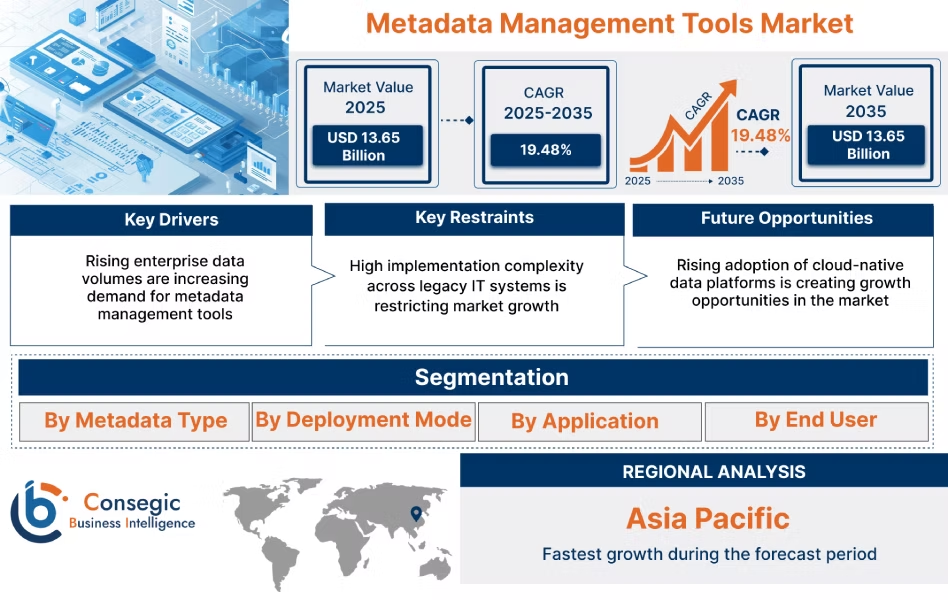
- Fastest Growth Region: Asia Pacific
- 2024 Market Size: USD 11.43 Billion
- 2025 Market Size: USD 13.65 Billion
- 2035 projected Market Size: USD 80.90 Billion
- CAGR (2025–2035): 19.48%
Report Highlights
- Technical metadata led with 1% share in 2024 due to data lineage demand
- Rising enterprise data volumes are increasing demand for metadata tools
- Rising cloud adoption is driving scalable data management requirements
- Focus on AI integration is improving metadata discovery and classification
- Strict regulatory compliance is increasing demand for data governance solutions
- North America held the largest share in 2024
Definition of Metadata Management Tools
Metadata management tools are software solutions used to organize, classify, and manage data. These tools support data discovery, governance, tracking, and cataloging. Organizations are using these solutions to ensure data consistency across databases, cloud computing solutions, analytics solutions, and business applications.
The market is witnessing growth due to an increase in data volume in organizations and an increasing need for data governance. Organizations are increasingly using these solutions to gain better visibility of data and ensure data compliance across digital applications. There is also an increasing trend in cloud computing solutions, analytics solutions, and AI-based data processing solutions, which is contributing to an increase in structured metadata management solutions.
Influence of AI on the Metadata Management Tools Market
Integration of AI with data discovery and data classification is becoming increasingly common in metadata management solutions. AI algorithms are used to analyze data sets and recognize data relationships across data repositories.
Enterprises are using AI-enabled metadata tools to improve data governance and analytics capabilities. In March 2025, Bedrock Security launched an industry-first metadata lake to improve data visibility, strengthen DSPM capabilities, and support responsible AI adoption. These tools help in the management of large volumes of data in the cloud, data lakes, and enterprise systems, which in turn improves the accuracy of data cataloging and data visibility.
Market Trends Shaping the Metadata Management Tools Industry
Rising enterprise data volumes are increasing demand for metadata management tools
Enterprises are creating large volumes of data in their enterprise systems and cloud platforms, which is mainly in the form of structured and unstructured data. Metadata management platforms are being used by enterprises to organize and maintain data consistency. Data teams use these platforms to improve data discovery and address data complexity.
For instance, in March 2026, Alation launched AI-based curation automation for metadata processes, reflecting rising enterprise data complexity. This is owing to the increasing data volumes in enterprises and the need for structured metadata management solutions.
Increasing focus on data governance is driving adoption of metadata platforms
Enterprises are enhancing their data governance infrastructure to address the rising complexity of data in their digital infrastructure. Organizations are employing metadata management tools to enhance data awareness and accuracy in their infrastructure. As per precisely, growth in data governance adoption is evident, with 71% of organizations reporting active programs this year, up from 60% in 2023. Thus, the trend is creating a rising demand for structured metadata management solutions in different sectors.
High Content Costs are Pressuring OTT Profit Margins
High content production and licensing costs are adding to the overall operating expenses for OTT service providers. Platforms are investing significantly in creating original content and media libraries to acquire new customers. Film production, as well as creating digital content, demands significant capital investment. Content creators are seeking higher licensing fees for streaming their content. This is affecting the profit margins of OTT service providers, especially for new players in the market.
High implementation complexity across legacy IT systems is restricting market growth
Many organizations have implemented legacy IT infrastructure that is not aligned with data governance requirements. The integration of metadata management tools with legacy systems is creating alignment issues. There is also a need to make technical changes in legacy systems. The low interoperability of old and new systems is making it difficult to deploy metadata management tools.
High initial investment costs are restricting adoption among small enterprises
There is a significant investment in terms of software, integration, and skilled resources is required for implementing metadata management platforms. Budget constraints and limited IT capabilities are challenges for small and mid-sized organizations. These limitations are affecting the adoption of these solutions.
Rising adoption of cloud-native data platforms is creating growth opportunities in the market
Enterprises are increasingly adopting cloud-based solutions for analytics, AI, and digital operations. These solutions are generating vast amounts of distributed data in cloud storage and data lakes. Enterprises are using metadata management solutions to provide data visibility, organization, and efficient access in cloud-based environments. The trend of moving towards multi-cloud environments is also creating demands for advanced metadata management solutions.
For instance, in November 2025, Cloudera announced integration with Apache Iceberg REST Catalog to provide unified metadata solutions in multi-cloud and hybrid environments. This is an example of increasing adoption of cloud-based solutions and demands for metadata management solutions.
Growth in data lakes and data warehouses creates future prospect for metadata management tools
Enterprises are adopting data lakes and data warehouses for storing and processing large amounts of structured and unstructured data. Data lakes and data warehouses need proper metadata management for proper data organization, accessibility, and traceability. According to Dremio, the top drivers for data lakehouse adoption are cost efficiency at 19%, data access and ease of use at 17%, and self-service analytics at 13%. In this regard, 41% of the user base has adopted data lakehouse after migrating from cloud data warehouses, and another 23% have come from traditional data lakes.
Geographical Breakdown
The market is analyzed across North America, Europe, Asia Pacific, Middle East and Africa, and Latin America.
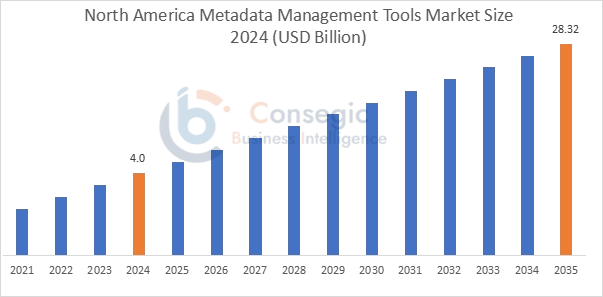
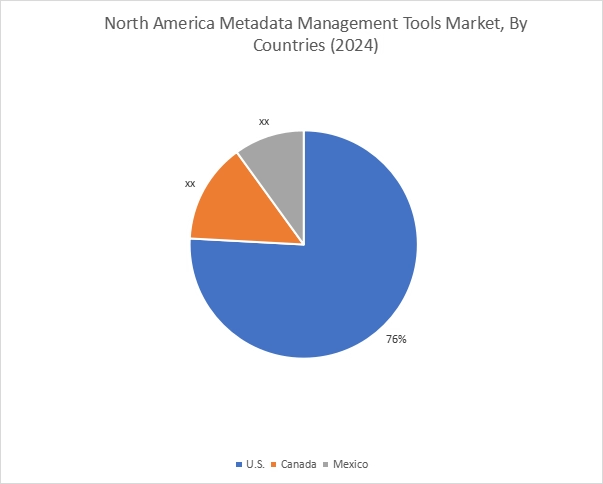
North America held the largest market share of 35% in 2024, with a value of USD 4.00 billion. The market is expected to reach USD 28.32 billion by 2035. The US market holds 76% of the regional market share in 2024. The rise in the adoption of cloud platforms and enterprise data management solutions also contributed to the market growth. Enterprises are also investing more in data governance to tackle large volumes of data.
For example, in December 2025, Collibra announced its partnership with Snowflake and other companies to form the Open Semantic Interchange (OSI) initiative. The OSI initiative is focused on creating a standard for semantic metadata.
Asia Pacific is projected to grow at the fastest rate during the forecast period. Growth in China is supported by rising digital transformation across enterprises. Japan is witnessing a rise in the adoption of enterprise data platforms and analytics solutions. India is witnessing growth in cloud-based data infra and data governance in IT and service industries.
For example, in July 2025, India Brand Equity Foundation announced that UPI processed 16.58 billion transactions in October 2024. This results in a need for metadata management tools to manage financial information.
Europe is witnessing steady growth due to proper data governance laws in countries like Germany, France, and the UK. Organizations are investing in data catalog platforms and enterprise data management systems.
Segmentation Analysis
By Metadata Type
The technical metadata segment held the largest market revenue share in 2024, at 55.1%. This can be attributed to the increasing requirement for data lineage tracking and system integration in complex enterprise data environments. Technical metadata supports data structure management and workflow tracking, which improves data consistency across platforms.
The business metadata segment is expected to register the highest CAGR in the market during the forecast period. The increasing adoption of self-service analytics is creating a strong requirement for better data interpretation and interaction between the business and data teams. The increasing emphasis on data transparency between various departments is also contributing to the growth of this segment.
By Deployment Mode
The cloud segment held the largest market revenue share in 2024. This can be attributed to the increasing adoption of cloud platforms for managing large-scale enterprise data. Cloud deployment supports scalable data management and integration with AI and analytics systems, which improves operational flexibility. Rise in adoption of multi-cloud technology is further fueling growth for cloud-based metadata tools.
The on-premises segment is expected to witness the highest CAGR during the forecast period. The need for data control and regulatory compliance is driving the adoption of metadata tools in organizations that require data security. The need for internal IT infrastructure is also fueling growth for on-premises technology.
By Application
The data governance segment held the largest share in the market in 2024. This is due to the increasing emphasis put on data quality, data lineage, and compliance in organizations. Metadata tools help in ensuring data transparency and structured data governance. In addition, rising regulatory demands are also contributing to the adoption of data governance-based metadata solutions.
The risk and compliance management segment is expected to register the highest CAGR during the forecast period. Rising data regulations are increasing demand for monitoring, auditing, and risk identification across enterprise data environments. Increasing investments in compliance frameworks are further supporting segment growth.
By End User
The BFSI sector was the largest segment in 2024. This is because of high transactional data volumes and stringent regulatory needs for tracking and reporting data. Financial services organizations utilize metadata tools for data accuracy and governance. The rise in digital banking platforms is also contributing to the growth of structured data management solutions.
Healthcare and life sciences is likely to have the highest CAGR in the forecast period. The increasing volume of clinical and patient data is contributing to structured data management and compliance in healthcare systems. The rise in digital health records is also contributing to the growth of metadata management tools.
Competitive Landscape of Metadata Management Tools Market
The moderately competitive structure of the metadata management tools market is dominated by data governance, data cataloging, and metadata integration. Companies are developing and improving the capabilities of the platform with AI-enabled metadata discovery, cloud integration, and analytics. The increasing adoption of AI-based automation and cloud-based data environments is creating competition among the participants in the market.
Key players operating in the metadata management tools market include :
- IBM Corporation
- Oracle Corporation
- Informatica Inc.
- SAP SE
- Collibra NV
- Alation Inc.
- TIBCO Software Inc.
- Talend Inc.
- Quest Software Inc.
- Ataccama Corporation.
Latest News:
- In February 2026, Quest Software introduced its Trusted Data Management Platform with an Automated Data Product Factory to offer AI-ready data governance, cataloging, and quality solutions.
- In July 2025, Ataccama Corporation announced the availability of Ataccama ONE v16.2 with AI-powered data lineage to automate metadata insights.
Metadata Management Tools Market Report Insights:
| Report Attributes | Report Details |
|---|---|
| Study Timeline | 2019-2035 |
| Market Size in 2035 (USD Billion) | USD 80.90 Billion |
| CAGR (2025-2035) | 19.48%% |
| By Metadata Type |
|
| By Deployment Mode |
|
| By Application |
|
| By End User |
|
| By Region |
|
| Key Players |
|
| Report Coverage |
|
Key Questions Answered in the Report
How big is the metadata management tools market? −
The metadata management tools market size is estimated to reach over USD 80.90 Billion by 2035 from a value of USD 11.43 Billion in 2024 and is projected to grow by USD 13.65 Billion in 2025, growing at a CAGR of 19.48% from 2025 to 2035.
Which segmentation details are covered in the metadata management tools report? +
The metadata management tools report includes specific segmentation details for metadata type, deployment mode, application, end user, and regions.
Which is the fastest segment anticipated to impact the market growth? +
Business metadata is the fastest growing segment due to rising demand for improved data understanding across business units.
Who are the major players in the metadata management tools market? +
The key participants in the metadata management tools market are IBM Corporation (US), Oracle Corporation (US), Informatica Inc. (US), SAP SE (Germany), Collibra NV (Belgium), Alation Inc. (US), TIBCO Software Inc. (US), Talend Inc. (US), Quest Software Inc. (US), Ataccama Corporation (Canada), and others.
What are the key trends in the metadata management tools market? +
Increasing adoption of cloud-based data platforms and AI-enabled metadata discovery tools is shaping the market.
Overview
Reputation & Certifications


Our Services
- Market Intelligence & Forecasting
- Custom Research Solutions
- Market Entry Strategy
- Competitive Intelligence
- Customer Insights
- Industry Innovation Analysis
- Investment Advisory