Jump to Content
Microencapsulation Market - Size, Share, Industry Trends, and Forecasts (2025-2032)
Microencapsulation Market Size:
Microencapsulation market size is estimated to reach over USD 32.05 Billion by 2032 from a value of USD 16.86 Billion in 2024 and is projected to grow by USD 17.97 Billion in 2025, growing at a CAGR of 8.4% from 2025 to 2032.
Microencapsulation Market Scope & Overview:
Microencapsulation is a technology that involves enclosing active ingredients within a protective coating, creating microcapsules of 1 to 100 µm average diameter, to enhance stability, controlled release, and functionality. This technique is widely applied in pharmaceuticals, food and beverages, agriculture, and personal care products to improve ingredient performance and extend shelf life. Encapsulation materials include polymers, lipids, and carbohydrates, selected based on the intended application and release mechanism.
Key features include precise ingredient protection, targeted delivery, and enhanced solubility of encapsulated compounds. This technology ensures controlled release, improves bioavailability, and minimizes degradation from environmental factors such as heat, moisture, and oxidation. It also allows for masking undesirable tastes and odors, making it particularly beneficial in food and pharmaceutical formulations.
Industries such as healthcare, cosmetics, and agrochemicals utilize this technology to enrich product effectiveness and stability. The continuous refinement of encapsulation techniques is expanding its application potential, ensuring improved efficiency and product innovation across multiple sectors.
How is AI Transforming the Microencapsulation Market?
The integration of AI is considerably transforming the microencapsulation market. Moreover, AI-powered systems are used for improving several processes, ranging from research and development to production and quality control. AI-powered tools enable predictive modeling for optimal conditions, accelerate the discovery of new materials, enhance manufacturing efficiency through real-time monitoring and adjustments, and improve the consistency and quality of microencapsulated products across various sectors such as pharmaceuticals, food, agrochemicals, and others. Consequently, the above factors are anticipated to drive the market growth in upcoming years.

Microencapsulation Market Dynamics - (DRO):
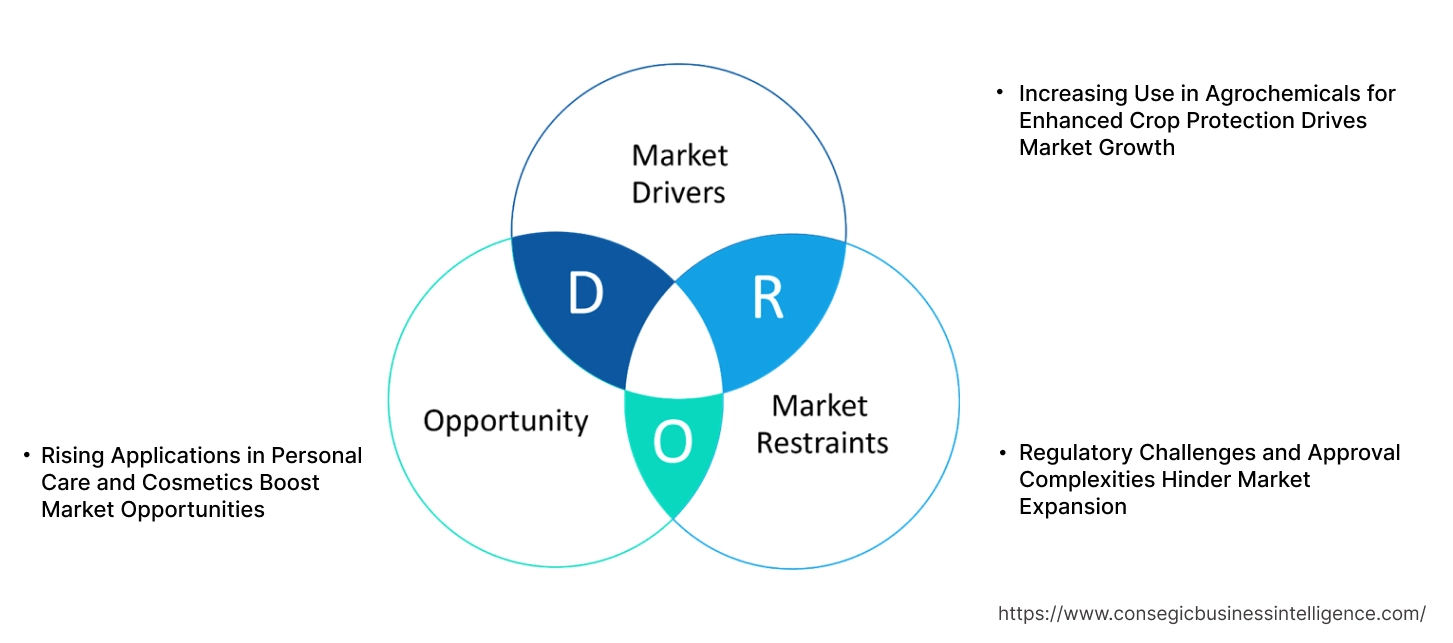
Key Drivers:
Increasing Use in Agrochemicals for Enhanced Crop Protection Drives Market Growth
Conventional pesticides, herbicides, and fertilizers often suffer from rapid degradation, volatility, and environmental leaching due to UV exposure, moisture, and soil interactions, reducing their effectiveness and increasing application costs. However, microencapsulation technology enables controlled release, targeted delivery, and enhanced stability of active ingredients, ensuring prolonged protection against pests, weeds, and nutrient deficiencies. This approach minimizes chemical runoff, reduces toxicity to non-target organisms, and enhances field performance, making it a preferred solution for precision farming. Furthermore, encapsulated formulations improve adhesion to plant surfaces and soil particles, reducing wastage and improving absorption by crops. Additionally, the demand for eco-friendly and bio-based agrochemical formulations is growing, driving the adoption of encapsulated products that comply with regulatory and environmental standards. As agricultural industries invest in next-generation controlled-release formulations, the development of advanced encapsulation techniques is expected to accelerate microencapsulation market expansion, ensuring broader adoption across global crop protection markets.
Key Restraints:
Regulatory Challenges and Approval Complexities Hinder Market Expansion
Government agencies, including the FDA, EFSA, and EPA, enforce strict guidelines on ingredient safety, environmental impact, and product efficacy, requiring extensive testing and compliance documentation. The approval process for encapsulated active ingredients involves long validation cycles, stability testing, and toxicological assessments, leading to increased costs and delayed market entry. Variations in regional regulations further complicate the process, forcing manufacturers to reformulate products and navigate differing compliance requirements. The demand for encapsulated ingredients is rising across multiple industries, but the need for detailed risk assessments and adherence to evolving regulatory frameworks slows product commercialization. Companies investing in regulatory expertise, alternative encapsulation materials, and eco-friendly formulations are better positioned to overcome these hurdles. Addressing these regulatory barriers is critical for ensuring microencapsulation market growth while maintaining product safety and compliance.
Future Opportunities:
Rising Applications in Personal Care and Cosmetics Boost Market Opportunities
Microencapsulation technology is widely applied in skincare, haircare, and fragrance formulations to protect active ingredients such as vitamins, antioxidants, essential oils, and UV filters from degradation. This ensures prolonged efficacy and improved absorption into the skin or hair. The demand for advanced cosmetic formulations with long-lasting fragrance, time-release moisturization, and anti-aging properties is driving investments in these technologies. Additionally, the shift toward natural and sustainable beauty products have accelerated the use of bio-based encapsulants that enhance product performance while maintaining clean-label formulations. Innovations such as triggered-release encapsulation for temperature-activated and pH-responsive skincare are gaining traction.
- For instance, in September 2023, Tagra Biotechnologies and Dermaclaim Lab collaborated to publish the formulation and in vitro evaluation of WS Biotin, a novel encapsulated form of D-Biotin with improved water solubility for hair and skin treatment applications. The compound is known for its hair keratinization and skin-lightening properties.
As cosmetic brands continue integrating cutting-edge delivery systems, the growth of advanced encapsulation techniques is expected to drive microencapsulation market opportunities, shaping the future of high-performance beauty products.
Microencapsulation Market Segmental Analysis :
By Technology:
By technology, the microencapsulation market is segmented into spray drying, emulsion-based, coacervation, liposome encapsulation, fluidized bed encapsulation, polymerization, and others.
The spray drying segment held the largest revenue share in 2024.
- Spray drying is widely used due to its cost-effectiveness, scalability, and high encapsulation efficiency across multiple industries.
- The need for controlled-release formulations in pharmaceuticals, food ingredients, and nutraceuticals is driving the adoption of spray drying technology.
- As per segmental analysis, continuous advancements in spray drying techniques are enhancing the stability and bioavailability of active compounds.
- Microencapsulation market trends suggest that spray drying will remain dominant, particularly in pharmaceutical and functional food formulations.
The liposome encapsulation segment is expected to experience the fastest CAGR during the forecast period.
- Liposome encapsulation is gaining traction in pharmaceuticals and cosmetics due to its ability to enhance the delivery and absorption of bioactive ingredients.
- The rising need for nano-encapsulation solutions in drug delivery and skincare is accelerating the adoption of liposomal technology.
- Segmental trends highlight a surge in the use of liposomes for targeted drug delivery and sustained release mechanisms.
- Market analysis shows that the integration of nanotechnology is fueling microencapsulation market growth in the pharmaceutical and personal care sectors.
By Coating Material:
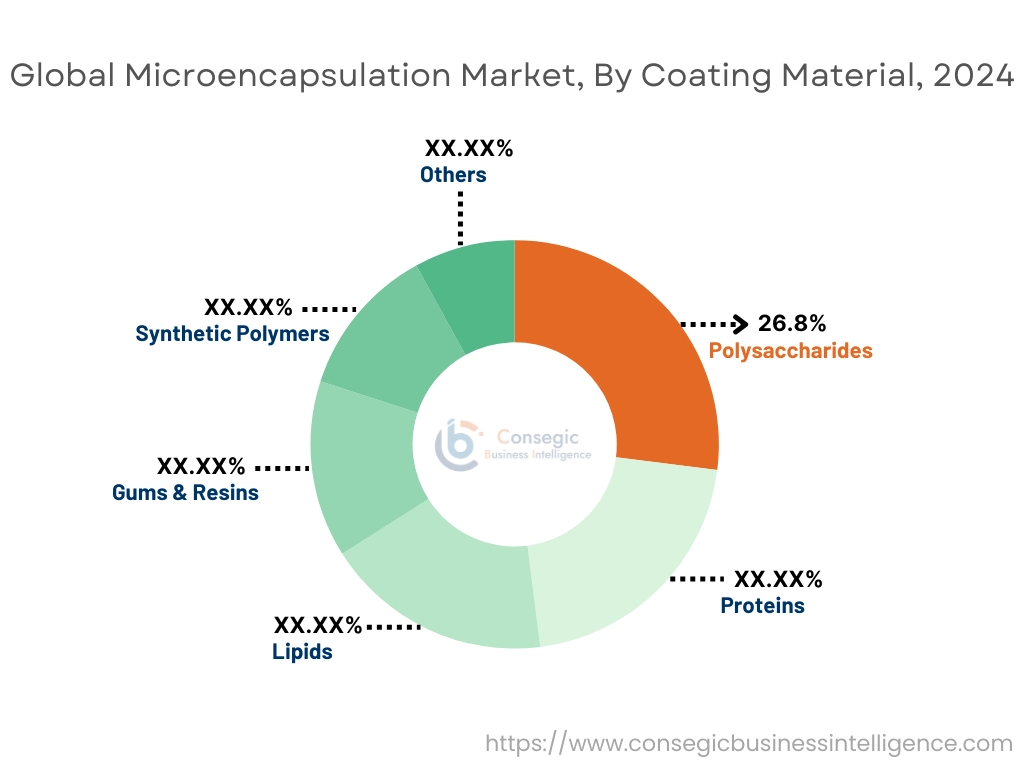
Based on coating material, the market is segmented into polysaccharides, proteins, lipids, gums & resins, synthetic polymers, and others.
The polysaccharides segment held the largest microencapsulation market share of 26.8% in 2024.
- Polysaccharides such as starch, alginate, and cellulose are widely used due to their biodegradability, cost-effectiveness, and compatibility with food and pharmaceutical applications.
- The need for natural and eco-friendly encapsulation materials is contributing to the growth of polysaccharide-based coatings.
- Microencapsulation market analysis reveals that the preference for plant-derived materials in food and nutraceutical applications is boosting market demand.
- Segmental trends analysis indicates that polysaccharides will remain the preferred coating material, particularly for clean-label and organic product formulations.
The lipids segment is anticipated to experience the fastest CAGR during the forecast period.
- Lipid-based product offers enhanced stability, controlled release, and improved bioavailability, making it ideal for pharmaceuticals, cosmetics, and functional foods.
- The rising need for encapsulated omega-3 fatty acids, probiotics, and lipid-soluble vitamins is driving the adoption of lipid-based coating materials.
- Segmental trends analysis shows that lipid coatings are increasingly being used in functional and fortified foods, offering better ingredient protection.
- Microencapsulation market expansion is expected, particularly in the health and wellness sector, where lipid-coated formulations enhance nutrient absorption.
By Application:
Based on application, the market is segmented into pharmaceutical & healthcare, food & beverages, personal care & cosmetics, agriculture, household & industrial products, textiles, chemicals, and others.
The pharmaceutical & healthcare segment held the largest microencapsulation market share in 2024.
- Microencapsulation plays a crucial role in drug delivery systems, enhancing solubility, stability, and targeted release of active pharmaceutical ingredients (APIs).
- The need for sustained release and controlled drug formulations is driving its widespread adoption in pharmaceutical research and development.
- Microencapsulation market analysis highlights that advancements in polymer-based drug carriers are improving treatment efficacy and reducing side effects.
- Market trends suggest continued investment in encapsulated probiotics, bioactive compounds, and personalized medicine solutions.
The food & beverages segment is expected to have the fastest CAGR during the forecast period.
- The rising requirement for functional foods, fortified ingredients, and natural flavor protection is accelerating its adoption in food applications.
- Encapsulation of probiotics, vitamins, minerals, and essential oils is enabling extended shelf life and improved ingredient stability in food products.
- Microencapsulation market trends indicate growing interest in plant-based and clean-label solutions to meet consumer preferences.
- In March 2023, Foodberry partnered with NadaMoo! to develop and launch a range of coatings—including mango, orange creme, peanut butter, mint, and salted caramel—to encapsulate their chocolate, vanilla and strawberry-flavored coconut milk ice cream using their patented technology.
- Market analysis suggests that innovations in encapsulated sweeteners, caffeine, and plant-based proteins will further drive microencapsulation market demand in the food sector.
Regional Analysis:
The regions covered are North America, Europe, Asia Pacific, the Middle East and Africa, and Latin America.
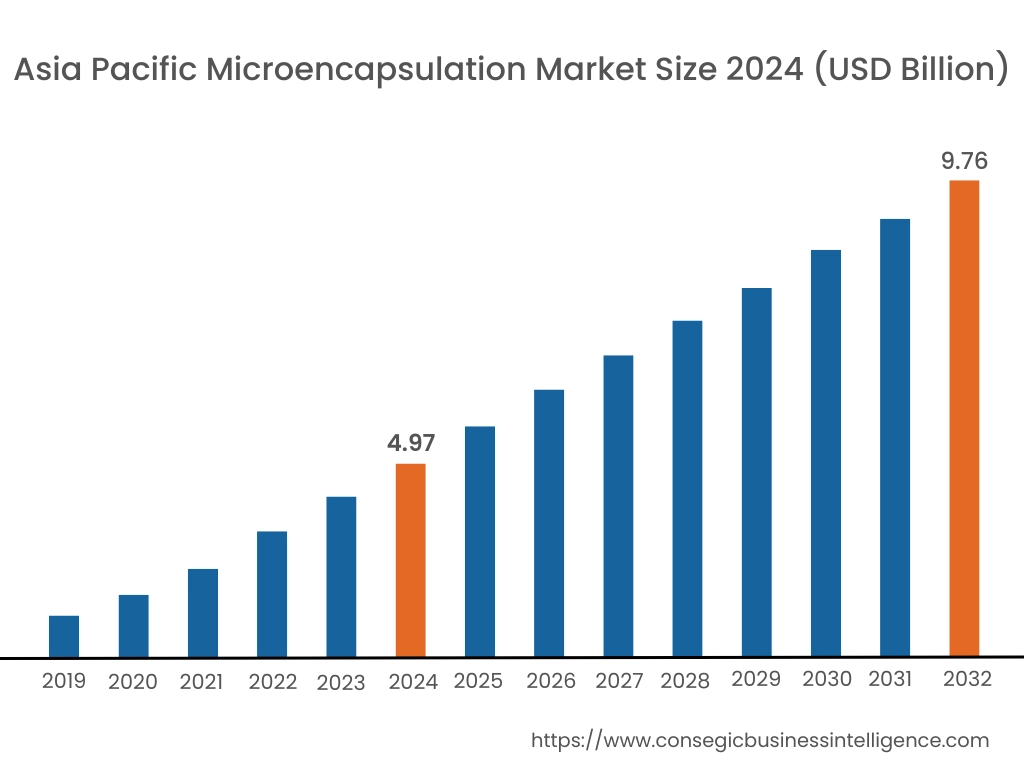
Asia Pacific is estimated to reach over USD 9.76 Billion by 2032 from a value of USD 4.97 Billion in 2024 and is projected to grow by USD 5.31 Billion in 2025. Out of this, China accounted for the maximum revenue share of 32.6%. Asia Pacific is driven by rapid industrialization and increasing consumer health awareness. Countries like China, India, and Japan are witnessing a surge in need for functional foods, dietary supplements, and advanced pharmaceutical products. This technology is pivotal in these sectors, enhancing product stability and efficacy. The region's expanding middle-class population, coupled with rising disposable incomes, fuels the need for premium personal care and cosmetic products incorporating microencapsulated active ingredients. Government support for research and development further accelerates market growth, presenting substantial opportunities for industry stakeholders.

North America region was valued at USD 5.59 Billion in 2024. Moreover, it is projected to grow by USD 5.95 Billion in 2025 and reach over USD 10.39 Billion by 2032. North America stands as a dominant force, propelled by rapid technological progress and significant investments in research and development. The region's robust pharmaceutical sector extensively employs microencapsulation to enhance drug delivery systems, improve bioavailability, and ensure controlled release of active ingredients. Additionally, the food and beverage sector utilizes this technology to encapsulate flavors, vitamins, and probiotics, thereby extending product shelf life and maintaining nutritional value. The presence of key industry players and a strong focus on innovation further amplify the region's market position.
In Europe, the market is characterized by a strong emphasis on sustainability and advanced material sciences. The region's well-established pharmaceutical and cosmetic industries are integrating microencapsulation to develop products with targeted delivery and controlled release properties. Moreover, the agrochemical sector benefits from this technology by improving the efficacy and environmental safety of pesticides and fertilizers. Collaborative research initiatives and stringent regulatory frameworks ensure high-quality standards, fostering consumer trust and expanding market applications.
Latin America's microencapsulation industry is gradually gaining momentum, primarily driven by the food and beverage and pharmaceutical sectors. The region's rich biodiversity offers a plethora of natural extracts and flavors, which, when microencapsulated, find applications in functional foods and nutraceuticals. Additionally, there is a growing trend of incorporating microencapsulated agrochemicals to enhance crop protection and yield. Challenges such as economic fluctuations and limited technological infrastructure exist; however, increasing investments and partnerships are paving the way for market expansion.
In the Middle East and Africa, the market is in its nascent stage but shows promising potential. The pharmaceutical sector's growth, driven by increasing healthcare investments, is a significant contributor to the adoption of this technology. Moreover, the cosmetic industry is exploring microencapsulation to develop products suitable for the region's climatic conditions, offering sustained release of active ingredients. While challenges such as limited research facilities and awareness persist, the rising demand for fortified foods and personalized medicine presents viable microencapsulation market opportunities.
Top Key Players & Market Share Insights:
The microencapsulation market is highly competitive with major players providing products and services to the national and international markets. Key players are adopting several strategies in research and development (R&D), product innovation, and end-user launches to hold a strong position in the global microencapsulation market. Key players in the microencapsulation industry include –
- BASF SE (Germany)
- International Flavors & Fragrances Inc. (US)
- Balchem Corporation (US)
- Sensient Technologies Corporation (US)
- Syngenta AG (Switzerland)
- Givaudan SA (Switzerland)
- Symrise AG (Germany)
- FrieslandCampina (Netherlands)
- DSM-Firmenich (Switzerland)
- Cargill, Incorporated (US)
Recent Industry Developments :
Product Launches:
- In January 2025, Spray-Tek received patent for breakthrough biodegradable microencapsulation The approach modifies a biopolymer using sustainable materials to form highly effective core/shell microcapsules that provide robust protection.
Partnerships:
- In July 2024, Xampla partnered with Yili to deploy their nutrient microcapsule technology for the fortification of vitamins and nutrients in a new range of products. This technology guards against degradation risks from UV, pH, or heat shock in products, ensuring optimal fortification of well-being ingredients and bringing healthy food products to consumers globally independent of environmental conditions.
Microencapsulation Market Report Insights:
| Report Attributes | Report Details |
| Study Timeline | 2019-2032 |
| Market Size in 2032 | USD 32.05 Billion |
| CAGR (2025-2032) | 8.4% |
| By Technology |
|
| By Coating Material |
|
| By Application |
|
| By Region |
|
| Key Players |
|
| North America | U.S. Canada Mexico |
| Europe | U.K. Germany France Spain Italy Russia Benelux Rest of Europe |
| APAC | China South Korea Japan India Australia ASEAN Rest of Asia-Pacific |
| Middle East and Africa | GCC Turkey South Africa Rest of MEA |
| LATAM | Brazil Argentina Chile Rest of LATAM |
| Report Coverage |
|
Key Questions Answered in the Report
How big is the Microencapsulation Market? −
Microencapsulation market size is estimated to reach over USD 32.05 Billion by 2032 from a value of USD 16.86 Billion in 2024 and is projected to grow by USD 17.97 Billion in 2025, growing at a CAGR of 8.4% from 2025 to 2032.
What specific segmentation details are covered in the Microencapsulation Market report? +
The microencapsulation market report includes specific segmentation details for coating material, technology and applications.
Which is the fastest-growing region in the Microencapsulation Market? +
Asia Pacific is the fastest-growing region in the microencapsulation market. These trends are encouraged by rapid industrialization and increasing consumer health awareness.
Who are the major players in the Microencapsulation Market? +
The key participants in the microencapsulation market are BASF SE (Germany), International Flavors & Fragrances Inc. (US), Givaudan SA (Switzerland), Symrise AG (Germany), FrieslandCampina (Netherlands), DSM-Firmenich (Switzerland), Cargill, Incorporated (US), Balchem Corporation (US), Sensient Technologies Corporation (US) and Syngenta AG (Switzerland).
Overview
Reputation & Certifications


Our Services
- Market Intelligence & Forecasting
- Custom Research Solutions
- Market Entry Strategy
- Competitive Intelligence
- Customer Insights
- Industry Innovation Analysis
- Investment Advisory