Jump to Content
Milk Fat Fractions Market - Size, Share, Industry Trends, and Forecasts (2025-2032)
Milk Fat Fractions Market Size:
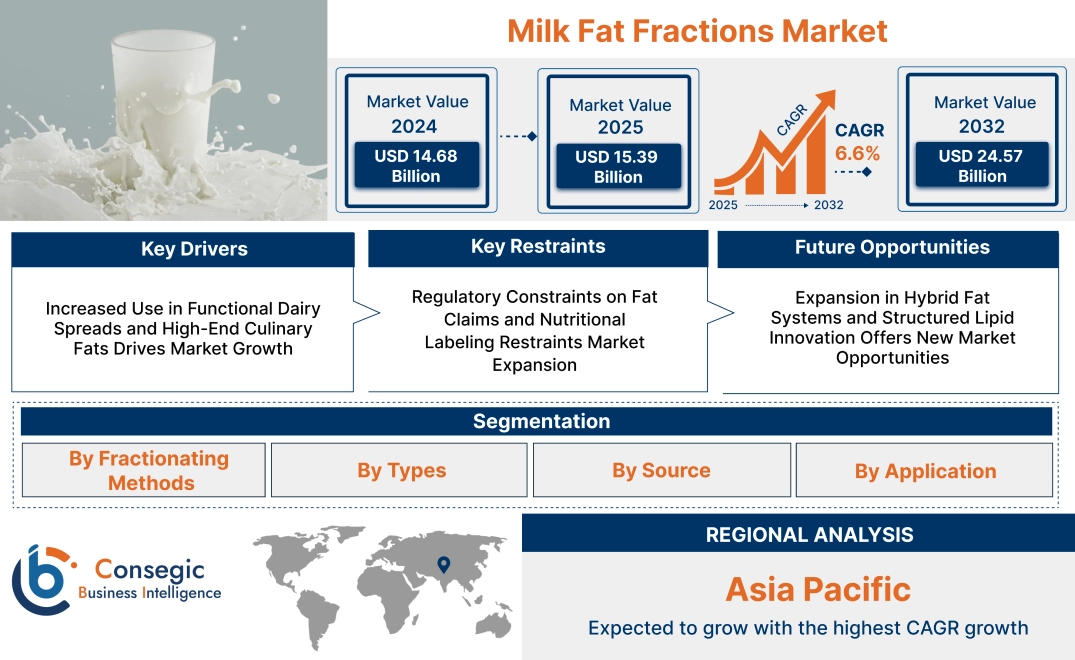
Milk Fat Fractions Market size is estimated to reach over USD 24.57 Billion by 2032 from a value of USD 14.68 Billion in 2024 and is projected to grow by USD 15.39 Billion in 2025, growing at a CAGR of 6.6% from 2025 to 2032.
Milk Fat Fractions Market Scope & Overview:
Milk fat fractions are specialized components derived from the separation of milk fat through controlled crystallization and filtration processes. These fractions are categorized based on melting points and fatty acid composition, allowing for tailored applications in different industries. They provide distinct functional properties that improve texture, flavor release, and product stability.
Key features include specific melting profiles, oxidative stability, and compatibility with various formulations. Their ability to enhance spreadability, creaminess, and mouthfeel makes them ideal for bakery products, infant nutrition, nutraceuticals and confectionery applications. Additionally, select fractions are used in cosmetic formulations for their emollient and moisturizing properties.
Food manufacturers, dairy processors, and cosmetic formulators utilize milk fat fractions to optimize product performance and meet application-specific requirements. Ongoing refinement in fractionation techniques ensures consistency, purity, and versatility, supporting their integration into diverse, value-added product categories across global markets.
How is AI Transforming the Milk Fat Fractions Market?
AI is being increasingly used in the milk fat fractions market. AI-powered solutions are being used for several applications, ranging from improving dairy farm efficiency and milk quality to optimizing manufacturing processes and supply chain management. AI-powered systems can analyze vast datasets to predict optimal fractionation methods, develop specialized fat fractions, enhance product quality control, reduce waste through predictive maintenance, and optimize logistics. Moreover, AI-powered sensors and analytical tools can monitor production lines in real-time to ensure consistent product quality and minimize waste. Additionally, AI tools are used to detect anomalies and defects in real-time during production, in turn preventing issues and product recalls. Thus, the above factors are projected to drive the market growth during the forecast period.
Milk Fat Fractions Market Dynamics - (DRO):
Key Drivers:
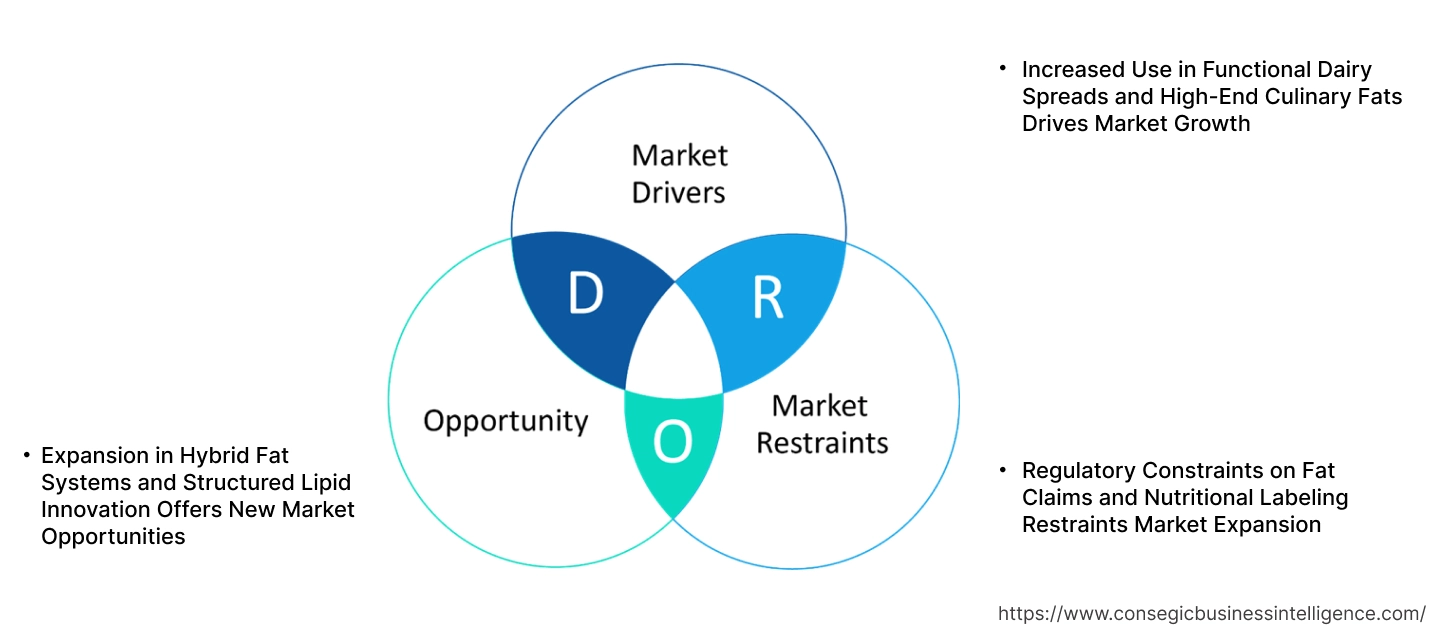
Increased Use in Functional Dairy Spreads and High-End Culinary Fats Drives Market Growth
Premium dairy applications are increasingly integrating specialized milk fat fractions to enhance performance, texture, and sensory attributes. These fractions offer superior spreadability, precise melting behavior, and enhanced oxidative stability, making them ideal for clarified butter alternatives, whipped dairy spreads, and gourmet fat blends. Culinary professionals and food manufacturers in the HORECA sector favor these ingredients for their consistency in heat application and flavor delivery. Low-melting-point fractions provide excellent cold spread functionality, while butyric-rich components deliver rich, buttery flavor ideal for bakery fillings and table spreads. Consumer preferences for indulgent, clean-label, and chef-formulated dairy products have further increased demand for these functional fats. The innovation focus in dairy fats is shifting toward tailored performance across temperature profiles and culinary use cases. This increasing application in premium formulations continues to drive milk fat fractions market expansion.
Key Restraints:
Regulatory Constraints on Fat Claims and Nutritional Labeling Restraints Market Expansion
Despite the functional and sensory advantages of dairy-derived fats, the expansion of value-added applications is hindered by regulatory constraints related to saturated fat content. In regions such as North America and the European Union, front-of-pack labeling systems discourage the marketing of products high in saturated fats, regardless of their nutritional efficacy or digestibility. As a result, manufacturers are restricted in positioning these products within health-forward categories, reducing visibility in wellness-driven retail segments. The regulatory limitations also impact product development strategies, as formulators are required to balance sensory quality with nutritional thresholds. This compliance challenge affects food categories such as functional spreads, infant nutrition, and bakery applications where fat plays a pivotal structural role. With rising consumer awareness around fat quality, there remains a demand for greater transparency and regulatory clarity. However, until labeling policies evolve, these constraints continue to moderate milk fat fractions market growth.
Future Opportunities:
Expansion in Hybrid Fat Systems and Structured Lipid Innovation Offers New Market Opportunities
The advancement of hybrid fat systems combining dairy fractions with plant-based oils is creating new product development possibilities across multiple food categories. These systems are engineered to achieve customized melting curves, improved flavor release, and clean-label functionality while optimizing formulation costs. Food manufacturers are utilizing structured lipids to enhance mouthfeel and stability in frozen desserts, bakery shortenings, and plant-dairy blends used in non-dairy creamers. The ability to design application-specific fats using enzymatic interesterification or physical blending is enabling high-performance products that meet evolving consumer expectations for taste and sustainability. The growing demand for premium yet balanced fat systems across functional food segments and the convergence of culinary and health needs are shaping the innovation landscape.
- For instance, in August 2020, So Delicious® Dairy Free unveiled new Light Frozen Desserts in new flavors with a lower calorie count as well as gluten and dairy free. The flavors available are salted caramel, peanut butter, strawberry, cocoa chip, mint chip and tiramisu.
As structured lipid platforms continue to gain traction in commercial formulation, they are expected to unlock long-term milk fat fractions market opportunities through enhanced versatility and nutritional alignment.
Milk Fat Fractions Market Segmental Analysis :
By Fractionating Methods:
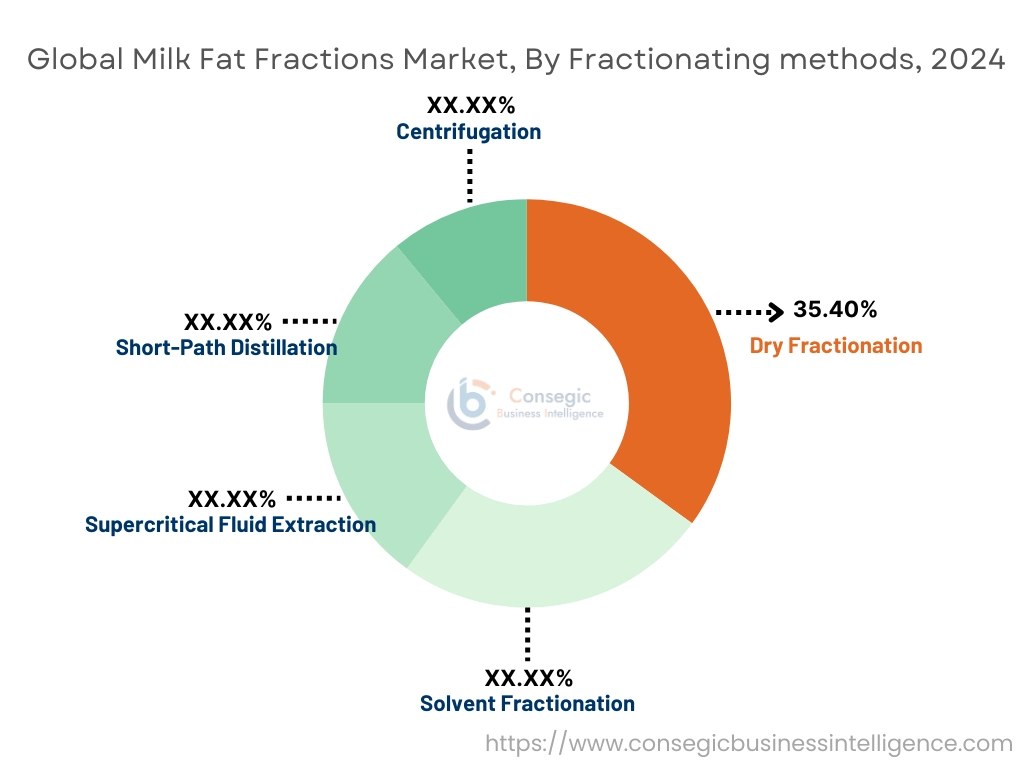
Based on fractionating methods, the milk fat fractions market is segmented into dry fractionation, solvent fractionation, supercritical fluid extraction, short-path distillation, and centrifugation.
The dry fractionation segment accounted for the largest market share of 35.4% in 2024.
- Dry fractionation is widely adopted due to its solvent-free nature, cost-effectiveness, and ability to maintain nutritional integrity.
- It is preferred by food manufacturers for applications in bakery fats and confectionery coatings.
- Milk fat fractions market analysis reveals that dry fractionation enables high-yield extraction of low-melting fractions used in spreads and creams.
- As per market trends, the increased usage of dry methods in sustainable dairy processing minimizes environmental impact.
The supercritical fluid extraction segment is projected to register the fastest CAGR.
- This method offers high selectivity and is suitable for producing purified fractions rich in bioactive lipids.
- The need for functional food ingredients and nutraceuticals is fueling the adoption of supercritical techniques.
- Milk fat fractions market trends reflect growing R&D interest in supercritical CO₂ for extracting tailored lipid profiles.
- Its ability to eliminate solvent residues aligns with regulatory trends in infant and medical nutrition segments, resulting in its expansion.
By Types:
Based on types, the market is segmented into low melting fractions, medium melting fractions, and high melting fractions.
The low melting fractions segment held the dominant milk fat fractions market share in 2024.
- These fractions are ideal for spreads, soft butter, and cold-process bakery applications due to their smooth texture and spreadability.
- The need for clean-label and functional dairy fat substitutes supports the segment’s growth.
- Market analysis indicates strong consumption in both foodservice and industrial baking sectors.
- As per milk fat fractions market trends, the rising processed food consumption results in increased usage in developing regions.
The high melting fractions segment is expected to grow at the fastest CAGR.
- These fractions are used in products requiring thermal stability, such as chocolate coatings and frying fats.
- As demand rises for heat-resistant fats in tropical climates, this segment is gaining traction.
- The market is being driven by new applications in confectionery and dairy whipping creams.
- Thus, ongoing product reformulations in high-temperature food systems are fueling this segment’s contribution to milk fat fractions market growth.
By Source:
Based on source, the market is segmented into Bovidae milk (cow, buffalo, goat, sheep) and plant-based milk (coconut, soy).
The Bovidae milk segment accounted for the largest market share in 2024.
- Cow milk continues to dominate fractionation due to its standard fat profile, processing compatibility, and global availability.
- Buffalo milk provides high milk fat content, making it suitable for fractionation into richer high high-melting fractions.
- Milk fat fractions market analysis shows consistent investment in buffalo and sheep milk value chains across South Asia and Europe.
- With ongoing requirement for origin-specific dairy ingredients, traditional animal sources maintain dominance.
The plant-based milk segment is expected to exhibit the fastest CAGR.
- Fractionation of coconut and soy milk fats is gaining interest in vegan and lactose-intolerant consumer segments.
- The need for non-dairy functional fat ingredients is rising in clean-label bakery and personal care applications.
- Market trends highlight innovation in plant-based ghee alternatives and confectionery coatings.
- Thus, this segment supports milk fat fractions market expansion by catering to sustainable and allergen-free diets.
By Application:
Based on application, the milk fat fractions market is segmented into bakery & confectionery, dairy products, infant nutrition, functional foods, ready-to-eat meals, cosmetics & personal care, and others.
The bakery & confectionery segment held the largest milk fat fractions market share in 2024.
- Milk fat fractions are integral in the production of laminated dough, chocolate fillings, and compound coatings.
- The need for fats with specific melting behavior drives customization among bakery product developers.
- Market analysis indicates strong penetration in developed markets and emerging bakery sectors in Asia-Pacific.
- As per segmental trends, there has been a rise in replacing trans-fat with medium and high melting dairy fractions.
The infant nutrition segment is projected to grow at the fastest CAGR.
- Structured milk fats are formulated to mimic the lipid composition of human breast milk, enhancing infant formula performance.
- The need for high-digestibility and immune-supporting lipids in neonatal products is accelerating innovation.
- Market trends highlight the use of advanced fractionation and enzymatic interesterification techniques.
- For instance, in November 2021, Arla Foods Ingredients pioneered a groundbreaking technology to revolutionize innovation for the dairy industry and opening up new opportunities for taking infant formula and sports products.
- Regulatory support for dairy lipid fortification in infant formulations is contributing to the milk fat fractions market demand.
Regional Analysis:
The regions covered are North America, Europe, Asia Pacific, the Middle East and Africa, and Latin America.
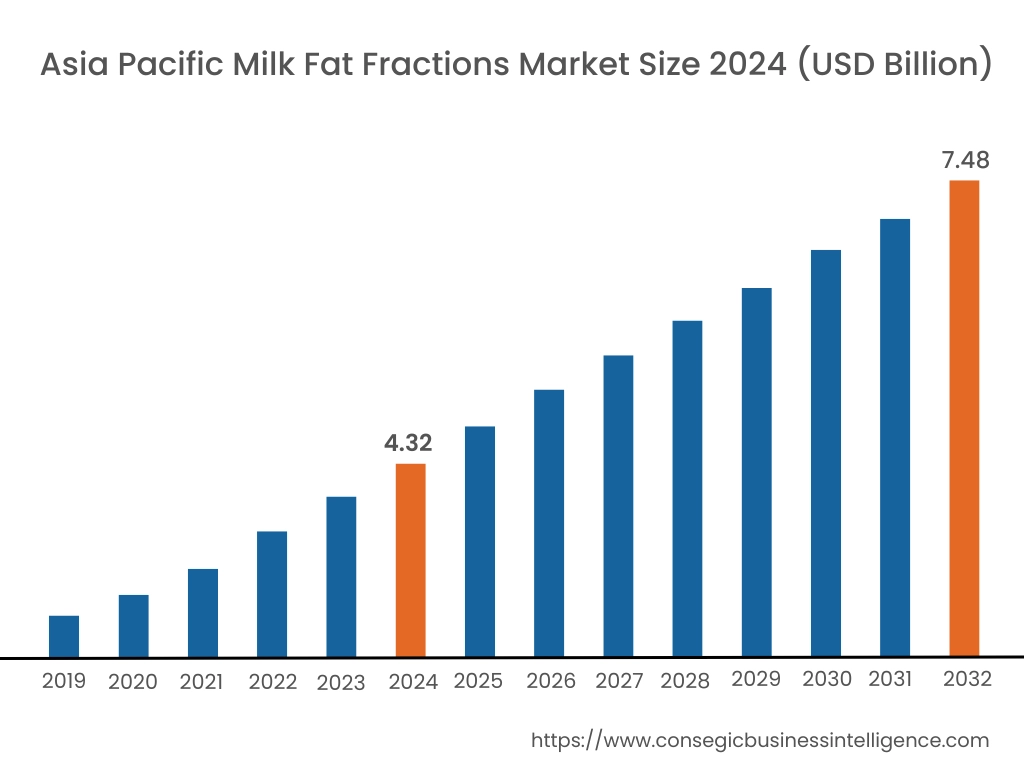
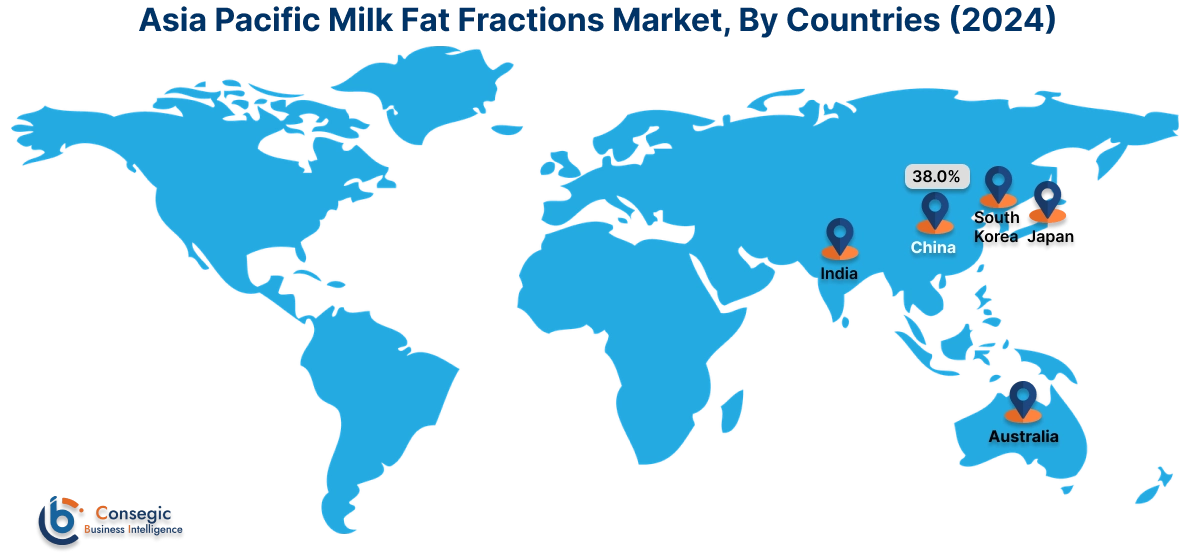
Asia Pacific region was valued at USD 4.32 Billion in 2024. Moreover, it is projected to grow by USD 4.55 Billion in 2025 and reach over USD 7.48 Billion by 2032. Out of this, China accounted for the maximum revenue share of 38.0%. Asia-Pacific is the fastest-growing region in the milk fat fractions industry, supported by rising urbanization, evolving dietary habits, and increasing interest in dairy-based functional foods. Countries such as China, India, Japan, and Australia are witnessing a surge in applications across bakery, frozen desserts, and nutritional supplements. The expanding middle class and growing awareness of health and wellness benefits associated with structured lipids and essential fatty acids are driving demand for specialty milk fat derivatives. Regional market analysis indicates that partnerships between local dairy firms and global ingredient manufacturers are helping to scale processing capacity and meet rising consumer expectations for both taste and nutritional quality.
North America is estimated to reach over USD 7.96 Billion by 2032 from a value of USD 4.87 Billion in 2024 and is projected to grow by USD 5.10 Billion in 2025. North America maintains a strong position in the milk fat fractions market, driven by well-established dairy processing infrastructure and significant consumption of functional food ingredients. The United States and Canada exhibit consistent demand across bakery, confectionery, and infant nutrition applications. Additionally, innovations in fractionation techniques and ingredient customization have allowed manufacturers to develop value-added dairy lipids tailored to health-conscious consumers. Market analysis suggests that the integration of milk fat derivatives into high-end culinary applications and dietary supplements will continue to support regional growth, particularly as clean-label preferences influence product formulation.
Europe represents a mature and innovation-driven market, characterized by high regulatory standards and a strong focus on product quality and traceability. Countries like Germany, France, the Netherlands, and Denmark are home to leading dairy processors actively engaged in fractionation of milk fat for use in premium chocolate, processed cheese, and medical nutrition. The region's emphasis on sustainability and traceable sourcing further enhances its global competitiveness. Analysis reveals that need is also expanding in niche categories such as sports nutrition and organic baby food, where customized lipid profiles derived from milk fat are increasingly valued. The growing use of anhydrous milk fat and specialty fractions in gourmet applications presents a notable milk fat fractions market opportunity.
In Latin America, the market for milk fat fractions is evolving, with steady uptake in processed foods, ice cream, and bakery products. Brazil, Argentina, and Mexico lead the region in dairy production and consumption, and there is growing interest in exporting value-added dairy ingredients. Technological upgrades in dairy processing facilities and investment in product innovation are contributing to gradual market expansion. Analysis suggests that while overall per capita consumption remains lower than in mature markets, rising disposable incomes and requirement for Western-style food products are key drivers of regional growth.
The Middle East and Africa region is witnessing early-stage development in the milk fat fractions market. While traditional dairy consumption is widespread, the focus on ingredient processing and value addition is relatively recent. Countries in the Gulf Cooperation Council (GCC) are investing in food manufacturing and self-sufficiency initiatives, creating demand for locally produced and imported dairy ingredients. In Africa, economic development and urbanization are encouraging new applications in infant nutrition and fortified foods. Market analysis highlights a need for greater technological adoption and regulatory alignment, both of which will be instrumental in realizing future growth across the region.
Top Key Players & Market Share Insights:
The milk fat fractions market is highly competitive with major players providing products and services to the national and international markets. Key players are adopting several strategies in research and development (R&D), product innovation, and end-user launches to hold a strong position in the global milk fat fractions market. Key players in the milk fat fractions industry include -
- Fonterra Co-operative Group Limited (New Zealand)
- Uelzena Ingredients (Germany)
- MCT Dairies (USA)
- Kerry Group (Ireland)
- Glanbia Ireland (Ireland)
- FrieslandCampina (Netherlands)
- Royal VIV Buisman (Netherlands)
- Flechard S.A. (France)
- Wilmar International (Singapore)
- Oleo-Fats Incorporated (Philippines)
Recent Industry Developments :
Acquisitions:
- In February 2023, Theo Müller Group acquired certain brands and production sites for a number of dairy products from Royal Friesland Campina.
Partnerships:
- In July 2024, Fonterra and Nourish Ingredients collaborated to develop innovative new dairy products. This partnership explores dairy applications across a range of dairy categories, including cheese, cream, butter and more. In addition, opportunities where Nourish Ingredients’ fats can provide enhancements to non-dairy categories, such as bakery, that traditionally rely on dairy lipids, were investigated.
Milk Fat Fractions Market Report Insights:
| Report Attributes | Report Details |
| Study Timeline | 2019-2032 |
| Market Size in 2032 | USD 24.57 Billion |
| CAGR (2025-2032) | 6.6% |
| By Fractionating methods |
|
| By Types |
|
| By Source |
|
| By Application |
|
| By Region |
|
| Key Players |
|
| North America | U.S. Canada Mexico |
| Europe | U.K. Germany France Spain Italy Russia Benelux Rest of Europe |
| APAC | China South Korea Japan India Australia ASEAN Rest of Asia-Pacific |
| Middle East and Africa | GCC Turkey South Africa Rest of MEA |
| LATAM | Brazil Argentina Chile Rest of LATAM |
| Report Coverage |
|
Key Questions Answered in the Report
How big is the Milk Fat Fractions Market? −
Milk Fat Fractions Market size is estimated to reach over USD 24.57 Billion by 2032 from a value of USD 14.68 Billion in 2024 and is projected to grow by USD 15.39 Billion in 2025, growing at a CAGR of 6.6% from 2025 to 2032.
What specific segmentation details are covered in the Milk Fat Fractions Market report? +
The Milk Fat Fractions market report includes specific segmentation details for fractionating methods, types, source and application.
Which is the fastest-growing region in the Milk Fat Fractions Market? +
Asia Pacific is the fastest-growing region in the Milk Fat Fractions market. These trends are encouraged by rising urbanization, evolving dietary habits, and increasing interest in dairy-based functional foods.
Who are the major players in the Milk Fat Fractions Market? +
The key participants in the Milk Fat Fractions market are Fonterra Co-operative Group Limited (New Zealand), Glanbia Ireland (Ireland), Uelzena Ingredients (Germany), FrieslandCampina (Netherlands), Royal VIV Buisman (Netherlands), Flechard S.A. (France), Wilmar International (Singapore), Oleo-Fats Incorporated (Philippines), MCT Dairies (USA) and Kerry Group (Ireland).
Overview
Reputation & Certifications


Our Services
- Market Intelligence & Forecasting
- Custom Research Solutions
- Market Entry Strategy
- Competitive Intelligence
- Customer Insights
- Industry Innovation Analysis
- Investment Advisory