Jump to Content
Mobile Power Plant Market - Size, Share, Industry Trends, and Forecasts (2025 - 2032)
Mobile Power Plant Market Scope & Overview:
The market of mobile power plants is financially strong in the world with an estimated USD 7.85 billion in 2024 and USD 8.42 billion in 2025 and a final point of USD 12.98 billion in 2032. This translates to a rate of 6.4 percent compound annual growth over the forecast period between 2025 and 2032 due to the growing grid instability, the need to respond in case of an emergency and the growing demand of flexible power solutions among remote industrial operations.
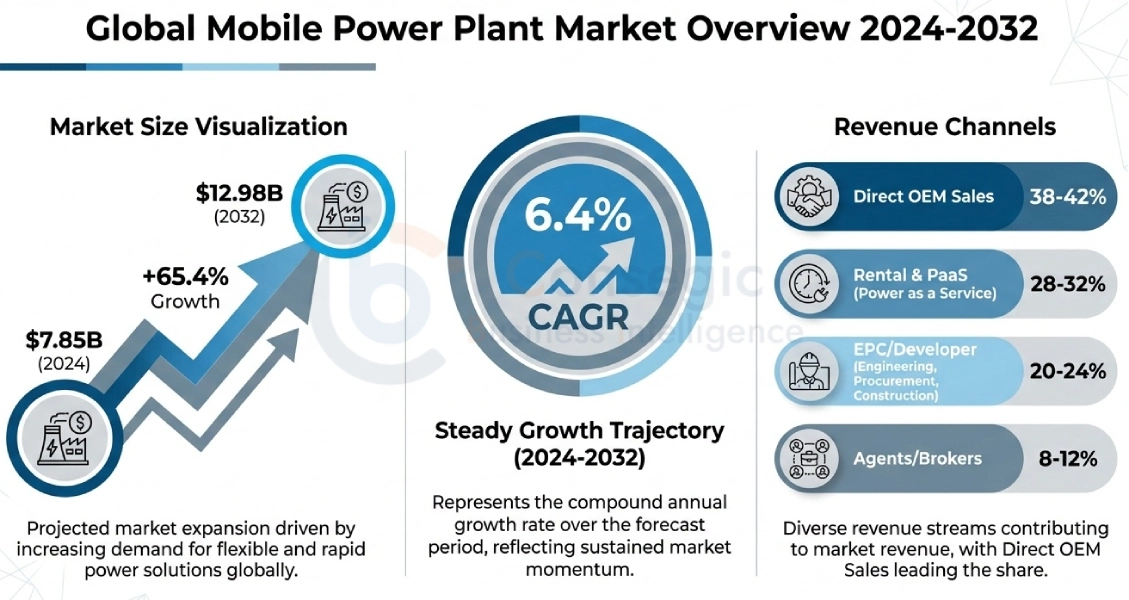
Four sales and delivery channels are used in the market, which cater to very different customer segments with diverse value propositions and economic models. As shown in the channel distribution, there are heavy variations by customer type, project size and regional factors and the total market revenue market distribution is as follows: Direct OEM Sales will be 38-42 percent, Rental and Power-as-a-Service will be 28-32 percent, EPC/Developer Channel will be 20-24 percent and Agents/Brokers and System Integrators will be 8-12 percent of the overall market value.
Mobile power infrastructure investment in the world had totaled USD 11.4 billion in the year 2024 and of the total capital outlay, about 58 percent is incurred in the rental fleet. The shift of the industry towards integrated service delivery through Power-as-a-Service solutions has been realized in the channel environment, with tremendous adoption in utility, industrial, and emergency response applications.
Direct OEM Sales Channel: Market Leadership and Strategic Value
Market Position and Financial Performance
The direct OEM sales channel is estimated at USD 3.1-3.4 billion of 2024 revenue, which will be 38-42 percent of the total market value. Such a channel includes sales offices operated by manufacturers, direct utility purchasing schemes, government purchasing initiatives, and more elaborate digital solutions that would allow direct interaction with customers. The channel has better growth momentum and is projected to have 6.8-7.2 CAGR growth to the year 2032 with an expected end of forecast period standing USD 5.2-5.8 billion.
Large producers also have huge direct sales networks that constitute a huge capital expenditure. Vernova division of General Electric has 28 direct sales and service centers worldwide with a total facility investment of over USD 240 million and Siemens energy has 24 direct sales sites in major markets worth about USD 180 million in facility worth. Caterpillar has 32 company-owned power systems facilities that are estimated to be USD 165 million showing the industry commitment to direct customer relationship.
Deal Structure and Economics
The scope of direct OEM deals usually covers holistic packages such as equipment supply, installation services, commissioning services, and safe services. The range of single unit transactions is between USD 2.8 million on 10 MW containerized installation and USD 45 million on 50 MW fast-track installation. Multi-site framework contracts often cost in excess of USD 150 million and utility scale implementations can cost USD 350 million in integrated fleet solutions.
Direct channel sales provide significantly higher gross margin of 22-28% on equipment and 35-45% on related services than the 15-22% margin in distributor channel sales. The mean customer acquisition costs per major account is USD 180,000-420,000, which is based on the consultative sales model and technical knowledge needed to make complex utility and industrial applications.
Customer Profile and Applications
The customers of direct sales are mainly utilities, independent power producers, government agencies, and large industrial customers that need large power capacity or specialized technical solutions. Mobile power plants are usually used by utility customers to stabilize the grid, in case of an emergency, to support planned maintenance, and to manage peak demand. The United States has a working capacity of about 2,800 utility-scale mobile power plants with the total capacity of over 18 gigawatts which is equivalent to USD 8.4 billion equipment value and has been acquired mainly in direct OEM channels.
The government emergency management agencies are developing strategic reserves of mobile generation capacity, and Federal Emergency Management Agency coordinates the access to 1,200 MW mobile capacity with direct manufacturer contracts worth USD 680 million. Military purposes demand costly mobile power systems with higher mobility and security, with high prices selling at 35-55 percent over the commercial models.
Artificial Intelligence Application and Quantifiable Change.
The cost drivers of artificial intelligence technologies cost 35-55% more than traditional equipment and provide measurable operational value. The worldwide welding system incorporating AI had a market value of about USD 1.87 billion in 2024, and it is predicted to increase at a rate of 12.8% CAGR to USD 4.92 billion in 2032.
Real-Time Optimization of Parameters: Sophisticated artificial intelligence systems continuously regulate more than 40 various parameters of the welding process, and process data at a rate of more than 20,000 samples per second. The manufacturing plants that have implemented AI-driven optimization report productivity gains of 23-31 and material savings of 18-26, which translate into cost savings of USD 180,000 to USD 520,000 annually in the case of medium fabrication plants.
Machine Vision and Quality Control: Computer vision systems with enhanced AI algorithms have a highest defect detection rate of over 96.5 that detects porosity, undercut, and absence of fusion during the welding process. According to automotive manufacturers who use these systems, they state that defect detection increase by 67 percent relative to more conventional inspection methods besides lowering inspection labor expenses by about USD 240,000 each year per production line.
Predictive Maintenance Advantages: AI-based predictive maintenance systems predict component faults with 89 percent precision up to 72 hours ahead of time so manufacturing plants may minimize unexpected downtime by 4158 percent. This translates to USD 420,000 to USD 890,000/year improvement in production continuity in the high-volume operations besides being able to increase equipment working life by 18-24 months.
Mobile Power Plant Market Dynamics - (DRO):
Key Drivers:
-
Infrastructure Crisis and Associated Economic Impacts Driving Market Growth
The most notable trigger behind adoption of mobile power plants across the world market today is the increasing grid instability, as the aging transmission infrastructure is posing remarkable levels of reliability risks in both the developed and the emerging markets. In 2024, the United States had about 1.33 billion hours of power interruption to its customers, with an 18 per cent increase compared to 2022, and the average outage time per year per customer was 8.2 hours, compared to 4.7 hours per year since 2013.
The economic impact of power interruptions is high and is estimated at USD 150 billion each year in the United States alone with small-scale manufacturing facilities losing USD 5,000-25,000 per hour, and a data center at USD 150,000-850,000 per hour. The manufacturing industry is especially vulnerable and the automotive assembly plants have been losing over USD 50,000 every minute during the production downtimes and the pharmaceutical sectors have been turning to losses of over USD 2.5 million every loss of service.
Key Restraints:
-
High Operating and Fuel Cost Structures Restricting Market Penetration
Mobile power plants prove to have a much large levelized cost of electricity than grid power and permanent generation facilities, limiting their application in long-term baseload situations. Diesel-fired mobile plants of typical 20-50 MW size at moderate utilization rates incur 60-80 percent of total operating costs due to fuel, making them very vulnerable to fluctuations in commodity prices.
Fuel coverage can usually be 65-75% of overall lifecycle expenses of diesel mobile power plants, with unpredictable diesel prices potentially leading to changes in the month-to-month operation cost by 18% each month in 2024, and thus it is extremely hard to predict the budget when using a diesel-powered industrial system. When they remain high over an extended period, levelized costs would be far over permanent gas-fired power plants, hydropower, or renewable energy with storage options.
Future Opportunities:
-
Technological Innovation and Investment Inflows Unlocking Growth Opportunities
The shift of mobile power plants to be hydrogen-ready and hydrogen-capable, along with the hydrogen-compatible mobile generation market, is among the longest growth prospects ever with the existence of the hydrogen-compatible mobile generation market projected to grow to USD 2.8-3.4 billion in 2032 compared to non-existent levels in 2024. Large-scale equipment manufacturers dedicated more than USD 1.2 billion in 2024-2025 towards developing hydrogen-compatible technology, with Siemens Energy investing USD 380 million in developing hydrogen-compatible turbine upgrades and General Electric investing USD 420 million in enhancing the development of the two-fuel capability.
These investments can allow the current gas turbine fleets to convert slowly to blends of hydrogen between 20-100 volumetric percent with natural gas without significant asset depreciation to comply with future emission requirements. Newer generation aeroderivative gas turbines that can accept up to 30-50 per cent hydrogen blends at commissioning fetch a 25-40 per cent higher price over conventional gas-only designs, but offer plausible routes to full decarbonization as hydrogen infrastructure is built up.
Mobile Power Plant Market Segmental Analysis:
By Power Source:
Diesel-Based Mobile Power Plants, Gas Turbine Mobile Power Plants, Dual-Fuel Systems, Renewable Hybrid Mobile Plants
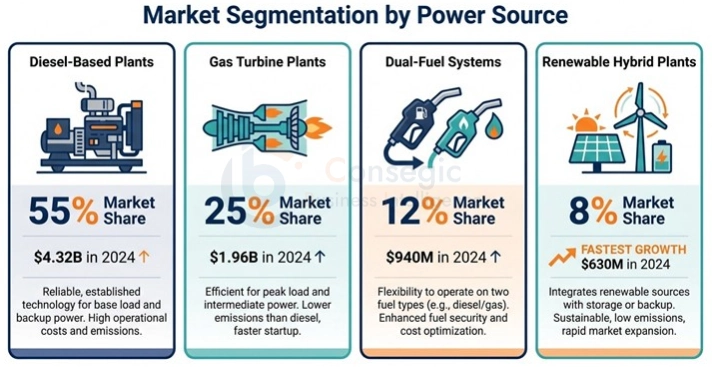
Mobile power plants that operate on diesel continue to drive the market with an estimate of USD 4.32 billion or 55 percent of the overall market worth in 2024, and USD 6.58 billion in 2032 with a 4.8 percent CAGR. Although the diesel technology is experiencing mounting environmental stresses and regulatory issues, its reliability, worldwide fuel availability, operational ease, and reduced capital expenditure remain the reasons behind its dominance over other technologies.
The portion will include containerized diesel generators between small (500 kW) and large (15-20MW) with a cost of USD 85,000-120,000 and USD 8-12 million respectively. The average cost of equipment is USD 300-450 per kW of a typical setup, and fuel is 65-80 percent of the overall lifecycle cost, leaving them highly vulnerable to fluctuations in the cost of commodities when compared and consuming commodities.
By Power Rating:
Below 10 MW, 10–50 MW, 50–100 MW, Above 100 MW
The following 10 MW subsector is the highest unit volumes, but also 42 percent of total market value today and USD 6.30 billion in 2032 with the CAGR at 5.0 percent. This division covers the widest range of applications such as construction sites, events, telecommunications, and small industrial facilities and has annual unit sales in the world that are above 42,000 units.
Depending on the size of the units, equipment prices vary between USD 85,000 on small units of 500 kW diesel and USD 5.8 million on 8-10 MW gas systems, with an average transaction value of USD 420, 000-680,000 representing standardized and modular systems. The rental markets are the best with 68-75% of the segment revenue characterized by short term applications and consumers preference on operational expenditure rather than investing in capital.
By Fuel Type:
Diesel, Natural Gas, Heavy Fuel Oil (HFO), LNG, Biofuels
Diesel fuel continues to assume commanding market leadership with an estimated USD 4.32-4.48 billion or 55-57% of total market value in 2024 that is expected to rise to USD 6.28-6.75 billion at 4.7-4.8% CAGR. Even with an increasing environmental pressure and regulatory restrictions, diesel maintains the lead due to the unmatched global fuel supply of 195+ countries, its ability to operate under the most stringent of operating conditions, simplicity of its operation and minimal specialized infrastructure requirements, and capital cost USD 300-450 less than alternative technologies.
The segment includes mobile power plants of all sizes in the range of small 250 kW trailer mounted to large-scale 20 MW containerized installations with a price range of USD 45,000-85,000 and USD 9-14 million respectively. Final compliance units are modern with intense emission control like Selective Catalytic Reduction and Diesel Particulate Filters that command a premium of 25-35% making the units cost USD 350-550 per kW.
Regional Analysis:
The regions covered are North America, Europe, Asia Pacific, the Middle East and Africa, and Latin America.
- North America: Technology Leadership
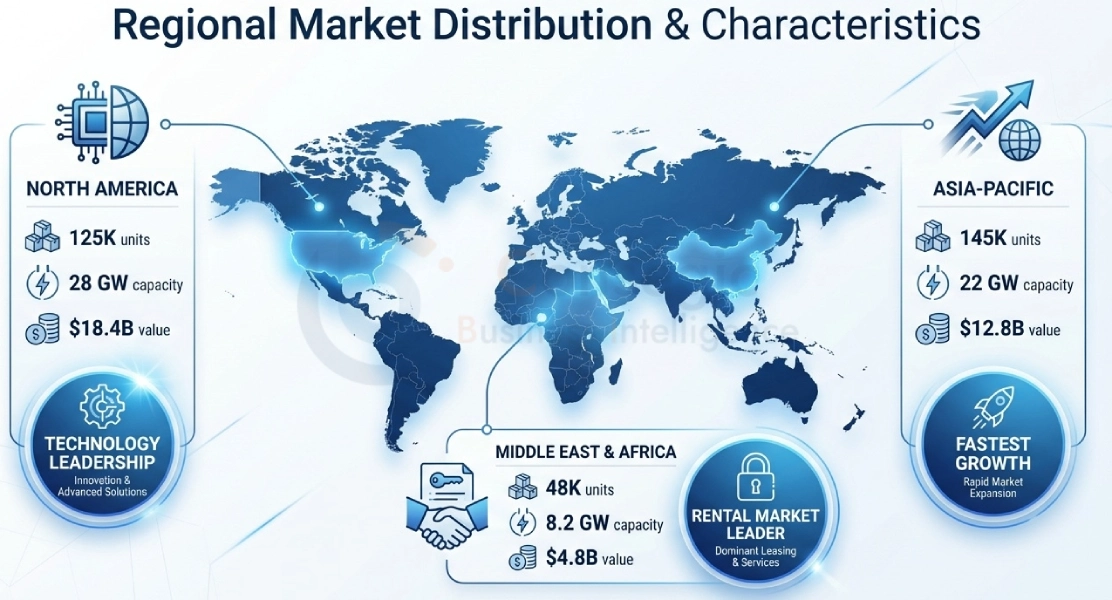
The North American markets are the most direct OEM penetrating markets at 45-50% of the regional revenue, owing to advanced utility customers, developed regulatory frameworks, and preference to long-term service relationships. It has an estimated 125,000 mobile power plants and a combined output of over 28 gigawatts and equipment value worth USD 18.4 billion.
Rental and PaaS channels are 25-30 percent of regional revenue with oil and gas operations, construction project and emergency response applications. The mature rental market records high rates of fleet utilization of 78-85 as well as premium pricing of special applications such as data center backup and utility grid support services.
- Asia-Pacific: Booming and Balkanizing.
The Asian-Pacific markets are more balanced in channel distribution where the rental/PaaS has a share of 30-35% of region revenue which illustrates fragmented markets and diverse customer credit profiles. It has an area of about 145,000 mobile power plants with a total capacity of 22 gigawatts worth USD 12.8 billion.
China boasts the biggest national fleet comprising of about 85,000 units that are deployed to aid construction, industrial and emergency purposes. The markets of Southeast Asia are based on the remote industrial operation of the rental solutions and the mining industry and oil and gas industries are the areas with a constantly increasing demand.
- Middle East and Africa: Leadership in Rental Market.
The Middle East and Africa prove to have the highest channel penetration of rental channels in the world of 35-45% of local revenue due to grid infrastructure problems, financing limitations of projects, and favoring off-balance-sheet solutions. The region has some 48,000 mobile power generator plants that have a combined capacity of 8.2 gigawatts and worth USD 4.8 billion.
The sustained demand of rental use is provided by emergency power needs and infrastructure building projects, and the governments tend to employ the models of operational expenditure as compared to capital investment in temporary solutions. Large operators of the rental business keep strategic fleet locations to help them in emergency responders and industrial projects.
- Remote Operations and Digital Transformation.
The mobile power industry is undergoing a high rate of digital transformation that is allowing remote fleet management, predictive maintenance, and automated dispatch systems. The major manufacturers and rental operators spend much money on the IoT connectivity, satellite communication, and artificial intelligence systems that optimize the performance of their fleets and the delivery of services to their customers.
Digital platforms allow real-time availability, pricing, and performance data availability to customers and automate the ordering and deployment process. The capabilities are especially useful to the rental channel making it run at a lower cost and enhance customer experience and expand into markets that were not served adequately.
- Integration of Hybrid Technology.
The mobile generators became a groundbreaking trend in the entire sales channels with the incorporation of battery energy storage systems to the existing mobile generators. The hybrid systems are consuming 25-45 percent less fuel with higher quality of power and lower emissions, which allows the operation in the environmentally sensitive regions that have strict regulations.
In 2024, Caterpillar rolled out integrated diesel-battery systems and Aggreko put 180 MW of hybrid capacity into operation worldwide. These technologies attract a high price of 45-65% above the traditional systems with operational savings of USD 85,000-240,000 per year when used in high applications.
Top Key Players & Market Share Insights:
- Aggreko plc (United Kingdom)
Market Position and Financial Performance
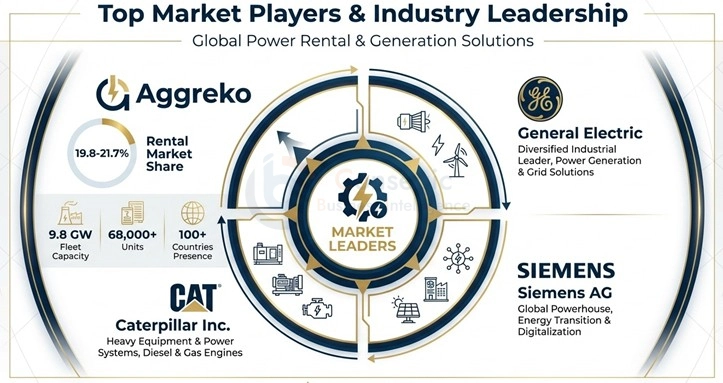
Aggreko is the world leader in mobile power rentals with projected 2024 revenue of USD 1.55-1.70 billion, 19.8-21.7 market share in the renting sector and about 12-14 market value. It has the largest mobile power fleet in the world, with more than 9.8 gigawatts installed capacity in 180+ locations in 100+ countries, worth equipment value of an approximate of USD 4.2 billion.
Operational Excellence and Technology Innovation
The fleet composition comprises of about 68,000 diesel generators of 20-260 kW, 240+ gas turbines of 5-50 MW and growing hybrid diesel-battery systems of 280 MW capacity. The average fleet utilization rates stand at 76-82% worldwide which helps in supporting the EBITDA margins of 32-38% through operational excellence and premium market positioning.
In 2024-2025, Aggreko spent USD 380 million to modernize its fleet with Tier 4 Final compliant equipment, hybrid solutions with 45-60% fuel savings, and digital monitoring systems that track 92% of all fleet worldwide.
Key players in the Mobile Power Plant industry include-
- General Electric Company
- Siemens AG
- Caterpillar Inc.
- Aggreko plc
- APR Energy
- PW Power Systems LLC
- Solar Turbines Incorporated
- Kawasaki Heavy Industries Ltd.
- Cummins Inc.
- Wärtsilä Corporation
- Atlas Copco AB
- Himoinsa Power Systems
- Generac Holdings Inc.
- Kohler Co.
- EthosEnergy Group Ltd.
- MTU Onsite Energy
- Vericor Power Systems
- Mapna Group
Recent Industry Developments
Pioneer Power Solutions - Data Center Hybrid Mobile Power System
Pioneer Power Solutions has introduced a hybrid mobile power system that has been designed specifically towards the data center market that is experiencing high growth. The system has scalable capacity of between 1 MW and 10 MW, which is flexible and fast to deploy in response to urgent power demand in data center applications. This is a strategic development since it goes to the core of the speed-to-power gap that data centers have to endure, where facilities must be able to obtain quality power before long-term utility connections can be built. It is to be expected that the hybrid arrangement would combine traditional generation along with energy storage or renewable aspects to achieve the best efficiency and environmental results. The scalability utility enables data center operators to scale power capacity accurately to their needs and scale on demand as demand increases, so as not only to be capital efficient but also to have operational flexibility.
PowerCell - Zero-Emission Power Generation Portfolio
PowerCell has launched its first products in the new Power Generation range and this is a strategic diversification into trustworthy zero-emission power solutions. This move by the PowerCell is a huge growth as compared to the traditional fuel cell component business into the entire turnkey power generation systems. The emphasis on zero-emission technology is consistent with the main business hydrogen fuel cell competence of PowerCell, which makes the company ready to cater to markets with stricter environmental policies. This introduction is especially significant because it will meet the increasing need of sustainable mobile power solutions in urban conditions, environmentally conscious regions, and those applications where the air quality is a major consideration.
Mobile Power Plant Market Report Insights:
| Report Attributes | Report Details |
|---|---|
| Study Timeline | 2019-2032 |
| Size in 2032 | USD 19.98 Billion |
| CAGR (2025-2032) | 5.4% |
| By Region |
|
| By Power Source |
|
| By Power Rating |
|
| By Fuel Type |
|
| Key Players |
|
| Report Coverage |
|
Key Questions Answered in the Report
How big is the Mobile Power Plant market? −
The global mobile power plant market demonstrates robust financial performance, valued at USD 7.85 billion in 2024 and projected to reach USD 8.42 billion in 2025, ultimately achieving USD 12.98 billion by 2032.
Which is the fastest-growing region in the Mobile Power Plant market? +
North America is the region experiencing the most rapid growth in the Mobile Power Plant market.
What specific segmentation details are covered in the Mobile Power Plant report? +
The Mobile Power Plant report includes specific segmentation details for By Power Source, By Power Rating, By Fuel Type, By Technology Type and region.
Who are the major players in the Mobile Power Plant market? +
The key participants in the Mobile Power Plant market areGeneral Electric Company, Siemens AG, Caterpillar Inc., Aggreko plc, APR Energy, PW Power Systems LLC, Solar Turbines Incorporated, Kawasaki Heavy Industries Ltd., Cummins Inc., Wärtsilä Corporation, Atlas Copco AB, Himoinsa Power Systems, Generac Holdings Inc., Kohler Co., EthosEnergy Group Ltd., MTU Onsite Energy, Vericor Power Systems, Mapna Group, and others.
Overview
Reputation & Certifications


Our Services
- Market Intelligence & Forecasting
- Custom Research Solutions
- Market Entry Strategy
- Competitive Intelligence
- Customer Insights
- Industry Innovation Analysis
- Investment Advisory