Jump to Content
Multi-Vendor Support Services Market Size & Industry Share - Growth Trends & Forecasts (2026 - 2034)
Multi-Vendor Support Services Market Size:
Multi-Vendor Support Services Market size is estimated to reach over 125.13 (US$B) by 2034 from a value of 62.08 (US$B) in 2025 and is projected to grow by 67.1 (US$B) in 2026, growing at a CAGR of 8.1% from 2026 to 2034, according to a recent report from Consegic Business Intelligence.
Multi-Vendor Support Services Market Scope & Overview:
Multi-vendor support services refer to the capability of software to oversee and monitor an entire IT infrastructure that consists of hardware, software, and services sourced from multiple vendors. These services play a crucial role for businesses that rely on a diverse range of technology solutions from various vendors to manage their infrastructure and manage their clients. It comprises of wide range of products from different vendors, such as switches, servers, storage devices, routers, and applications. IT infrastructure management software that supports multiple vendors can efficiently integrate and manage a variety of network components from different providers, offering a unified view of IT infrastructure.

Multi-Vendor Support Services Market Dynamics - (DRO) :
Key Drivers:
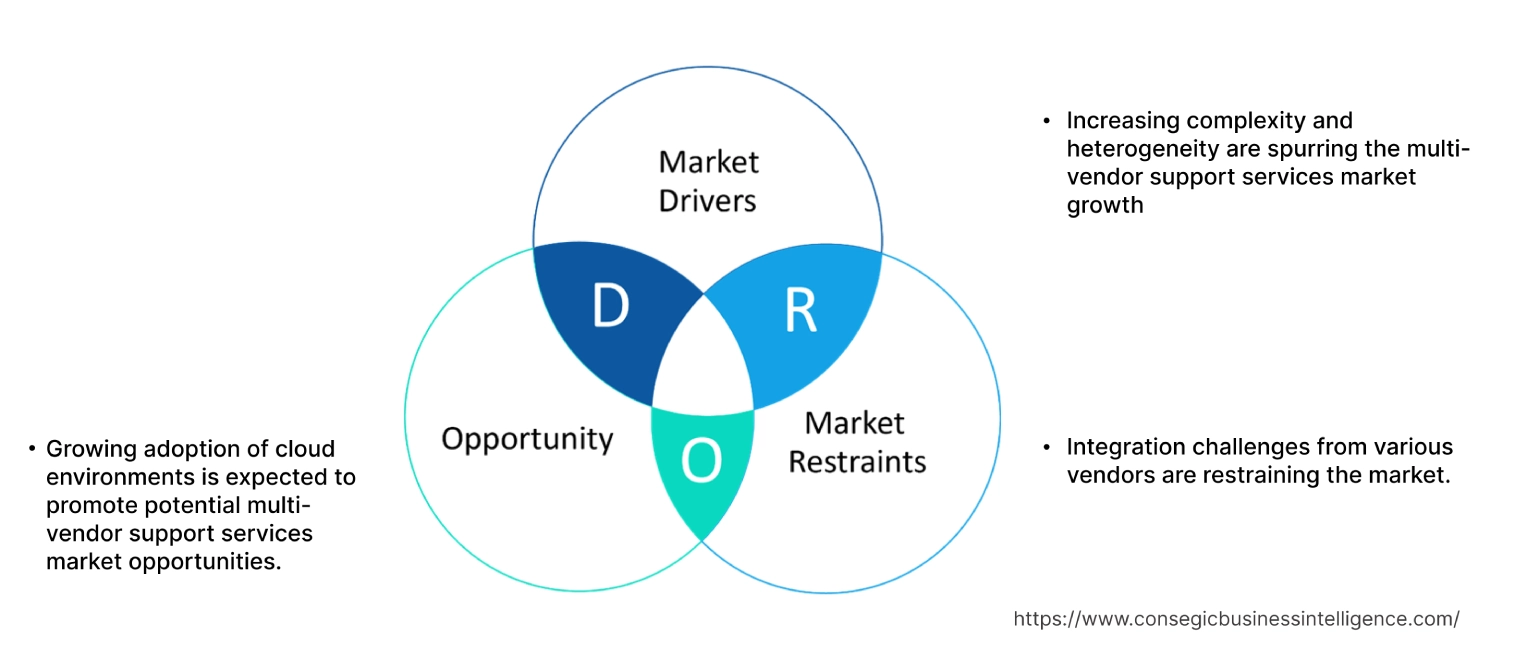
Increasing complexity and heterogeneity are spurring the multi-vendor support services market growth
The rising complexity in integration and heterogeneity of IT environments are key factors in the multi-vendor support services market. As businesses adopt a variety of technologies, from legacy systems to modern cloud solutions, managing and maintaining a mix of hardware and software solutions across various vendors has become difficult. Multiple vendor support services provide a centralized approach to handling complexity, offering specialized expertise, faster issue resolution, and cost optimization. By simplifying vendor coordination, enterprises can reduce the risk of downtime, enhance operational efficiency, and ensure seamless functionality.
- For instance, Cisco multi-vendor support services achieved 89% customer satisfaction by catering to 1.8 million cases per year through its Technical Assistance Center.
Hence, the growing adoption of support services for streamlined management and support for diverse IT systems is driving the multi-vendor support services market growth.
Key Restraints :
Integration challenges from various vendors are restraining the market.
The integration challenge of various technologies from different vendors is restraining the market growth. Each vendor has its own proprietary systems, standards, and protocols, which can create compatibility issues in support services. This lack of standardization increases the complexity of managing multiple software systems and hardware equipment, which can slow down the resolution of issues, leading to efficiency and downtime.
Moreover, coordinating the support across several vendors can result in delays and fragmented communication, affecting the overall performance of IT infrastructure. Therefore, the rising complexity in integration is restraining the multi-vendor support services industry.
Future Opportunities :
Growing adoption of cloud environments is expected to promote potential multi-vendor support services market opportunities.
Cloud computing offers a major opportunity in the multiple vendor support services market by enabling businesses to seamlessly manage and support diverse platforms. As companies increasingly migrate to cloud-based solutions from traditional on-premise setups, the demand for centralized support across various vendors and platforms grows. Cloud infrastructure allows for better scalability, reliability, flexibility, and real-time operations, reducing the need for on-premise hardware such as data storage devices and expensive servers for services, further minimizing operational costs. Additionally, cloud solutions enable seamless integration between different vendor solutions including hardware and software.
- In March 2023, Hewlett Packard Enterprise acquired OpsRamp, to provide a unified approach to manage multi-vendor solutions in hybrid and multi-cloud IT environments.
Consequently, the increasing trend of adopting cloud solutions for better scalability, reliability, and flexibility is projected to promote multi-vendor support services opportunities.
Multi-Vendor Support Services Market Segmental Analysis :
By Type:
Based on the type, the market is segmented into hardware support services and software support services.
Trends in the type:
- The rising trend for hardware support services and equipment in large and SMEs (Small and medium Enterprises) is growing due to rapid technological advancements in IT infrastructure.
- The trend towards the adoption of software support services is growing to the integration of AI-powered tools and predictive analytics.
The hardware support services accounted for the largest revenue in the year 2024 of the overall multi-vendor support services market share.
- Large enterprises deploy various hardware devices and equipment from different manufacturers according to the requirements, which often include servers, storage systems, and networking equipment among others.
- These complex hardware components require scheduled maintenance, specialized expertise, and comprehensive support.
- For instance, Clear Technologies offers hardware IT support services, which aim to improve performance and reduce maintenance costs.
- Thus, the rising advancement associated with support services for IT hardware is driving the multi-vendor support services market trends.
The software support services segment is anticipated to register a significant CAGR during the forecast period.
- Software support services in multi-vendor environments focus on ensuring seamless operation of diverse applications through regular updates, security patches, and troubleshooting.
- Managing multiple software vendors presents challenges such as integration issues and version control for larger businesses.
- For instance, Hewlett Packard Enterprise provides software support services that aim to boost productivity and provide valuable insights from cloud infrastructure to edge computers.
- Thus, as per the analysis, the increasing demand for maintaining updates, security patches, and troubleshooting in software systems is anticipated to boost the market during the forecast period.
By Enterprise:
Based on the enterprise, the market is segmented into small & medium-sized enterprises and large enterprises.
Trends in the enterprise:
- Large enterprises are increasingly adopting multiple vendor support services to manage complex IT ecosystems.
- SMEs (small and medium enterprises) are increasingly adopting multiple vendor support services to reduce operational costs and increase efficiency.
The large enterprise accounted for the largest revenue in the year 2024 of the overall multi-vendor support services market share.
- Large corporations manage a wide and diverse technology infrastructure, which includes a wide range of software and hardware solutions from different vendors.
- Multiple vendor support services offer help to large enterprises in solving problems with comprehensive knowledge.
- Additionally, multiple vendor support services improve operational efficiency and minimize downtime for hassle-free management in large enterprises.
- For instance, Tata Consulting Services (TCS) collaborated with various vendors including SAP, Oracle, Ariba, and others for hardware and software support services.
- Thus, according to the analysis, the rising partnerships for hardware and software services are driving the multi-vendor support services market trends.
The small & medium enterprises segment is anticipated to register a significant CAGR growth during the forecast period.
- Increasing reliance on diverse hardware and software solutions to stay competitive is driving the adoption of multiple vendor support services in small and medium enterprises.
- As small & medium enterprises expand, managing multiple vendors becomes crucial for ensuring operational flexibility and avoiding vendor lock-in.
- For instance, DewCIS provides multi-vendor support services to small and medium enterprises involving hardware equipment and software solutions.
- According to the analysis, the rising adoption in small and medium enterprises is anticipated to boost the market during the forecast period.
By Application:
Based on the application, the market is segmented into IT operations, sales & marketing, finance & accounting, supply chain & logistics, and others.
Trends in the application:
- In finance and accounting, multi-vendor support services are being used to manage and maintain financial software.
- Rising adoption of multiple vendor support services in supply chain & logistics due to various complex logistic software and to improve operational efficiency.
The IT operations accounted for the largest revenue share of 32.09% in the year 2024 and are anticipated to register a significant CAGR growth during the forecast period.
- The IT industry depends on support services for optimization, seamless integration, maintaining multiple systems, and ensuring smooth and efficient operations.
- Additionally, the increasing technological advancements and rising demand for smooth services are driving the need for multiple vendor services to troubleshoot issues and resolve queries across different integrated platforms.
- For instance, CDS aims to reduce maintenance costs in IT operations with multiple vendor support services on OS, hardware, and software.
- Thus, according to the analysis, the rising adoption of multiple-vendor support services in the IT industry is driving the multi-vendor support services market demand.
Regional Analysis:
The regions covered are North America, Europe, Asia Pacific, the Middle East and Africa, and Latin America.
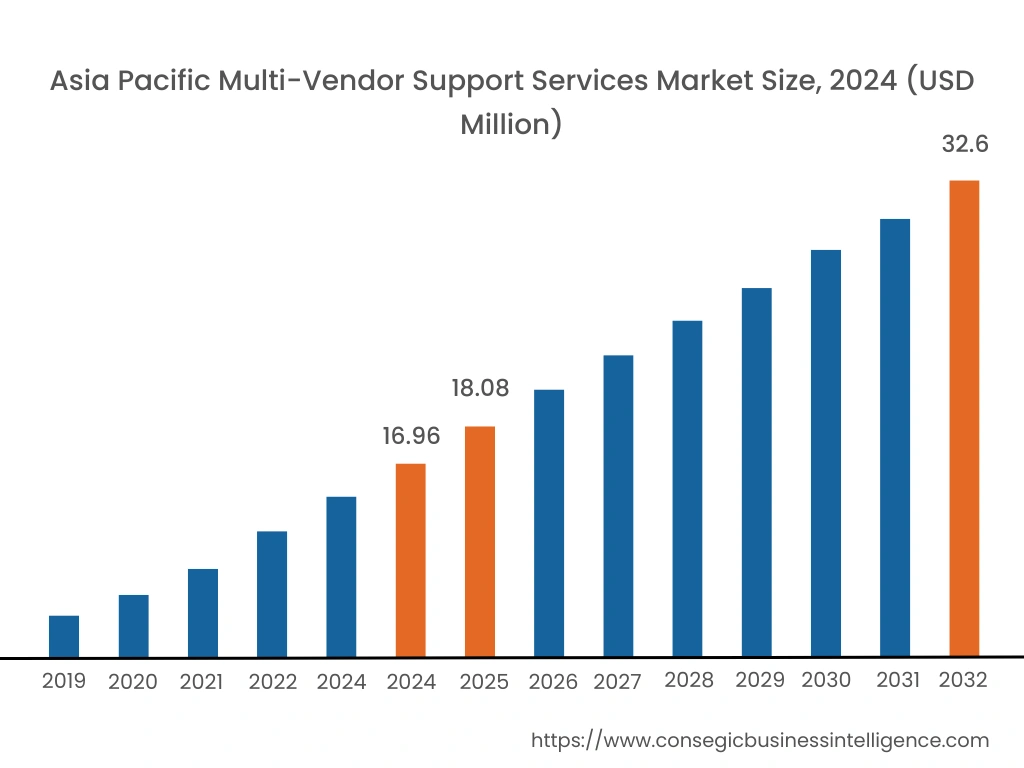
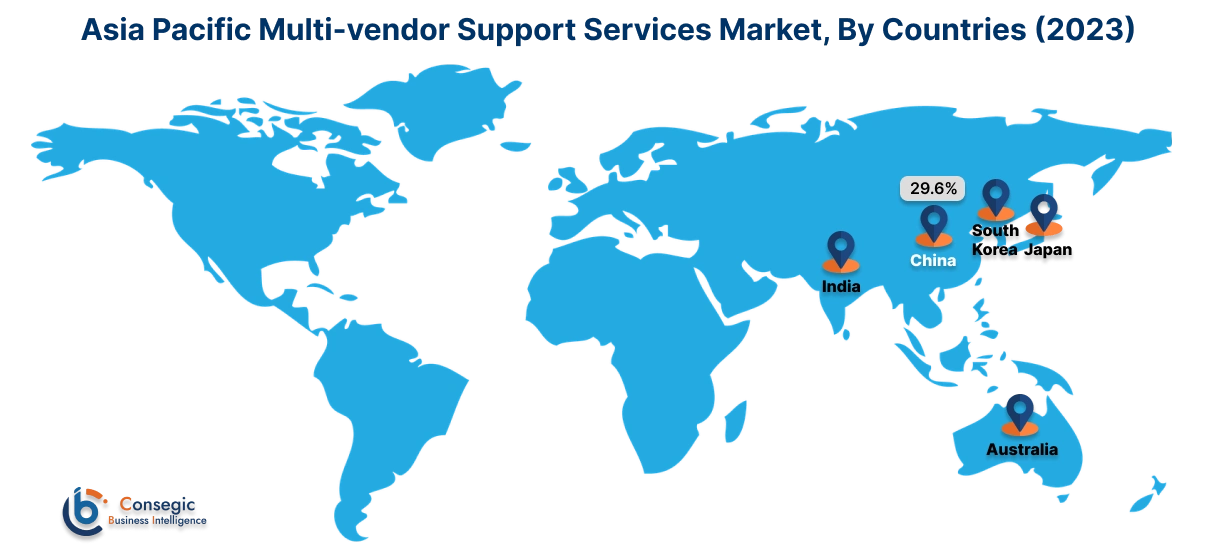
Asia Pacific region was valued at USD 16.96 Billion in 2024. Out of this, China accounted for the maximum revenue share of 29.6%. Moreover, it is projected to grow by USD 18.08 Billion in 2025 and reach over USD 32.6 Billion by 2032. The Asia Pacific region's growing pace of digital growth offers lucrative prospects for the market. Additionally, the rapid digitalization and the rise of IT infrastructure are contributing to the multi-vendor support services market expansion in the Asia-Pacific region.
- For instance, Lenovo, a China-based company provides support services across a wide range of applications including storage, networking components, servers, and others.
North America is estimated to reach over USD 34.7 Billion by 2032 from a value of USD 19.1 Billion in 2024 and is projected to grow by USD 20.27 Billion in 2025. The multi-vendor support services market demand in North America is mainly driven by their developed IT infrastructure and technology-intensive businesses such as manufacturing, healthcare, and telecommunications.
- For Instance, IBM, an American company, provides multi-vendor services (MVS) and remote technical support for non-IBM software and hardware.
As per the multi-vendor support services market analysis, factors such as growing demand for reduced IT costs and improved operational efficiency among enterprises are projected to drive the multi-vendor support services market in North America during the forecast period.
As per the multi-vendor support services market analysis, Europe is anticipated to witness substantial development that is backed by the increasing number of small and medium-sized enterprises seeking advanced and affordable solutions to manage and enhance their systems.
The Middle East, Africa, and Latin America are expected to grow at a considerable rate due to increasing investment share in the development of IT and telecommunication, healthcare, and other sectors in countries such as Brazil, UAE, and others.
Further, the Latin American region is experiencing an evolution for multi-vendor support devices, backed by the robust need for support solutions in supply chain & logistics from different vendors. Countries such as Brazil, Argentina, and others are representing the cumulative multi-vendor support services market expansion in the region.
Top Key Players & Market Share Insights:
The global multi-vendor support services market is highly competitive with major players providing solutions to small & medium enterprises and large enterprises. Key players are adopting several strategies in research and development (R&D), product innovation, and end-user launches to hold a strong position in the market. Key players in the multi-vendor support services industry include-
Multi-Vendor Support Services Market Report Insights :
| Report Attributes | Report Details |
| Study Timeline | 2021-2034 |
| Market Size in 2034 | USD 125.13 Billion |
| CAGR (2026-2034) | 8.10% |
| Base Year | 2025 |
| By Type |
|
| By Enterprise |
|
| By Application |
|
| By Region |
|
| Key Players |
|
| North America | U.S. Canada Mexico |
| Europe | U.K. Germany France Spain Italy Russia Benelux Rest of Europe |
| APAC | China South Korea Japan India Australia ASEAN Rest of Asia-Pacific |
| Middle East and Africa | GCC Turkey South Africa Rest of MEA |
| LATAM | Brazil Argentina Chile Rest of LATAM |
| Report Coverage |
|
Key Questions Answered in the Report
How big is the multi-vendor support services market? −
The multi-vendor support services market was valued at USD 57.6 Billion in 2024 and is projected to grow to USD 107.08 Billion by 2032.
Which is the fastest-growing region in the multi-vendor support services market? +
Asia-Pacific is the region experiencing the most rapid growth in the multi-vendor support services market.
What specific segmentation details are covered in the multi-vendor support services report? +
The multi-vendor support services report includes specific segmentation details for type, enterprise, application, and region.
Who are the major players in the Multi-Vendor Support Services market? +
The key participants in the Multi-Vendor Support Services market are Atos SE (France), Dell Inc. (US), Oracle (US), Cisco Systems, Inc. (US), Hitachi, Ltd (Japan), Unisys (US), IBM (US), HP (US), Lenovo (China), Fujitsu (Japan).
Overview
Reputation & Certifications


Our Services
- Market Intelligence & Forecasting
- Custom Research Solutions
- Market Entry Strategy
- Competitive Intelligence
- Customer Insights
- Industry Innovation Analysis
- Investment Advisory