Jump to Content
Multilayer Ceramic Capacitor Market - Size, Share, Industry Trends, and Forecasts (2024 - 2031)
Multilayer Ceramic Capacitor Market Size:
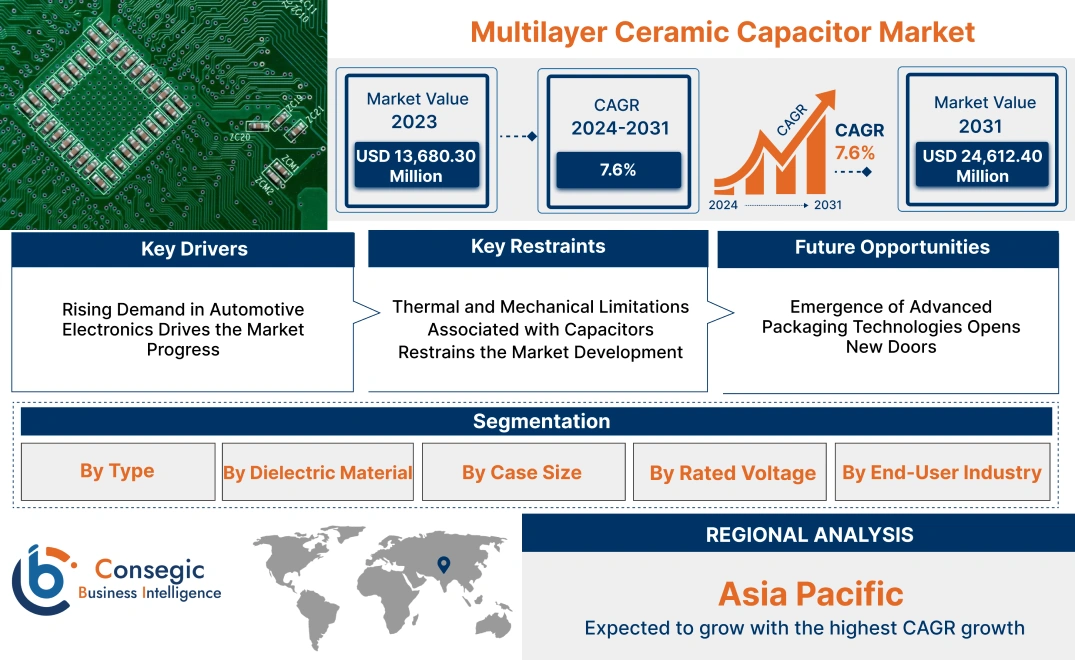
Multilayer Ceramic Capacitor Market size is estimated to reach over USD 24,612.40 Million by 2031 from a value of USD 13,680.30 Million in 2023 and is projected to grow by USD 14,478.68 Million in 2024, growing at a CAGR of 7.6% from 2024 to 2031.
Multilayer Ceramic Capacitor Market Scope & Overview:
Multilayer ceramic capacitors (MLCCs) are small electronic components that store and regulate electrical energy in circuits. They are made of multiple ceramic layers with metal electrodes, allowing them to provide high capacitance in a compact size. MLCCs are widely used in electronics such as smartphones, automotive systems, telecommunications equipment, and industrial devices due to their reliability and efficiency.
These capacitors come in various types, including high-voltage and high-temperature designs, to suit different applications. They are known for their stability, low energy loss, and ability to perform well in challenging environments. MLCCs are commonly used for tasks like filtering signals, storing energy, and reducing noise in electronic devices.
End-users of MLCCs include manufacturers of consumer electronics, automotive systems, and medical devices, where compact and reliable components are essential for product performance.
Multilayer Ceramic Capacitor Market Dynamics - (DRO) :
Key Drivers:
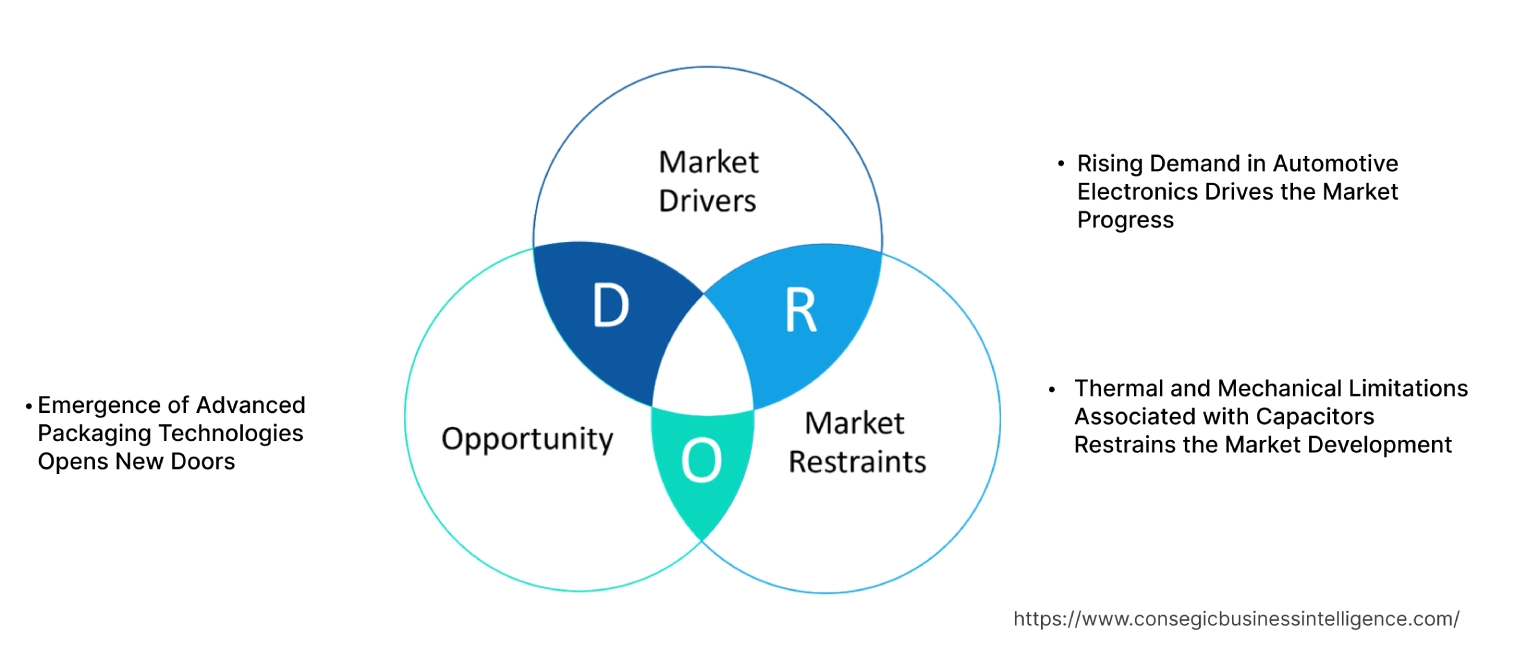
Rising Demand in Automotive Electronics Drives the Market Progress
The increasing integration of electronic systems in vehicles is driving significant demand for high-performance capacitors. Advanced driver-assistance systems (ADAS), infotainment solutions, and electric vehicle (EV) powertrains rely on capacitors for stable power management, filtering, and signal processing. In electric vehicles, capacitors are essential for battery management systems, motor controls, and energy recuperation processes.
Additionally, ADAS technologies, such as lane-keeping assistance and collision avoidance systems, depend on capacitors to ensure fast and reliable signal transmission. The need for components that operate under extreme temperatures and high-stress conditions is particularly critical in automotive applications. With the ongoing shift toward autonomous vehicles and the rising adoption of EVs globally, manufacturers are focusing on developing capacitors with enhanced reliability, compact designs, and temperature stability. These trends position the automotive sector as a key driver of innovation, driving the multilayer ceramic capacitor market growth.
Key Restraints :
Thermal and Mechanical Limitations Associated with Capacitors Restrains the Market Development
Capacitors, while widely used across various applications, face thermal and mechanical limitations that restrict their performance in extreme environments. High operating temperatures cause material degradation, leading to reduced capacitance, shorter lifespans, and potential failures. Similarly, exposure to mechanical stress, such as vibration or impact, compromise structural integrity, affecting the reliability of capacitors in demanding conditions. These limitations are particularly critical in industries like aerospace, heavy industrial manufacturing, and defense, where components are subjected to harsh environments and must maintain consistent performance. For example, aerospace systems often operate under extreme temperatures and intense vibrations, requiring components with exceptional durability and reliability.
While advancements in capacitor technologies aim to address these restraints, the current limitations create adoption barriers in applications demanding high resilience, making thermal and mechanical durability a key area of focus for manufacturers in the market. Thus, the above mentioned factors are limiting the multilayer ceramic capacitor market demand.
Future Opportunities :
Emergence of Advanced Packaging Technologies Opens New Doors
The emergence of advanced packaging technologies, including chip-scale packaging (CSP) and flexible designs, is transforming the capacitor market. These innovations allow capacitors to be integrated into increasingly compact and complex devices, meeting the needs of modern electronics. CSP enables a smaller footprint and higher performance, making it ideal for next-generation applications such as 5G networks and artificial intelligence (AI) systems that require high-density, reliable components.
Flexible packaging designs further expand the applicability of capacitors by supporting integration into devices with unconventional shapes, such as wearable electronics and advanced medical devices. These advancements not only improve functionality but also align with shift towards miniaturization and enhanced device efficiency. By enabling capacitors to meet the specific requirements of cutting-edge technologies, advanced packaging technologies are creating significant multilayer ceramic capacitor market opportunities and expanding the market into emerging fields that need high performance in compact designs.
Multilayer Ceramic Capacitor Market Segmental Analysis :
By Type:
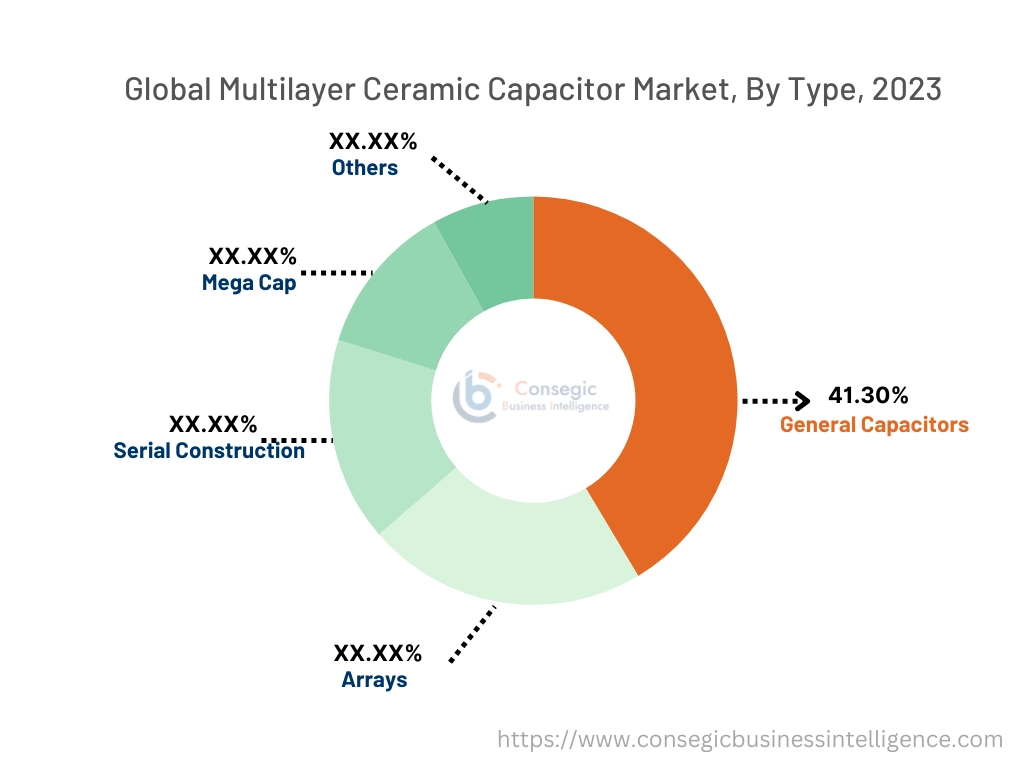
Based on type, the market is segmented into general capacitors, arrays, serial construction, mega cap, and others.
The general capacitor segment accounted for the largest revenue of 41.30% of the total multilayer ceramic capacitor market share in 2023.
- General capacitors are widely used in diverse applications, including power supply stabilization, signal coupling, and decoupling across various industries.
- Their broad utility in both consumer electronics and industrial applications supports their dominant position in the market.
- Technological advancements in general capacitor design enhance their reliability and efficiency in modern electronic systems.
- The segment's dominance is attributed to its versatility and extensive adoption in end-use sectors such as automotive and telecommunications, which further drives the multilayer ceramic capacitor market expansion.
The mega cap segment is expected to grow at the fastest CAGR during the forecast period.
- Mega caps are increasingly used in applications requiring high capacitance values, such as energy storage systems and high-power industrial equipment.
- Their ability to handle large voltage variations makes them ideal for renewable energy systems and advanced automotive technologies.
- The rapid adoption of mega caps is supported by trends in electrification and the shift toward energy-efficient solutions in industrial applications.
- As per the multilayer ceramic capacitor market analysis, the growing requirement for mega caps aligns with advancements in high-performance electronics.
By Dielectric Material:
Based on dielectric material, the market is segmented into X7R, X5R, C0G (NP0), Y5V, Z5U, and others.
The X7R segment held the largest revenue of the total multilayer ceramic capacitor market share in 2023.
- X7R dielectric capacitors are widely used in automotive and industrial applications due to their stability over a wide temperature range.
- Their suitability for both low and high-frequency circuits ensures widespread adoption across end-use industries.
- The dominance of X7R capacitors is driven by their reliability in harsh environments and high-demand applications such as electric vehicles and 5G infrastructure.
- As per multilayer ceramic capacitor market trends, the preference for X7R materials reflects the need for durable and consistent performance in advanced electronic designs.
The C0G (NP0) segment is expected to grow at the fastest CAGR during the forecast period.
- C0G (NP0) capacitors offer excellent thermal and electrical stability, making them ideal for precision applications such as aerospace and medical devices.
- Their minimal capacitance variation with temperature changes supports their use in high-reliability and high-frequency applications.
- The segment’s rapid growth is fueled by advancements in IoT devices and the increasing adoption of high-frequency communication systems.
- The preference for C0G (NP0) materials highlights the need for precision components in cutting-edge technologies, fueling the multilayer ceramic capacitor market demand.
By Case Size:
Based on case size, the market is segmented into 01005, 0201, 0402, 0603, 0805, 1206, 1210, and others.
The 0402 segment accounted for the largest revenue share in 2023.
- The 0402 case size is commonly used in consumer electronics due to its compact dimensions, which enable miniaturization in smartphones, wearables, and other devices.
- Its balance between size, cost-effectiveness, and performance supports its dominance in high-volume manufacturing processes.
- The adoption of automated assembly technologies enhances the reliability and production efficiency of 0402 capacitors.
- As per market analysis, the prominence of this segment is driven by its alignment with trends in miniaturized electronic components, contributing to the multilayer ceramic capacitor market growth.
The 01005 segment is expected to grow at the fastest CAGR during the forecast period.
- The ultra-miniature 01005 capacitors are gaining traction in IoT devices, medical implants, and compact electronics, where size and performance are critical.
- Technological advancements in material science support their application in high-frequency and high-density designs.
- The segment's rapid growth is attributed to the rising need for miniaturization and the proliferation of next-generation technologies such as 5G and AI.
- As per the multilayer ceramic capacitor market analysis, the increasing adoption of 01005 capacitors in advanced applications positions this segment for substantial growth.
By Rated Voltage:
Based on rated voltage, the market is segmented into low voltage (<50V), medium voltage (50V-500V), and high voltage (>500V).
The low voltage segment held the largest revenue share in 2023.
- Low voltage capacitors are widely used in consumer electronics, including smartphones, tablets, and other portable devices.
- Their cost-effectiveness and high-volume production make them a preferred choice for applications requiring efficient power delivery.
- The increasing adoption of low voltage capacitors in wearable devices and IoT applications further supports their dominance.
- As per market analysis, the segment’s prominence reflects the growing requirement for compact and energy-efficient electronic components, which facilitates the multilayer ceramic capacitor market expansion.
The high voltage segment is expected to grow at the fastest CAGR during the forecast period.
- High voltage capacitors are critical for industrial and automotive applications, including electric vehicles, renewable energy systems, and power grid infrastructure.
- Their ability to handle significant voltage variations ensures their reliability in demanding environments.
- The segment’s growth is fueled by advancements in renewable energy technologies and the electrification of industrial processes.
- As per the multilayer ceramic capacitor market trends, the increasing adoption of high voltage capacitors aligns with the need for robust and durable components in modern applications.
By End-User Industry:
Based on end-user industry, the market is segmented into automotive, consumer electronics, industrial, healthcare, IT & telecommunications, and others.
The consumer electronics segment held the largest revenue share in 2023.
- The widespread use of capacitors in devices such as smartphones, laptops, and smart home systems supports the dominance of this segment.
- Increasing consumer requirement for high-performance and compact electronics drives the adoption of advanced capacitor technologies.
- Technological advancements in consumer devices, including wearables and AR/VR equipment, further bolster the segment’s prominence.
- Therefore, the segment’s dominance reflects its alignment with trends in innovative and portable consumer technologies.
The automotive segment is expected to grow at the fastest CAGR during the forecast period.
- Capacitors are integral to electric vehicles (EVs), hybrid vehicles, and autonomous systems for energy storage, power conversion, and system stabilization.
- The increasing adoption of EVs and advancements in ADAS technologies drive the need for capacitors in the automotive sector.
- The segment’s growth is supported by stringent energy efficiency standards and the electrification of automotive components.
- Thus, the rising focus on sustainable transportation solutions highlights the importance of capacitors in modern automotive designs.
Regional Analysis:
The regions covered are North America, Europe, Asia Pacific, the Middle East and Africa, and Latin America.
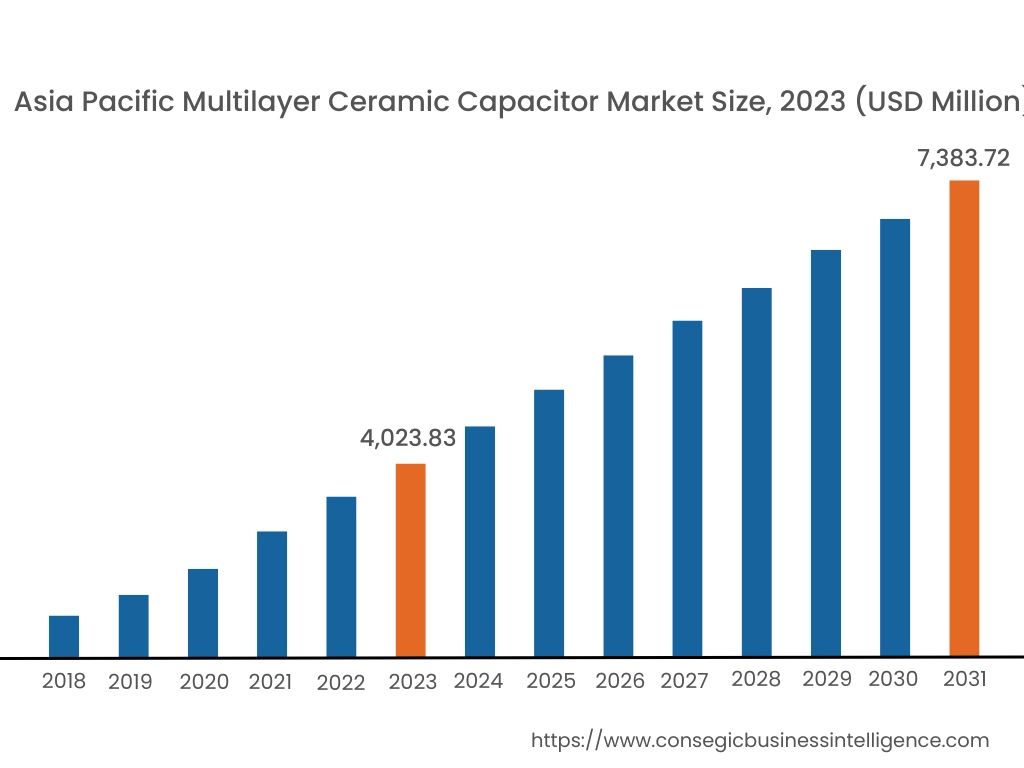
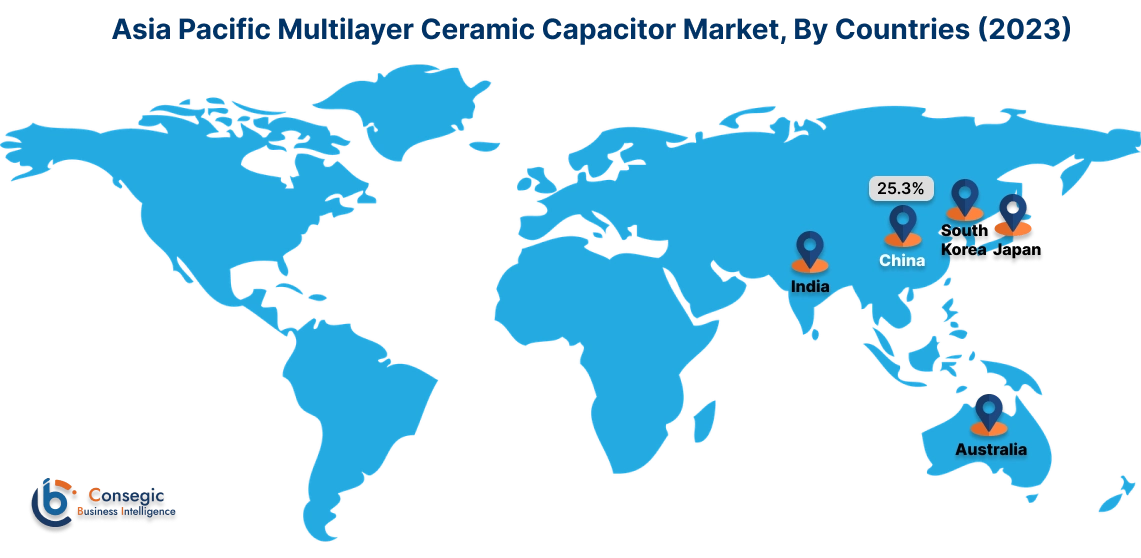
Asia Pacific region was valued at USD 4,023.83 Million in 2023. Moreover, it is projected to grow by USD 4,265.74 Million in 2024 and reach over USD 7,383.72 Million by 2031. Out of which, China accounted for the largest share of 25.3% in 2023. The Asia-Pacific region is experiencing rapid development in the MLCC market, driven by industrialization and technological advancements in countries such as China, Japan, and South Korea. The proliferation of consumer electronics and the expansion of the semiconductor sector have intensified the need for compact and efficient MLCC solutions. Government initiatives promoting digital transformation further influence multilayer ceramic capacitor market opportunities.
North America is estimated to reach over USD 8,097.48 Million by 2031 from a value of USD 4,547.22 Million in 2023 and is projected to grow by USD 4,808.50 Million in 2024. This region holds a significant stake of the MLCC market, driven by rapid technological innovation and the presence of major industry players. The United States, in particular, has seen extensive adoption of MLCCs across sectors such as automotive, telecommunications, and consumer electronics. A notable trend is the integration of MLCCs in advanced driver-assistance systems (ADAS) and 5G infrastructure, enhancing performance and reliability.
Europe represents a substantial portion of the global MLCC market, with countries like Germany, France, and the United Kingdom leading in adoption and innovation. The region's emphasis on automotive electronics and industrial automation has propelled the utilization of MLCCs. Analysis indicates a growing trend towards the deployment of MLCCs in electric vehicles (EVs) and renewable energy systems, aiming to improve energy efficiency and sustainability.
The Middle East & Africa region shows a growing interest in MLCC solutions, particularly in the telecommunications and automotive sectors. Countries like the United Arab Emirates and South Africa are investing in advanced MLCC technologies to support digitalization efforts. Analysis suggests an increasing shift towards adopting MLCCs in smart city projects and renewable energy applications, enhancing connectivity and operational efficiency.
Latin America is an emerging market for MLCCs, with Brazil and Mexico being key contributors. The region's growing electronics manufacturing sector and initiatives to promote technological innovation have spurred the adoption of advanced MLCC solutions. Government policies aimed at modernizing infrastructure and enhancing digital capabilities influence market trends.
Top Key Players and Market Share Insights:
The Multilayer Ceramic Capacitor market is highly competitive with major players providing products and services to the national and international markets. Key players are adopting several strategies in research and development (R&D), product innovation, and end-user launches to hold a strong position in the global Multilayer Ceramic Capacitor market. Key players in the Multilayer Ceramic Capacitor industry include -
- Murata Manufacturing Co., Ltd (Japan)
- Samsung Electro-Mechanics Co., Ltd. (South Korea)
- Vishay Intertechnology, Inc. (USA)
- AVX Corporation (USA)
- Johanson Dielectrics, Inc. (USA)
- Taiyo Yuden Co., Ltd. (Japan)
- Yageo Corporation (Taiwan)
- Walsin Technology Corporation (Taiwan)
- TDK Corporation (Japan)
- KEMET Corporation (USA)
Recent Industry Developments :
Product Launches:
- In November 2024, Samsung Electro-Mechanics launched the world’s first automotive MLCC, the CL10Z106MP96PN#, offering 10μF capacitance at 10V in a compact 0603-inch size. Designed for high-temperature (up to 125°C) and high-density applications, it supports miniaturization trends in ADAS, LiDAR, and communication modules. This innovation maintains the performance of larger MLCCs while leveraging advanced materials and stacking technology for reliability and stability. Samples are now available for mass production.
- In July 2024, Kyocera AVX expanded its KAM Series automotive-grade MLCCs with 20 new components, featuring compact sizes, high capacitance (0.1µF–22µF), and voltages (4V–16V). Designed for EVs, ADAS, and ADS, they meet AEC-Q200 standards and are optimized for space-constrained automotive circuits. Manufactured in certified facilities, these MLCCs ensure high reliability for applications like ECUs, cameras, and CPUs. Their miniaturized design reduces board space and component count, supporting advanced automotive electronics development.
- In July 2024, Murata Manufacturing expands its MLCC range with GRM188C80E107M and GRM188R60E107M, offering 100μF capacitance in a compact 0603-inch size. Ideal for servers, data centers, and IT applications, these capacitors feature low ESR, X6S/X5R temperature ratings, and broad operating ranges. Leveraging advanced thin-layer technology, they support miniaturization, reduce circuit area, and meet requirements for efficiency and high performance in AI-driven and high-temperature environments.
- In March 2024, Samsung Electro-Mechanics developed high-voltage Multi-Layer Ceramic Capacitors (MLCCs) designed for electric vehicles, enhancing battery stability and supporting high-speed charging. The company has introduced five types of automotive MLCCs capable of operating at 630V and 1000V, significantly higher than the typical 6.3V for IT applications. This advancement addresses the growing requirement for high-voltage MLCCs in the electric vehicle market, aiming to strengthen Samsung Electro-Mechanics' position in the automotive sector.
Multilayer Ceramic Capacitor Market Report Insights :
| Report Attributes | Report Details |
| Study Timeline | 2018-2031 |
| Market Size in 2031 | USD 24,612.40 Million |
| CAGR (2024-2031) | 7.6% |
| By Type |
|
| By Dielectric Material |
|
| By Case Size |
|
| By Rated Voltage |
|
| By End-User Industry |
|
| By Region |
|
| Key Players |
|
| North America | U.S. Canada Mexico |
| Europe | U.K. Germany France Spain Italy Russia Benelux Rest of Europe |
| APAC | China South Korea Japan India Australia ASEAN Rest of Asia-Pacific |
| Middle East and Africa | GCC Turkey South Africa Rest of MEA |
| LATAM | Brazil Argentina Chile Rest of LATAM |
| Report Coverage |
|
Key Questions Answered in the Report
How big is the Multilayer Ceramic Capacitor Market? −
Multilayer Ceramic Capacitor Market size is estimated to reach over USD 24,612.40 Million by 2031 from a value of USD 13,680.30 Million in 2023 and is projected to grow by USD 14,478.68 Million in 2024, growing at a CAGR of 7.6% from 2024 to 2031.
What specific segmentation details are covered in the Multilayer Ceramic Capacitor Market report? +
The market is segmented based on type (General Capacitor, Array, Serial Construction, Mega Cap, Others), dielectric material (X7R, X5R, C0G (NP0), Y5V, Z5U, Others), case size (01005, 0201, 0402, 0603, 0805, 1206, 1210, Others), rated voltage (Low Voltage, Medium Voltage, High Voltage), end-user industry (Automotive, Consumer Electronics, Industrial, Healthcare, IT & Telecommunications, Others), and region (Asia-Pacific, Europe, North America, Latin America, Middle East & Africa).
Which is the fastest-growing segment in the Multilayer Ceramic Capacitor Market? +
The automotive segment is expected to grow at the fastest CAGR during the forecast period, driven by the increasing adoption of MLCCs in electric vehicles (EVs), hybrid vehicles, and advanced driver-assistance systems (ADAS).
Who are the major players in the Multilayer Ceramic Capacitor Market? +
Major players in the Multilayer Ceramic Capacitor market include Murata Manufacturing Co., Ltd. (Japan), Samsung Electro-Mechanics Co., Ltd. (South Korea), Taiyo Yuden Co., Ltd. (Japan), Yageo Corporation (Taiwan), Walsin Technology Corporation (Taiwan), TDK Corporation (Japan), KEMET Corporation (USA), Vishay Intertechnology, Inc. (USA), AVX Corporation (USA), and Johanson Dielectrics, Inc. (USA).
Overview
Reputation & Certifications


Our Services
- Market Intelligence & Forecasting
- Custom Research Solutions
- Market Entry Strategy
- Competitive Intelligence
- Customer Insights
- Industry Innovation Analysis
- Investment Advisory