Jump to Content
Nafion Market - Size, Share, Industry Trends, and Forecasts (2025-2032)
Nafion Market Size:
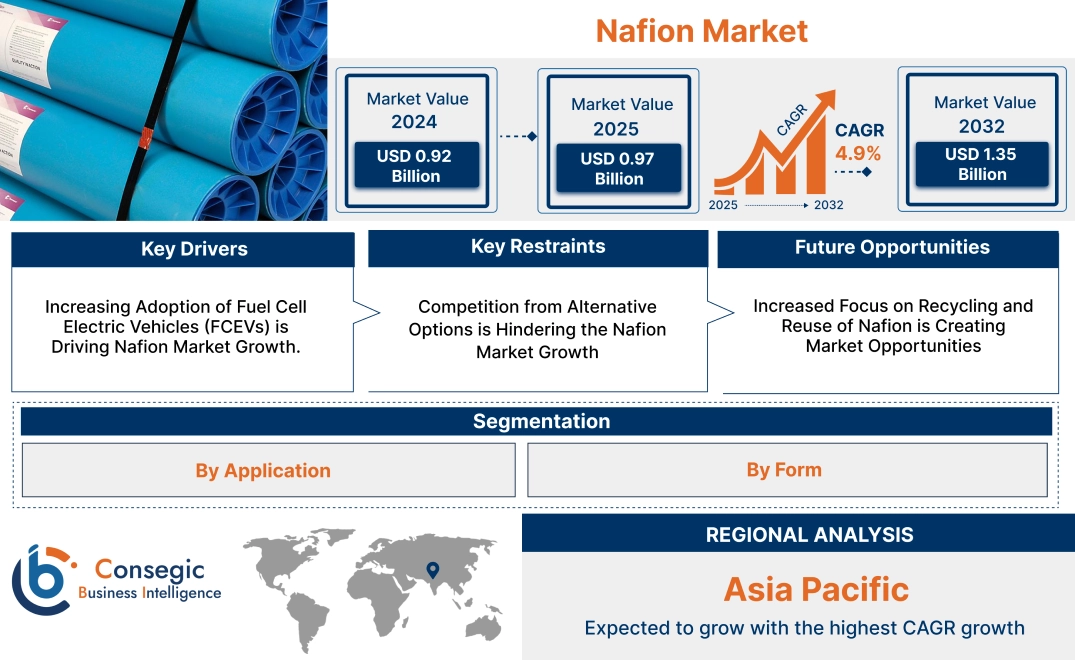
The Nafion Market size is growing with a CAGR of 4.9% during the forecast period (2025-2032), and the market is projected to be valued at USD 1.35 Billion by 2032 from USD 0.92 Billion in 2024. Additionally, the market value for 2025 is attributed to USD 0.97 Billion.
Nafion Market Scope & Overview:
Nafion is a brand name for sulfonated tetrafluoroethylene copolymer. It is a synthetic fluoropolymer distinguished due to its properties such as ion-conducting. This material belongs to the ionomers class. It showcases features such as a Teflon-like backbone with sulfonic acid side chains that enables the transport of positive ions efficiently. It also shows a strong chemical stability due to its fluorinated structure. This fluorinated structure allows it to withstand harsh environments. Similarly, sulfonated tetrafluoroethylene copolymer finds its usage in diverse applications. Primary applications are in proton exchange membrane (PEM) fuel cells, chlor-alkali electrolysis, and gas humidification. Based on the form category, the market is further sub categorized into membrane, dispersion and resin.
Nafion Market Dynamics - (DRO) :
Key Drivers:
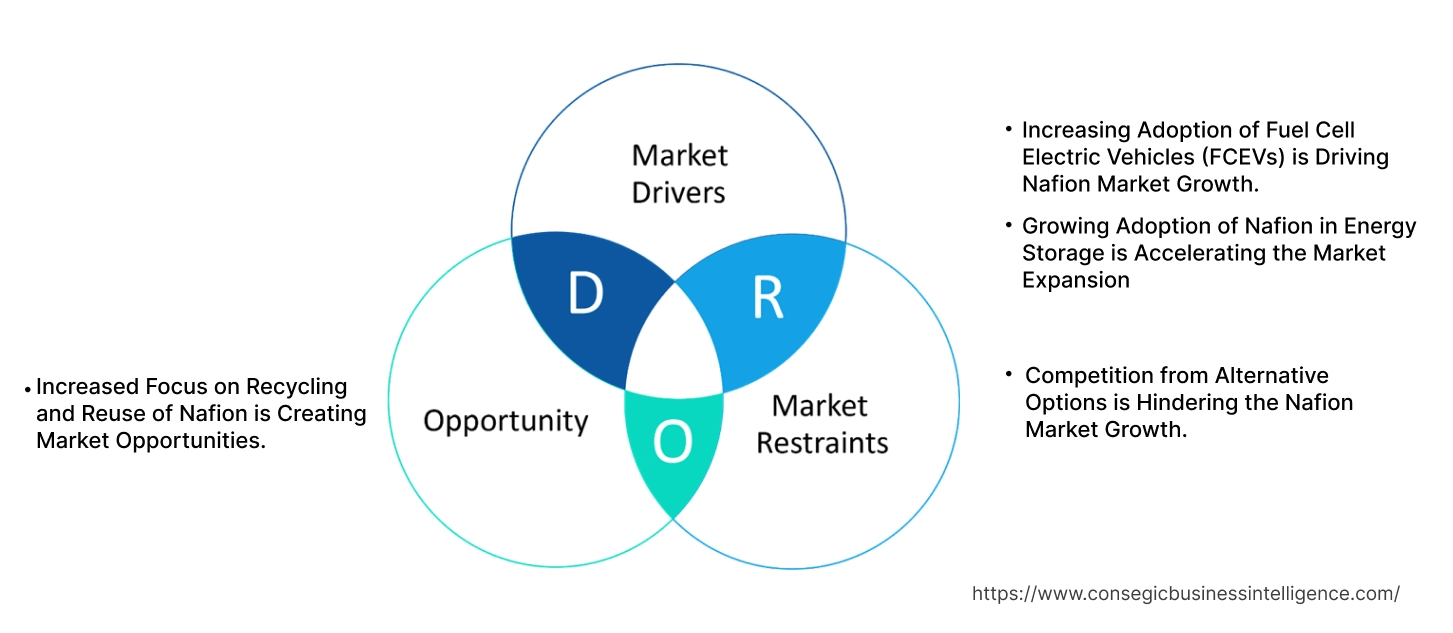
Increasing Adoption of Fuel Cell Electric Vehicles (FCEVs) is Driving Nafion Market Growth.
The propulsion for fuel cell electric vehicles (FCEVs) relies on the PEM fuel cells. In the PEM fuel cells, Nafion membranes act as the critical electrolyte that enables the selective transport of protons while blocking the electron flow. This complex process starts with the electrochemical reaction between hydrogen and oxygen which in turn generates electricity and water as byproducts. As the global automotive sector increasingly prioritizes sustainable mobility solutions, the need for this sulfonated tetrafluoroethylene copolymer in FCEV’s is increasing contributing to the higher market revenue.
- For instance, according to the European Hydrogen Observatory, the number of registrations for FCEVs increased from 962 to 1,549 in 2022, showcasing an increase of roughly around 61% from 2020.
Thus, this surge in FCEV deployment driven by advancements in hydrogen infrastructure and fuel cell efficiency are directly contributing to its substantial requirement.
Growing Adoption of Nafion in Energy Storage is Accelerating the Market Expansion.
Nafion is utilized in diverse energy storage technologies such as flow batteries, where it functions as an ion-exchange membrane. This is leading to its higher adoption in the energy storage sector. As the global need for renewable energy integration increases, the need for strong grid-scale energy storage solutions becomes mandatory in turn creating a lucrative position for the utilization of this sulfonated tetrafluoroethylene copolymer.
- For instance, according to Bloomberg NEF, the energy storage market across the globe grew by 3x in 2023 from its previous year, showcasing the largest year-on-year growth rate of the industry.
Additionally, the rise in adoption is further increased by the continuous advancements in energy storage technologies contributing to the nafion market expansion.
Key Restraints:
Competition from Alternative Options is Hindering the Nafion Market Growth
The focus of key players on developing new sustainable and cost-effective solutions has led to an increase in research and development to produce alternatives with similar characters or more than that of nafion. This serves as a primary factor contributing to the hindrance to the overall upward trajectory of the market. These alternatives are developed with focus to reduce or eliminate the drawbacks shown by sulfonated tetrafluoroethylene copolymer. Furthermore, its performance limitations under specific parameters, such as elevated temperatures or diminished humidity levels, are contributing towards the players looking for alternatives. As a result, the above-mentioned factors are contributing to the hindrance in nafion market expansion.
Future Opportunities :
Increased Focus on Recycling and Reuse of Nafion is Creating Market Opportunities
The growing focus on recycling and reusing nafion is driven by the rising inclination towards the concerns regarding Per- and polyfluoroalkyl substances (PFAS). This preference is rising due to the development of advanced recycling technologies. These technologies have led in the creation of new strategies for reprocessing and refurbishing used membranes. This has created a new pathway for recycled sulfonated tetrafluoroethylene copolymer. Furthermore, the focus towards closed-loop systems and specialized consulting services within its lifecycle is contributing to an upward market trajectory over the forecast period.
- For instance, Chemours introduced a new Discover Hub facility towards the end of 2020 wherein, an internal team is assigned to find new ways for sustainable Nafion for hydrogen economy. This creates potential for recycling and reusing the material in future years.
Therefore, the above-mentioned factors are creating lucrative nafion market opportunities in future years.
Nafion Market Segmental Analysis :
By Form:
Based on Form, the market is categorized into membrane, dispersion, and resin.
Trends in Form:
- The trend is to improve the durability and performance of membranes in applications such as FCEVs and electrolysis.
- The preference for Nafion dispersions in the development of advanced materials is rising.
The membrane segment accounted for the largest market share in 2024.
- Nafion membranes act as the critical electrolyte in PEM fuel cells. These cells are a vital component for FCEVs.
- Additionally, they are also increasingly important for stationary power generation within the hydrogen economy.
- Furthermore, their application in electrolysis, a large-scale industrial process, contributes to segmental revenue.
- The nature of applications such as FCEVs and large-scale electrolysis is of high value, along with continuous research and development focused on enhancing membrane performance and durability is contributing to segmental dominance.
- For instance, in 2023, Chemours stated the investment of USD 200 million at its French facility which includes the ionomer production rise and associated membrane to provide more capacity to the nafion materials supply chain.
- Thus, as per the analysis and trends, the membrane dominates the nafion market trends.
The dispersion segment is expected to grow at the fastest CAGR over the forecast period.
- Segmental growth is attributed to the dispersion's versatility in developing thin films, coatings, amongst others that enables it to be utilized across a diverse range of applications.
- Additionally, the high demand for catalyst layers in PEM fuel cells and electrolyzers are also factors contributing to market revenue.
- Furthermore, advancements in precise coating technologies along with the increasing adoption of dispersions in advanced sensors, electronics, and nanocomposite materials are supporting the upward segment trajectory.
- Dispersion's ability to open new paths for utilization in precise applications allows for a higher growth rate over the forecast period.
- Thus, according to market analysis and trends, the dispersion segment is expected to grow at the fastest rate in future years in the overall nafion market trends.
By Application:
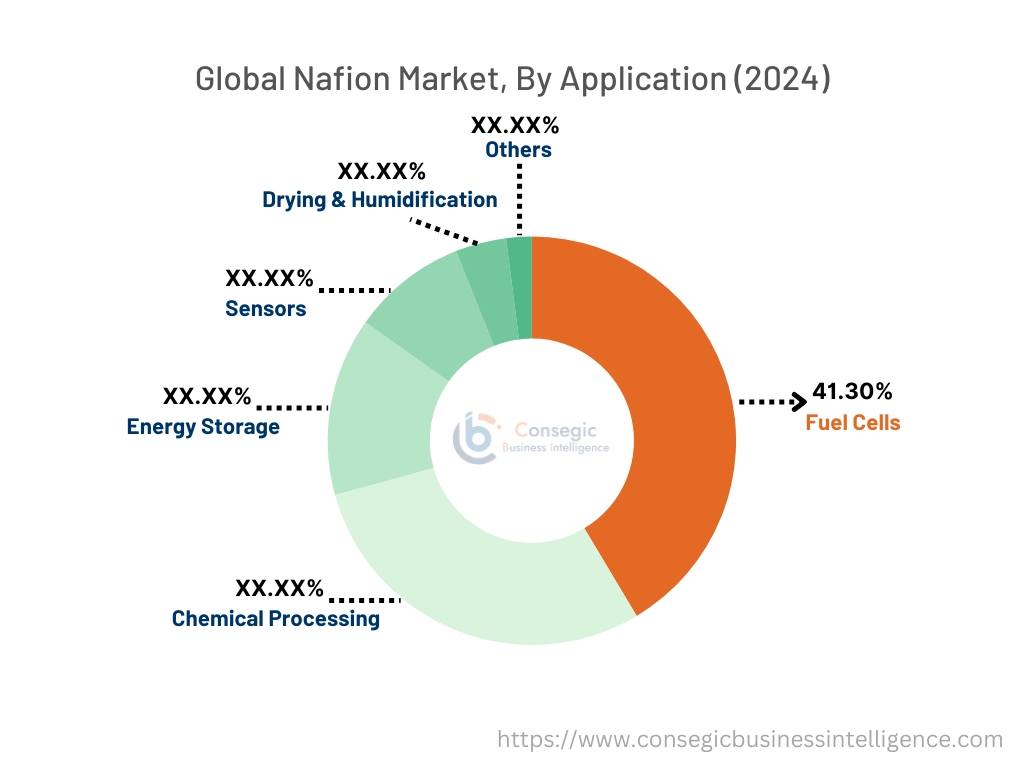
The Application segment is categorized into fuel cells, chemical processing, energy storage, sensors, drying & humidification, and others.
Trends in the Application:
- The automotive sector’s focus towards inclusion of sulfonated tetrafluoroethylene copolymer membranes in FCEVs is increasing.
- The inclination of key players towards miniaturizing sensors that are nafion-based and to integrate them into portable and wearable devices.
The fuel cells segment accounted for the largest share of 41.30% in 2024.
- The fuel cell segment holds prominence in the base year due to the focus towards sustainable energy solutions, with proton exchange membrane (PEM) fuel cells playing a primary role.
- The major increase in adoption of fuel cell electric vehicles due to the automotive sector's inclination towards decarbonization and the increasing availability of hydrogen infrastructure are contributing to the substantial need for this sulfonated tetrafluoroethylene copolymer.
- This surge in FCEV deployment along with the focus on hydrogen economy is creating a significant demand for sulfonated tetrafluoroethylene copolymer membranes.
- Additionally, the rise towards inclusion in stationary fuel cells for backup power, distributed generation, and combined heat and power systems further contribute to the segment's market share.
- Thus, as per analysis and trends, the market revenue for this segment is the largest in the overall nafion market demand.
The sensors segment is expected to grow at the fastest CAGR over the forecast period.
- The sensors segment contribution is driven by technological advancement using nafion and their expanding application domains.
- The increasing need for chemical sensors in environmental monitoring and industrial process control is contributing significantly.
- The focus towards miniaturization and the integration of sensors into portable and wearable devices are further contributing to the segment's revenue over the future years.
- For instance, according to Honeywell, the sensors market is expected to growth at a CAGR of more than 10% by 2032 showcasing potential for the adoption of lucrative strategies for the utilization of sulfonated tetrafluoroethylene copolymer into sensor market.
- Thus, according to market analysis, the sensor segment is expected to grow at the fastest rate in future years in the overall nafion market demand.
Regional Analysis:
The regional segment includes North America, Europe, Asia Pacific, the Middle East and Africa, and Latin America.
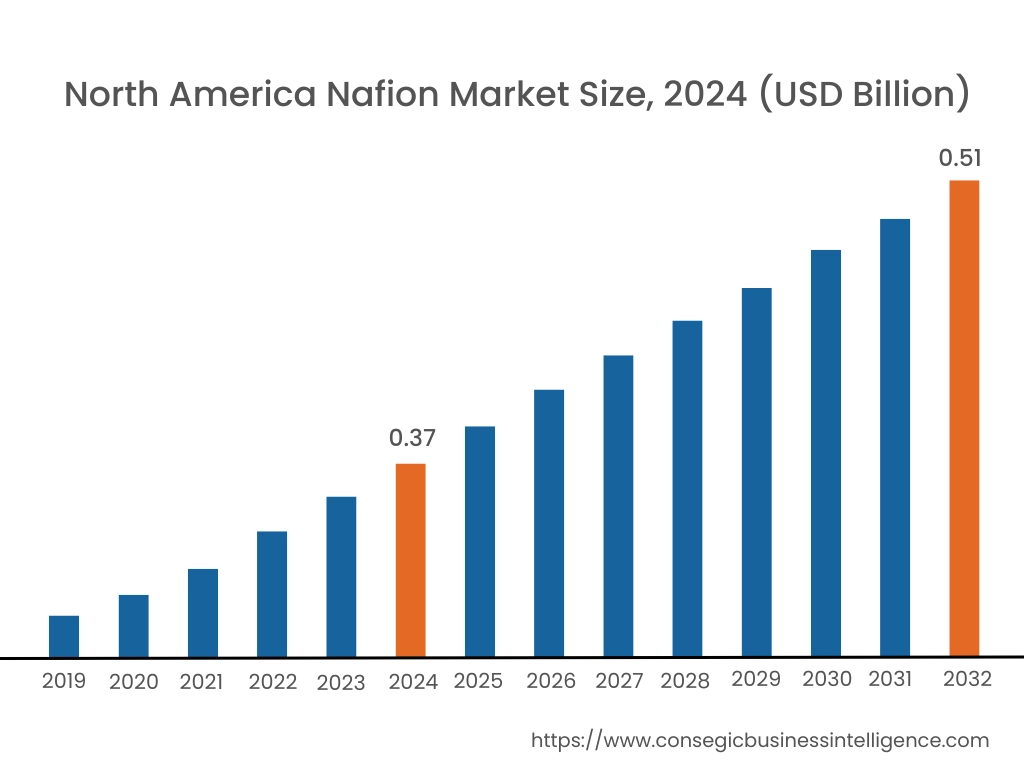
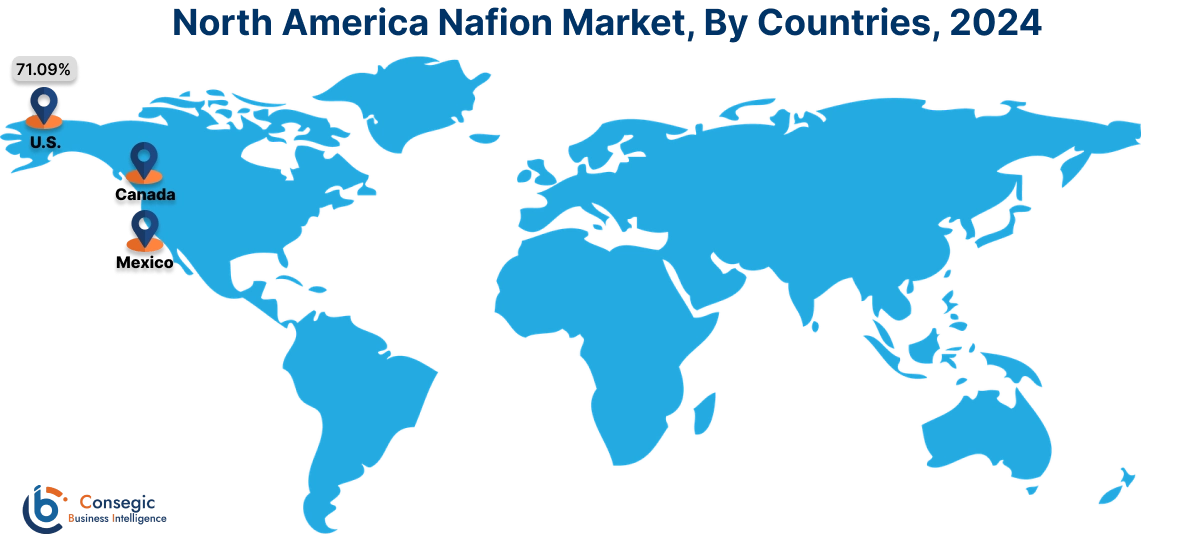
In 2024, North America accounted for the highest market share at 40.57% and was valued at USD 0.37 Billion and is expected to reach USD 0.51 Billion in 2032. In North America, U.S., accounted for the Nafion market share of 71.09% during the base year of 2024. The North American Nafion market share dominating due to the increasing adoption of fuel cell electric vehicles. This dominance is attributed to the supportive government policies along with a rapidly expanding hydrogen refueling network, particularly in the U.S. Corporate sustainability initiatives and fleet electrification goals are also contributing to this demand. Consequently, the need for high-performance sulfonated tetrafluoroethylene copolymer membranes, essential components of PEM fuel cells powering FCEVs, is increasing significantly.
- For instance, according to Arthur D Little, the number of FCEVs sold in the United States in 2021 attributed to 3,341 units.
Thus, due to the above-mentioned factors North America showcases dominant regional contribution of the Nafion market analysis.
In the Asia Pacific, the Nafion industry is experiencing the fastest growth with a CAGR of 6.7% over the forecast period primarily due to environmental and regulatory frameworks. As countries such as China, India, Japan amongst others across the region are focusing on the increasing environmental challenges, the need for sustainable practices including concerns related to PFAS compounds has become important. Stringent regulations, along with the key players focusing on reducing reliance on imported raw materials, are driving the development of advanced recycling technologies and the establishment of dedicated processing facilities for sulfonated tetrafluoroethylene copolymer. These are the major factors contributing to the market growth in this region.
In Europe’s Nafion market analysis, energy storage applications serve as the most widely used sector wherein sulfonated tetrafluoroethylene copolymer has been used. The region's focus is on climate goals and the integration of renewable energy sources. The governments focus on the development of a hydrogen economy is driving significant investments in sulfonated tetrafluoroethylene copolymer-based technologies, particularly flow batteries for grid stabilization and PEM electrolyzers for green hydrogen production. As Europe is focusing on its transitions into decentralized energy systems, its versatility has made sulfonated tetrafluoroethylene copolymer a suitable option.
In the Middle East and African (MEA) market, Nafion is widely utilized in the chemical processing applications due to the regions strong petrochemical sector and a government initiative towards higher-value chemical production. Additionally, abundant oil and natural gas reserves are driving investments in petrochemical industries, where catalytic properties and chemical resistance of sulfonated tetrafluoroethylene copolymer are utilized. Simultaneously, the region's focus on diversifying its industrial base and producing specialty chemicals, pharmaceuticals, and advanced materials is creating its growing demand.
The Latin America's market is driven by the region's new initiatives towards clean energy adoption. Government policies and growing environmental consciousness are contributing to this transition. The increasing deployment of PEM fuel cells for transportation and stationary power, alongside the surge of green hydrogen production via PEM electrolyzers, is creating a substantial demand for sulfonated tetrafluoroethylene copolymer membranes. As Latin American nations are focusing to meet their climate goals and diversify their energy portfolios, the overall nafion market opportunities are expected to be lucrative over the forecast period.
Top Key Players & Market Share Insights:
The Global Nafion Market is highly competitive with major players providing products to the national and international markets. Key players are adopting several strategies in research and development (R&D) and product innovation to hold a strong position in the global Nafion market. Key players in the Nafion industry include
- The Chemours Company (U.S.)
- Solvay (Belgium)
- KANOPY (India)
- DuPont de Nemors Inc. (U.S.)
- AGC Inc. (Japan)
- Dongyue Group Ltd (China)
Nafion Market Report Insights:
| Report Attributes | Report Details |
| Study Timeline | 2019-2032 |
| Market Size in 2032 | USD 1.35 Billion |
| CAGR (2025-2032) | 4.9% |
| By Form |
|
| By Application |
|
| By Region |
|
| Key Players |
|
| North America | U.S. Canada Mexico |
| Europe | U.K. Germany France Spain Italy Russia Benelux Rest of Europe |
| APAC | China South Korea Japan India Australia ASEAN Rest of Asia-Pacific |
| Middle East and Africa | GCC Turkey South Africa Rest of MEA |
| LATAM | Brazil Argentina Chile Rest of LATAM |
| Report Coverage |
|
Key Questions Answered in the Report
How big is the Nafion market? −
In 2024, the Nafion market is USD 0.92 Billion.
Which is the fastest-growing region in the Nafion market? +
Asia Pacific is the fastest-growing region in the Nafion market.
What specific segmentation details are covered in the Nafion market? +
By Form and Application segmentation details are covered in the Nafion market.
Who are the major players in the Nafion market? +
The Chemours Company (U.S.), DuPont de Nemors Inc. (U.S.), AGC Inc. (Japan), Dongyue Group Ltd (China), Solvay (Belgium), KANOPY (India) are some of the major players in the market.
Overview
Reputation & Certifications


Our Services
- Market Intelligence & Forecasting
- Custom Research Solutions
- Market Entry Strategy
- Competitive Intelligence
- Customer Insights
- Industry Innovation Analysis
- Investment Advisory