Jump to Content
Next Generation Integrated Circuit Market - Size, Share, Industry Trends, and Forecasts (2026-2034)
Next Generation Integrated Circuit Market Size:
Next Generation Integrated Circuit Market is estimated to reach over USD 5,018.52 Million by 2034 from a value of USD 1,458.22 Million in 2025 and is projected to grow by USD 1,650.79 Million in 2026, growing at a CAGR of 13.1% from 2026 to 2034.
Next Generation Integrated Circuit Market Key Takeaways
- Rising demand for AI, high-performance computing, and 5G technologies is driving market growth.
- Asia Pacific led the market, driven by strong semiconductor manufacturing and electronics production.
- Digital Integrated Circuits dominated the market, accounting for 43.50% of revenue.
- System-on-Chip (SoC) technology held the largest share due to its compact and energy-efficient design.
- IT & Telecom remained the leading end-use industry, supported by data centers and 5G infrastructure deployment.
- NVIDIA, Intel, Qualcomm, AMD, and TSMC were among the key players shaping the competitive landscape.
Next Generation Integrated Circuit Market Scope & Overview:
Next generation integrated circuits (ICs) are advanced semiconductor devices engineered with advanced manufacturing technologies to provide significantly higher computing power, superior energy efficiency, and expanded functionality. These circuits utilize innovations such as 3D stacking, heterogeneous integration, and specialized AI architectures to enable rapid data processing for applications like high-performance computing, artificial intelligence, and advanced mobile networks. Further, key trends driving the market include rapid integration of artificial intelligence and machine learning into chip architectures and widespread adoption of 5G and 6G connectivity, which necessitates specialized, low-latency integrated circuits. Additionally, the increasing shift toward heterogeneous integration and modular chiplet architectures is expected to boost the market.

Next Generation Integrated Circuit Market Dynamics - (DRO) :
Market Drivers:
Growing Transition to Electric and Autonomous Vehicles Drives the Market
The transition toward electric and autonomous vehicles is transforming the automotive sector into a sophisticated, software-defined ecosystem. This transformation acts as a primary catalyst for the semiconductor market. Electric vehicles require two to three times more semiconductor components than traditional combustion engines, driven by the need for complex battery management systems, high-efficiency power conversion, and advanced motor control units. Similarly, the evolution of autonomous driving necessitates high-performance computing, specialized AI accelerators, and extensive sensor suites like LiDAR and radar. This shift is fueling a massive surge in requirement for power-efficient materials, such as silicon carbide and gallium nitride, which enhance vehicle range and charging speeds.
- For instance, according to the International Energy Agency (IEA), electric vehicle sales are booming across the globe. In 2024, 17 million were sold, and that number is expected to increase to over 20 million by the end of 2025.
Thus, rapid shift toward vehicle electrification and the integration of sophisticated autonomous driving capabilities contribute significantly in driving the next generation integrated circuit market.
Market Restraints:
Supply Chain and Geopolitical Risks are Restraining the Market Growth
Artificial intelligence is driving major development in the semiconductor sector; however, the companies have to navigate a complex landscape of persistent geopolitical and economic disruptions. Many countries are now using trade restrictions and strict policies to gain an advantage in technology, which makes it harder for companies to get the parts they need. Because of these trade tensions and shifting international alliances, businesses are being forced to move away from low-cost production and instead focus on making their supply chains more secure. Additionally, a limited supply of essential raw materials and concerns over energy costs caused by regional conflicts are making it harder to manufacture chips. These combined challenges raise the overall cost of doing business and slow down the growth needed to keep up with the world's hunger for electronics.
Future Market Opportunities :
Increasing Penetration of 5G Deployment Drives Next Generation Integrated Circuit Market Opportunities
The widespread deployment of 5G infrastructure is a primary factor that is driving the need for advanced integrated circuits. Unlike previous cellular standards, 5G requires highly specialized hardware capable of managing significantly higher data volumes, ultra-low latency, and complex network architectures like mmWave and sub-6 GHz bands. This shift is forcing a transition from general-purpose hardware to highly integrated, specialized components, such as sophisticated Radio Frequency Integrated Circuits (RFICs) and advanced System-on-Chip (SoC) solutions that combine processing and connectivity functions. Furthermore, as 5G turns mobile networks into distributed data centers, it creates a symbiotic relationship with artificial intelligence, mandating powerful, energy-efficient chips that can perform real-time computing at the network edge. Thus, the rapid expansion of 5G infrastructure and the demand for high-performance, edge-computing hardware drive the next generation integrated circuit market opportunities.
Next Generation Integrated Circuit Market Segmental Analysis:
By Type:
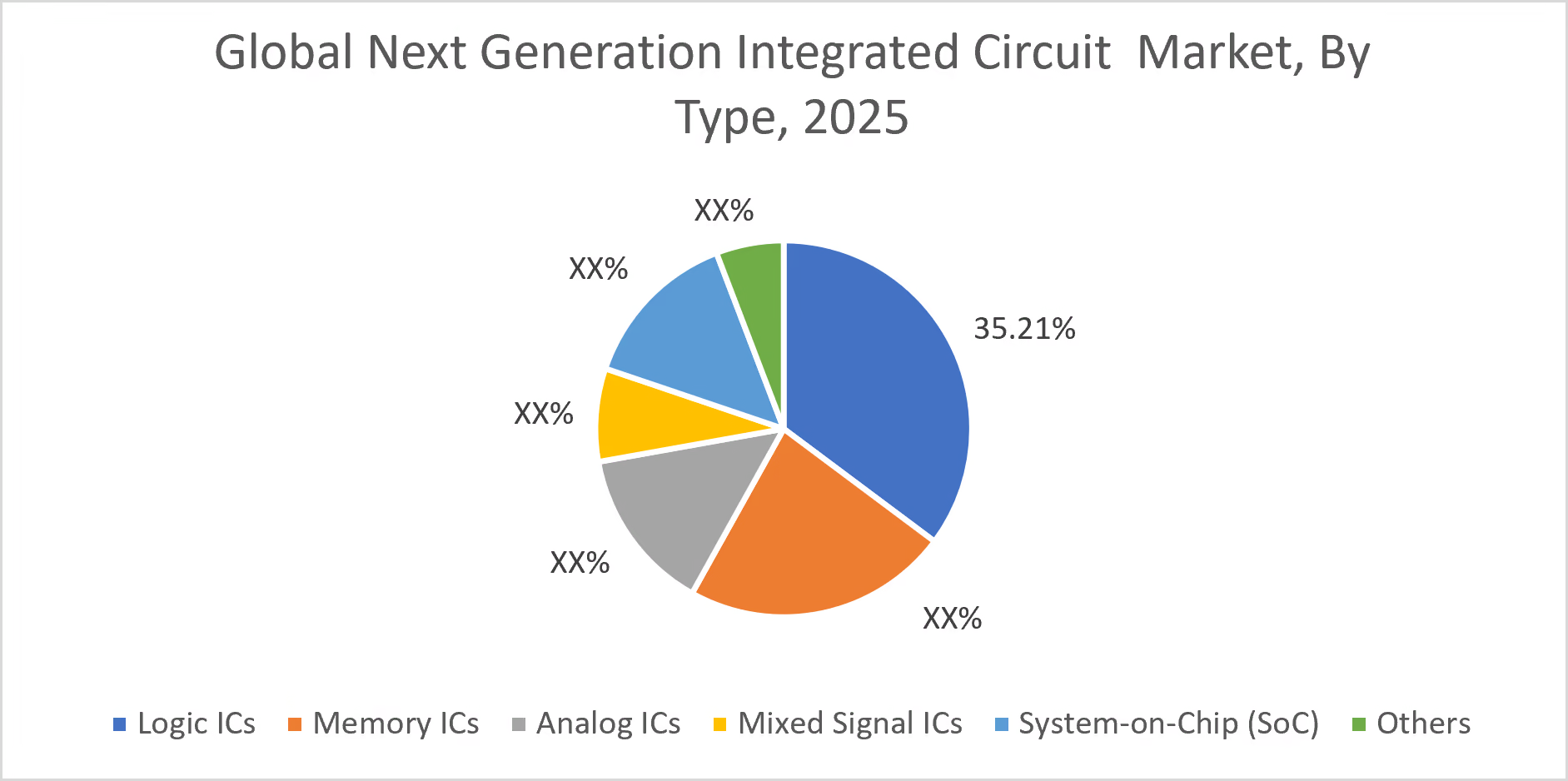
Based on the type, the market is segmented into Logic ICs, Memory ICs, Analog ICs, Mixed Signal ICs, System-on-Chip (SoC), and others.
Trends in the Type:
- The increased integration of electronics for fuel efficiency and safety in vehicles is driving the market trends.
- Portable and wearable medical diagnostic devices are fueling demand for mixed-signal ICs, which in turn drives the market size.
Logic ICs accounted for the largest revenue share in the year 2024 and is anticipated to register the fastest CAGR during the forecast period.
- There is an increasing integration of advanced AI and machine learning capabilities directly into logic ICs to enhance computing power, which is driving the circuit market.
- Further, there is an increasing focus toward designs that prioritize reduced power consumption, which in turn drives the market.
- Furthermore, the rise of autonomous vehicles is driving demand for highly reliable, high-speed logic ICs capable of managing complex safety and navigation systems, which in turn drives the next generation integrated circuit market trends.
- Thus, as per the next generation integrated circuit market analysis, autonomous vehicles, AI/ML integration, and low-power requirements are driving the market.
By Material:
Based on the material, the market is segmented into Silicon-based, Gallium Nitride (GaN), Silicon Carbide (SiC), Gallium Arsenide (GsAs), and others.
Trends in the Material:
- GaAs devices are seeing faster adoption in automotive electronics, specifically for sensing and communication systems, driving the next generation integrated circuit market demand.
- SiC is increasingly preferred over silicon in grid-scale renewable energy inverters and high-power industrial motors, driving the next generation integrated circuit market share.
Silicon-based accounted for the largest revenue share in the year 2024.
- Manufacturers are relentlessly focusing on smaller process nodes (sub-5 nm) to meet the extreme performance needs, which in turn drives the next generation integrated circuit market growth.
- Further, silicon design is moving from monolithic dies to chiplet-based architectures, allowing for the mixing and matching of components to improve customization and cost-efficiency.
- Furthermore, silicon is being optimized for better power-efficiency features to support the massive energy needs, which in turn drives the market.
- Thus, as per the next generation integrated circuit market analysis, focus on sub-5 nm nodes, chiplet architecture adoption, and focus on power efficiency are driving the market.
Gallium Nitride (GaN) is anticipated to register the fastest CAGR during the forecast period.
- Manufacturers are emphasizing advanced fourth-generation GaN technology to significantly boost thermal performance, switching frequencies, and overall power density.
- Further, GaN is becoming the standard for consumer electronics fast-charging ecosystems due to its ability to provide high power in a compact form factor, which subsequently propels the market expansion.
- Therefore, based on analysis, the aforementioned trends are anticipated to boost the growth of the market during the forecast period.
By Application:
Based on the application, the market is segmented into AI & ML, Internet of Things (IoT), edge computing, 5G/6G communications, autonomous vehicles, AR/VR devices, quantum computing, and others.
Trends in the Application:
- AI is moving beyond data centers into physical systems like robots and vehicles, requiring real-time, local inference, in turn driving the next market.
- Generative AI is being used to create realistic AR avatars that replicate human emotions and gestures in real time, driving the next generation integrated circuit market size.
5G/6G communications accounted for the largest revenue share in the year 2024 and is anticipated to register a significant CAGR during the forecast period.
- Telecom networks are evolving into systems where machine learning is embedded across the radio access network (RAN) and core to enable self-optimizing operations, which in turn drives the next generation integrated circuit market growth.
- Further, operators are adopting hybrid, multi-cloud strategies to enable network slicing and on-demand 5G APIs, in turn driving the next generation integrated circuit industry.
- Furthermore, networks are adopting agentic AI to sense, predict, and heal faults autonomously.
- Thus, based on analysis, the aforementioned trends are anticipated to boost the market during the forecast period.
By End User:
Based on the end user, the market is segmented into consumer electronics, automotive, industrial automation, healthcare, telecommunication, and others.
Trends in the End User:
- Smart manufacturing and industrial IoT (IIoT) are growing with the adoption of embedded AI, intelligent sensors, and real-time automation, which in turn drives the market next generation integrated circuit market expansion.
- Rising demand for continuous health monitoring and remote patient care is driving the wearables segment, propelling the market.
Consumer Electronics accounted for the largest revenue share in the year 2024.
- Premium smartphones, PCs, and wearables are increasingly integrated with on-device AI accelerators and NPUs (Neural Processing Units), which allow for real-time, context-aware processing without relying solely on the cloud.
- Further, devices are becoming smart as they are able to learn, adapt, and act on user behavior, environmental changes, or security threats.
- Furthermore, Near-field communication (NFC) adoption is accelerating rapidly, moving beyond basic payments to become a central enabler of digital identity, secure keys, and personalized wellness tracking.
- Thus, based on analysis, growing NFC adoption, shift toward edge intelligence, and proliferation of AI-enabled hardware are driving the market growth.
Automotive is anticipated to register the fastest CAGR during the forecast period.
- The increasing need for power electronics, including inverters, converters, and power modules, is driving the market.
- Further, the sector is pivoting toward high-performance domain controllers, AI accelerators, and GPU-based platforms to support ADAS and autonomous driving features.
- Furthermore, increasing focus on automation and electric vehicles is driving the market.
- Therefore, based on analysis, the aforementioned trends are anticipated to boost the market during the forecast period.
Next Generation Integrated Circuit Market Regional Analysis:
The regions covered are North America, Europe, Asia Pacific, Middle East and Africa, and Latin America.
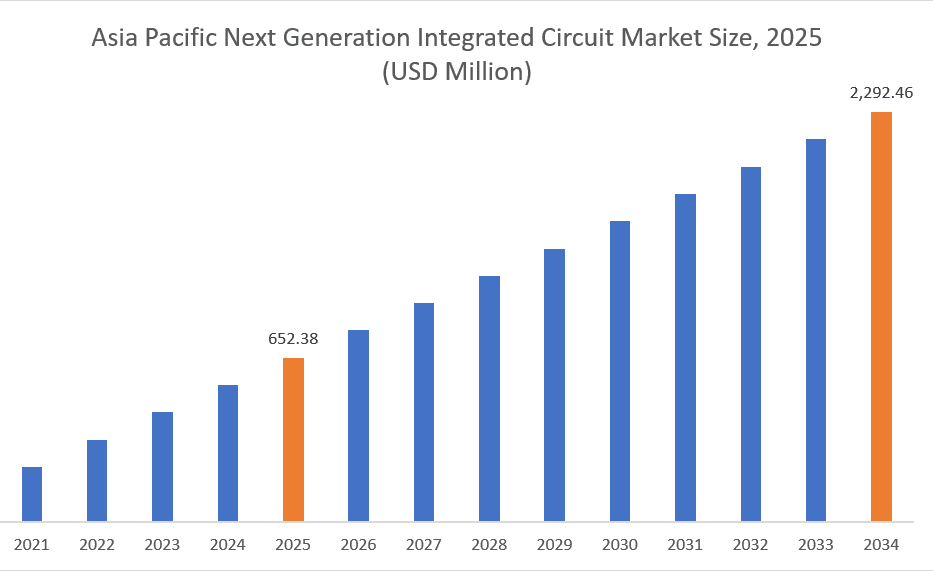
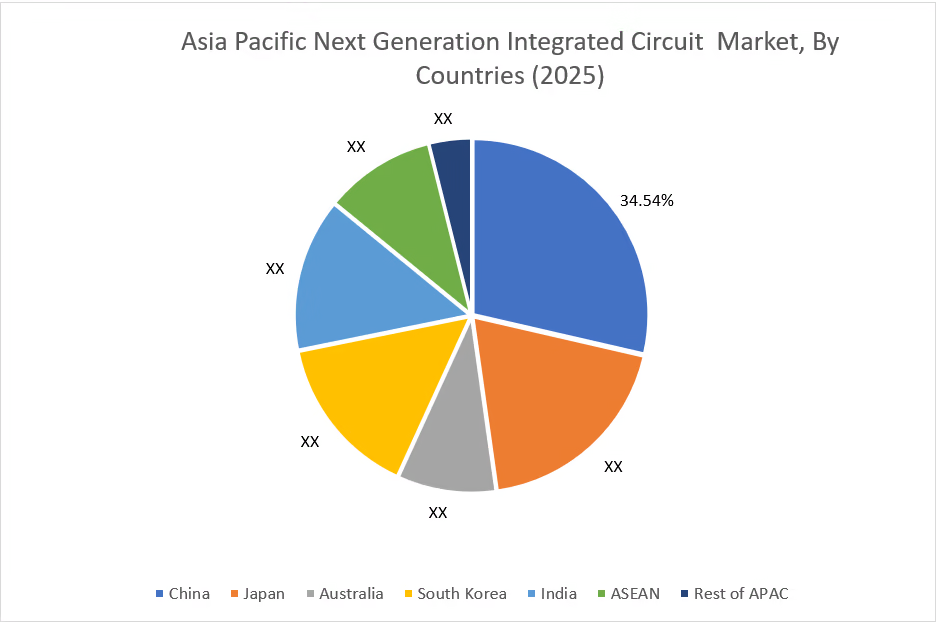
Asia Pacific region was valued at USD 652.38 Million in 2025. Moreover, it is projected to grow by USD 740.26 Million in 2026 and reach over USD 2,292.46 Million by 2034. Out of this, China accounted for the maximum revenue share of 34.54%. The market growth is mainly driven by rapid industrialization, the region's position as a dominant global manufacturing hub for consumer electronics, and aggressive deployments of 5G and 6G telecommunications infrastructure. The growth is further accelerated by growing need for IoT-integrated devices, electric vehicles (EVs), and increased investments in domestic semiconductor research and development programs.
- For instance,in 2024, according to the International Energy Agency (IEA), China strengthened its lead in the global electric vehicle market, with nearly 50% of all new car sales in the country being electric, amounting to approximately 11 million vehicles.
North America is estimated to reach over USD 1,387.12 Million by 2034 from a value of USD 402.79 Million in 2025 and is projected to grow by USD 456.02 Million in 2026. The North American market is primarily driven by emphasis on advanced technologies, including artificial intelligence (AI) and the Internet of Things (IoT). This market is further accelerated by substantial regional investments in research and development.
- For instance, in October 2024, Rambus launched the complete chipset solution for DDR5 MRDIMMs and RDIMMs, specifically engineered to boost performance in data centers. By optimizing memory throughput and minimizing latency, these chipsets provide the high-bandwidth efficiency required for next generation server infrastructure and demanding AI workloads.
The regional analysis depicts stringent regulations, implementation of the EU Chips Act, and the growing EV sector in Europe are driving the market. Additionally, the factors driving the market in the Middle East and African region are infrastructure development, the growing EV sector, and rising need for advanced microelectronics. Further, expanding infrastructure development and industrialization efforts in the Latin America region are driving the market.
Top Key Players & Market Share Insights:
The global next generation integrated circuit market is highly competitive, with major players providing solutions to the national and international markets. Key players are adopting several strategies in research and development (R&D), product innovation, and end-user launches to hold a strong position in the next generation integrated circuit industry. Key players in the market include-
- NVIDIA Corporation (U.S.)
- TSMC (Taiwan)
- Intel Corporation (U.S.)
- Qualcomm Incorporated (U.S.)
- Broadcom Inc. (U.S.)
- Samsung Electronics Co., Ltd. (South Korea)
- Micron Technology, Inc. (U.S.)
- SK hynix Inc. (South Korea)
- Advanced Micro Devices, Inc. (U.S.)
- Texas Instruments Incorporated (U.S.)
Recent Industry Developments :
Collaboration and Partnership
Resonac inaugurated a dedicated R&D center in Silicon Valley to serve as the headquarters for a new U.S.-Japanese consortium focused on advancing next generation semiconductor packaging technologies. By collaborating with 12 industry partners and local end-users, the initiative aims to accelerate the development and commercialization of new materials and evaluation techniques through real-time market integration.
Product Launch
LG Innotek launched the world's first "Next generation Smart IC Substrate," a component for smart cards and identification that improves durability by three times while reducing production-related carbon emissions by 50%. The company began mass production in November 2025 and is aiming to leverage these performance and sustainability gains to accelerate extension among global customers.
Next Generation Integrated Circuit Market Report Insights :
| Report Attributes | Report Details |
| Study Timeline | 2021-2034 |
| Market Size in 2034 (USD Million) | USD 5,018.52 Million |
| CAGR (2026-2034) | 13.1% |
| By Type |
|
| By Material |
|
| By Application |
|
| By End User |
|
| By Region |
|
| Key Players |
|
| Report Coverage |
|
Key Questions Answered in the Report
How big is the next generation integrated circuit market? −
Thenext generation integrated circuit market is estimated to reach over USD 5,018.52 Million by 2034 from a value of USD 1,458.22 Million in 2025 and is projected to grow by USD 1,650.79 Million in 2026, growing at a CAGR of 13.1% from 2026 to 2034.
What specific segmentation details are covered in the n report? +
The report includes specific segmentation details for type, material, application,end user, and regions.
Which is the fastest segment anticipated to impact the market growth? +
In the market, Gallium Nitride (GaN) is the fastest-growing segment during the forecast period.
Who are the major players in the market? +
The key participants in the market are NVIDIA Corporation (U.S.), TSMC (Taiwan), Intel Corporation (U.S.), Qualcomm Incorporated (U.S.), Broadcom Inc. (U.S.), Samsung Electronics Co., Ltd. (South Korea), Micron Technology, Inc. (U.S.), SK hynix Inc. (South Korea), Advanced Micro Devices, Inc. (U.S.), Texas Instruments Incorporated (U.S.), and others.
What are the key trends in the market? +
The marketis being shaped by several key trends including high demand for AI infrastructure and the integration of edge AI across consumer and industrial devices. Furthermore, the industry is transitioning toward chiplet architectures, to overcome traditional scaling limits while simultaneously prioritizing energy-efficient designs to address the power constraints of modern data centers and edge applications.
Overview
Reputation & Certifications


Our Services
- Market Intelligence & Forecasting
- Custom Research Solutions
- Market Entry Strategy
- Competitive Intelligence
- Customer Insights
- Industry Innovation Analysis
- Investment Advisory