Jump to Content
Next Generation Sequencing Market - Size, Share, Industry Trends, and Forecasts (2025-2035)
Next Generation Sequencing Market:
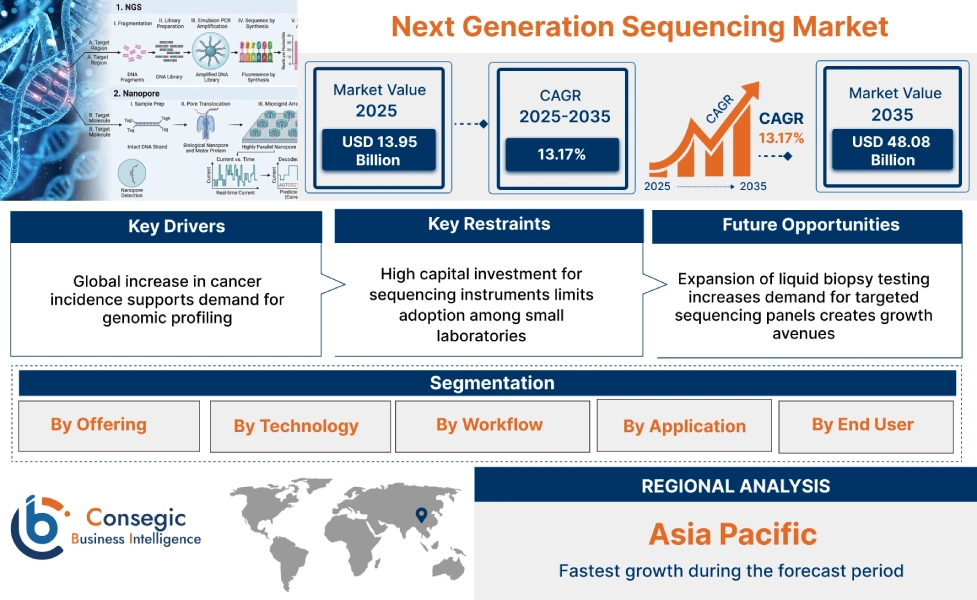
Next Generation Sequencing Market size is estimated to reach over USD 48.08 Billion by 2035 from a value of USD 12.33 Billion in 2024 and is projected to grow by USD 13.95 Billion in 2025, growing at a CAGR of 13.17% from 2025 to 2035
Next Generation Sequencing Market Scope & Overview:
Next generation sequencing can be defined as a high-throughput approach to analyze DNA and RNA sequences in a rapid manner. The next generation sequencing industry can be defined as the development and commercialization of next generation sequencing devices, reagents, sample preparation tools, bioinformatics tools, and data analysis tools. The main aim of next generation sequencing is to produce accurate genomic data in a shorter time and at a lower cost compared to other sequencing methods. The infrastructure supports clinical diagnostics, drug discovery, academic research, agricultural genomics, and population-scale sequencing programs.
The next generation sequencing sector is expanding due to the rising use of genomic testing in oncology and rare disease diagnosis. Healthcare institutions and research organizations are increasing investment in sequencing platforms and bioinformatics capabilities to support precision medicine initiatives. The development of large-scale genome initiatives and the integration of next generation sequencing in clinical practice are driving the next generation sequencing industry in hospitals, diagnostic centers, and research institutions.
Market Size & Forecast
- 2024 Market Size : USD 12.33 Billion
- 2025 Market Size : USD 13.95 Billion
- 2035 Evaluate Market Size : USD 48.08 Billion
- CAGR (2025-2035) : 13.17%
- Largest growing region : North America
- Fastest growing region : Asia Pacific
How is the Next Generation Sequencing Market Affected by AI?
AI improves next generation sequencing workflows by processing large volumes of genomic data, variant reads, and alignment outputs with high accuracy. Machine learning algorithms detect sequencing errors, low-quality reads, and variant inconsistencies across whole genome and targeted panels.
AI systems are also used for automated variant annotation, disease risk prediction, and pattern recognition within bioinformatics pipelines. Predictive models assess sequencing depth, sample quality, and data reliability before reporting, allowing laboratories to maintain diagnostic accuracy and reduce interpretation time across clinical and research applications.
Next Generation Sequencing Market Dynamics - (DRO):
Key Drivers:
Global increase in cancer incidence supports demand for genomic profiling
The cancer cases are rising in developed and emerging countries worldwide, which is creating a need for molecular diagnostics. Hospitals and oncology centers are incorporating genomic profiling into routine cancer care to identify mutations and guide targeted therapy decisions. The comprehensive sequencing panels help clinicians understand cancer biology and develop personalized treatment strategies. Diagnostic laboratories are expanding sequencing capacity to manage rising oncology testing volumes.
- For instance, in February 2024, according to WHO there are an estimated 20 million new cases and 9.7 million cancer-related deaths worldwide in 2022. Additionally, there are 53.5 million survivors within 5 years of diagnosis. Out of every 5 people, 1 develops cancer during their lifetime. Out of every 9 males and 12 females, 1 dies from cancer.
Thus, the rising cancer cases worldwide are propelling the growth of next-generation sequencing services worldwide.
Key Restraints:
High capital investment for sequencing instruments limits adoption among small laboratories
Huge investment is necessary for next generation sequencing instruments, associated hardware, as well as informatics tools. The setup of the laboratory involves further costs associated with data storage facilities, quality control equipment, as well as workforce recruitment. For small diagnostic centers, financial constraints are a hindrance for allocating budgets for next generation sequencing systems. Long payback periods on investment add financial risks to the healthcare market.
Therefore, a lot of capital investment is a major hindrance for the widespread adoption of next generation sequencing technologies by small and independent laboratories.
Future Opportunities:
Expansion of battery energy storage systems improves renewable reliability and creates growth avenues
Liquid biopsy tests have started showing promise in oncology for cancer profiling and treatment monitoring. Blood-based tests for genomic analysis require highly sensitive targeted sequencing tests for the detection of mutations. Diagnostic companies are designing special tests that have shown promise for the analysis of DNA. The shift toward minimally invasive cancer diagnostics is expanding the use of sequencing in early detection and disease monitoring.
- For example, Thermo Fisher’s Chief Development Officer Dr. Gary Pestano has revealed that Oncomine NGS has shown improvements in liquid biopsy tests for the detection of tumor mutations in the blood for cancer therapy selection and monitoring. The tests have shown promise for precision oncology for the analysis of SNVs, indels, CNVs, and fusions with high sensitivity.
Thus, the expansion of liquid biopsy testing is creating new growth opportunities in the next generation sequencing market.
Next Generation Sequencing Market Segmental Analysis:
By Offering:
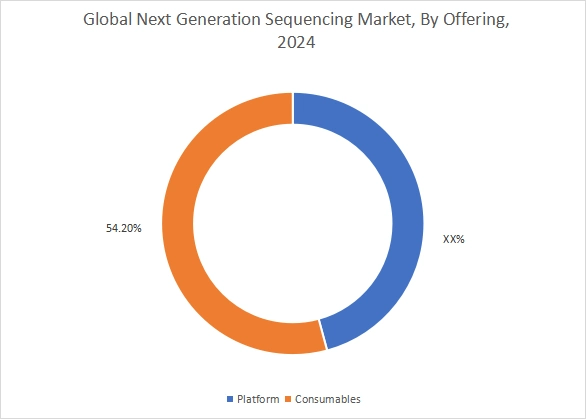
On the basis of offering, the next generation sequencing market is segmented into platform and consumables.
Trends in the Offering:
- Increasing installation of high-throughput sequencers is supporting demand for advanced platforms.
- Growing test volumes in clinical laboratories are increasing recurring demand for consumables.
The consumables was responsible for the highest revenue share of 54.2% in 2024.
- Consumables comprise reagent kits, library preparation kits, flow cells, and sample preparation.
- High testing frequency for oncology and genetic screening tests results in frequent purchases.
- Additionally, the constant usage of reagents for every sequencing run ensures consistent revenue generation.
- In addition, expansion of diagnostic laboratories is increasing procurement of standardized kits.
- Therefore, rising test volumes across clinical and research applications are expected to boost the consumables segment during the forecast period.
It is anticipated that the platforms will exhibit the highest compound annual growth rate (CAGR) during the forecast period.
- Platforms include sequencing instruments and integrated workflow systems.
- Hospitals and research institutes are upgrading to higher throughput systems to improve turnaround time.
- Furthermore, the incorporation of automation technology in new systems minimizes human intervention.
- In addition, demand for compact and benchtop sequencers is increasing in mid-sized facilities.
- Therefore, technology upgrades and infrastructure expansion are expected to support growth of the platform segment during the forecast period.
By Technology:
On the basis of technology, the next generation sequencing market is segmented into WGS, whole exome sequencing, targeted sequencing and resequencing, and others.
Trends in the Technology:
- Growing use of precision medicine is increasing adoption of comprehensive sequencing approaches.
- Cost optimization strategies are supporting demand for focused gene panels.
The targeted sequencing and resequencing was responsible for the highest revenue share in 2024.
- Targeted panels focus on specific genes associated with cancer and inherited disorders.
- Laboratories prefer targeted panels to reduce data complexity and analysis time.
- Moreover, lower sequencing cost per sample improves accessibility in routine diagnostics.
- In addition, demand for companion diagnostics is supporting focused gene testing.
- Therefore, efficiency and cost control are expected to sustain dominance of targeted sequencing during the forecast period.
It is anticipated that the whole genome sequencing will exhibit the highest compound annual growth rate (CAGR) during the forecast period.
- WGS enables comprehensive analysis of coding and non-coding regions.
- Research institutes are expanding genome mapping projects across populations.
- Further, declining sequencing cost is improving feasibility of large-scale genome studies.
- In addition, integration with advanced bioinformatics platforms is strengthening data interpretation.
- Therefore, increasing adoption in research and complex disease studies is expected to support WGS growth.
By Workflow:
On the basis of workflow, the next generation sequencing market is segmented into pre-sequencing, sequencing, and NGS data analysis.
Trends in the Workflow:
- Automation in sample preparation is improving laboratory efficiency.
- Growing data volumes are increasing reliance on advanced analytics platforms.
The sequencing was responsible for the highest revenue share in 2024.
- Sequencing includes the core process of nucleotide identification and data generation.
- High throughput systems increase sample processing capacity.
- Moreover, continuous platform upgrades improve speed and accuracy.
- In addition, clinical laboratories prioritize faster turnaround time for diagnostic reporting.
- Therefore, expanding test demand is expected to support the sequencing segment during the forecast period.
It is anticipated that the NGS data analysis will exhibit the highest compound annual growth rate (CAGR) during the forecast period.
- Data analysis involves alignment, variant calling, and interpretation.
- Increasing data complexity requires advanced bioinformatics tools.
- Further, integration of AI-based analytics improves variant interpretation accuracy.
- In addition, cloud-based platforms are expanding access to scalable computing resources.
- Therefore, rising demand for efficient data interpretation is expected to drive growth of the NGS data analysis segment.
By Application:
On the basis of application, the next generation sequencing market is segmented into oncology, clinical investigation, reproductive health, HLA typing and immune system monitoring, metagenomics epidemiology and drug development, agrigenomics and forensics, and consumer genomics.
Trends in the Application:
- Rising cancer incidence is increasing genomic testing volumes.
- Expansion of genetic screening programs is supporting clinical adoption.
The oncology was responsible for the highest revenue share in 2024.
- Oncology applications include tumor profiling and mutation detection.
- Targeted therapy selection requires precise genomic insights.
- Moreover, liquid biopsy testing is expanding use of sequencing in cancer monitoring.
- In addition, integration of sequencing into routine oncology practice is increasing test frequency.
- In July 2025, Thermo Fisher’s Oncomine Dx Express Test got FDA approval as a companion diagnostic for ZEGFROVY in NSCLC with EGFR exon 20 insertions and tumor profiling, delivering results in 24 hours.
- Therefore, strong clinical demand is expected to sustain dominance of the oncology segment during the forecast period.
It is anticipated that the reproductive health will exhibit the highest compound annual growth rate (CAGR) during the forecast period.
- Applications include non-invasive prenatal testing and carrier screening.
- Growing awareness of genetic disorders supports early screening programs.
- Further, expansion of private diagnostic centers increases accessibility.
- In addition, declining sequencing cost improves affordability of prenatal tests.
- Therefore, expanding prenatal and carrier screening programs are expected to drive growth of the reproductive health segment.
By End User:
On the basis of end user, the next generation sequencing market is divided into academic and research institutes, hospitals and clinics, pharmaceutical and biotechnology companies, and other end users.
Trends in the End User:
- Rising research funding is increasing sequencing adoption in academic institutions.
- Growth in precision medicine programs is expanding hospital-based genomic testing.
Academic and Research institutes accounted for the largest revenue share in the year 2024.
- Research institutes conduct genome mapping and disease association studies.
- Large-scale research projects require high throughput sequencing systems.
- Moreover, government funding supports installation of advanced platforms.
- In addition, collaborations with biotechnology companies strengthen research pipelines.
- Therefore, expanding genomic research activities are expected to support the academic and research institutes segment during the forecast period.
Hospitals and clinics is anticipated to register the fastest CAGR during the forecast period.
- Hospitals are increasingly integrating genomic testing into routine diagnostics.
- There is an increased need for rapid molecular profiling in oncology departments.
- In addition, the improvement in reimbursement coverage is fueling the adoption by hospitals.
- In addition, demand for personalized treatment pathways increases in-house sequencing capabilities.
- Therefore, integration of genomic testing into clinical workflows is expected to drive growth of the hospitals and clinics segment.
Regional Analysis:
North America, Europe, Asia Pacific, the Middle East and Africa, and Latin America are the regions of coverage.
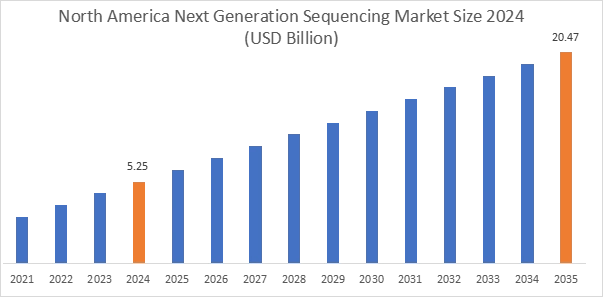
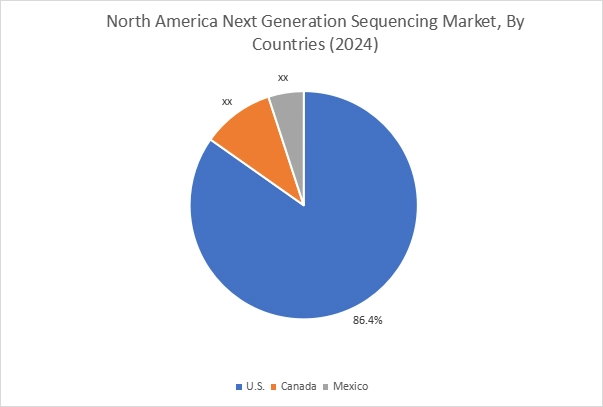
In 2024, North America accounted for the highest market share at 42.57% and was valued at USD 5.25 Billion, and is expected to reach USD 20.47 Billion by 2035. In North America, the U.S. accounted for the highest market share of 86.4% during the base year of 2024. This is driven by the strong adoption rate of genomic testing in cancer therapy and rare disease testing. The country has the presence of key players in the genetic sequencing technology space and established reimbursement systems. It is expanding its genome research initiatives through funding programs.
- For example, in February 2026, Ultima Genomics introduced its UG 200 series of sequencers and Solaris 2.0 workflows, which allowed for massive-scale DNA sequencing at less than USD 100 per genome and increased speed and efficiency.
Asia Pacific market segment is expected to show the fastest growth during the forecast period. China is investing heavily in large-scale genome sequencing projects and developing domestic biotechnological capabilities. It is increasing the adoption of NGS technology for oncology diagnostics and prenatal screening in private hospitals in the country. Japan and South Korea are investing heavily in precision medicine initiatives by investing in national genomic initiatives. Rising healthcare expenditure is supporting installation of advanced sequencing platforms.
- For instance, India faces a growing burden as well, with approximately 100 in every 1 lakh people diagnosed with the disease. ICMR data puts the total number of new cancer cases in India at over 14 lakhs in 2023. Thus, rising cancer cases in India is pushing adoption of next generation sequencing for faster diagnosis and precision treatment.
Europe next generation sequencing market growth is supported by government funded genome mapping programs in the UK, Germany, and France. Expansion of personalized medicine frameworks is increasing routine genomic profiling across public healthcare systems.
Latin America next generation sequencing market growth is supported by rising cancer testing volumes in Brazil and Mexico. Private diagnostic laboratories are increasingly using benchtop sequencers for expanding molecular testing services.
Middle East & Africa next generation sequencing market growth is supported by healthcare modernization programs in the UAE and Saudi Arabia. There is an increase in the use of genomic research in academic institutions in South Africa for infectious disease and population health research.
Top Key Players & Market Share Insights:
The next-generation sequencing market is moderately consolidated, with the presence of platform vendors, reagent vendors, and bioinformatics vendors. Firms are expanding their instrument offerings and data analysis capabilities. Associations with pharmaceutical companies and diagnostic laboratories are helping vendors establish themselves. The emphasis on automation continues to influence the competition. Key participants in the market for next generation sequencing include:
- Illumina Inc.– US
- Thermo Fisher Scientific Inc.– US
- BGI Genomics Co. Ltd.– China
- Agilent Technologies Inc. – US
- Pacific Biosciences of California Inc. – US
- Oxford Nanopore Technologies plc – UK
- QIAGEN N.V. – Germany
- Roche Sequencing Solutions Inc. – US
- PerkinElmer Inc. – US
- Eurofins Scientific SE – Luxembourg
Recent Industry Developments:
Product Launches
- In February 2026, Illumina announced an 18-month NovaSeq X roadmap with upgrades with 40% higher output (35B reads), Q70 quality scores, 30% faster speeds, and flexible workflows like staggered starts. These enhancements boost sequencing for oncology, rare diseases, and multiomics across 890+ global systems.
- In February 2025, Roche unveiled Sequencing by Expansion (SBX), a breakthrough NGS technology using Xpandomers for ultra-fast, high-throughput genome sequencing that slashes sample-to-result time from days to hours.
Next Generation Sequencing Market Report Insights:
| Report Attributes | Report Details |
|---|---|
| Study Timeline | 2019-2035 |
| Market Size in 2035 (USD Billion) | USD 48.08 Billion |
| CAGR (2025-2035) | 13.17% |
| By Offering |
|
| By Technology |
|
| By Workflow |
|
| By Application |
|
| By End User |
|
| By Region |
|
| Key Players |
|
| Report Coverage |
|
Key Questions Answered in the Report
How big is the next generation sequencing market? −
The next generation sequencing market size is estimated to reach over USD 48.08 Billion by 2035 from a value of USD 12.33 Billion in 2024 and is projected to grow by USD 13.95 Billion in 2025, growing at a CAGR of 13.17% from 2025 to 2035.
Which segmentation details are covered in the next generation sequencing report? +
The next generation sequencing report includes specific segmentation details for offering, technology, workflow, application, end user, and regions.
Which is the fastest segment anticipated to impact the market growth? +
NGS data analysis is the fastest growing segment, driven by rising genomic data volumes and increasing adoption of AI-based bioinformatics tools.
Who are the major players in the next generation sequencing market? +
The key participants in the next generation sequencing market are Illumina Inc. (US), Thermo Fisher Scientific Inc. (US), BGI Genomics Co. Ltd. (China), Agilent Technologies Inc. (US), Pacific Biosciences of California Inc. (US), Oxford Nanopore Technologies plc (UK), QIAGEN N.V. (Germany), Roche Sequencing Solutions Inc. (US), PerkinElmer Inc. (US), Eurofins Scientific SE (Luxembourg), and others.
What are the key trends in the next generation sequencing market? +
The next generation sequencing market is shaped by expanding use of genomic profiling in oncology, growth in liquid biopsy testing, and integration of advanced bioinformatics platforms into clinical workflows.
Overview
Reputation & Certifications


Our Services
- Market Intelligence & Forecasting
- Custom Research Solutions
- Market Entry Strategy
- Competitive Intelligence
- Customer Insights
- Industry Innovation Analysis
- Investment Advisory