Jump to Content
Nfc Chip Market Size & Industry Share - Growth Trends & Forecasts (2026 - 2034)
NFC Chip Market Size:
NFC Chip Market size is estimated to reach over 9.99 (US$B) by 2034 from a value of 3. (US$B) in 2025 and is projected to grow by 3.43 (US$B) in 2026, growing at a CAGR of 14.3% from 2026 to 2034, according to a recent report from Consegic Business Intelligence.
NFC Chip Market Scope & Overview:
An NFC chip is a small electronic component that enables short-range communication between devices through near-field communication technology. These chips are integrated into smartphones, payment terminals, access control systems, and other electronic devices to facilitate secure data transfer, contactless payments, and authentication processes. NFC chips operate in close proximity, ensuring fast and reliable connectivity for various consumer and industrial applications.
These chips are designed with features like low power consumption, secure encryption, and compatibility with a wide range of devices and protocols. They support applications such as contactless payment systems, identity verification, smart card functionalities, and data exchange. Modern chips are also equipped with enhanced security measures to ensure safe and tamper-proof transactions.
End-users of this technology include financial institutions, retail businesses, transportation systems, and consumer electronics manufacturers, where NFC functionality is critical for enhancing operational efficiency and user convenience across diverse use cases.

NFC Chip MarketDynamics - (DRO) :
Key Drivers:
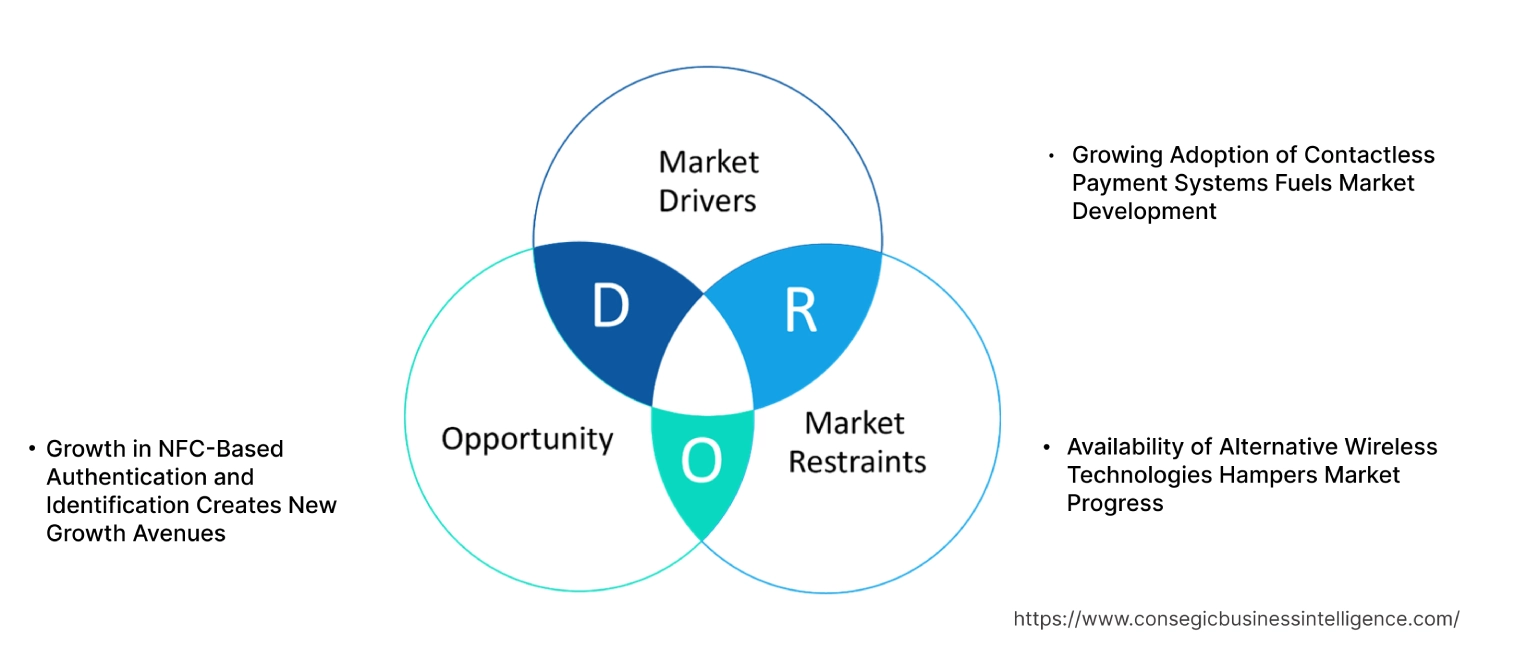
Growing Adoption of Contactless Payment Systems Fuels Market Development
The rising demand for contactless payment systems is a major driver for the market. With the growing need for secure and seamless transactions, retailers and financial institutions are increasingly adopting payment solutions powered by near-field communication (NFC) technology. These systems allow consumers to make fast and secure payments by simply tapping their smartphones or contactless cards. The proliferation of digital wallets, such as Google Pay and Apple Pay, further boosts the demand for NFC-enabled devices, particularly in regions with a rising preference for cashless economies, driving NFC chip market growth.
Key Restraints :
Availability of Alternative Wireless Technologies Hampers Market Progress
The adoption of NFC technology faces challenges from alternative wireless communication technologies such as Bluetooth, RFID, and QR codes, which offer distinct advantages in various applications. While NFC is limited to short-range interactions of a few centimeters, technologies like Bluetooth provide significantly longer communication ranges, making them more suitable for applications like large-scale asset tracking or wireless data sharing across devices.
Additionally, NFC often requires dedicated infrastructure, such as NFC-enabled terminals and readers, whereas QR codes are scanned using standard smartphone cameras, reducing implementation costs for businesses. In terms of data transfer speed, Bluetooth outperforms NFC, making it preferable for high-volume data exchanges. The relatively higher cost of manufacturing and integrating chips into devices further contributes to its competitive disadvantage compared to these alternatives. These limitations hinder the broader adoption of NFC technology, especially in cost-sensitive and infrastructure-limited markets, restraining NFC chip market demand.
Future Opportunities :
Growth in NFC-Based Authentication and Identification Creates New Growth Avenues
The rising demand for secure and efficient authentication solutions offers significant opportunities for NFC technology. With the growing emphasis on cybersecurity and user convenience, NFC’s ability to enable fast, contactless, and secure identity verification has made it an ideal choice for a wide range of applications. In mobile banking, NFC enables seamless two-factor authentication by allowing users to securely verify their identity using smartphones or wearables, enhancing protection against fraud.
Similarly, in e-passports, NFC allows for quick and reliable verification of digital credentials, expediting processes at border control and ensuring compliance with international security standards. NFC is also transforming secure access systems in workplaces, healthcare facilities, and government buildings by replacing traditional keycards and PIN-based systems. Its encrypted communication capabilities provide enhanced security against cloning and unauthorized access, addressing growing concerns over data breaches. As organizations and governments continue to prioritize advanced security measures, NFC’s ability to provide a combination of convenience, speed, and security positions it as a critical technology for the future of authentication and identification solutions, creating NFC chip market opportunities.
Expanding Use in Smart Packaging Solutions Opens New Doors
The integration of NFC technology in smart packaging is revolutionizing consumer engagement and product tracking, particularly in sectors like pharmaceuticals, food, and luxury goods. By embedding NFC tags within packaging, manufacturers provide consumers with interactive and value-added experiences. With a simple tap of their smartphone, consumers access detailed product information, verify authenticity, check expiration dates, or receive personalized promotions and usage instructions.
In the pharmaceutical sector, NFC-enabled packaging enhances patient safety by providing real-time medication reminders and dosage details, improving adherence to treatment regimens. Similarly, in the luxury goods market, NFC tags allow customers to authenticate products, combating counterfeiting and ensuring brand trust. The technology also streamlines supply chain management by enabling real-time inventory tracking and monitoring of product conditions during transit. As brands increasingly prioritize transparency and consumer interaction, NFC-based smart packaging is becoming a key driver of innovation and adoption across industries, fueling NFC chip market expansion.
NFC Chip Market Segmental Analysis :
By Type:
Based on type, the market is segmented into Active NFC Chips and Passive NFC Chips.
The Active NFC Chips segment accounted for the largest revenue of the total NFC chip market share in 2023.
- Active NFC chips have their power source, allowing them to initiate communication and operate over longer distances compared to passive chips.
- These chips are widely adopted in advanced applications such as contactless payments, ticketing systems, and access control, where continuous operation is critical.
- Technological advancements in active chips have enhanced their efficiency, reducing energy consumption and improving performance in smart devices.
- As per NFC chip market trends, the dominance of active chips is due to their extensive use in automotive and consumer electronics for seamless data transfer and communication.
The Passive NFC Chips segment is expected to register the fastest CAGR during the forecast period.
- Passive NFC chips rely on external power sources, such as the electromagnetic field from an NFC reader, making them cost-effective and lightweight.
- These chips are commonly used in applications like smart posters, identification tags, and device authentication, offering flexibility in design and deployment.
- Their adoption is driven by trends favoring low-cost, scalable solutions for sectors such as retail and healthcare.
- As per NFC chip market analysis, the rapid expansion of this segment reflects its suitability for applications requiring minimal power and short-range communication.
By Operating Mode:
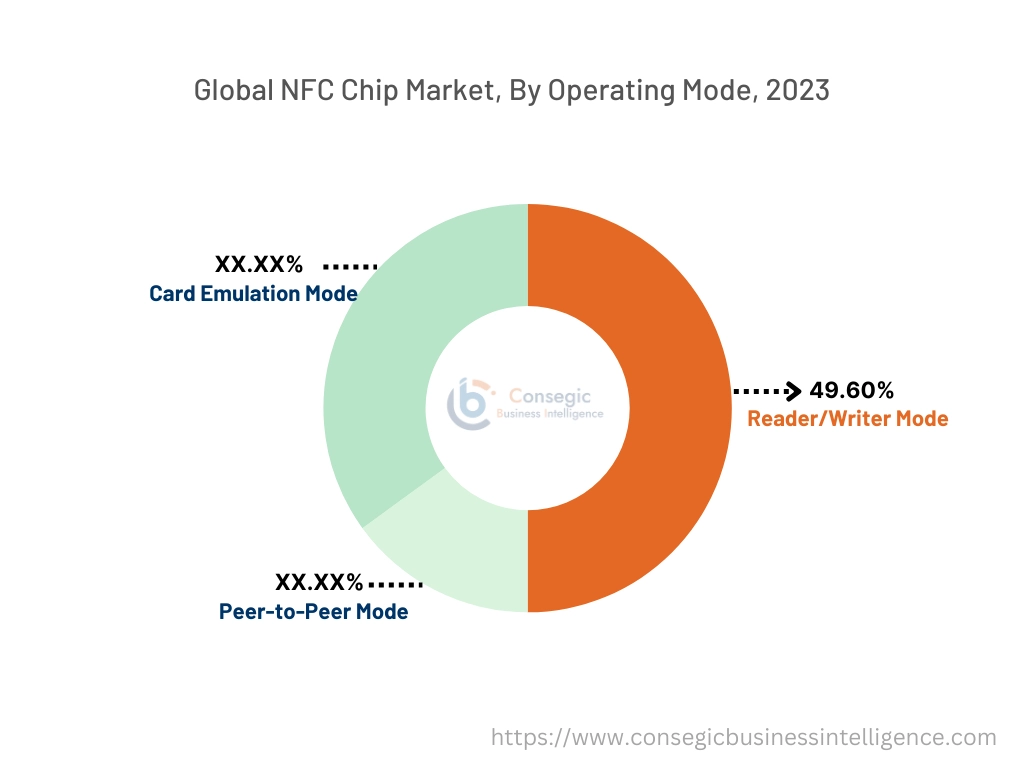
Based on operating mode, the market is segmented into Reader/Writer Mode, Peer-to-Peer Mode, and Card Emulation Mode.
The Reader/Writer Mode segment held the largest revenue of 49.60% of the total NFC chip market share in 2023.
- Reader/writer mode enables devices to read and write NFC tags, making it essential for applications such as ticketing, inventory management, and digital marketing.
- This mode is widely used in retail for product tagging and interactive advertising, enhancing customer engagement and operational efficiency.
- The segment's dominance is supported by advancements in image processing and data analysis tools, which optimize reader/writer capabilities for smart environments.
- Trends in automation and contactless transactions are further boosting the adoption of this operating mode in various industries, driving NFC chip market growth.
The Peer-to-Peer Mode segment is expected to register the fastest CAGR during the forecast period.
- Peer-to-peer mode allows direct communication between two NFC-enabled devices, making it ideal for applications such as file sharing, payment processing, and device synchronization.
- The increasing adoption of this mode in consumer electronics for quick data sharing and connectivity is a major driver for its growth.
- Innovations in secure communication protocols are enhancing the functionality of peer-to-peer mode, making it suitable for sensitive applications such as financial transactions.
- Market analysis indicates that this segment is gaining traction as industries prioritize real-time data exchange and improved connectivity, fueling NFC chip market demand.
By Application:
Based on application, the market is segmented into Contactless Payments, Authentication & Access Control, Data Sharing, Device Monitoring, and Smart Advertising.
The Contactless Payments segment accounted for the largest revenue share in 2023.
- NFC chips are integral to contactless payment systems, ensuring secure and convenient transactions across retail, BFSI, and transportation sectors.
- The adoption of contactless payments is driven by trends favoring digital wallets and tap-to-pay systems, particularly in urban areas.
- Major players in the financial sector are integrating NFC-enabled payment solutions to enhance customer experience and operational efficiency.
- The segment's dominance reflects the growing reliance on NFC technology to support the global shift towards cashless economies, driving NFC chip market expansion.
The Device Monitoring segment is expected to register the fastest CAGR during the forecast period.
- NFC-enabled device monitoring systems are increasingly used in industrial automation and healthcare for real-time equipment tracking and maintenance.
- These systems offer enhanced operational efficiency by enabling seamless communication between devices and central monitoring units.
- The segment's rapid proliferation is fueled by advancements in IoT and AI technologies, which enhance the capability of NFC systems for predictive maintenance and analysis.
- Market analysis highlights the growing adoption of device monitoring systems in smart factories and connected healthcare facilities, creating NFC chip market opportunities.
By Storage Capacity:
Based on storage capacity, the market is segmented into 64 Bytes, 168 Bytes, 180 Bytes, and 540 Bytes.
The 168 Bytes segment held the largest market share in 2023.
- NFC chips with 168 bytes of storage are widely used in applications such as product tagging, loyalty cards, and access control, offering an optimal balance of cost and functionality.
- These chips provide sufficient capacity for most text-based data and simple communication protocols, making them ideal for retail and authentication applications.
- The segment's dominance is supported by its affordability and versatility, catering to a wide range of low-power NFC applications.
- As per NFC chip market trends, interactive advertising and smart packaging are driving the adoption of 168-byte chips in consumer-facing industries.
The 540 Bytes segment is expected to register the fastest CAGR during the forecast period.
- NFC chips with 540 bytes of storage are designed for advanced applications requiring larger data capacities, such as healthcare monitoring and multimedia advertising.
- These chips enable the storage of detailed information, including medical records, product specifications, and promotional videos.
- Their adoption is increasing in sectors requiring high-capacity data handling, supported by advancements in storage technologies.
- As per the NFC chip market analysis, the segment's steady growth reflects its role in addressing the evolving needs of data-intensive applications across multiple industries.
By End-User Industry:
Based on the end-user industry, the market is segmented into Retail, Automotive, Healthcare, Consumer Electronics, BFSI, and Others.
The Retail segment accounted for the largest revenue share in 2023.
- NFC technology is transforming the retail sector by enabling smart shelves, interactive advertisements, and personalized shopping experiences.
- Retailers are adopting NFC solutions to enhance inventory management, streamline checkout processes, and improve customer engagement.
- Trends in contactless transactions and connected commerce are driving the integration of NFC chips in retail systems.
- The segment’s dominance reflects the growing adoption of NFC solutions to meet consumer expectations for convenience and efficiency.
The Automotive segment is expected to register the fastest CAGR during the forecast period.
- Automotive manufacturers are integrating NFC chips for keyless entry, engine start systems, and in-car connectivity solutions.
- These chips enhance vehicle security and user experience by enabling seamless communication between vehicles and mobile devices.
- The adoption of NFC in electric and autonomous vehicles is a major driver for this segment, supported by advancements in connected car technologies.
- As per the NFC chip market trends, the segment's rapid progress reflects its critical role in the automotive sector's digital transformation and smart vehicle initiatives.
Regional Analysis:
The regions covered are North America, Europe, Asia Pacific, the Middle East and Africa, and Latin America.
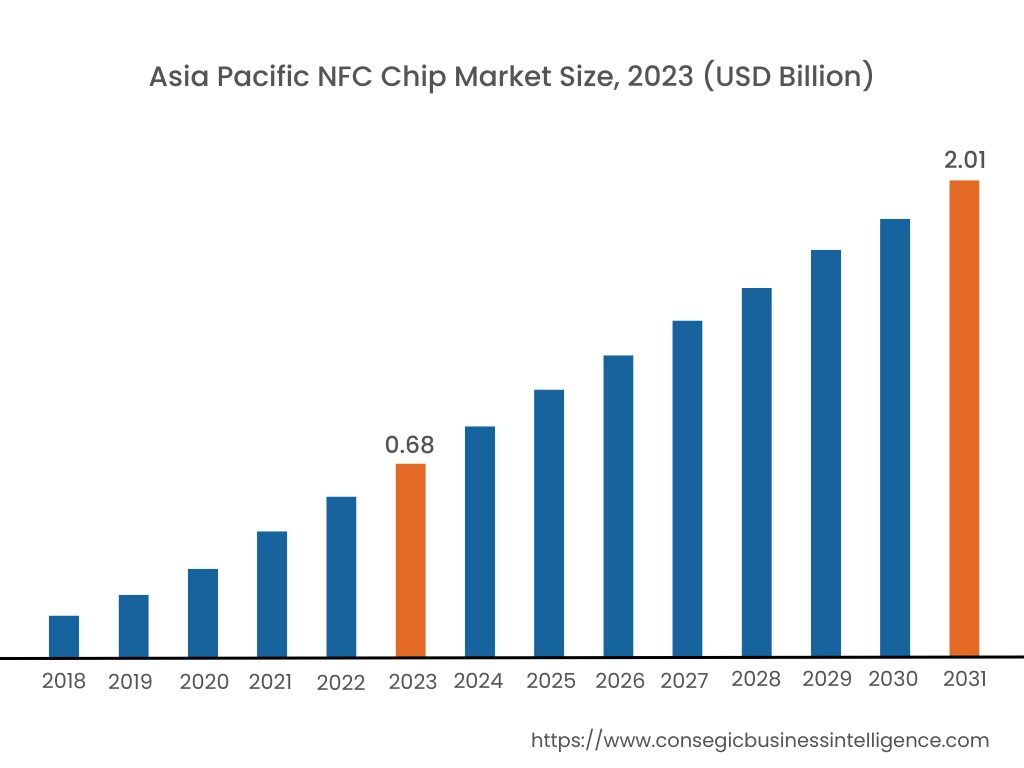
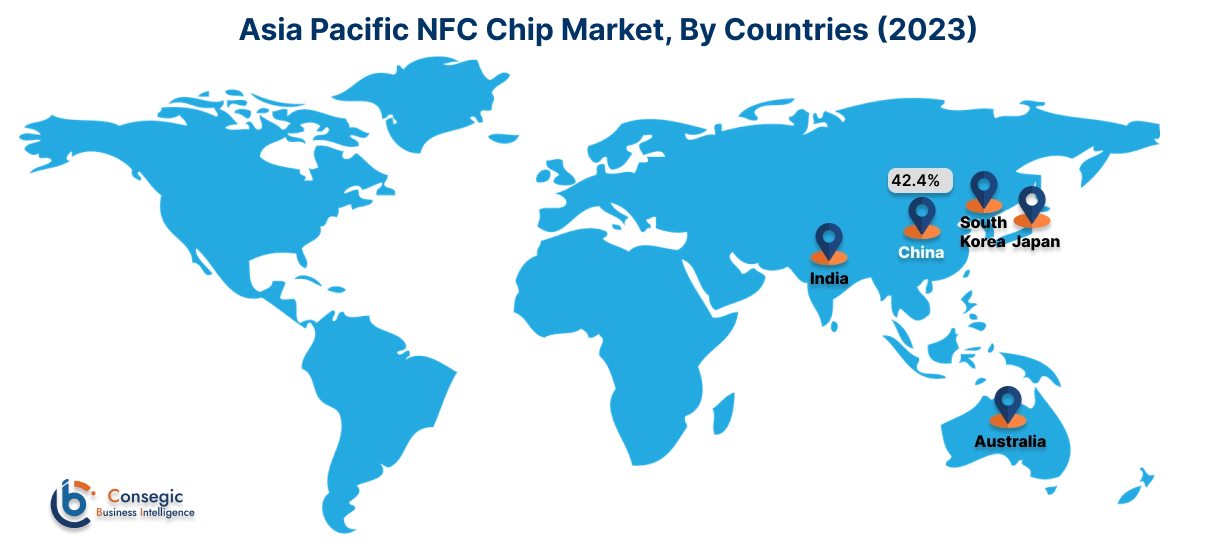
Asia Pacific region was valued at USD 0.68 Billion in 2023. Moreover, it is projected to grow by USD 0.76 Billion in 2024 and reach over USD 2.01 Billion by 2031. Out of these, China accounted for the largest share of 42.4% in 2023. Asia-Pacific is witnessing rapid growth in the NFC chip market, driven by the proliferation of smartphones and the rise of mobile payment platforms in countries like China, India, and Japan. The region has become a global hub for consumer electronics manufacturing, with a strong emphasis on integrating NFC technology into devices to enhance user experience.
North America is estimated to reach over USD 2.20 Billion by 2031 from a value of USD 0.76 Billion in 2023 and is projected to grow by USD 0.86 Billion in 2024. This region maintains a significant position in the market, primarily due to the widespread adoption of contactless payment systems and the integration of NFC technology in consumer electronics. The United States, in particular, has seen substantial incorporation of NFC chips in smartphones and point-of-sale terminals, facilitating seamless transactions.
Europe represents a considerable portion of the global NFC chip market, with countries like Germany, France, and the United Kingdom leading in terms of implementation and innovation. The region benefits from a well-established financial infrastructure and a strong emphasis on digitalization. The increasing use of NFC-enabled devices for public transportation and retail payments underscores the market's potential.
The Middle East & Africa region shows promising potential in the market, particularly in countries like the United Arab Emirates, Saudi Arabia, and South Africa. Increasing investments in digital infrastructure and the extension of the retail sector are driving the adoption of NFC-enabled payment systems. The focus on enhancing financial inclusion and promoting cashless transactions further supports market development.
Latin America is an emerging market with Brazil and Mexico being the primary growth drivers. The rising adoption of smartphones, improving internet penetration, and increasing focus on digital payments contribute to the market’s enlargement. As per market trends, government initiatives aimed at modernizing financial systems and promoting electronic transactions are supporting market progress.
Top Key Players & Market Share Insights:
The NFC Chip market is highly competitive with major players providing products and services to the national and international markets. Key players are adopting several strategies in research and development (R&D), product innovation, and end-user launches to hold a strong position in the global NFC Chip market. Key players in the NFC Chip industry include –
- NXP Semiconductors N.V. (Netherlands)
- STMicroelectronics N.V. (Switzerland)
- Broadcom Inc. (USA)
- Qualcomm Technologies, Inc. (USA)
- Infineon Technologies AG (Germany)
- Texas Instruments Incorporated (USA)
- Renesas Electronics Corporation (Japan)
- HID Global Corporation (USA)
- Toshiba Electronic Devices & Storage Corporation (Japan)
- Zebra Technologies Corporation (USA)
Recent Industry Developments :
Product Launches:
- In April 2024, STMicroelectronics introduced the ST25TA-E NFC tag IC with TruST25™ Edge technology, offering advanced on-chip digital signatures using elliptic curve cryptography (ECC). Designed for high-value products, the tags ensure authenticity, protect against counterfeiting, and support blockchain-based applications. They also enhance consumer engagement with tailored digital experiences and secure data exchange via NFC-enabled smartphones. Additional features include password-protected memory, anonymous mode, and Augmented NDEF support.
- In January 2023, Panthronics introduced the PTX30W, the first single-chip NFC wireless battery charging solution, now available for worldwide sampling. The innovative chip supports wireless power transfer with enhanced efficiency and simplified integration, aimed at wearable devices, medical technology, and compact electronics. The PTX30W is designed to streamline product designs by combining NFC communication and charging capabilities in one compact solution, reducing the need for additional components.
NFC Chip Market Report Insights :
| Report Attributes | Report Details |
| Study Timeline | 2021-2034 |
| Market Size in 2034 | USD 9.99 Billion |
| CAGR (2026-2034) | 14.30% |
| Base Year | 2025 |
| By Type |
|
| By Operating Mode |
|
| By Application |
|
| By Storage Capacity |
|
| By End-User Industry |
|
| By Region |
|
| Key Players |
|
| North America | U.S. Canada Mexico |
| Europe | U.K. Germany France Spain Italy Russia Benelux Rest of Europe |
| APAC | China South Korea Japan India Australia ASEAN Rest of Asia-Pacific |
| Middle East and Africa | GCC Turkey South Africa Rest of MEA |
| LATAM | Brazil Argentina Chile Rest of LATAM |
| Report Coverage |
|
Key Questions Answered in the Report
How big is the NFC Chip Market? −
NFC Chip Market size is estimated to reach over USD 6.69 Billion by 2031 from a value of USD 2.30 Billion in 2023 and is projected to grow by USD 2.59 Billion in 2024, growing at a CAGR of 14.3% from 2024 to 2031.
What specific segmentation details are covered in the NFC Chip Market report? +
The NFC Chip Market report includes segmentation details by type (Active NFC Chips, Passive NFC Chips), operating mode (Reader/Writer Mode, Peer-to-Peer Mode, Card Emulation Mode), application (Contactless Payments, Authentication & Access Control, Data Sharing, Device Monitoring, Smart Advertising), storage capacity (64 Bytes, 168 Bytes, 180 Bytes, 540 Bytes), end-user industry (Retail, Automotive, Healthcare, Consumer Electronics, BFSI, Others), and region (Asia-Pacific, Europe, North America, Latin America, Middle East & Africa).
Which is the fastest-growing segment in the NFC Chip Market? +
The Device Monitoring segment is expected to register the fastest CAGR during the forecast period. This growth is driven by advancements in IoT and AI technologies, which enhance NFC systems' capability for predictive maintenance and analysis, especially in industrial automation and healthcare applications.
Who are the major players in the NFC Chip Market? +
The major players in the NFC Chip Market include NXP Semiconductors N.V. (Netherlands), STMicroelectronics N.V. (Switzerland), Broadcom Inc. (USA), Qualcomm Technologies, Inc. (USA), Infineon Technologies AG (Germany), Texas Instruments Incorporated (USA), Renesas Electronics Corporation (Japan), HID Global Corporation (USA), Toshiba Electronic Devices & Storage Corporation (Japan), and Zebra Technologies Corporation (USA).
Overview
Reputation & Certifications


Our Services
- Market Intelligence & Forecasting
- Custom Research Solutions
- Market Entry Strategy
- Competitive Intelligence
- Customer Insights
- Industry Innovation Analysis
- Investment Advisory