Jump to Content
Occlusion Devices Market Size & Industry Share - Growth Trends & Forecasts (2026 - 2034)
Occlusion Devices Market Size:
Occlusion Devices Market size is estimated to reach over 6,541.35 (US$M) by 2034 from a value of 4,005.83 (US$M) in 2025 and is projected to grow by 4,230.16 (US$M) in 2026, growing at a CAGR of 5.6% from 2026 to 2034, according to a recent report from Consegic Business Intelligence.
Occlusion Devices Market Scope & Overview:
Occlusion devices are specialized, often minimally invasive medical tools that are designed for blocking, obstructing, or closing off blood vessels, aneurysms, or abnormal heart structures. They are mostly used in cardiology and interventional radiology for improving blood circulation, managing vascular issues, or preventing stroke. Moreover, occlusion devices offer several benefits, including permanent, minimally invasive alternatives to long-term anticoagulation, lower stroke risk, improved quality of life, and immediate, effective hemorrhage control, among others. Additionally, the market is driven by the rising global prevalence of cardiovascular diseases and neurovascular disorders, which require precise, minimally invasive interventions.
How is AI Transforming the Occlusion Devices Market?
AI is considerably transforming the occlusion devices market. AI incorporation helps in improving diagnostic precision, enabling personalized treatment planning, along with assisting in real-time procedural guidance for cardiovascular and neurovascular conditions. AI-powered solutions can be used for optimizing device selection and improving patient outcomes by decreasing complication rates. Also, AI and machine learning models can be used during occlusion system research, design, and development processes, particularly for simulating device performance, thereby accelerating the development of safer and more effective occlusion devices.
Moreover, by incorporating predictive analytics, AI solutions are capable of evaluating vast datasets from historical patient outcomes and real-time cardiac imaging to forecast potential risks and identify the most effective device sizes and placement strategies for occlusion systems. In addition, AI-powered systems are used for facilitating real-time guidance during minimally invasive procedures, which in turn helps physicians navigate complex anatomy while improving device deployment accuracy. Therefore, the above factors are expected to boost the market growth in the upcoming years.

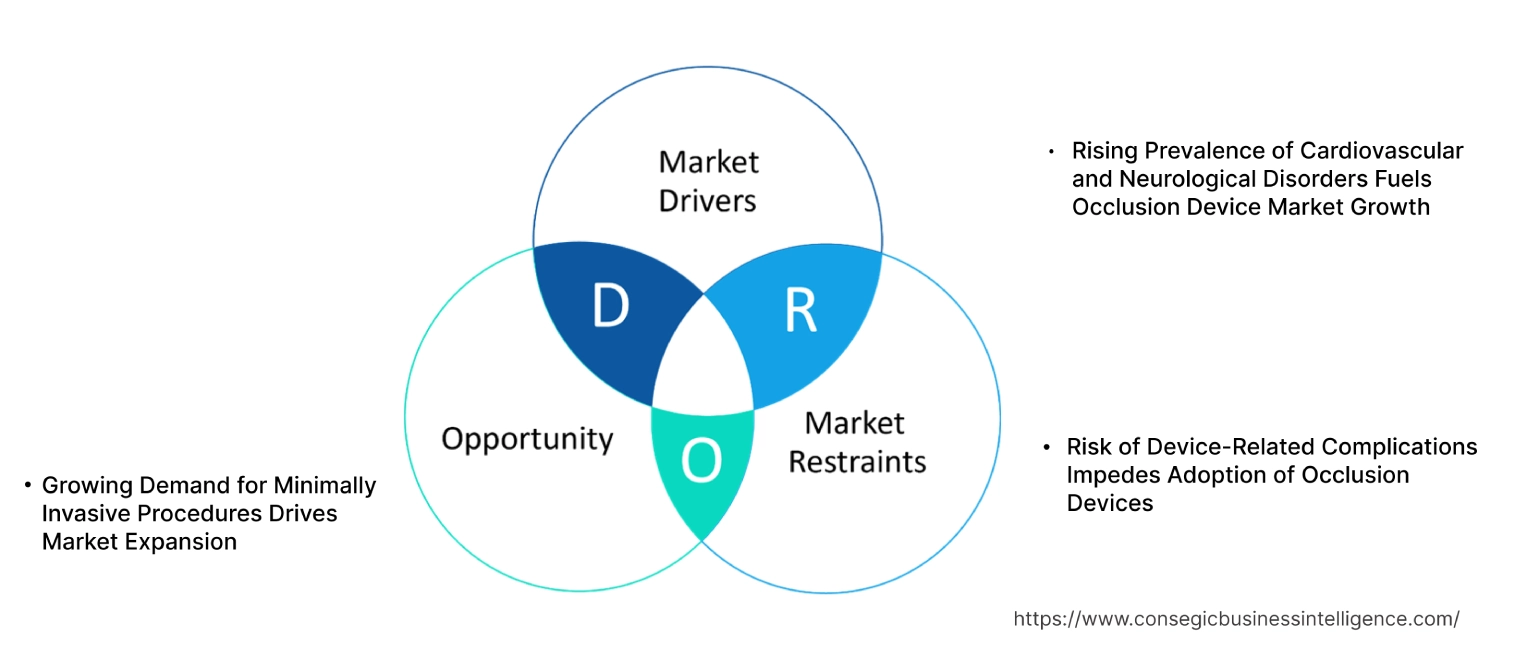
Occlusion Devices MarketDynamics - (DRO) :
Key Drivers:
The rising prevalence of cardiovascular diseases is driving the occlusion devices market growth
The escalating global prevalence of cardiovascular diseases, including stroke, coronary artery disease, and atrial fibrillation, is among the key factors driving the market. The above conditions mostly require the management of aberrant blood flow or sealing of structural heart defects, which in turn has increased the demand for specialized vascular and cardiac occlusion systems. The market is also driven by an aging population, rising obesity rates, and a strong clinical preference for minimally invasive procedures over open-heart surgery. Also, occlusion systems offer shorter recovery times, lower complication rates, and better patient outcomes, which are key aspects for driving its adoption for management of cardiovascular diseases.
- For instance, according to the American Heart Association (AHA), cardiovascular diseases, including coronary heart disease, atrial fibrillation, heart failure, and stroke, are few of the common causes of death in the United States. AHA also states that the prevalence of cardiovascular disease is anticipated to increase from 11.3% to 15% of the population, affecting up to 45 million U.S. adults by 2050.
Hence, the rising prevalence of cardiovascular diseases is increasing the use of occlusion systems, in turn driving the occlusion devices market size.
Key Restraints :
Stringent regulatory frameworks are restraining the occlusion devices market growth
The presence of stringent regulatory frameworks is among the key aspects limiting the market growth, as it lengthens product development cycles and increases approval costs. Regulatory bodies, such as the U.S. Food and Drug Administration (FDA) and European Medicines Agency (EMA), usually demand extensive clinical data, pre-clinical studies, and rigorous post-market surveillance for demonstrating the safety as well as efficacy of these implantable devices. These complex, time-consuming processes for market authorization, particularly regarding Class III devices, result in prolonged, costly procedures, which in turn may create high barriers to entry, particularly for smaller manufacturers.
Furthermore, with new regulations like the EU Medical Device Regulation (MDR) increasing compliance requirements, companies may face higher operational and R&D costs, which can limit developments in the market. Thus, the above factors are hindering the occlusion devices market expansion.
Future Opportunities :
Growing geriatric population is expected to drive the occlusion devices market opportunities
The growing geriatric population is expected to offer lucrative aspects for market growth, due to the high prevalence of age-related cardiovascular, neurovascular, and peripheral vascular diseases. As individuals age, they are more prone to conditions requiring intervention, such as structural heart disorders, atrial fibrillation, stroke, and peripheral artery disease, which in turn increases the need for left atrial appendage closure devices, embolization coils, and vascular occlusion systems. Also, the rising preference for minimally invasive, catheter-based procedures over high-risk open-heart surgeries in elderly patients is driving market innovation, while focusing on safer, faster-recovery, and technologically advanced products. The above factors, combined with increasing awareness of stroke prevention therapies and expanding reimbursement coverage, are expected to boost the market.
- For instance, according to the S. Census Bureau, the total number of Americans aged 65 and older is estimated to increase from 58 million in 2022 to 82 million by 2050. Likewise, the share of 65 and older age group in the U.S. is anticipated to increase from 17% to 23% of the total population.
Consequently, the growing geriatric population is projected to boost the occlusion devices market opportunities during the forecast period.
Occlusion Devices Market Segmental Analysis :
By Type:
Based on type, the market is segmented into occlusion removal devices, embolization devices, and others.
Trends in the type:
- Factors including the growing geriatric population, rising incidence of chronic lifestyle diseases, and increasing shift toward minimally invasive, image-guided procedures are key trends boosting the market.
- Rapid technological advancements in bioresorbable materials, improved device maneuverability, and enhanced embolization efficiency, along with increasing healthcare expenditures, are key trends driving the market.
The occlusion removal devices segment accounted for the largest revenue in the occlusion devices market share in 2024.
- Occlusion removal devices are specialized medical instruments which are designed for removing, extracting, or clearing obstructions, such as blood clots, plaque, or foreign bodies, from bodily lumens, primarily within the vascular system.
- Also, occlusion removal devices are essential for restoring normal blood flow, mostly used in minimally invasive, image-guided procedures for treating conditions like acute stroke or thrombosis, among others.
- In addition, the market is driven by factors such as the rising geriatric population, increasing incidence of chronic lifestyle diseases, and a strong shift toward minimally invasive, image-guided procedures, among others.
- According to the occlusion devices market analysis, the above factors are increasing the adoption of occlusion removal devices, in turn driving the occlusion devices market size.
The embolization devices segment is anticipated to register the fastest CAGR during the forecast period.
- Embolization devices are medical instruments which are used in interventional radiology for purposely blocking blood vessels or abnormal vascular structures. By inducing controlled thrombosis, embolization devices help in treating bleeding, tumors, aneurysms, or malformations.
- Also, embolization devices offer several benefits, including a minimally invasive procedure, targeted treatment, lower risks of bleeding and complications, faster recovery, and others.
- Further, the market is driven by factors including rapid technological advancements in bioresorbable materials, enhanced device maneuverability, improved embolization efficiency, and increasing healthcare expenditures, among others.
- The above factors are expected to increase the adoption of embolization devices, in turn driving the market during the forecast period.
By Application:
Based on application, the market is segmented into peripheral vascular disease (PVD)/cardiology, neurology, oncology, and others.
Trends in the application:
- Factors including the growing aging global population, increasing prevalence of cardiovascular diseases, and rising adoption of minimally invasive catheter-based procedures are among the key trends driving the market growth.
- Increasing prevalence of neurovascular disorders, specifically ischemic stroke and brain aneurysms, combined with a rapid shift toward minimally invasive, endovascular procedures, are among the key factors driving the neurology segment.
The peripheral vascular disease (PVD)/cardiology segment accounted for the largest revenue in the occlusion devices market share in 2024, and it is anticipated to register a substantial CAGR during the forecast period.
- Occlusion systems are primarily used in peripheral vascular disease and cardiology applications for facilitating two primary functions, including sealing access sites after percutaneous procedures and treating blockages, aneurysms, or abnormal connections within blood vessels.
- Moreover, in PVD, occlusion systems are used for blocking vessels in cases of arteriovenous malformations, treating peripheral aneurysms, or performing embolization for reducing vascularity in tumors, often employing coils or plugs to permanently or temporarily stop arterial flow.
- Also, factors including the growing aging global population, rising prevalence of cardiovascular diseases, andincreasing adoption of minimally invasive catheter-based procedures are further driving the segment.
- According to the analysis, the aforementioned factors are driving the occlusion devices market trends.
By End-User:
Based on the end user, the market is segmented into hospitals and clinics, ambulatory surgical centers (ASCs), and others.
Trends in the end user:
- Factors such as increasing government spending on healthcare infrastructure, advancements in medical technology and surgical services, and growing need for quality and accessible healthcare services are further driving the segment development.
- Ambulatory surgical centers (ASCs) are emerging as a vital, growing, and cost-effective setting for minimally invasive, transcatheter-based procedures, particularly for outpatient cardiac and peripheral vascular interventions.
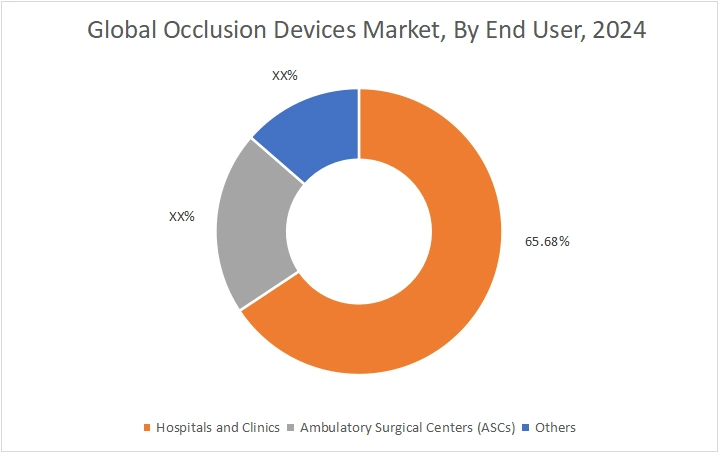
The hospitals and clinics segment accounted for the largest revenue share of 65.68% in the market in 2024, and it is anticipated to register a substantial CAGR during the forecast period.
- Occlusion systems are specialized medical tools designed for blocking or closing off blood vessels, anatomical spaces, or conduits within the body.
- They are primarily utilized in minimally invasive, image-guided, or surgical procedures within hospitals and clinics, particularly for treating vascular diseases, stopping internal bleeding, treating heart defects, and preventing strokes in patients with atrial fibrillation.
- In addition, factors such as increasing government spending on healthcare infrastructure, rise of cardiovascular diseases, advancements in medical technology and services, along with growing demand for quality and accessible healthcare services, are key prospects driving the growth of the hospitals and clinics segment.
- According to the analysis, the aforementioned factors arepropelling the market
Regional Analysis:
The regions covered are North America, Europe, Asia Pacific, the Middle East and Africa, and Latin America.
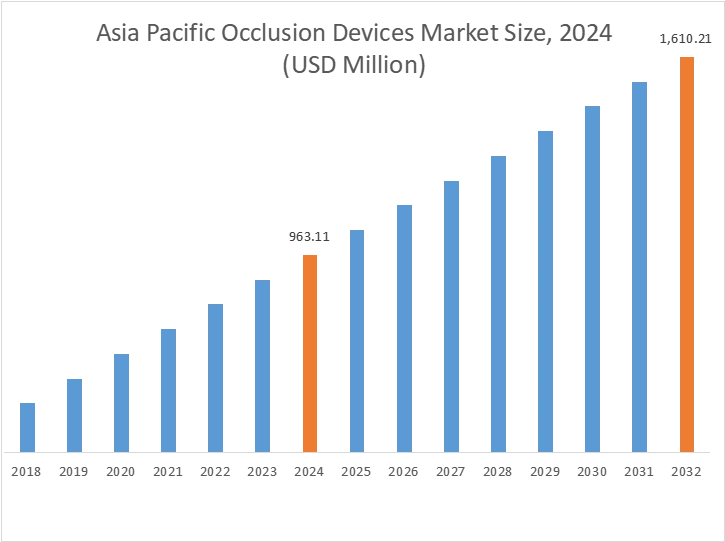
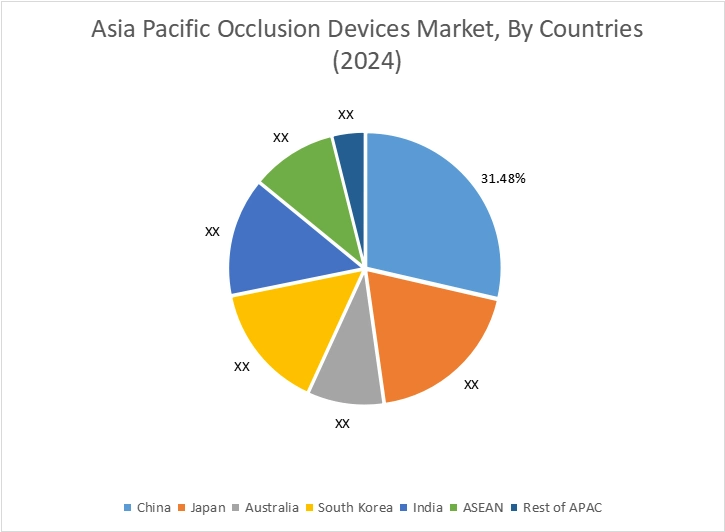
Asia Pacific region was valued at USD 963.11 Million in 2024. Moreover, it is projected to grow by USD 1,005.12 Million in 2025 and reach over USD 1,610.21 Million by 2032. Out of this, China accounted for the maximum revenue share of 31.48%. As per the occlusion devices market analysis, the adoption of occlusion systems in the Asia-Pacific region is primarily driven by factors including the rising prevalence of cardiovascular diseases and increasing investments in healthcare facilities, among others. Similarly, the rising development of hospitals, growing geriatric population, and increasing adoption of minimally invasive catheter-based procedures are further accelerating the occlusion devices market expansion.
- For instance, cardiovascular diseases is considered to be one of the leading causes of mortality in India, causing nearly 31% of all deaths in the country. The above factors are increasing the demand for occlusion systems, in turn driving the market in the Asia-Pacific region.
North America is estimated to reach over USD 2,047.22 Million by 2032 from a value of USD 1,286.41 Million in 2024 and is projected to grow by USD 1,336.93 Million in 2025. In North America, the growth of the occlusion devices industry is driven by the increasing cases of neurovascular disorders, prevalence of chronic diseases, including cardiovascular diseases, caused by factors such as changing lifestyles and rising obesity rates, among others. Additionally, the increasing government expenditure on improving healthcare infrastructure and services is further contributing to the occlusion devices market demand.
- For instance, according to the American Hospital Association, there are approximately 6,100 hospitals across the United States, which mainly include community hospitals, federal government hospitals, and others. The above factors are expected to propel the occlusion devices market trends in North America during the forecast period.
Meanwhile, according to the regional analysis, factors including the prevalence of elderly population, growing healthcare industry, and robust healthcare infrastructure are driving the occlusion devices market demand in Europe. Furthermore, according to the market analysis, the market in Latin America, Middle East, and African regions is expected to grow at a considerable rate due to factors such as increasing incidence of cardiovascular diseases, combined with the increasing development of healthcare facilities including hospitals and clinics, and expanding access to improved healthcare services, among others.
Top Key Players & Market Share Insights:
The global occlusion devices market is highly competitive with major players providing products to the national and international markets. Key players are adopting several strategies in research and development (R&D), product innovation, and end-user launches to hold a strong position in the occlusion devices market. Key players in the occlusion devices industry include-
- Medtronic Plc (Ireland)
- Boston Scientific Corporation (USA)
- Abbott Laboratories (USA)
- Stryker Corporation (USA)
- Terumo Corporation (Japan)
- Edwards Lifesciences (USA)
- Cook Medical (USA)
- Becton, Dickinson and Company (BD) (USA)
- Braun (Germany)
- Merit Medical Systems Inc. (USA)
Recent Industry Developments:
Investments:
- In August 2025, Conformal Medical Inc. closed a USD 32 million Series D extension for advancing its CLAAS AcuFORM Left Atrial Appendage Occlusion (LAAO) technology, supporting the ongoing CONFORM pivotal trial as well as pre-commercialization efforts. The funding supports a unique foam-based design, which is intended for simplifying procedures and decreasing stroke risk in patients with non-valvular atrial fibrillation.
Acquisitions:
- In January 2026, L. Gore & Associates Inc. announced its plan to acquire Conformal Medical Inc., a U.S-based company developing next-generation left atrial appendage occlusion (LAAO) technology. The acquisition aims at strengthening Gore’s position in the left atrial appendage occlusion (LAAO) market.
Occlusion Devices Market Report Insights:
| Report Attributes | Report Details |
| Study Timeline | 2021-2034 |
| Market Size in 2034 | USD 6,541.35 Million |
| Size in 2032 | USD 5,865.97 Million |
| CAGR (2026-2034) | 5.60% |
| Base Year | 2025 |
| By Type |
|
| By Application |
|
| By End-User |
|
| By Region |
|
| Key Players |
|
| North America | U.S. Canada Mexico |
| Europe | U.K. Germany France Spain Italy Russia Benelux Rest of Europe |
| APAC | China South Korea Japan India Australia ASEAN Rest of Asia-Pacific |
| Middle East and Africa | GCC Turkey South Africa Rest of MEA |
| LATAM | Brazil Argentina Chile Rest of LATAM |
| Report Coverage |
|
Key Questions Answered in the Report
How big is the occlusion devices market? −
The occlusion devices market was valued at USD 3,655.18 Million in 2024 and is projected to grow to USD 5,865.97 Million by 2032.
Which is the fastest-growing region in the occlusion devices market? +
Asia-Pacific is the region experiencing the most rapid growth in the occlusion devices market.
What specific segmentation details are covered in the occlusion devices report? +
The occlusion devices report includes specific segmentation details for type, application, end user, and region.
Who are the major players in the occlusion devices market? +
The key participants in the occlusion devices market are Medtronic Plc (Ireland), Boston Scientific Corporation (USA), Abbott Laboratories (USA), Stryker Corporation (USA), Terumo Corporation (Japan), Edwards Lifesciences (USA), Cook Medical (USA), Becton, Dickinson and Company (BD) (USA), B. Braun (Germany), Merit Medical Systems Inc. (USA), and others.
Which product segment is growing at the fastest pace? +
The Embolization Devices segment is anticipated to register the fastest CAGR due to its expanding use in minimally invasive procedures for aneurysms, vascular malformations, and oncology treatments.
Overview
Reputation & Certifications


Our Services
- Market Intelligence & Forecasting
- Custom Research Solutions
- Market Entry Strategy
- Competitive Intelligence
- Customer Insights
- Industry Innovation Analysis
- Investment Advisory