Jump to Content
Offshore Pipeline Market - Size, Share, Industry Trends, and Forecasts (2025 - 2035)
Offshore Pipeline Market Size:
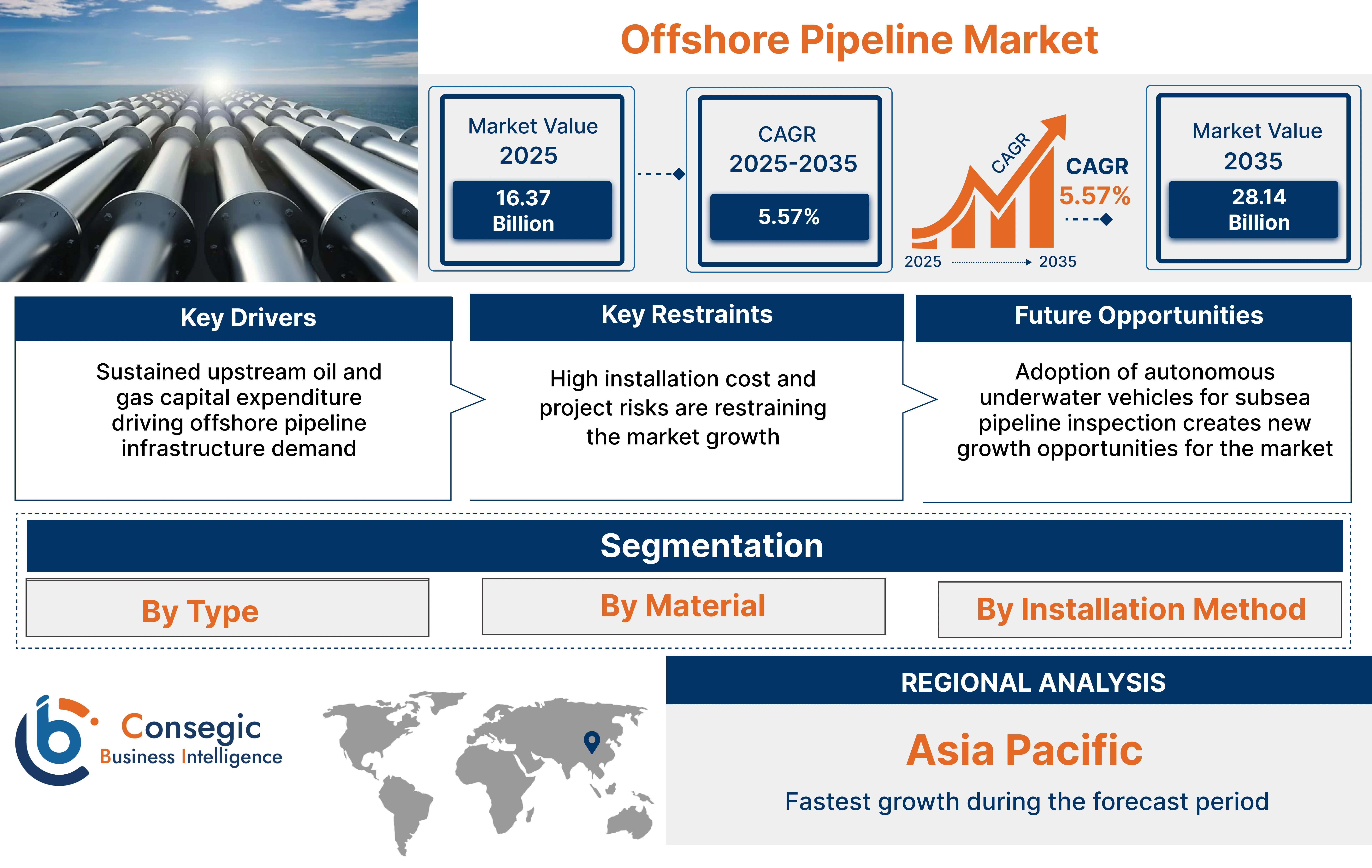
Offshore Pipeline Market size is estimated to reach over USD 28.14 Billion by 2035 from a value of USD 15.50 Billion in 2024 and is projected to grow by USD 16.37 Billion in 2025, growing at a CAGR of 5.57% from 2025 to 2035
Offshore Pipeline Market Scope & Overview:
Offshore pipelines are subsea pipeline networks that transport crude oil, natural gas, and refined products from offshore production platforms to onshore facilities. These pipelines are designed to work in high-pressure conditions and harsh marine environments. They are essential in facilitating offshore exploration and production operations.
Market growth is fueled by the rising offshore oil and gas exploration in deep and ultra-deep waters. The growing demand for energy is driving investments in subsea infrastructure. Advances in pipeline technology, installation, and monitoring systems are enhancing safety and efficiency, thus fueling market growth.
How are Tariffs Impacting the Offshore Pipeline Market?
Tariffs on imported steel pipes, valves, and subsea components have increased project costs for offshore pipeline developments. Also, trade restrictions on specialized construction vessels and advanced subsea equipment have affected procurement timelines and capital planning. In addition, tariffs on the materials used in cross-border energy infrastructure have impacted the choice of suppliers and contracting approaches. Moreover, the changing nature of trade policies is promoting regional sourcing and local production of pipeline parts, which is further changing the supply chain approach in the offshore pipeline industry.
Regional Analysis:
North America, Europe, Asia Pacific, the Middle East and Africa, and Latin America are the regions of coverage.
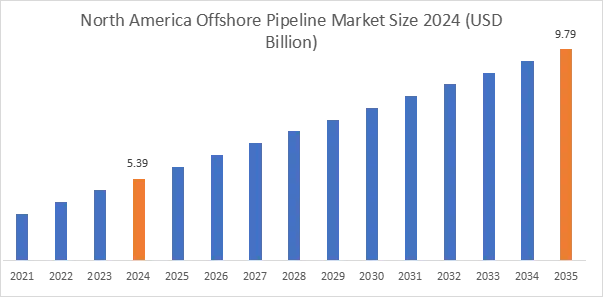
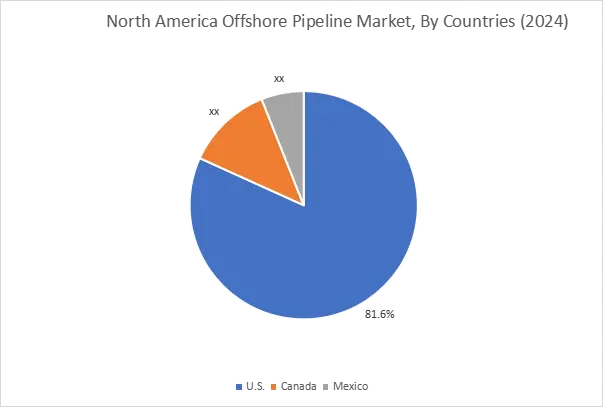
In 2024, North America accounted for the highest market share at 34.80% and was valued at USD 5.39 Billion, and is expected to reach USD 9.79 Billion by 2035. In North America, the U.S. accounted for the highest market share of 81.60% during the base year of 2024. North America offshore pipeline market growth is supported by Gulf of Mexico production activity and offshore hydrocarbon transportation requirements in the United States and Canada. Development of deepwater oil fields and liquefied natural gas export facilities is increasing demand for subsea pipeline networks, thereby driving market growth.
- For instance, the S. Energy Information Administration reported that crude oil production from the U.S. Federal Gulf of Mexico averaged approximately 1.8 million barrels per day in 2024, accounting for around 15% of total U.S. crude output. High offshore production volumes are increasing the need for subsea pipeline infrastructure to transport crude from deepwater fields to onshore processing facilities.
In Asia Pacific, the offshore pipeline market is experiencing the fastest growth over the forecast period. Asia Pacific offshore pipeline market growth is supported by offshore oil and gas field development and rising natural gas demand across China, India, Malaysia, and Australia. National energy security programs and expansion of deepwater exploration projects are increasing installation of subsea transport pipelines, thereby driving market growth.
- For instance, China’s crude oil production averaged approximately 4.26 million barrels per day in 2024, supporting offshore hydrocarbon transport needs and increasing demand for subsea pipeline infrastructure across the Asia Pacific.
Europe offshore pipeline market growth is supported by North Sea field redevelopment, gas import diversification, and expansion of offshore wind-to-grid interconnections in Norway, the UK, and Germany. Energy transition strategies and cross-border gas transport requirements are increasing subsea pipeline installation and maintenance activity, thereby driving market growth.
Latin America offshore pipeline market growth is supported by deepwater exploration and production activities in Brazil and Guyana. Expansion of offshore pre-salt reserves and export-oriented oil projects is increasing installation of subsea transportation pipelines, thereby driving market growth.
Middle East & Africa offshore pipeline market growth is supported by offshore gas development projects and export infrastructure expansion in Qatar, Saudi Arabia, and West Africa. National energy strategies focused on increasing gas production and export capacity are increasing subsea pipeline deployment, thereby driving market growth.
Offshore Pipeline Market Segmental Analysis:
By Type:
Based on type, the offshore pipeline market is segmented into oil pipelines, gas pipelines, and multi-product pipelines.
Trends in the Type:
- The increasing offshore oil exploration activities are driving the demand for oil pipelines.
- The growing global consumption of natural gas is accelerating investments in offshore gas pipeline infrastructure.
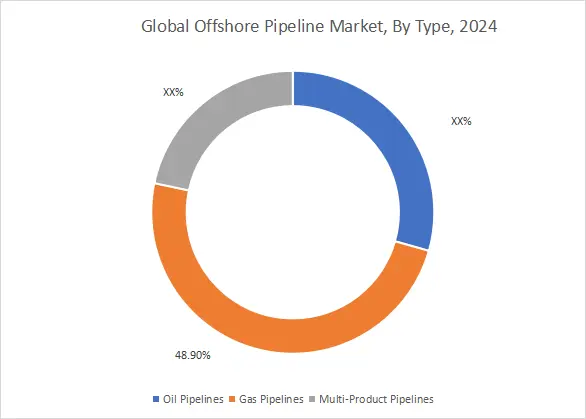
Gas Pipelines accounted for the largest revenue share of 48.9% in the year 2024.
- Gas pipelines are widely used to transport natural gas from offshore fields to onshore processing facilities. They support large-scale energy distribution.
- The rising shift toward cleaner fuels is increasing demand for natural gas transportation infrastructure.
- Additionally, expansion of LNG projects is supporting offshore gas pipeline development.
- Further, increasing investments in deepwater and ultra-deepwater gas fields are boosting segment growth.
- Thus, as per the offshore pipeline market analysis, rising natural gas demand and energy transition trends are driving dominance of gas pipelines.
Multi-Product Pipelines are anticipated to register the fastest CAGR during the forecast period.
- Multi-product pipelines are designed to transport different types of hydrocarbons through a single pipeline system. This improves operational efficiency.
- These pipelines reduce infrastructure costs compared to building separate pipelines.
- Additionally, increasing offshore production activities are supporting the need for flexible transport solutions.
- Further, advancements in monitoring and flow control technologies are improving safety and efficiency.
- Therefore, as per the market analysis, cost efficiency and operational flexibility are expected to boost the multi-product pipelines segment during the forecast period.
By Material:
Based on material, the offshore pipeline market is segmented into carbon steel, stainless steel, and composite materials.
Trends in the Material:
- The rising demand for high-strength and corrosion-resistant materials for pipelines is fueling the demand for high-quality steel grades.
- The rising need for corrosion-resistant materials in deep-water and adverse environments is boosting the demand for composite materials.
Carbon Steel accounted for the largest revenue share in the year 2024.
- Carbon steel is used extensively in offshore pipelines due to its high strength and economic nature. It can resist high pressure.
- It is suitable for transporting oil and gas over long distances. This is encouraging large-scale offshore developments.
- In addition, its availability and established production processes make carbon steel a popular choice.
- Further, advancements in coating technology are improving corrosion resistance.
- Thus, as per the offshore pipeline market analysis, strength, availability, and cost benefits are driving dominance of carbon steel.
Composite Materials are anticipated to register the fastest CAGR during the forecast period.
- Composite materials offer high corrosion resistance and lightweight properties. They reduce maintenance requirements.
- These materials are suitable for harsh offshore environments. They improve operational life.
- Additionally, increasing deepwater exploration activities are supporting segment growth.
- Further, advancements in material engineering are improving durability and pressure resistance.
- Therefore, as per the market analysis, rising demand for corrosion-resistant and lightweight solutions is expected to boost the composite materials segment during the forecast period.
By Installation Method:
Based on installation method, the offshore pipeline market is segmented into S-Lay, J-Lay, Reel-Lay, and Tow-In.
Trends in the Installation Method:
- The rising development of deepwater and ultra-deepwater oil and gas resources is fueling the need for innovative installation methods.
- The rising interest in minimizing installation time and costs is encouraging the use of effective pipeline installation methods.
S-Lay accounted for the largest revenue share in the year 2024.
- S-Lay is widely used for shallow and medium water depths. It is suitable for long pipeline routes.
- This method allows continuous welding and laying of pipes from a horizontal ramp. It supports faster installation.
- Additionally, S-Lay is cost effective for large-scale offshore projects.
- Further, increasing offshore oil and gas production in moderate water depths is supporting segment growth.
- Thus, as per the offshore pipeline market analysis, operational efficiency and suitability for long-distance projects are driving dominance of S-Lay.
J-Lay is anticipated to register the fastest CAGR during the forecast period.
- J-Lay is mainly used in deepwater and ultra-deepwater installations. It reduces stress on the pipeline during laying.
- This method allows pipes to be installed in a near-vertical position. It improves structural integrity in deep waters.
- Additionally, rising investments in deep-sea exploration are supporting segment growth.
- Further, increasing demand for high-pressure and high-temperature pipeline systems is accelerating adoption.
- Therefore, as per the market analysis, expanding deepwater projects are expected to boost the J-Lay segment during the forecast period.
Offshore Pipeline Market Dynamics - (DRO):
Key Drivers:
Sustained upstream oil and gas capital expenditure driving offshore pipeline infrastructure demand
The offshore pipeline industry is expanding owing to ongoing investments in upstream oil and gas projects. Offshore production entails the use of subsea pipelines to transport crude oil and natural gas from offshore platforms to onshore processing plants and export terminals. New field developments and the expansion of existing infrastructure drive the demand for pipeline installation and associated subsea infrastructure.
Effective capital expenditure on upstream activities helps in continuous exploration, development, and production activities. Offshore projects constitute a major part of the global upstream business, especially in the Middle East and other major production areas.
- For example, in May 2025, the International Energy Agency reported in the World Energy Investment 2025 report that the global upstream investment in oil and gas in 2025 was about USD 570 billion.
Therefore, increasing offshore upstream investments and sustained global oil production are driving the growth of the offshore pipeline market.
Key Restraints:
High installation cost and project risks are restraining the market growth
Offshore pipeline projects require heavy capital investment. Installation in deepwater and ultra-deepwater areas is expensive. Specialized vessels, advanced welding systems, and inspection technologies increase project cost.
Projects are also exposed to operational and environmental risks. Adverse sea conditions may cause delays in the construction phase. Approvals from the government and environmental approvals require time. Variations in the price of oil and gas also impact investment. Thus, the high installation cost and risks associated with the project are impeding the growth of the offshore pipeline market.
Future Opportunities:
Adoption of autonomous underwater vehicles for subsea pipeline inspection creates new growth opportunities for the market
The increasing requirement to enhance the integrity of offshore pipelines and minimize the cost of inspection is opening up new avenues in the offshore pipeline industry. Conventional inspection techniques are highly dependent on vessels and remotely operated vehicles, thereby increasing operational costs. Autonomous underwater vehicles (AUVs) make it possible to carry out long-duration inspections with minimal support from the surface.
- For example, in May 2024, in May 2024, Oceaneering successfully completed a pilot pipeline inspection with its Freedom autonomous underwater vehicle (AUV) for TotalEnergies.
Thus, the increasing deployment of autonomous subsea inspection technologies is expected to improve pipeline integrity management and reduce lifecycle costs, thereby promoting future opportunities in the offshore pipeline market during the forecast period.
Top Key Players & Market Share Insights:
The global offshore pipeline market is highly competitive, with major engineering, procurement, construction, and installation companies delivering integrated subsea and pipeline solutions to national and international energy operators. The key players are using various approaches in research and development, innovative installation methods, digital asset management, and effective contract acquisition to ensure a competitive position in the offshore pipeline market.
The companies are emphasizing deepwater and ultra-deepwater project expertise, predictive maintenance solutions, subsea engineering innovation, and efficiency enhancements to ensure a competitive presence in the offshore market. The key players operating in the offshore pipeline market are:
- Saipem S.p.A. (Italy)
- Subsea 7 S.A. (UK)
- TechnipFMC plc (UK)
- McDermott International Ltd. (U.S.)
- Allseas Group S.A. (Switzerland)
- Tenaris S.A. (Luxembourg)
- National Oilwell Varco, Inc. (U.S.)
- TMK Group (Russia)
- Mitsubishi Heavy Industries, Ltd. (Japan)
- Jindal SAW Ltd. (India)
Recent Industry Developments:
- In January 2026, Subsea7 received a contract in the Mediterranean Sea for the installation of subsea structures, umbilicals, risers, and flowlines. This acquisition enhances the company’s offshore pipeline offerings and further establishes its presence in key deepwater projects.
- In February 2025, Saipem has implemented an AI predictive maintenance solution on its Saipem 12000 drillship to improve operational efficiency and minimize unplanned downtime. The solution utilizes advanced data analytics to maximize asset performance and facilitate safe and reliable offshore pipeline and subsea operations.
Offshore Pipeline Market Report Insights:
| Report Attributes | Report Details |
|---|---|
| Study Timeline | 2019-2035 |
| Market Size in 2035 (USD Billion) | USD USD 28.14 Billion |
| CAGR (2025-2035) | 5.57% |
| By Type |
|
| By Material |
|
| By Installation Method |
|
| By Region |
|
| Key Players |
|
| Report Coverage |
|
Key Questions Answered in the Report
How big is the offshore pipeline market? −
The offshore pipeline market size is estimated to reach over USD 28.14 Billion by 2035 from a value of USD 15.50 Billion in 2024 and is projected to grow by USD 16.37 Billion in 2025, growing at a CAGR of 5.57% from 2025 to 2035.
Which segmentation details are covered in the offshore pipeline report? +
The offshore pipeline report includes specific segmentation details for type, material, installation method, and regions.
Which is the fastest segment anticipated to impact the market growth? +
In the offshore pipeline market, the J-Lay installation method segment is anticipated to be the fastest-growing segment during the forecast period. This is due to its suitability for deepwater and ultra-deepwater projects, where its near-vertical pipe deployment reduces bending stress. It also enables installation in high-pressure offshore environments.
Who are the major players in the offshore pipeline market? +
The key participants in the offshore pipeline market are Saipem S.p.A. (Italy), Subsea 7 S.A. (UK), TechnipFMC plc (UK), McDermott International Ltd. (U.S.), Allseas Group S.A. (Switzerland), Tenaris S.A. (Luxembourg), National Oilwell Varco, Inc. (U.S.), TMK Group (Russia), Mitsubishi Heavy Industries, Ltd. (Japan), Jindal SAW Ltd. (India), and others.
What are the key trends in the offshore pipeline market? +
The offshore pipeline market is being shaped by several key trends including increasing investments in deepwater oil and gas projects, growing adoption of corrosion-resistant materials, advancements in pipeline monitoring and inspection technologies, and rising demand for natural gas transportation infrastructure.
Overview
Reputation & Certifications


Our Services
- Market Intelligence & Forecasting
- Custom Research Solutions
- Market Entry Strategy
- Competitive Intelligence
- Customer Insights
- Industry Innovation Analysis
- Investment Advisory