Jump to Content
Orthokeratology Lens Market - Size, Share, Industry Trends, and Forecasts (2025 - 2032)
Orthokeratology Lens Market Size:
Orthokeratology lens market size is estimated to reach over USD 1,502.78 Million by 2032 from a value of USD 895.30 Million in 2024, growing at a CAGR of 6.8% from 2025 to 2032.
Orthokeratology Lens Market Scope & Overview:
The orthokeratology lens also called ortho-k lens is specially designed rigid, gas permeable contact lens that temporarily reshapes the cornea. There are various properties of this lens including high oxygen permeability, durability, and advanced surface design. There are two types of orthokeratology lens namely overnight ortho-k lens and daytime ortho-k lens. It is used to treat various conditions including myopia, hyperopia, presbyopia, and astigmatism. Orthokeratology lens are widely used in hospitals, ophthalmology clinics, optometry clinics, and others. Orthokeratology lens offers several advantages like non-invasive, durable, reversible and others. Advances in lens design, high-oxygen permeability materials, and growing awareness of their benefits have contributed to the increasing demand in the market.
How is AI Impacting the Orthokeratology Lens Market?
AI is impacting the orthokeratology lens market by enhancing the precision of lens design and fitting. AI algorithms analyze vast datasets from corneal topographers, enabling the creation of highly customized lenses that precisely match a patient's unique eye geometry. This predictive modeling reduces the need for trial-and-error fitting, saving time for both practitioners and patients and leading to higher success rates. Furthermore, AI helps predict the long-term effectiveness of treatment and can assist in monitoring for subtle ocular changes, thereby improving myopia control outcomes and advancing the overall quality of care.

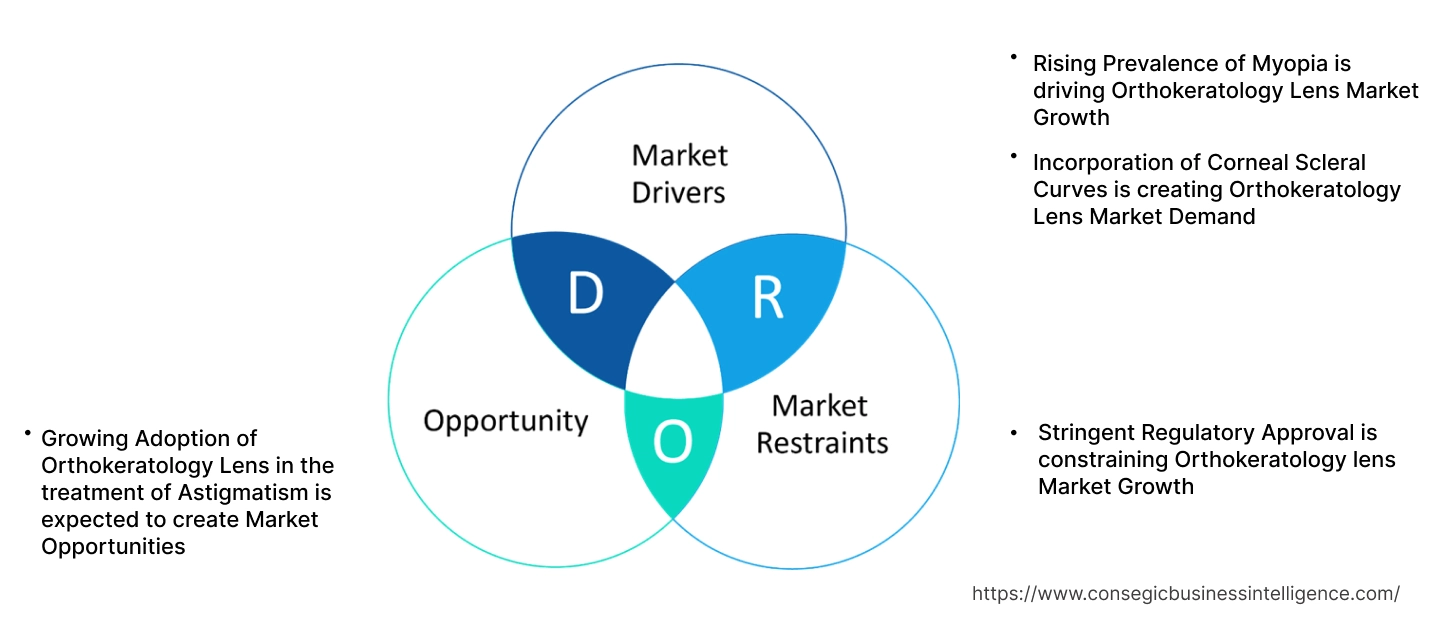
Orthokeratology Lens Market Dynamics - (DRO) :
Key Drivers:
Rising Prevalence of Myopia is driving Orthokeratology Lens Market Growth
Myopia is a vision condition in which people is able to see close objects clearly, but objects farther away appear blurred. Orthokeratology lens is used in the treatment of myopia by gently flattening the cornea by a controlled amount. The prevalence of myopia is rising due to factors such as genetics, prolonged closed-up activities, screen time and environmental conditions, further driving the market.
- In 2023, according to British Journal of Ophthalmology, global prevalence of myopia is 35.81% and is expected to reach 39.80% in the year 2050. Orthokeratology lens is used to treat myopia by correcting blurred vision and slowing down myopia progression in patients. It also lowers the refractive error and slows the axial elongation in myopic patients.
Thus, rising cases of myopia is leading to orthokeratology lens market demand by improving blurred vision and reducing axial elongation in patients.
Incorporation of Corneal Scleral Curves is creating Orthokeratology Lens Market Demand
The incorporation of corneal and scleral curves involves mapping both corneal and scleral surfaces in the lens design to enhance precise fit, stability, and comfort for the patients. It is tucked under the upper and lower eye lids for proper tear flow under the lens and allows daytime comfort while wearing the lens. The corneal and scleral curves design is made of Contamac Infinite (tisilfocon A) material and provides wear-time flexibility to the patients.
- In 2023, Acculenslaunched orthokeratology lens with corneal-scleral design. This lens named as NewVision SC incorporates corneal-scleral curves with larger diameter and better centration to ensure optical comfort and the best fit for each patient.
Thus, growing incorporation of corneal scleral curves in design of the orthokeratology lens is leading to orthokeratology lens market expansion by providing stability and best fit for each patient.
Key Restraints:
Stringent Regulatory Approval is constraining Orthokeratology lens Market Growth
Orthokeratology lens are medical devices and hence their manufactures must adhere to regulatory standards for safety, performance and biocompatibility. Authorities such as United States Food and Drug Administration, European Medicines Agency (EMA) impose rigorous testing and documentation requirement for orthokeratology lens before they are approved for clinical use. These regulations ensure that the orthokeratology lens do not cause harm, function effectively in treatment and meet the required quality standards. The approval process involves multiple stages, including preclinical trials, testing, biocompatibility evaluations and clinical trials, which are time-intensive and costly. It typically causes delays due to lengthy evaluations on additional requirements for compliance. Thus, these regulatory approvals is constraining the orthokeratology lens market due to increased cost and limited availability of advanced technology.
Future Opportunities :
Growing Adoption of Orthokeratology Lens in the treatment of Astigmatism is expected to create Market Opportunities
Astigmatism is a refractive error characterized by an irregular curvature of the cornea or lens, causing blurred or distorted vision. The orthokeratology lens is used to treat astigmatism to correct vision distortion in vertical and horizontal directions in patients. The cases of astigmatism is rising lifestyle changes, aging population, increased digital screen time and others, further creating orthokeratology lens market opportunities.
- In 2024, according to research article published in Clinical & Experimental Ophthalmology, the global prevalence of Astigmatism is 14.9% in children and 40.4% in adults. The orthokeratology lens is specially designed rigid, gas permeable contact lens used to treat astigmatism which flattens the specific areas of the cornea, providing clear and stable vision in patients.
Thus, growing adoption of orthokeratology lens in the treatment of astigmatism is creating orthokeratology lens market opportunities by correcting vision distortion and providing clear and stable vision in patients.
Orthokeratology Lens Market Segmental Analysis :
By Type:
By type, the market is divided into overnight ortho-k lens and daytime ortho-k lens.
Trends in Type:
- According to orthokeratology lens market trends, overnight ortho-k lens is widely used due to its cornea reshaping and rigid properties.
- Adoption of day-time ortho-k lens is growing due to sensitivity and corneal conditions in patients as per market trends.
The overnight ortho-k lens accounted for the largest market share in the year 2024.
- Overnight ortho-k lens is worn solely at night , allowing patients to see clearly during the day without glasses or contacts.
- This lens is rigid, gas-permeable lens that are sturdy enough to reshape the cornea in patients at night.
- Overnight ortho-k lens are made of highly oxygen permeable material, which allows your eye to breathe overnight and maintain excellent health.
- Due to rising demand for overnight ortho-k lenscontact lens , companies are largely investing in its development.
- For instance, in 2021, Johnson & Johnson Vision launched Abiliti™ overnight ortho-k lens. Abiliti™ Overnight lens is optimized by the use of corneal topography, refractive error and other measurements connected to an experiential fitting software, FitAbiliti™ to best fit for each patients’ unique corneal shape.
- Thus, overnight ortho-k lensis widely used due to its cornea reshaping and oxygen permeable properties.
The day-time ortho-k lens is expected to grow at the fastest CAGR over the forecast period.
- Day-time ortho-k lens is worn solely at daytime and removed at night, providing temporary vision correction without reshaping the cornea at night.
- This lens is designed for the individuals who does not prefers overnight lenses due to sensitivity and corneal conditions.
- They are particularly suitable for addressing refractive errors, including low to moderate levels of myopia and astigmatism.
- The adoption of day-time ortho-k lensis rising among individuals with specific corneal sensitivities where overnight wearing of lens is difficult.
- Thus, use of day-time ortho-k lens is rising among individuals due to sensitivity and corneal conditions and for addressing low to moderate levels of myopia.
By Application:
By application, the market is divided into myopia , hyperopia, presbyopia, and astigmatism.
Trends in Application:
- As per orthokeratology lens market trends, orthokeratology lens is widely used in the treatment of myopia to reshape the cornea in patients.
- Adoption of orthokeratology lens is rising in the treatment of astigmatism to correct vision distortion and offering an alternative to laser eye surgery as per market trends.
The myopia accounted for the largest market share in the year 2024.
- Myopia is a vision condition in which people is able to see close objects clearly, but objects farther away appear blurred.
- The orthokeratology lens is used in the treatment of myopia by gently flattening the cornea by a controlled amount.
- The orthokeratology lens wear slows the axial elongation of the eye in comparison to spectacle lens wear in myopic children and is an effective alternative to spectacle treatment in the patients.
- Due to growing adoption of this lens in the treatment of myopia, companies are developing the lens which improves the corneal shape in the patients.
- For instance, in 2023, Menicon Co., Ltd. launched orthokeratology lens in China. This contact lens are designed with a specially shaped inner surface, improve the myopia in patients by flattening the shape of the cornea.
- Thus, orthokeratology lens is widely used in the treatment of myopia as an alternative to spectacle treatment in patients.
The astigmatism is expected to grow at the fastest CAGR over the forecast period.
- Astigmatism is a type of refractive error due to rotational asymmetry in the eye's refractive power .
- The orthokeratology lens is used to treat astigmatism to correct vision distortion in vertical and horizontal directions in patients.
- This lens also corrects the flattening the specific areas of the cornea, providing clear and stable vision for individuals.
- The adoption of orthokeratology lens is growing among patients with astigmatism, particularly with moderate to high levels of astigmatism, which offers an alternative to laser eye surgery.
- Thus, use of orthokeratology lens in the treatment of astigmatism is rising for providing clear, stable vision and offering alternative to laser eye surgery.
By End User:
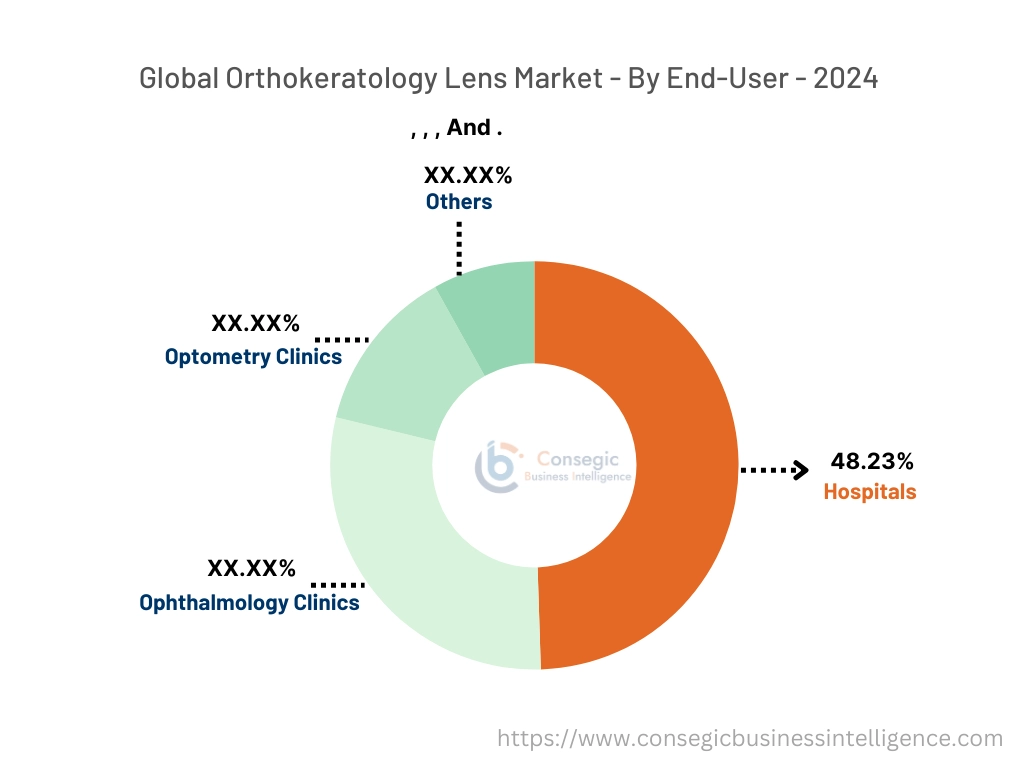
By end-user, the market is divided into hospitals, ophthalmology clinics, optometry clinics, and others.
Trends in End-User:
- As per market trends, hospitals are widely incorporating orthokeratology lens for treating various refractive errors like myopia, hyperopia, and others.
- Use of orthokeratology lens in optometry clinics are growing as non-invasive, reversible alternative to corrective surgery.
The hospitals accounted for the largest market share of 48.23% in the year 2024.
- A hospital is a healthcare facility that provides medical and nursing care as well as medical supplies to patients.
- Hospitals plays a crucial role in the orthokeratology lens market through diagnosis and management of refractive errors like myopia, hyperopia, presbyopia, and astigmatism.
- Many hospitals are collaborating with manufacturer of orthokeratology lens to provide orthokeratology treatment access to patients.
- For instance, in 2022, Aravind Eyecare hospital collaborated with ZEISS to launch Myopia Management Centre in Coimbatore. It will enable patients to avail specialized treatments which include spectacle lenses like ZEISS MyoVision Pro, orthokeratology lens, and others.
- Thus, hospitals are dominating in the market through diagnosis and management of refractive errors like myopia, hyperopia, presbyopia, and astigmatism.
The optometry clinics is expected to grow at the fastest CAGR over the forecast period.
- Optometry clinics are healthcare facilities that specializes in the examination, diagnosis and treatment of vision-related issues.
- These clinics provide clinical assessment of a patient’s eye health to determine orthokeratology lens design.
- Many optometry clinics offer orthokeratology lens as a part of broader vision care services promoting them as a non-invasive, reversible alternative to corrective surgery.
- They also educate patients about the benefits of orthokeratology lens, especially for managing myopia progression, astigmatism and other refractive errors.
- Thus, optometry clinics are growing adopting orthokeratology lens to provide non-invasive and effective treatment to the patients suffering from myopia progression, astigmatism and other refractive errors.
Regional Analysis:
The regional segment includes North America, Europe, Asia Pacific, the Middle East and Africa, and Latin America.
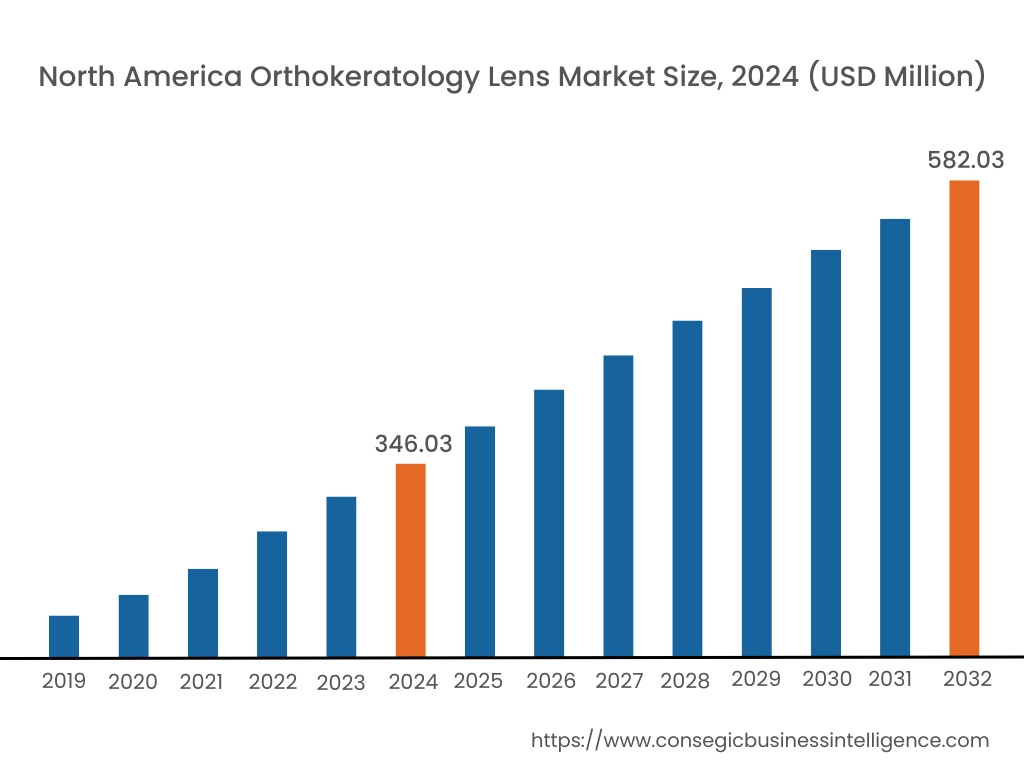
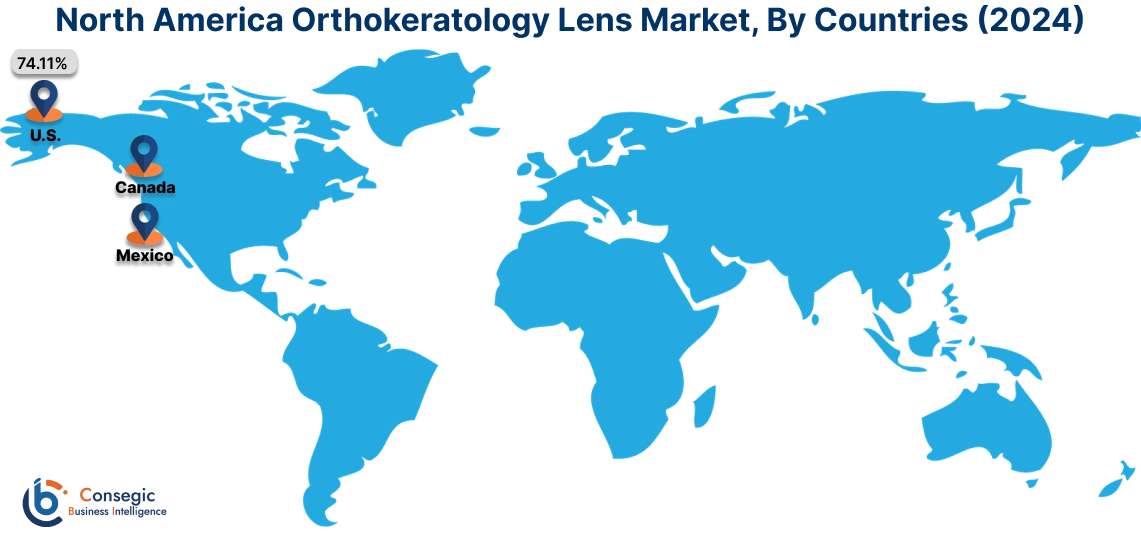
In 2024, North America accounted for the highest market share at 38.65% and was valued at USD 346.03 Million and is expected to reach USD 582.03 Million in 2032. In North America, United States accounted for the highest market share of 74.11% during the base year of 2024. The orthokeratology lens market share of North America is significant due to well-established healthcare infrastructure and growing prevalence of myopia & Astigmatism. Countries like United States, Canada, and Mexico are major contributors in the market due to technological innovations, rising healthcare investments, and upgraded infrastructure. Hospitals, optometry clinics, and specialized eye care providers in the region are playing significant role in the distribution and customization of orthokeratology lens . Additionally, the eye care professionals in this region are significantly adopting orthokeratology lens for treating various refractive errors like myopia, hypermetropia and others.
- In 2022, according to The Fitting of Orthokeratology in the United States survey, 52% of eye care professionals in the United States prescribe and fit orthokeratology lens , particularly for treating myopia.
Thus, North America is leading due to rising healthcare investments and growing adoption of advanced eye care technologies as per orthokeratology lens market analysis.
Asia-pacific is expected to witness the fastest CAGR of 7.2% over the forecast period of during 2025-2032. As per orthokeratology lens market analysis, Asia-Pacific region is experiencing rapid growth driven by increasing myopia prevalence, particularly among children and young adults. Countries like China, Japan, South Korea, and India are witnessing a surge in demand due to rising awareness about myopia control and the benefits of non-invasive vision correction. The high adoption rate of orthokeratology lens is largely attributed to trend of digital screen usage and reduced outdoor activities, contributing to refractive errors like myopia, astigmatism and others. Additionally, the advancement in lens technology and improved accessibility in both rural and urban areas is expanding the market. Thus, orthokeratology lens market share of Asia-Pacific is expanding due to rising prevalence of refractive errors like myopia and improved healthcare infrastructure as per market analysis.
The Middle East and Africa region is experiencing steady growth in the market, driven by increasing awareness of myopia management growing demand for non-surgical vision correction options. Myopia prevalence is rising especially among children, which has led to the orthokeratology lens market expansion. Additionally, the region is improving healthcare infrastructure along with a growing emphasis on advanced vision care , further boosting the market. The adoption of orthokeratology lens in Middle East and Africa region is also driven by higher disposable income particularly in countries like Dubai, UAE, and South Africa. Moreover, advancements in lens technology and growing optometry clinics is further driving the market in the region as per market analysis.
As per market analysis, Latin America is experiencing steady growth, driven by increasing awareness of myopia management and rising prevalence of refractive errors in children and young adults. Countries like Brazil, Mexico and Argentina are the major contributors in the market due to improved healthcare infrastructure and growing adoption of advanced eye care technologies. The patients in this region are preferring non-invasive treatment options like orthokeratology lens for the treatment of Presbyopia and Astigmatism, further accelerating the market in the region. However, challenges like limited availability of skilled eye specialists, and higher cost is restraining the industry growth in the Latin America as per market analysis.
Top Key Players and Market Share Insights:
The orthokeratology lens industry is highly competitive with major players providing products to the national and international markets. Key players are adopting several strategies in research and development (R&D) and product innovation to hold a strong position in the global orthokeratology lens market. Key players in the orthokeratology lens industry include-
- Bausch + Lomb (Canada)
- Johnson & Johnson Vision (United States)
- CE GP Specialists (United States)
- Procornea Netherlands B.V. (Netherlands)
- Visioneering Technologies Inc. (United States)
- CooperVision SEC (United States)
- Art Optical Contact Lens, Inc (United States)
- Brighten Optix (Taiwan)
- Euclid Vision Corporation (United States)
- Menicon Co. Ltd. (Japan)
Recent Industry Developments :
Product Launches:
- In 2021, Euclid Systems Corporation launched Euclid MAX orthokeratology lens. It provides incredible oxygen permeability, lens stability, and wettability for the patients and features an innovative material with a Hyper Dk of 180.
Orthokeratology Lens Market Report Insights :
| Report Attributes | Report Details |
| Study Timeline | 2019-2032 |
| Market Size in 2032 | USD 1,502.78 Million |
| CAGR (2025-2032) | 6.8% |
| By Product Type |
|
| By Application |
|
| By End User |
|
| By Region |
|
| Key Players |
|
| North America | U.S. Canada Mexico |
| Europe | U.K. Germany France Spain Italy Russia Benelux Rest of Europe |
| APAC | China South Korea Japan India Australia ASEAN Rest of Asia-Pacific |
| Middle East and Africa | GCC Turkey South Africa Rest of MEA |
| LATAM | Brazil Argentina Chile Rest of LATAM |
| Report Coverage |
|
Key Questions Answered in the Report
How big is the Orthokeratology lens market? −
In 2024, the Orthokeratology lens market is USD 895.30 Million.
Which is the fastest-growing region in the Orthokeratology lens market? +
Asia-pacific is the fastest-growing region in the Orthokeratology lens market.
What specific segmentation details are covered in the Orthokeratology lens market? +
Product type, application, and end-user are covered in the Orthokeratology lens market.
Who are the major players in the Orthokeratology lens market? +
Bausch + Lomb (Canada), Johnson & Johnson Vision (United States), and CooperVision SEC (United States) are some of the major players in the market.
Overview
Reputation & Certifications


Our Services
- Market Intelligence & Forecasting
- Custom Research Solutions
- Market Entry Strategy
- Competitive Intelligence
- Customer Insights
- Industry Innovation Analysis
- Investment Advisory