Jump to Content
Packaged Tuna Market - Size, Share, Industry Trends, and Forecasts (2025-2035)
Packaged Tuna Market :
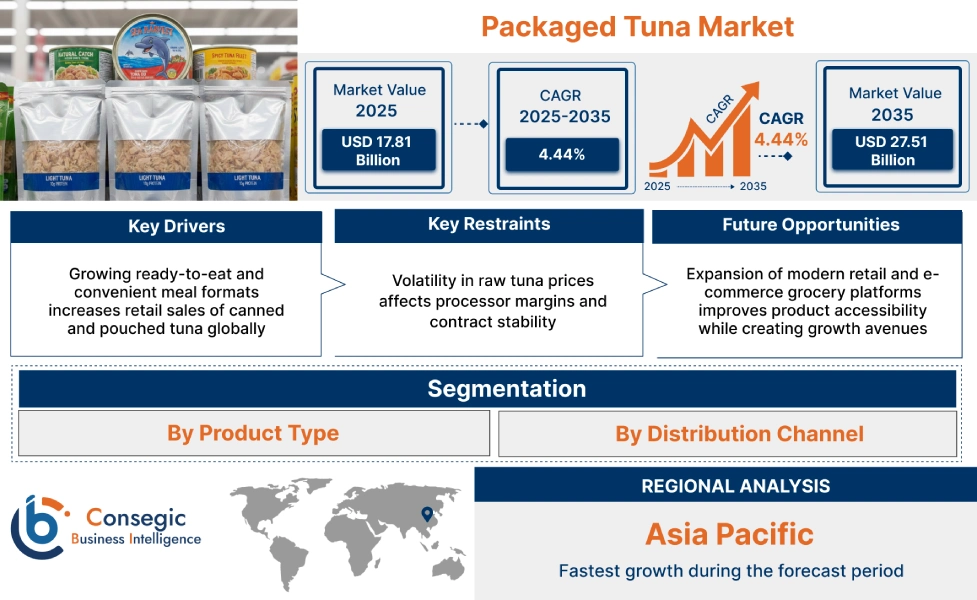
Packaged Tuna Market size is estimated to reach over USD 27.51 Billion by 2035 from a value of USD 17.06 Billion in 2024 and is projected to grow by USD 17.81 Billion in 2025, growing at a CAGR of 4.44% from 2025 to 2035
Packaged Tuna Market Scope & Overview:
Packaged tuna refers to tuna products which are processed, cleaned, cooked, and packed in cans, pouches, or any other form for direct consumption or further food preparation. The packaged tuna industry includes sourcing of raw tuna, processing and canning operations, cold chain logistics, private label manufacturing, and branded retail distribution. The goal is to offer consumers convenient and safe food products, which are rich in nutrients. The supply chain is focused on serving the needs of various food retailers, including supermarkets, hypermarkets, convenience stores, and foodservice operators in developed and emerging markets.
The packaged tuna segment is growing owing to the increase in demand for affordable sources of protein and the rise of ready-to-eat meals. Urban consumers are increasingly moving towards convenient food formats, which require minimal preparation time. Retailers are expanding private label seafood ranges to improve margins. The rise of modern trade networks and online grocery sites is enhancing the availability of the product in key markets of consumption.
Market Size & Forecast
- 2024 Market Size : USD 17.06 Billion
- 2025 Market Size : USD 17.81 Billion
- 2035 Evaluate Market Size : USD 27.51 Billion
- CAGR (2025-2035) : 4.44%
- Largest growing region : North America
- Fastest growing region : Asia Pacific
Impact of Tariffs on Packaged Tuna Market?
The recent US tariff agenda has disrupted the packaged tuna and wider seafood supply chain. The US imports nearly three quarters of its seafood, which increases exposure to trade actions. Imports from China reached about USD 1030 million in 2024, and tariffs of up to 145% have increased landed costs. Additional duties imposed on India, Vietnam, and Indonesia have increased the prices of the product. The demand for discounts by consumers in the frozen yellowfin tuna segment has created pressure on the stable pricing structure. The tariffs imposed on US-caught seafood processed abroad and re-imported have increased the pressure.
The structure of tariffs is also seen to have an impact on the pattern of seafood consumption. It is projected that an increase in tariffs would lead to an increase in the price of shrimp, salmon, canned tuna, and tilapia. Seafood is already considered to have a price premium over other protein sources. This is seen to have an impact on the gap in the level of consumption in relation to the recommendations of the USDA. However, the increase in the price of tuna is seen to have an impact on the margins of the value chain of packaged tuna.
Packaged Tuna Market Dynamics - (DRO):
Key Drivers:
Growing ready-to-eat and convenient meal formats increases retail sales of canned and pouched tuna globally
There is an increase in the demand for meals by consumers in cities. These are meals that require the least preparation time. The demand for packaged food is seen, particularly by working households. This is because these food products have longer shelf life and can be stored. Tuna can be included in salads, sandwiches, and meal kits. Foodservice operators are also integrating ready-to-use tuna into fast casual menus to improve kitchen efficiency.
- For instance, in January 2025, the Spanish fishing firm Albacora bought the tuna purse-seiner Playa de Aritzatxu from its peer Pesquería Vasco-Montañesa (Pevasa). This increase in the fishing fleet is beneficial for Albacora in the context of consolidating tuna fisheries in the competitive Spanish purse-seiner industry.
Therefore, the rise of ready-to-eat and convenient meal styles is positively impacting the sales of packaged tuna products.
Key Restraints:
Volatility in raw tuna prices affects processor margins and contract stability
Raw tuna product prices are subject to change based on the season, fuel costs, and fishing quota regulations. The processors have forward purchase contracts with retailers. This restricts the ability of the processors to respond quickly to any increase in costs. The situation is worsened if the increase in costs is higher than the increase in the sale price.
Therefore, the volatility of raw tuna prices is limiting the stability of the margin for the value chain of packaged tuna.
Future Opportunities:
Expansion of modern retail and e-commerce grocery platforms improves product accessibility while creating growth avenues
Retail organized chains are increasing their presence in tier two and tier three cities, thereby increasing the available shelf space for packaged seafood products. E-commerce grocery platforms are offering nationwide distribution channels for products to reach consumers directly. Digital channels are enabling companies to launch new pack formats and promotional bundles to specific target audiences.
- For example, in December 2025, the Census Bureau announced that retail e-commerce sales in the US reached USD 304.2 billion in Q2 2025, representing a 1.4% increase compared to the previous quarter, adjusting for seasonal variation.
Therefore, the rise of modern retail and electronic commerce-based grocery stores is creating new opportunities for the packaged tuna market
Packaged Tuna Market Segmental Analysis:
By Product Type:
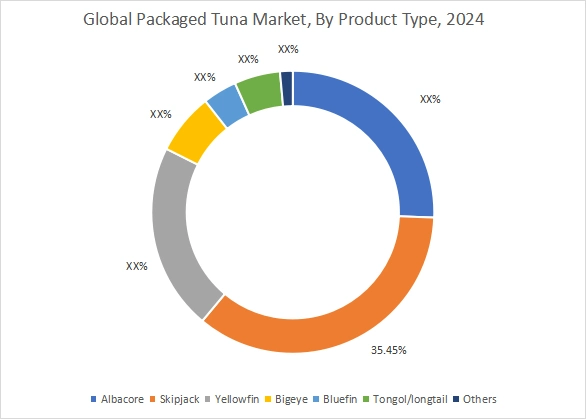
On the basis of product type, the packaged tuna market is segmented into albacore, skipjack, yellowfin, bigeye, bluefin, tongol or longtail, and others.
Trends in the Product Type:
- Retail demand is shifting toward affordable mass-consumption species.
- Sustainability certifications are impacting the premium segment.
The skipjack was responsible for the highest revenue share of 35.45% in 2024.
- Skipjack is also commonly utilized in canned tuna, considering its taste and price benefits.
- Also, large catch sizes in the wild ensure that supply is readily available for processors.
- Moreover, skipjack tuna is preferred for private label brands by retailers due to price competition.
- Further, robust market demand for skipjack tuna in North America and Europe ensures that production levels remain high.
- Therefore, supply availability and price positioning for skipjack tuna are expected to remain favorable during the forecast period.
It is anticipated that the albacore will exhibit the highest compound annual growth rate (CAGR) during the forecast period.
- Albacore is positioned as a premium white meat tuna with higher price realization.
- Health-focused consumers associate albacore with higher quality and clean labeling.
- In addition, expansion of premium retail shelves is increasing product visibility.
- Furthermore, brands are introducing low-sodium and organic variants within this category.
- Therefore, premiumization trends in packaged seafood are expected to support the albacore segment during the forecast period.
By Distribution Channel:
On the basis of distribution channel, the packaged tuna market is divided into supermarkets and hypermarkets, convenience stores, specialty stores, and online.
Trends in the Distribution Channel:
- Organized retail chains are expanding shelf space for packaged seafood products.
- Digital grocery platforms are strengthening repeat purchase cycles.
Supermarkets and hypermarkets accounted for the largest revenue share in the year 2024.
- Large retail chains provide high product visibility and bulk stocking capacity.
- Promotional pricing strategies increase volume sales across mass brands.
- Moreover, private label penetration is strong within this channel.
- Further, established cold chain logistics improve inventory turnover.
- Therefore, wide retail presence and high consumer footfall are expected to support the supermarkets and hypermarkets segment during the forecast period.
Online is anticipated to register the fastest CAGR during the forecast period.
- E-commerce platforms for grocery shopping offer doorstep delivery and subscription services.
- For urban consumers, digital ordering is preferred for its convenience and time-saving benefits.
- Furthermore, online platforms can be utilized for targeted promotions and offers.
- Moreover, the development of digital payment systems can be leveraged for the growth of transactions.
- Therefore, rising penetration of online grocery platforms is expected to support the online segment during the forecast period.
Regional Analysis:
North America, Europe, Asia Pacific, the Middle East and Africa, and Latin America are the regions of coverage.

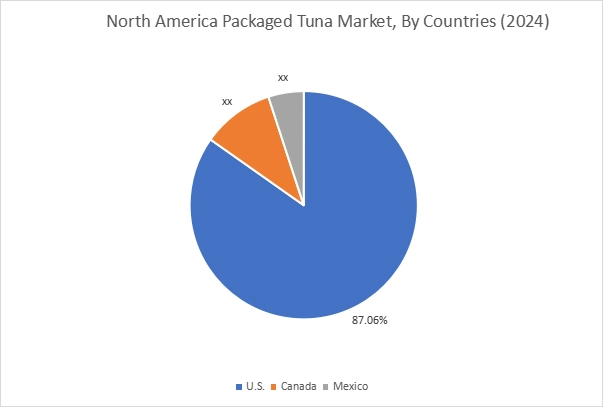
In 2024, North America accounted for the highest market share at 44.2% and was valued at USD 7.54 Billion, and is expected to reach USD 12.16 Billion by 2035. In North America, the U.S. accounted for the highest market share of 87.06% during the base year of 2024. The market growth is further supported by the high seafood consumption per capita and strong penetration of canned protein products. Also, large retail chains and established private label programs improve the overall shelf presence of the product across supermarkets and hypermarkets. Stable import channels from Asia Pacific and Latin American countries ensure the continuous availability of the product across major distribution channels.
- For example, in April 2024, according to the USDA data released in April 2024, the consumption of seafood in the United States has been growing steadily, with per capita consumption increasing by 30% to reach 20.5 pounds in 2021. Fresh and frozen seafood formats have led this growth, with fresh and frozen seafood contributing to almost 80% of the total seafood consumption, up from 63% in 1990.
Asia Pacific is expected to experience the quickest growth during this period. The increasing rates of urbanization and growth of organized retailing in China, India, and Southeast Asia are expected to drive growth in packaged seafood sales. An increase in middle-income households is supporting the growth of packaged seafood sales.
- United Nations Human Settlements Programme stated that Asia Pacific currently accounts for 54% of the world's population residing in cities, and with an additional 1.2 billion people expected to reside in cities by 2050, Asia Pacific is expected to present a significant long-term growth opportunity.
The growth of the Europe packaged tuna market is further supported by strong market fundamentals in countries such as Spain, Italy, and the UK. High seafood consumption rates and the popularity of ready meals are key drivers of the market.
Latin America market growth is supported by domestic consumption in Brazil and Mexico along with export-oriented processing in Ecuador. Expansion of modern retail infrastructure is improving product distribution across urban centers.
Middle East and Africa market growth is supported by rising demand for shelf-stable protein products in the UAE and Saudi Arabia. Growing supermarket penetration and import dependence are strengthening packaged tuna availability across the region.
Top Key Players & Market Share Insights:
The packaged tuna market is relatively fragmented, with key companies competing across the globe. Companies are currently focusing on long-term sourcing agreements, sustainable seafood certifications, and cost optimization strategies to improve market position. Companies are investing heavily in developing new product portfolios by offering flavor varieties and premium white meat products to establish differentiation in the market. Companies are investing heavily in improving efficiencies and partnerships to improve market position in markets such as North America, Europe, and Asia Pacific. Key participants in the market for packaged tuna include:
- Thai Union Group– Thailand
- StarKist Co.– US
- Bumble Bee Foods LLC– US
- Dongwon Group – South Korea
- Bolton Group – Italy
- Jealsa Corporación – Spain
- Frinsa del Noroeste S.A. – Spain
- Century Pacific Food Inc. – Philippines
- Wild Planet Foods Inc. – US
- Albacora S.A. – Spain
Recent Industry Developments:
Product Launches
- In August 2025, Bumble Bee launched single-serve 3oz flavored tuna Snackers cans (e.g., Lemon Pepper, Hickory Smoke) that are pre-mixed, no-drain, and ready-to-eat for convenient on-the-go snacking.
- In October 2025, Ecuador launched its first major canned tuna export to Dubai with 6,600 boxes of Envasur's Tunnis brand, expanding into the Gulf amid booming 2025 tuna exports over USD 1.6 billion.
Packaged Tuna Market Report Insights:
| Report Attributes | Report Details |
|---|---|
| Study Timeline | 2019-2035 |
| Market Size in 2035 (USD Billion) | USD 27.51 Billion |
| CAGR (2025-2035) | 4.44% |
| By Product Type |
|
| By Distribution Channel |
|
| By Region |
|
| Key Players |
|
| Report Coverage |
|
Key Questions Answered in the Report
How big is the packaged tuna market? −
The packaged tuna market size is estimated to reach over USD 27.51 Billion by 2035 from a value of USD 17.06 Billion in 2024 and is projected to grow by USD 17.81 Billion in 2025, growing at a CAGR of 4.44% from 2025 to 2035.
Which segmentation details are covered in the packaged tuna report? +
The packaged tuna report includes specific segmentation details for product type, distribution channel, and regions.
Which is the fastest segment anticipated to impact the market growth? +
Online channel is the fastest growing segment, driven by rising e-commerce grocery adoption and subscription purchases.
Who are the major players in the packaged tuna market? +
The key participants in the packaged tuna market are Thai Union Group (Thailand), StarKist Co. (US), Bumble Bee Foods LLC (US), Dongwon Group (South Korea), Bolton Group (Italy), Jealsa Corporación (Spain), Frinsa del Noroeste S.A. (Spain), Century Pacific Food Inc. (Philippines), Wild Planet Foods Inc. (US), Albacora S.A. (Spain), and others.
What are the key trends in the packaged tuna market? +
Growth in ready-to-eat meals, expansion of private label products, and higher focus on sustainable sourcing are shaping the market.
Overview
Reputation & Certifications


Our Services
- Market Intelligence & Forecasting
- Custom Research Solutions
- Market Entry Strategy
- Competitive Intelligence
- Customer Insights
- Industry Innovation Analysis
- Investment Advisory