Jump to Content
Passenger Information System Market - Size, Share, Industry Trends, and Forecasts (2025 - 2035)
Why Are Passenger Information Systems Important for Smart Transportation Infrastructure?
The passenger information system helps to communicate real-time information to passengers across a network of public transportation. Real-time information includes schedules, arrivals, delays, and changes to the route. These systems are used across a variety of public transportation modes, such as buses, rail, metro, and airports.
The growth of the market can be attributed to an increase in investments in smart transportation infrastructure. An increase in the need for real-time information on public transportation is driving the adoption of the system. Improvements are seen in digital display technology, GPS, and cloud technology.
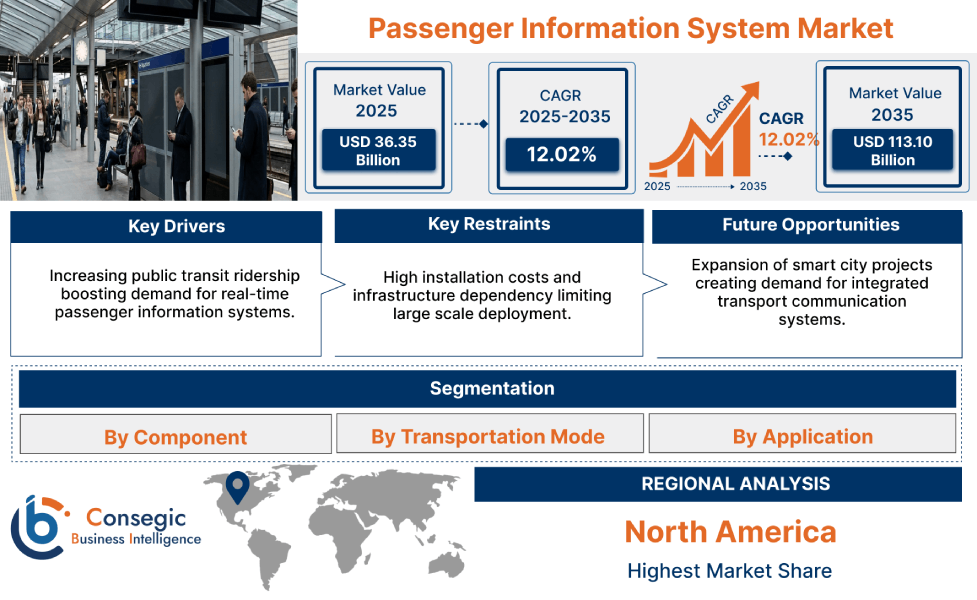
Key Figures
- Dominating Region: North America
- 2024 Market Size: USD 32.45 Billion
- 2025 Market Size: USD 36.35 Billion
- 2035 projected Market Size: USD 113.10 Billion
- CAGR (2025-2035): 12.02%
Key Pointers
- Hardware segment dominated the market in 2024, driven by rising deployment of display and communication systems.
- Increasing public transit ridership is driving system adoption.
- Growing urban population is increasing demand for transport communication systems.
- Adoption of integrated mobility platforms is creating growth opportunities.
- Expansion of smart city projects is boosting passenger information system adoption during forecast period.
- North America accounted for the highest market share in 2024.
Drivers, Challenges and Opportunities
Increasing public transit ridership driving demand for passenger information systems
The passenger information system market is witnessing growth due to the increased use of public transport facilities in various regions. Metro, rail, and bus transport facilities are witnessing an increase in the number of passengers, as governments are encouraging people to use public transport to reduce traffic congestion. Passenger information systems are implemented in various regions by transport authorities.
For instance, according to the National Transit Summaries and Trends Report 2024, published by the U.S. Federal Transit Administration, in 2024, the total number of passenger trips facilitated with the help of public transportation systems in the U.S. was recorded at 7.6 billion. This indicates an increase of 9.8% over the previous year, i.e., 2023. It can be inferred that the increased demand for public transportation systems would boost the market for passenger information system solutions.
Growing Urban Population Increases Demand for Efficient Public Transport Communication Systems
The increasing urban population leads to more demands placed on public transportation networks, thus increasing the need for effective passenger communication. Public transportation authorities seek to enhance the reliability and quality of experience offered to commuters in order to address the increasing demands. For example, United Nations estimates that urban populations will rise from 55% (4.2 billion) in 2018 to 68% (6.7 billion) in 2050 globally. These factors contribute to the development of real-time passenger information systems, ensuring timely and accurate information is relayed to commuters.
High installation cost and infrastructure dependency are restraining the market growth
The passenger information system involves investment in display systems, communication systems, control systems, and data management systems. The overall cost of installing passenger information systems would be high, considering the number of stations, terminals, and vehicles where such systems have to be installed. This would be a restraining factor for the market for passenger information systems.
Integration Challenges with Legacy Transport Infrastructure Reduce Deployment Efficiency
Challenges associated with integration arise from existing transport infrastructure, which has proven inefficient in supporting digital integration. The existing infrastructure lacks compatibility with digital technologies, thus making integration more expensive. Transport operators face operational disruptions during system integration, which slows down the adoption of advanced passenger information solutions.
Adoption of integrated mobility management platforms for fleet and passenger data creates new growth opportunities for the market
The increasing digitalization of public transport and mobility services is thus opening up fresh opportunities for growth in the market for the passenger information system. Public transport operators are adopting integrated platforms that enable them to track their services, routes, and provide real-time information on their services. These platforms are providing operators and transport authorities with the ability to optimize their services while providing passengers with accurate information about the services they offer.
For instance, in June 2025, BearingPoint announced the launch of an integrated e-mobility platform based on SAP, which aims to support fleet managers in the monitoring of their fleets, infrastructures, and operations through an integrated digital system. Therefore, the use of integrated mobility management platforms is anticipated to enhance fleet management and data-based passenger communication systems.
Expansion of Smart City Projects Creates Demand for Integrated Transport Communication Systems
The expansion of smart city projects generates more demands for an integrated transport communication system within urban areas. Governments invest in digital infrastructure for enhanced mobility management and service delivery. For instance, the U.S. Department of Transportation mobilized almost USD 350 million in funding, allocated USD 40 million in the Smart City Challenge, and facilitated cities to access an additional USD 500 million in public and private sector investment. This is an example of how passenger information systems can be adopted for data sharing and communication.
Passenger Information System Market Segmental Analysis:
By Component
Based on component, the hardware segment dominated the market in 2024, driven by rising deployment of digital display and communication systems across transport networks. Hardware components include display panels, audio systems, networking devices, and control units that deliver real-time travel information. Transport authorities are increasing installation of digital boards at stations and terminals to improve passenger communication.
The services segment is expected to record the fastest CAGR during the forecast period, considering the growing requirement for system integration and technical support. The services segment includes maintenance, monitoring, and upgrading of information systems, ensuring uninterrupted operation of information systems. Transport agencies are increasingly opting for managed services to operate complex digital infrastructures.
By Transportation Mode:
In terms of transportation mode, the railways segment held a significant share in 2024, considering the large volume of passengers and growing demand for real-time updates on travel schedules. Information provided through passenger information systems includes updates on arrival and departure times, along with delays, providing greater comfort to passengers. Expanding metro and high-speed rail networks are contributing to segment growth, along with growing investments in smart railway stations.
The roadways segment is projected to grow at the fastest CAGR during the forecast period, due to rising adoption of intelligent transport systems in urban mobility. Passenger information systems are used for buses and terminals to give information regarding routes and time tables. The increasing development of smart city transportation infrastructure is boosting the segment's growth. The integration of real-time data systems is also helping to improve the use of passenger information systems in road transportation.
By Application:
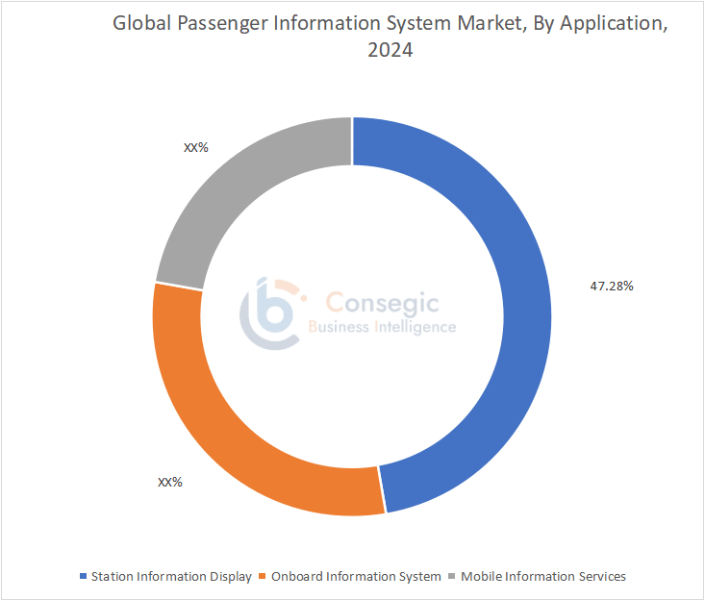
Based on application, the station information display segment accounted for the largest market share of 47.28% in 2024. This is due to an increase in the number of digital signage systems installed. These systems provide real-time arrival and departure information, which improves passenger awareness. Deployment across railway stations, airports, and bus terminals is supporting segment growth. Modernization of transport infrastructure is further increasing demand for station display systems.
The mobile information services segment is forecasted to record the fastest CAGR during the forecast period. The increasing use of smartphones to access real-time travel information has been driving this segment. Mobile information services offer route, schedule, and delay notifications, thereby enhancing accessibility for passengers. The integration of ticketing and journey planning has been supporting this segment.
Regional Scenario:
Some of the key regions covered in the study includes North America, Europe, Asia Pacific, the Middle East and Africa, and Latin America.
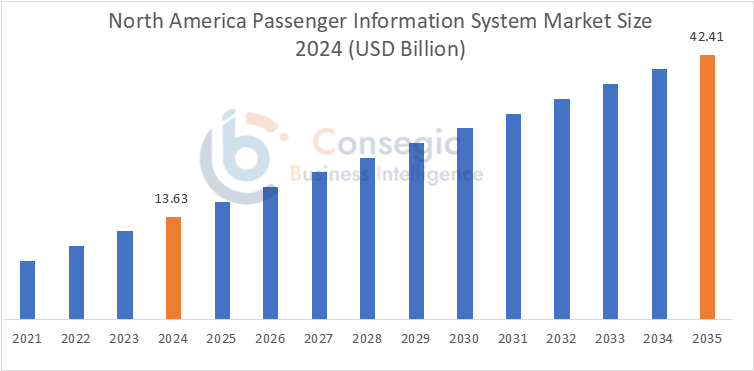
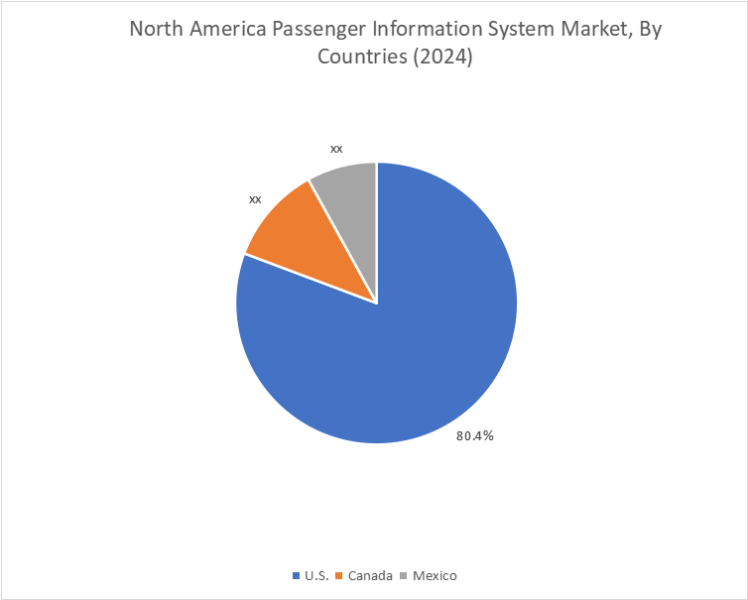
North America led the market with a 37.50% share and was valued at USD 13.63 billion in 2024. The market is expected to reach USD 42.41 billion by 2035. The country that contributed the highest share of 80.40% in 2025 was the US, under the North American region. The North American region has been witnessing growth due to increasing investments in smart transit systems and upgrades in public transportation infrastructure. The increasing use of real-time passenger information technologies in the US and Canada has been supporting this region.
For instance, The U.S. Department of Transportation announced an investment of USD 2 billion to support 165 transit modernization projects across 45 states and Washington, D.C. This investment will strengthen public transport networks and increase the deployment of real-time arrival displays, onboard information screens, and digital communication platforms in buses and transit stations.
Asia Pacific is expected to register the highest growth rate during the forecast period. The growth of the market is attributed to the expansion of urban rail infrastructure and increased investments in smart transportation infrastructure. The high rate of adoption of intelligent transport systems, especially in China, India, Japan, and Southeast Asia, is also contributing to the growth of the market. Government initiatives are also improving the efficiency of public transportation and passenger communication through metro rail, high-speed rail, and bus rapid transit systems.
For instance, in March 2026, the Government of India sanctioned a railway line expansion project worth approximately USD 535 million in March 2026 to develop new railway lines in eastern India. This is expected to improve the use of passenger information systems, as the number of trains and passengers is expected to increase.
Competitive Analysis:
The passenger information system market is highly competitive, with major players in the transportation technology industry providing real-time communication and display technologies for rail, metro, bus, and airport applications. The focus is on research and development, smart mobility, and digital display technology to improve market share. Partnerships and contracts with transportation authorities are helping players expand the passenger information system market across domestic and international markets.
Key players operating in the market include:
- Siemens Mobility GmbH
- Alstom SA
- Hitachi Rail Limited
- Thales Group
- Cubic Corporation
- Teleste Corporation
- ST Engineering Electronics Ltd.
- Luminator Technology Group
- INIT GmbH
- Indra Sistemas S.A.
Recent Developments:
- In October 2024, Wabtec Corporation and Siemens Mobility partnered to deliver passenger information systems for 90 Munich S-Bahn trains, starting 2025, with LED and TFT displays for real-time passenger information.
Passenger Information System Market Report Insights:
| Report Attributes | Report Details |
|---|---|
| Study Timeline | 2019-2035 |
| Market Size in 2035 (USD Billion) | USD 113.10 Billion |
| CAGR (2025-2035) | 12.02% |
| By Component |
|
| By Transportation Mode |
|
| By Application |
|
| By Region |
|
| Key Players |
|
| Report Coverage |
|
Key Questions Answered in the Report
How big is the passenger information system market? −
The passenger information system marketsize is estimated to reach over USD 113.10 Billion by 2035 from a value of USD 32.45 Billion in 2024 and is projected to grow by USD 36.35 Billion in 2025, growing at a CAGR of 12.02% from 2025 to 2035.
Which segmentation details are covered in the passenger information system report? +
The passenger information system report includes specific segmentation details for component, transportation mode, application, and regions.
Which is the fastest segment anticipated to impact the market growth? +
The mobile information services segment is anticipated to be the fastest-growing segment during the forecast period due to the rising demand for real-time travel information through mobile platforms.
Who are the major players in the passenger information system market? +
The key participants in the passenger information system marketare Siemens Mobility GmbH (Germany), Alstom SA (France), Hitachi Rail Limited (UK), Thales Group (France), Cubic Corporation (U.S.), Teleste Corporation (Finland), ST Engineering Electronics Ltd. (Singapore), Luminator Technology Group (U.S.), INIT GmbH (Germany), Indra Sistemas S.A. (Spain), and others.
What are the key trends in the passenger information system market? +
The passenger information system market is shaped by several key trends including increasing adoption of real-time travel information platforms and integration of mobile applications with transport information systems.
Overview
Reputation & Certifications


Our Services
- Market Intelligence & Forecasting
- Custom Research Solutions
- Market Entry Strategy
- Competitive Intelligence
- Customer Insights
- Industry Innovation Analysis
- Investment Advisory