Jump to Content
Pet Wearable Market Size & Industry Share - Growth Trends & Forecasts (2026 - 2034)
Pet Wearable Market Size:
The Pet Wearable market size was valued at 4,293.32 (US$M) in 2025 and is projected to grow from 4,890.09 (US$M) in 2026 to 13,851.8 (US$M) by 2034, at a CAGR of 13.9% from 2026 to 2034, according to a recent report from Consegic Business Intelligence.
Pet Wearable Market Scope & Overview:
Pet wearable refers to an electronic device that can be worn on a pet's body to serve various purposes, such as identification and tracking. Pet wearables are versatile and can be used for monitoring and controlling pet behavior, health and activity levels, medical diagnosis and treatment of pets, and enhancing pet safety and security. Moreover, they offer a range of benefits including real-time monitoring of pet health, fitness, and location, early detection of health issues and timely medical intervention, and others. The above benefits of pet wearables are primary determinants for driving the market.
How is AI Transforming the Pet Wearable Market?
AI is playing a crucial role in the pet wearable market, particularly for providing personalized health monitoring, early disease detection, behavioral analysis, and personalized training recommendations. By analyzing data from smart collars and sensors, AI helps identify health issues, track activity levels, and offers tailored care plans, in turn improving pet safety and well-being. Additionally, these devices provide personalized health insights and fitness tracking, offer security features such as GPS tracking, and enable remote communication and engagement, which significantly improves pet welfare. Therefore, the above factors are expected to positively impact the market growth in upcoming years.

Pet Wearable Market Dynamics - (DRO) :

Key Drivers:
Awareness about Pet Health and Wellness Propels the Market
The growth is largely driven by increased awareness among pet owners about their pets' health and wellness. Companies specializing in pet health are utilizing comprehensive data on pet behavior to identify new health conditions and potential health-related issues.
Moreover, these smart devices can provide real-time data on a pet's vital signs, activity levels, and general condition, enabling timely medical interventions and improving the overall well-being of the pet. The increased emphasis on pet health and wellness among owners is a key factor propelling the market worldwide.
- For instance, in November 2022, Whistle introduced a new feature in their application called daily check-ins. To utilize this feature, a tap on the check-in option enables the logging of an initial entry. This feature prompts the user to rate the pet's condition as either great, okay, or not good and to add tags that explain the reason for the pet's current state, such as weather, vet visit, stress, arthritis, and so on.
Thus, the heightened focus on pet health and wellness, coupled with advancements in smart devices that monitor pet health in real-time, is driving the global pet wearable market growth.
Technological Advancements in Pet Wearables Drive the Market
The pet care industry has been revolutionized by technological advancements, particularly in the field of pet wearables. These devices, which include everything from smart collars to health monitors, are equipped with various sensors that collect data on a pet's movements, location, vital signs, and environmental conditions. This data is then analyzed to provide pet owners with insights into their pet's health and well-being.
Moreover, the rise in pet wearables has been facilitated by improvements in wireless networks, cost-effective sensors, digital maps, and mobile applications. Companies in this sector are now focusing on integrating these devices with cloud-based analytics for real-time decision-making and providing valuable information to veterinarians.
- For instance, in September 2023, Halo launched the Halo 3, its third-generation GPS dog collar. This collar employs AI and various wireless systems to establish a virtual fence for a dog. It permits the dog to roam freely within a predefined boundary, which can be tailored to encompass a specific residence.
Thus, the technological advancements in pet wearables, enhanced by wireless networks and cloud-based analytics, are transforming the pet care industry by providing pet owners and veterinarians with real-time health insights and improved decision-making capabilities, driving the pet wearable market demand.
Key Restraints :
Privacy Concerns Associated with Devices Limits the Market
Pet wearable devices provide many advantages, but they also pose significant privacy risks. These devices gather, process, and share vast amounts of data among various users such as pet owners, farmers, and veterinarians, potentially leading to cyber-attacks and data breaches. There are potential issues with organizations or government agencies accessing pet owners' data without their knowledge or consent when using these devices. These systems often lack sufficient security measures and do not respect user privacy, possibly due to insufficient regulations around animal data. Therefore, understanding consumer behavior and ensuring adequate data protection legislation is crucial for a more privacy-conscious use of pet wearables.
- For instance, a collaborative study between the University of Bristol and the University of Haifa, published in IEEE Security & Privacy, examined data captured by 19 consumer pet wearable devices. The lead researcher, Dr. Dirk van der, highlighted that the data collected from these devices has privacy implications for the pet owners, not just the pets. The data could potentially be used to build profiles on pet owners, posing risks such as burglary or insurance companies inferring the health profiles of pet owners.
Thus, as per the market trends analysis, pet wearables offer numerous benefits, but they also raise substantial privacy concerns due to insufficient data protection measures and regulations, hindering the pet wearable market growth.
Future Opportunities :
Pet Insurance to Promote New Opportunities
A significant factor contributing to the market is the rising availability of pet insurance plans that cover wearable devices, encouraging pet owners to invest in smart collars. Moreover, this trend is further supported by the global pet insurance market's robust growth, as an increasing number of pet owners are opting for pet insurance. In addition, the demand for pet wearables is expected to rise due to their capability to track the health of pets, with the expenses possibly being taken care of by insurance policies, thus propelling both sectors.
- For instance, in May 2024 Wagmo, a top provider of pet wellness plans, and Rover, the largest online pet care marketplace, formed a strategic partnership. This collaboration aims to offer discounted pet care services on Rover to selected Wagmo partner companies and their employees. The partnership will provide access to redeemable Rover credits for everyday pet care services, including pet sitting, boarding, doggy daycare, dog walking, and drop-in visits.
Thus, as per the market trends analysis, the market is strongly supported by the increasing availability of pet insurance plans covering these devices, creating pet wearable market opportunities.
Pet Wearable Market Segmental Analysis :
By Product Type:
Based on the product type, the market is segmented into Smart Collars, Trackers, Pet Cameras, Whistles, Activity Monitors, Pet health Monitors, and Others.
The activity monitor segment accounted for the largest revenue of the total pet wearable market share in the year 2023.
- An activity monitor refers to a device that tracks and records a pet's physical activities, similar to a fitness tracker for humans.
- Moreover, activity monitoring offers a range of benefits including providing insights into a pet's behavior, regular exercise, and early detection of potential health issues.
- For instance, in June 2024 Pawfit, a division of Latsen Technology, launched its top-selling pet location and activity tracker, Pawfit 3, in the United States. This 100% waterproof tracker uses LTE (4G) technology for optimal coverage and is packed with advanced features for pet safety and health. It offers live tracking updates, customizable virtual fencing zones, voice commands for pet recall, and alerts for collar removal and harsh weather conditions. The Pawfit app allows pet owners to set fitness goals, monitor their pets' activities, and share account access with family members.
- Thus, the activity monitor segment leads the market, driven by increasing demand for tools that offer insights into pet behavior, exercise, and health, driving the pet wearable market demand.
The smart collars segment is anticipated to register a significant CAGR during the forecast period.
- A smart collar refers to a technologically advanced device worn around a pet's neck that can track its location, monitor its activities, and even provide training.
- Moreover, the primary benefits of smart collars include real-time tracking and geo-fencing for loss prevention and behavior analysis for improved pet care and training.
- These features enhance pet safety, health, and overall well-being, making smart collars a valuable tool for pet owners.
- For instance, in March 2024 PetPace, a leader in pet health monitoring, launched PetPace 2.0, an AI-powered smart dog collar that provides continuous, near real-time medical insights for early detection, treatment, monitoring, and GPS tracking of canine health. The collar measures all major vital signs and health-related biometrics and uses multiple non-irradiating, non-invasive, passive sensors. It stands out for its patent-pending pain indicator, health profile, wellness index, and workout intensity assessment.
- Hence, the smart collars segment is poised for a significant rise due to its advanced tracking and health monitoring features, boosting the pet wearable market trends.
By Services:
Based on the services, the market is segregated into Hardware and Software.
The Hardware segment accounted for the largest revenue in the year 2023 and is expected to witness the fastest CAGR during the forecast period.
- Factors including pet safety, increased awareness of pet health issues, and advancements in pet wearable technology are key aspects driving the segment.
- For instance, in March 2024 Enabot launched the ROLA PetPal and ROLA PetTracker. The PetPal allows remote interaction with pets, featuring high-definition cameras, AI-enabled pet recognition, and interactive toys. The PetTracker includes a built-in camera and uses GPS and other technologies for real-time tracking. Both products aim to enhance pet care and monitoring.
- Thus, the hardware segment dominates the pet wearable market and is expected to continue its rapid surge, supported by advancements in pet tracking and monitoring devices, driving the pet wearable market trends.
By Technology:
Based on the technology, the market is segregated into GPS, RFID, Sensors, Wi-Fi, Bluetooth, Processors, Memory, Displays, and Batteries.
The RFID segment accounted for the largest revenue of the overall pet wearable market share in the year 2023.
- Factors including reliability and accuracy of RFID trackers, technological advancements, and enabling real-time transmission of pet health data to veterinarians and pet owners, are key aspects driving the segment.
- For instance, in January 2024 PETLIBRO, a top US smart pet supply brand, introduced the One RFID Pet Feeder, a cutting-edge pet feeder with RFID pet recognition technology. This device accurately identifies pets before feeding, ensuring they receive the right nutrition at the right time. It also allows pet owners to monitor their pet's eating habits through a log of meal times and frequencies, shown in the PETLIBRO app.
- Hence, RFID technology holds a leading share of the market due to its reliability and accuracy in tracking, driving the pet wearable market expansion.
The GPS Segment is expected to witness the fastest CAGR during the forecast period.
- GPS Segment offers a range of features, including real-time tracking capabilities, geofencing, and seamless integration with smartphones, enhancing the safety and prevention of pet loss.
- Moreover, the GPS Segment provides multiple benefits including pet health management, actionable insights, and personalized recommendations. These collective advantages are driving the segment.
- For instance, in May 2024 PetSafe introduced the Guardian GPS + Tracking Dog Fence, a first-ever portable GPS dog fence and tracking collar. It uses patented AccuGuard technology for accurate tracking and allows owners to create custom GPS boundaries. The system offers superior protection, predicting when a dog is nearing the fence boundary. This launch is part of PetSafe's ongoing commitment to pet safety.
- Therefore, the GPS segment is anticipated to grow fastest, with features like real-time tracking and geofencing boosting its adoption.
By Sales Channel:
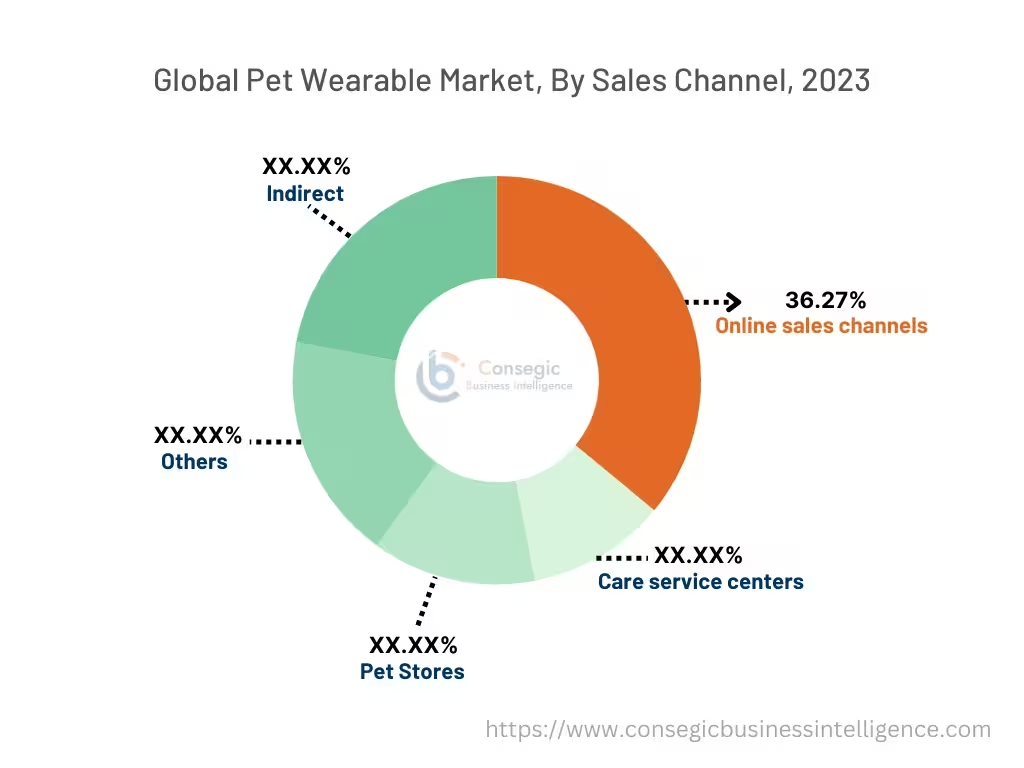
Based on the sales channel, the market is segregated into Indirect, Online sales channels, Care service centers, Pet stores, and others.
The online sales channel segment accounted for the largest revenue share of 36.27% in the year 2023 and is expected to witness the fastest CAGR during the forecast period.
- Factors including internet penetration, online shopping, wide product selection, reviews, and ratings are key aspects driving the segment.
- For instance, according to the National Association of Professional Pet Sitters, Online pet stores such as Pet.co.nz have revolutionized pet shopping by offering a wide variety of products, affordable prices, 24/7 customer support, and the convenience of home delivery. They also provide a platform for customer reviews and the ability to send gifts or donations, making pet care easier and more enjoyable for pet parents worldwide.
- Hence, segmental trends depict that the online sales channel leads in revenue propelled by increasing internet penetration and e-commerce adoption.
By Application:
Based on the application, the market is segregated into Medical Diagnosis & Treatment, Identification and Tracking, Safety & Security, Facilitation, and Behavioral Monitoring & Control.
The identification and tracking segment accounted for the largest revenue share in the year 2023.
- Factors including an increased awareness among pet owners about their pet's physical and mental fitness, and the growing demand for pet monitoring are key aspects driving the segment.
- For instance, in May 2023 Datamars, in a strategic move to expand its global offerings to pet owners, announced the acquisition of Kippy S.r.l., a successful provider of GPS tracker and activity monitoring solutions for pets. The transaction was facilitated by Growth Capital, a leading advisor in corporate finance transactions for startups and scaleups. This partnership enhances Datamar's market-leading identification and reunification solution, which has already identified over 50 million pets and reunited thousands of lost animals with their owners.
- Thus, analysis of segmental trends depicts that the identification and tracking segment dominates the application market, driven by rising awareness of pet health and security.
The medical diagnosis and treatment segment is expected to witness a significant CAGR during the forecast period.
- The surge in the medical diagnosis and treatment segment is attributed to several factors including increased demand for pet monitoring and technological advancements in areas such as sensors, cameras, and GPS.
- These devices provide real-time health data of pets to veterinarians and pet owners. These collective factors are driving the segment.
- For instance, According to the 2022 Pet Obesity Prevalence Survey, there has been a rise in the number of overweight and obese dogs and cats. The survey found that 59% of dogs and 61% of cats were categorized as overweight or obese. This is an increase from 56% for dogs in 2018 and 2017 and a slight increase from 60% for cats.
- Hence, the pet wearable market analysis shows that the medical diagnosis and treatment segment is set for significant growth, fueled by technological advancements and demand for real-time health data.
By End Use:
Based on the end use, the market is segregated into Individuals, Wildlife Sanctuaries, Animal Shelters, NGOs, Veterinary Doctors, and Others.
The Individual segment accounted for the largest revenue share in the year 2023.
- Factors including increased demand for pet monitoring and health monitoring activity are key aspects driving the segment.
- For instance, in February 2024 Global pet healthcare innovator, IDEXX Laboratories, Inc., launched Vello, a unique software solution designed to streamline communication between veterinary practices and pet owners. Integrated with IDEXX's ezyVet, Neo, and Cornerstone software, Vello offers an efficient, user-friendly system for engaging pet owners throughout their pet's life stages, fostering informed partnerships for improved health outcomes.
- Thus, the individual segment leads the market, supported by the rising demand for pet health monitoring solutions, driving the pet wearable market expansion.
Veterinary Doctors segment is expected to witness significant CAGR during the forecast period.
- The growth of the veterinary doctors segment is attributed to several factors including real-time health data of pets to veterinarians.
- For instance, in January 2022 Petriagea and Smart Tracking Technologies, LLC announced Link Smart Pet Wearable Partnership. This partnership will enable dog owners to use a petriage-connected care platform which will enable bonds between veterinarians and more than 500,000 clients by providing them with improved assessments of their pet's health (i.e., alerts that their pet may require medical attention).
- Hence, as per the pet wearable market analysis, the veterinary doctors segment is expected to grow substantially, driven by the need for real-time health data to support better medical outcomes.
Regional Analysis:
The regional segment includes North America, Europe, Asia Pacific, the Middle East and Africa, and Latin America.
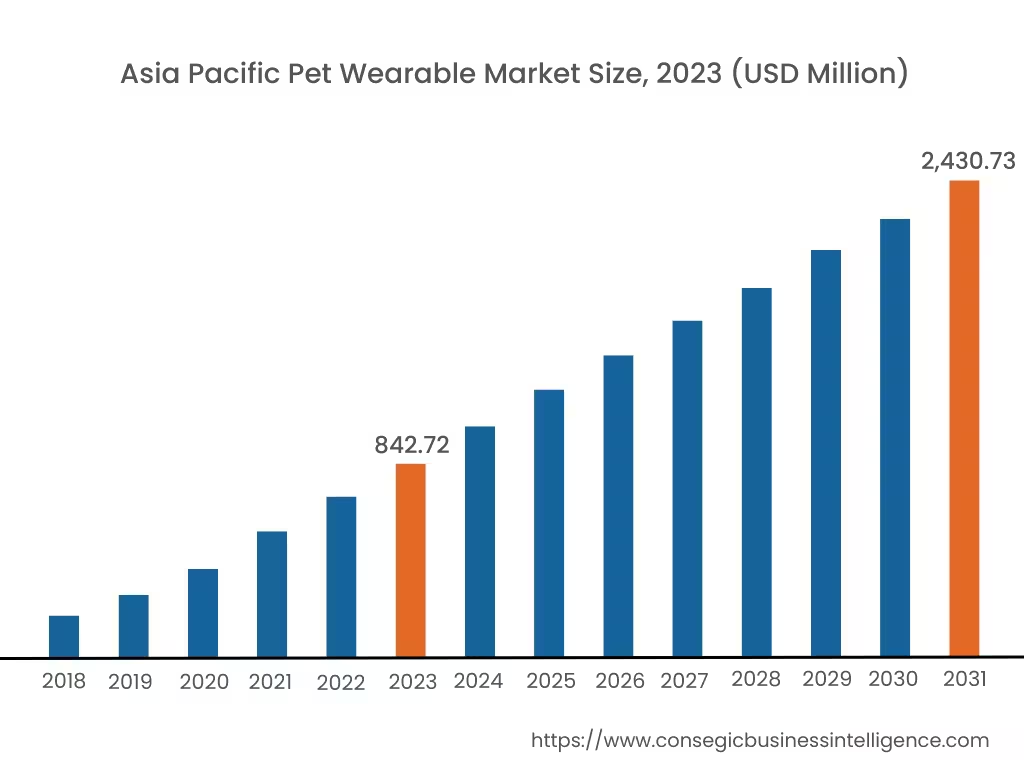
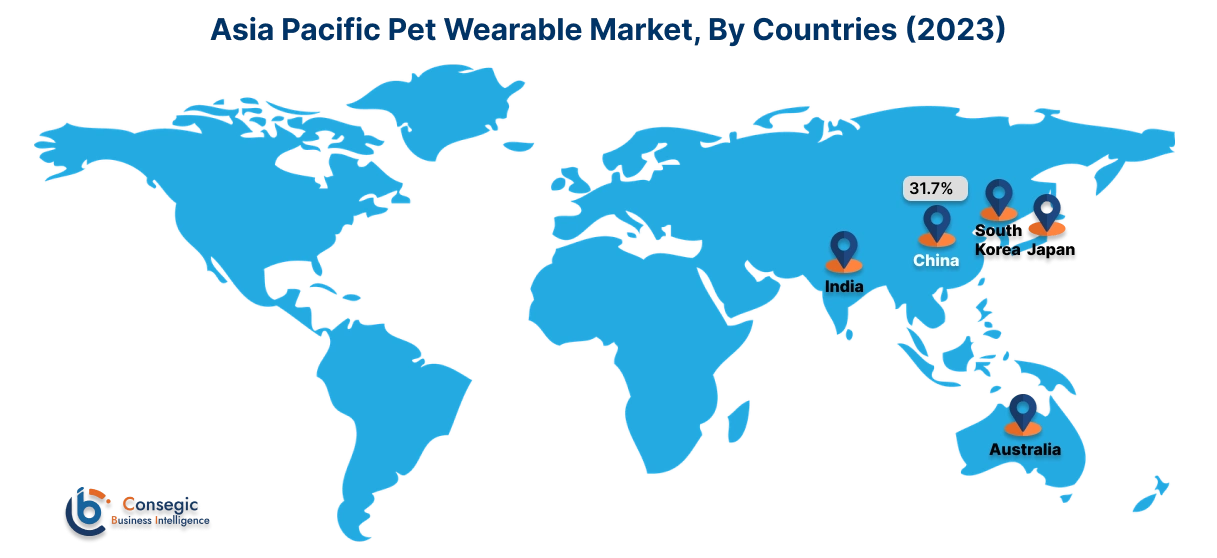
Asia Pacific region was valued at USD 842.72 Million in 2023. Moreover, it is projected to grow by USD 946.17 Million in 2024 and reach over USD 2,430.73 Million by 2031. Out of this, China accounted for the maximum revenue of 31.7%. The market in the Asia Pacific is primarily driven by the prevalence of tracking pets' daily activities and checking on their health in the region.
- For instance, in January 2023 According to Agriculture and Agri-Food Canada data, China imported USD 182 million of dog and cat food from Canada in 2021 due to Chinese consumer trust in international brands to deliver on safety and nutrition.
North America is estimated to reach over USD 3,171.30 Million by 2031 from a value of USD 1,113.76 Million in 2023 and is projected to grow by USD 1,249.11 Million in 2024. The regional trends show that the advancements in product innovation and technology are providing lucrative growth prospects for the market in the region. In addition, factors including increased pet health awareness among owners are driving the market in the North American region.
- For instance, in January 2022 Tractive, globally recognized for its reliable, 24/7 real-time pet location tracking, has unveiled a new LTE GPS pet tracker exclusively designed for cats. The device, dedicated to enhancing the safety of felines, has been launched today in North America, aligning with the fact that the United States is currently the top country for cat ownership.
Top Key Players & Market Share Insights:
The pet wearable market is highly competitive with major players providing products in the national and international markets. Key players are adopting several strategies in research and development (R&D), product innovation, and end-use launches to hold a strong position in the global pet wearable market. Key players in the pet wearable industry include-
- Supertails (India)
- Pawsindia (India)
- Dogo (United States)
- HonestDog (United States)
- hound.vet (United Kingdom)
- Pawfit (United Kingdom)
- PetSafe (United States)
- PETLIBRO (United States)
- PetPace (United States)
- FitBark (United States)
- Datamars (Switzerland)
Recent Industry Developments :
Collaborations:
- In June 2024, PetSafe, a leader in innovative pet products for over a quarter of a century, revealed a new collaboration with dog enthusiast Brittany Mahomes and celebrity dog trainer Tom Davis. The partnership aims to promote the Guardian GPS + Tracking Dog Fence, a groundbreaking system that promises to bring happiness to pets and their families by offering unparalleled safety and peace of mind.
Pet Wearable Market Report Insights :
| Report Attributes | Report Details |
| Study Timeline | 2021-2034 |
| Market Size in 2034 | USD 13,851.80 Million |
| CAGR (2026-2034) | 13.90% |
| Base Year | 2025 |
| By Product Type |
|
| By Services |
|
| By Technology |
|
| By Sales Channel |
|
| By Application |
|
| By End Use |
|
| By Region |
|
| Key Players |
|
| North America | U.S. Canada Mexico |
| Europe | U.K. Germany France Spain Italy Russia Benelux Rest of Europe |
| APAC | China South Korea Japan India Australia ASEAN Rest of Asia-Pacific |
| Middle East and Africa | GCC Turkey South Africa Rest of MEA |
| LATAM | Brazil Argentina Chile Rest of LATAM |
| Report Coverage |
|
Key Questions Answered in the Report
How big is the Pet Wearable Market? −
In 2023, the Pet Wearable Market was USD 9,374.22 Million.
What will be the potential market valuation for the Pet Wearable Market by 2031? +
In 2031, the market size of the Pet Wearable Market is expected to reach USD 3,319.22 Million.
What are the segments covered in the Pet Wearable market report? +
The market report covers product type, services, technology, application, sales channels, and end-users in the report.
Who are the major players in the Pet Wearable market? +
Supertails (India), Pawsindia (India), Dogo (United States), HonestDog (United States), hound. vet (United Kingdom), Pawfit (United Kingdom), PetSafe (United States), PETLIBRO (United States), PetPace (United States), FitBark (United States), Datamars (Switzerland) are the major players in the Pet Wearable market.
Overview
Reputation & Certifications


Our Services
- Market Intelligence & Forecasting
- Custom Research Solutions
- Market Entry Strategy
- Competitive Intelligence
- Customer Insights
- Industry Innovation Analysis
- Investment Advisory